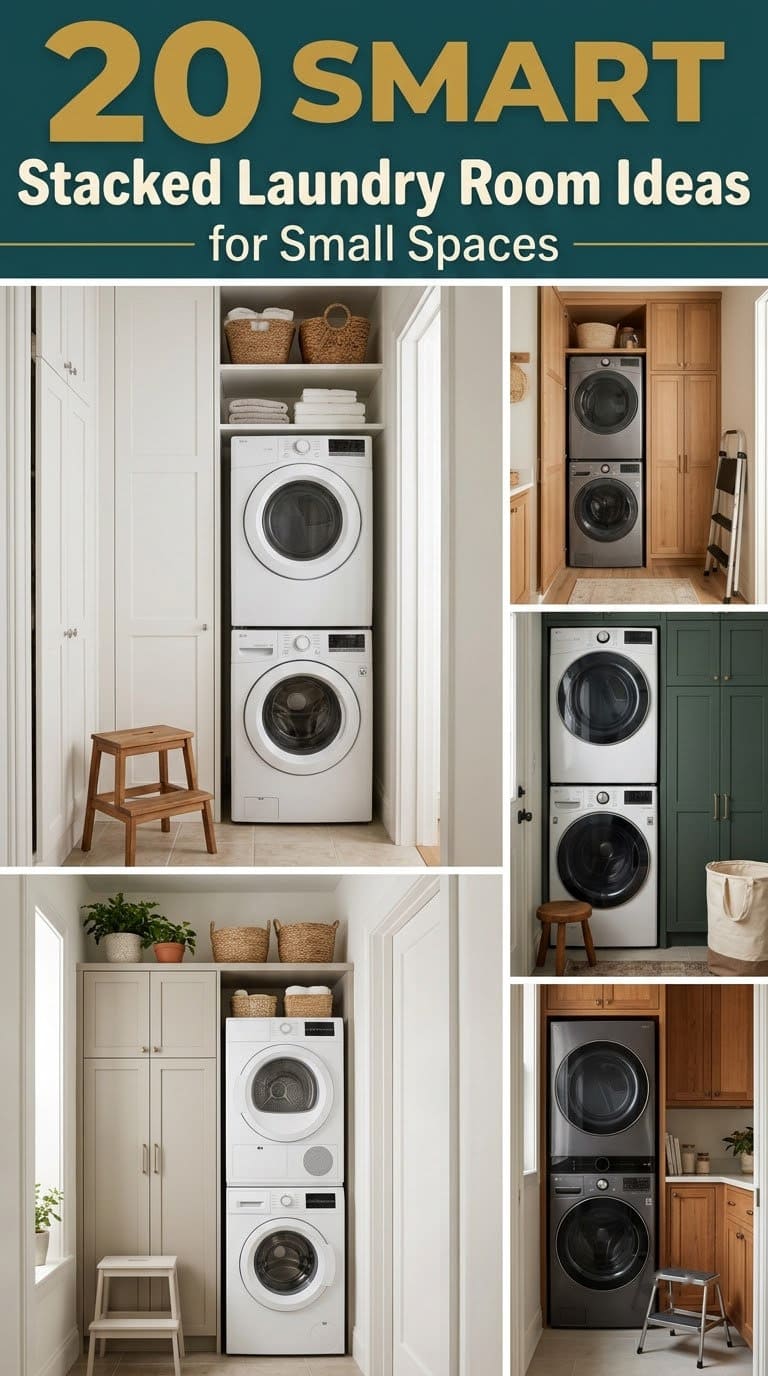
20 Smart Stacked Laundry Room Ideas for Small Spaces
Stacking the washer and dryer frees floor space, but it only works well when you plan the reach, the vent and the storage around it.

Never miss an update — choose FarmFoodFamily as your preferred source on Google.
How it works: Tap the button below to open Google's settings page, then check the box next to FarmFoodFamily.
Tap the checkbox to turn it blue — that's how you know it's set.
Stacking the washer and dryer frees floor space, but it only works well when you plan the reach, the vent and the storage around it.
Products We Recommend
This post contains affiliate links. We may earn a commission on qualifying purchases at no extra cost to you.

Handy Laundry Folding Step Stool, 9 Inch, 2-Pack
A slim, foldable, non-slip step stool listed at 300 lb capacity, with a handle. It suits idea 12. Rated 4.7 stars from 84,805 ratings.
Shop Now
Holikme Dryer Vent Cleaner Kit, 15 Ft
A flexible brush kit for 4-inch vent pipes with a drill attachment. It suits idea 13. Rated 4.4 stars from 6,344 ratings.
Shop Now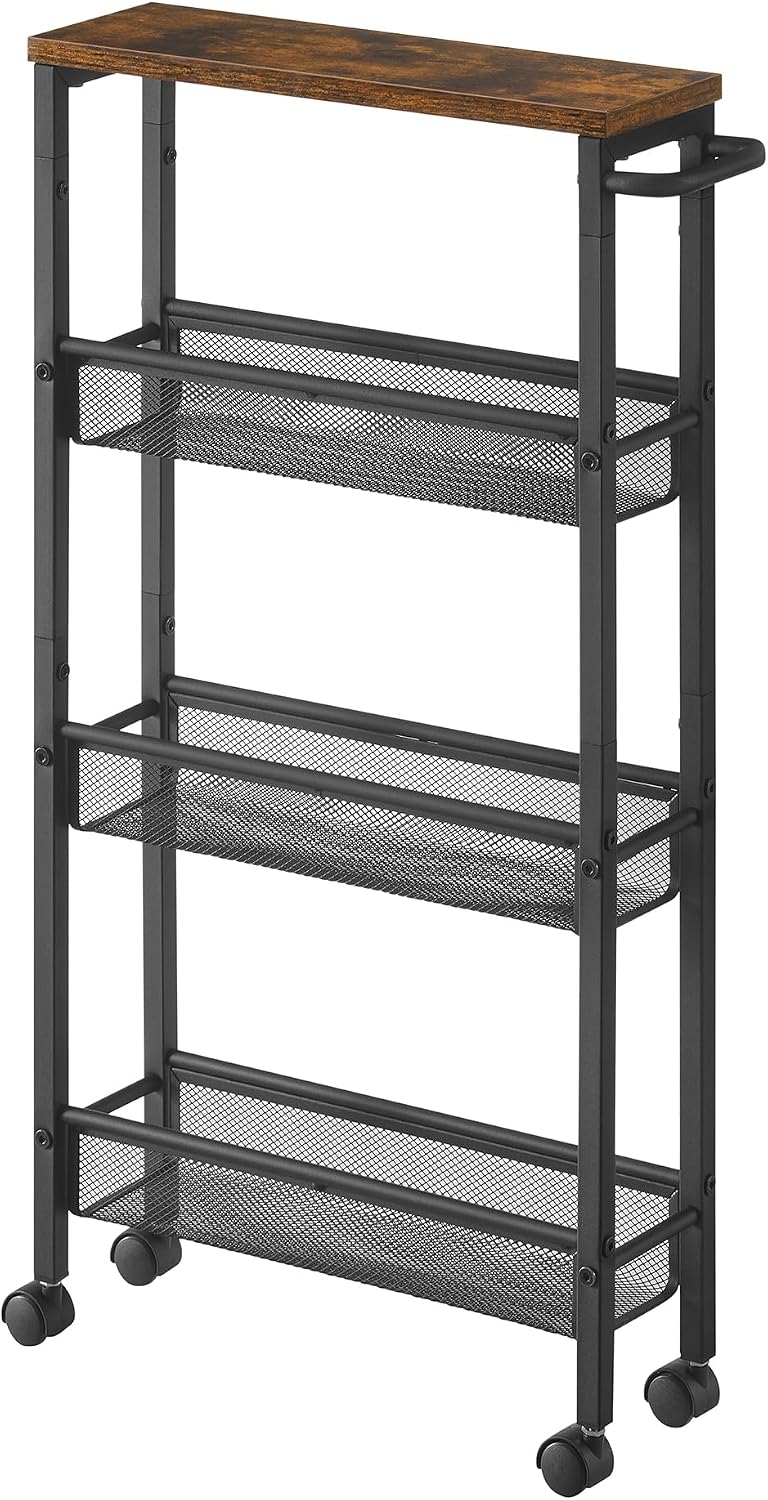
VASAGLE 4-Tier Slim Rolling Storage Cart, 5.1 Inches
A metal slim cart, 5.1 x 17.9 x 30.3 inches, with four swivel casters. It suits idea 16. Rated 4.4 stars from 1,765 ratings.
Shop NowStacking is the oldest trick for a small laundry space. Two machines take the floor space of one, and the wall above them becomes storage.
It also creates new problems: reaching the controls, venting the dryer and finding somewhere to fold. We rebuilt this page around those problems. Most ideas below come with a practical tip and a catch to know before you start.
Quick Answer
Stacking puts the dryer on top of the washer and cuts the footprint in half. It suits closets, alcoves, hallways and bathroom corners where a side-by-side pair won’t fit.
Choose a stackable pair, use the stacking kit made for those two models, and follow the manual for clearances and venting. Add a step stool, because the top controls can sit high.
But don’t forget the dryer. The Washington State Patrol says to clean the lint filter before and after each load and clear the vent pipe every three months.
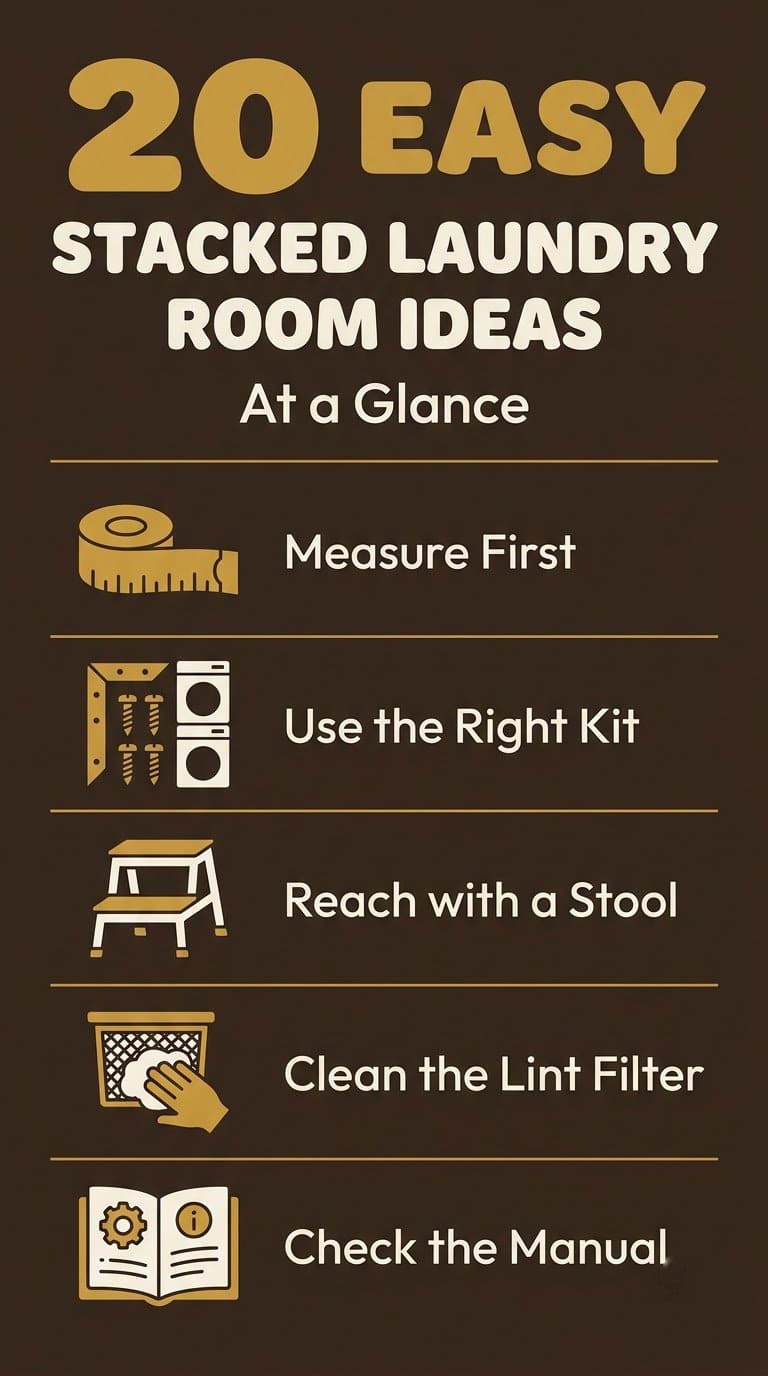
Measure first and keep your manual handy, since clearances differ by model.
Below are 20 ideas for small spaces, covering where to stack, which machines to buy, how to stay safe and how to store everything around the stack. Pick the ones that solve your biggest problem first.


Before You Start
Measure the space before you shop. Write down the width, depth and ceiling height, and where the vent, water lines and outlet sit. Note which way the door swings.
Your appliance manual sets the clearances and the stacking steps. Follow it for your models, and check local rules if the machines will sit in a closet. We don’t give clearance numbers here, because they differ by model.
Here’s how we’d scale the project by budget.
| Level | What you do | Good for |
|---|---|---|
| Renter ($) | A step stool, a slim cart, shelves that need no drilling, a curtain to hide the stack | Apartments, leases that forbid changes |
| Refresh ($$) | Shelves and hooks into studs, a fold-down table, new lighting | Most small laundry rooms |
| Build ($$$) | New stackable machines, full-height cabinets, new doors | Remodels |
A few facts help you choose machines. ENERGY STAR says its front-load washers use about 50 percent less energy and water than top-load agitator washers, and that stackable designs are available for limited space.
For the dryer, ENERGY STAR notes that heat pump dryers need no exterior vent and use about 70 percent less energy than conventional dryers.
20 Stacked Laundry Room Ideas
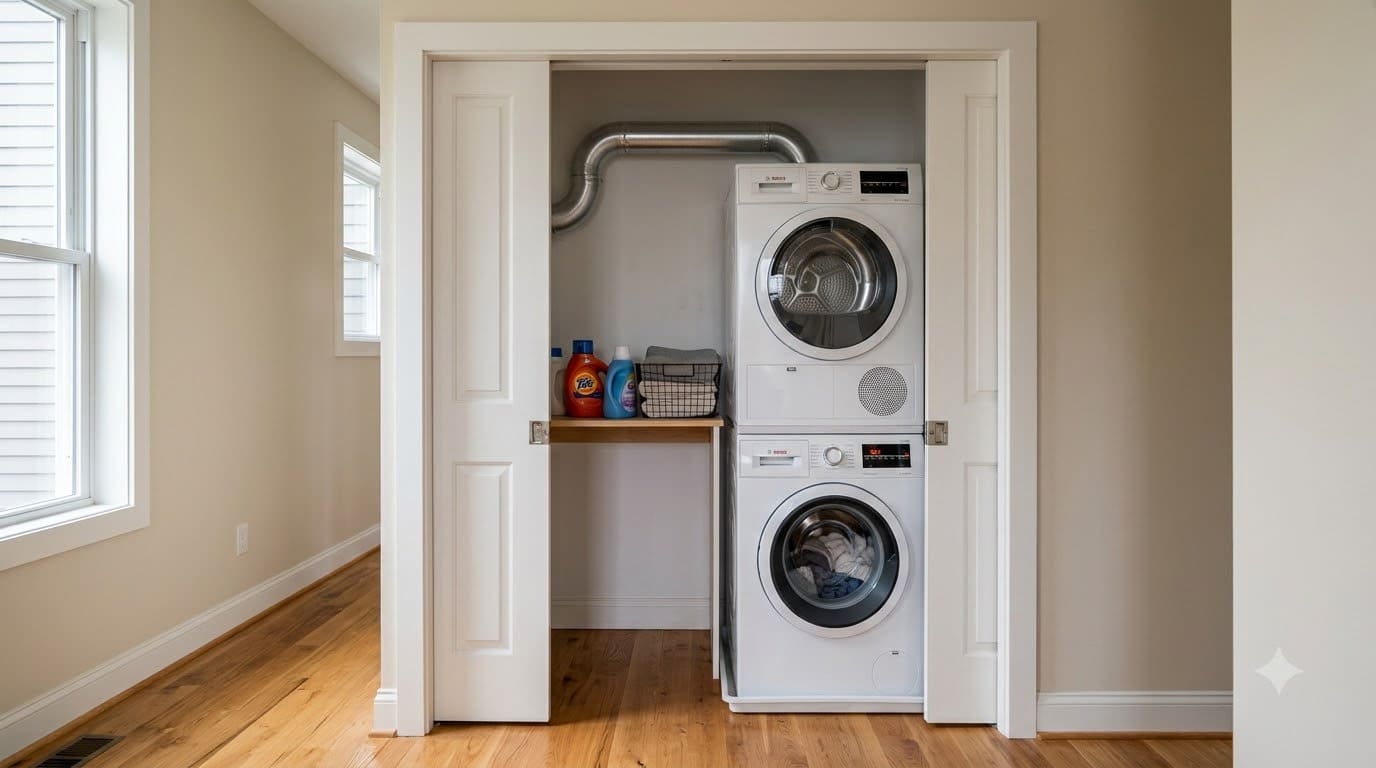
1. Stack in a Closet or Alcove
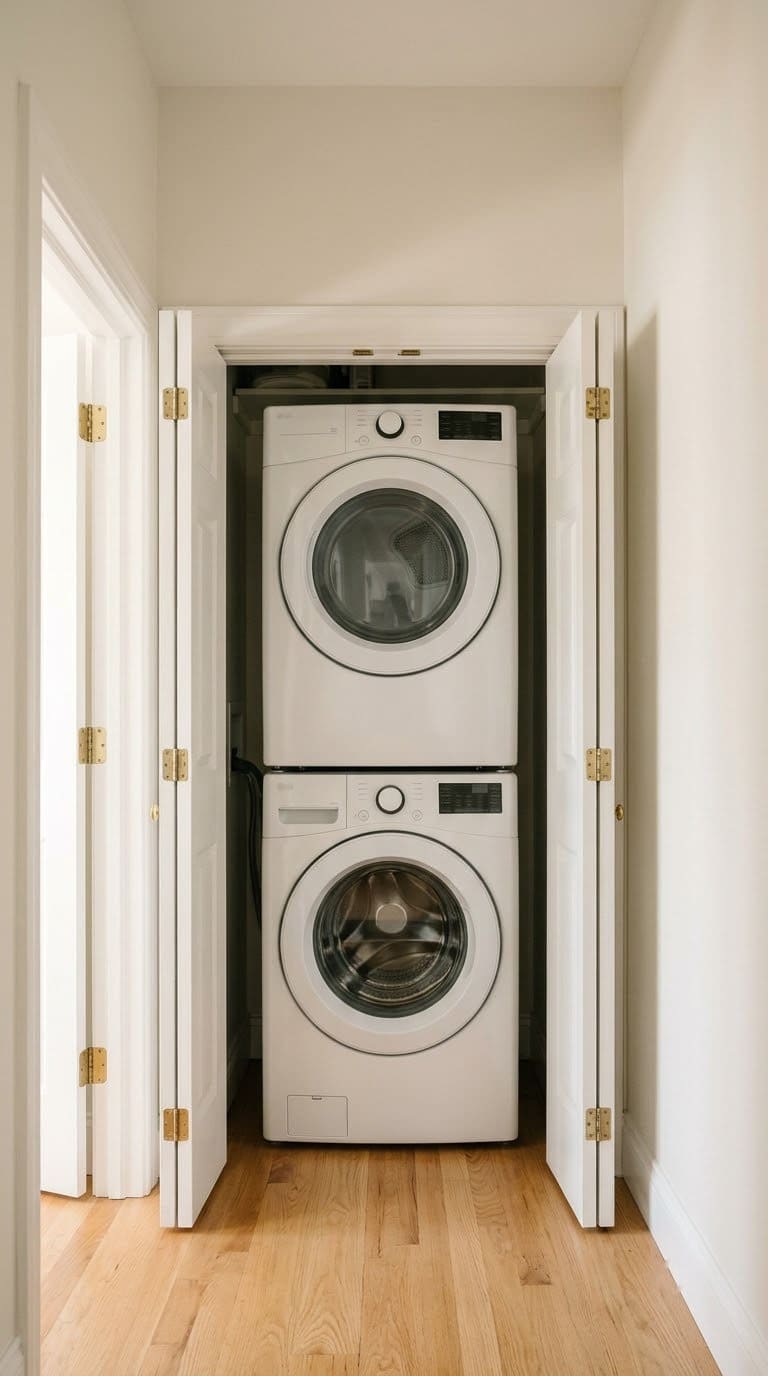
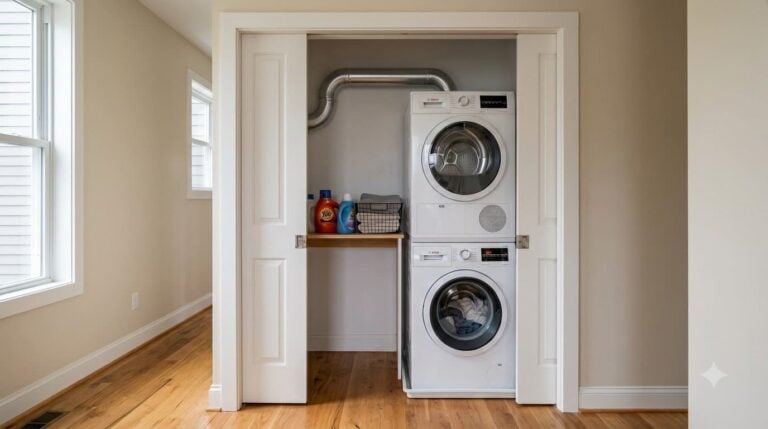
A closet or alcove is the classic home for a stack. The machines sit in a narrow space with a wall on three sides.
Check your manual for door and ventilation rules before you close the doors on a running dryer. Follow it for clearances behind and above the stack.
The catch is heat. A closed closet can trap warm air, so open the doors when the dryer runs unless the manual says otherwise.
A slim, foldable, non-slip step stool listed at 300 lb capacity, with a handle. It suits idea 12. Rated 4.7 stars from 84,805 ratings.
Shop NowThis post contains affiliate links. We may earn a commission on qualifying purchases at no extra cost to you.
Mount a shelf above the stack for light items. Keep the vent path clear.
2. Stack in a Hallway Nook
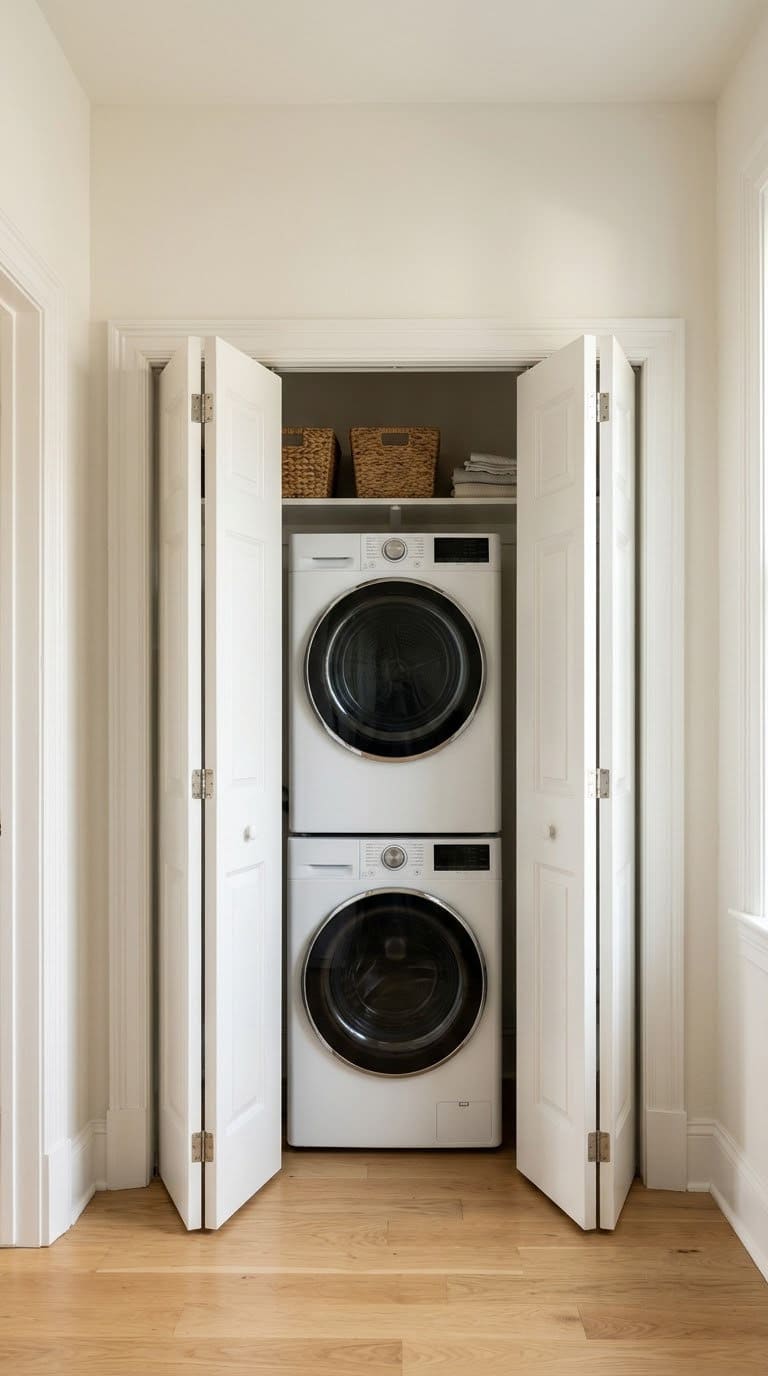
A hallway nook hides the machines behind bifold or sliding doors. It keeps laundry on the main floor with no extra room needed.
Measure the hall’s width, since the door swing must not block the walkway. Bifold doors save space.
The catch is noise. Machines in a hallway are heard through the house, so look for quiet models and a level floor.
Add a hook rail on the side wall for bags and hangers.
3. Stack in a Bathroom Corner
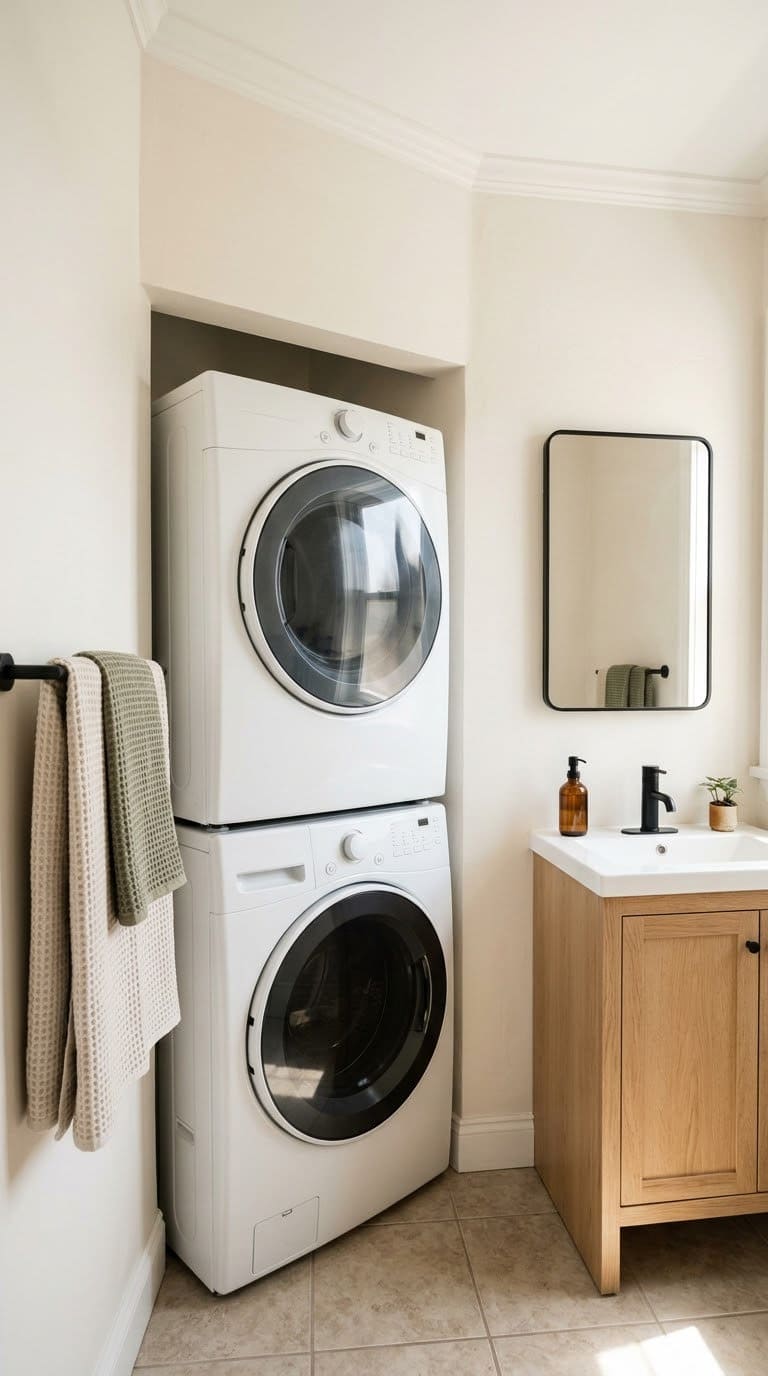
A bathroom corner can hold a stack when no other room has space. It puts laundry near towels and hampers.
Run the bathroom fan, and keep water away from outlets and the dryer’s controls. Follow the manual for any distance rules around water.
The catch is moisture. Steam and splashes can damage cabinets and the machine, so use a fan and wipe surfaces dry.

Hang a rack for towels on the side wall to use the vertical space.
4. Stack in a Pantry or Mudroom Corner
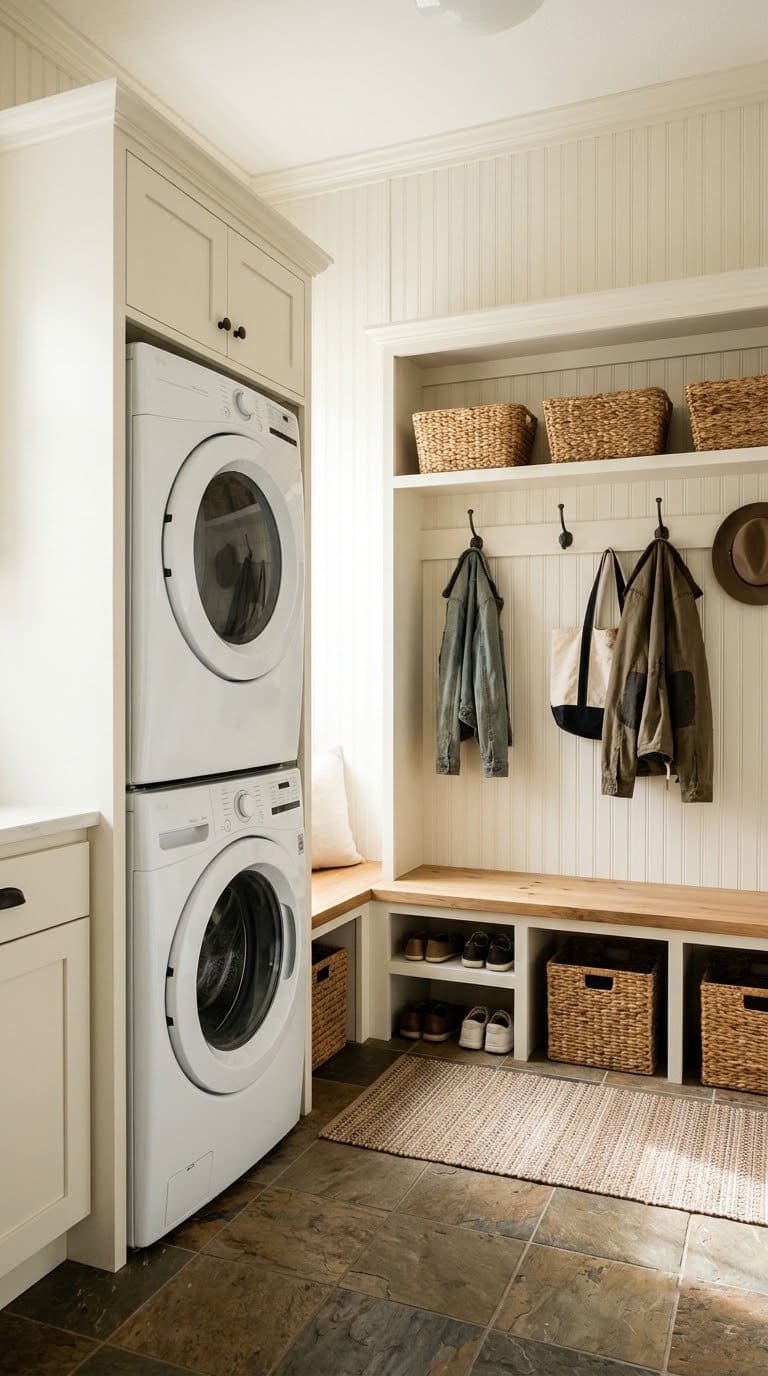
A mudroom or pantry corner makes laundry handy for muddy clothes. Add a bench and hooks to turn it into a utility zone.
Plan a route for the vent. A corner near an outside wall is often easier to vent.
The catch is traffic. People walk past, so keep the floor clear and the machines’ doors out of the path.
Use a washable mat so mud doesn’t track onto the floor.
5. Stack in a Basement Corner
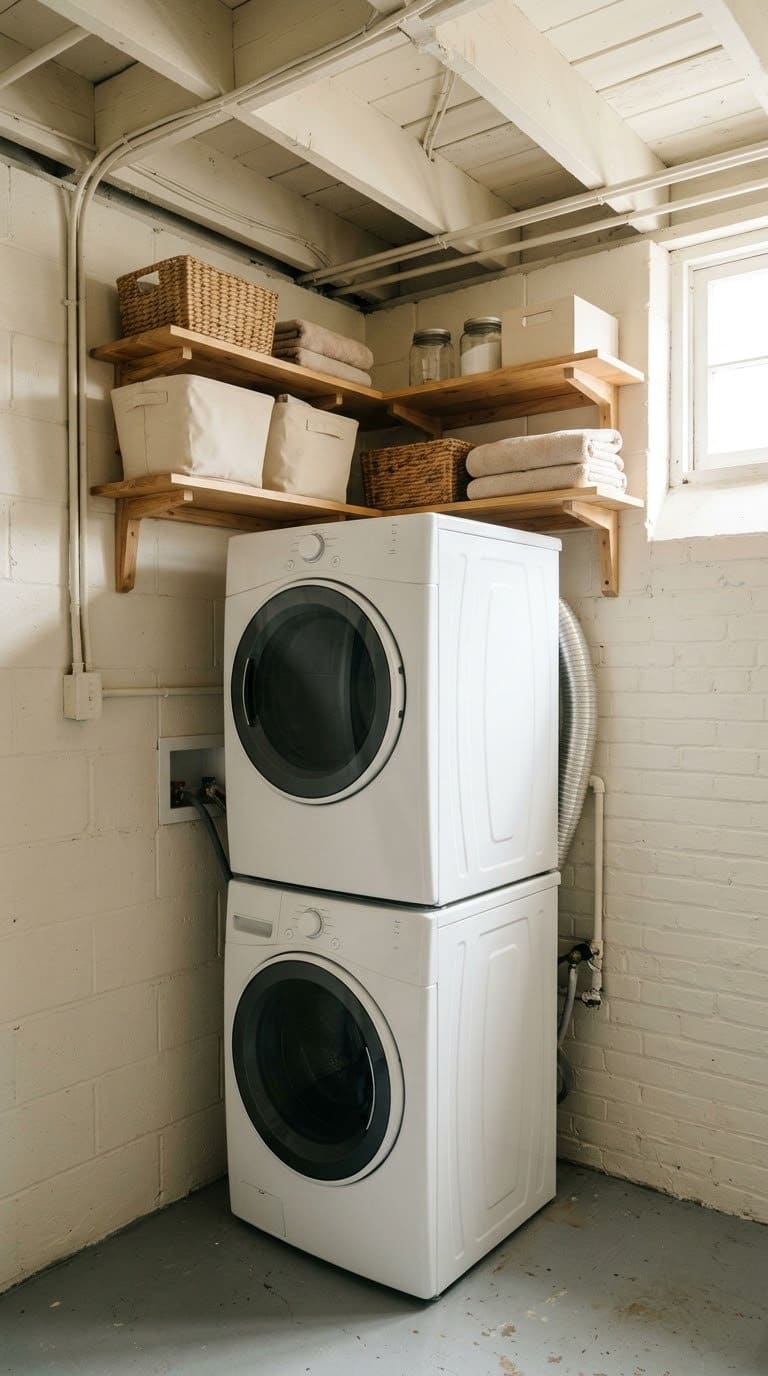
A basement corner has room to spare and easy access to drains. It keeps noise away from living spaces. See our basement laundry room ideas for more.
Keep the machines off a damp floor and watch for moisture. Check the manual for any base or leveling requirements.
The catch is humidity. A damp basement is hard on machines and stored fabrics, so use a dehumidifier if needed.
Put shelves on the wall above the stack for detergent and baskets.
6. Stack in a Bedroom Closet
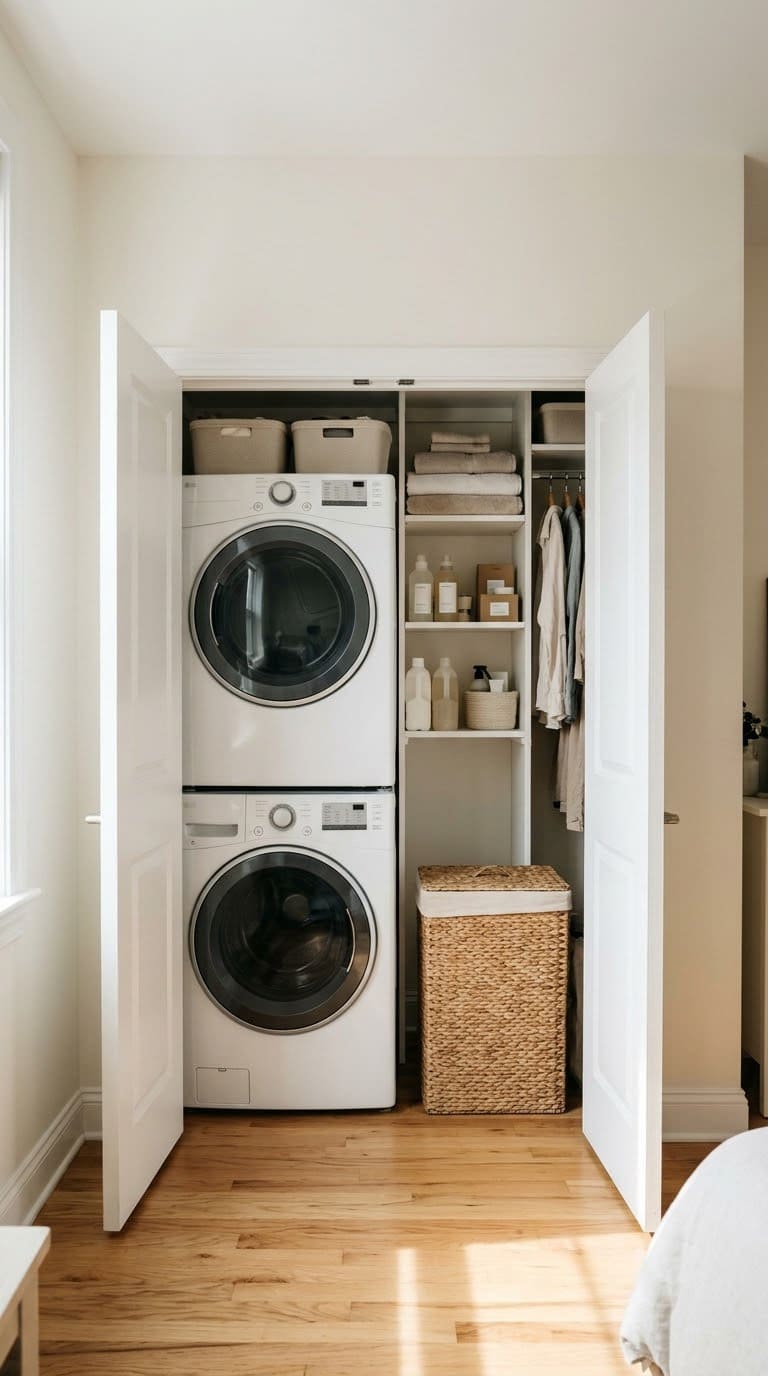
A bedroom closet puts laundry where dirty clothes start. It works well for upstairs laundry.
Ask a licensed plumber and electrician about water, drain and power. Check the weight the floor must carry.
The catch is vibration and noise. Spin cycles can travel through the floor, so look for quiet, level machines.
Keep clothes away from the dryer exhaust and keep the vent clear.
7. A Front-Load Stackable Pair
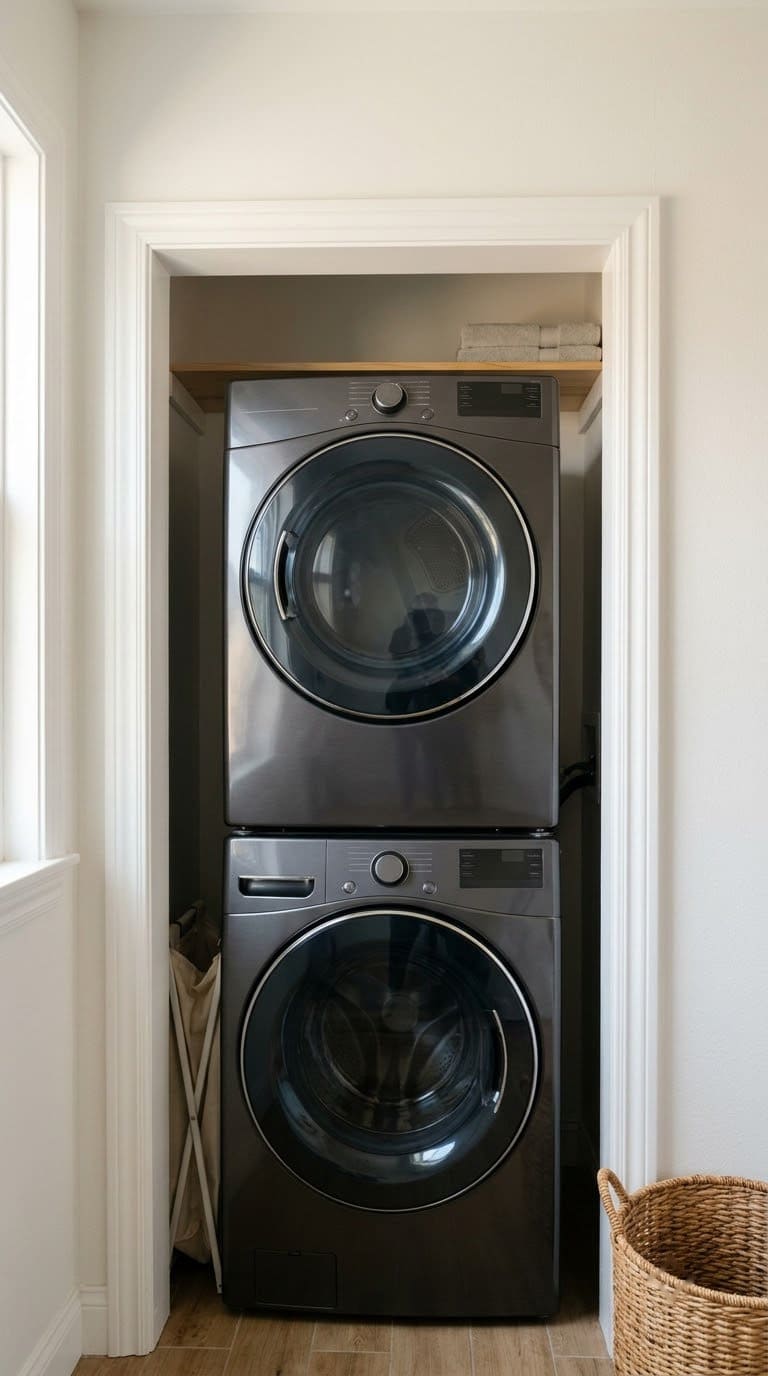
Most stacks use a front-load washer on the bottom. ENERGY STAR says front-load washers use about 50 percent less energy and water than top-load agitator washers.
Buy the washer and dryer as a matched pair when you can. ENERGY STAR says matched pairs save more energy together.
The catch is bending. Front-loaders sit low, so loading takes crouching. A pedestal under the washer raises it but also raises the dryer.
Leave the door ajar after use. ENERGY STAR says this prevents mold in front loaders.
8. A Compact Stackable Set
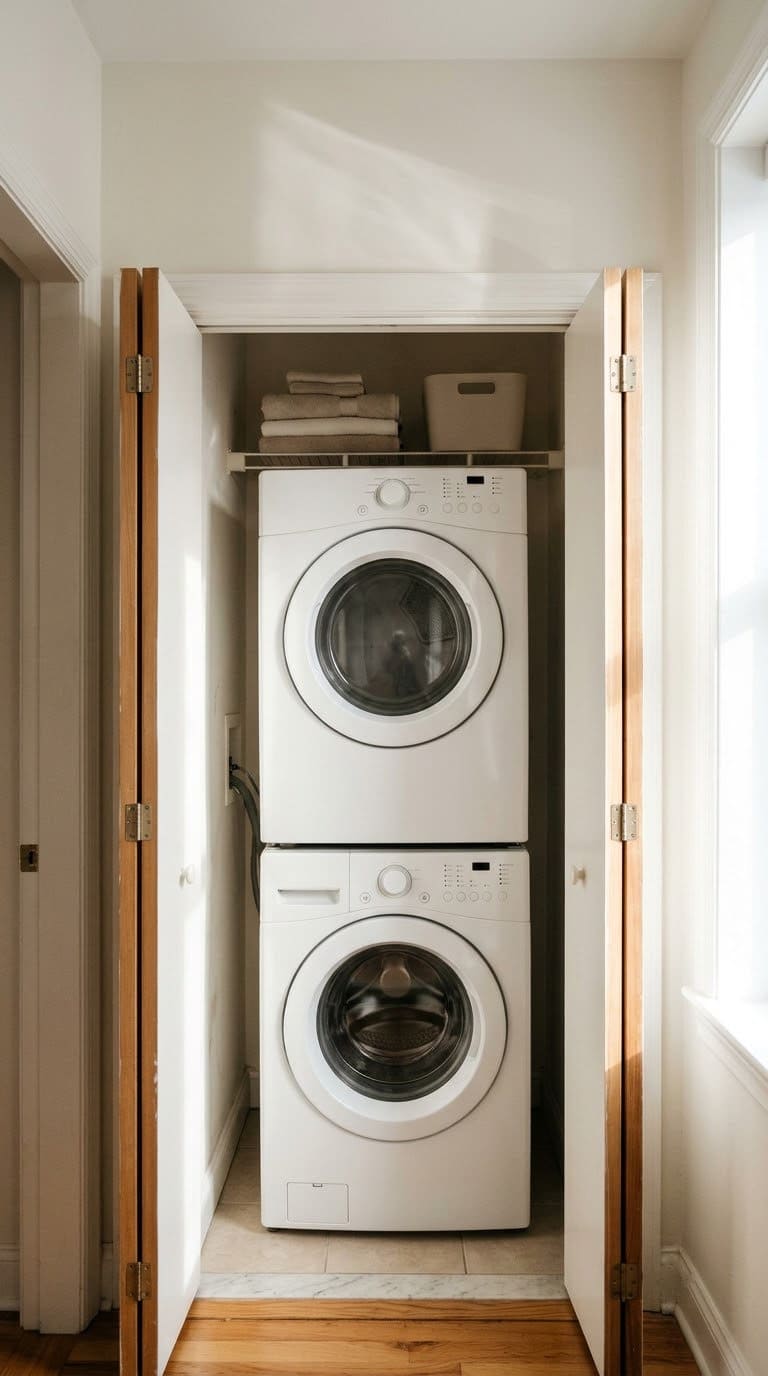
A compact set suits the tightest spaces. ENERGY STAR lists stackable, under-the-counter and combination models for smaller spaces.
ENERGY STAR calls dryers under 4.4 cubic feet compact. Check the capacity against your loads before you buy.
The catch is load size. A compact drum holds less, so big households do more loads.
Choose a set made for stacking. Don’t stack machines that aren’t designed for it.
9. A Ventless Heat Pump Dryer on Top
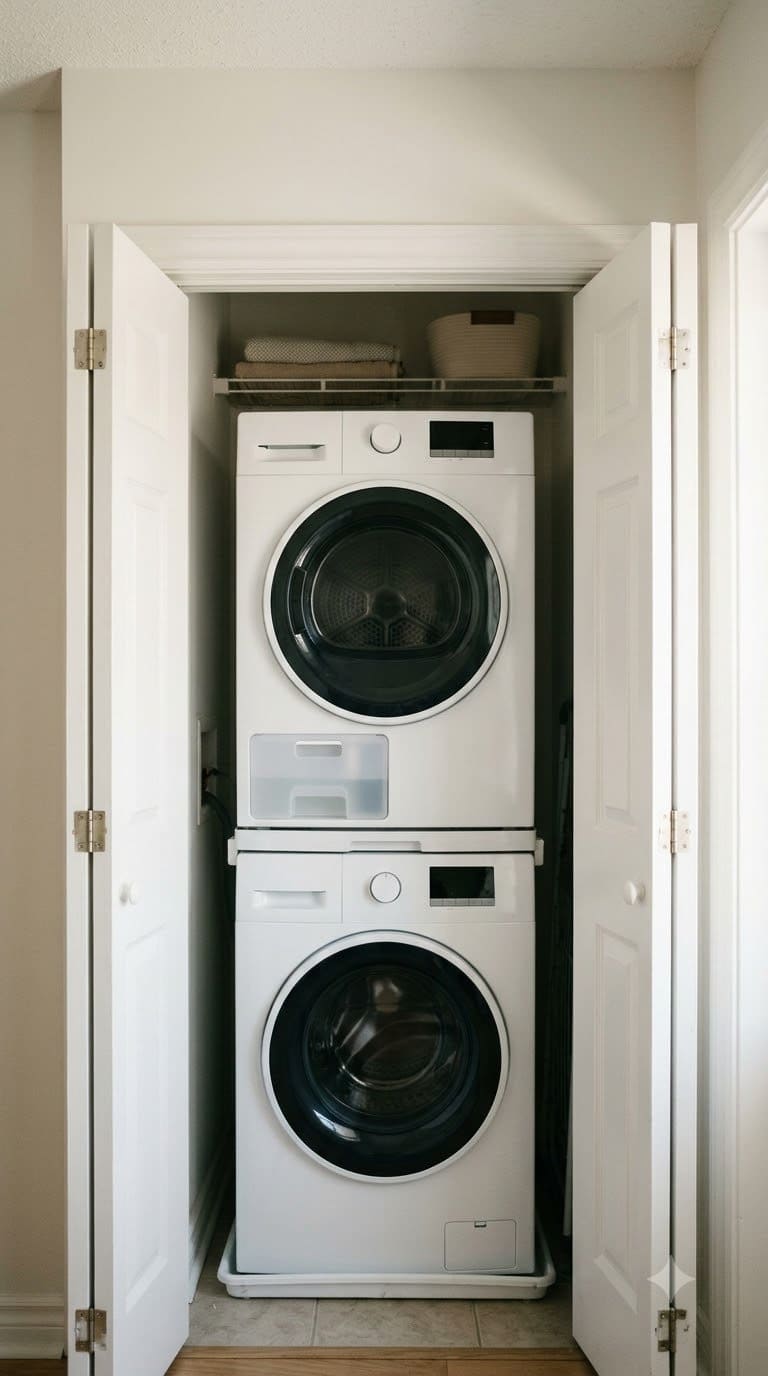
If you can’t run a vent, a heat pump dryer is an option. ENERGY STAR says heat pump dryers need no exterior vent, which can cut installation costs in homes without one.
The water has to go somewhere. ENERGY STAR says condensed water drains or collects in a holding tank that must be emptied, unless it is connected to a washer drain.
The catch is that you still need the right setup. Ask the manual how to stack it and how to handle the water.
It uses about 70 percent less energy than a conventional dryer, according to ENERGY STAR.
10. An All-in-One Washer-Dryer
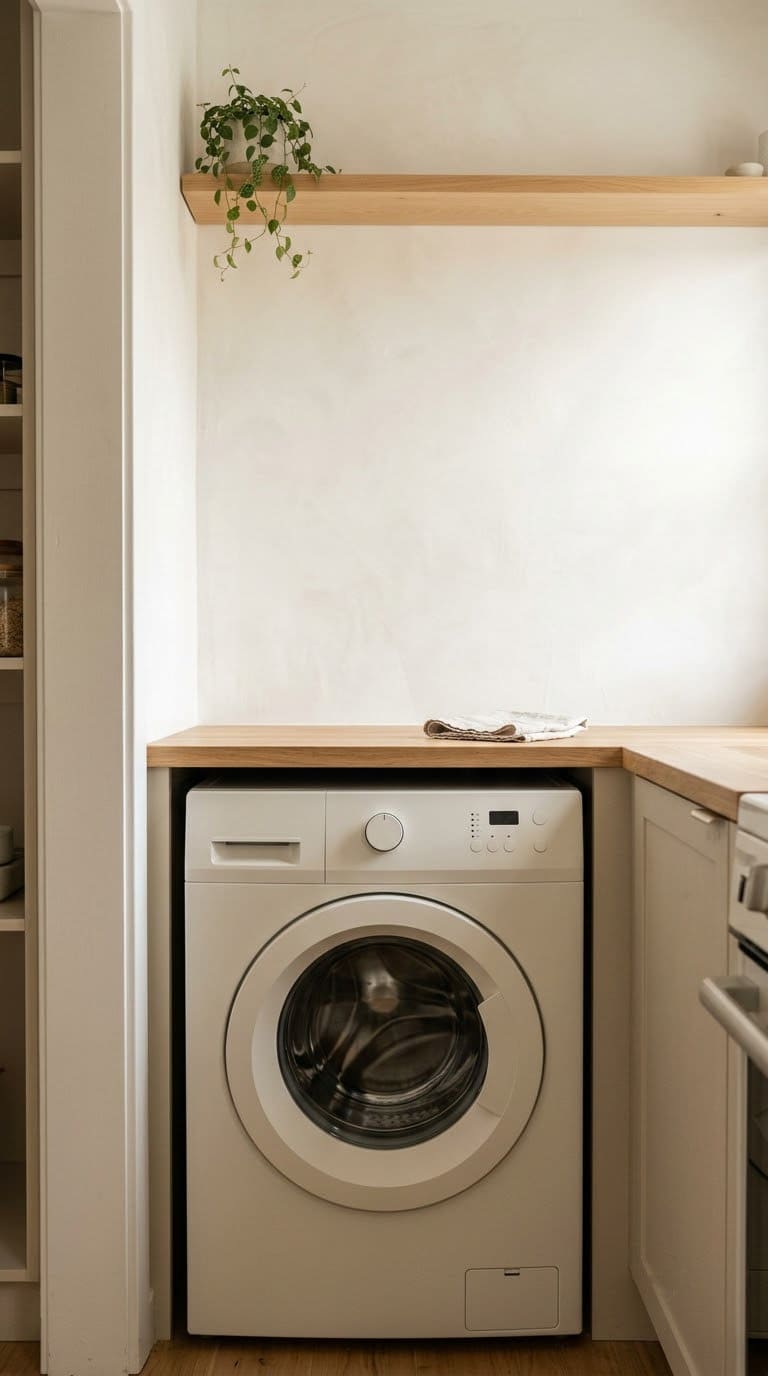
A combo does both jobs in one machine, so you need one footprint and no stack. ENERGY STAR lists combination models among the options for small spaces.
Check capacity and cycle time before you decide. Many people compare a combo with a stack of two machines.
The catch is flexibility. With one machine you can’t wash and dry at once.
Choose it if floor space matters more than speed.
11. Use the Stacking Kit Made for Your Models
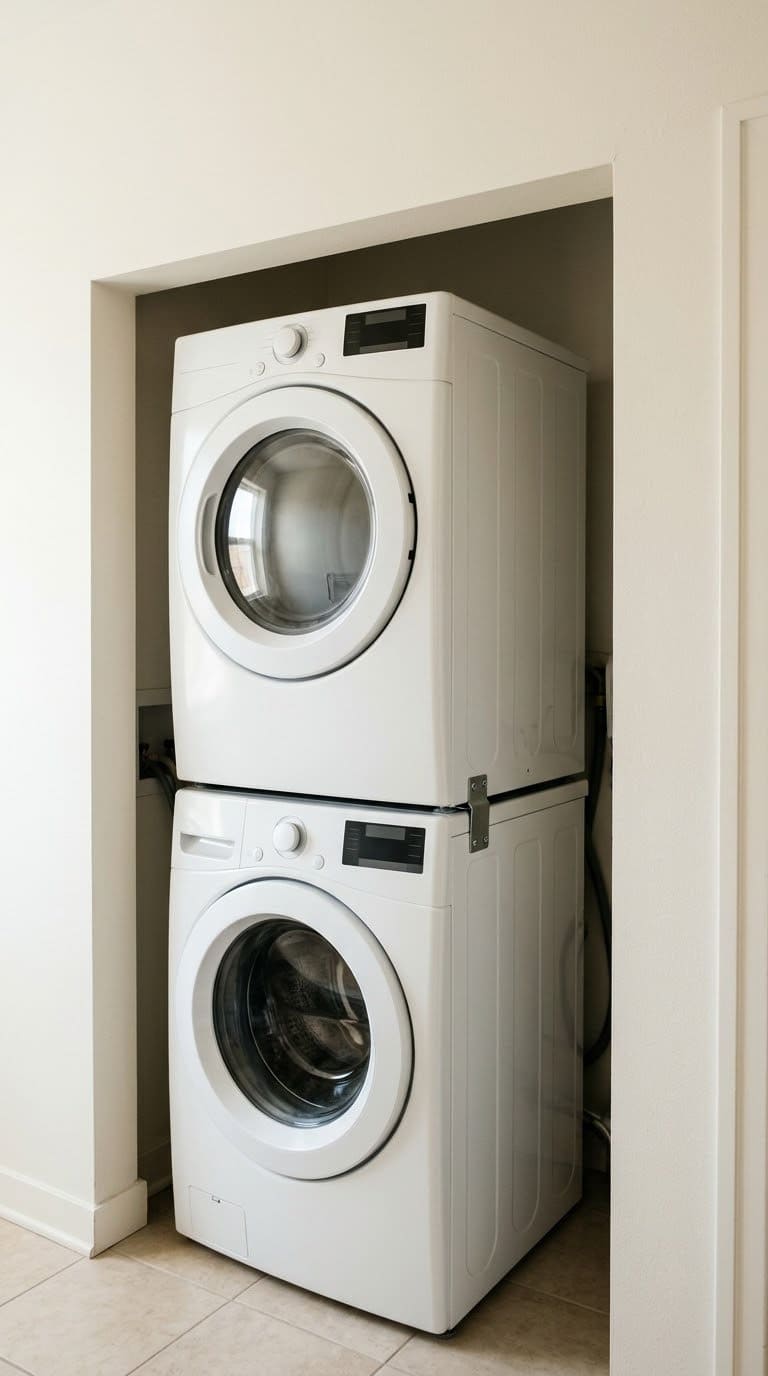
A stacking kit locks the dryer to the washer so it can’t slide or fall. It is not a place to improvise.
Use the kit made for your exact models. Follow the manual’s steps and ask for a second pair of hands when lifting.
The catch is that a mismatched kit may not fit or hold. If the manual calls for a wall or floor anchor, use it.
When in doubt, ask the manufacturer or a licensed installer.
12. A Step Stool for the Top Controls
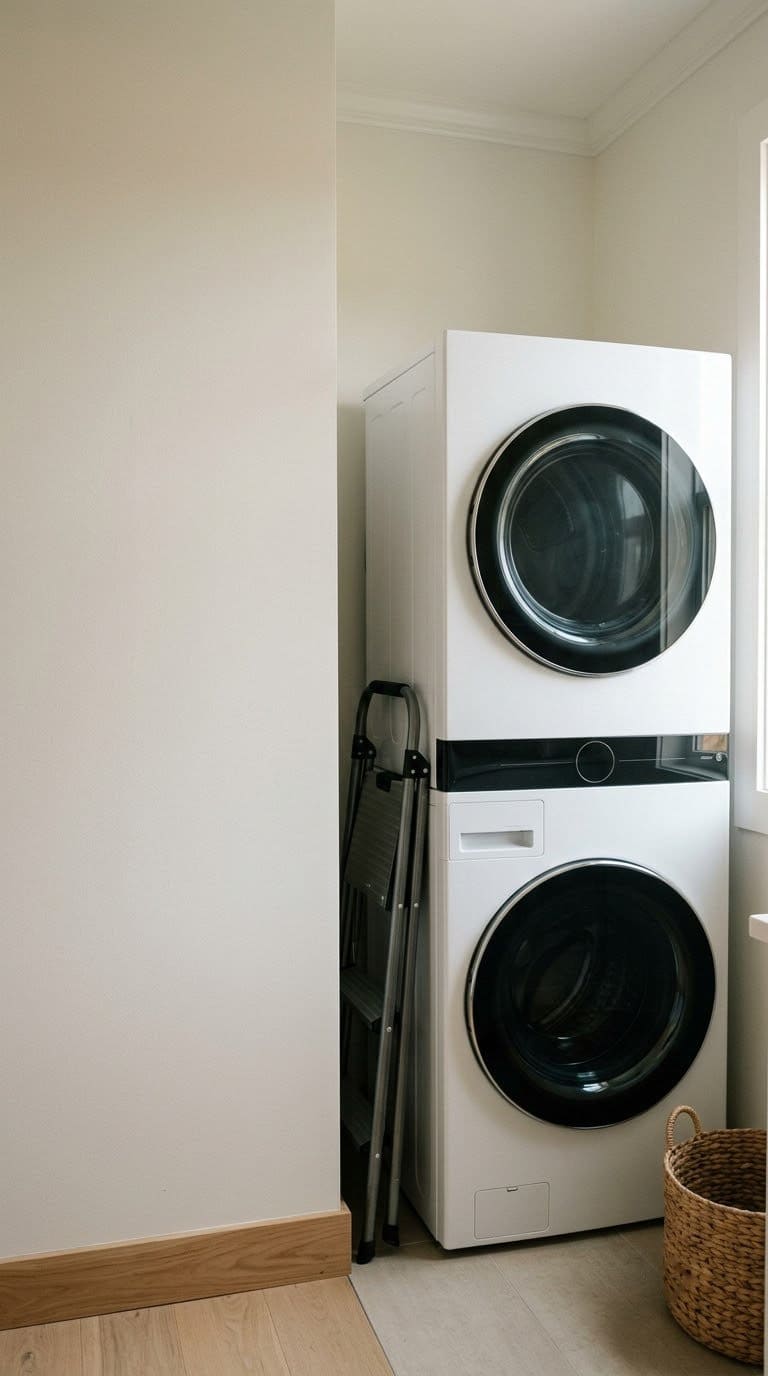
The dryer’s controls and lint filter sit at the top of the stack. A step stool gets you there safely.
Choose a stool with a non-slip surface that folds flat. Store it beside the stack or in a drawer.
The catch is clutter. A stool left out trips you, so tuck it away after each use.
Check the filter from a stable stool, not a chair.
13. A Lint and Vent Routine
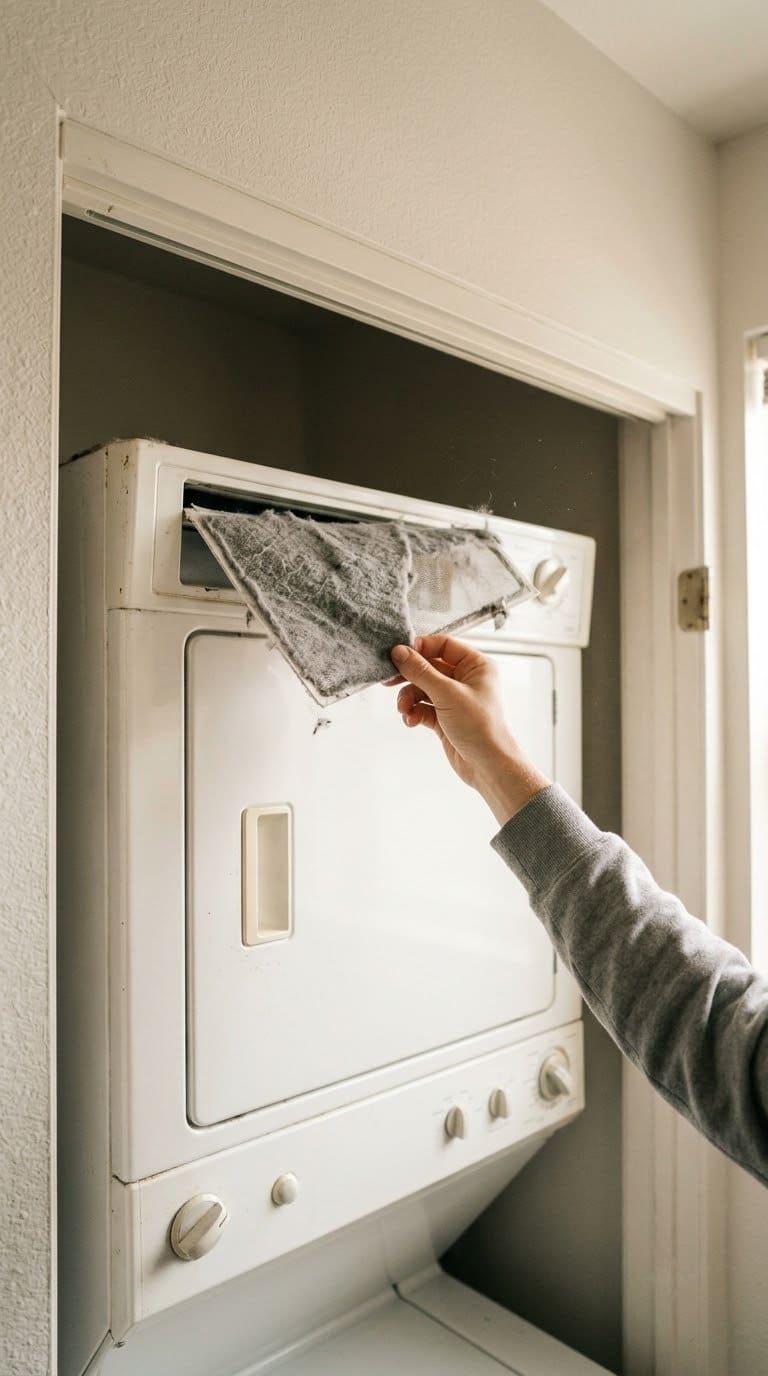
A stacked dryer is easy to forget. Build a routine around the lint filter and the vent.
The Washington State Patrol says to clean the lint filter before and after each load, clean it with a nylon brush at least every six months, and clear the vent pipe every three months. ENERGY STAR adds that dryer sheets leave a film, so scrub the filter monthly.
Use rigid or flexible metal venting, as the Washington State Patrol advises. Slow drying is a sign the vent needs cleaning.
Turn the dryer off when you leave home or go to bed.
14. Full-Height Cabinets Beside the Stack
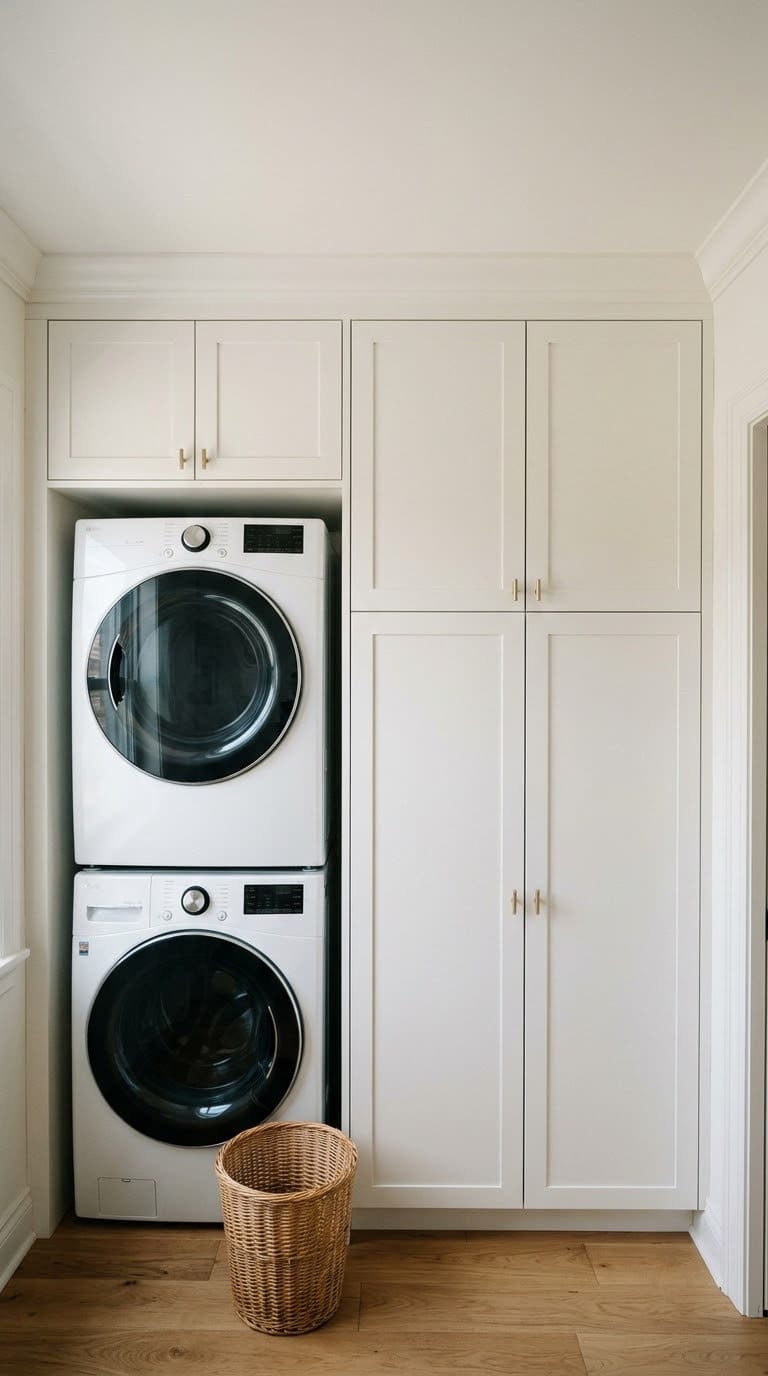
Tall cabinets use the wall next to the stack. Put daily supplies at eye level and rarely used items high.
Leave the clearance your manual lists between the cabinet and the machines. Keep the vent path open.
The catch is bulk. Closed cabinets can make a small room feel heavy, so choose light colors or leave one section open.
Add a pull-out shelf near the bottom for heavy detergent.
15. Open Shelves and Hooks on the Side Wall
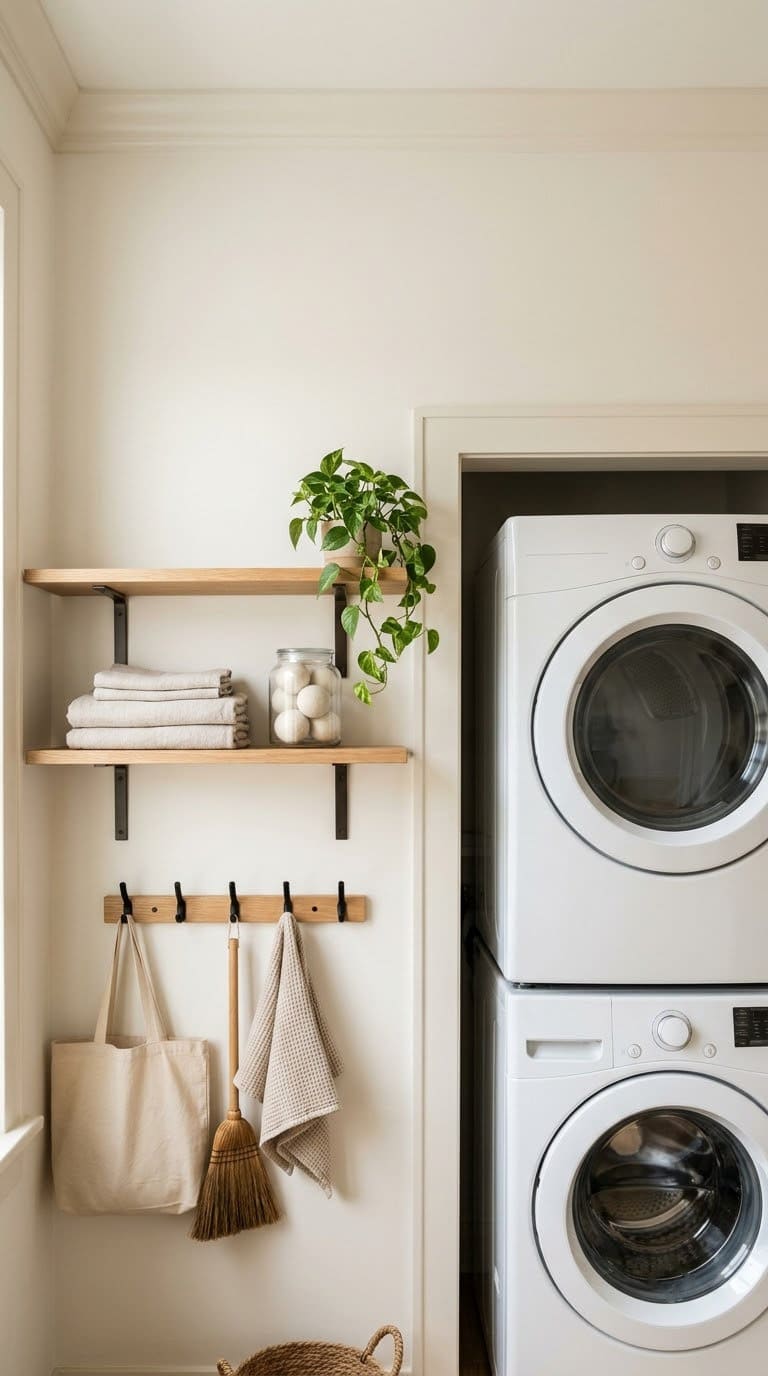
A side wall is free storage. Shelves hold baskets and bottles, and hooks hold hangers and bags.
Mount them into studs, and keep the lowest shelf above head height so you don’t bump it.
The catch is dust and clutter. Open shelves show everything, so keep only weekly items there.
Store detergent and cleaners out of reach of children and pets, in their original containers.
16. A Slim Rolling Cart Beside the Stack
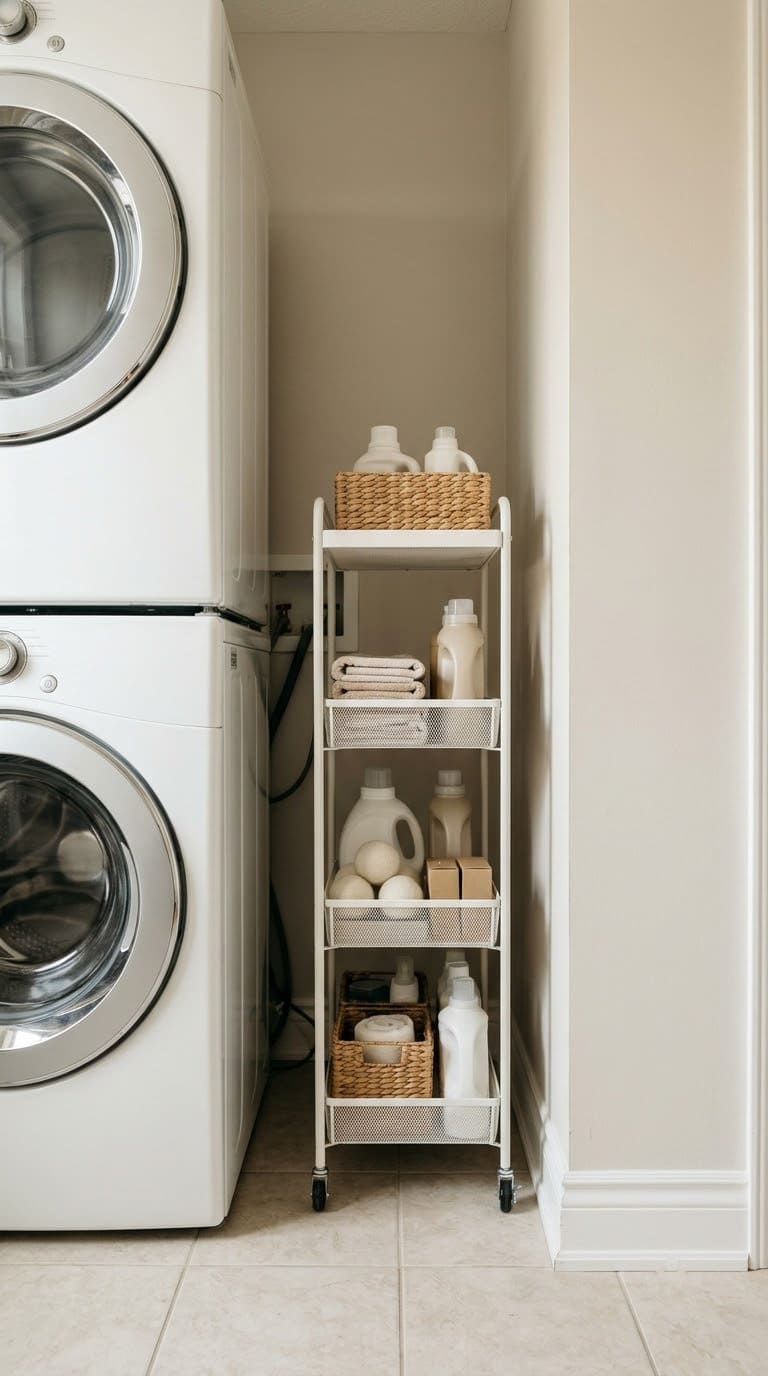
A slim cart slides into a narrow gap and rolls out when you need it. It holds detergent, stain removers and dryer balls.
Measure the gap at several heights, since walls and hoses can narrow it lower down. Our product pick measures 5.1 inches deep.
The catch is stability. Keep heavy bottles on the bottom shelf so the cart doesn’t tip.
Check that the cart doesn’t block the vent or the hoses.
17. A High Shelf Above the Stack
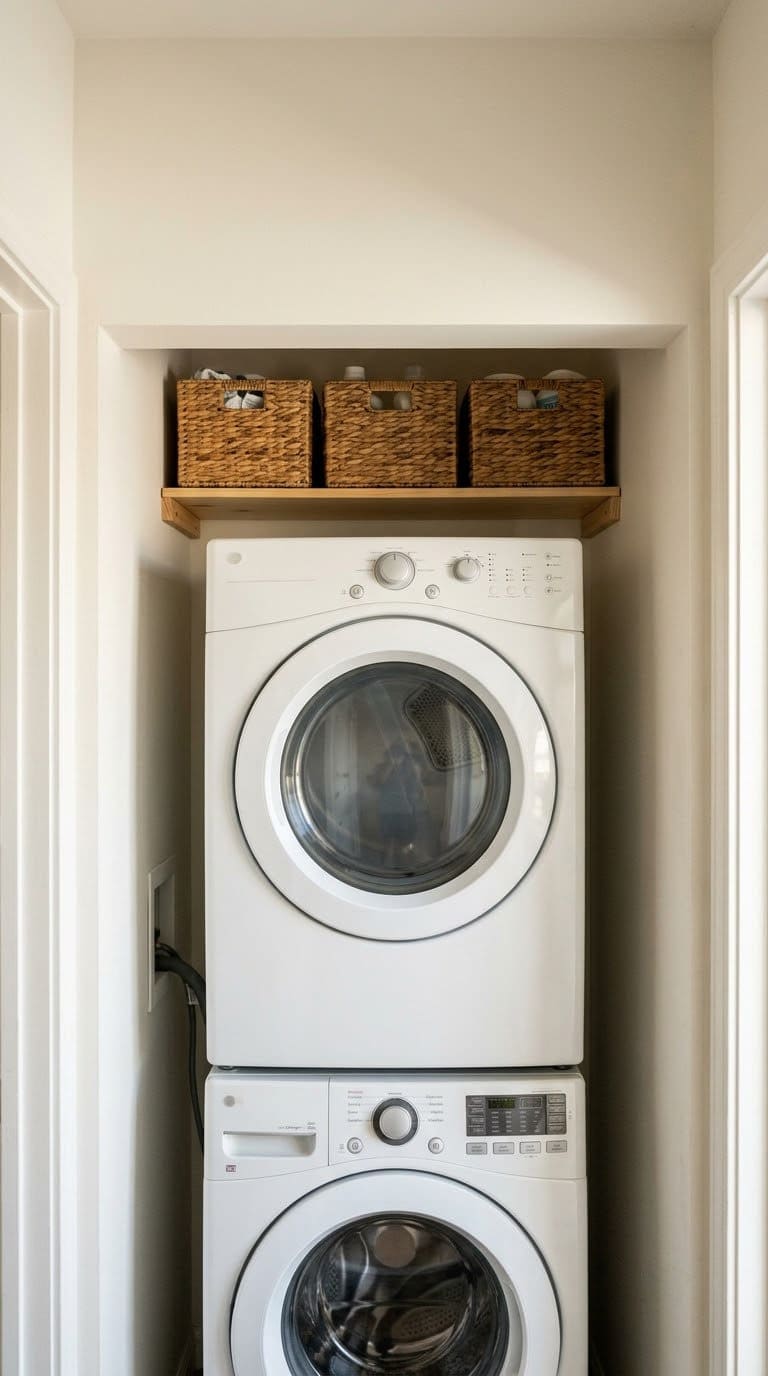
The wall above the stack is wasted in many rooms. A high shelf holds rarely used items.
Leave space for the dryer’s top and any vent. Check your manual for the clearance above the unit.
The catch is reach. You’ll need a step stool, so keep only light, seasonal items there.
Mount the shelf into studs.
18. A Folding Surface Next to the Stack
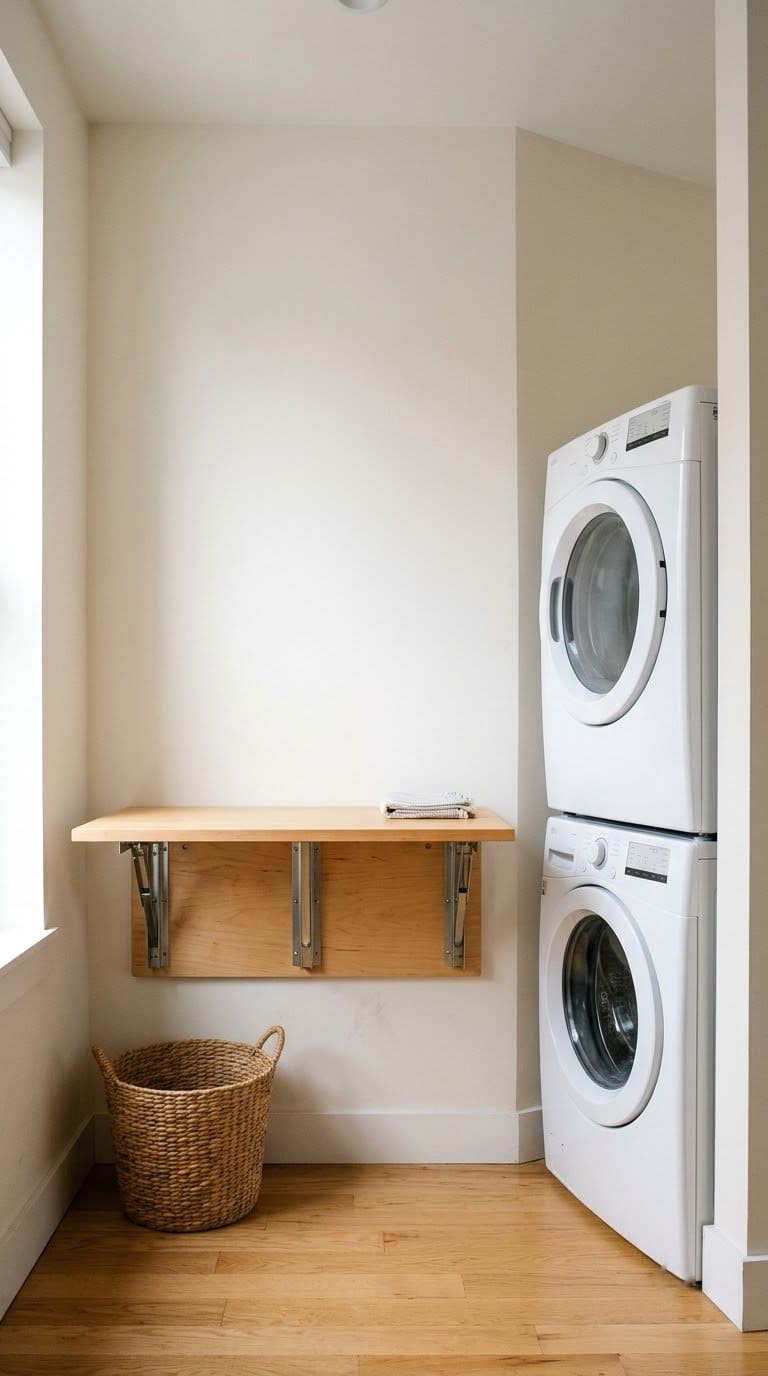
A stack leaves no counter on top, so make a folding spot nearby. A fold-down table on the side wall works well.
Mount it into studs and choose hardware rated for the load. Fold it flat when you’re done.
The catch is weight. A table not secured to studs can pull out of the wall, so use a stud finder.
A rolling cart or a nearby bed can also serve as a folding surface.
19. Light Colors and a Mirror
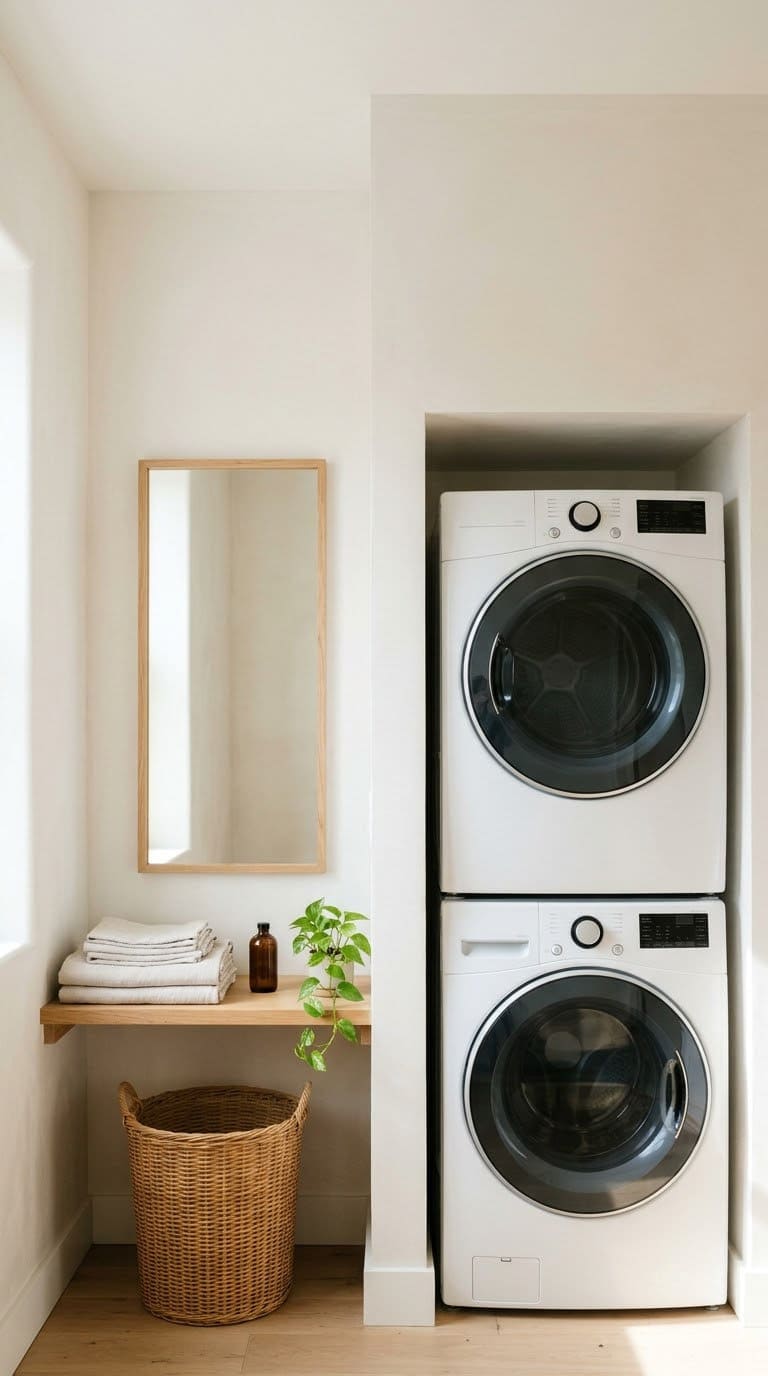
Light paint and a mirror make a small space feel bigger. Pale walls reflect light, and a mirror bounces it around.
Choose a mildew-resistant paint for a damp space. Add one textured material for warmth.
The catch is that white shows lint and drips. Pick a warm white and a wipeable finish.
Keep the mirror away from steam and the dryer vent.
20. Hide the Stack
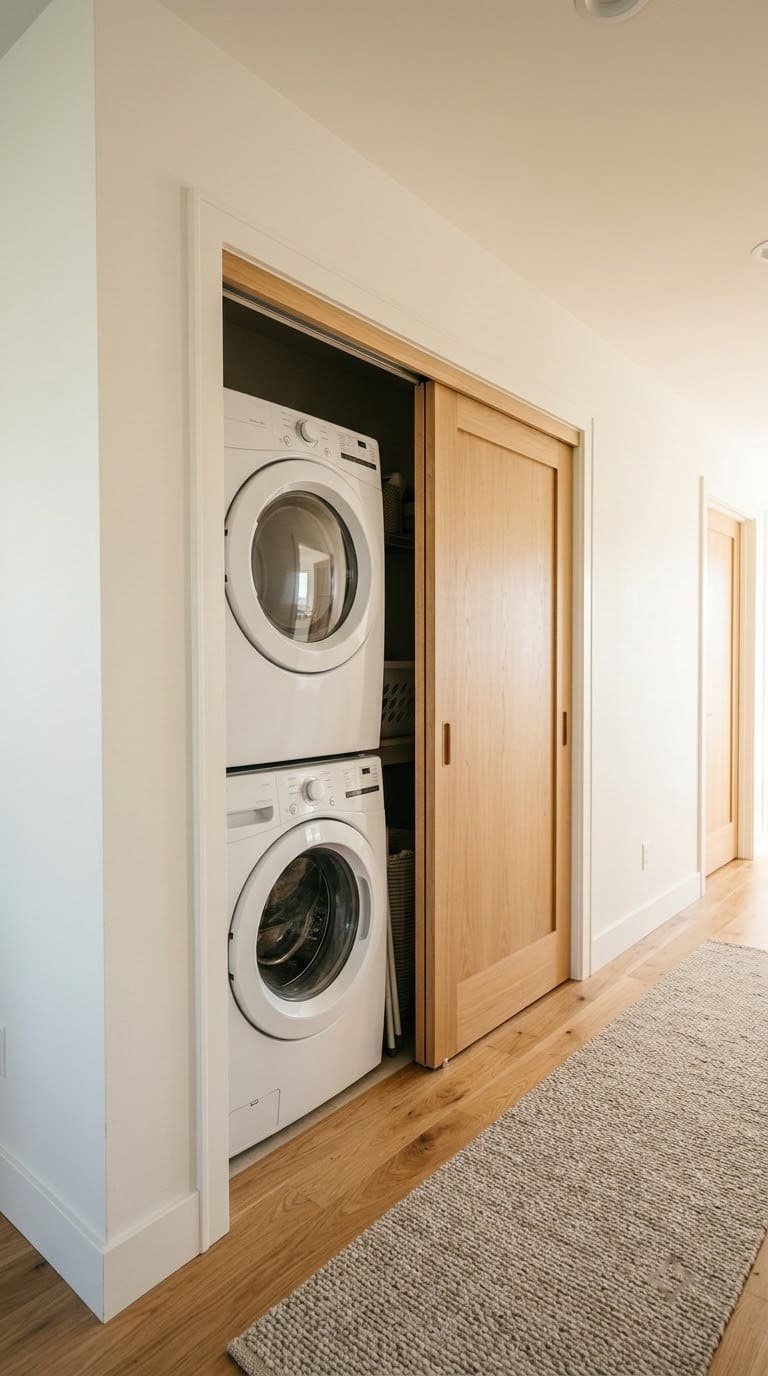
A hidden stack keeps the laundry area tidy. Sliding doors, bifold doors or a curtain all work.
Check your manual before you close anything around a dryer. Leave the doors open while it runs unless the manual says otherwise.
The catch is ventilation. Never block the vent or trap heat around the machine.
Use the same colors as the rest of the room so the doors blend in.
Style It Without Losing Floor Space
Once the layout works, style it lightly. A pale palette and a mirror make the space feel larger, and plants add freshness if the room has light.
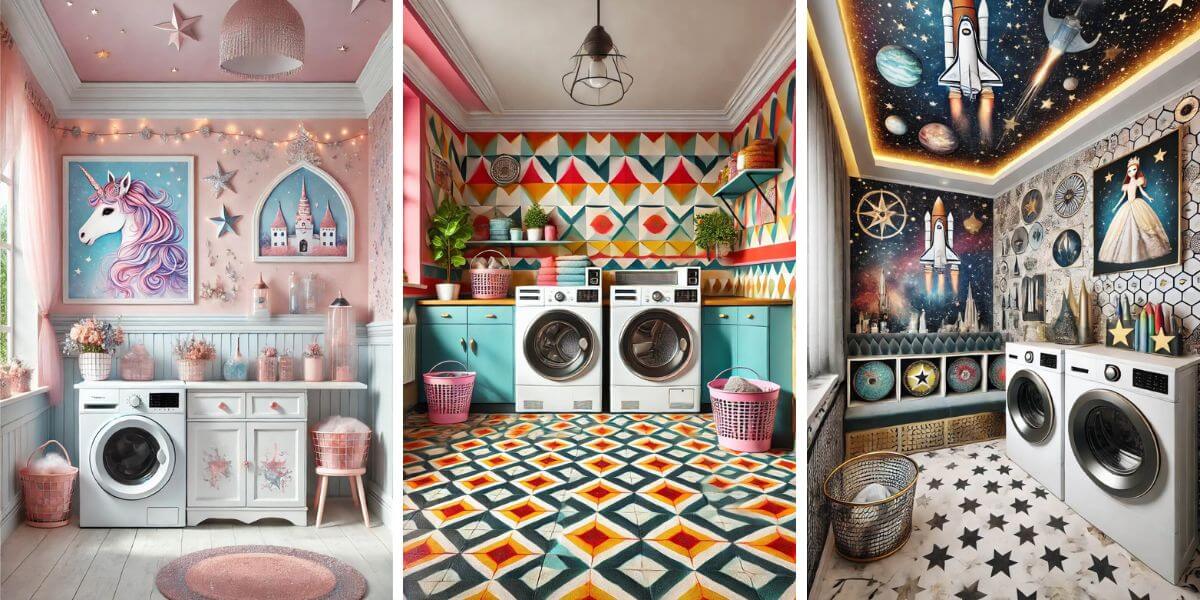
For a farmhouse look, see our farmhouse laundry room ideas. For playful themes, our whimsical laundry room ideas have plenty.
If your goal is efficiency, choose ENERGY STAR machines and wash in cold water. ENERGY STAR says water heating accounts for about 90 percent of a washer’s energy use.
What Goes Wrong (and What We’d Do Differently)
Most small stacked laundry rooms go wrong in one of three ways.
The first is buying before measuring. A stack, a cabinet or a cart looks perfect online and then doesn’t fit. We’d measure width, depth, height and door swing first.
The second is forgetting the dryer. A stack hides the lint filter at the top. The Washington State Patrol says failing to clean the dryer is the leading cause of home dryer fires, so we’d set a routine.
The third is improvising the stack. A mismatched kit or a machine not meant to stack can slide. If there’s one thing worth doing differently, it’s using the kit and steps from your own manual.
Where to Stack It
This is our rough read, based on common problems in each spot.
| Spot | Best for | Watch out for | Renter-friendly |
|---|---|---|---|
| Closet or alcove | Small homes | Heat and door rules | Often |
| Hallway nook | Main-floor laundry | Noise and door swing | Often |
| Bathroom corner | No other room | Moisture | Sometimes |
| Mudroom or pantry | Muddy clothes | Traffic | Sometimes |
| Basement corner | Spare space | Humidity | Sometimes |
| Bedroom closet | Upstairs laundry | Floor load and vibration | Rarely |
Stacked Laundry Room FAQs
Can any washer and dryer be stacked?
No. Only models designed for stacking should be stacked, and you need the kit made for those models. Check the manual for the steps.
Which goes on the bottom?
The washer goes on the bottom and the dryer on top in most stacks. Follow your manual for your models.
Do I need a vent for a stacked dryer?
A vented dryer needs one. A heat pump dryer does not need an exterior vent, according to ENERGY STAR, but it collects or drains water.
How do I reach the controls on top?
Use a stable step stool with a non-slip surface. Keep it beside the stack or in a drawer.
How often should I clean the dryer vent?
The Washington State Patrol says to clear lint from the vent pipe every three months and to clean the lint filter before and after each load.
Never miss an update — choose FarmFoodFamily as your preferred source on Google.
How it works: Tap the button below to open Google's settings page, then check the box next to FarmFoodFamily.
Tap the checkbox to turn it blue — that's how you know it's set.