Why Transplanted Trees Die: The Hidden Root Problems Nobody Talks About
Transplanted trees rarely die from anything you can see, so the fix starts underground: keep the root ball wet, plant at the right depth, and correct the roots before the first leaf drops.

Never miss an update — choose FarmFoodFamily as your preferred source on Google.
How it works: Tap the button below to open Google’s settings page, then check the box next to FarmFoodFamily.
Tap the checkbox to turn it blue — that’s how you know it’s set.
Every spring, homeowners and landscapers plant thousands of trees with high hopes. By the following year, a surprising number of them are dead or dying, and almost nobody can explain why. The tree was watered. The hole looked big enough. The nursery guaranteed healthy stock. So what went wrong?
In most cases, the answer was never visible above ground. Transplanted trees almost never die from what you can see. They die from what happens in the root zone during the first critical months, and most planting advice skips over those details entirely. From girdling roots to desiccated root balls to soil that repels water, the real killers work quietly underground. Understanding them, along with practices like proper backfilling and the use of planting granules designed to support root establishment, is what separates trees that thrive from trees that slowly fade.
Here is a look at the root problems that actually kill transplanted trees, and what to do about each one.
Quick Answer: Why Do Transplanted Trees Die?
Transplanted trees mostly die from root zone problems that nobody sees. The big three are a root ball that dries out, a planting hole that holds too much or too little water, and a trunk flare buried too deep.
Nebraska Extension says the root flare should be visible at the surface, and that new trees generally need about 1 inch of water per week. Purdue Extension adds that the root collar should sit level with or slightly above the existing grade.


Fix those three problems and correct any circling roots, and most losses are preventable. Water the ball itself, not just the soil around it, and keep mulch a few inches off the trunk. Skip fertilizer in the hole. Each fix takes only minutes at planting time, and none of them costs much money.
Answer 4 quick questions and get matched to the exact fix for your yard — drainage, budget, layout, or something else entirely.
Take the Free QuizWhat Does Transplant Shock Look Like?
Transplant shock rarely looks dramatic at first. Leaves wilt on a day that is not hot, turn brown at the edges, or drop in midsummer. Some trees color early in fall, long before their neighbors do.
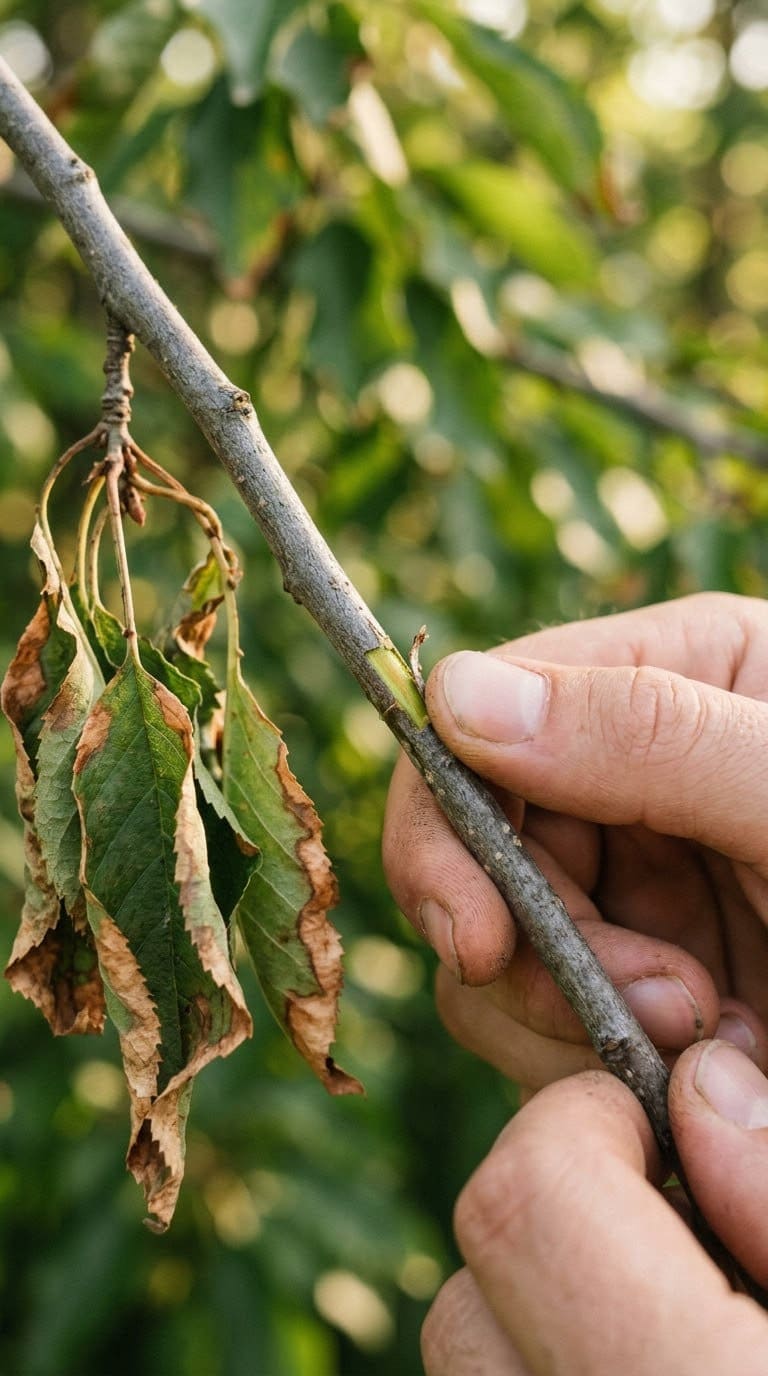
Those signs point to a root system that cannot keep up with the leaves. A quick scratch test helps. Scrape a small patch of bark on a young twig with a fingernail. Green underneath means the branch is still alive.
If the tree is struggling but not gone, act early. Our guide on how to rescue a dying fruit tree covers the same steps, and most of them work for shade trees too.
The Root Ball Dries Out Before Roots Can Grow
The single most common cause of transplant death is simple: the root ball dries out before new roots grow into the surrounding soil.
When a tree is dug at the nursery, it loses the majority of its fine feeder roots. Those fine roots are the only part of the system that actually absorbs water. What remains is a woody root ball with limited ability to take up moisture, and it takes weeks or months for new roots to grow outward into the backfill.
During that window, the tree is living on a knife’s edge. The top of the tree continues to transpire water through its leaves on every warm, sunny day while the reduced root system struggles to keep up. If the root ball dries even once during this period, fine roots die back further, and the spiral begins.
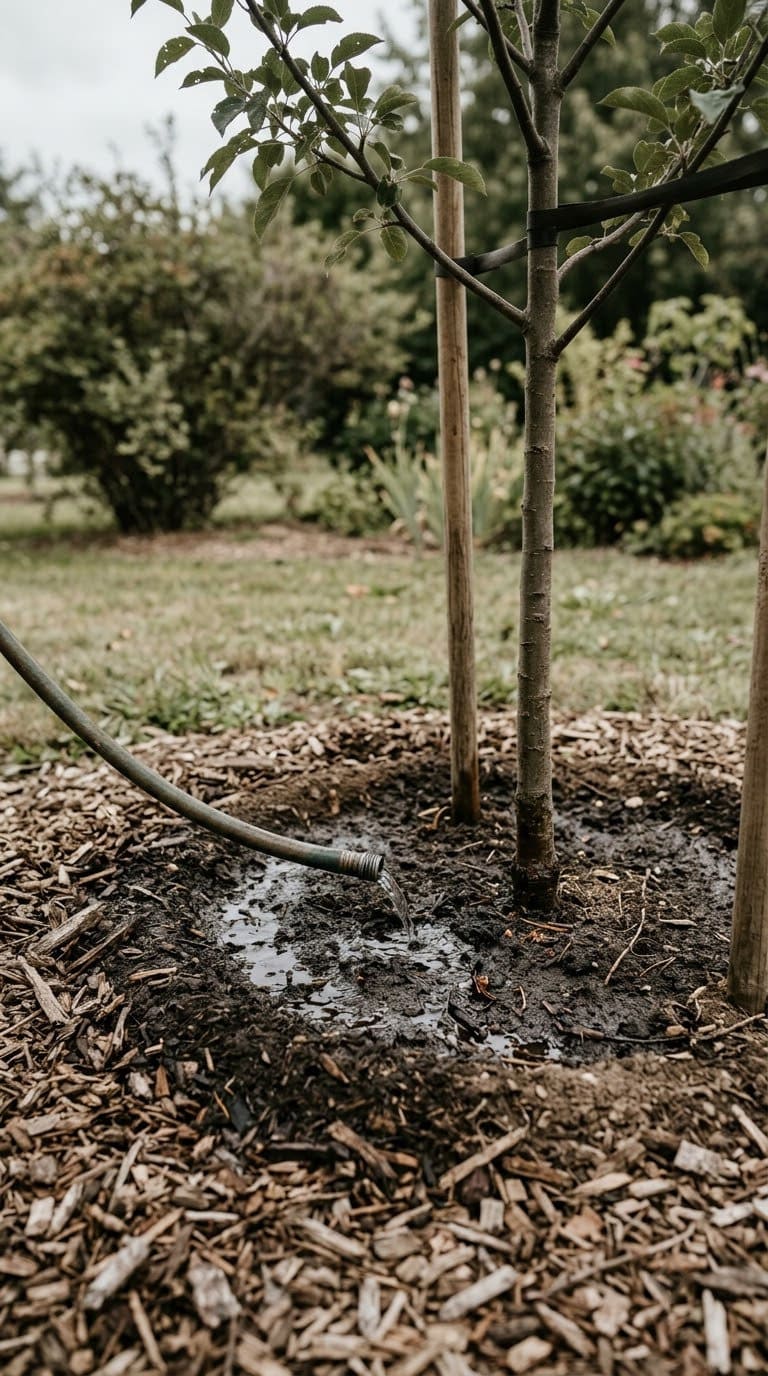
Here is the trap that catches even careful waterers. Water applied to the surrounding soil does not always wet the root ball itself. In clay or compacted sites, water pools around the outside of the ball while the interior stays dry. You can water faithfully every other day and still lose the tree to drought stress from the inside out.
Most yard problems trace back to one specific, fixable cause. Find yours in 4 quick questions.
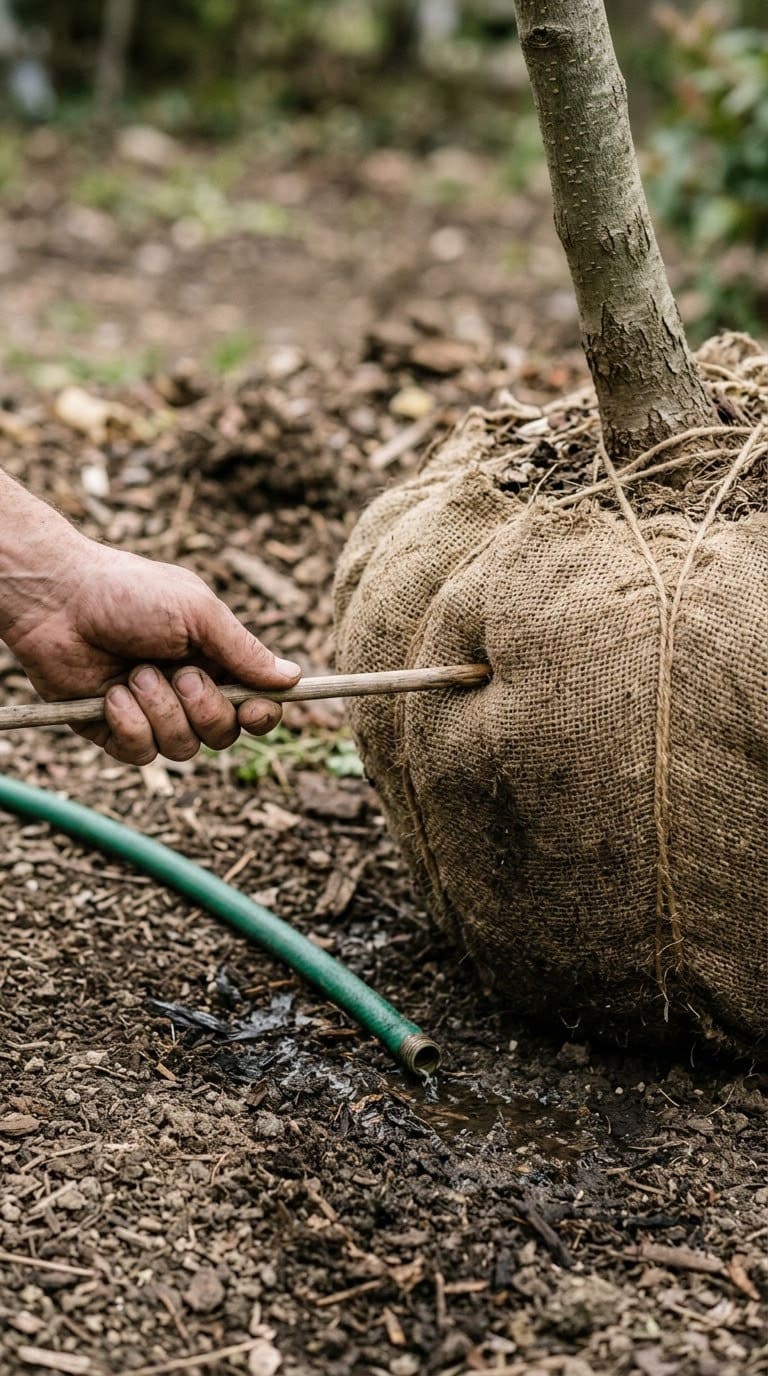
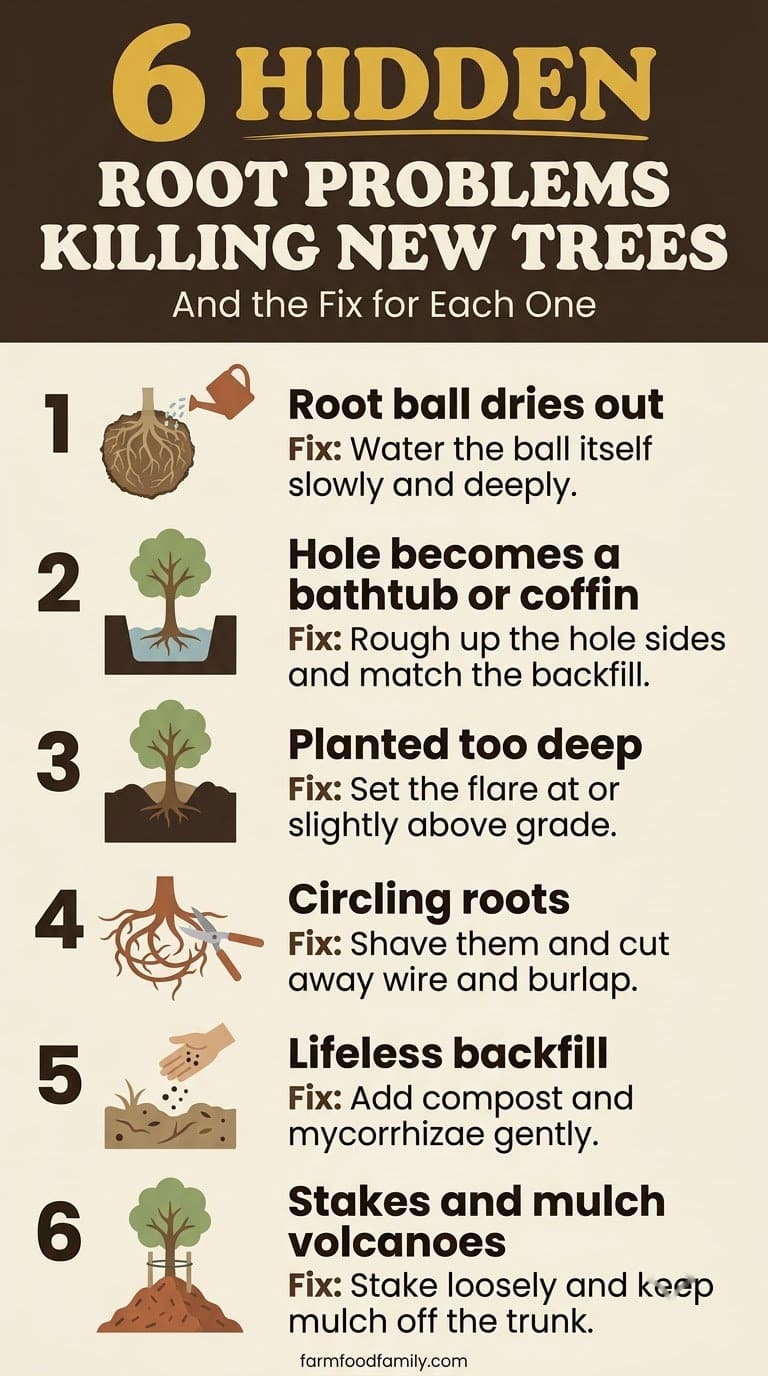
Take the Free QuizThe fix is to water the root ball directly, slowly, and deeply, not the general area around it. A slow trickle at the base for twenty or thirty minutes does more good than a quick soaking of the whole planting area. Check moisture by pushing a finger or a dowel into the ball itself, not the backfill.
How Much Water Does a New Tree Actually Need?
There is no single number that fits every yard. Soil, weather, and tree size all change the answer. Two university extension sources agree on the pattern, though: deep and infrequent beats light and daily.
| Source | What it says |
|---|---|
| Nebraska Extension | About 1 inch of water per week. Wet the top 6 to 8 inches of soil, deeply but not often. Clay soil may need less in cool weather. |
| Purdue Extension | Water deeply and infrequently. Aim for roughly 1 inch per week from rain plus irrigation. |
Our take: use the inch as a ceiling, not a schedule. Push a finger into the ball before you water. If the top few inches are damp, wait a day or two. If they are dry, give it a long, slow soak.
Frequent shallow watering trains roots to stay near the surface, which is the opposite of what a new tree needs. A tree with deep roots handles a dry August far better than one that was sprinkled every morning.
The Planting Hole Becomes a Bathtub or a Coffin
Soil structure around the root ball matters as much as anything you do above ground. Two opposite failures happen constantly.
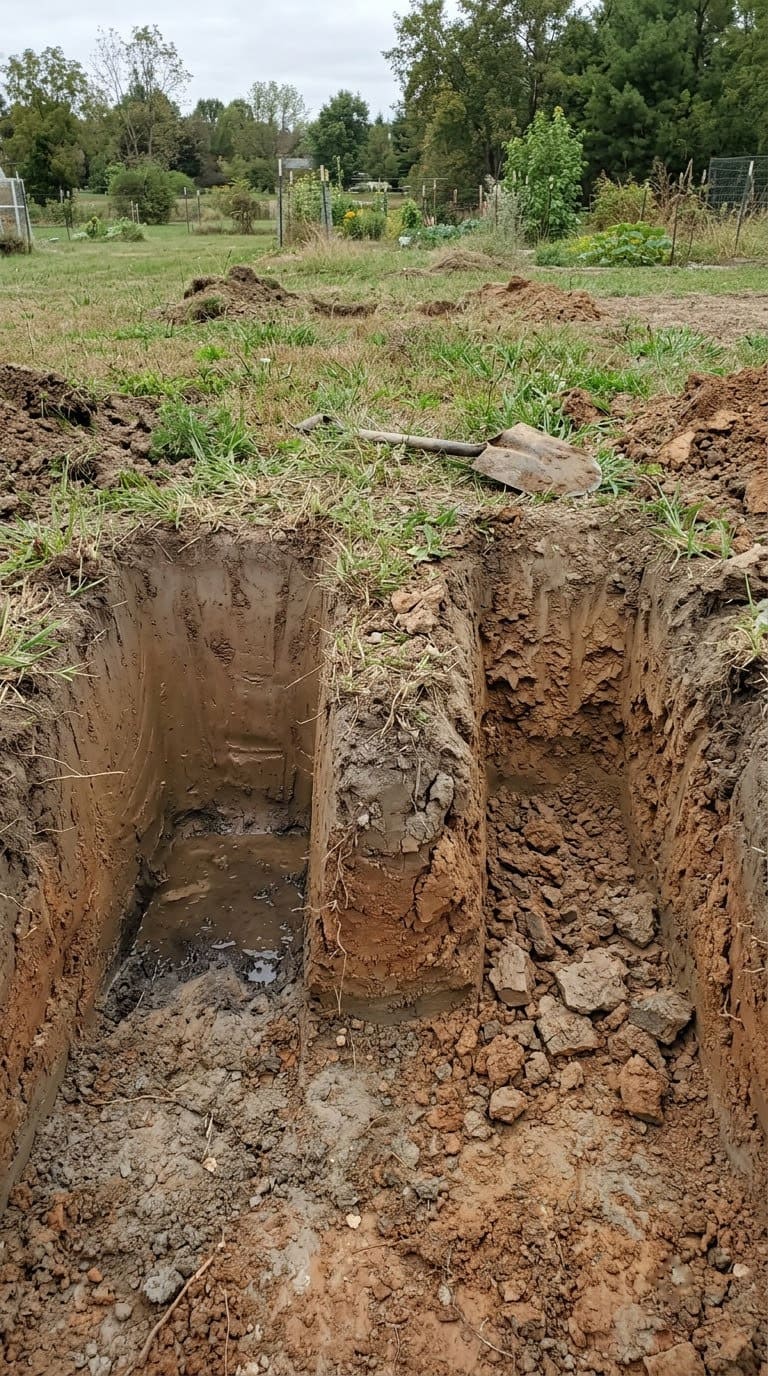
In heavy clay soil, a smoothly dug hole with slick, compacted walls can become a bathtub. Water collects in the hole, oxygen disappears, and roots drown. This is especially common where irrigation runs daily or the site has poor drainage. The tree sits in saturated backfill while the surrounding clay stays firm and dry.
In sandy or fast-draining soil, the opposite happens. Water runs through the backfill and away from the root zone so quickly that the ball never stays moist long enough for roots to establish.
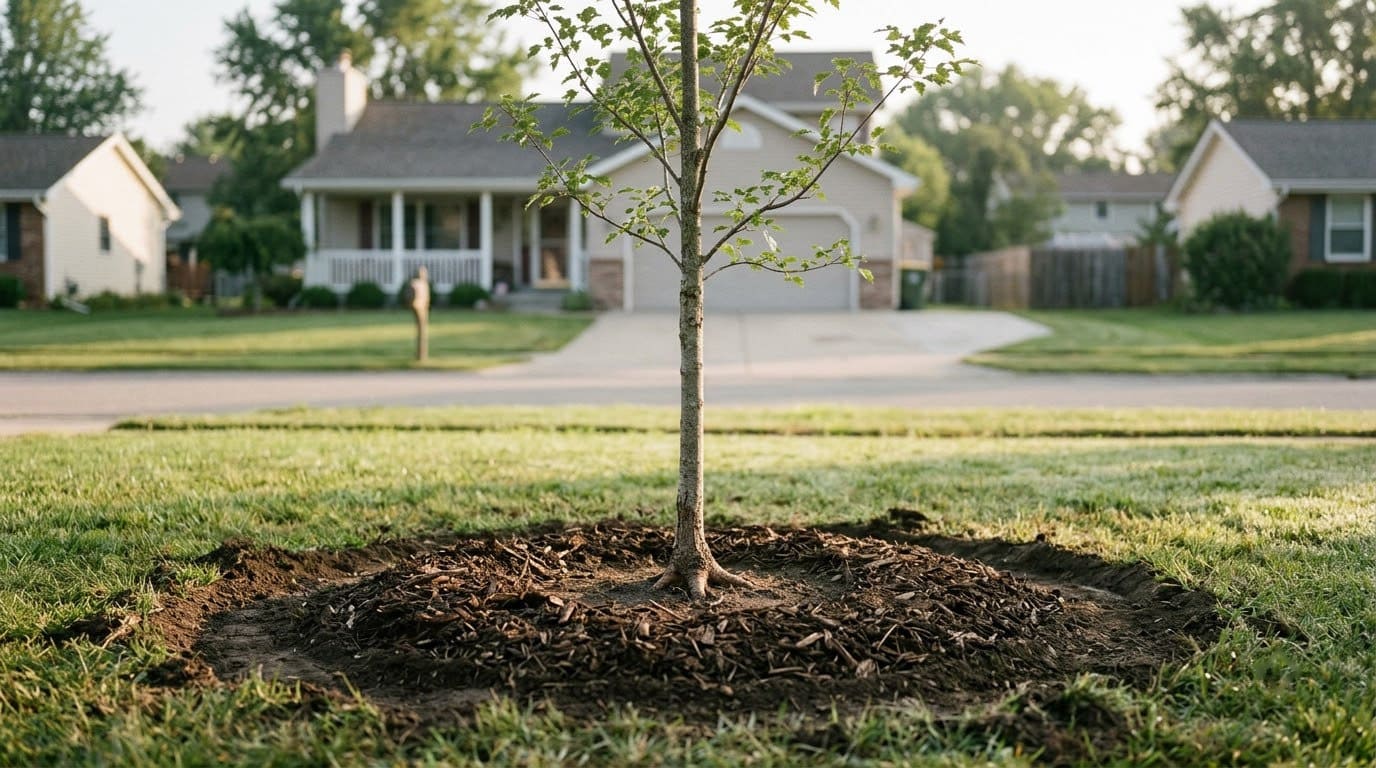
In both cases, the problem is the interface between the backfill and the native soil. Rough up the sides of the hole with a shovel rather than leaving them polished. Amend the backfill so its texture roughly matches the surrounding soil, and never bury a tree in a hole that turns into an underground swimming pool after rain. If drainage is genuinely bad, plant high, with the root ball raised several inches above grade and mulched up to it.


If you are not sure what you are digging into, a short read on choosing the right soil for a landscape project helps you tell clay from loam before you pick up the shovel.
Planted Too Deep: The Silent Killer
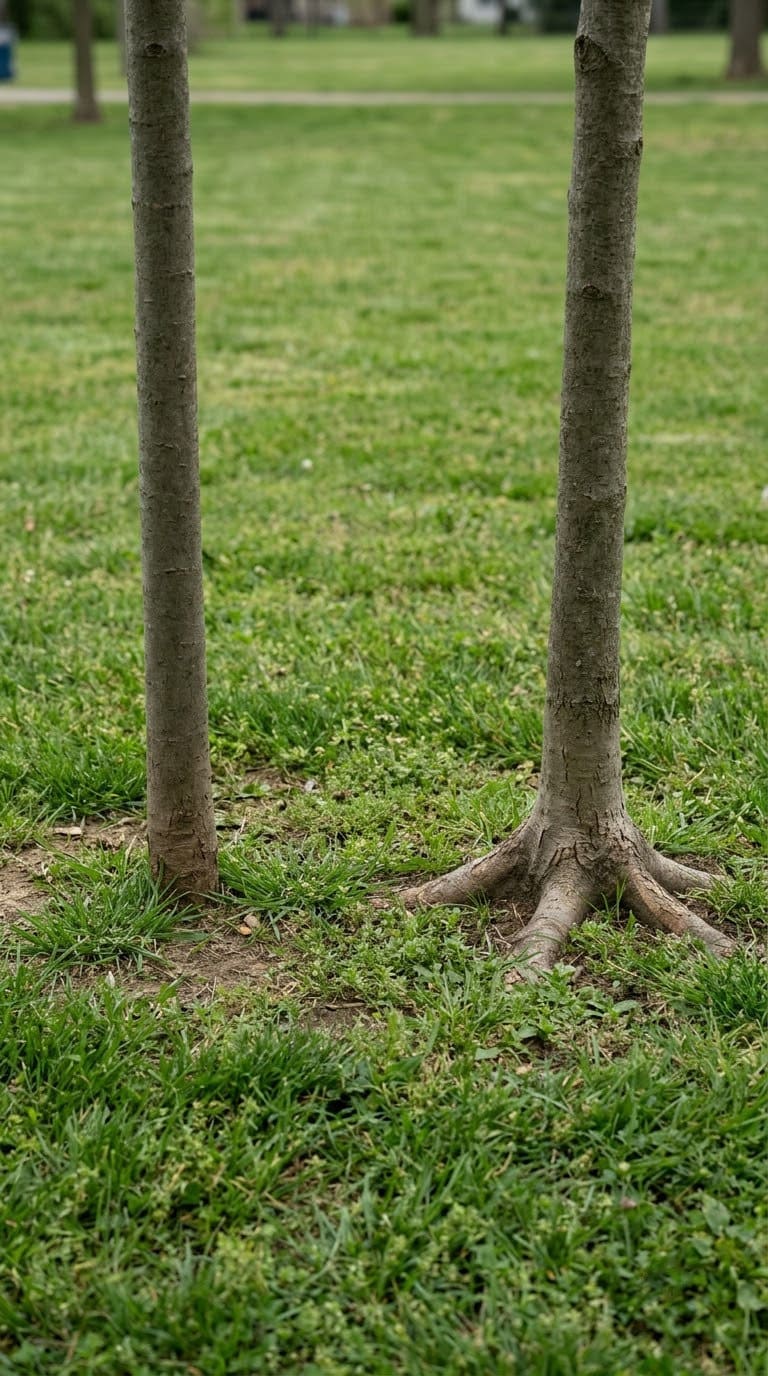
Look at trees dying slowly in parking lots and front yards, and you will often find the same cause. The root flare, the point where the trunk widens and transitions into roots, is buried inches below the soil surface.
Bury the flare and several bad things happen. Bark that was designed to sit in open air is now in constant contact with moist soil. It decays, and decay at the base of a tree is often fatal. Roots that should spread outward instead circle and grow upward, some of them eventually wrapping around the trunk and strangling it. Girdling roots like these can kill a tree ten years after planting, long after anyone connects the death to how it went in the ground.
The average homeowner spends $616/year on yard fixes that don't address the real problem. Find out what yours actually is — before you spend another dollar.
Take the Free QuizNursery stock is frequently already too deep in its container or burlap, with soil heaped over the flare. Planting “as deep as it was in the pot” is often planting too deep. Before backfilling, find the flare by brushing away soil with your fingers, and set the tree so that flare sits at or slightly above the surrounding grade.
How Do You Check Planting Depth in 60 Seconds?
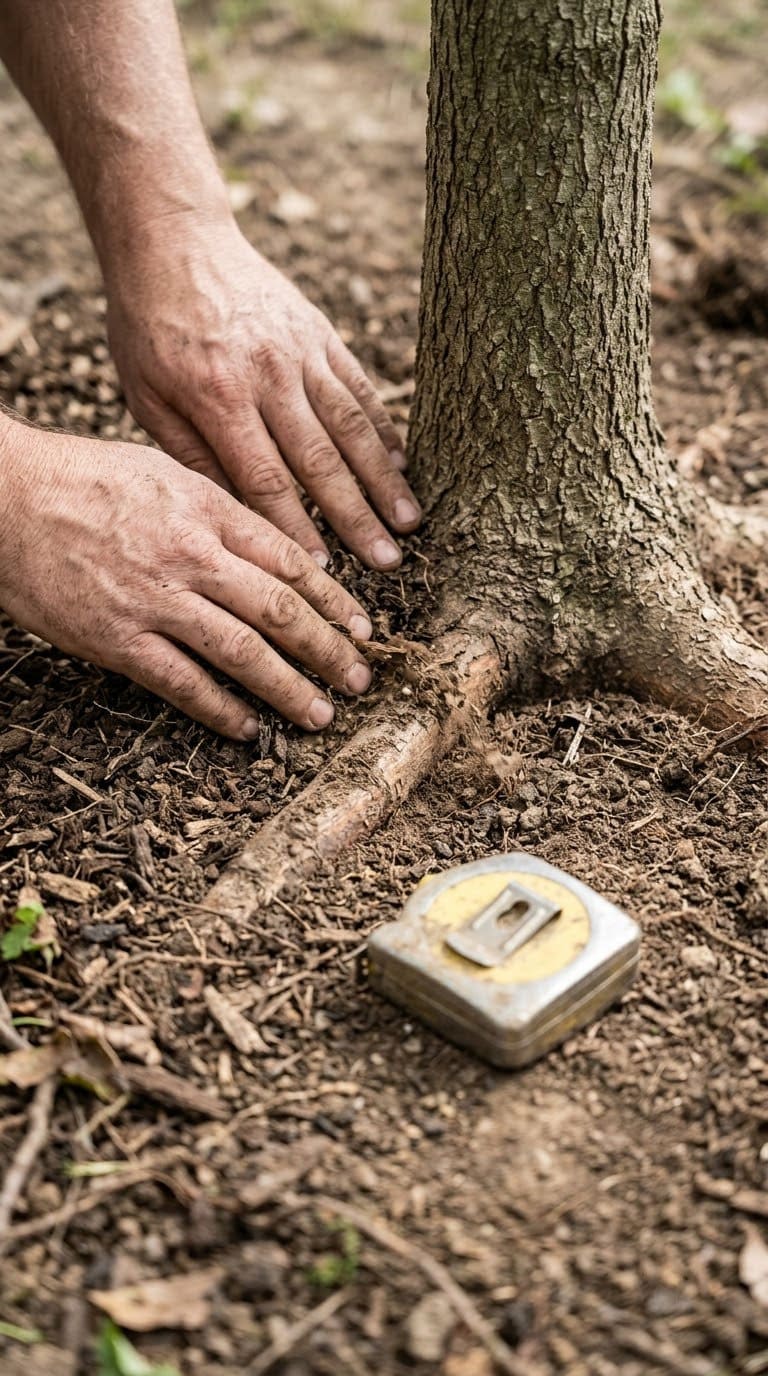
You do not need special tools. A hand and a tape measure are enough.
- Brush the soil off the top of the root ball until you see where the trunk starts to widen.
- Look for the first main root. Nebraska Extension says it should sit just an inch or two below the soil surface.
- Check the trunk sides. If they run straight into the ground like a post, the tree is too deep.
- Dig the hole no deeper than the root ball. Purdue Extension suggests 1 to 1.5 times the root width, and 2 to 3 times in heavy clay.
- Lower the tree by the ball, not the trunk, and set the collar level with or a little above grade.
A deeper hole feels safer, but loose soil under the ball lets the tree settle later and bury its own flare. Firm, undisturbed soil underneath is the better base.
Girdling and Circling Roots From Container Stock
Container-grown trees that sit too long in pots develop circling roots. Left uncorrected, those circles become permanent. As the trunk and roots thicken over the years, a circling root tightens against the trunk like a wire, cutting off the flow of water and nutrients between roots and canopy.
The symptoms are confusing because they show up years later. The tree leafs out late, thins out at the top, and declines gradually, and the owner blames drought, disease, or pests. By the time the problem is visible, correcting it usually requires surgery that the tree may not survive.
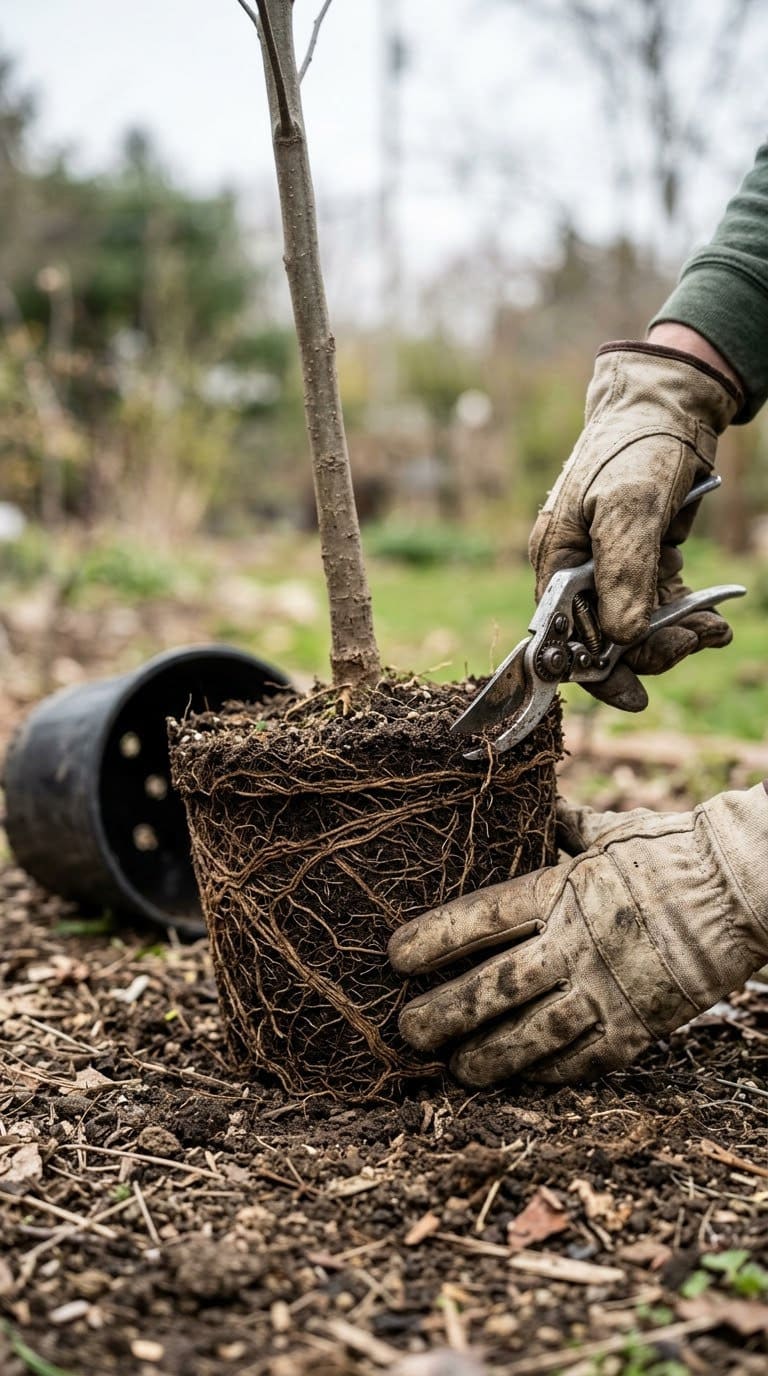
At planting time, the correction is cheap. Prune or shave off the outer circling roots with a sharp blade, or rough up the root ball surface so roots are redirected outward. On balled and burlapped stock, cut away wire baskets and burlap from at least the upper half of the ball. Synthetic burlap and nylon twine never decompose and will strangle roots permanently if left in place.
Nobody Feeds the Soil Life
A transplanted tree does not grow in a vacuum. It depends on soil biology, beneficial fungi, and organic matter in the backfill to help new roots explore and absorb. Sterile, compacted, lifeless backfill slows establishment dramatically.
This is where thoughtful soil preparation earns its keep. Incorporating compost into the backfill, inoculating the root zone with mycorrhizal fungi, and adding gentle organic nutrition gives new roots something to partner with. Mycorrhizae in particular extend the effective reach of a damaged root system, which is exactly what a freshly transplanted tree needs. The key word is gentle. High-salt synthetic fertilizers dumped into a planting hole can burn tender regenerating roots and set the tree back further.
Should You Amend the Planting Hole?
Extension advice on this is more cautious than many garden centers. Purdue Extension recommends backfilling with the native soil from the hole and calls amendments and fertilizers unnecessary.
That does not cancel the point above. It sharpens it. A light mix of finished compost into the same soil you dug out keeps the texture matched to the surrounding ground. A pocket of rich, fluffy soil in the middle of heavy clay does the opposite. It holds water like a bowl and brings the bathtub problem back.
If you make your own, our walkthrough on easy homemade compost shows how to get a finished, crumbly product. For a wider look at prepping a bed or tree site, see our garden soil preparation guide.
Stakes, Straps, and Other Well-Meaning Mistakes
Staking is often done wrong. Strapped too tightly, stakes prevent the natural sway that stimulates trunk taper and root strength. Left on too long, straps girdle the trunk as it grows. Most trees need no staking at all, and those that do should be staked loosely and removed within a year.
Over-mulching is the other common offense. Mulch volcanoes piled against the trunk trap moisture against bark, invite rodents, and starve roots of oxygen. Keep mulch a few inches away from the trunk and spread it out to the drip line instead.
How Should You Mulch a New Tree?
Mulch is one of the cheapest things you can do for a new tree, and one of the easiest to get wrong. Both extension sources keep the numbers simple.
- Depth: 2 to 3 inches of wood chips or similar mulch.
- Width: Out to at least the dripline per Purdue, or at least 2 feet across per Nebraska.
- Gap at the trunk: Pull mulch back 1 to 3 inches so bark stays dry and the flare stays visible.
Mulch also holds water in the root zone, which cuts how often you need to irrigate. Our piece on why mulch earns a place in the garden explains how it helps soil moisture and temperature.
The First Year Sleep, Creep, Leap Pattern
Old nursery wisdom says a tree sleeps the first year, creeps the second, and leaps the third. Transplanted trees spend their initial seasons rebuilding root systems, and top growth lags as a result. A tree that looks stagnant in year one may be perfectly healthy, just busy underground.
That patience only pays off if the root zone is actually being cared for. Consistent moisture at the ball, a flare at grade, corrected circling roots, and living backfill are what carry a tree through that vulnerable first stretch.
Your First-Year Care Calendar
Use this as a quick checklist. It pulls the points above into one place.
| When | What to do | Why it matters |
|---|---|---|
| Planting day | Find the flare, set it at or just above grade, cut circling roots, remove wire and synthetic burlap | Fixes the problems that cannot be fixed later |
| First weeks | Check the ball with a finger or dowel, water slowly at the base | Keeps the ball from drying while roots grow out |
| First growing season | Keep mulch 2 to 3 inches deep and off the trunk, water deeply and not often | Builds deep roots and stops volcano rot |
| After a storm or a dry spell | Check stakes, straps, and ball moisture | Loose ties and dry balls cause quiet damage |
| Within 12 months | Remove stakes and straps | Prevents girdling as the trunk thickens |
For routine pruning, pest checks, and seasonal care after year one, see our general tree care and maintenance guide.
Frequently Asked Questions
How long does transplant shock last?
Plan on one to three growing seasons. The old “sleep, creep, leap” saying describes it well: little top growth in year one, modest growth in year two, and a strong push in year three. A tree that holds its leaves and puts out some new growth is usually recovering.
Can I save a transplanted tree that looks dead?
Sometimes. Scratch a twig and check for green under the bark. Give the tree a full growing season before you decide, since many trees leaf out late after a rough start. If it is truly gone, our dead tree removal cost breakdown helps you plan the next step.
Should I fertilize a newly planted tree?
Not at planting. Purdue Extension calls fertilizer unnecessary in the planting hole, and high-salt products can burn tender new roots. Focus on depth, water, and mulch first.
How wide and deep should the hole be?
Wide and shallow. Purdue Extension suggests 1 to 1.5 times the root width, and 2 to 3 times in heavy clay, but no deeper than the root ball.
Do planting granules replace good planting practice?
No. Products like the planting granules mentioned earlier are meant to support root establishment. They cannot fix a buried flare, a dry root ball, or a circling root.
The Takeaway
Trees rarely die from a single dramatic mistake. They die from quiet root zone problems that compound over months: a buried flare, a root ball that dried out once in July, a planting hole that never drained, a strap left on for three years. The good news is that every one of these failures is preventable at planting time, usually with a few minutes of extra attention rather than extra money.
Plant at the right depth, rough up the hole, correct the roots, water the ball itself, and give the root zone the biological support it needs. Do that, and the tree you plant this season will still be shading your yard decades from now.
Never miss an update — choose FarmFoodFamily as your preferred source on Google.
How it works: Tap the button below to open Google's settings page, then check the box next to FarmFoodFamily.
Tap the checkbox to turn it blue — that's how you know it's set.