Aship Shoe Washing Machine Bag Review: The Clever Fix for Scrubbing Sneakers by Hand
The Aship Shoe Washing Machine Bag lets you deep-clean sneakers in the washer without scrubbing, as long as your shoes are canvas or mesh and you skip the dryer afterward.

Never miss an update — choose FarmFoodFamily as your preferred source on Google.
How it works: Tap the button below to open Google’s settings page, then check the box next to FarmFoodFamily.
Tap the checkbox to turn it blue — that’s how you know it’s set.
If you have ever spent twenty minutes hunched over the bathtub with an old toothbrush, trying to get the gray scuff off a pair of white sneakers, you already understand the pitch behind a shoe washing bag. You put the shoe in a padded, fiber-lined pouch, zip it shut, and let the washing machine do the scrubbing for you. No bent back, no splashing, no soaked sleeves.
The Aship Shoe Washing Machine Bag is one of the more popular versions of this idea. It sells as a two-pack, it holds a 4.5-star average across nearly a thousand ratings, and the brand leans hard on one number: 20,000-plus “fluffy fibers” lining the inside of each bag. We looked at what those fibers actually do, how much shoe you can fit, and whether the before-and-after holds up.
- All-over fiber contact does real scrubbing work, hands-free
- Large enough for adult men's sneakers, unlike many shoe bags
- Side zipper with a tuck-away band is easy to load and stays shut
- Heavy chenille resists matting, so it keeps working over many washes
- Muffles the drum-banging noise and protects both shoe and machine
- Two-pack allows proper washer balance and one-shoe-per-bag deep cleans
- Doubles as a travel shoe pouch when not in laundry use
- Coil zipper is the likeliest long-term weak point, so treat it gently
- Not a fix for oil, grass, or deeply set stains without pre-treatment
- Does little for the hard rubber sole edge
- Sheds loose fiber on the first wash until you pre-rinse it
- Useless for the leather and suede shoes some buyers hope to clean
We earn a commission, at no additional cost to you.
Quick Answer
The Aship Shoe Washing Machine Bag is worth buying if you regularly wash canvas, knit, or mesh sneakers and you are tired of hand-scrubbing them. The chenille fiber lining rubs the whole surface of the shoe as the drum turns, so lightly to moderately dirty sneakers come out noticeably cleaner with zero manual effort. The padded walls also cut the banging noise and protect both your shoes and your drum. The bag is large, 15 inches long and 7.1 inches across, fits one pair per pouch, and the tuck-away side zipper is a real improvement over older top-zip designs. It will not work miracles on ground-in mud, deep oil stains, leather, or suede, and the shoes still need to air dry for a day afterward. For the price of a two-pack, it costs less than one professional sneaker cleaning.

Rating Details
| Criteria | Score |
|---|---|
| Cleaning Performance | 8.5 / 10 |
| Durability | 8.0 / 10 |
| Capacity & Fit | 8.5 / 10 |
| Value | 9.0 / 10 |
| Overall | 8.5 / 10 |
Aship Shoe Washing Machine Bag at a Glance
| Spec | Detail |
|---|---|
| Pack size | 2 bags |
| Bag dimensions | 15 in long x 7.1 in diameter |
| Outer wall material | Chenille, roughly 1,450 gsm, pile about 1.2 in long |
| End panels | Sandwich / air mesh (lets soapy water flow through) |
| Closure | Invisible side zipper with elastic tuck-away band |
| Capacity | 1 pair per bag, or 1 shoe per bag for a deep clean |
| Extras | Top strap for hang-drying, doubles as a travel shoe pouch |
| Reusable | Yes, rated for repeated washes |
Who it is for: anyone with kids’ sneakers, gym shoes, canvas slip-ons, or knit running shoes that get dirty faster than you want to hand-wash them. Who should skip it: people whose main problem is leather boots, suede, or dress shoes. None of those belong in a washing machine in the first place, per Whirlpool’s guidance on machine-safe shoe materials.
What Is the Aship Shoe Washing Machine Bag?
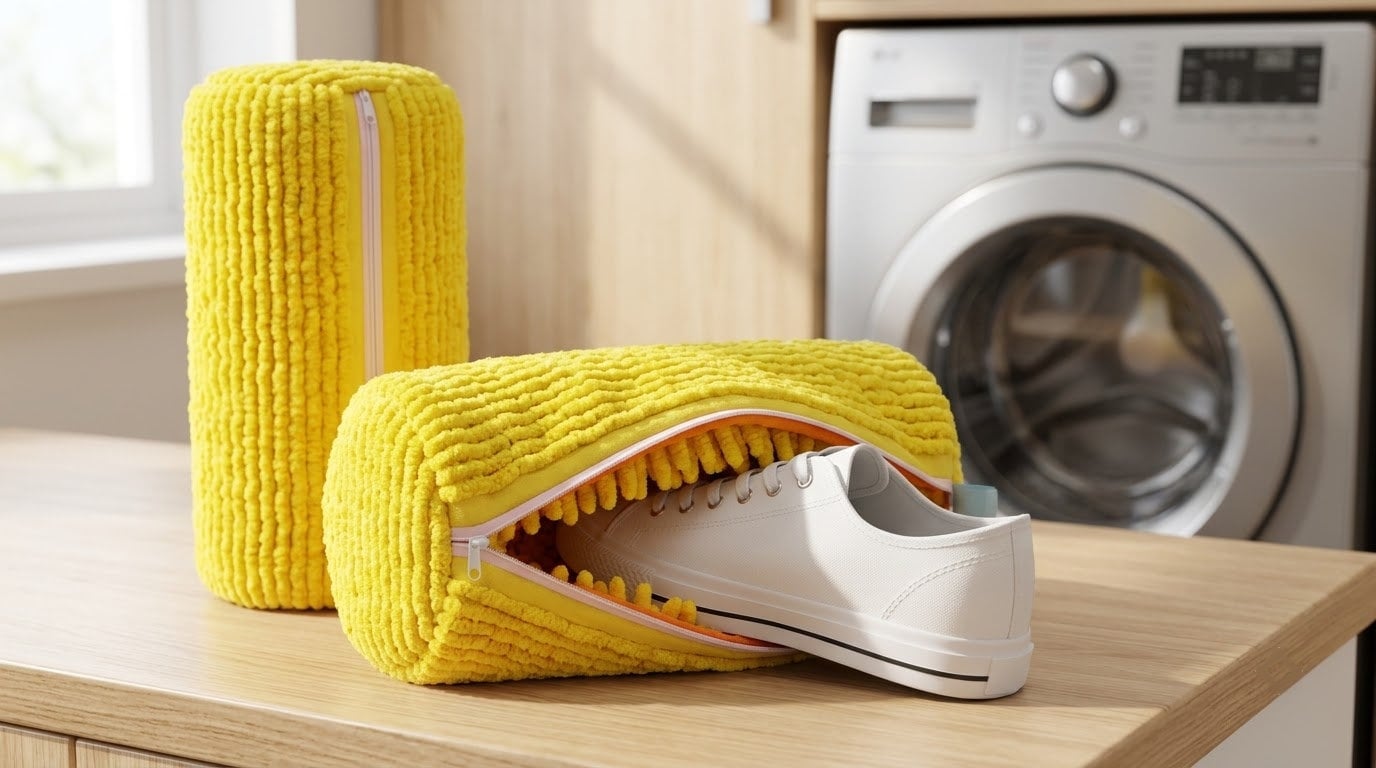
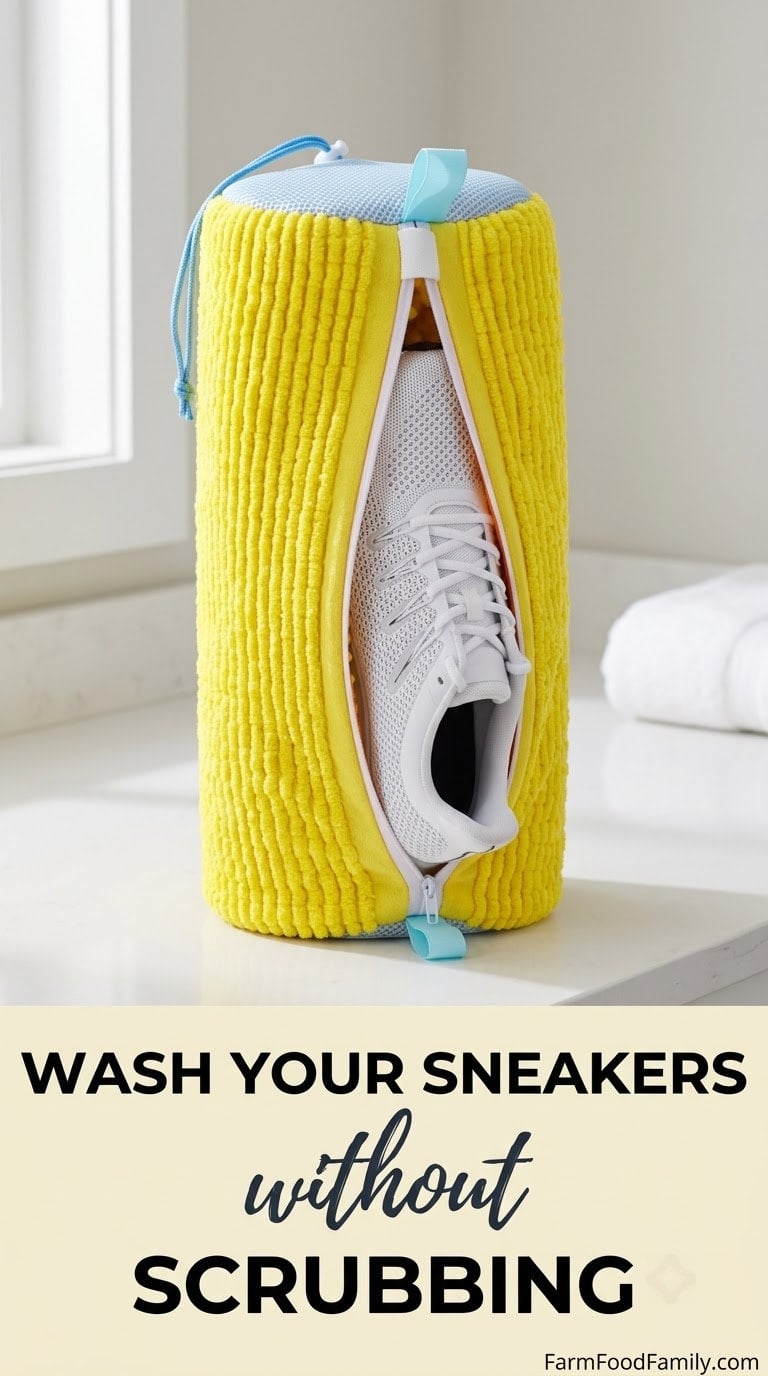
It is a cylindrical zip pouch, about the size of a large water bottle, that goes into your washing machine with the shoes inside. The difference between this and a plain mesh laundry bag is the lining.
The side walls are chenille, a fabric with thousands of short, soft yarn tufts standing up off the backing, like a very dense towel. Aship quotes more than 20,000 of these fiber columns per bag, each about 1.2 inches long.
As the drum tumbles, those fibers drag across the shoe from every angle. That is the “360 degree” claim in plain terms, and the fibers hold detergent and water against the surface to provide the gentle scrubbing you would otherwise do by hand. The top and bottom of the bag are a stiffer sandwich mesh, which lets soapy water pass in and out freely.
The padding does a second job. A pair of sneakers loose in the drum bangs against the glass and the paddles for the whole cycle. Inside a thick fiber bag, that impact is muffled, which is easier on your shoes, your machine door, and anyone in the next room.
There is also a detail that sounds minor until you use it. The zipper is on the side, not the top, and it tucks under an elastic band once closed.
Older shoe bags use a top zipper that is fiddly to load and can work itself open. The side opening on the Aship bag makes it easy to push a shoe in flat, and the hidden zip stays put.
Build Quality and Durability

The chenille Aship uses is heavy. At roughly 1,450 grams per square meter, it is closer to a bath mat than a washcloth. That weight is what lets the fibers keep their shape and keep scrubbing wash after wash instead of matting flat after a month.
Two things tend to fail first on any shoe washing bag: the zipper and the stitching where the mesh panel meets the fabric wall. On the Aship, the zipper is a conventional coil zip, not a chunky molded one, so it is the part we would watch.
The brand’s own advice helps here. Aship says to run the bags through an empty pre-wash before first use to shake out loose fiber shedding, and to keep the water cold.
Cold water is standard advice for washing shoes anyway, because heat softens the glue that holds a sneaker together, as ARM & HAMMER notes in its shoe-washing guide. Cold washing also puts less stress on the bag itself.
Treated gently, a well-made shoe bag of this type lasts for a few hundred cycles, which for most households is years. The failure mode to avoid is overstuffing. Forcing two pairs into one bag strains the zipper and stops the fibers from reaching the shoe.
Quick tip: after the wash, hang the bags by the top strap and let them dry fully before folding them away. Storing a damp chenille bag in a drawer is how you get a musty smell and, eventually, mildew on the fibers.

Size and Capacity: How Many Shoes Fit?
Each bag is 15 inches long and 7.1 inches in diameter, which Aship correctly describes as larger than most competing bags. In real terms:
- One adult pair per bag is the normal load. A men’s size 12 running shoe fits with room to spare. Bulky basketball shoes or chunky “dad” sneakers also fit, though they fill the bag more completely.
- One shoe per bag is the option for a deeper clean. With a single shoe, the fibers wrap the entire surface and nothing is shielded by a second shoe pressed against it. Because the set includes two bags, you can still do one pair at a time this way.
- Kids’ shoes can double up. Two pairs of small children’s sneakers fit comfortably in one bag.
The two-bag set is the right call for washer balance. Two loaded bags on opposite sides of the drum, plus a few towels, keeps the machine from going off-balance during the spin. One lone bag thumping around a big drum is louder and spins unevenly.
What does not fit: tall boots, cleats, and anything over about a US men’s 14. The bag is built around the sneaker and casual-shoe shape.
Cleaning Performance: Before and After

This is the part that matters, so we will be specific about what changes and what does not.
What comes out looking genuinely better:
- Surface grime and gray dinginess on canvas and knit uppers. This is the bag’s strong suit. The all-over fiber contact lifts the dull film that builds up on white and light-colored fabric shoes.
- Dust, dried dirt, and light mud that has not been ground in. A quick knock-off of loose dirt before the wash, then one cycle, and it is gone.
- Smell. Between the detergent and a half cup of baking soda in the drum, gym-shoe odor drops sharply. Washing the removable insoles by hand at the same time finishes the job.
- Laces. Toss them in the second bag and they come out white again instead of tangling around the agitator.
What still needs pre-treatment or hand work:
- Deep or oily stains, grass stains, and set-in scuffs. The bag provides gentle friction, not a targeted scrub. Hit these spots with a sneaker cleaner and a brush first, then let the machine handle the rest of the shoe.
- Rubber midsoles and outsoles. The fibers clean the upper well but do less for the hard rubber sole edge. A quick pass with a melamine sponge afterward closes that gap.
- Suede, leather, and anything with beading or glued-on decoration, which should never go in a washing machine regardless of the bag.
The Before-and-After, in Plain Terms
| Shoe condition going in | Result after one cycle in the bag |
|---|---|
| White canvas sneakers, gray and dingy all over | Close to new, the dull film is gone |
| Kids’ mesh sneakers with dried playground dirt | Clean, a light pre-knock of loose dirt helps |
| Knit runners with sweat salt and odor | Odor mostly gone, salt lines cleared |
| Sneaker with one deep grass or oil stain | Whole shoe cleaner, but the stain needs pre-treatment |
| Muddy shoe straight from the yard, mud still wet | Rinse and scrape the worst off first, then wash |
And the honest summary is this. For the everyday case, a fabric sneaker that has just gotten dull and grubby, the before-and-after is impressive and takes about two minutes of your active time. For a rescue job on a badly stained shoe, the bag is one step in the process, not the whole process.

How to Use It Without Wrecking Your Shoes
The bag removes the scrubbing, but the rest of the standard shoe-washing routine still applies. This sequence follows the guidance published by Whirlpool and ARM & HAMMER:
- Check the shoe. Canvas, cotton, nylon, and polyester are machine-safe. Leather, suede, rubber clogs, vinyl, and cleats are not.
- Pull the laces and insoles. Laces go in the second bag. Insoles get washed by hand and air-dried separately, because the machine leaves them waterlogged for days.
- Knock off loose dirt with a dry brush, and pre-treat any specific stains.
- Load one pair per bag, zip it, and tuck the zipper under the elastic band.
- Add two or three old towels to the drum for balance and extra scrubbing action.
- Run a delicate or hand-wash cycle, cold water, low or no spin. Use liquid detergent, not powder, plus optional baking soda for odor. A full cycle runs about 45 minutes to an hour.
- Air dry only. Never put the shoes in the dryer, because the heat warps soles and melts glue. Stuff them with paper and set them near a fan or an open window, out of direct sun, for at least overnight.
Quick tip: run the empty bags through one wash before their first real use. They shed a little loose fiber at first, and you do not want that landing on a load of dark clothes later.
What We Like
- All-over fiber contact does real scrubbing work, hands-free
- Large enough for adult men’s sneakers, unlike many shoe bags
- Side zipper with a tuck-away band is easy to load and stays shut
- Heavy chenille resists matting, so it keeps working over many washes
- Muffles the drum-banging noise and protects both shoe and machine
- Two-pack allows proper washer balance and one-shoe-per-bag deep cleans
- Doubles as a travel shoe pouch when not in laundry use
What We Don’t Like
- Coil zipper is the likeliest long-term weak point, so treat it gently
- Not a fix for oil, grass, or deeply set stains without pre-treatment
- Does little for the hard rubber sole edge
- Sheds loose fiber on the first wash until you pre-rinse it
- Useless for the leather and suede shoes some buyers hope to clean
What We Learned the Hard Way
A shoe washing bag fails people for predictable reasons, and almost all of them come down to expecting the bag to replace the whole routine.
The first mistake is skipping pre-treatment and then blaming the bag. The fiber lining gives even, gentle friction across the whole shoe, but it does not concentrate force on one stubborn spot the way your thumb and a brush do. If a shoe has one obvious stain, spend thirty seconds on that spot with a cleaner before it goes in.
The second is the dryer. It is tempting, because the shoes come out damp and you want them back today. But heat is what destroys sneakers, softening the adhesive that holds the sole to the upper and stiffening the fabric, which is why every appliance and detergent maker says to air dry only.
The third is overloading. Cramming two pairs into one bag feels efficient but produces a worse result on both counts: a weaker clean because the fibers cannot reach the shoes, and a strained zipper that will eventually split. One pair per bag, every time.
The fourth is water temperature. Hot water seems like it should clean better, but on shoes it does the opposite kind of favor, loosening glue and setting some stains. Cold and gentle is correct, and it is also easier on the bag.
Do those four things and the bag delivers. Ignore them and you will be back at the bathtub with the toothbrush, telling people shoe bags do not work.

How It Compares to Hand-Scrubbing and a Bare Drum
| Method | Effort | Cleaning result | Risk to the shoe |
|---|---|---|---|
| Hand-scrubbing in a sink | High, 15 to 25 minutes per pair | Best for targeted stains, uneven on large surfaces | Low |
| Shoes loose in the washer | Low | Decent, but no scrubbing action | High: banging, possible drum damage, faster wear |
| Plain mesh laundry bag | Low | Mild, protects the shoe but adds no cleaning | Medium: still knocks around |
| Aship fiber shoe bag | Low, about 2 minutes active | Strong on all-over grime, weak on set-in stains | Low: padded, quiet, drum-safe |
For most people the fiber bag is the best trade of effort for result. Serious sneakerheads restoring a prized pair will still hand-clean. Everyone washing the family’s everyday shoes is better served letting the machine and the bag do it.
If you are rethinking your whole entry area while you are at it, the site’s rundown of ways to keep shoes tidy by the door and its larger set of shoe storage solutions pair well with a regular wash routine. There is also a collection of laundry shortcuts worth stealing and a broader guide to deep-cleaning the parts of the house that get skipped. For anyone who tracks in dirt from the garden, the roundup of footwear made for working outside covers shoes built to be hosed off, and our hands-on review of Hisea’s rain boots follows the same test-it-ourselves approach as this one.
Frequently Asked Questions
How many shoes fit in one Aship bag?
One adult pair per bag is the standard load, and a men’s size 12 fits easily. For a more thorough clean you can put a single shoe in each bag, and because the set has two bags you can still wash a full pair that way. Small kids’ sneakers can go two pairs to a bag.
Will the bag damage my washing machine?
No, and it is gentler than washing shoes loose. The padded chenille walls absorb the impact that would otherwise have your shoes slamming the drum and door, and the side zipper tucks under an elastic band so it cannot scratch anything. Run a delicate cycle with a low or no spin.
Do shoes actually come out clean, or just less dirty?
Fabric sneakers with all-over grime or a gray, dingy look come out genuinely clean, close to new, with no scrubbing from you. Shoes with a specific deep stain, oil, or ground-in mud come out cleaner overall, but the stain itself needs pre-treatment with a brush and cleaner first.
Can I put the shoes in the dryer afterward?
No. Dryer heat softens the glue that holds a sneaker together and can warp the sole and shrink the fabric. Air dry only: stuff the shoes with paper, keep them out of direct sun, and allow at least overnight, usually a full day or two.
What shoes should never go in the bag?
Leather, suede, vinyl, rubber clogs, shoes with cleats, and anything with beading, sequins, or glued-on decoration. None of these belong in a washing machine even inside a protective bag. Stick to canvas, cotton, nylon, and knit or mesh synthetics.
Does the bag shed fiber into my other laundry?
A little, on the first use. Run the empty bags through one wash cycle before you use them for shoes and the shedding mostly stops.
The Verdict
The Aship Shoe Washing Machine Bag does the specific job it claims. It turns sneaker washing from a fifteen-minute scrubbing chore into a two-minute load-and-go, and the heavy chenille lining is the real feature, not marketing, because that all-over fiber contact is what actually cleans the shoe while protecting it and quieting the machine.
It is large enough for adult shoes, the side zipper is a genuine design improvement, and the two-pack is priced well below a single professional cleaning.
Go in with the right expectations. This is a tool for keeping fabric sneakers looking good with regular, low-effort washes, not a stain-removal miracle, and it does nothing for leather or suede. Within those limits, it earns its spot in the laundry room.
Never miss an update — choose FarmFoodFamily as your preferred source on Google.
How it works: Tap the button below to open Google's settings page, then check the box next to FarmFoodFamily.
Tap the checkbox to turn it blue — that's how you know it's set.