How to Landscape a Narrow Backyard: 8 Designer Tricks That Beat the “Bowling Alley” Look
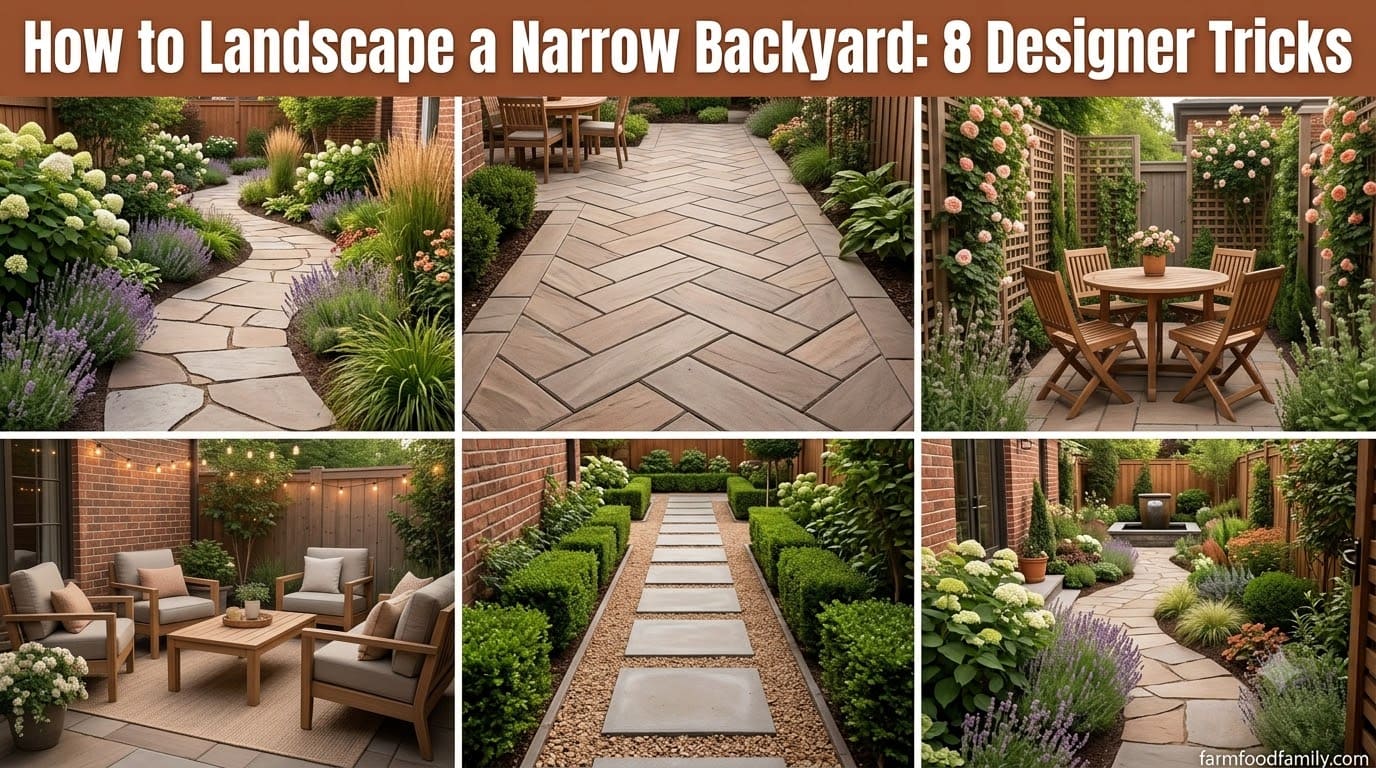
The problem with most narrow backyards isn’t the width, it’s a straight line running down the middle of it, and these 8 tricks fix exactly that.

Never miss an update — choose FarmFoodFamily as your preferred source on Google.
How it works: Tap the button below to open Google’s settings page, then check the box next to FarmFoodFamily.
Tap the checkbox to turn it blue — that’s how you know it’s set.
You already know your backyard is narrow. What you might not know is why it feels even narrower than it actually is. It usually isn’t the fence lines. It’s a straight path or a strip of lawn running dead-center from the house to the back fence. That’s the exact layout that creates what designers call the “bowling alley” effect: a space that feels like a chute you walk through, not a yard you spend time in.
The good news is this is a layout problem, not a size problem. Layout problems have layout fixes. Here are 8 techniques real landscape designers use to break the bowling-alley effect. None of them require adding a single square foot of land.
You don’t need all 8 at once, either. Most narrow backyards see a real, visible difference from just two or three of these tricks used together, usually the path (Trick #1), one zone or planting change (Trick #3 or #5), and whichever material or lighting fix suits the yard’s actual shade pattern. Treat the full list as a menu, not a checklist you have to clear before the yard “counts” as fixed.
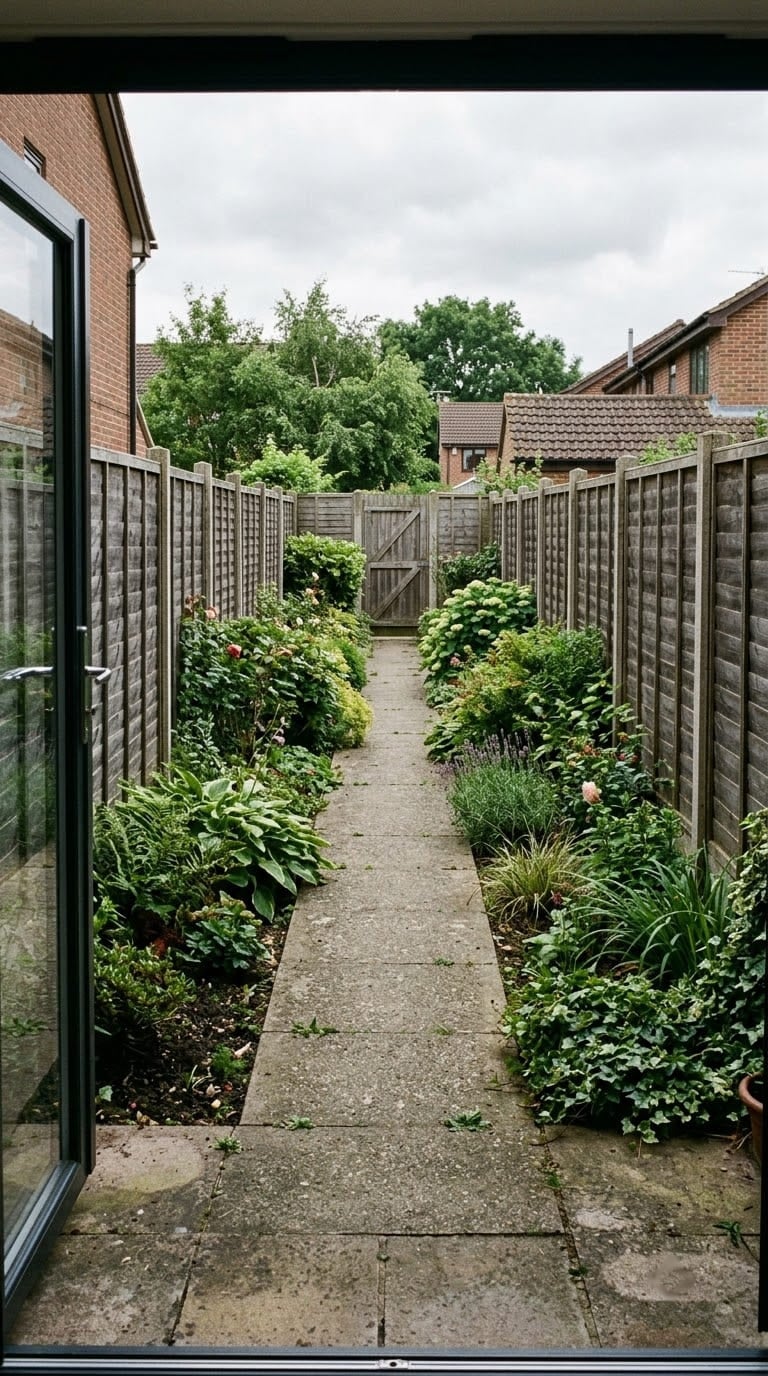
Quick Answer: A narrow backyard reads as a “bowling alley” when a straight path or strip of lawn runs dead-center from house to fence, with nothing to break the view. Designers fix this with 8 techniques. Curve or offset the main path instead of running it straight. Lay hardscape on a 30-to-70-degree diagonal. Divide the yard into zones instead of one long stretch. Use tall plants to break the “tunnel ceiling” feeling. Stagger planting beds so the eye moves side to side, not straight down the middle. Choose light-reflective materials to open up a shaded space. Screen the far fence line so the eye stops before it. And add one overhead structure at a zone transition to break the vertical tunnel. None of it needs more land, just a different layout.
At a Glance: The 8 Designer Tricks
| # | Trick | What It Fixes |
|---|---|---|
| 1 | Curve or offset the main path | Straight sightline that creates the tunnel feeling |
| 2 | Lay hardscape on a diagonal | Rigid parallel-fence-line layout that emphasizes narrowness |
| 3 | Divide the yard into zones | One long undifferentiated strip with no destination |
| 4 | Add tall vertical plants | The “low ceiling” feeling of two close fence lines |
| 5 | Stagger planting beds side to side | A flat, symmetrical corridor with nothing to look at |
| 6 | Use light-reflective materials | A dark, closed-in feeling in a shaded narrow space |
| 7 | Screen the far fence line | An abrupt dead-end that shortens the sense of depth |
| 8 | Add one overhead structure | An open vertical tunnel with no sense of enclosure or “room” |
Trick #1: Curve or Offset the Main Path
A straight concrete path down the center of a narrow yard is the single biggest cause of the bowling-alley look. It draws the eye in one uninterrupted line straight to the back fence and tells your brain exactly how narrow the space is in about half a second.
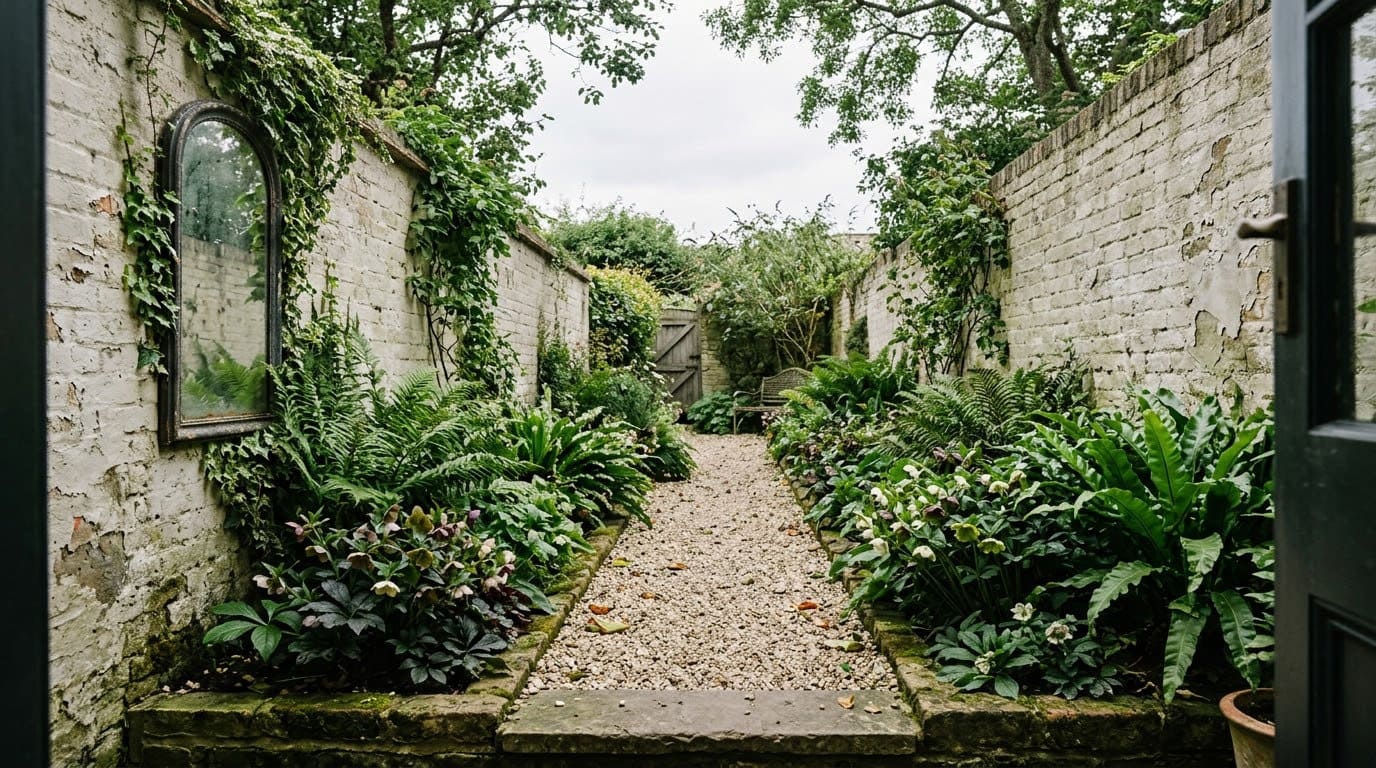
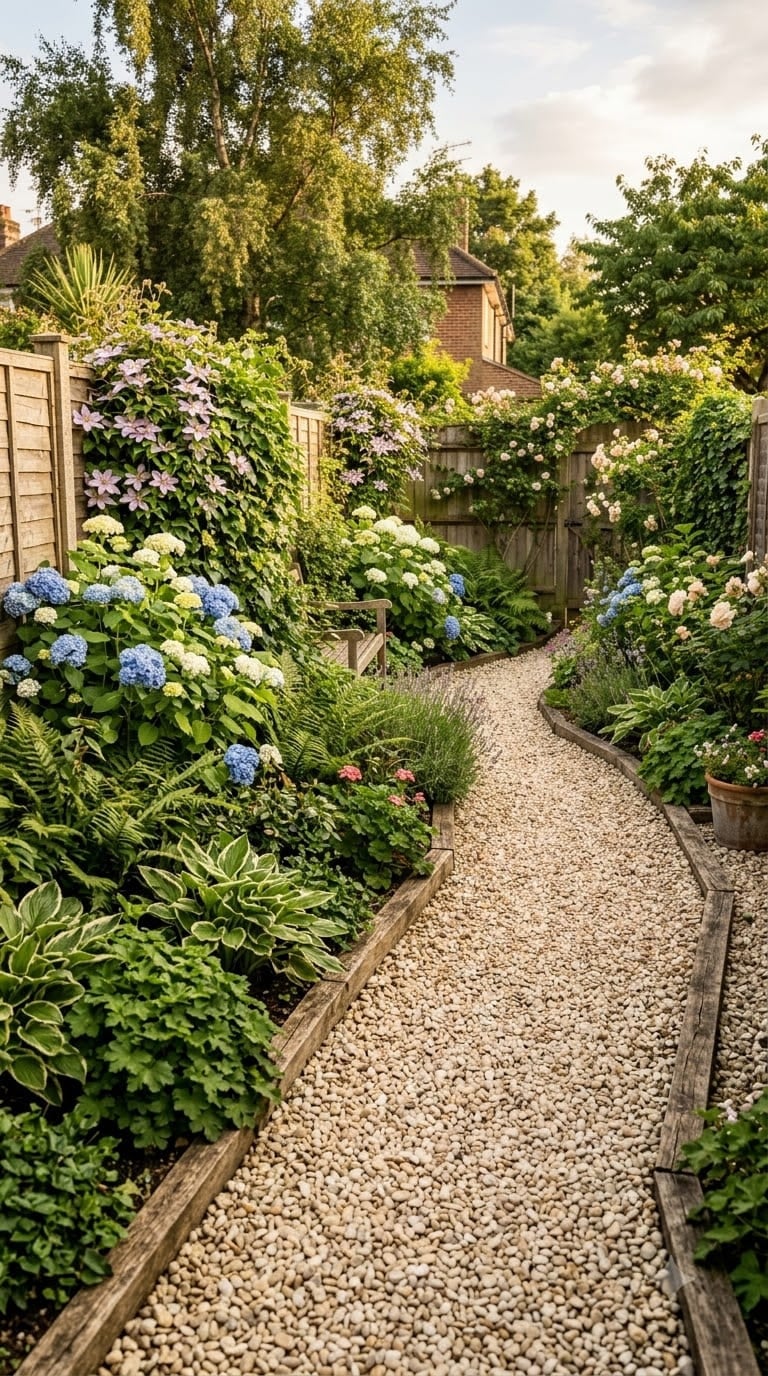
British designer Tom Hoblyn recommends the opposite for long, narrow gardens: “an offset winding path in a pale sand or gravel tone.” It draws attention away from the straight boundary lines and turns the walk into a meandering journey. Even a gentle curve, not a dramatic zigzag, is usually enough to break the tunnel effect.
Answer 4 quick questions and get matched to the exact fix for your yard — drainage, budget, layout, or something else entirely.
Take the Free QuizQuick tip: If you’re offsetting an existing straight path rather than building new, you don’t need to rip it out. Add a planting bed that eats into one side of it at an angle, so the walkable line curves around the bed instead of running dead straight. It’s a fraction of the cost of a full path replacement and does most of the same visual work.
Trick #2: Lay Hardscape on a Diagonal
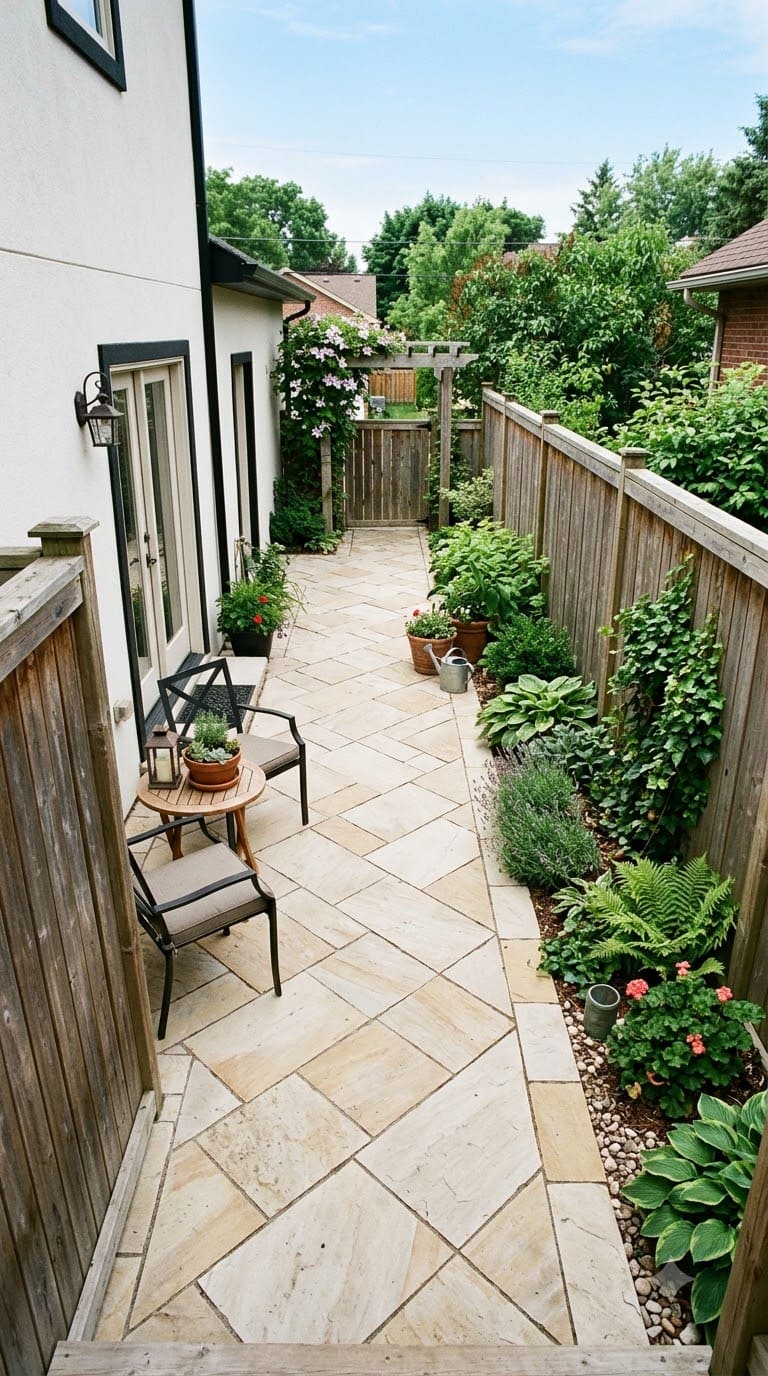
Every fence, wall, and straight path in a narrow yard runs parallel to the same two boundary lines. That reinforces exactly how narrow the space is at every glance. Shifting a patio, path, or bed to an angle breaks that repetition.
San Francisco firm Arterra Landscape Architects used a 62-degree diagonal layout on a real narrow-lot project. It directs the eye and makes the space read as wider than it is. The rule of thumb: keep the angle between 30 and 70 degrees off the house line. Keep any other diagonal lines parallel or perpendicular to that first one, not scattered at new angles.
Quick tip: Mock up the angle with string and stakes before committing to a poured or paved surface. Stand at the patio door, the spot you’ll see the yard from most, and check whether the angle actually reads as intentional from that specific viewpoint. An angle that looks great from the side fence can look accidental from the one window you actually look through every day.
Trick #3: Divide the Yard Into Distinct Zones
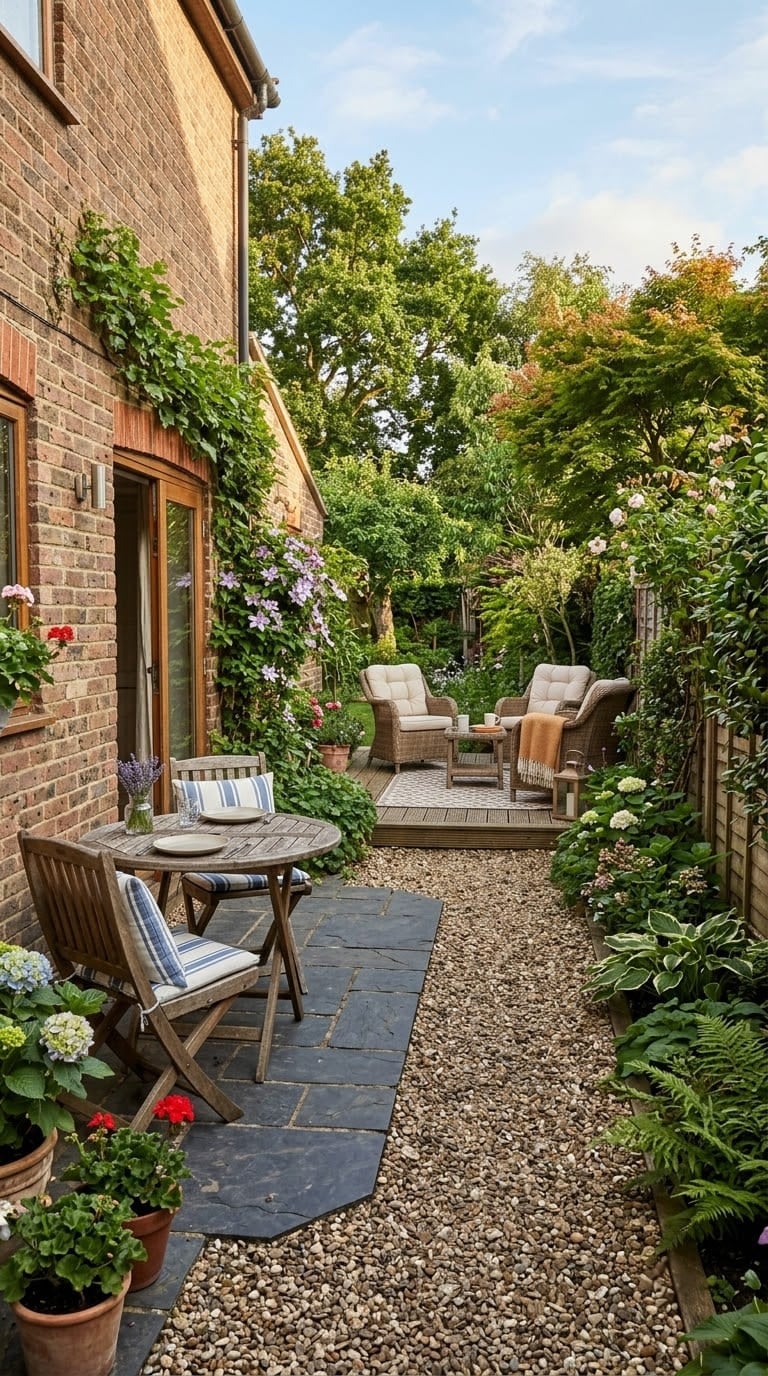
One long, undifferentiated strip of lawn has nowhere for the eye, or your feet, to stop. It just runs from the house to the fence with no reason to linger anywhere in between.
London designer Will Williams breaks long narrow gardens into separate “rooms,” each with a different job. A dining space near the house. A lounge zone further back. A utility or potting area at the far end. Don’t wall these zones off with hard structures. A solid divider in a narrow space just makes each half feel smaller. A change in paving material, a low bed, or a shift in level does the same job without closing anything in.
Quick tip: Two zones is plenty for most narrow backyards under about 30 feet long. Trying to squeeze in three or four distinct “rooms” in a genuinely small footprint just recreates the choppy, over-divided feeling zoning is supposed to fix. Combine the lounge and utility functions into one flexible zone if the yard is on the smaller side.
Most yard problems trace back to one specific, fixable cause. Find yours in 4 quick questions.
Take the Free Quiz
Directly solves Trick #6 (light-reflective paving material for a shaded narrow yard)
Shop NowThis post contains affiliate links. We may earn a commission on qualifying purchases at no extra cost to you.
Trick #4: Use Tall Vertical Plants to Break the “Low Ceiling” Feeling
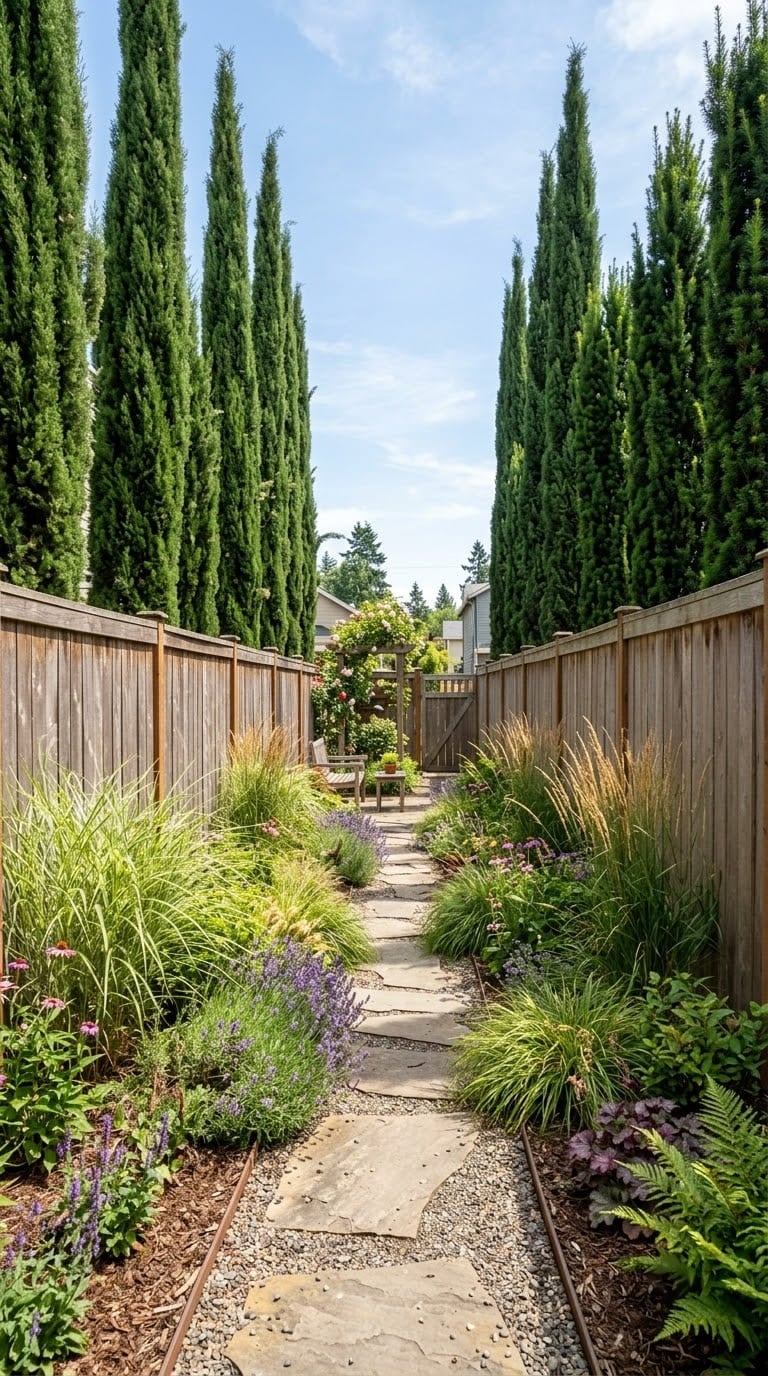
Two close fence lines create a “low ceiling” effect. It makes a narrow yard feel oppressive, even though it’s open to the sky. The fix isn’t more width, it’s height. Tall, narrow-profile plants and vertical structures pull the eye up instead of letting it flatten along the ground.
Columnar trees, tall ornamental grasses, and climbing vines on a simple support all do this job. None of them eat into the walkable width the way a wide shrub would. The goal is one vertical line the eye can follow up, away from the two fences pressing in.
Quick tip: Check the plant tag for “mature spread,” not just mature height, before you buy. A columnar variety should list a spread of no more than a third of its height, that’s what makes it read as a vertical line instead of a normal shrub that just happens to be tall. If the spread and height numbers are close together, it’s not actually a columnar plant no matter what the nursery display calls it.
Trick #5: Stagger Planting Beds From Side to Side
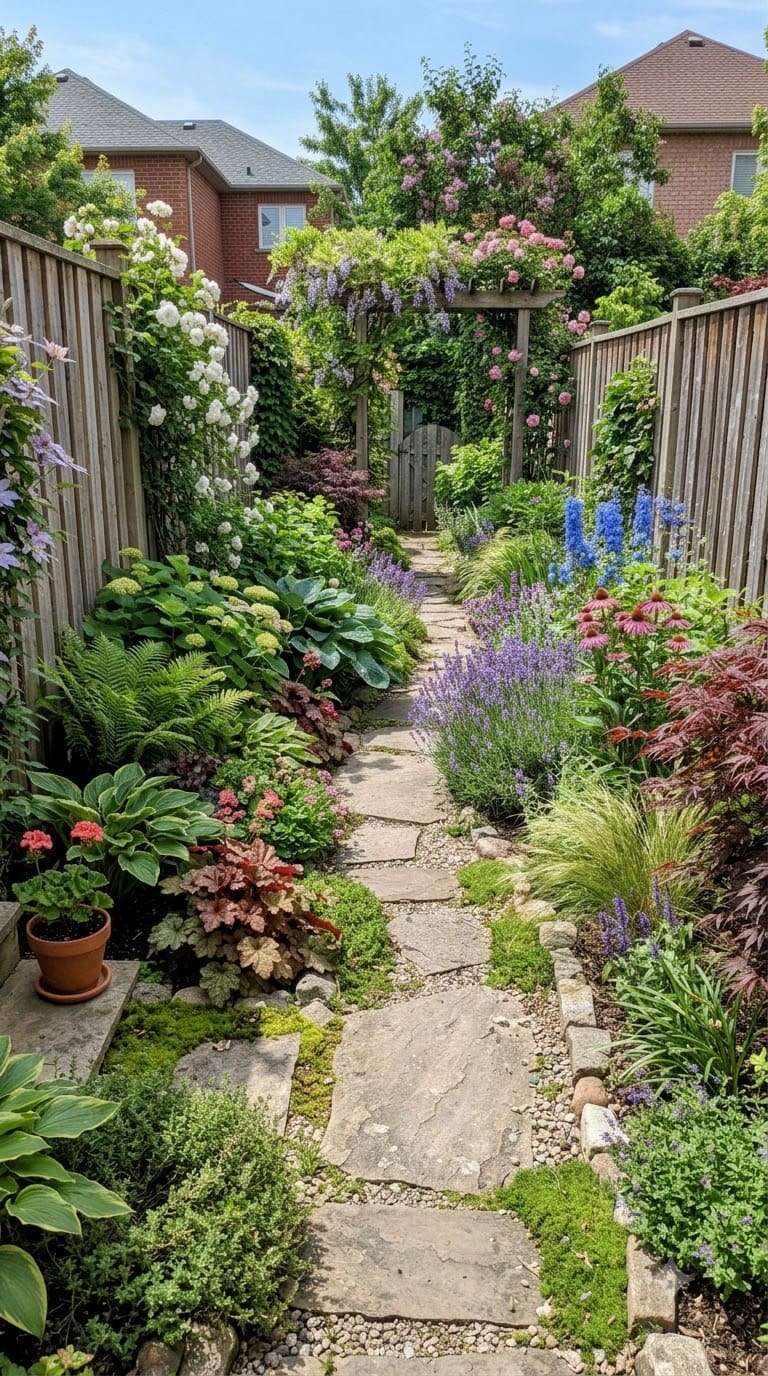
A symmetrical layout, matching beds on both sides at the same points down the yard, actually emphasizes the corridor feeling instead of softening it. Your eye reads the repetition and clocks the narrowness even faster.
Alternate generous beds from one side to the other instead of mirroring them. That makes the eye travel side to side instead of straight down the middle. It also blurs the hard fence-line edges and limits how much of the yard shows in any one glance. That’s the opposite of what a straight, symmetrical layout does.
Quick tip: If you already have symmetrical beds and don’t want to dig them out, break the symmetry with height and plant choice instead of position. Let one side’s planting grow taller and fuller than the matching bed on the other side. The eye reads the imbalance the same way it reads staggered beds, even though the bed outlines themselves never moved.
Trick #6: Choose Light-Reflective Materials
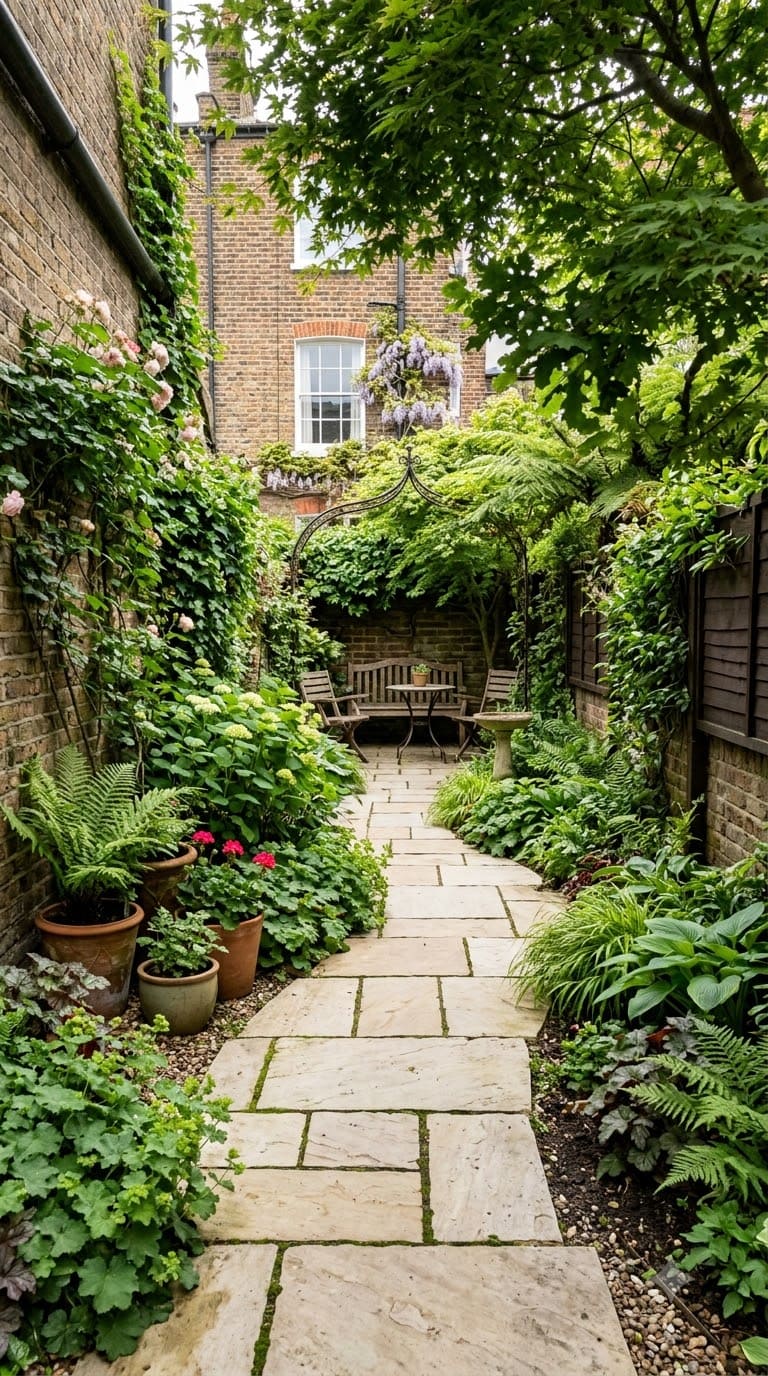
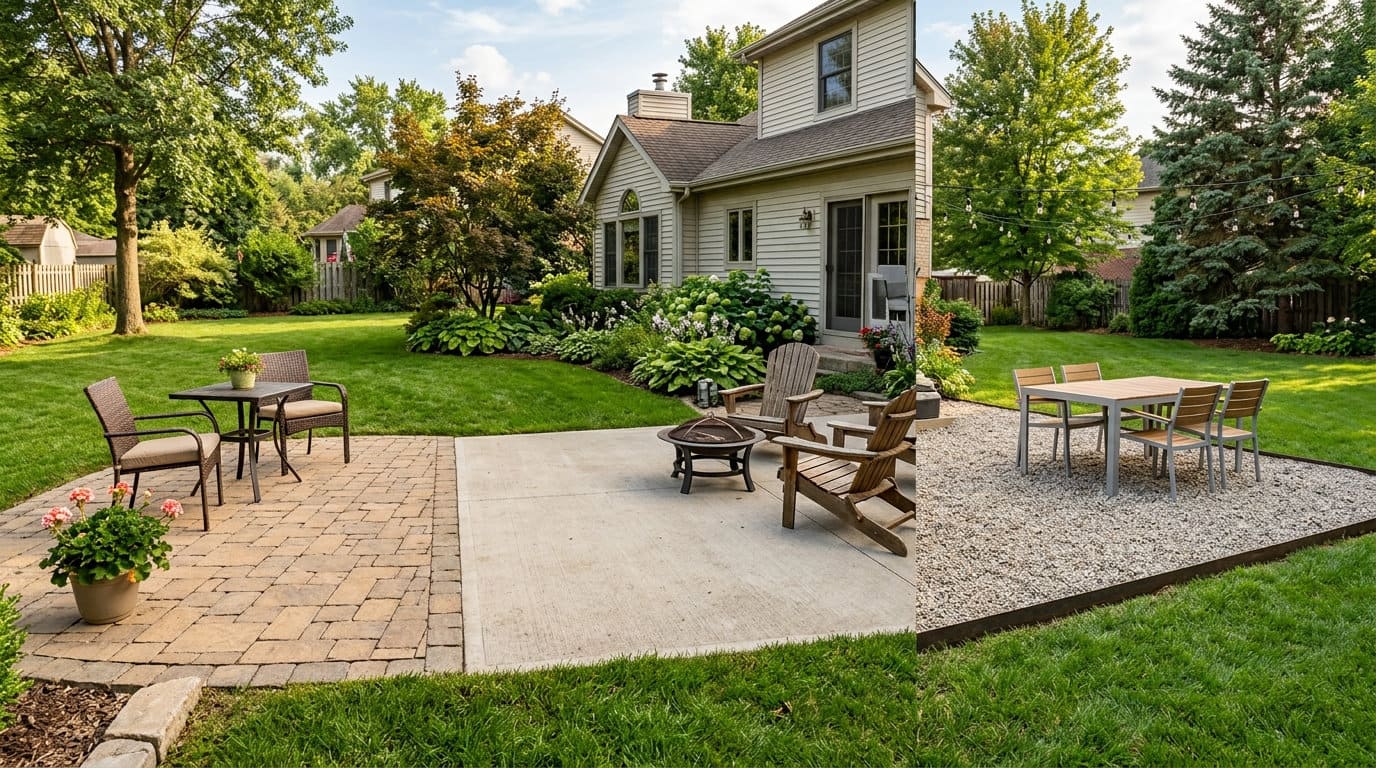
Narrow backyards are often shaded by the houses and fences on either side. A dark hardscape material in a dim space makes the closed-in feeling worse. Pale stone, light sand-toned gravel, and pale grout lines all bounce light back into the space instead of soaking it up.
This isn’t just cosmetic. A brighter surface can make a genuinely shaded yard read as more open. It’s the same trick interior designers use with pale flooring in a small, dim room.
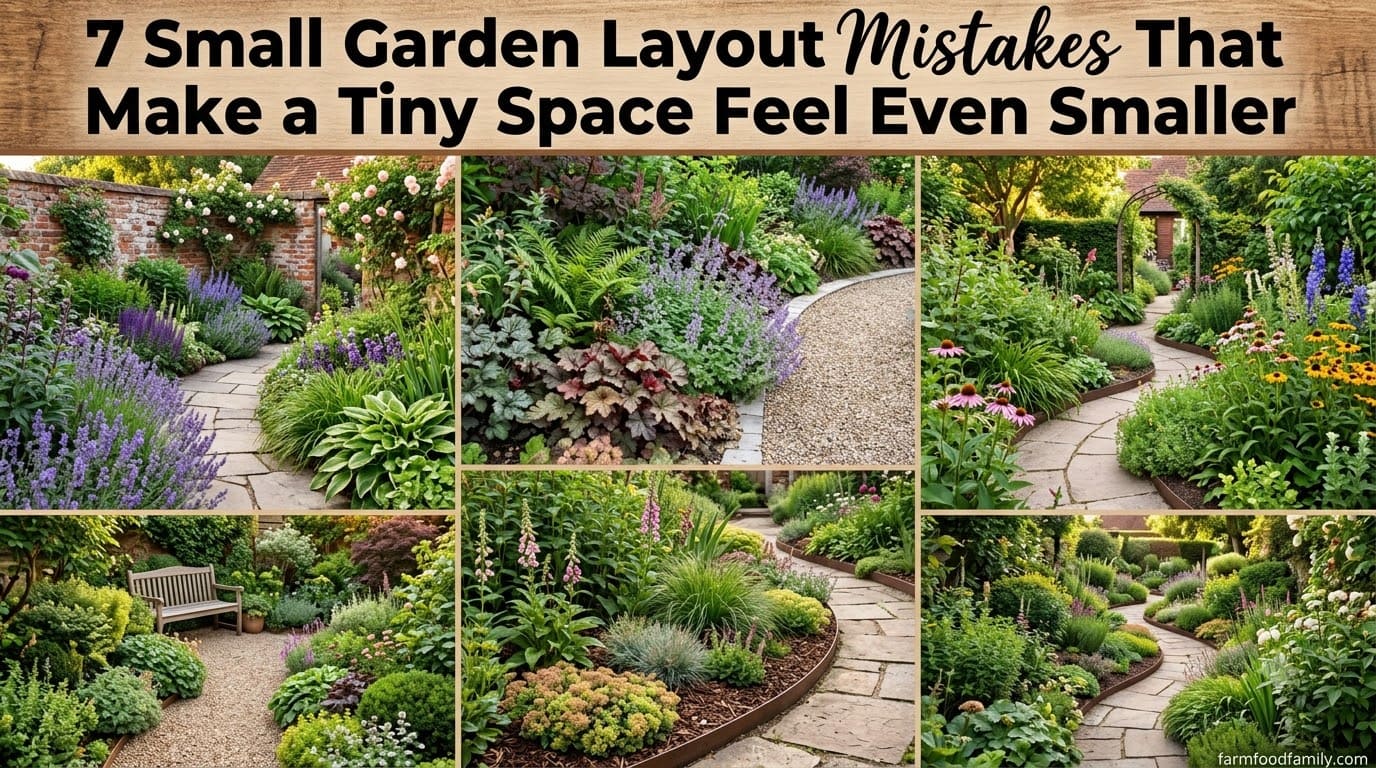
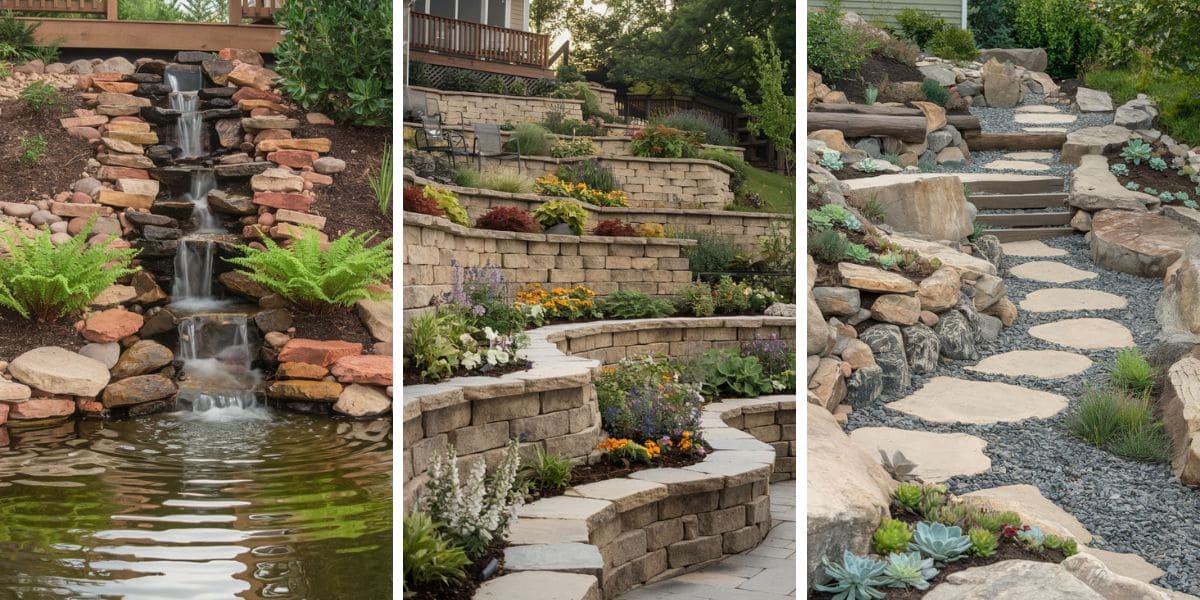
Quick tip: Test a sample paver or a small patch of gravel in the actual shaded spot before ordering enough for the whole yard. Materials often look noticeably lighter or darker in real shade than they do under a showroom’s bright lighting, and a “light” gravel that reads as beige indoors can read as dull grey once it’s sitting under a fence’s afternoon shadow.
The average homeowner spends $616/year on yard fixes that don't address the real problem. Find out what yours actually is — before you spend another dollar.
Take the Free QuizTrick #7: Screen the Far Fence Line
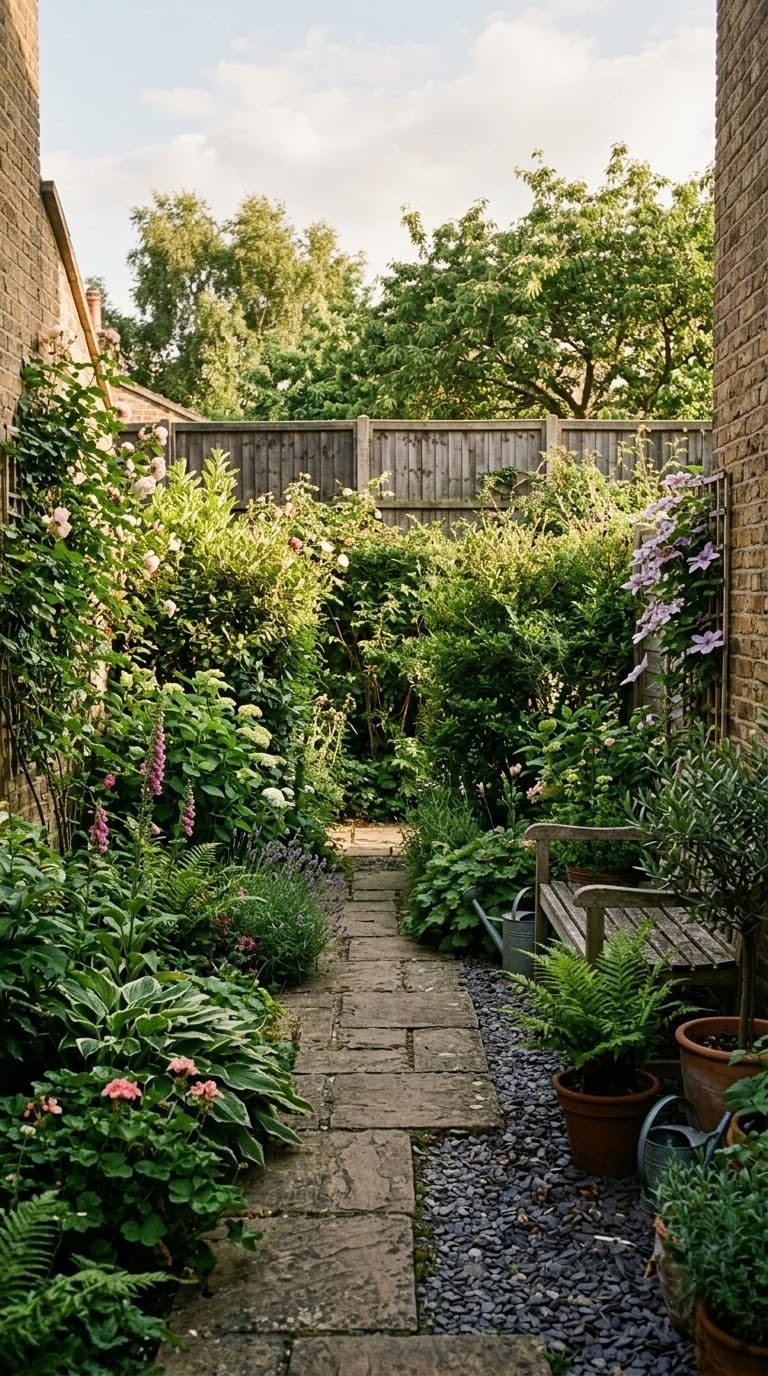
A fully visible fence at the far end tells you exactly where the yard ends the moment you step outside. That shortens how deep the whole space feels. Softening or partly screening that line has the opposite effect.
Place a loose hedge, a large multi-stemmed shrub, or an open trellis with climbing plants a few feet in front of the actual boundary. The eye reads more depth than the fence line technically allows. The goal isn’t to hide the fence completely, just to stop the eye before it hits a flat wall.
Quick tip: Leave gaps in the screening rather than a solid wall of green. A loose, slightly irregular hedge with visible gaps between plants reads as natural depth. A tight, solid hedge just becomes a second fence, and you’ve traded one flat visual stop for another one a few feet closer.
Trick #8: Add One Overhead Structure
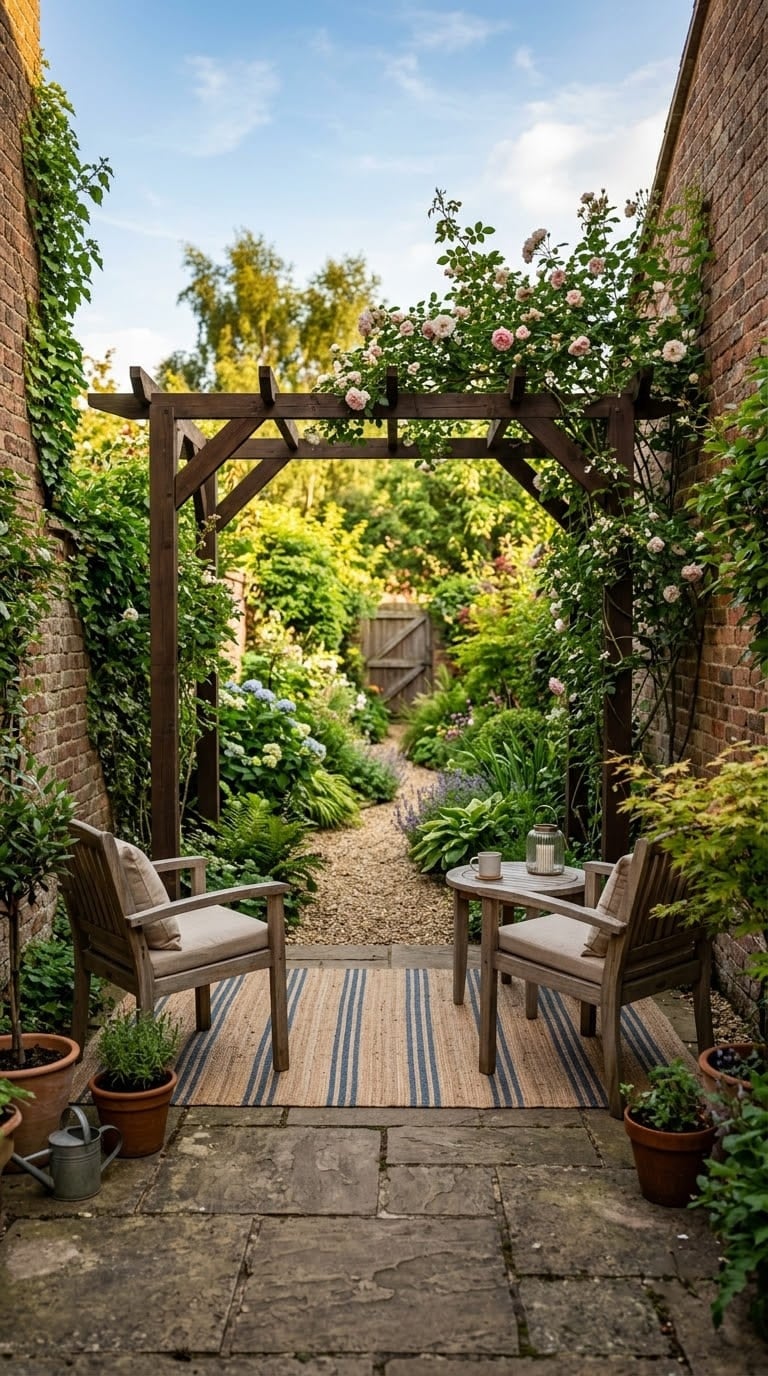
Without anything overhead, a narrow yard is an open vertical tunnel from fence to sky. That reinforces the corridor feeling instead of relieving it. One overhead structure, a pergola over a seating area or an arch at a zone transition, gives the space a sense of a “ceiling.” It turns a chute into a room.
This works best placed at one of the zone transitions from Trick #3 rather than spanning the entire yard. A single arch or pergola section reads as a deliberate architectural moment. But covering the whole length would just recreate the tunnel effect overhead instead of fixing it.
Quick tip: Size the structure to the path or seating area beneath it, not to the width of the whole yard. An overhead structure that’s noticeably narrower than the fence-to-fence width reads as a deliberate “room,” the same logic as Trick #4’s threshold idea, while one that spans the full width just becomes a low ceiling of its own.
What We Learned Landscaping Our Own Narrow Backyard
Our own backyard is barely 14 feet wide, and for two years it was exactly the straight-strip-of-grass layout that creates the bowling-alley look. We didn’t believe a curved path could make that much difference until we actually laid one.
The single biggest change wasn’t the plants. It was moving the path off-center and giving it one gentle curve about a third of the way back. Standing at the patio door, you can no longer see the back fence in a straight line. That one change did more for how the yard feels than every plant we added that year combined.
Frequently Asked Questions
What actually causes the “bowling alley” look in a narrow yard?
A straight, unbroken sightline, usually a center path or strip of lawn, running from the house directly to the back fence with nothing interrupting the view. The eye reads the full length and narrowness of the yard in a single glance.
Do I need to remove my straight path to fix this?
Not necessarily. Offsetting an existing straight path a foot or two to one side, or adding a gentle curve partway down its length, breaks the sightline without a full re-do. A new planting bed or zone transition placed to interrupt the view can achieve the same thing.
Will dividing my narrow yard into zones make it feel smaller?
Only if you use solid dividers like fences or walls between zones. A change in paving material, a low planting bed, or a shift in grade level creates the same sense of separate “rooms” without closing off sightlines the way a hard barrier does.
What’s the cheapest way to break up a narrow backyard’s straight lines?
Move the path off-center and stagger your existing planting beds to alternate sides rather than mirroring each other. Both changes cost nothing beyond labor and immediately interrupt the straight sightline that causes the bowling-alley effect.
Related Posts
Products We Recommend
This post contains affiliate links. We may earn a commission on qualifying purchases at no extra cost to you.
Sekcen Rubber Stepping Stones, light-toned, 3 Pack
Directly solves Trick #6 (light-reflective paving material for a shaded narrow yard)
Shop Now
Thickened Tube Metal Garden Arch Trellis
Directly solves Trick #8 (one overhead structure at a zone transition)
Shop Now
Outsidepride Little Bluestem Grass Seed, 1 lb, narrow-profile native prairie grass
Directly solves Trick #4 (a genuinely columnar, narrow-profile plant to break the low-ceiling feeling)
Shop NowNever miss an update — choose FarmFoodFamily as your preferred source on Google.
How it works: Tap the button below to open Google's settings page, then check the box next to FarmFoodFamily.
Tap the checkbox to turn it blue — that's how you know it's set.