Hot Composting: How to Build a No-Fail Pile That Heats Up in a Week
A cold pile takes a year and does nothing to weed seeds or disease. A hot pile is warm to the touch in two days, done in three weeks, and comes down to four things you set before you build it.

Never miss an update — choose FarmFoodFamily as your preferred source on Google.
How it works: Tap the button below to open Google’s settings page, then check the box next to FarmFoodFamily.
Tap the checkbox to turn it blue — that’s how you know it’s set.
Most backyard compost is a slow, cold pile. You add a bit whenever you have it, and 6 to 12 months later the bottom has turned into something usable. It works, but it is slow, and it does nothing to the weed seeds and plant disease you tossed in along the way.
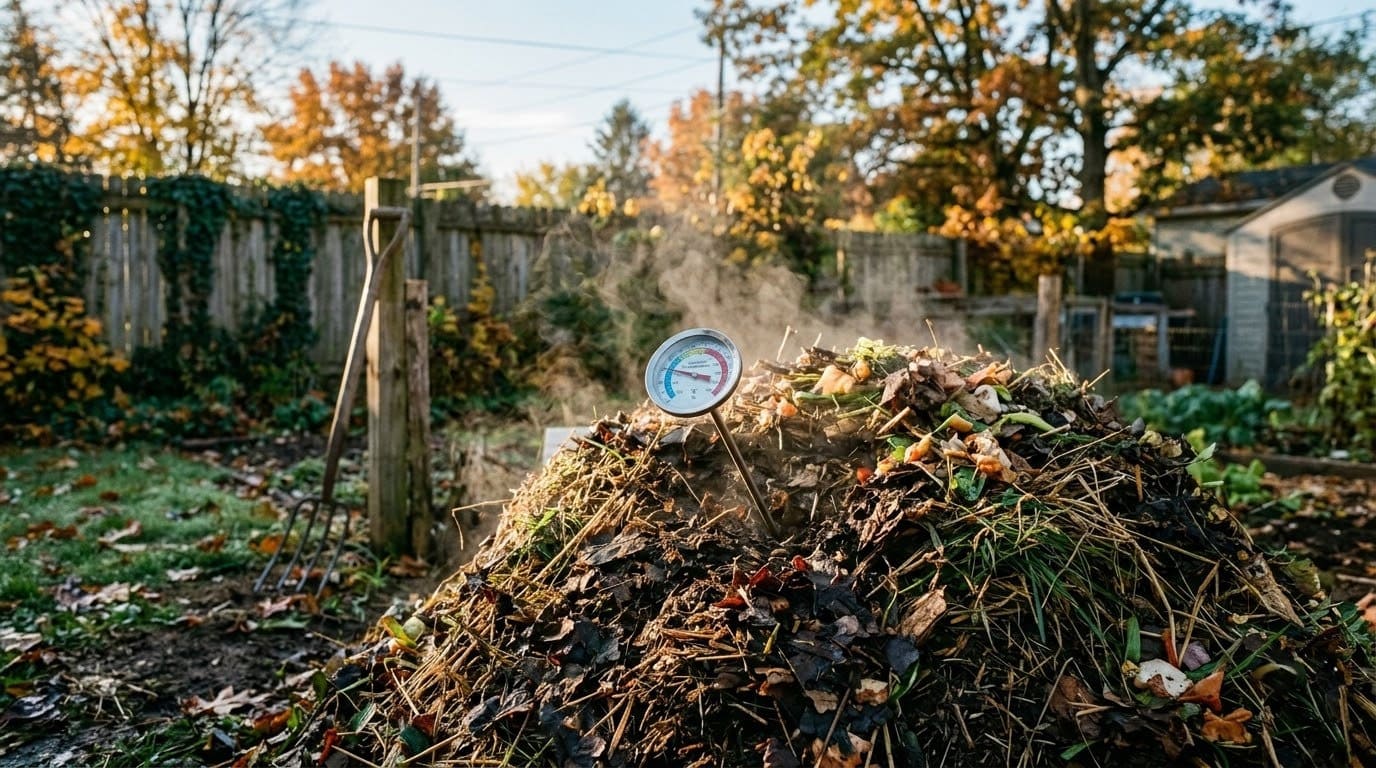
A hot pile is a different animal. Built right, it climbs past 130°F within a day or two, holds 140 to 150°F for weeks, and gives you finished compost in about three weeks instead of a year. Those temperatures also kill most weed seeds and pathogens.
The catch is that a hot pile has to be built all at once, to a specific size, with a specific mix. Here is how to get all four things right.
Quick Answer
Hot composting means building a pile that reaches thermophilic, or heat-loving, temperatures of 140 to 150°F. It breaks material down in weeks instead of months, and the heat kills most weed seeds and pathogens.
Four things make a pile heat up. It has to be at least 3 feet by 3 feet by 3 feet, one cubic yard, so it self-insulates. The mix should be about two parts browns to one part greens by volume, near a 30-to-1 carbon-to-nitrogen ratio.
It also needs to be as damp as a wrung-out sponge, with every material chopped smaller than 2 inches. Build the whole pile in one session, not a scoop at a time, and push a compost thermometer into the center.
Answer 4 quick questions and get matched to the exact fix for your yard — drainage, budget, layout, or something else entirely.
Take the Free QuizTurn the pile from the outside to the center every few days once it is hot. NC State Extension notes a pile over 130°F kills pathogens and over 140°F destroys most weed seeds.
What makes a compost pile heat up?
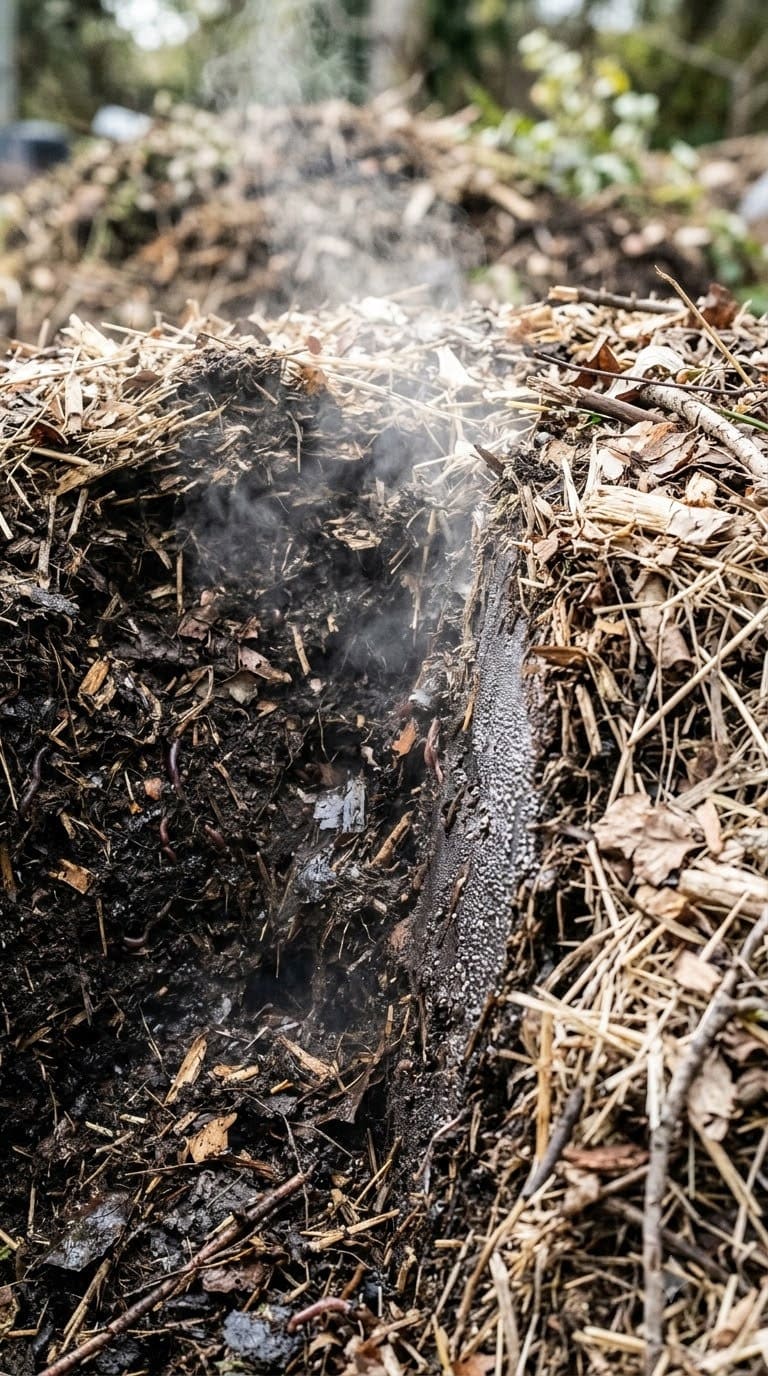
The heat is not magic and it is not the sun. It is billions of microbes generating warmth as they break down the pile, the same way a crowd warms a room.
The trick is holding onto that heat. Cornell Composting explains that “the smaller the compost pile, the greater the surface area-to-volume ratio, and therefore the larger the degree of heat loss to conduction and radiation.” A small pile bleeds warmth off its surface faster than the microbes inside can make it, so it never really gets going.
Get the pile big enough and fed right, and the microbes push it into the thermophilic stage. Cornell notes that “decomposition occurs most rapidly during the thermophilic stage of composting,” which it puts at roughly 40 to 60°C, or about 104 to 140°F.
This is also why an add-a-scrap-a-day pile stays cold. You are never assembling enough active mass at once for it to heat. A hot pile is a batch, built and closed in a single session.
How big does the pile have to be?
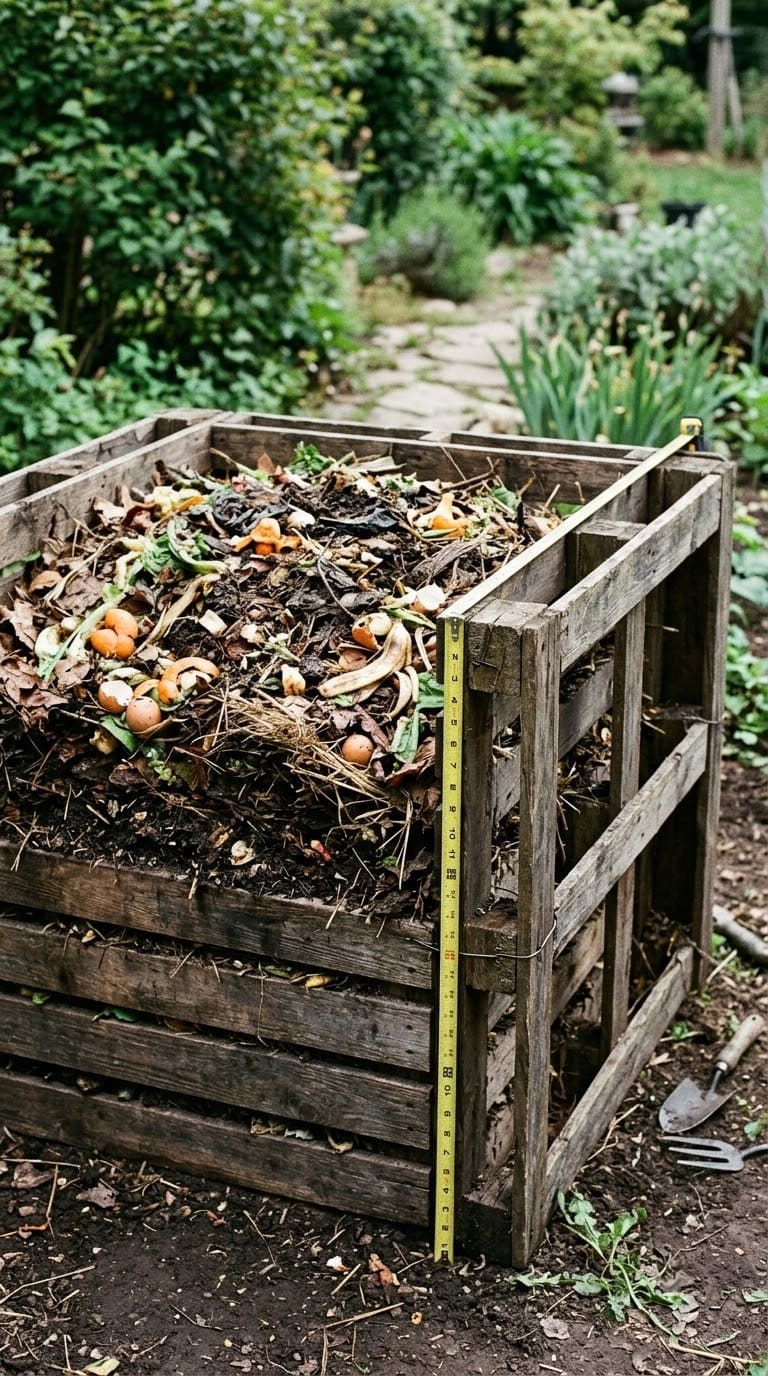
One cubic yard is the number to remember. NC State Extension says to “build a pile 3-feet high and at least 3-feet in diameter so it can become self-insulating to retain heat.”
That is the minimum, not the ideal. A pile up to about 5 feet in each direction works fine and holds heat even better. Past that, the center can go short on air.
Most yard problems trace back to one specific, fixable cause. Find yours in 4 quick questions.
Take the Free Quiz
Reads the center temperature so you know when to turn and when the pile is done
Shop NowThis post contains affiliate links. We may earn a commission on qualifying purchases at no extra cost to you.
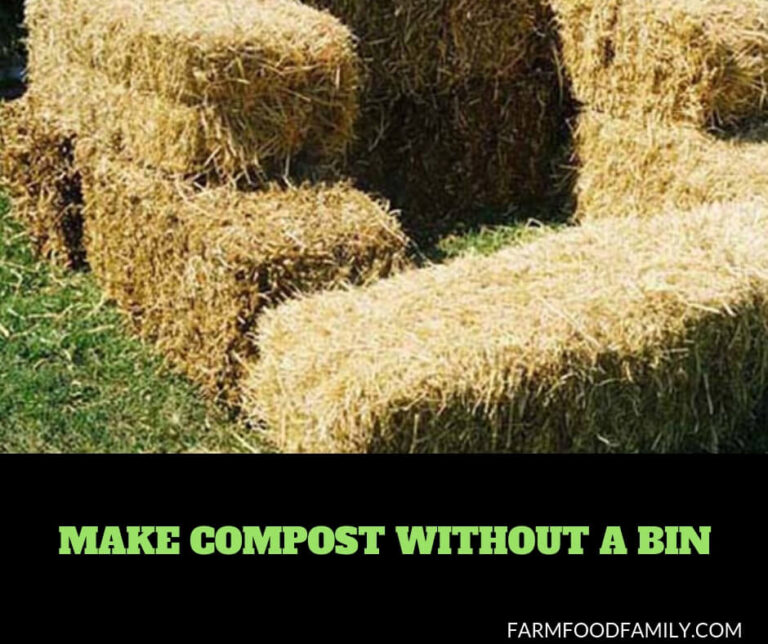
A bin, a wire ring, or three shipping pallets lashed into a U all help the pile hold its shape while you build, but none of them are required. A free-standing heap of the right size heats just as well. Our rundown of low-budget compost bins covers the cheap options.
What is the right mix of browns and greens?
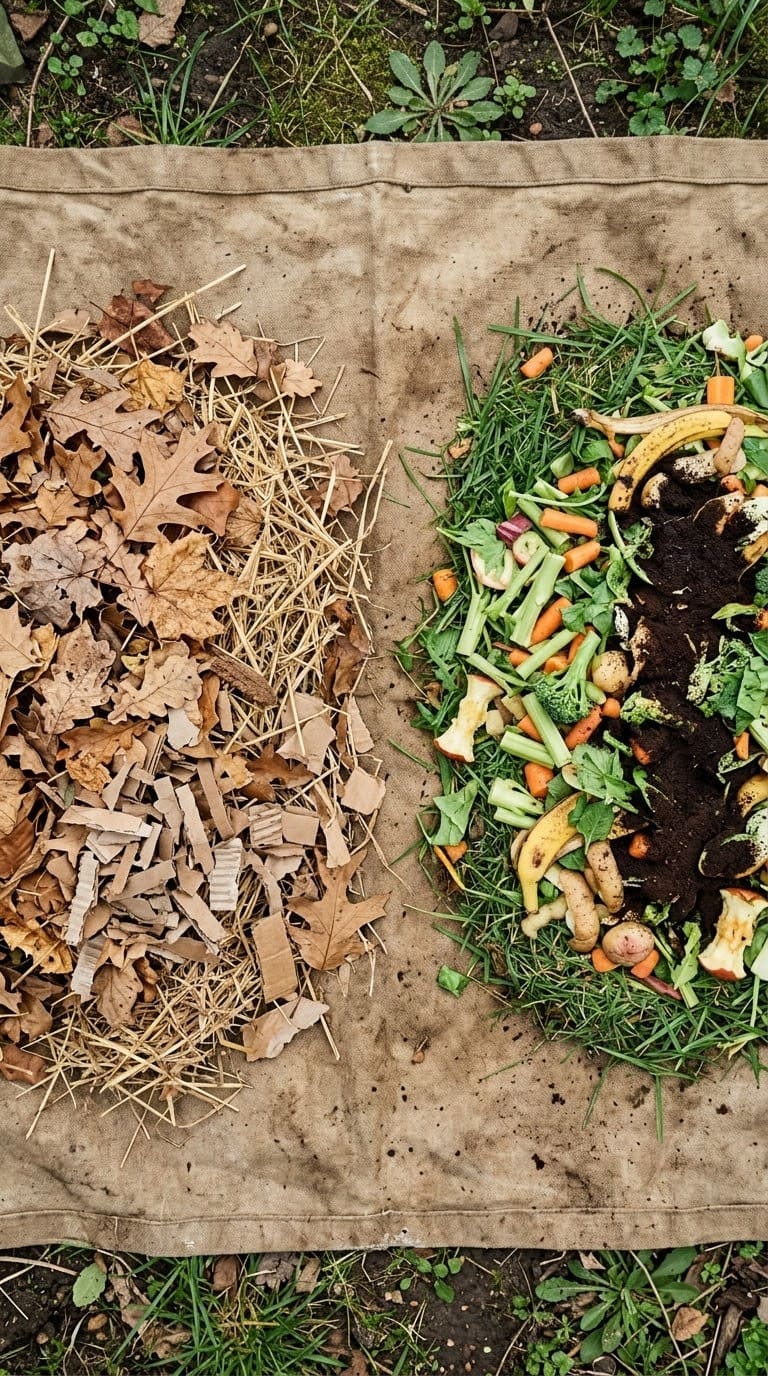
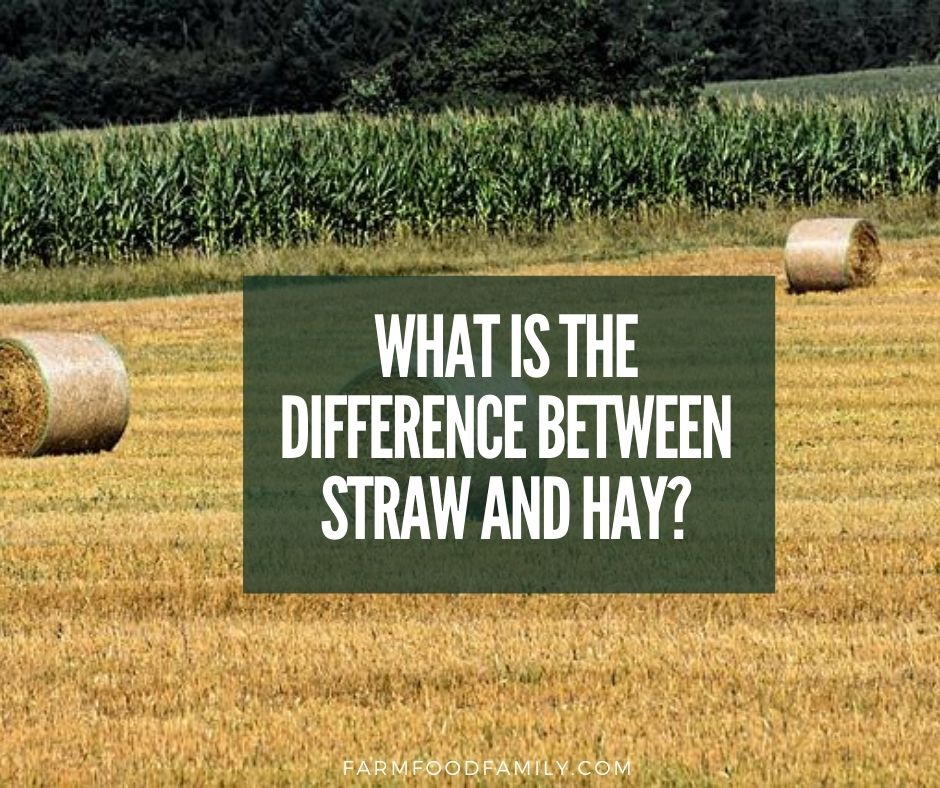
Browns are dry and carbon-rich: fallen leaves, straw, shredded cardboard, wood shavings. Greens are wet and nitrogen-rich: grass clippings, fresh garden trimmings, kitchen scraps, coffee grounds, manure.
Aim for roughly two parts browns to one part greens by volume, which lands near the carbon-to-nitrogen ratio of “around 30:1” that Cornell calls ideal. NC State frames the same target as a “2-to-1 mix of browns and greens.”
Get the ratio wrong and the pile tells you. With too many browns, Cornell says, “there is not sufficient nitrogen for optimal growth of the microbial populations, so the compost will remain relatively cool and degradation will proceed at a slow rate.” With too many greens, the excess “will be lost as ammonia gas, causing undesirable odors.”
What can I put in a hot pile?
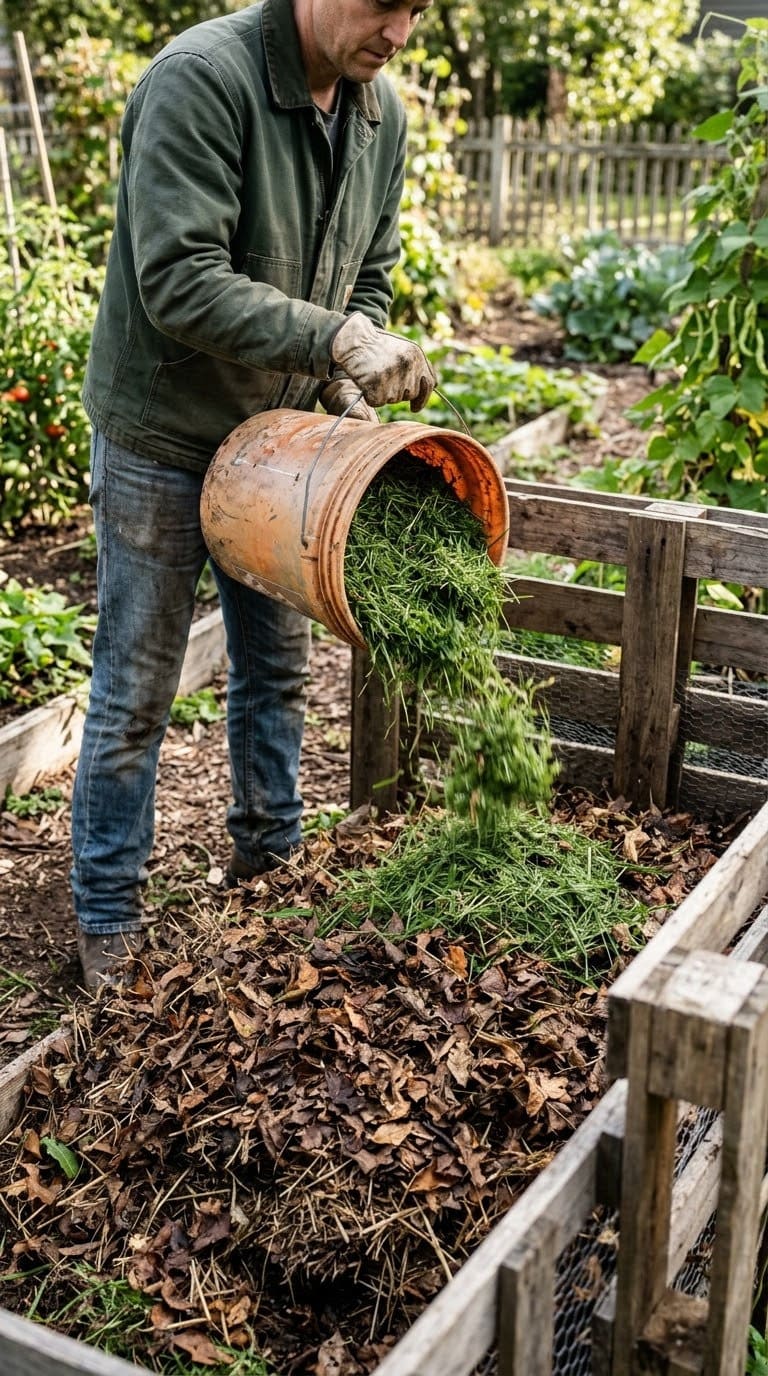
Almost anything plant-based, as long as the browns and greens balance out.
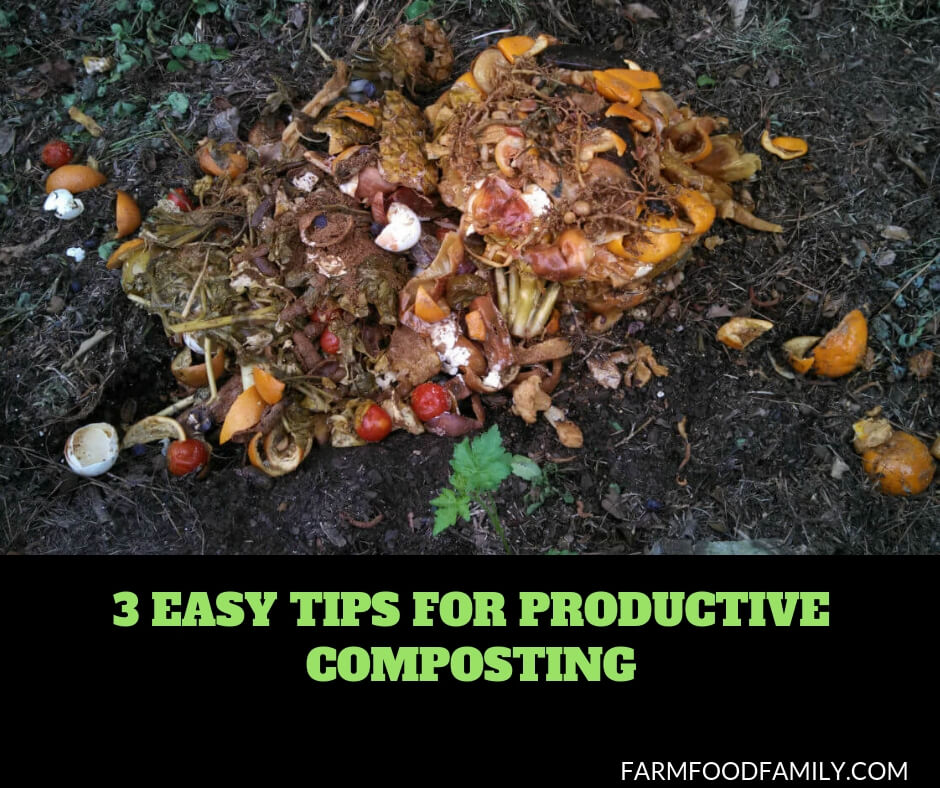
Good browns are fallen leaves, straw, shredded paper and plain cardboard, wood shavings, dried plant stalks, and pine needles in moderation. Good greens are grass clippings, fresh weeds pulled before they seed, spent crop plants, fruit and vegetable scraps, coffee grounds and filters, and aged manure from chickens, cows, horses, or rabbits.
A hot pile also handles things a cold pile cannot. Weeds that have gone to seed, and plants with disease like blight or powdery mildew, break down safely once the whole pile has rotated through temperatures over 140°F.
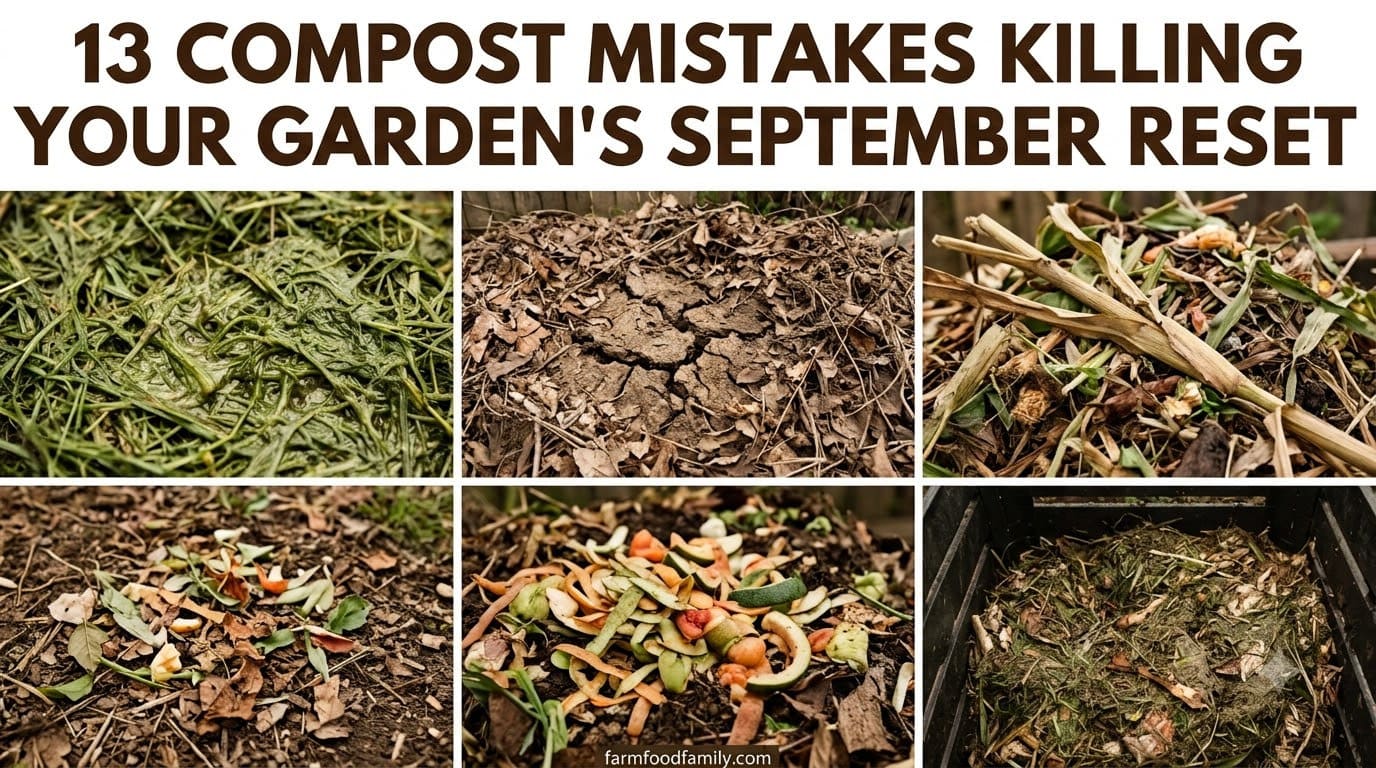
Leave out meat, fish, dairy, greasy or oily food, and dog or cat waste. A backyard pile does not hold high enough temperatures for long enough to make those safe, no matter how hot the center gets. Our step-by-step compost guide has fuller ingredient lists.
How wet should the pile be?
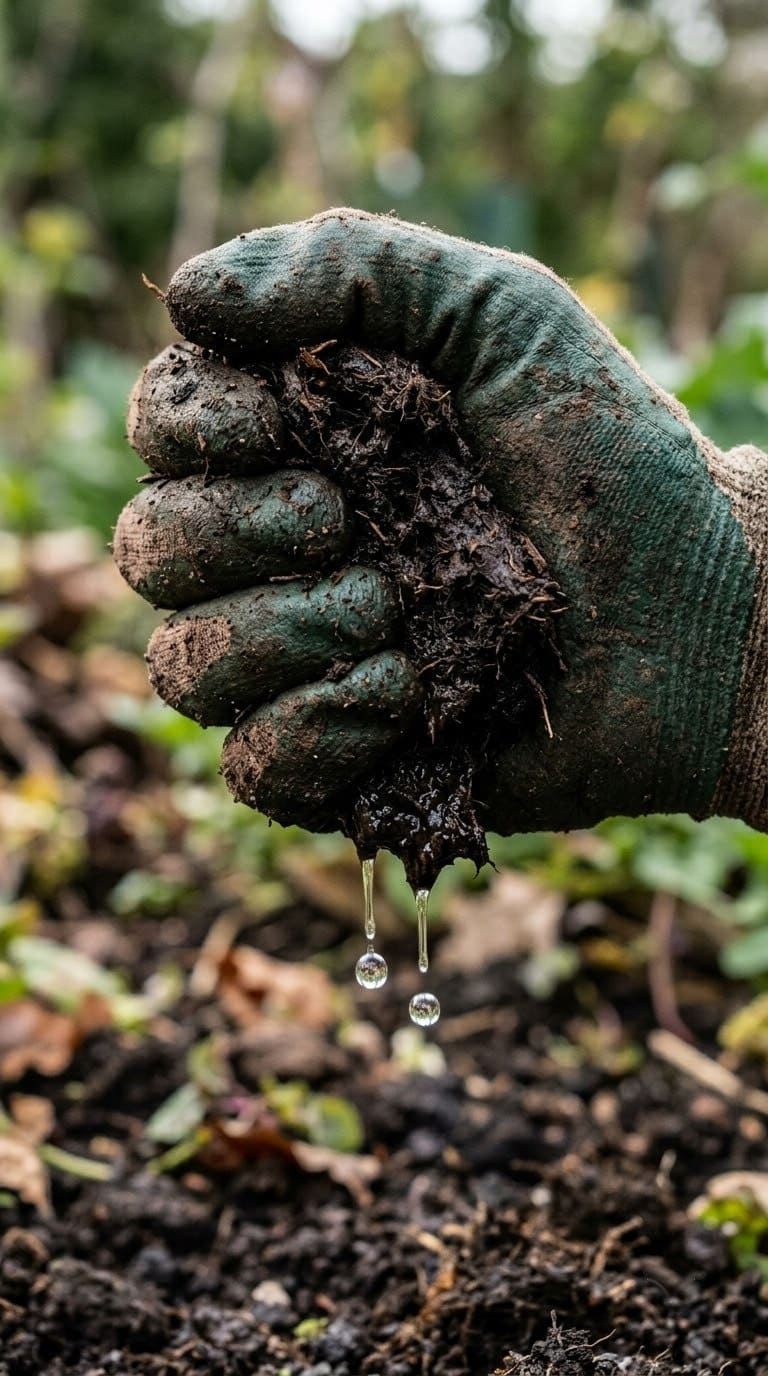
Damp as a wrung-out sponge. NC State puts a number on it: the moisture is right “if a drop or two of water can be squeezed from a handful of material.”
The average homeowner spends $616/year on yard fixes that don't address the real problem. Find out what yours actually is — before you spend another dollar.
Take the Free QuizWater each layer with a hose as you build, because it is very hard to wet a dry pile evenly after the fact. Dry leaves in particular shed water and stay dry in pockets.
But too wet is its own problem. A soggy pile packs down, the air spaces fill with water, and it turns sour and airless instead of hot. If a squeezed handful drips a stream, it is too wet.
Why does everything need to be chopped small?
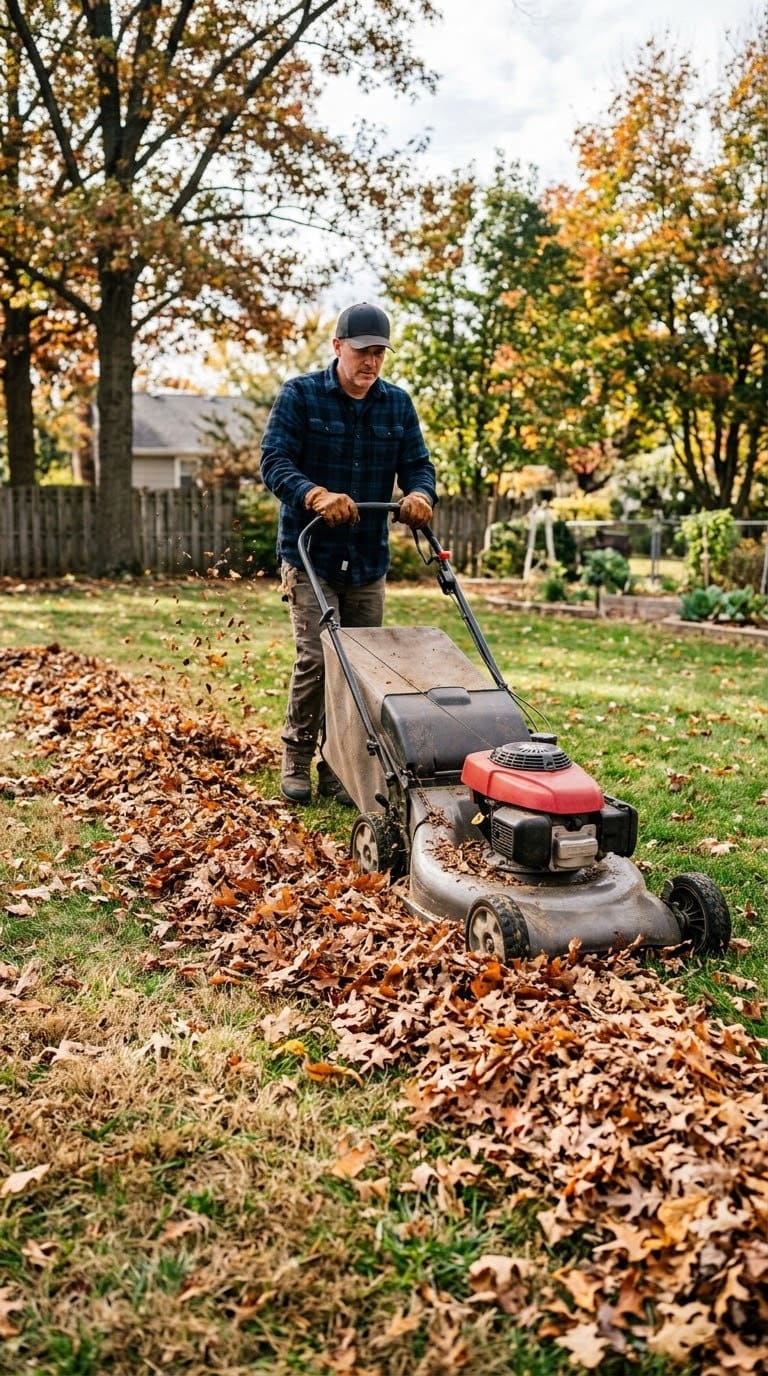
Microbes work on surfaces, so more surface area means faster decomposition. NC State recommends cutting materials into “particles less than 2-inches in diameter,” and Cornell notes that finely divided material makes its carbon “more readily available for microbial use.”
You do not need a shredder. Run the mower over a pile of leaves, lop prunings into short lengths, and chop bulky kitchen scraps against a board or under a spade. The Berkeley rapid method developed at the University of California calls for pieces roughly half an inch to an inch and a half.
How do I build the pile, step by step?
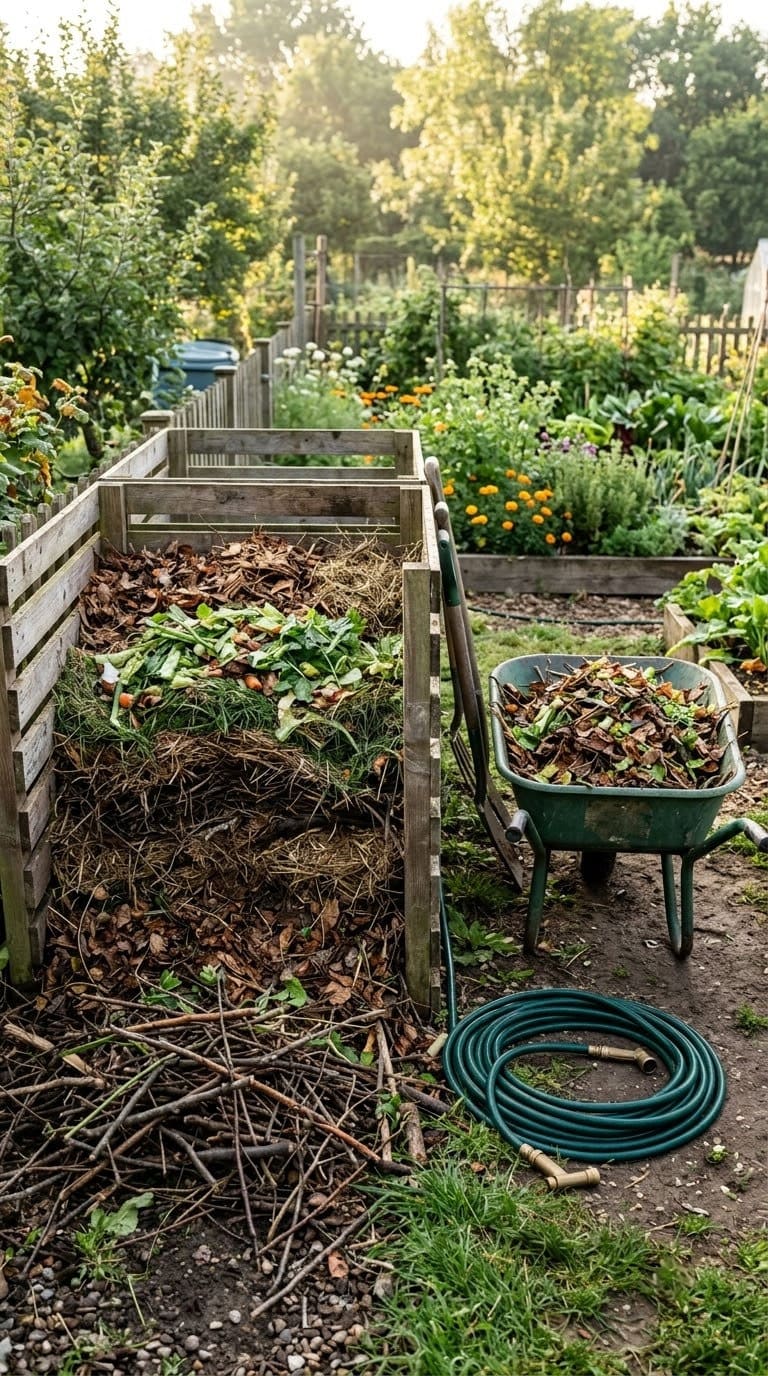
Do all the gathering and chopping first, then build the whole pile in one go.
1. Stockpile everything. Collect enough browns and greens for a full cubic yard before you start, and pre-chop it all.
2. Pick the spot. Bare soil in part shade is ideal, so worms can move up into the pile and it does not dry out or cook in full sun.
3. Start with a coarse base. A few inches of twigs or coarse stalks on the bottom lets air in from below.
4. Layer and water. Add browns and greens in rough two-to-one layers, 4 to 6 inches at a time, watering each layer to wrung-sponge dampness.
5. Build it to size. Keep going until the pile is a full 3 by 3 by 3 feet or larger. A half-size pile will not heat.
6. Insert a thermometer. Push a long-stem compost thermometer into the center and check it daily.
When and how do I turn it?
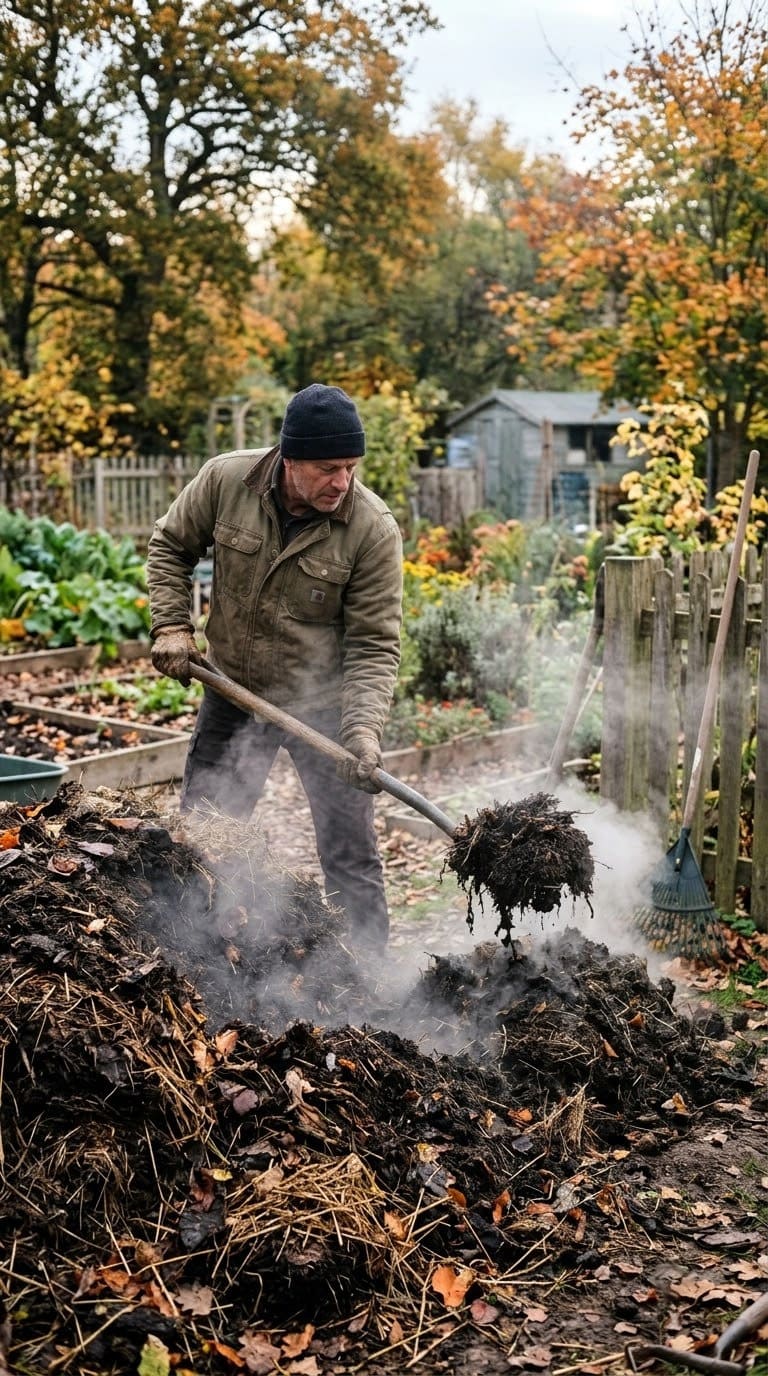
Turning re-oxygenates the pile and mixes cooler outside material into the hot core, which sends the temperature back up.
Make the first turn when the center hits 150 to 160°F, or when the temperature starts falling on its own, usually somewhere around day 3 to 5. NC State’s method is to move “the material from the outside to the center.” Everything that was on the edge goes into the middle, and the spent middle moves out.
After that, turn every few days to about once a week. Each turn should trigger another heat spike. The Berkeley method pushes this hard, turning as often as every day for a finished pile in around 14 days, at the cost of a lot more labor.
When a turn no longer makes the pile re-heat, usually after two to three weeks, it is done or nearly so.
What temperature should the pile reach, and what do the readings mean?
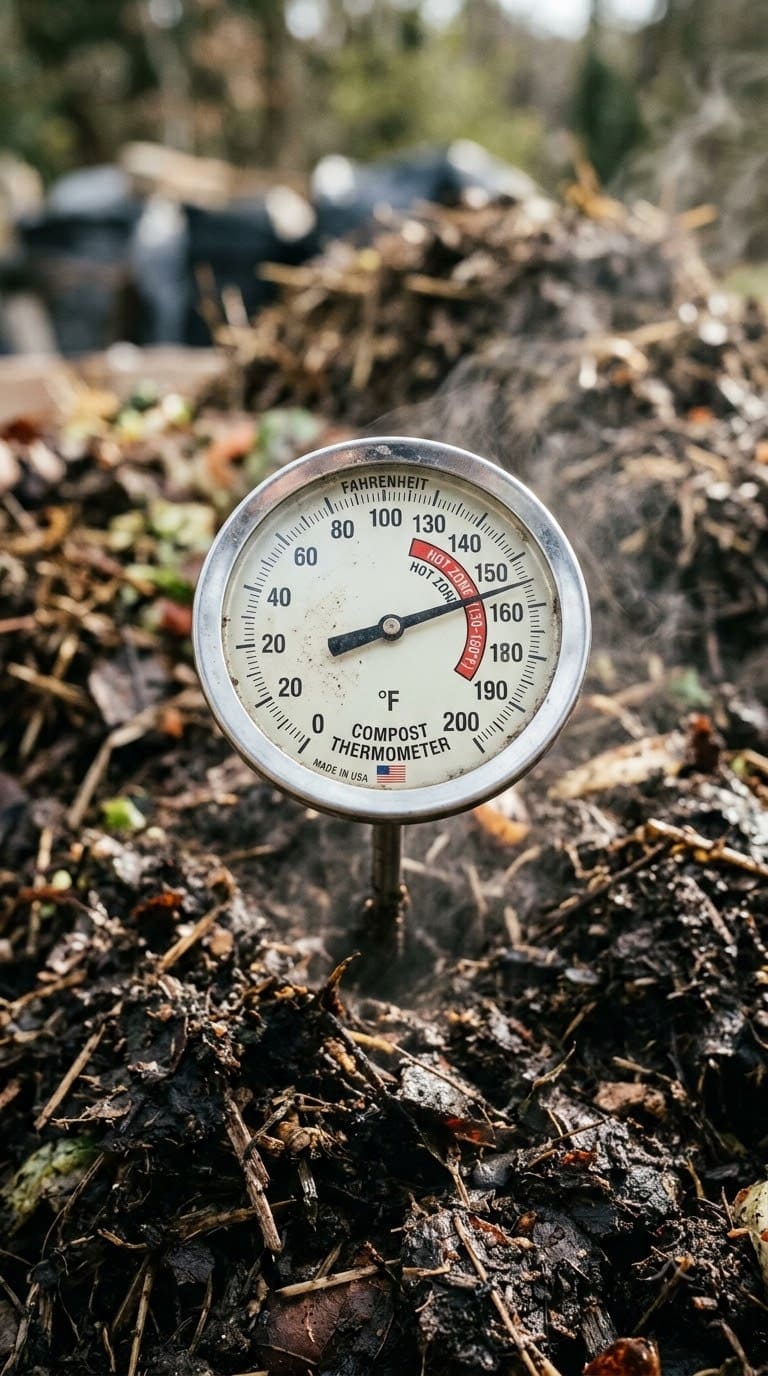
A well-built cubic-yard pile usually climbs past 100°F within a day and into the 130s or 140s within 48 to 72 hours. The center often peaks around 150 to 160°F.
The readings each mean something specific, per NC State:
- Over 130°F kills most human and pet pathogens.
- Over 140°F destroys most weed seeds.
- At 160°F the heat “can kill decomposers and slow the composting process,” so that is your signal to turn and cool it down.
A cheap long-stem compost thermometer is the single tool worth buying for this. Guessing by hand tells you warm or not warm, and not much else.
Push the probe into the true center of the pile, not just under the surface, since that is where the temperature is highest. Check it at the same time each day, ideally the morning, and take a second reading a foot from the edge. A big gap between the center and the edge is normal and is exactly why you turn.
Why isn’t my pile heating up?
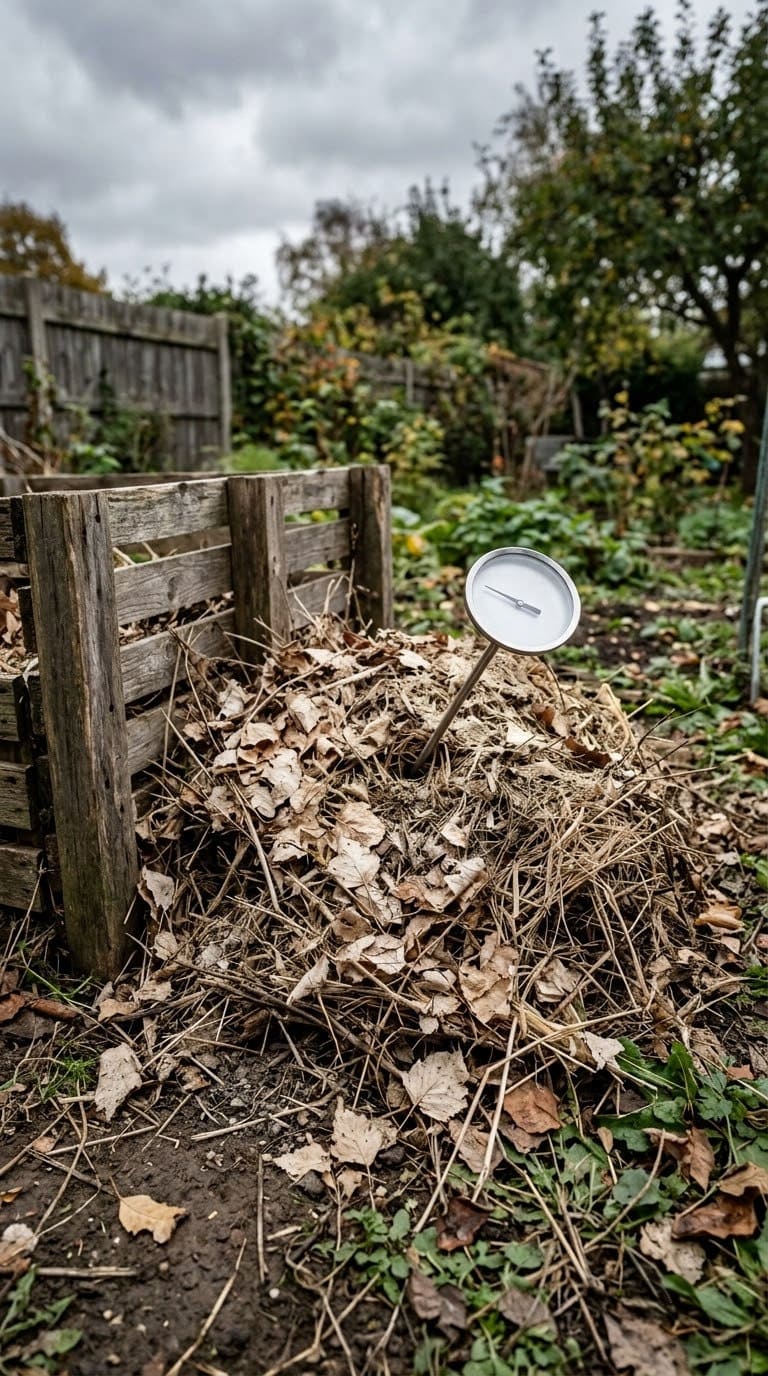
Almost every failure is one of a short list. Match the symptom to the fix, and see our guides to common compost problems and compost pile mistakes for the longer version.
| Symptom | Most likely cause | Fix |
|---|---|---|
| Never got warm | Pile too small, too dry, or too many browns | Rebuild to a full cubic yard, moisten to wrung-sponge, mix in more greens |
| Warmed, then stalled within days | Dried out, or compacted and airless | Turn it, water to wrung-sponge, break up any matted layers |
| Sharp ammonia smell | Too much nitrogen, too many greens | Mix in dry browns and turn |
| Rotten, sour, or eggy smell | Too wet and airless | Turn, add dry browns, do not add water |
| Hot but swarming with flies | Food scraps sitting on the surface | Bury all food scraps at least 8 inches into the center |
The one-week hot pile cheat sheet
Save this for build day.
| Lever | Target | Why it matters |
|---|---|---|
| Size | At least 3 x 3 x 3 ft, one cubic yard | Self-insulates so heat outpaces heat loss |
| Browns to greens | About 2 to 1 by volume, C:N near 30 to 1 | Too many browns stays cool, too many greens smells of ammonia |
| Moisture | Wrung-out sponge, a drop or two squeezes from a handful | Microbes need water, but too wet goes airless |
| Particle size | Under 2 inches, chopped or shredded | More surface area means faster decomposition |
| Build style | All at once, as one batch | The whole mass has to heat together |
| Turning | Outside to center, every few days to weekly | Re-oxygenates and re-spikes the heat |
| Target temperature | 140 to 150°F, turn if it reaches 150 to 160°F | Over 130 kills pathogens, over 140 kills weed seeds, 160 kills the microbes |
Is this the same as the Berkeley 18-day method?
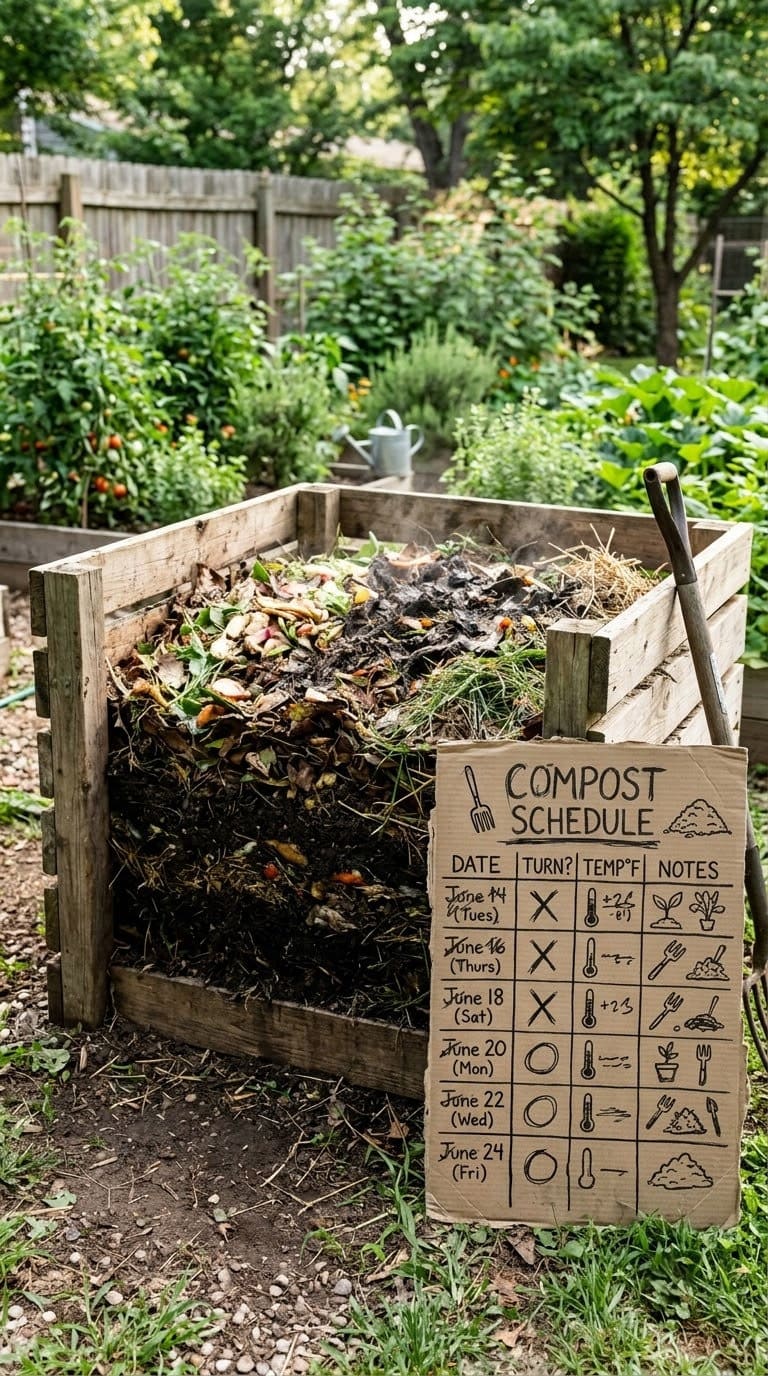
It is the same idea, tightened up. The Berkeley rapid composting method, developed by plant pathologist Robert D. Raabe at the University of California, is the best-known formal version of hot composting.
Berkeley locks in the same four levers this guide uses, then adds a strict turning schedule: turn on day four, then every second day after that, for finished compost in about 18 days. Turn every single day and Raabe found you can get there in as little as 14.
The daily-turn version is genuinely hard work, and most home gardeners do not keep it up. If you build the pile right and turn it once or twice a week, you still get finished compost in three to four weeks, which is the part that matters. Treat the 18-day number as the ceiling, not the requirement.
A real failed-pile story
My first “hot” pile never got above lukewarm. I was pleased with myself for building it in one afternoon, but it was maybe half a cubic yard, and it was almost entirely dry autumn leaves with a thin scatter of kitchen scraps.
It sat at about 90°F for a week and then just slowly cooled. Both problems were obvious in hindsight: not enough mass to hold heat, and nowhere near enough nitrogen or water to feed the microbes.
I pulled it apart, mixed in three bags of grass clippings and a bucket of coffee grounds from a local cafe, watered every layer as I rebuilt it, and piled it a good 4 feet in each direction. It hit 150°F in two days and stayed hot through four turns. Same leaves, completely different result.
FAQ
How hot should a compost pile get? A working hot pile runs 140 to 150°F in the center. Over 130°F kills most pathogens and over 140°F kills most weed seeds. If it climbs to 160°F, turn it, because that heat starts killing the microbes doing the work.
Why did my pile heat up then stop after a few days? Usually it dried out or ran out of air. Turn it, water it back to wrung-sponge dampness, and break up any slimy matted layers. It should re-heat within a day.
Can I hot compost in winter? It is harder but possible. A full cubic yard or larger, built in one go on a mild day and ideally insulated with a thick straw jacket, can hold heat through a cold snap. A small or half-built pile will freeze.
Do I need a compost thermometer? For hot composting, yes. A long-stem dial thermometer costs little and tells you exactly when to turn, when the weed seeds are being killed, and when the pile is finished. Without one you are guessing.
Can a hot pile really kill weed seeds and plant disease? Yes, if the whole pile reaches the target temperature, which is why turning matters. Material that spends time on the cool outer edge is not sterilized, so every part has to rotate through the hot center at least once.
What can’t go in even a hot pile? Meat, dairy, oily food, and pet waste from dogs and cats still do not belong in a backyard pile, since the temperatures and holding times are not controlled enough to make them safe. Diseased plants and weeds gone to seed are fine in a properly hot pile.
Related Posts
Products We Recommend
This post contains affiliate links. We may earn a commission on qualifying purchases at no extra cost to you.


Never miss an update — choose FarmFoodFamily as your preferred source on Google.
How it works: Tap the button below to open Google's settings page, then check the box next to FarmFoodFamily.
Tap the checkbox to turn it blue — that's how you know it's set.