25 Smart Tiny Laundry Room Ideas That Use Every Inch
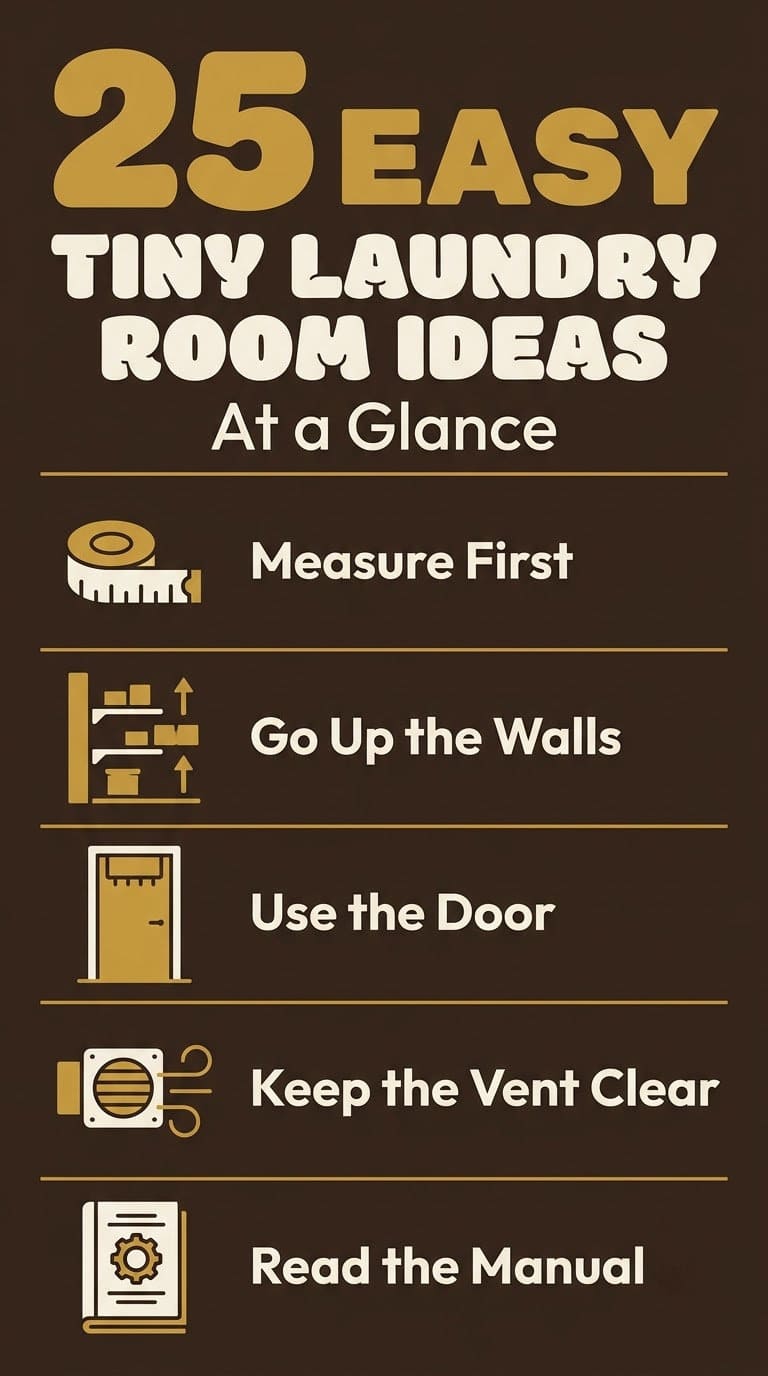
A tiny laundry room works when you measure first, build up the walls and keep the dryer vent clear.

Never miss an update — choose FarmFoodFamily as your preferred source on Google.
How it works: Tap the button below to open Google’s settings page, then check the box next to FarmFoodFamily.
Tap the checkbox to turn it blue — that’s how you know it’s set.
A tiny laundry room forces good decisions. There’s no spare floor, so every shelf, hook and door has to earn its place.
We looked at what designers say about small laundry spaces, then built 25 ideas around the constraints you actually face. Each one comes with a catch to know before you start. For closet-style setups, see our laundry closet ideas, and for stacking tips, our stacked laundry room ideas.
Quick Answer
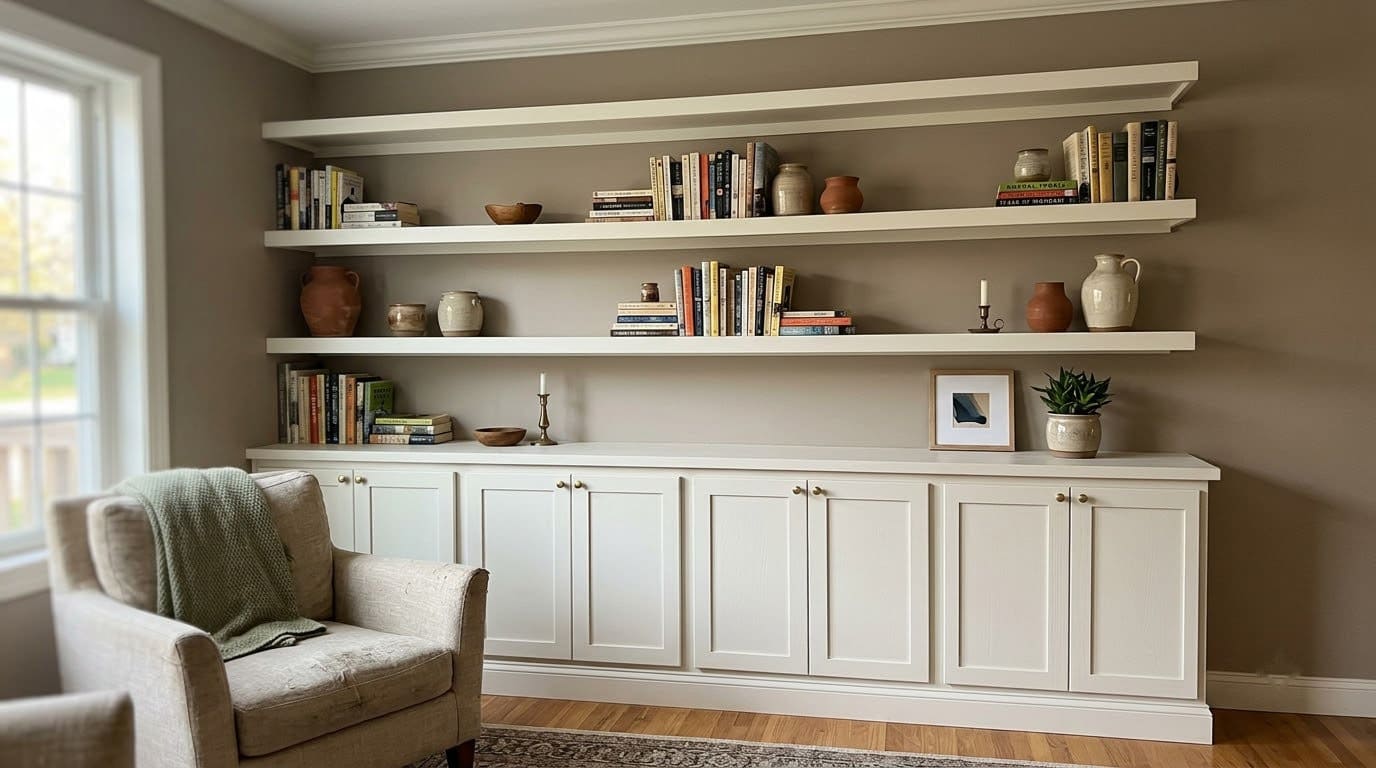
Measure first, then go up. In a tiny laundry room, the floor is gone before you start, so wall and door space does the work.
Valerie Helgeson of Design Directions designed a small laundry porch around stacked machines and full-height cabinetry. Choose appliances that fit the space, add a surface that folds away, and keep every item off the floor.
But don’t forget the dryer. Clean the lint filter before and after each load, and keep the vent clear. Read your appliance manual for the clearances your model needs.



Start with your biggest problem. If you’re short on floor, stack the machines. If you’re short on light, add a mirror and pale paint, and if you can’t run a vent, look at a ventless dryer.
Below are 25 ideas sorted by what you’re short on, from floor space to light. Each has a catch and a quick setup tip.
Before You Start
Measure before you buy anything. Write down the width, depth and ceiling height of the space. Note which way the door swings and where the vent and water lines sit.
Designer Jordan Mollé of Compass Studio told Livingetc to “focus on the desired functionality first.” That’s the right order. Decide what the room must do, then pick the look.
Your appliance manual sets the clearances around the machines and any door. Follow it, and check local rules if the machines sit in a closet. Never block the vent.
Here’s how we’d scale it by budget.
| Level | What you do | Good for |
|---|---|---|
| Renter ($) | Over-the-door hampers, a slim cart, peel-and-stick wallpaper, a folding rack | Apartments, leases that forbid drilling |
| Refresh ($$) | Shelves, a counter over the machines, new lighting | Most tiny laundry rooms |
| Build ($$$) | Full-height cabinets, a new door, new or stacked appliances | Remodels |
Dryer safety matters more in a tight space. The Washington State Patrol says to clean the lint filter before and after each load and clear the vent pipe every three months. It also says to use rigid or flexible metal venting.
25 Tiny Laundry Room Ideas
1. Stack the Washer and Dryer
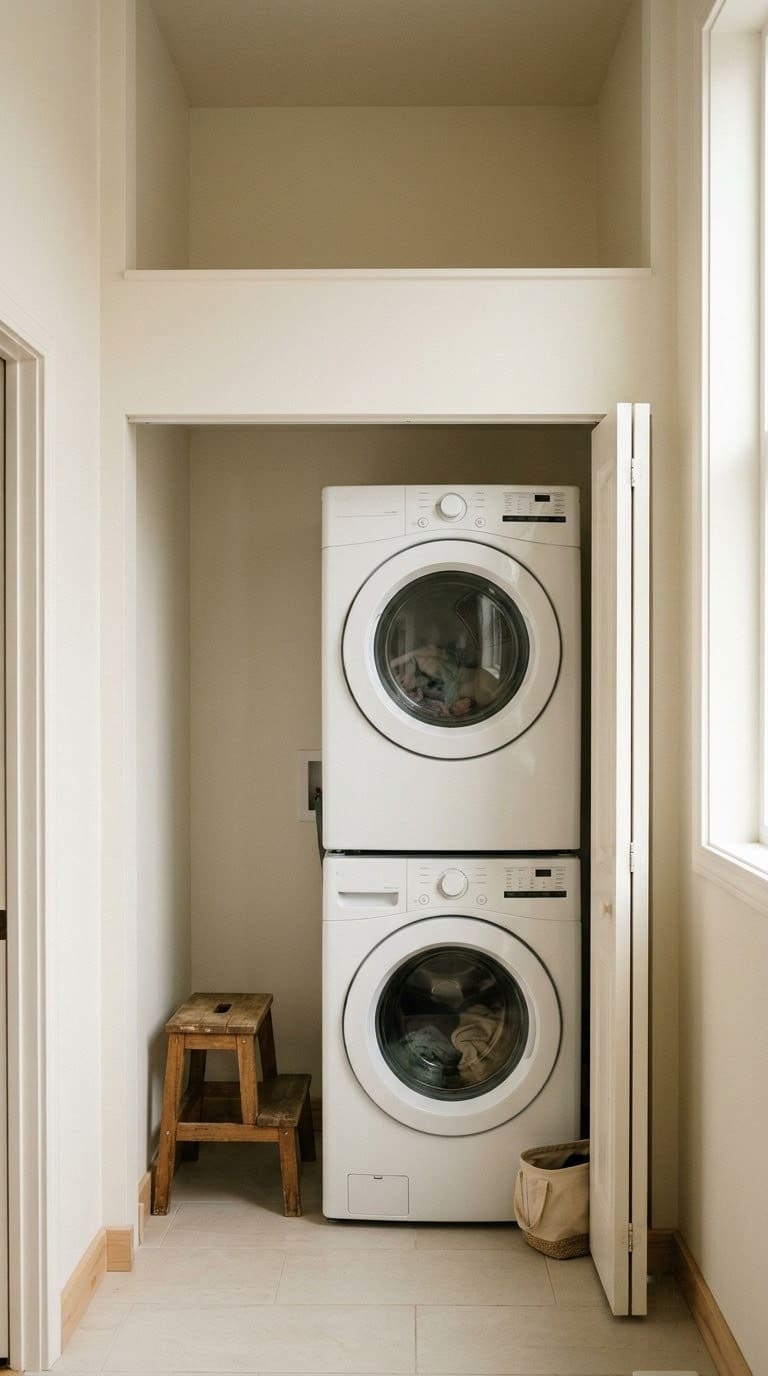
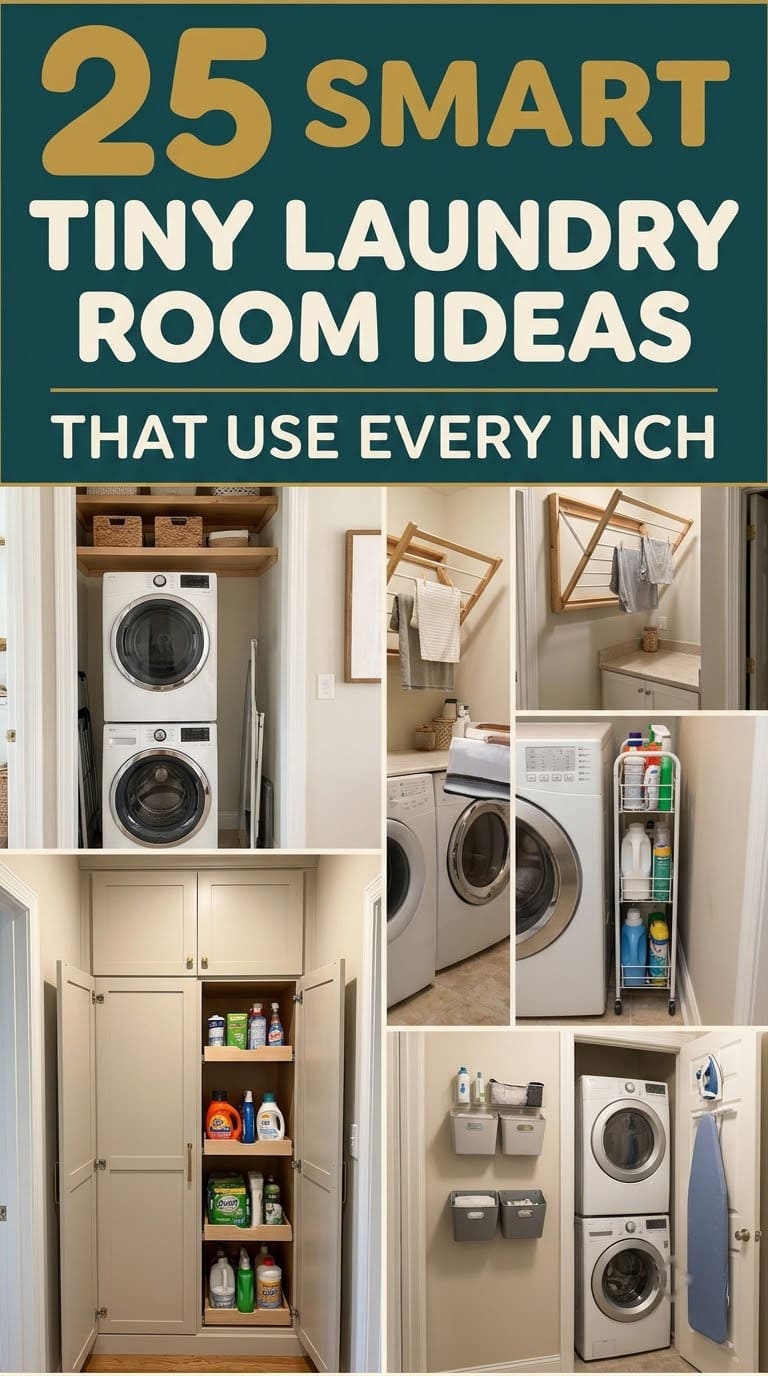
Stacking puts the dryer on top of the washer and frees a big share of the floor. It’s a common fix for a tiny room. Helgeson’s small laundry porch was designed around its stacked machines.
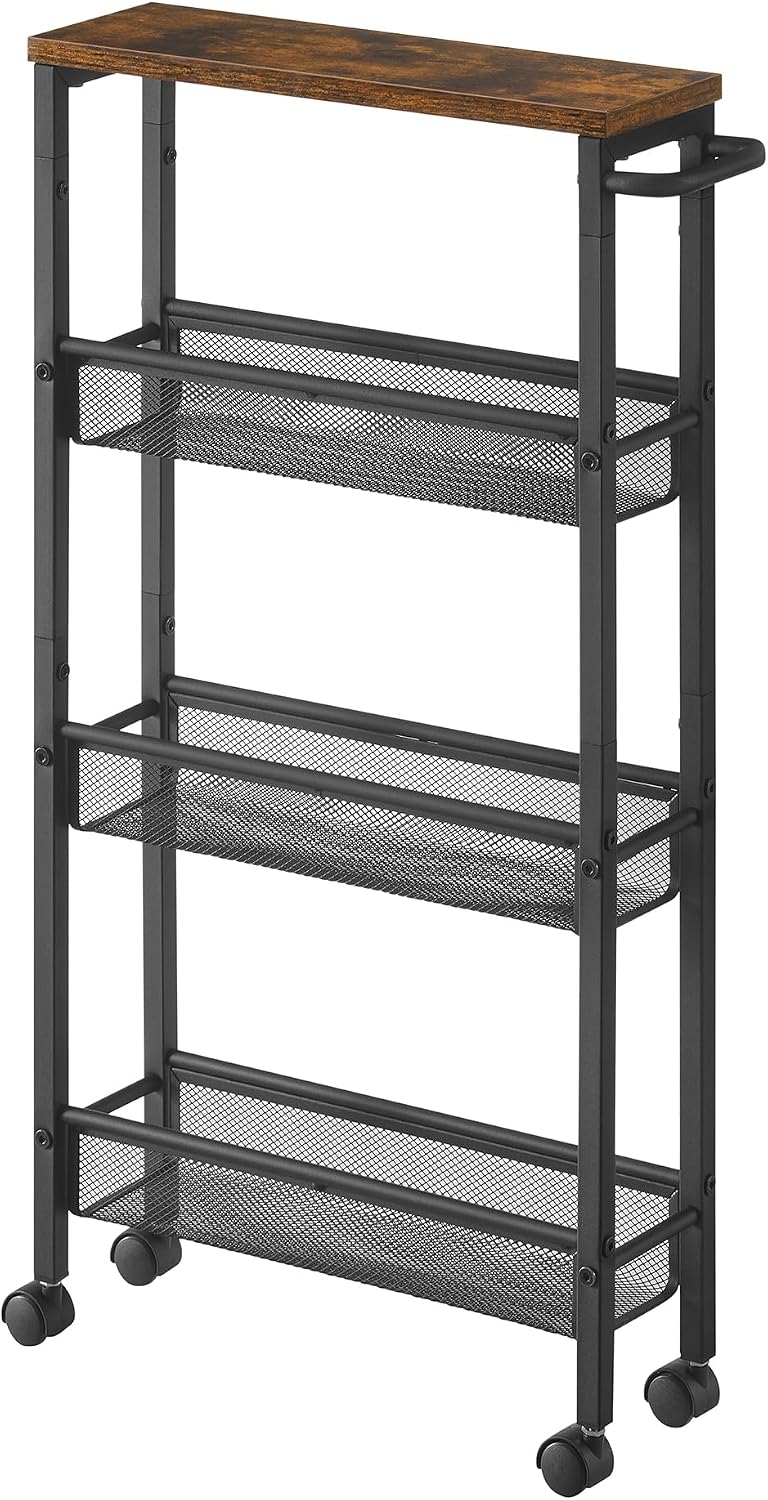
A metal slim cart, 5.1 x 17.9 x 30.3 inches, with four swivel casters. It suits idea 13. Rated 4.4 stars from 1,765 ratings.
Shop NowThis post contains affiliate links. We may earn a commission on qualifying purchases at no extra cost to you.
Check that you can reach the controls and the lint filter at the top. Use the kit made for your two machines.
The catch is height. A tall stack leaves less room for shelves above, so measure the ceiling first.
Put your detergent and a step stool within reach of the stack.
2. Side-by-Side With a Counter on Top
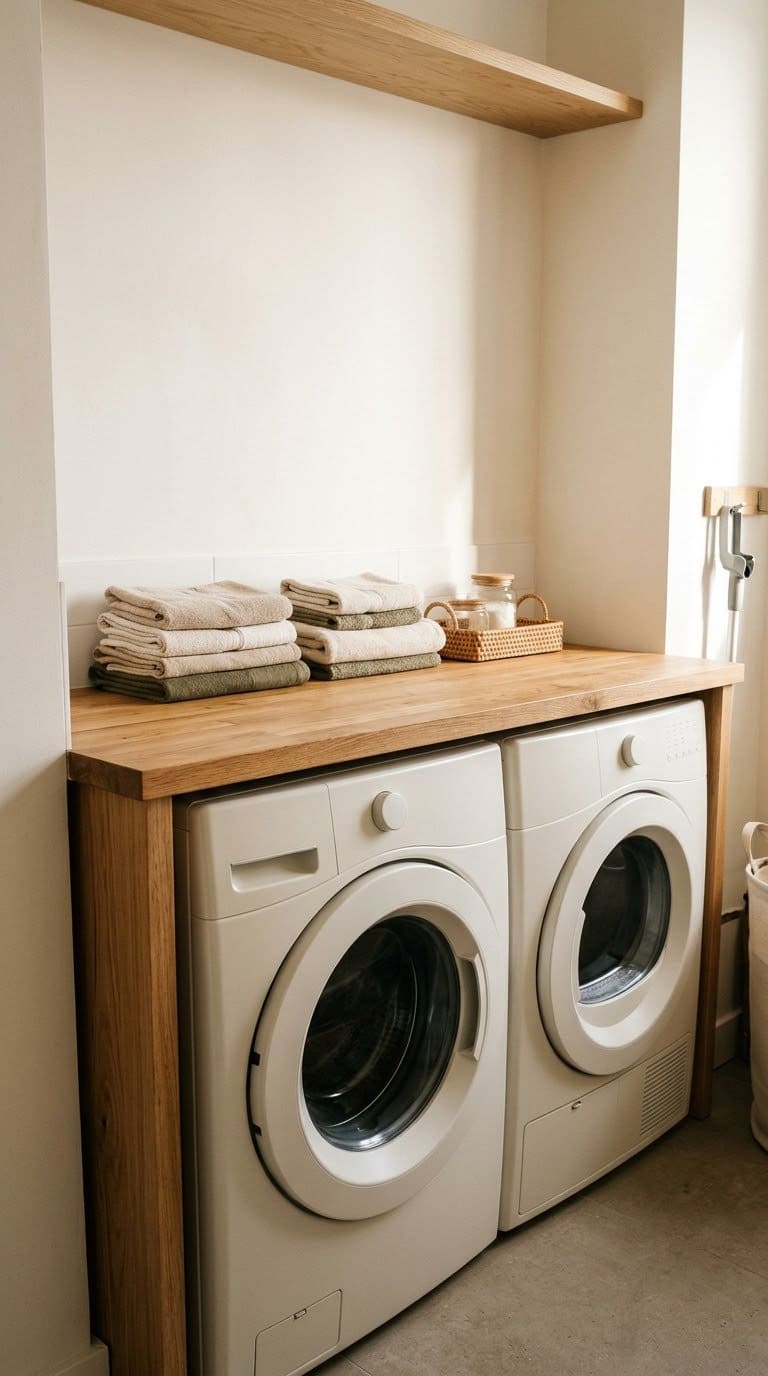
If you keep two machines side by side, bridge them with a counter. Public Storage suggests a countertop above side-by-side machines as a folding surface.
Mollé also advises leaving plenty of working counter space. A counter gives you a place to fold and sort.
Mind the access. A fixed counter can block the top of a top-load washer, so use front-loaders under it.
Leave a small gap behind the counter for hoses and the vent. Seal the surface so splashes don’t mark it.
3. A Ventless Dryer
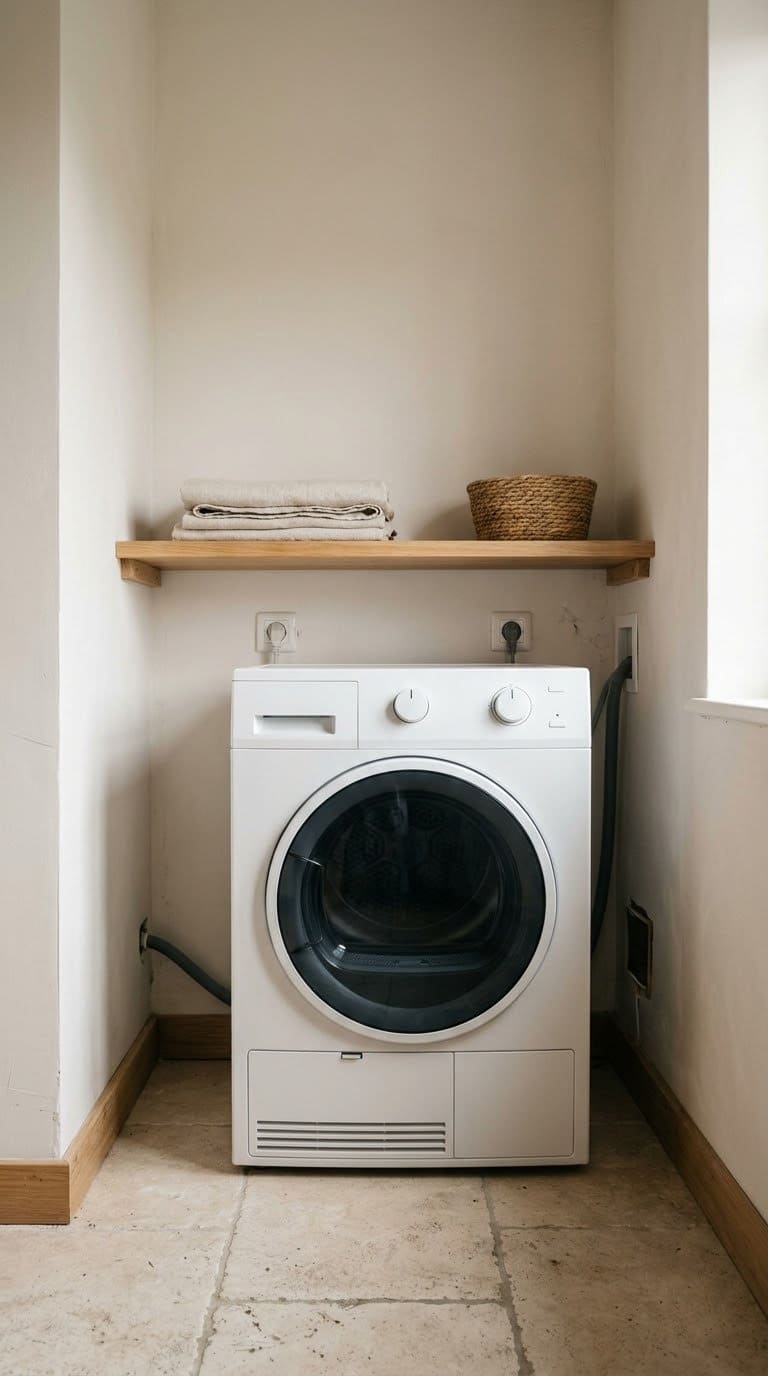
If you can’t run a vent, a ventless dryer is an option. Kristine Klein wrote in Fine Homebuilding that condenser and heat-pump dryers dry clothes without venting outdoors.


Klein notes that both types drain condensate through a pipe or collect it in a tank. Vented dryers are the fastest, condenser dryers are the slowest and heat-pump dryers fall in between.
Cost and speed are the tradeoffs. Klein says vented dryers are the cheapest and heat-pump dryers the most expensive.
If you choose one, plan where the water goes. Check the manual for the drain or tank, and for the room it needs.
4. Top-Load Washer Under a Counter or Shelf
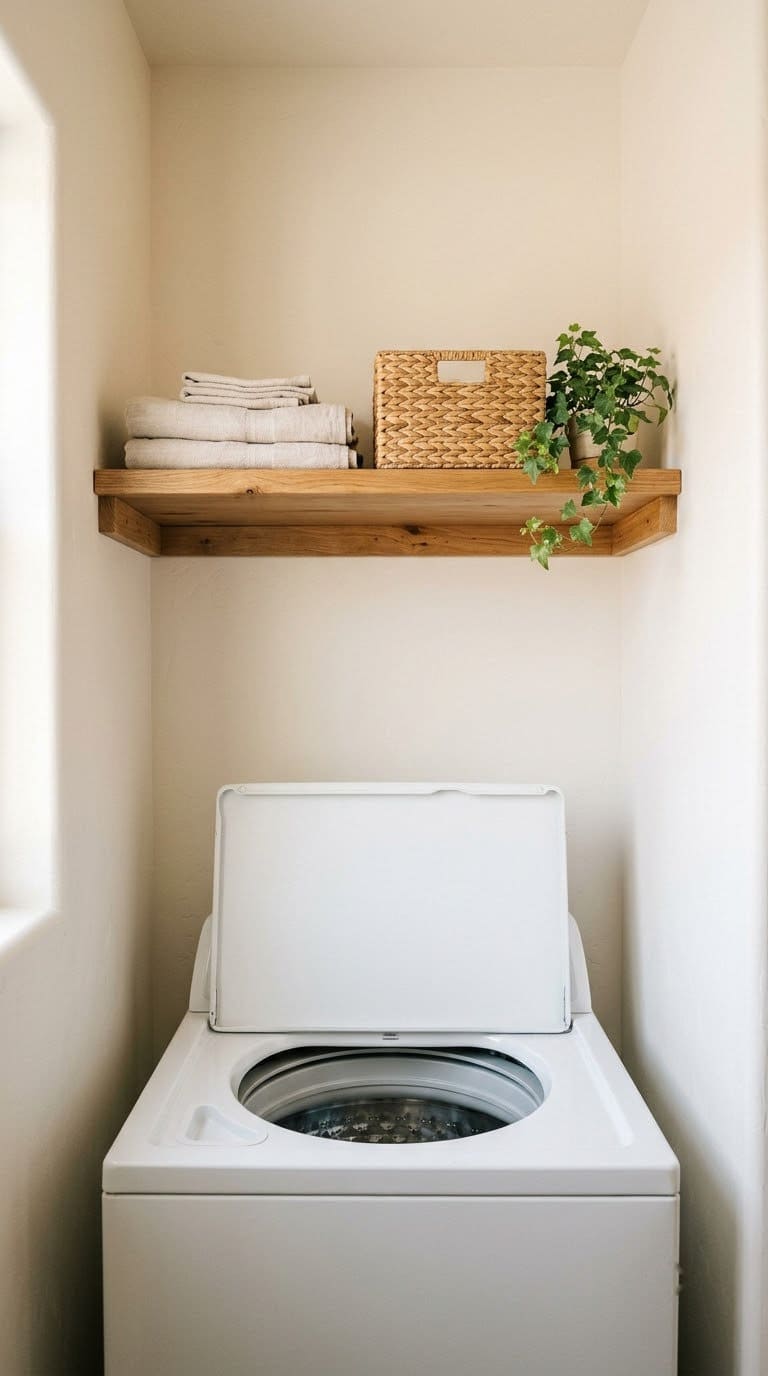
A top-load washer fits a narrow room, but its lid needs headroom. Put a shelf high enough above it that the lid opens fully.
Measure the lid when it’s open, not just the machine. Add the height of your tallest detergent bottle.
Don’t use the counter from idea 2 here. A fixed counter over a top-loader blocks the lid, so use a shelf or a folding surface instead.
Pair it with idea 10, a rack that folds flat, so the lid area stays clear.
5. All-in-One Combo Unit
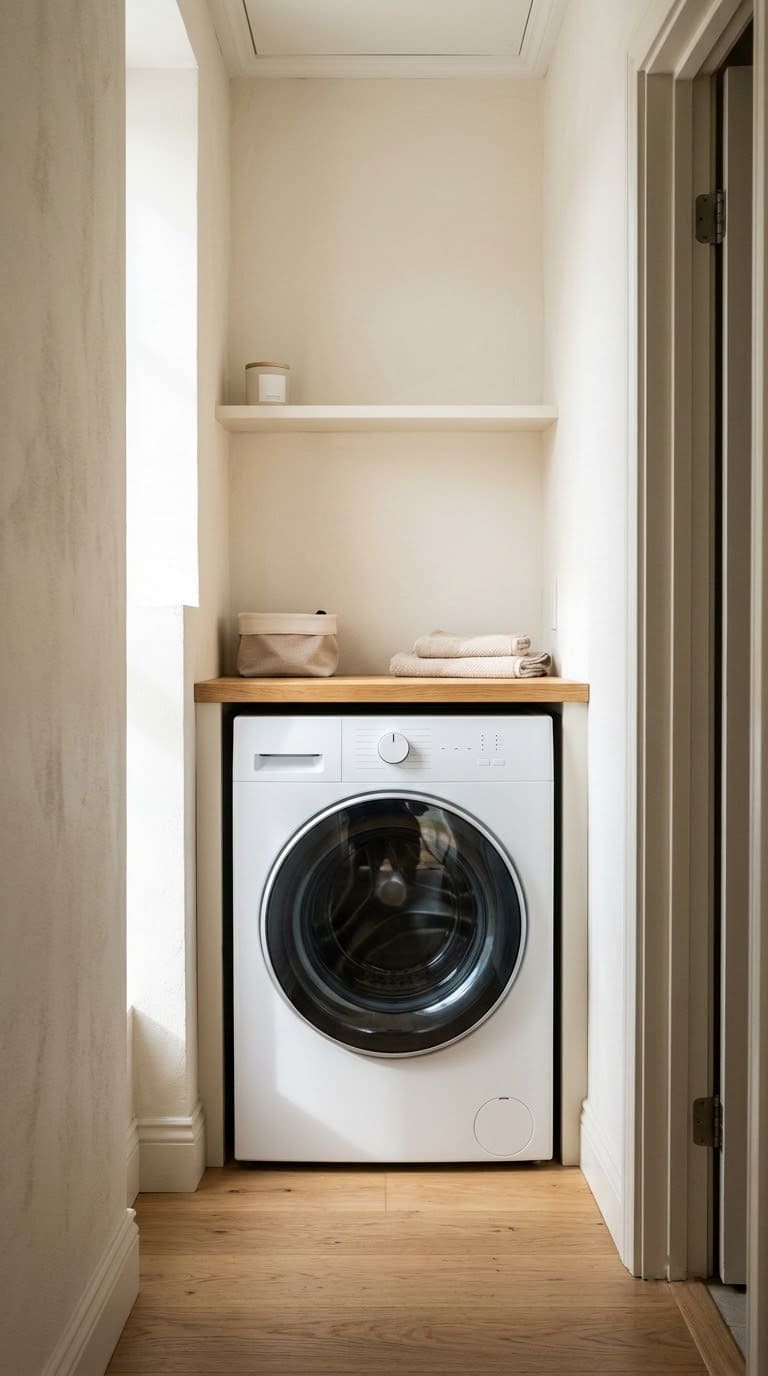
A combo washes and dries in one machine, so you need one footprint instead of two. It suits a hallway nook or an apartment.
Read the specs before you buy. Look at drum capacity and the length of the dry cycle.
Speed and capacity are the tradeoffs. Check both against how much laundry your household does, since a combo may take longer than a separate dryer.
Place it where you can reach the filter and the water drain. Leave the clearances your manual lists.
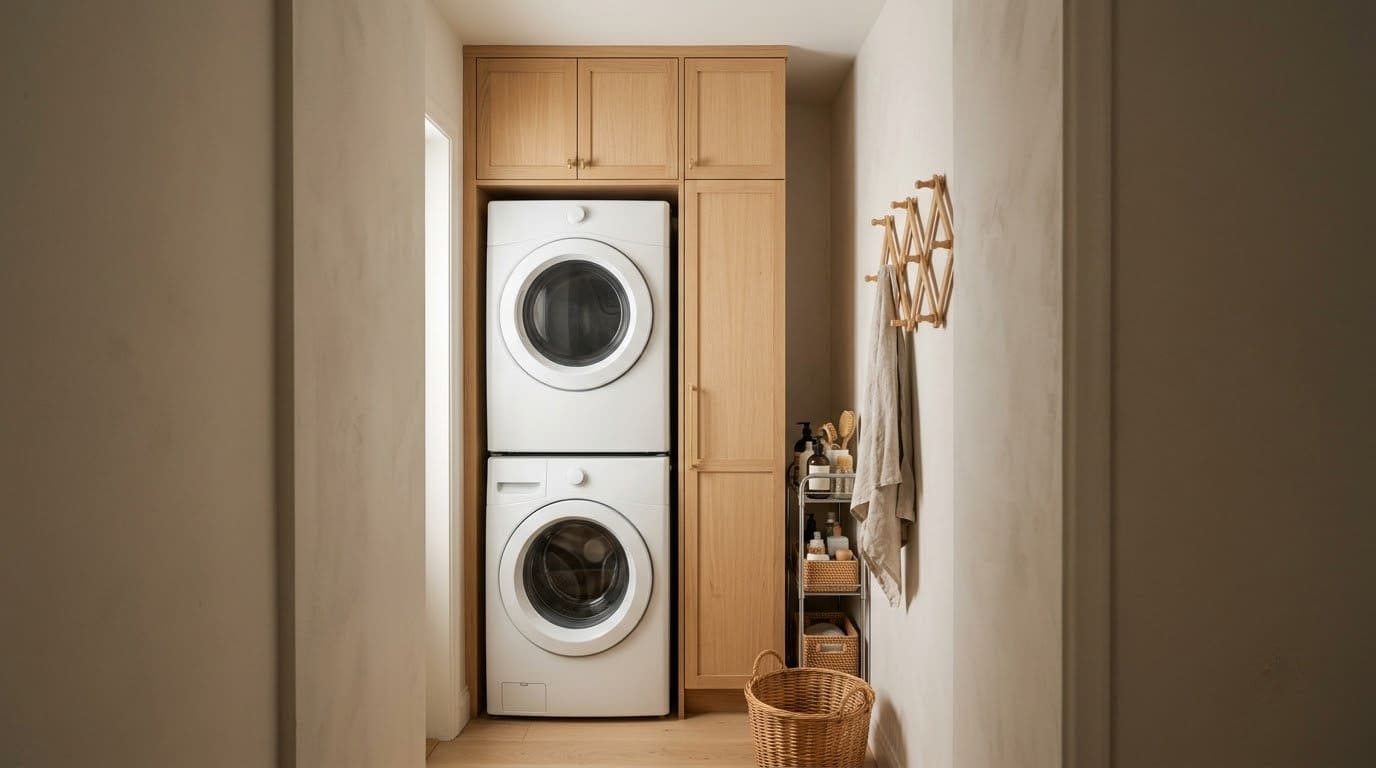
6. Laundry Closet or Hallway Nook
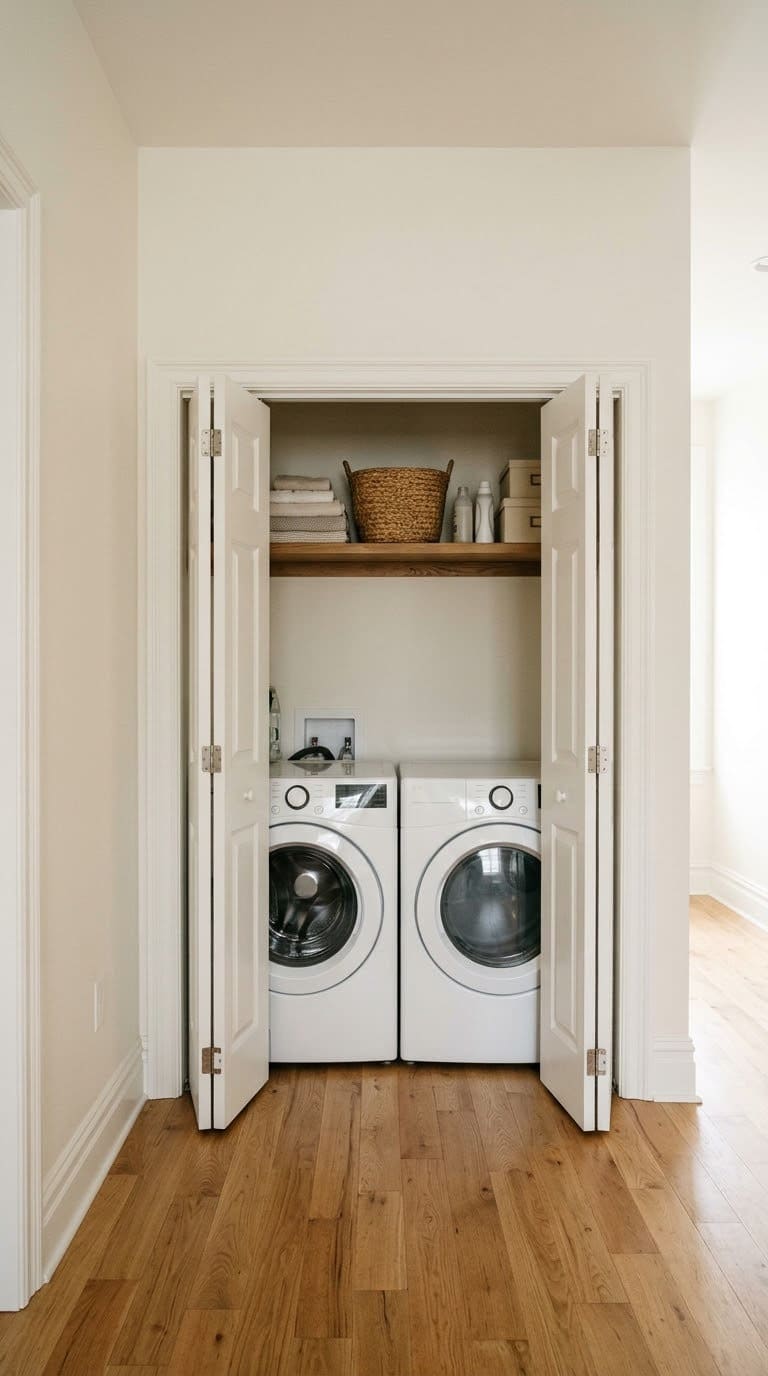
Tuck the machines into a closet or hallway nook and close the doors. It hides the mess and muffles some noise.
Interior designer Valerie Helgeson says to think vertically when wall space is limited. A closet gives you walls on three sides to build on.
Heat and ventilation need care. Check your manual for door and clearance rules, and never block the dryer vent.
Open the doors during a load. That keeps warm air from building up.
7. Full-Height Cabinets
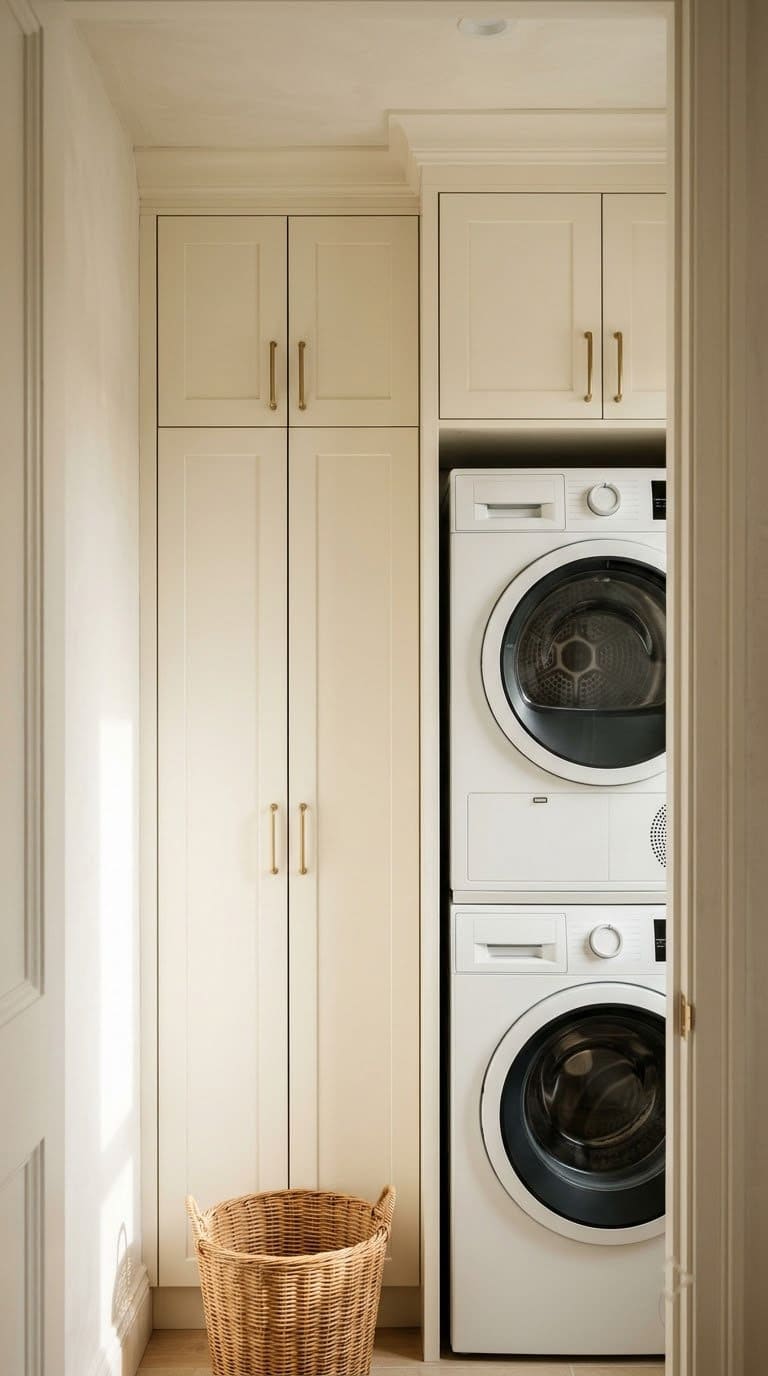
Helgeson’s laundry porch was designed around full-height cabinetry as well as stacked machines. Tall cabinets use the whole wall.
Mollé recommends maximizing storage with cabinetry. Put rarely used items high and daily supplies at eye level.
Bulk is the risk. Closed cabinets can make a tiny room feel heavy, so choose light colors or leave one section open.
Add a pull-out shelf at the bottom for heavy detergent. It saves your back.
8. Open Shelves Above the Machines
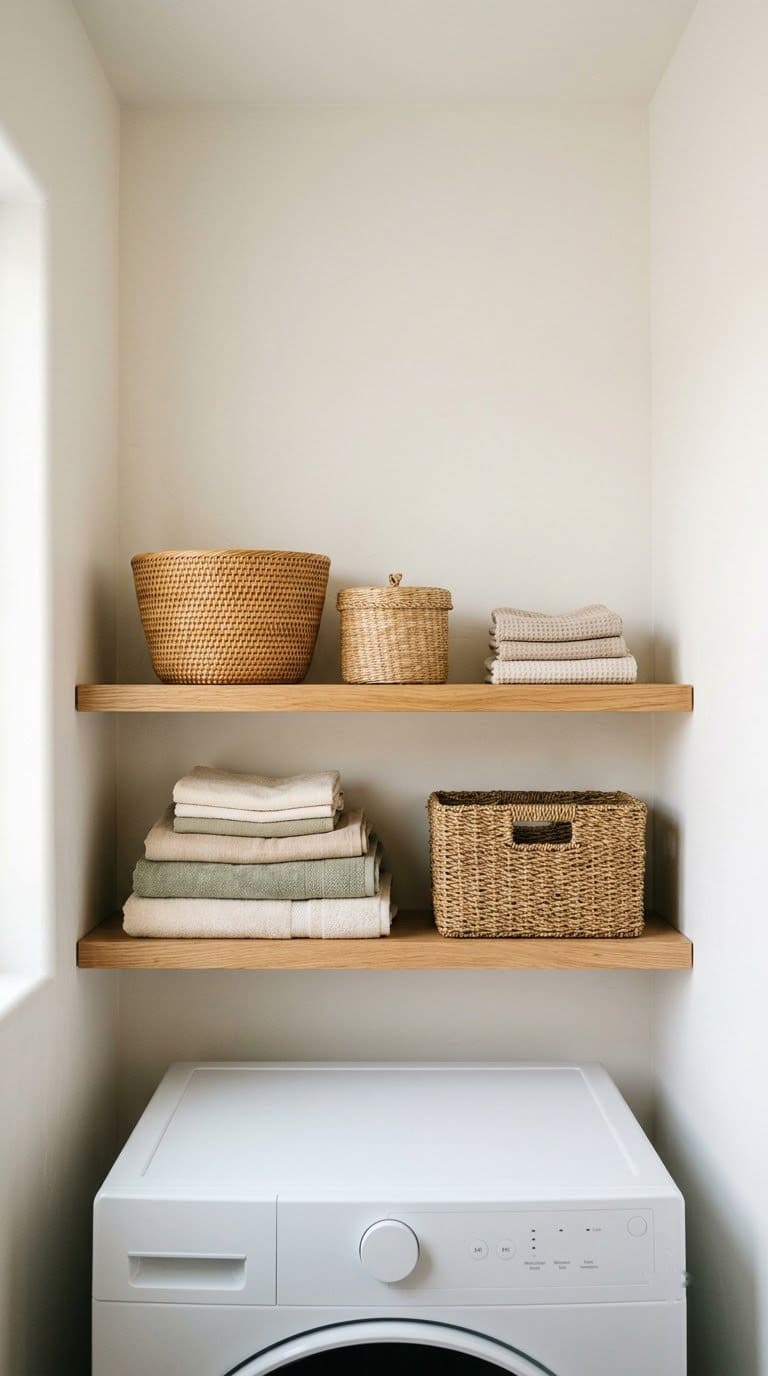
Public Storage suggests open shelves or wall cabinets above the washer and dryer for everyday supplies. Shelves cost less than cabinets and look lighter.
Mount them into studs and fill them with matching baskets. Keep the lowest shelf above your head so you don’t bump it.
Open shelves collect dust and clutter. Open shelves show everything, so keep only what you use weekly there.
Put detergent and cleaners out of reach of kids and pets, and keep them in their original containers.
9. Shelf Over the Door
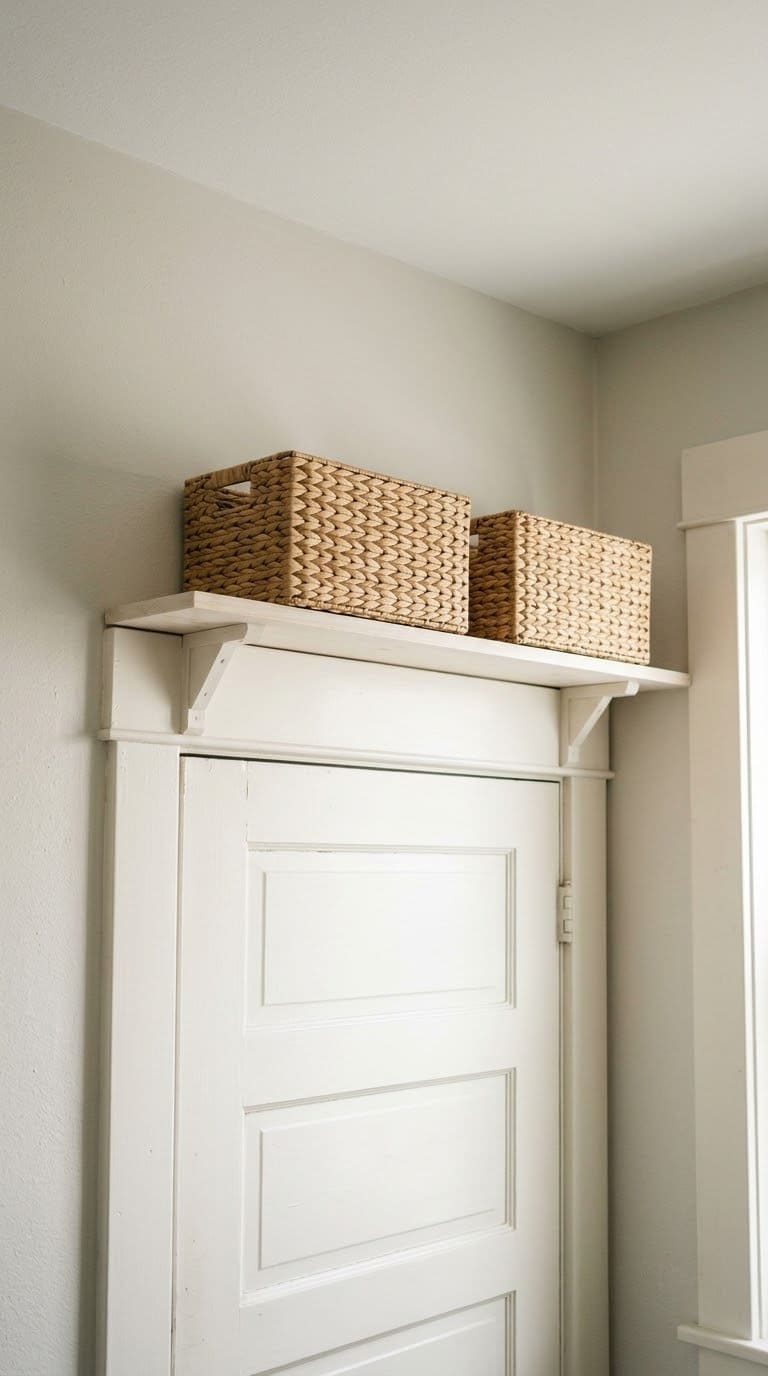
The wall above the door is wasted space in most rooms. A shelf there holds things you need a few times a year.
Mount it into studs and keep it shallow. Store light items like spare baskets and seasonal linens.
Reach is the trade. You’ll need a step stool, so don’t store daily items up there.
Label the front edge so you can find things fast. Keep heavy boxes lower.
10. Drying Rack That Folds Flat
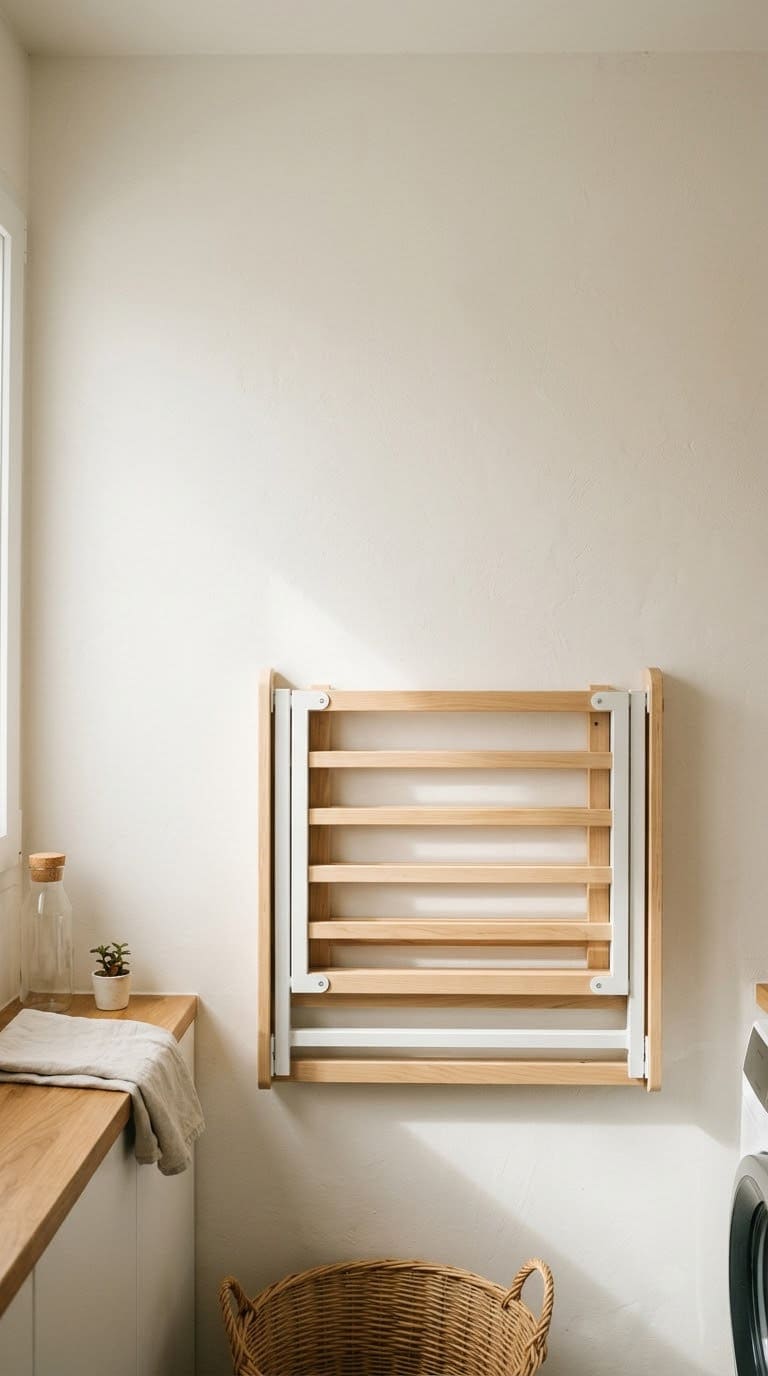
Mollé’s design includes a drying rack that folds flat against the wall. Public Storage also suggests a wall-mounted rack near the washer.
Pick a rack with a stated load rating and mount it into studs. Fold it flat when it’s not in use.
The catch is drips. Hang a towel or place a shallow tray below, and keep it away from the dryer exhaust.
Mount it where you can still open the machine doors. Measure the swing first.
11. Hook Rail for Hangers and Bags
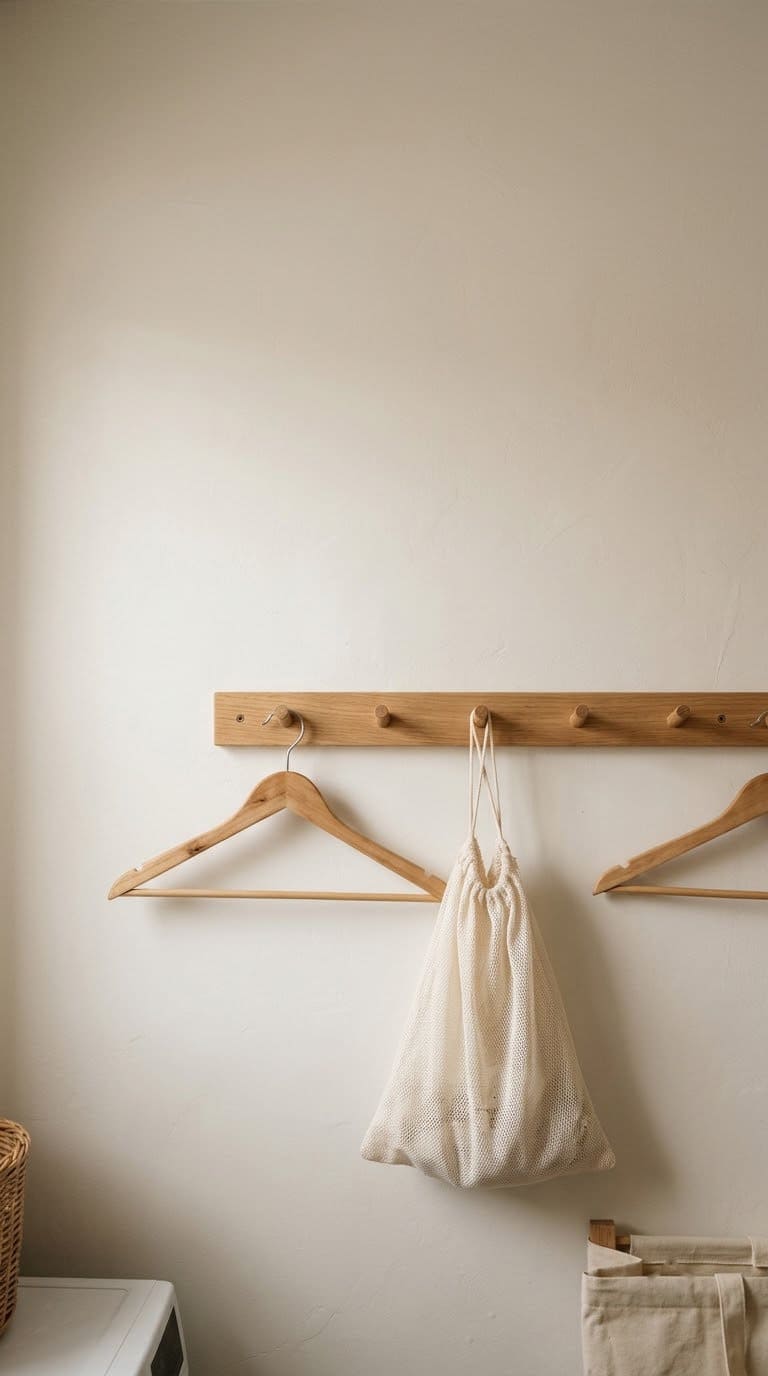
A hook rail takes almost no depth, which suits a narrow room. Hang hangers, mesh bags and a lint brush.
Mount it at eye level and into studs. Space the hooks a hand apart.
Clutter creeps in. A rail fills up fast, so set a rule of one item per hook.
Paint the rail the same color as the wall so it blends in.
12. Pegboard for the Odd Things
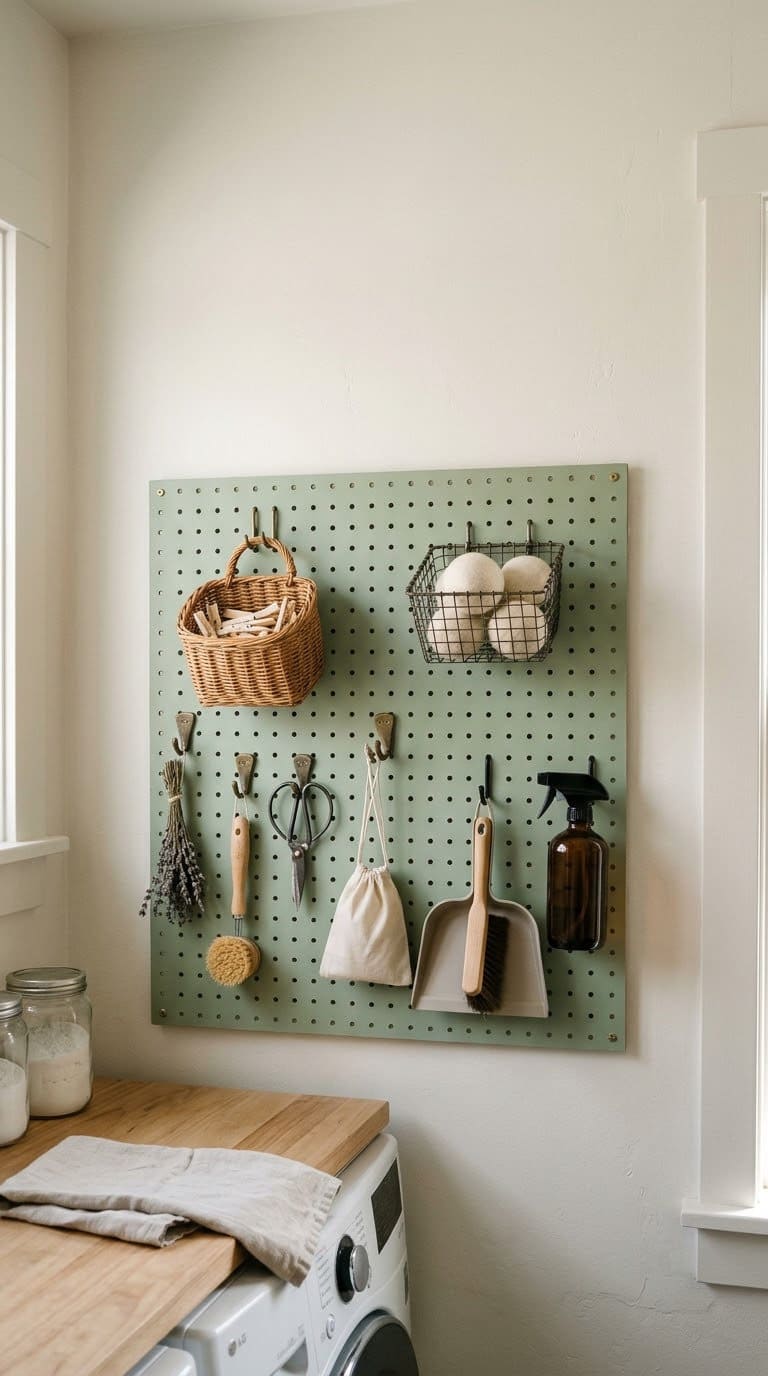
Pegboard holds the odd items that never fit elsewhere. Hang a stain stick, a small basket for coins and a lint roller.
Mount the board into studs and use hooks rated for the load. Paint it a calm color.
It can look busy. Limit it to a handful of items, and keep the rest in a cabinet.
Place it beside the machines so tools are within reach.
13. Slim Rolling Cart Between Machine and Wall
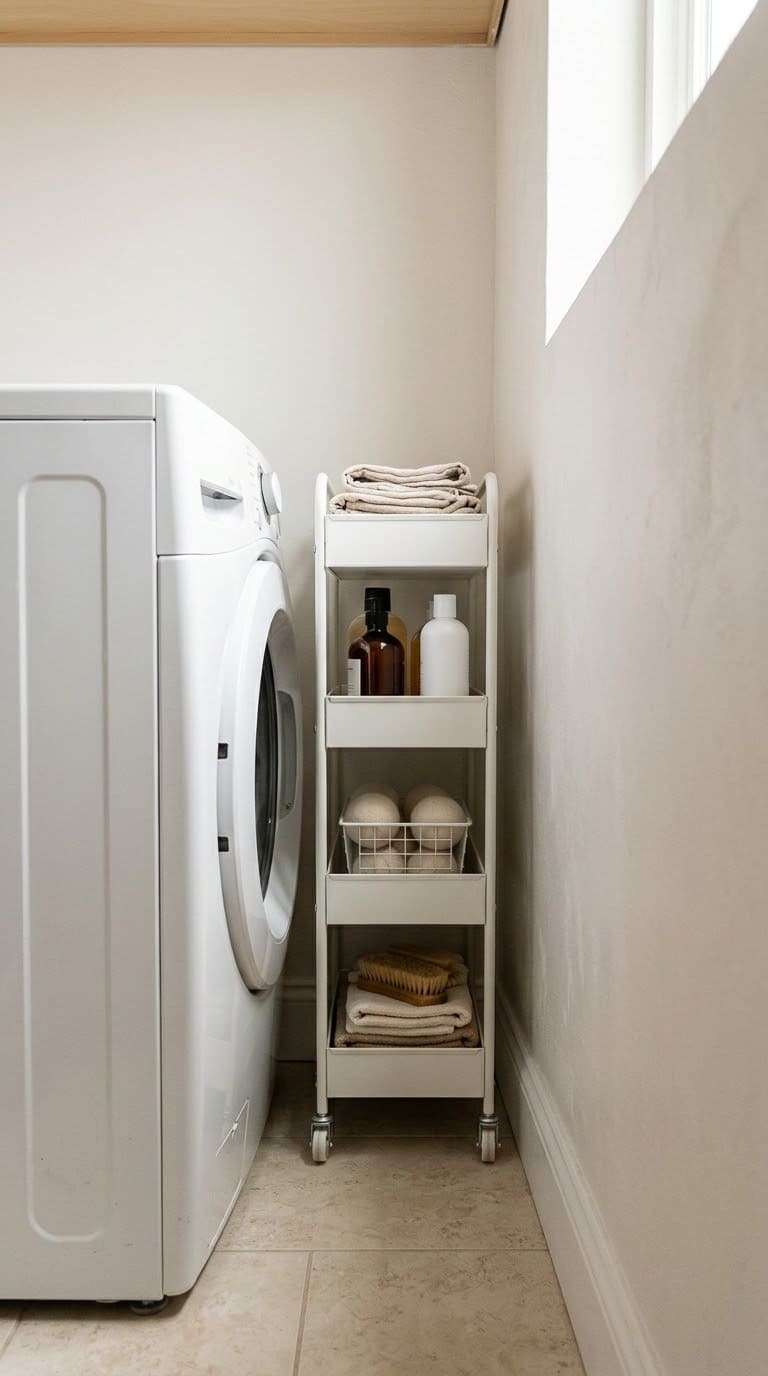
A slim cart slides into a narrow gap and rolls out when you need it. Our product pick measures 5.1 inches deep and 17.9 inches wide.
Measure the gap at several heights, not just the top. Walls and hoses can narrow the space lower down.
Stability matters. A tall cart with heavy bottles can tip, so keep heavy items on the bottom shelf.
Check that the cart doesn’t block the vent or the hoses. Keep the path clear.
14. Over-the-Door Hamper
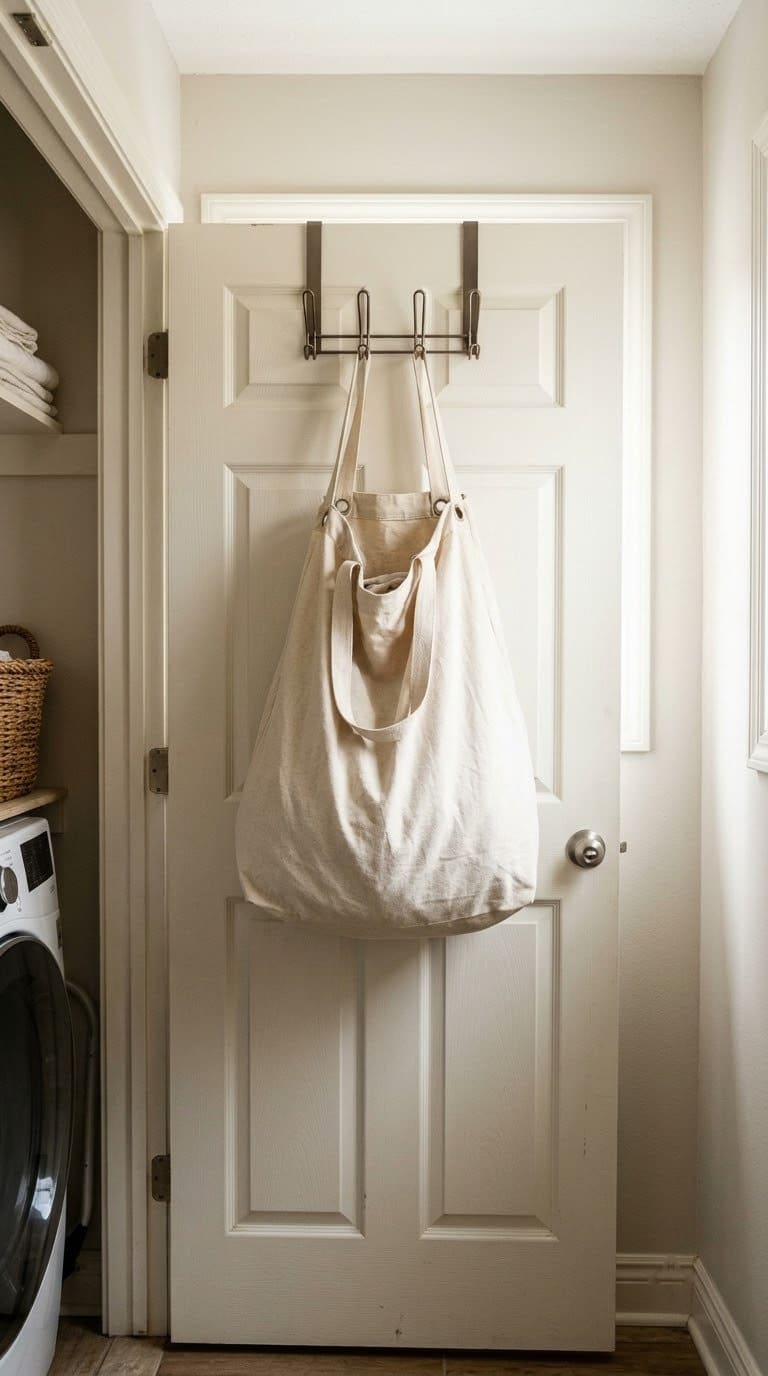
A hanging hamper uses the back of the door and no floor. Our product pick is 20 by 30 inches and fits doors 1.37 to 1.97 inches thick.
Measure your door thickness before you buy. Test that the door still closes with a full bag.
Weight is the limit. A full bag of wet towels is heavy, so empty it before it overflows.
Choose one that unzips at the bottom so you can drop clothes into the machine.
15. Over-the-Door Ironing Board Caddy
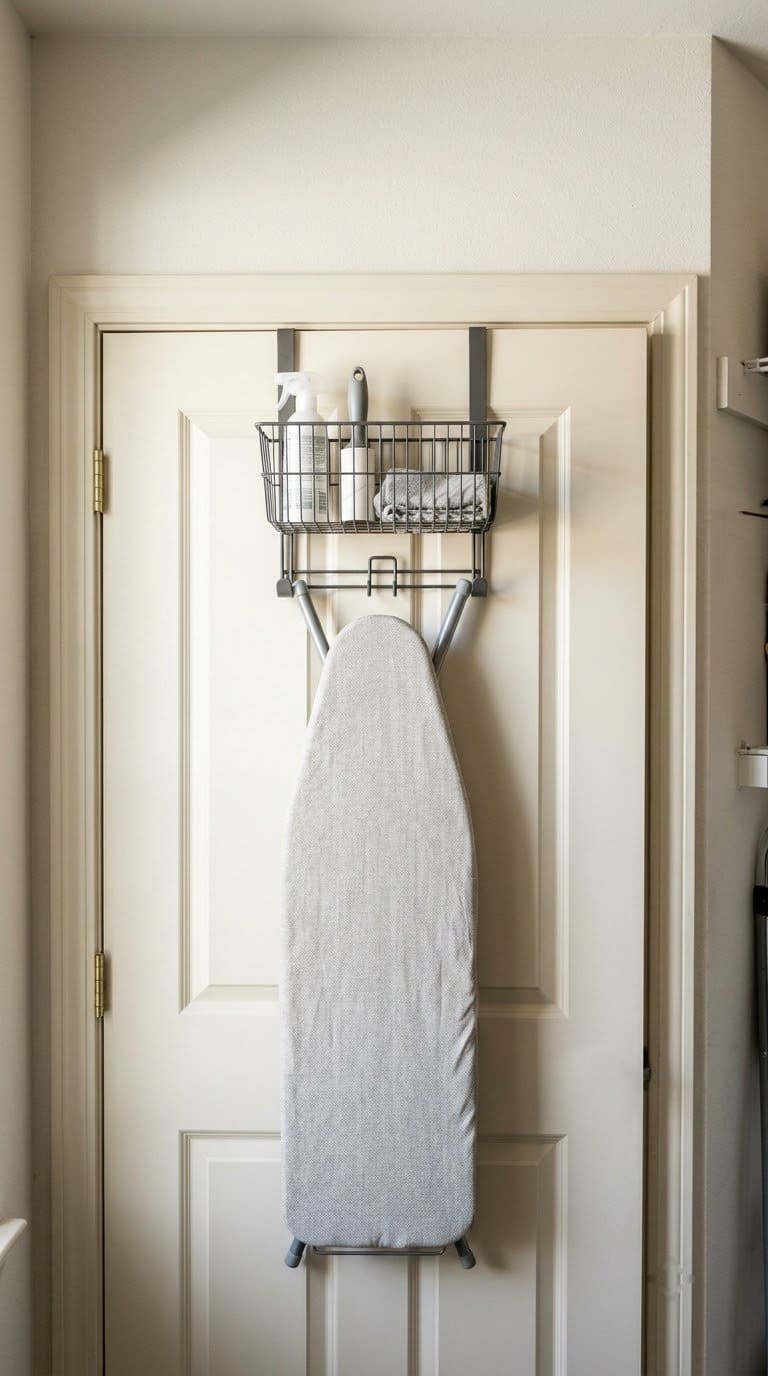
A caddy hangs the ironing board flat against the door. Our product pick has a basket rated for 30 lb that holds the iron and supplies.
Check that your board’s legs fit the hooks. Keep the iron cool and unplugged before you store it.
Door space is limited. If you also use idea 14, one door may not hold both.
Put the caddy on a wall if the door is full. It works either way.
16. Bifold or Pocket Door
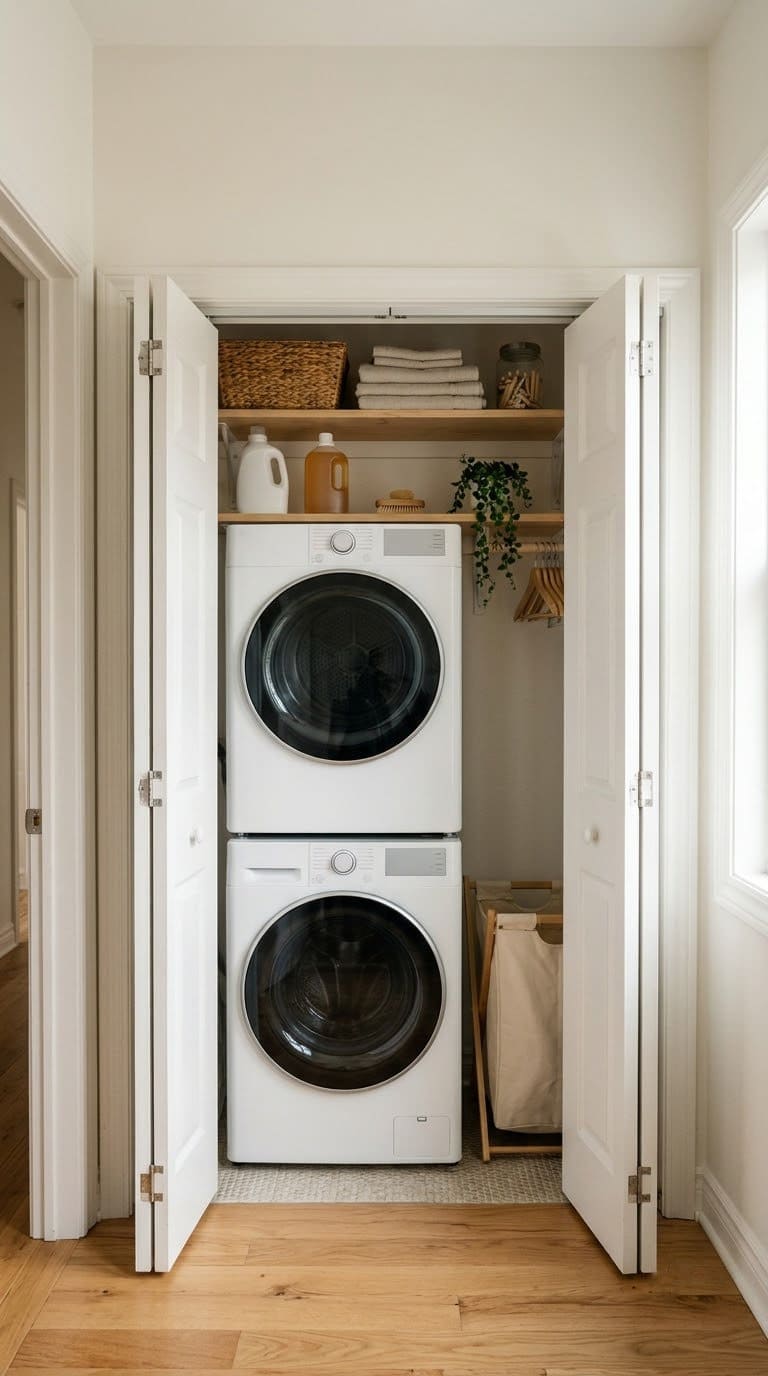
A swing door eats floor space. A bifold or pocket door folds out of the way.
Measure the opening and the space the door would need. A pocket door needs space inside the wall, so ask a contractor.
Cost and ventilation both matter. If the machines sit behind a closed door, check your manual for ventilation rules.
Leave the doors open during a dryer load. It keeps heat from building up.
17. Corner Shelf
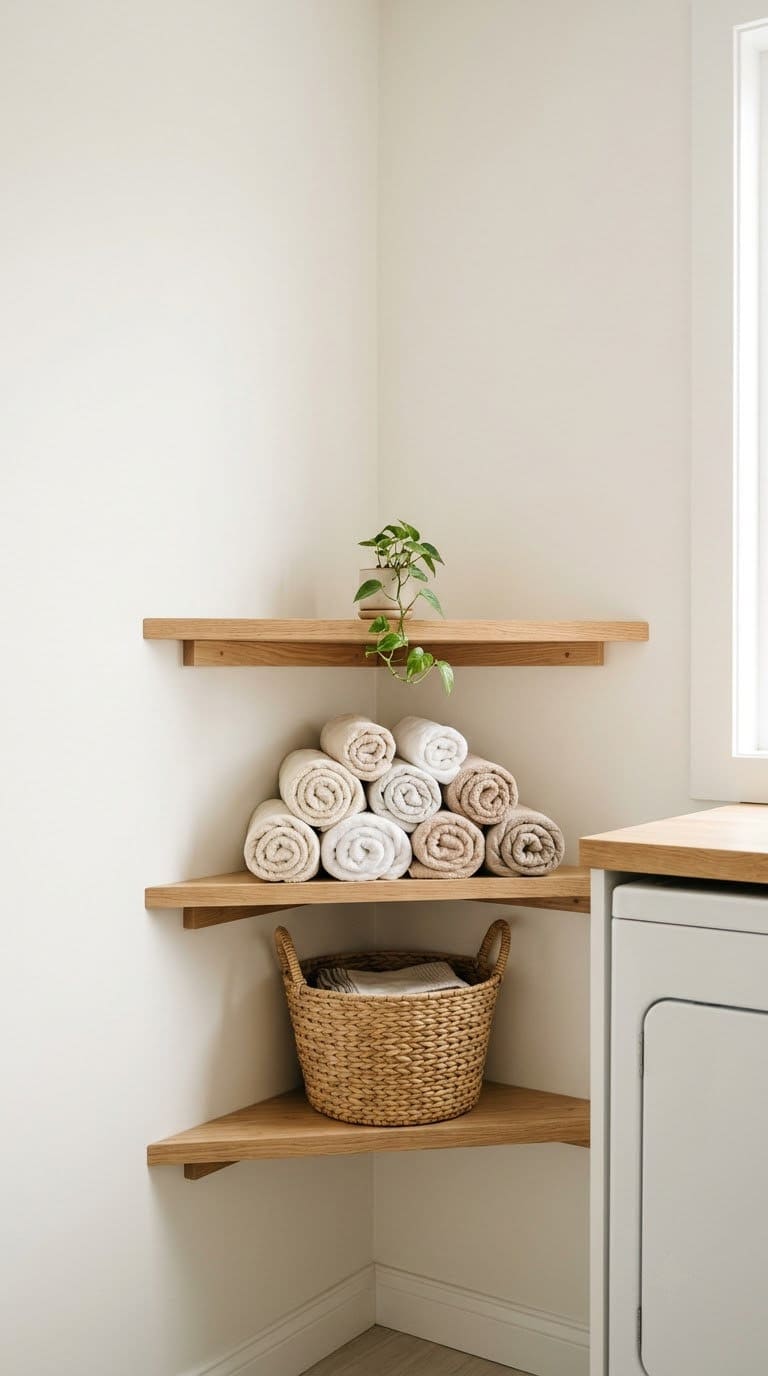
A corner shelf uses a spot nobody else wants. It holds towels, baskets or a plant.
Mount it into a stud or use the right anchors for your wall. Keep it above the machines’ reach.
Corners vary. Measure the angle before you buy.
Use it for lightweight items. Heavy things belong on a stud-mounted shelf.
18. Tension Rod for Hanging
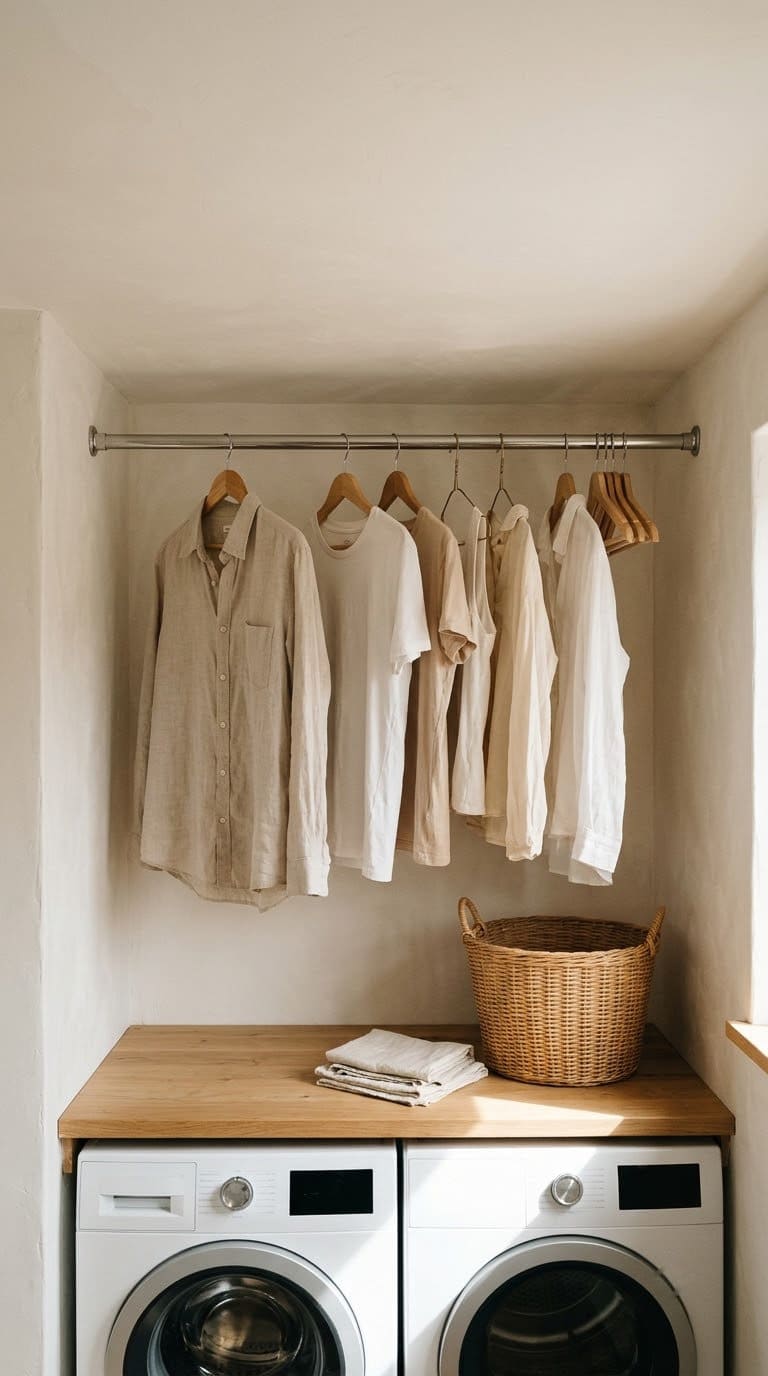
A tension rod is a no-drill hanging bar. Stretch it across the nook or above the machines for drip-drying shirts.
Pick a rod rated for the load. Wipe its ends so it grips.
Slipping is the risk. A heavy load can pull a tension rod down, so keep it for light items.
Place a tray or towel under it to catch drips.
19. Light, Airy Paint and Texture
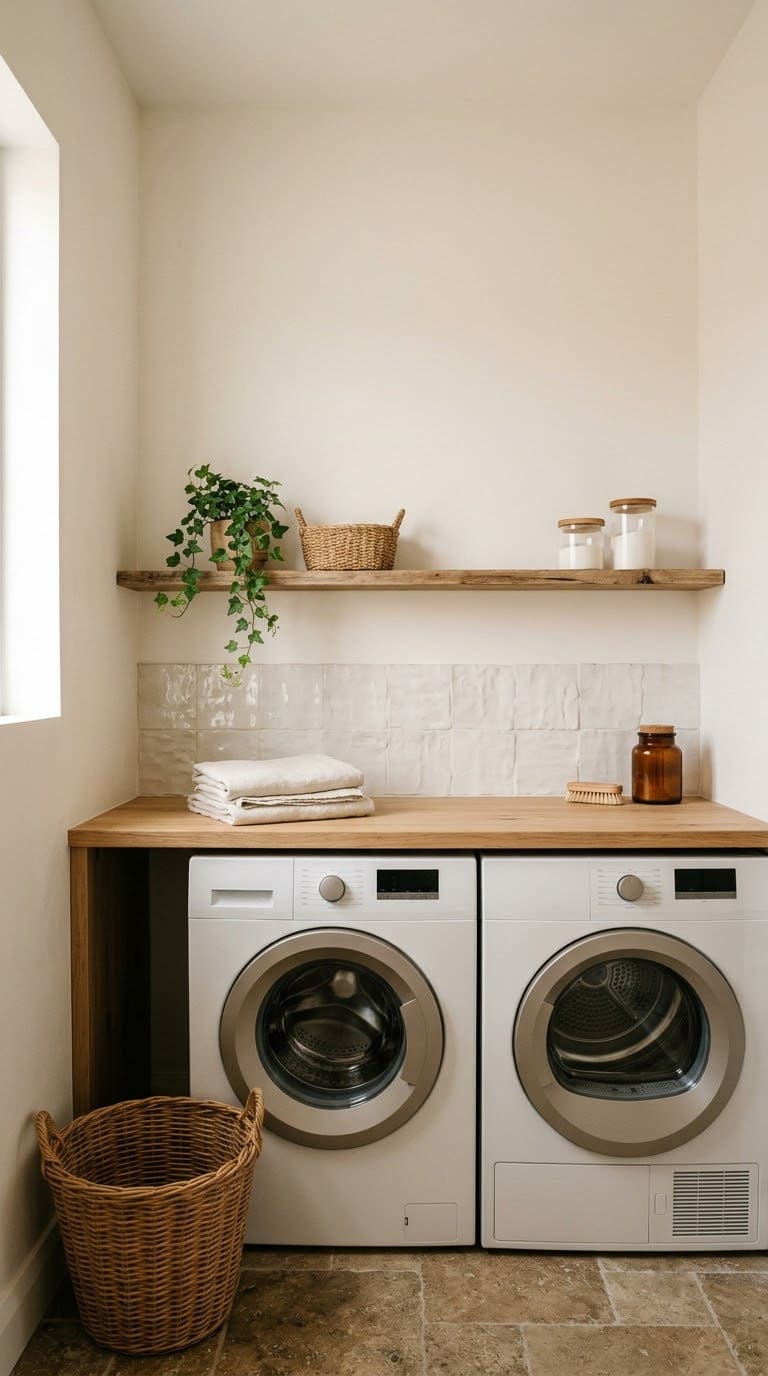
Mollé uses light, airy finishes with textured tile and warm wood notes. In a tiny room, light colors reflect light and feel bigger.
Pick a bathroom or kitchen paint that stands up to moisture. Add one textured material for warmth.
White shows lint and drips. Choose a slightly warm white and a wipeable finish.
Add a wooden shelf for warmth. It breaks up the white.
20. Peel-and-Stick Wallpaper Accent
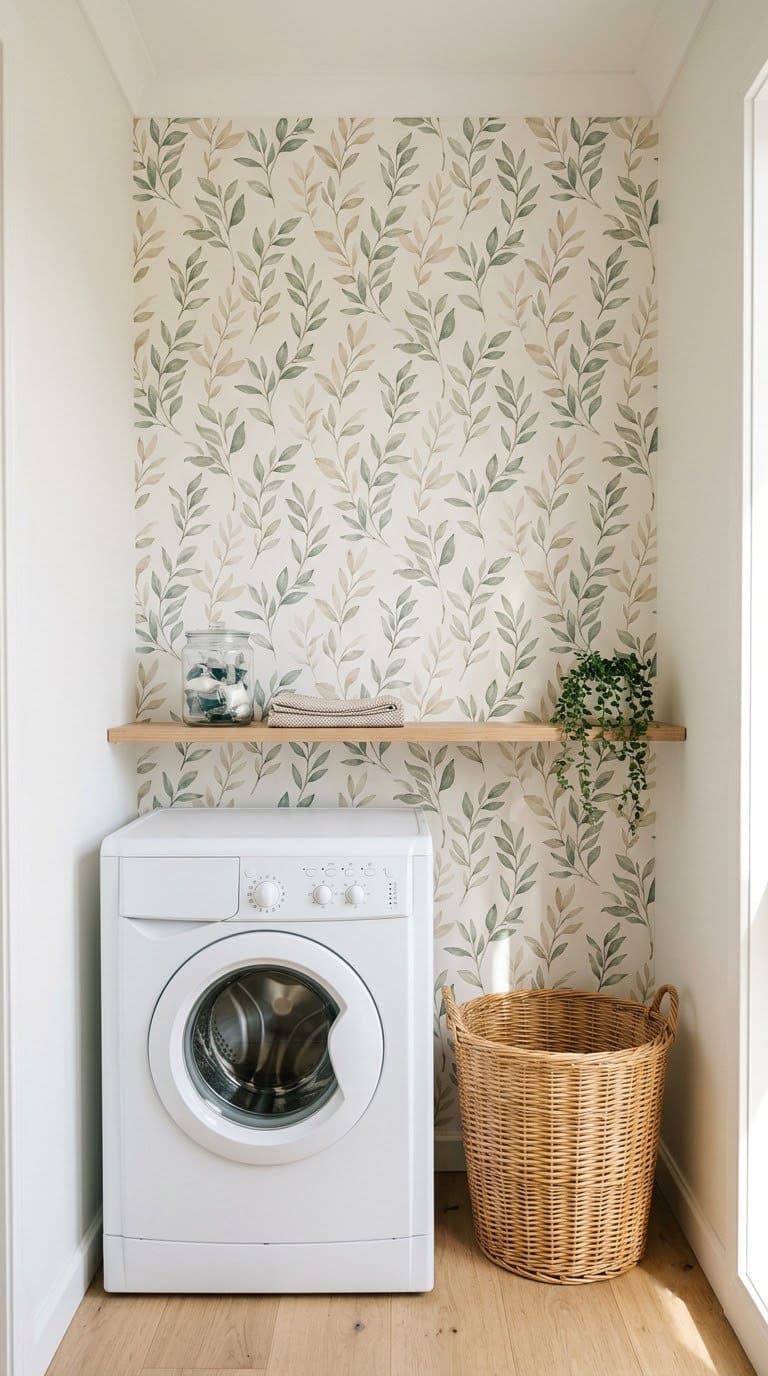
Wallpaper brings a pattern without painting. Peel-and-stick versions suit renters.
Put the paper on one wall only, behind the machines or on the back wall. Press the seams flat.
The catch is moisture. Steam can lift the edges, so run a fan and check the seams after a few weeks.
Pick a small-scale pattern for a tiny room.
21. Retro Floor Pattern
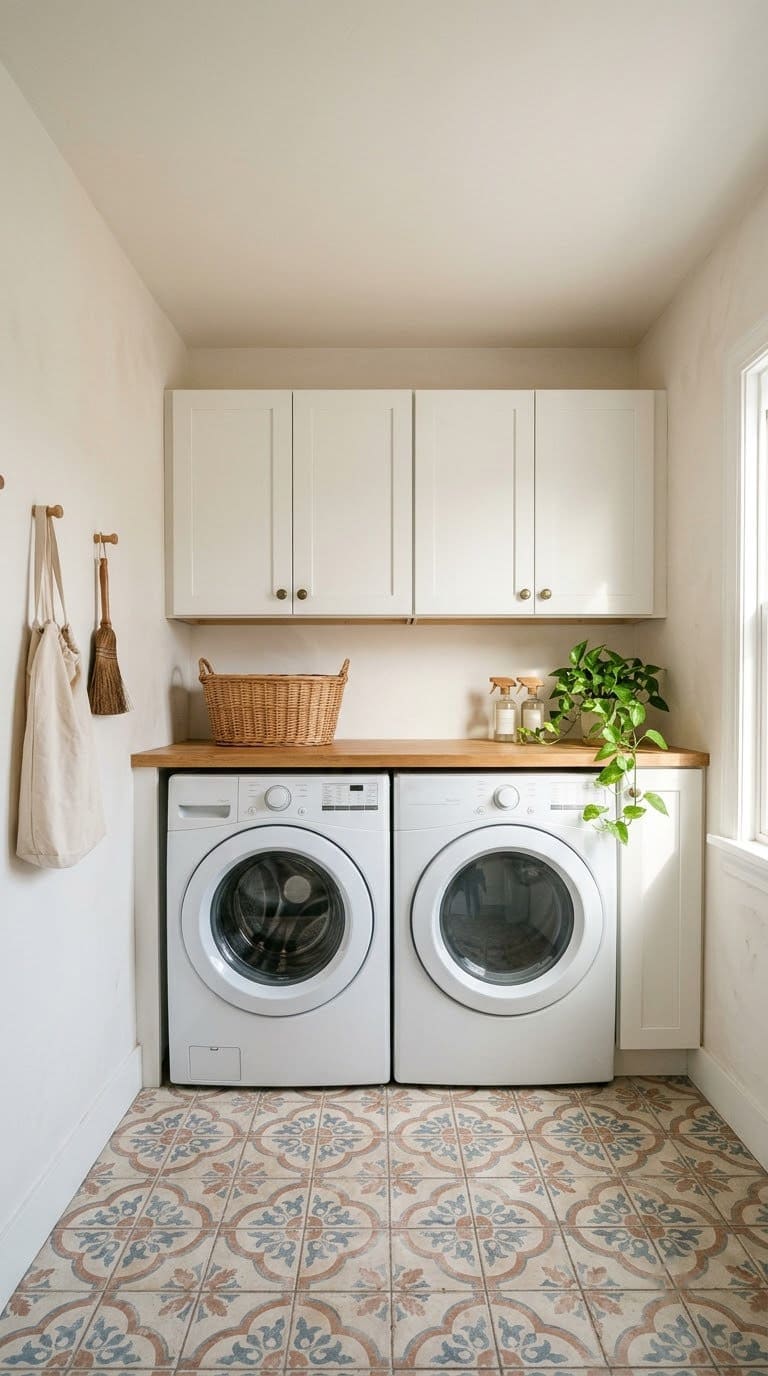
Designer Maggie Glendenning of Maggie + Co Studio used retro-inspired flooring for depth and playfulness, as Livingetc reported. A pattern underfoot adds interest without using any wall space.
Choose a durable, easy-clean floor. Vinyl tile or peel-and-stick tile suits renters.
Busy patterns can overwhelm. In a tiny room, a bold pattern can feel loud, so keep the walls calm.
Use a mat in front of the machines to hide drips.
22. Under-Cabinet LED Lights
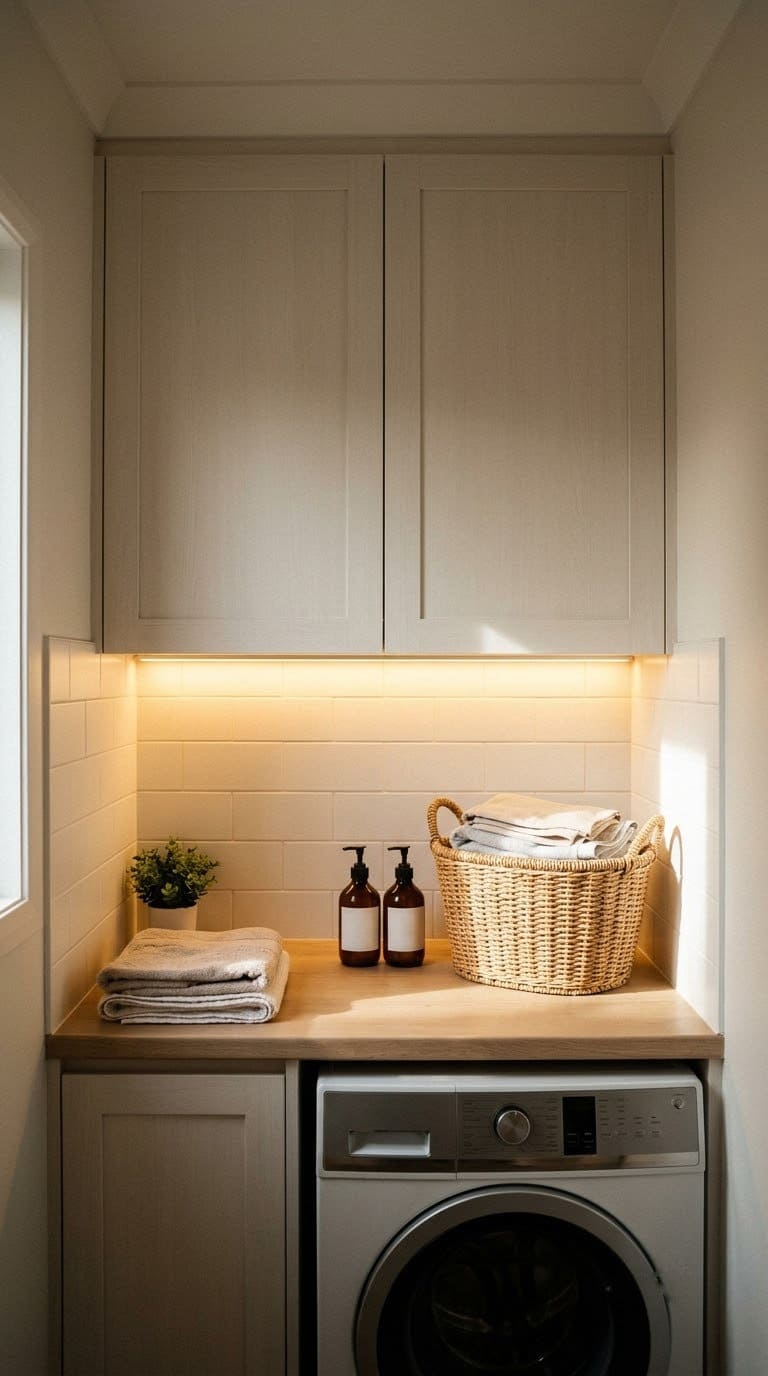
Strip lights under a cabinet make a small room feel brighter and help you read labels and spot stains.
Choose lights rated for damp areas and keep them away from the dryer exhaust.
Wiring is the hurdle. A plug-in strip is easiest, so hide the cord along the cabinet. Our laundry room lighting ideas help you plan.
Aim the light at the counter, not at your eyes.
23. A Mirror on a Door or Wall
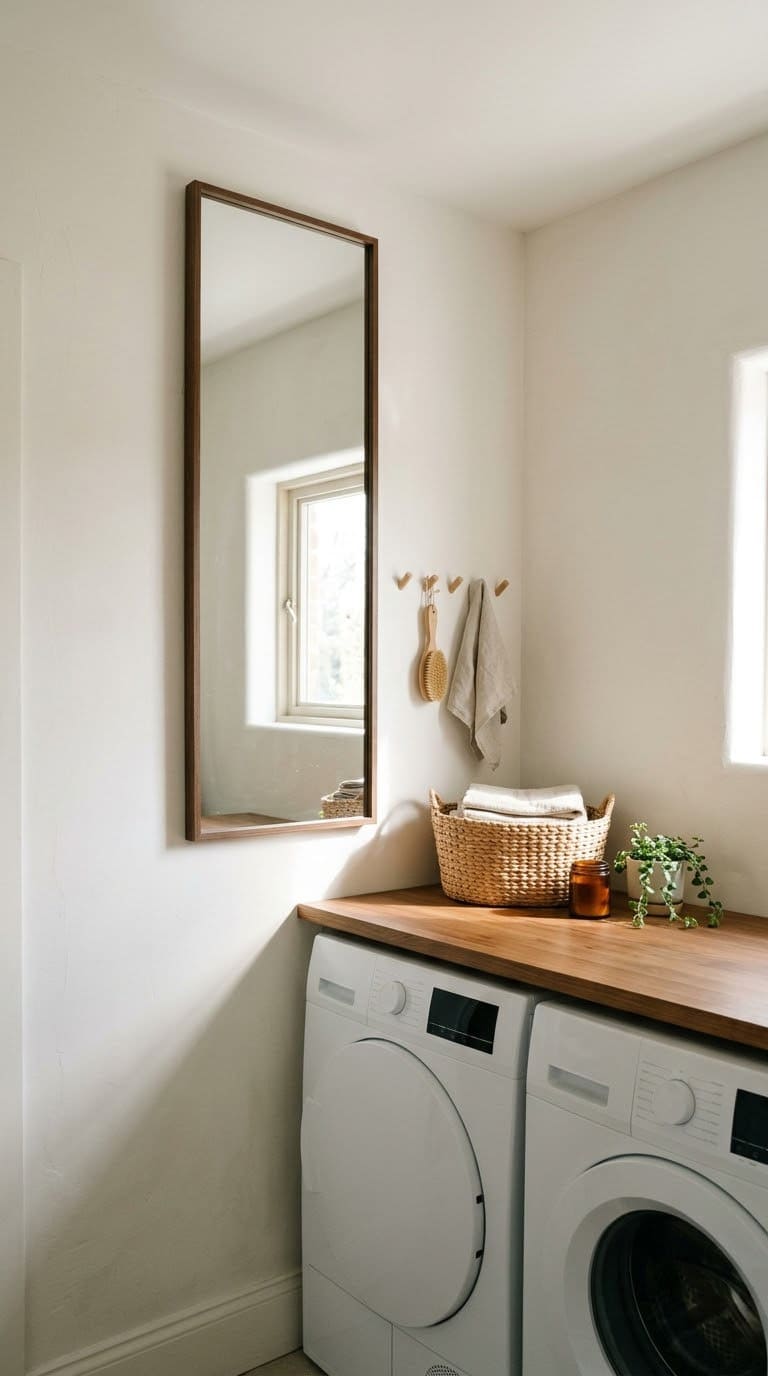
A mirror bounces light and makes a tiny room feel wider. Hang one opposite a window or a light.
Mount it securely and keep it away from the dryer’s steam. A small leaning mirror also works.
A mirror can show clutter. Keep the surfaces in view tidy.
Hang it on the back of a door if the walls are full.
24. Labeled Bins, One Per Person
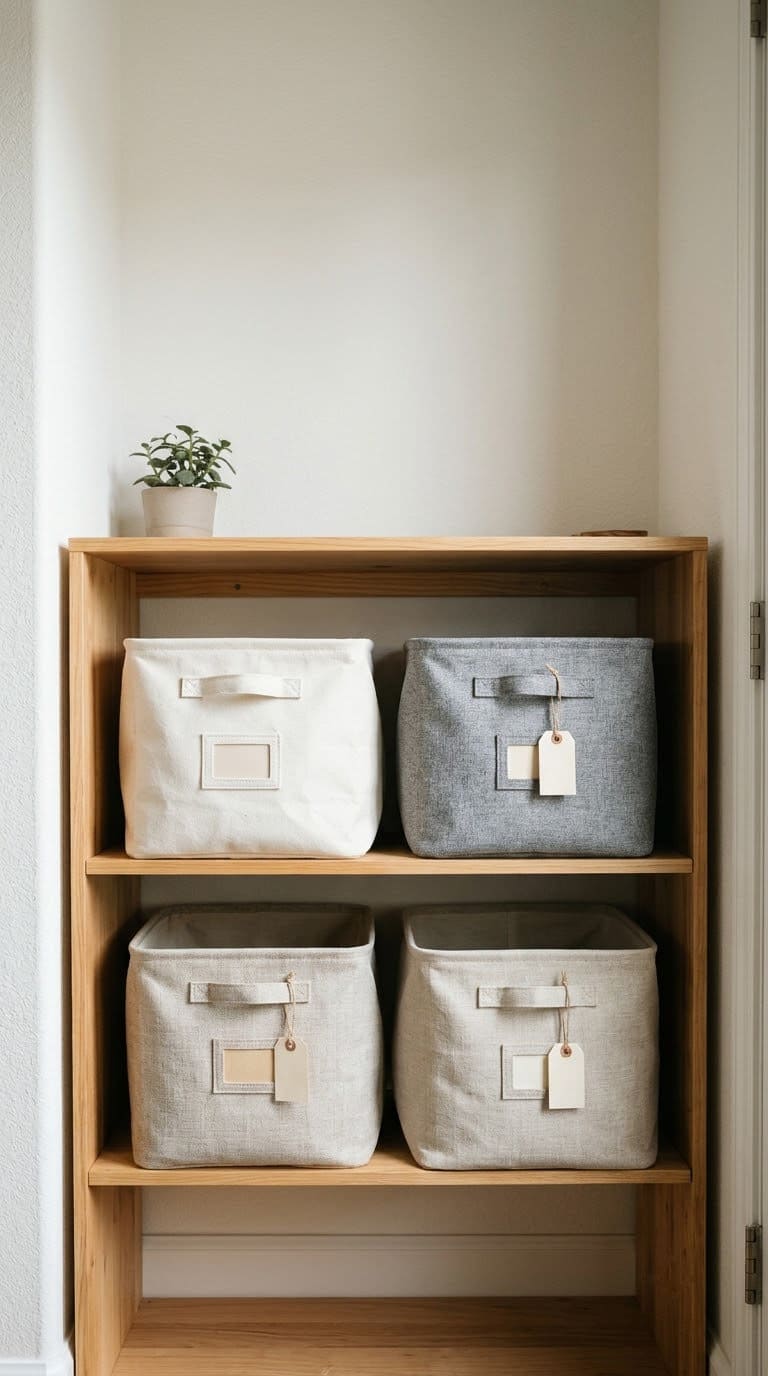
Public Storage suggests labeled bins or a rolling sorter to separate loads. In a tiny room, one bin per person keeps piles off the floor.
Choose bins that fit your shelf and label each clearly. Use soft fabric bins for lighter items.
Bins overflow. Bins fill up fast, so empty them weekly.
Color-code the labels so kids can find their own.
25. The One-In, One-Out Rule
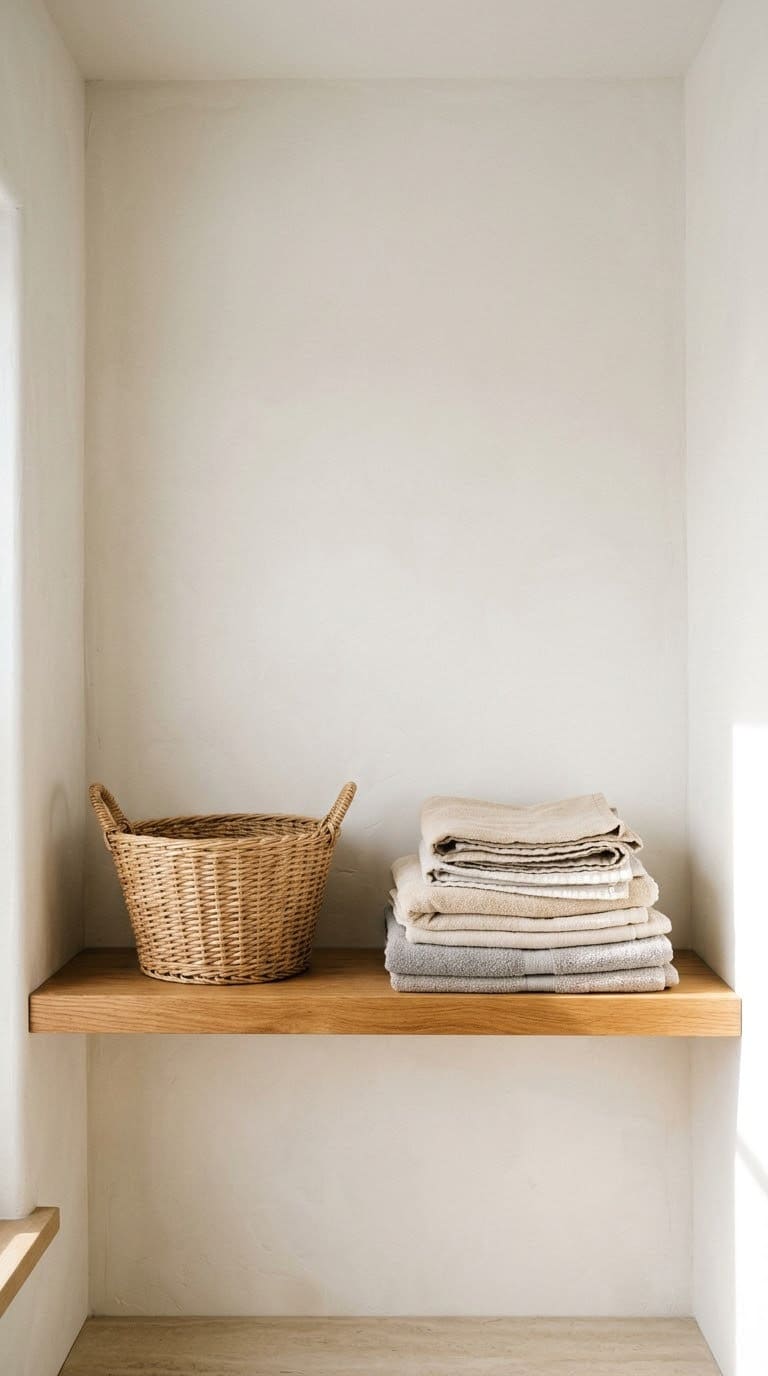
A good storage trick is to own less. Keep one basket of dirty clothes in and one folded stack out.
Decide what lives in the room, and what goes elsewhere. Move spare linens and seasonal items to a closet.
Habit decides it. A system only works if everyone follows it, so keep the rule simple.
Check the room once a week and clear what doesn’t belong.
What Goes Wrong (and What We’d Do Differently)
Most tiny laundry rooms go wrong in one of three ways.
The first is buying before measuring. A stack, a cart or a counter looks perfect online and then doesn’t fit. We’d measure width, depth, height and door swing first.
The second is forgetting the vent. In a tight space, lint builds up fast and the room gets hot. The Washington State Patrol says to clean the lint filter before and after each load and the vent pipe every three months.
The third is crowding the walls. Shelves and racks packed edge to edge make a tiny room feel smaller. If there’s one thing worth doing differently, it’s leaving room to move around the machines, as Public Storage advises.
Problem and Fix
| If you’re short on… | Try ideas | Renter-friendly | Pro needed |
|---|---|---|---|
| Floor space | 1, 5, 13 | Partly | Maybe for 1 |
| Wall space | 8, 10, 11, 12 | No | Studs, not a pro |
| Door space | 14, 15, 9 | Yes | No |
| Light | 19, 22, 23 | Yes | No |
| A vent | 3 | No | Maybe |
Tiny Laundry Room FAQs
How small can a laundry room be?
Small enough for the machines and room to open their doors. Your appliance manual lists the clearances your model needs. Follow it rather than a rule of thumb.
Can I stack a washer and dryer?
Often yes, if both are made to stack and you have the ceiling height. Use the stacking kit made for your two models and check the manual.
Do I need a vent for a dryer?
A vented dryer needs one. A ventless condenser or heat-pump dryer does not, according to Fine Homebuilding, but it drains or collects water instead.
How do I keep a tiny laundry room from feeling cramped?
Use light colors, keep the floor clear and store things on the wall and door. One pattern is plenty.
How often should I clean the dryer vent?
The Washington State Patrol says to clear lint from the vent pipe every three months. Clean the lint filter before and after each load.
Products We Recommend
This post contains affiliate links. We may earn a commission on qualifying purchases at no extra cost to you.
VASAGLE 4-Tier Slim Rolling Storage Cart, 5.1 Inches
A metal slim cart, 5.1 x 17.9 x 30.3 inches, with four swivel casters. It suits idea 13. Rated 4.4 stars from 1,765 ratings.
Shop Now
KEEPJOY Hanging Laundry Hamper Bag, 20 x 30 Inch
Washable Oxford fabric with two hook types for doors 1.37 to 1.97 inches thick. It suits idea 14. Rated 4.6 stars from 8,281 ratings.
Shop Now
Siyzda Ironing Board Hanger, Over-the-Door or Wall
A metal caddy with adjustable hooks and a basket listed at 30 lb. It suits idea 15. Rated 4.4 stars from 368 ratings.
Shop NowNever miss an update — choose FarmFoodFamily as your preferred source on Google.
How it works: Tap the button below to open Google's settings page, then check the box next to FarmFoodFamily.
Tap the checkbox to turn it blue — that's how you know it's set.