25 Hanging Air Plant Holder Ideas (DIY, Shop, and Care Tips That Actually Work)
Air plants hang from almost anything, but the holder you pick determines how easy watering becomes, so here are 25 ideas with real cost estimates, adhesive notes, and care guidance for each.

Never miss an update — choose FarmFoodFamily as your preferred source on Google.
How it works: Tap the button below to open Google's settings page, then check the box next to FarmFoodFamily.
Tap the checkbox to turn it blue — that's how you know it's set.
Air plants hang from almost anything, but the holder you pick determines how easy watering becomes, so here are 25 ideas with real cost estimates, adhesive notes, and care guidance for each.
Products We Recommend
This post contains affiliate links. We may earn a commission on qualifying purchases at no extra cost to you.

Mkono 4-Pack Metal Himmeli Air Plant Holder, Gold
Gold-finished open geometric metal frames, set of four, for small to medium Tillandsia
Shop Now
Sea Urchin Shell Hanging Air Plant Holders (3-pack)
Three natural sea urchin shells in purple, green, and pink with 16 ft hanging rope, no plants included
Shop Now
Mkono 3-Pack Glass Hanging Planter Terrarium Globe
Clear glass globe hangers with open top, set of three, for air plants, ferns, or succulents
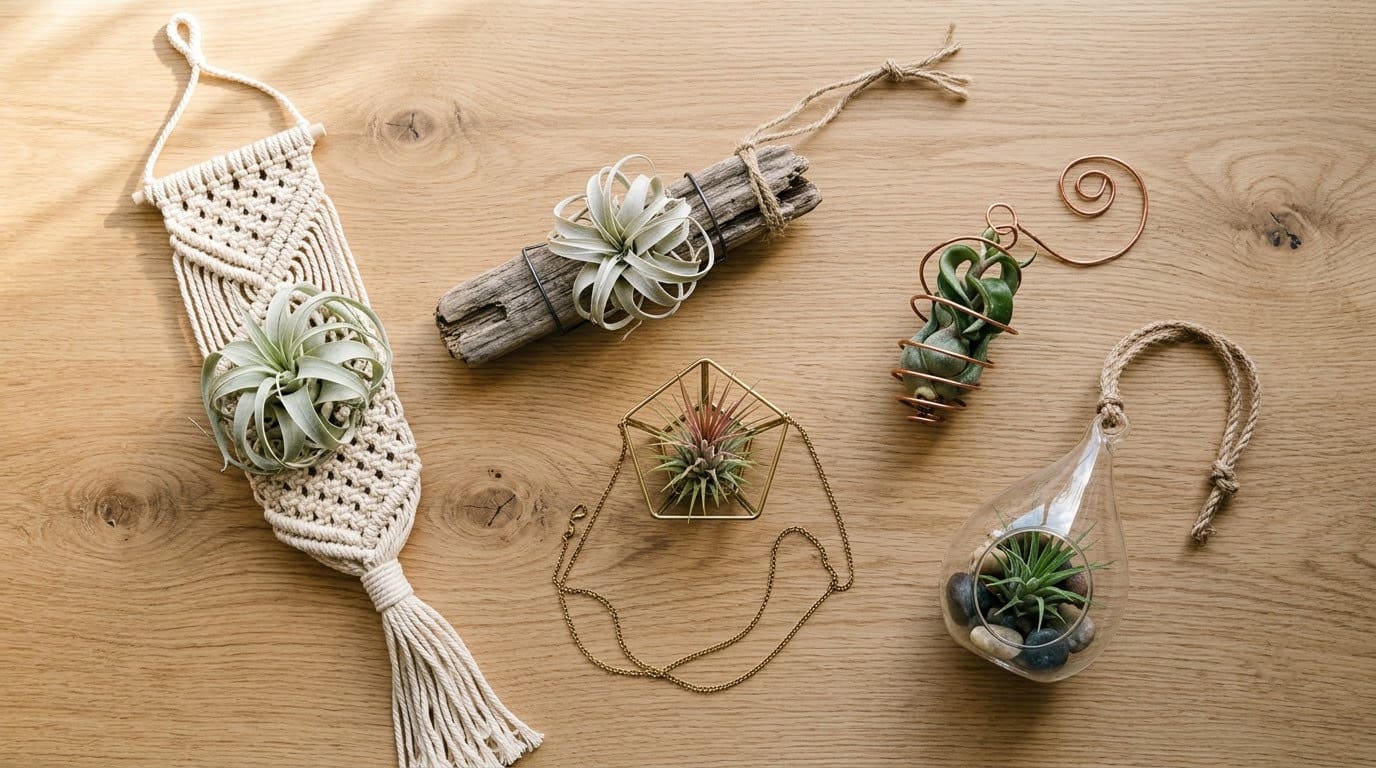
Shop NowHanging air plant holders work with almost any material because Tillandsia species absorb water through their leaves, not their roots, and need no soil. The most popular options include wire and cord cradles, driftwood mounts, macramé hangers, glass globes, and geometric metal frames. Each style works differently for care: holders that let you remove the plant easily allow weekly soaking, while glued mounts require misting in place.
The best holder for a beginner is a simple open wire cradle or macramé hanger that lets the plant slide out for soaking and back in to dry. Closed glass terrariums are beautiful but trap moisture and block the air circulation that air plants need to survive. Match the holder to your watering habits first, then choose a style that fits the room.
For outdoor use, sealed copper components can harm Tillandsia by leaching copper oxide into wet foliage during watering. Apply a clear waterproof sealant to any raw copper before using it outdoors or in humid spaces like a bathroom.
Answer 4 quick questions and get matched to the exact fix for your yard — drainage, budget, layout, or something else entirely.
Take the Free QuizWhy Holder Type Matters Before You Buy
Most air plant holders look great in photos and kill plants over time.
The reason is watering. Air plants need to be soaked for 20 to 30 minutes once a week, then dried upside down for four to five hours to prevent rot at the base. If the holder makes that process awkward enough that you skip it, the plant suffers.
Some holders make watering easy. Others make it nearly impossible without removing adhesive or disassembling the display. Understanding which type you are buying matters as much as the look.
Holder Type Comparison
| Holder Type | Remove Plant Easily? | Watering Method | Best Species |
|---|---|---|---|
| Wire or cord cradle | Yes | Remove, soak 20–30 min, dry inverted | Any small to medium species |
| Driftwood or cork mount (wired) | Yes (unwind wire) | Remove and soak or heavy mist | T. bulbosa, T. caput-medusae |
| Macramé hanger | Yes | Remove, soak, dry, replace | Medium to large species |
| Open glass globe | Yes | Remove and soak, or tilt globe to mist | T. ionantha, T. stricta |
| Glued mount (E6000 or hot glue) | No | Mist-only, no soaking | Xeric species: T. xerographica, T. tectorum |
Wire, Cord, and Craft Wire Holders (Ideas 1–5)
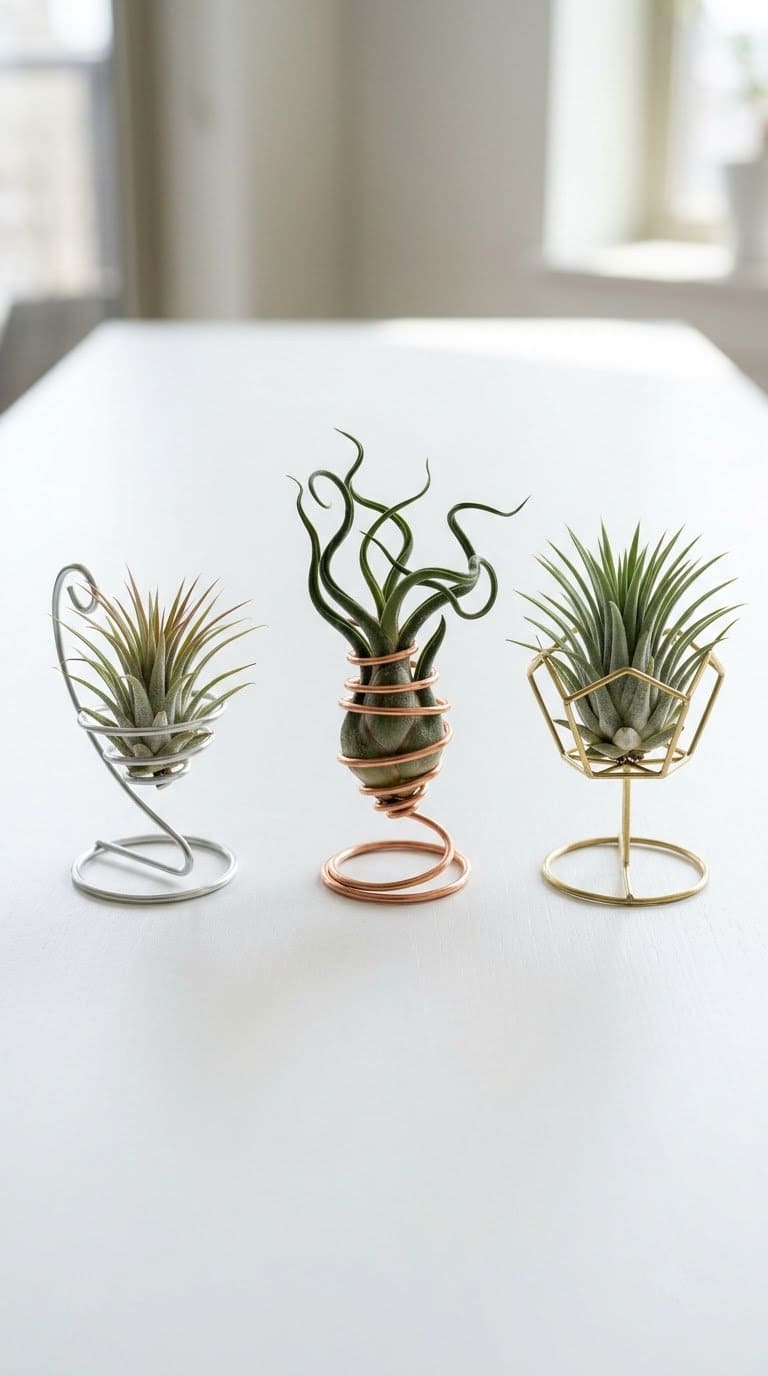
1. Looped Craft Wire Cradle
Bend 18-gauge aluminum or copper-coated craft wire into a small loop that cups the plant base, then twist the ends into a hanging hook. This is the fastest and cheapest holder to make.


Materials cost: Under $3 (wire only)
Most yard problems trace back to one specific, fixable cause. Find yours in 4 quick questions.
Take the Free QuizDifficulty: Beginner
A 10-foot roll of 18-gauge aluminum wire from a craft store is enough for four to six cradles. Use aluminum or stainless-coated wire rather than bare copper outdoors or in humid rooms, since unsealed copper can leach into wet foliage and harm the plant. For indoor-only displays in dry air, copper wire is fine.
2. Spiral Wire Wrap
Wrap a longer strand of craft wire in a tight spiral up from the plant’s base, leaving the leaves free. Form the top end into a hook or loop for hanging.
Materials cost: Under $3
Difficulty: Beginner
This method holds the plant securely without adhesive, so soaking is easy. Remove the wire, soak the plant, let it dry, then rewrap. The spiral pattern catches light and adds visual interest.
3. Fishing Line Invisible Hang
Thread 20-lb monofilament fishing line through the natural cavity at the base of a larger air plant (T. xerographica or T. streptophylla) and knot it at the desired length.
Gold-finished open geometric metal frames, set of four, for small to medium Tillandsia
Shop NowThis post contains affiliate links. We may earn a commission on qualifying purchases at no extra cost to you.
Materials cost: Under $2
Difficulty: Beginner
The average homeowner spends $616/year on yard fixes that don't address the real problem. Find out what yours actually is — before you spend another dollar.
Take the Free QuizThe plant appears to float. This works best on larger species with a clearly defined base cup. Watering is simple because you just untie the knot or lower the plant into a bowl of water without removing the line.
4. Knotted Jute or Twine Single-Plant Hanger
Tie four lengths of jute twine together at the top with a simple knot, spread them apart, and tie them again below the spread to create a cupped cradle for one small plant.
Materials cost: $1–$3
Difficulty: Beginner
Jute is natural, biodegradable, and fits a farmhouse or cottage aesthetic. It is not ideal for humid bathrooms because it molds over time in high moisture. For bathrooms, substitute cotton macramé cord, which is more mold-resistant.
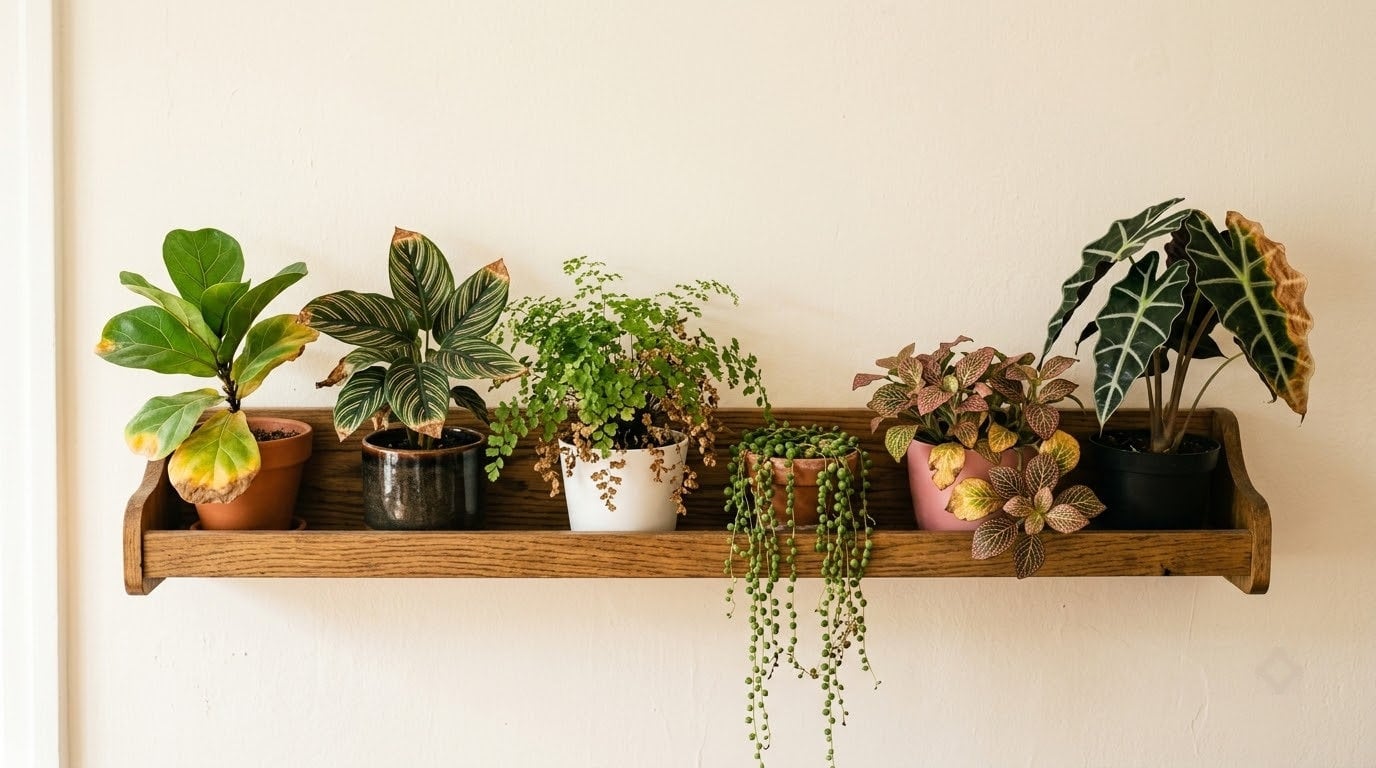
5. Wire Geometric Mobile (Multi-Plant)
Bend a longer piece of stiff wire into a horizontal bar and hang multiple wire cradles from it at different lengths, each holding one plant. This creates a mini mobile.


Materials cost: $5–$12
Difficulty: Beginner to intermediate
Position the mobile near a bright east or south window where the plants get indirect light. Rotating it every week or two keeps growth even. Watering requires removing each plant from its cradle, which is straightforward once you have the system down.
Driftwood, Wood, and Cork Holders (Ideas 6–10)
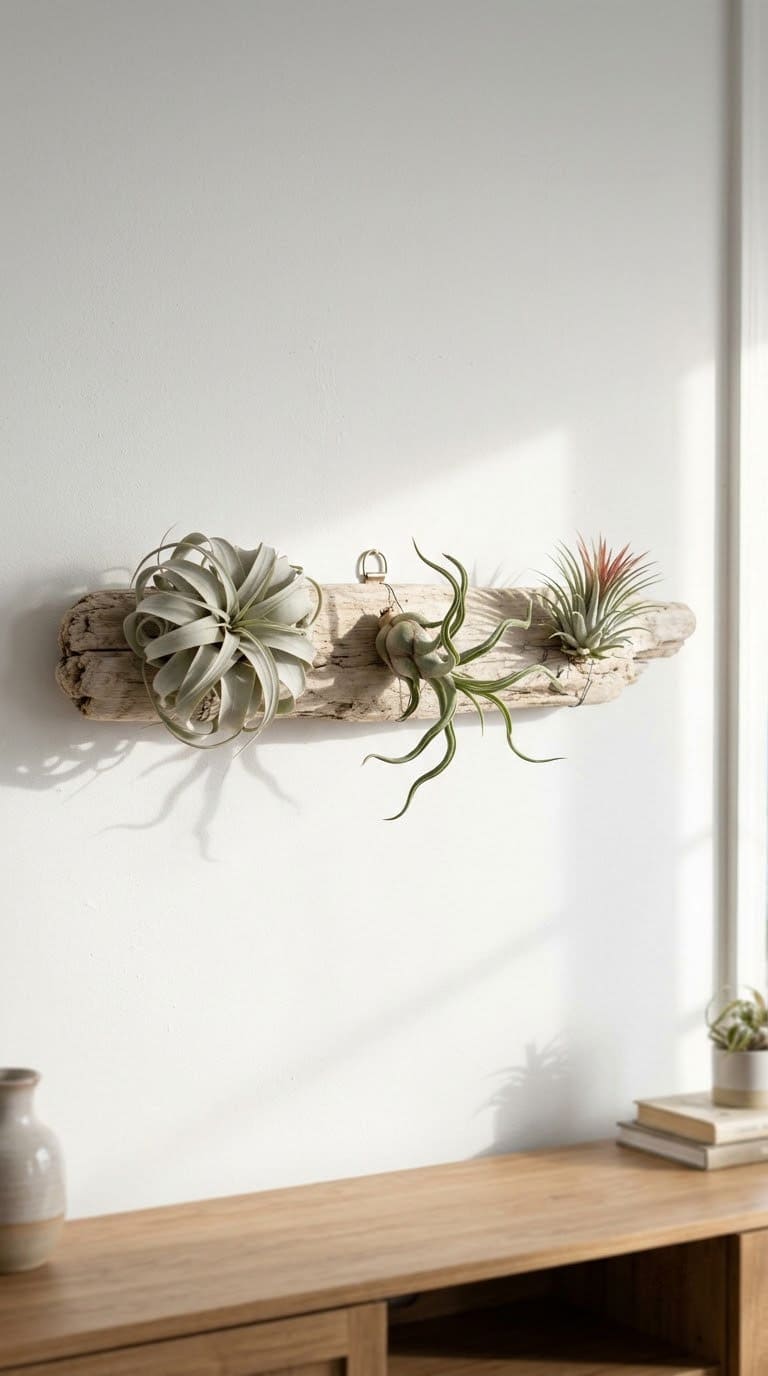
6. Driftwood Branch Wall Mount
Secure a piece of driftwood to the wall using a D-ring picture hanger or a single nail through a drilled hole. Wire or glue small air plants directly to the branch at natural-looking angles.
Materials cost: $0–$15 (free if collected; $10–$15 for purchased driftwood)
Difficulty: Beginner
Driftwood mimics the epiphytic habitat where Tillandsia species grow naturally in tropical forests. Zenaida Sengo, author of “Air Plants: The Curious World of Tillandsias” (Timber Press), notes that mounting air plants on organic materials like wood and cork bark is the most naturalistic way to display them. For plants wired on rather than glued, watering is straightforward.
7. Cork Bark Mount
Attach an air plant to a piece of cork bark with fishing line or a small amount of E6000 adhesive. Cork bark is lightweight, porous, and absorbs some moisture, which benefits the plant between waterings.
Materials cost: $5–$15 per piece
Difficulty: Beginner
Cork bark pieces are available at plant specialty stores and online. They are the preferred mounting substrate among mosaic tillandsia enthusiasts because the texture grips roots naturally over time. For small species like T. ionantha and T. stricta, a single strip of cork bark can hold three to five plants.
8. Cholla Wood Hanger
Cholla is a dried cactus skeleton with natural hollow channels. Slip small air plants into the openings, no adhesive needed, and hang the whole piece with jute twine.
Materials cost: $8–$20 per piece
Difficulty: Beginner
The natural holes hold plants without any hardware. Cholla wood is especially good for small xeric species that prefer dry conditions. Misting works well for plants in cholla because removing them each time is tedious.
9. Drilled Wooden Plank Vertical Display
Drill a series of small holes in a stained or painted wooden board, thread wire or cord through each hole, and loop it around a plant base to hold it in place. Mount the board on the wall.
Materials cost: $10–$25
Difficulty: Intermediate (requires drill)
This is one of the best multi-plant display formats for a boho living room or a bathroom with plants. Bathrooms are an ideal location because humidity from showers supplements watering. If mounting in a bathroom, seal the wood first to prevent warping.
10. Grapevine Wreath Mount
Wire several air plants to a grapevine wreath at varied angles. Hang the wreath flat against a wall or horizontally from the ceiling as a chandelier-style display.
Materials cost: $8–$18 (wreath plus wire)
Difficulty: Beginner
A grapevine wreath gives air plants a naturalistic twig-and-bark texture that suits their epiphytic origins. Wire the plants loosely so they can be removed for soaking. Plants wired through the wreath with fishing line and a small washer knot are easiest to remove.
Macramé and Rope Holders (Ideas 11–14)
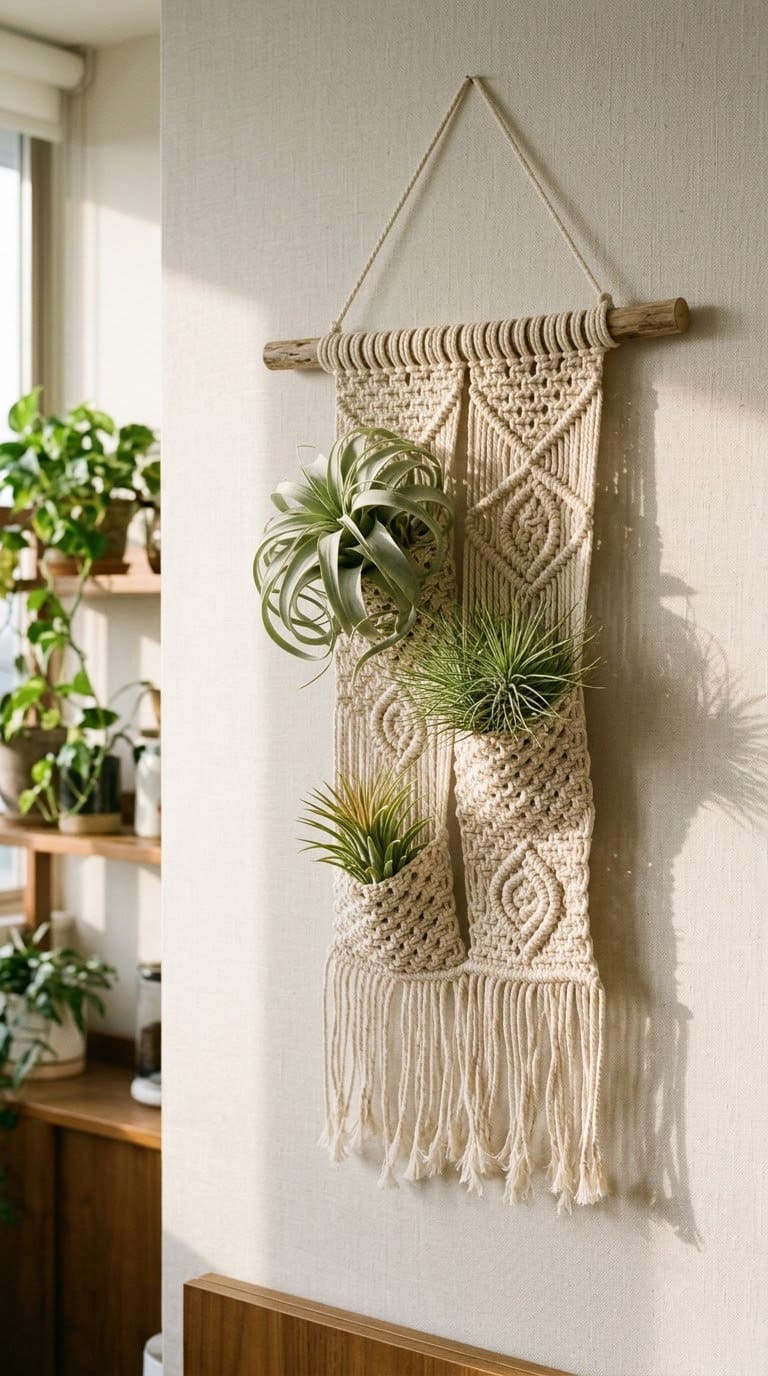
11. Classic Knotted Macramé Pocket
Use square knots in macramé cord to create a small cupped pocket sized to hold one air plant. The plant rests in the pocket and can be lifted out for soaking.
Materials cost: $5–$10 (cord only)
Difficulty: Intermediate
The macramé style suits boho living rooms and bedroom walls. A 3mm or 5mm cotton cord works best.
Avoid jute for this application in humid rooms, since it absorbs moisture and can transfer it back to the plant base. Cotton dries faster and handles humidity better.
12. Multi-Plant Macramé Wall Hanging
Scale up the pocket design to hold three or five plants at staggered heights on a single dowel. This creates a wall art piece that combines texture and living plants.
Materials cost: $10–$20
Difficulty: Intermediate
Plan the pocket sizes to match the species you intend to display. A T. xerographica can reach six inches across and needs a wider pocket than a T. ionantha. Mixing species adds visual contrast and creates a display that changes as the plants grow and eventually bloom.
13. Rope Loop Single Hanger
Cut a 12-inch length of thick natural fiber rope, fold it in half, and tie the two ends together above the fold to create a loop with a small cradle at the bottom. Drop one plant into the cradle.
Materials cost: $1–$5
Difficulty: Beginner
This is the simplest rope display possible. It takes about two minutes to make and works well as a DIY wall art filler between larger pieces. Use three or five of them at different heights on a wall for a gallery arrangement.
14. Braided Cotton Hammock Hanger
Braid three lengths of cotton cord together, then spread the ends at the bottom into a hammock-style cradle that cups one medium plant.
Materials cost: $3–$8
Difficulty: Beginner to intermediate
The braid gives a cleaner, more structured look than a knotted macramé design. It suits Scandinavian minimalist interiors as well as farmhouse and cottage styles.
Glass Globes and Open Terrariums (Ideas 15–18)
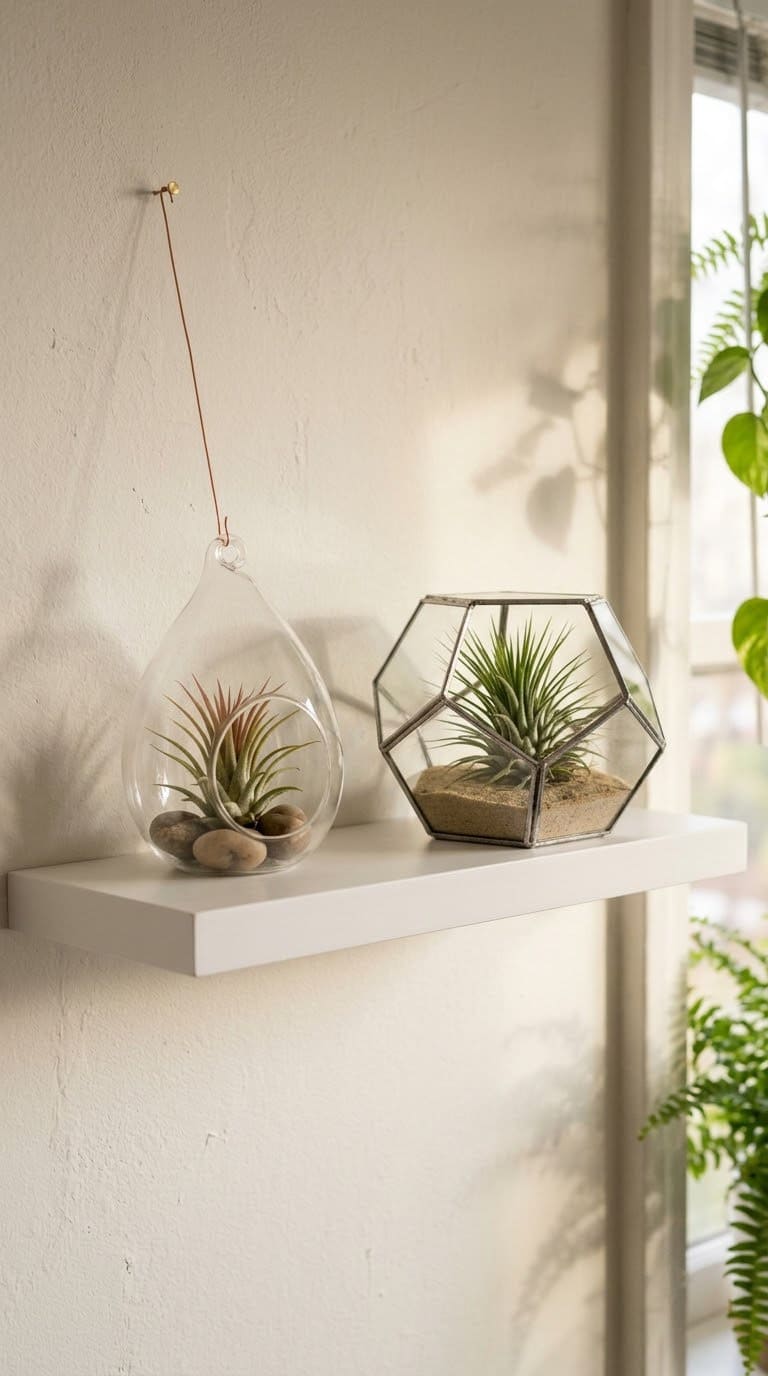
15. Teardrop Glass Globe
Place one or two small air plants inside a teardrop-shaped glass globe with a small opening at the top. Add a handful of smooth river pebbles or sand for visual grounding.
Materials cost: $8–$20
Difficulty: Beginner
The key requirement is ventilation. The globe must have an opening large enough to allow air to flow through.
Sealed or near-sealed glass containers trap humidity and carbon dioxide, which cause the plants to rot within weeks. Homestead and Chill’s air plant care guide confirms that air plants need good air circulation to thrive, which closed terrariums cannot provide.
16. Open Geometric Terrarium
A faceted open glass terrarium, sometimes called a wardian case with open sides, holds one large or several small air plants. Because the sides are open, air circulates freely.
Materials cost: $15–$35
Difficulty: Beginner
Add a layer of decorative moss, gravel, or colored sand to the base. Use these to complement the plant, not bury its base. The plant’s base should sit above any substrate layer so it stays dry between waterings. For the types of succulents and other low-water plants, a similar open terrarium works for mixed arrangements.
17. Hanging Glass Bulb with Driftwood Top
Some glass bulb ornaments sold for holiday decoration are large enough to hold one T. ionantha. Attach a small piece of driftwood or cork across the top opening, wedge the plant in so it leans against the glass, and hang with wire.
Materials cost: $5–$12
Difficulty: Beginner
This is a budget repurpose of widely available ornaments. The opening at the top keeps air flowing. Remove the plant monthly for a longer soak and check that no moisture is pooling at the bottom of the bulb between waterings.
18. Stacked Glass Orb Mobile
Three or five different-sized glass orbs suspended from a wooden branch at different lengths make a striking ceiling mobile. Each orb holds one plant.
Materials cost: $20–$45
Difficulty: Intermediate
This works well in a high-ceilinged room or above a dining table. Position it where it catches diffused light but avoids direct afternoon sun through the glass, which concentrates heat and can scorch the plants.
Shell, Crystal, and Natural Object Holders (Ideas 19–22)
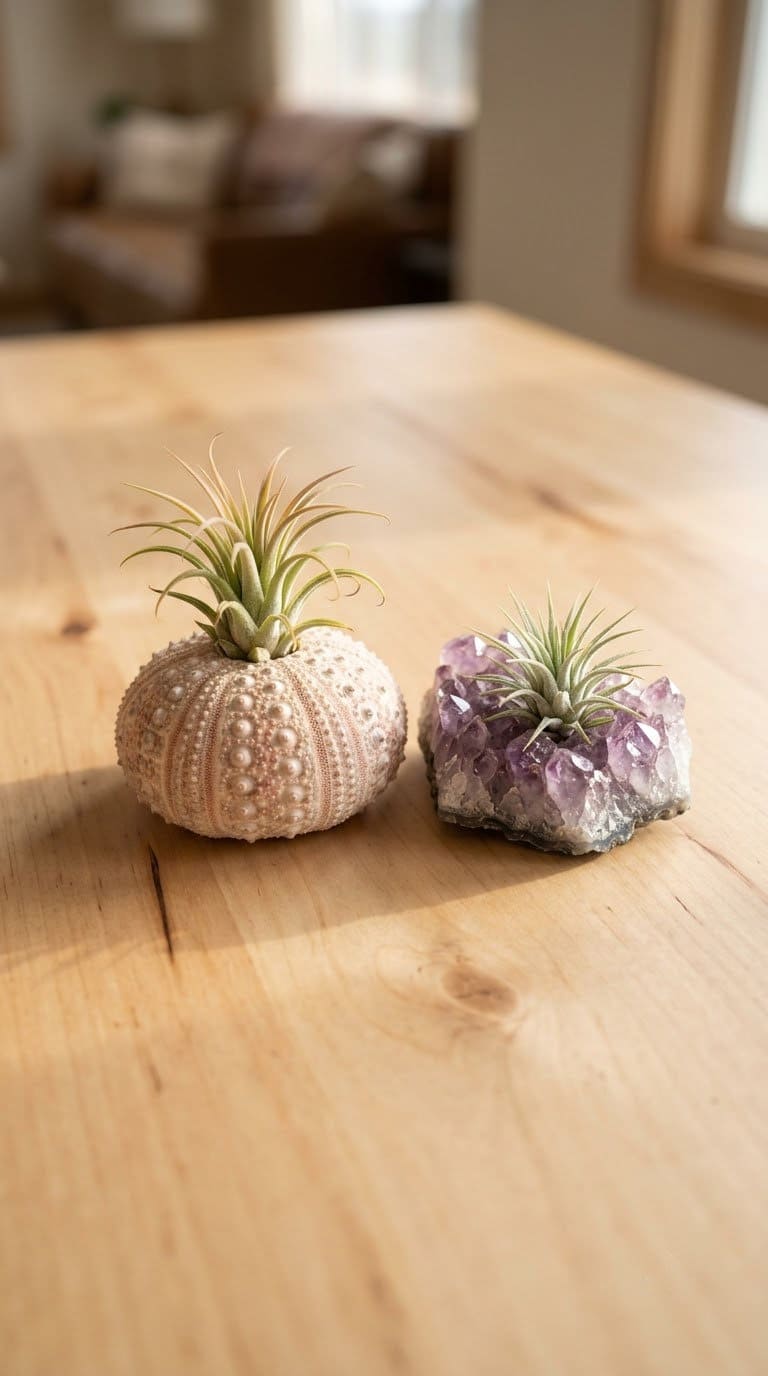
19. Sea Urchin Shell Hanger
Sea urchin shells have a natural round form that cups small air plants perfectly. Thread thin wire through two of the shell’s natural openings and form a hanging loop above the plant.
Materials cost: $3–$8 per shell
Difficulty: Beginner
Sea urchin shells are sold in sets at craft stores and online. A T. ionantha or T. stricta sits naturally in the cup without any adhesive. Remove the plant for soaking by simply lifting it out. The natural opening lets air flow around the roots.
20. Abalone or Flat Shell Wall Mount
Drill two small holes near the top edge of a larger abalone or scallop shell and thread cord through to create a wall hanger. Set one larger air plant into the shell cup.
Materials cost: $5–$15
Difficulty: Beginner
Larger flat shells work well for T. caput-medusae, which has an octopus-like shape that suits the organic form of a shell. Avoid seashells with tight curved lips that trap water around the plant base.
21. Crystal Cluster Display
Some crystal clusters, particularly amethyst geodes and quartz points, have natural indentations that hold small air plants without any attachment. Hang the crystal from a cord looped around its natural edges.
Materials cost: $10–$30
Difficulty: Beginner
The plant simply rests in the hollow. For soaking, lift it out, submerge it, let it dry upside down, then rest it back in the crystal. This is one of the lowest-hardware options available.
22. Woven Rattan or Wicker Ball Holder
Hollow rattan balls sold as decorative objects have gaps wide enough to nestle a small air plant inside while letting air circulate through the weave. Hang with jute twine.
Materials cost: $5–$12
Difficulty: Beginner
The organic texture pairs well with boho and farmhouse interiors. Because the plant sits loosely inside, watering is easy. The rattan weave provides enough grip to hold the plant at different angles.
Geometric Metal and Repurposed Object Holders (Ideas 23–25)
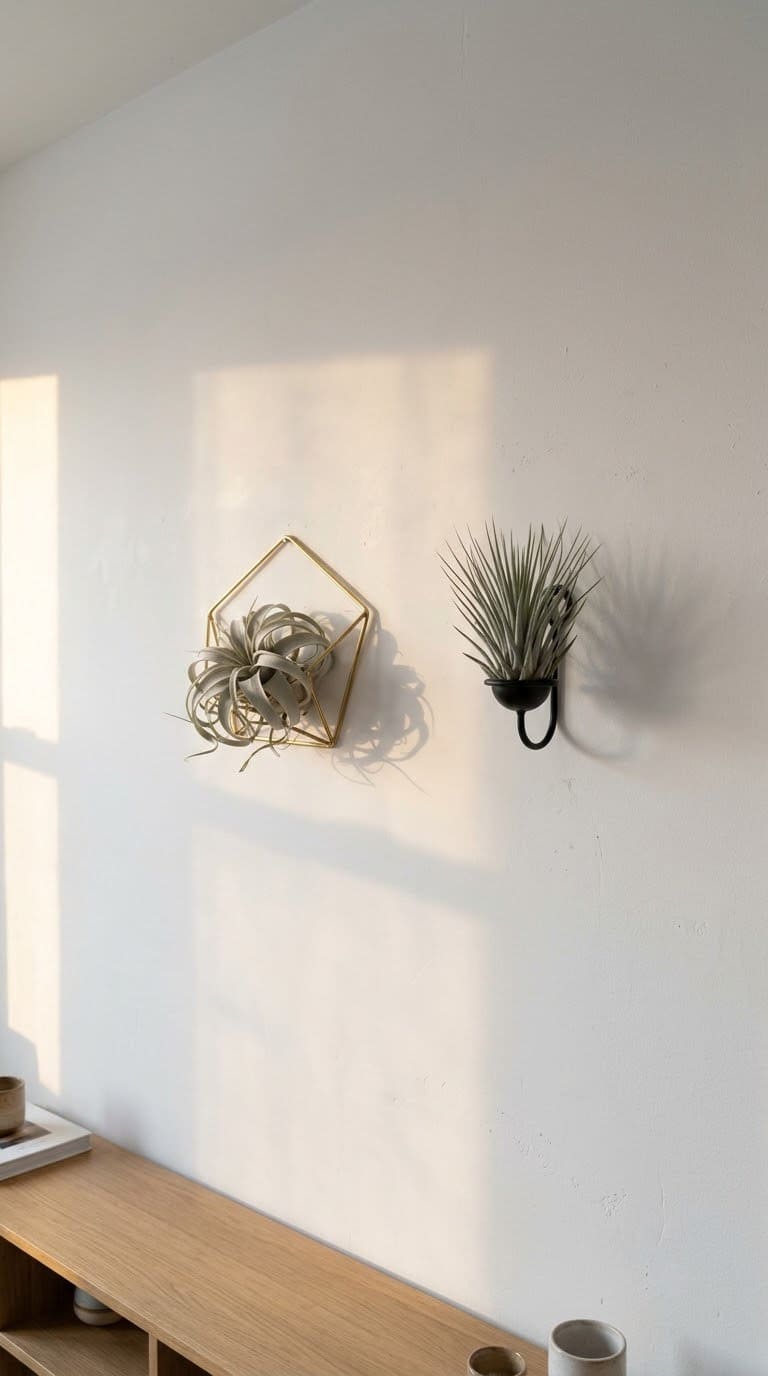
23. Brass Geometric Frame Holder
Geometric brass or copper frames sold as home decor accents make elegant air plant holders. A pentagon or triangle frame with a small wire cradle inside holds one medium plant at a sophisticated angle.
Materials cost: $15–$40
Difficulty: Beginner (plant placement only; frame is purchased)
This is one of the most popular styles for modern, Scandinavian, or Japandi living room interiors. Use copper frames indoors only unless sealed with a clear waterproof coat. Unsealed copper in humid conditions or with wet foliage can leach copper oxide, which is toxic to Tillandsia.
24. Iron Wall Sconce Repurpose
Small iron wall sconces, sold for candle holders and accent lighting, have a cup or cradle shape that fits one air plant. Mount them directly on the wall and set the plant inside.
Materials cost: $8–$25 per sconce
Difficulty: Beginner
This repurpose takes about five minutes. The iron cradle holds the plant securely while still allowing air to circulate. A set of three sconces at staggered heights on a wall makes an instant installation.
25. Vintage Colander or Strainer Hanger
A small decorative colander or mesh strainer has holes on all sides that provide maximum airflow. Hang it from a hook and set one or several small air plants inside.
Materials cost: $5–$15 (thrift store find)
Difficulty: Beginner
The holes in a colander allow air to circulate from every direction, which is close to the airflow tillandsia species experience in nature. Watering is easy: remove the plants, soak, dry, return. This holder also works well outdoors on a covered porch.
How to Water an Air Plant in a Holder
The watering method depends entirely on whether you can remove the plant from its holder.
For removable holders (wire cradles, macramé, glass globes, shells, geometric frames): Lift the plant out and submerge it in a bowl of room-temperature water for 20 to 30 minutes once a week. Shake off excess water gently, then set it upside down on a clean towel or drying rack for four to five hours before returning it to the display. Deanna Talerico at Homestead and Chill recommends that mounted plants be “fully dry within 4 to 5 hours after being watered” to prevent rot at the base.
For xeric species like T. xerographica, T. tectorum, and T. streptophylla, reduce soaking to once every two weeks. These species come from dry coastal deserts and cloud forests where rainfall is infrequent, and weekly soaking can cause rot at the base of the plant.
For glued mounts (E6000, construction adhesive, or fully wired-on plants): Misting is the only option. Mist all sides of the plant until the leaves glisten with water. In dry indoor air, mist twice a week.
In a naturally humid space, once a week or less is enough. After misting, leave the plant in a spot with good air movement so it dries within four hours. Avoid misting plants in the evening and leaving them wet overnight.
Adhesive Safety for Air Plants
Not all adhesives are safe. This matters if you plan to glue a plant directly to a surface.
E6000 is the most widely recommended adhesive among mosaic artists and plant enthusiasts. It forms a waterproof bond and does not off-gas chemicals that harm plant tissue after curing. Allow 24 to 72 hours for full cure in a well-ventilated area before attaching the plant.
Apply E6000 to the mounting surface, let it become tacky, then press the plant’s base against it.
Hot glue is safe once fully cooled and hardened. The risk is applying it while still hot, which burns the plant’s base. Let hot glue cool to the point where it is still slightly pliable but not hot to the touch before pressing the plant against it. The bond is less permanent than E6000 and may fail on smooth surfaces over time.
Copper and brass, unsealed: Raw copper and unsealed brass can leach copper oxide when wet. Copper oxide is toxic to Tillandsia. For copper wire holders used indoors in dry conditions, this is not a concern during occasional brief contact. For copper in humid bathrooms, or any copper where wet foliage rests directly against the metal, apply a clear waterproof sealant to the copper before use.
Common Mistakes to Avoid
Closed glass containers. A fully sealed terrarium traps moisture and blocks air circulation. Tillandsia rot in closed terrariums within weeks. All glass containers used for air plants must have an opening large enough for a hand to pass through.
Skipping the drying step. Setting an air plant back in its holder while still wet causes water to pool at the base, which is the leading cause of air plant rot. Always dry inverted on a towel for four to five hours after soaking.
Hanging too far from light. Air plants need bright indirect light. A display that looks good in a dark hallway or on a north-facing wall will produce a slow-declining plant within a few months. Bright indirect light from a south, east, or west window is the minimum.
Using untreated copper for bathroom displays. Bathrooms are excellent environments for air plants because of the humidity. But bare copper pipe or wire left in contact with wet foliage in a humid space corrodes and harms the plant. Seal copper first or switch to aluminum wire.
Frequently Asked Questions
What is the best holder for hanging air plants?
An open wire cradle or a macramé hanger is the most practical choice for beginners because both let you remove the plant easily for weekly soaking. Glass globe terrariums and geometric frames also work well as long as the plant can be lifted out. Glued mounts are best reserved for experienced growers who prefer misting-only care.
Can you hot-glue air plants to a holder?
Yes, with one precaution. Let the hot glue cool until it is no longer hot to the touch but still slightly pliable before pressing the plant against it. Hot glue applied at full temperature burns the plant’s base. The bond also weakens over time and may release, especially in humid conditions, so E6000 adhesive is a more permanent alternative.
Is copper bad for air plants?
Copper is only a concern when it corrodes and comes into contact with wet foliage repeatedly over time. Bare copper in a dry indoor setting where the plant is misted briefly is generally fine. In a humid bathroom or outdoors, seal any copper wire, pipe, or frame components with a clear waterproof lacquer before using them with air plants.
How do you water an air plant that is glued to a display?
You mist it. Use a spray bottle to mist all sides of the plant until the leaves are wet, then allow it to dry completely within four to five hours.
In dry conditions, mist twice a week. In naturally humid rooms like a bathroom, once a week is usually sufficient. Glued mounts cannot be soaked without destroying the adhesive bond.
What size air plant fits in a glass globe holder?
Small glass globes with openings of one inch or less work for T. ionantha and other compact species that stay under two inches in diameter. Medium globes (two to three inch opening) fit T. stricta, T. andreana, and T. bulbosa.
Avoid squeezing a plant through a tight opening, as this damages the leaves. The opening should be at least as wide as the widest point of the plant.
Never miss an update — choose FarmFoodFamily as your preferred source on Google.
How it works: Tap the button below to open Google's settings page, then check the box next to FarmFoodFamily.
Tap the checkbox to turn it blue — that's how you know it's set.