Dry Cow Feed 101: What Changes When Your Milk Cow Stops Milking
If you keep a family milk cow, the day you stop milking her can feel stranger than the day she freshened. The routine you built your mornings around suddenly ends, and the animal standing in the pasture looks the same, so it is tempting to keep feeding her the same way. That instinct is where…

Never miss an update — choose FarmFoodFamily as your preferred source on Google.
How it works: Tap the button below to open Google’s settings page, then check the box next to FarmFoodFamily.
Tap the checkbox to turn it blue — that’s how you know it’s set.
If you keep a family milk cow, the day you stop milking her can feel stranger than the day she freshened. The routine you built your mornings around suddenly ends, and the animal standing in the pasture looks the same, so it is tempting to keep feeding her the same way. That instinct is where a lot of small dairy owners go wrong. What a dry cow needs is genuinely different from what a lactating cow needs, and understanding dry cow feed basics is one of the simplest ways to protect her health, her calf, and your next lactation.
This guide covers what actually changes at dry-off, how to adjust the ration, and the mistakes that tend to show up in small operations.
First, What the Dry Period Is Actually For
A dry period is the stretch of time between when you stop milking and when she calves, usually around 60 days. It is not a vacation from management. It is the window where her mammary tissue regenerates, her body condition gets rebuilt, and the calf does most of its growing. Research going back decades has shown that cows given an appropriate dry period produce significantly more milk in the following lactation than cows milked straight through.
The dry period also happens to be when the most expensive metabolic problems in dairy cattle get their start. Milk fever, ketosis, fatty liver, and displaced abomasum are rarely caused by what happens on calving day. They are set up weeks earlier by how the cow was fed while dry. That is why dry cow feeding deserves its own plan rather than whatever is left over from the milking ration.
The Biggest Change: Energy Needs Drop, Then Rise Again
A lactating cow eating 40 or 50 pounds of feed a day is burning most of that energy making milk. Take away the milk production and her energy requirement falls sharply. If you keep feeding the same grain ration after dry-off, she keeps eating it, and the surplus energy goes straight to body fat.
That sounds harmless, even good. It is not. An over-conditioned dry cow is the classic setup for a chain of problems. Fat cows eat less after calving, mobilize fat quickly, and are prime candidates for ketosis and fatty liver. They also calve with more difficulty. The goal at dry-off is a body condition score around 3.5 to 4 on the 5-point scale, not a cow that looks like she is headed to the county fair.
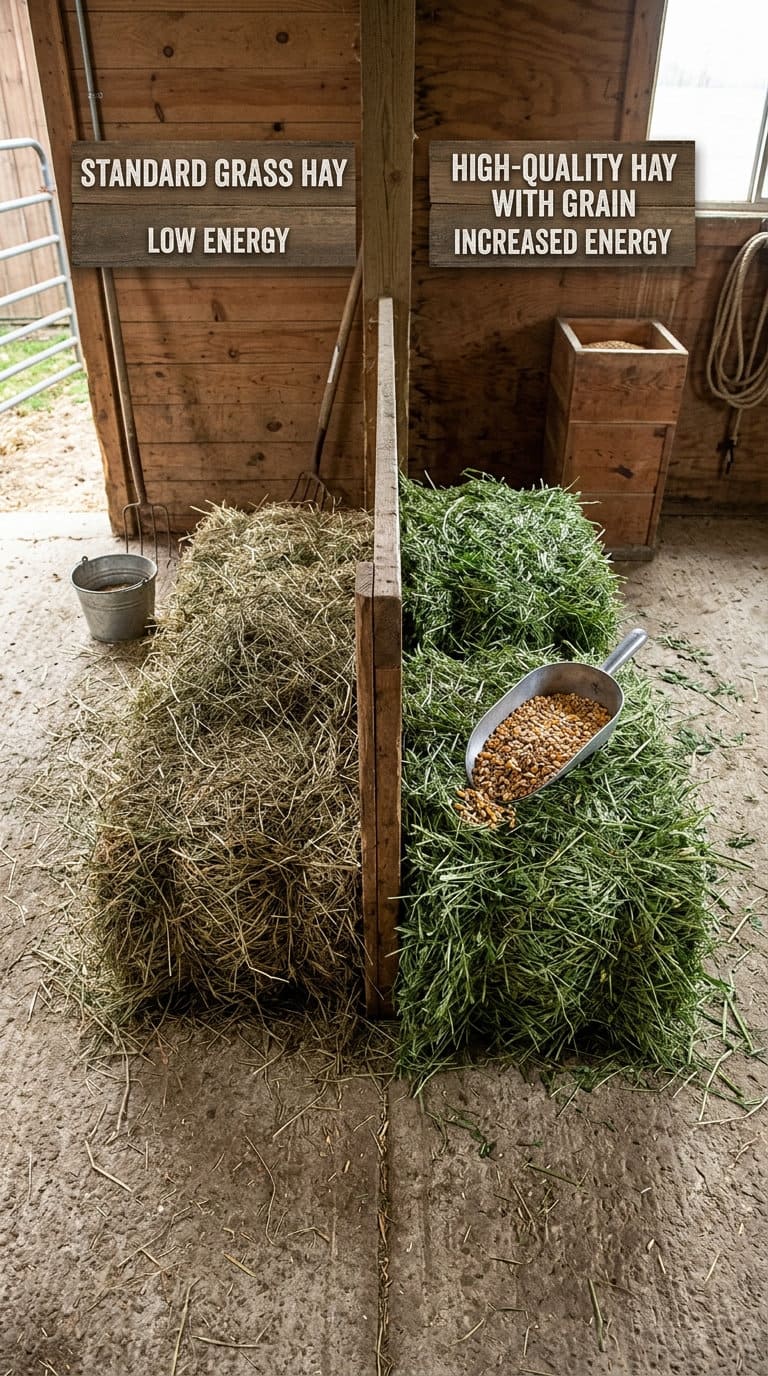
So the first practical change is cutting grain back hard at dry-off. Many small operations drop to little or no grain for the far-off portion of the dry period and rely on forage. The second change comes in reverse. During the last three weeks before calving, the close-up period, the calf is growing fast and the rumen is running out of room, so energy density needs to come back up. This two-phase pattern, low energy first, higher energy later, is the backbone of dry cow feeding.
Protein and Forage: The Ration Foundation
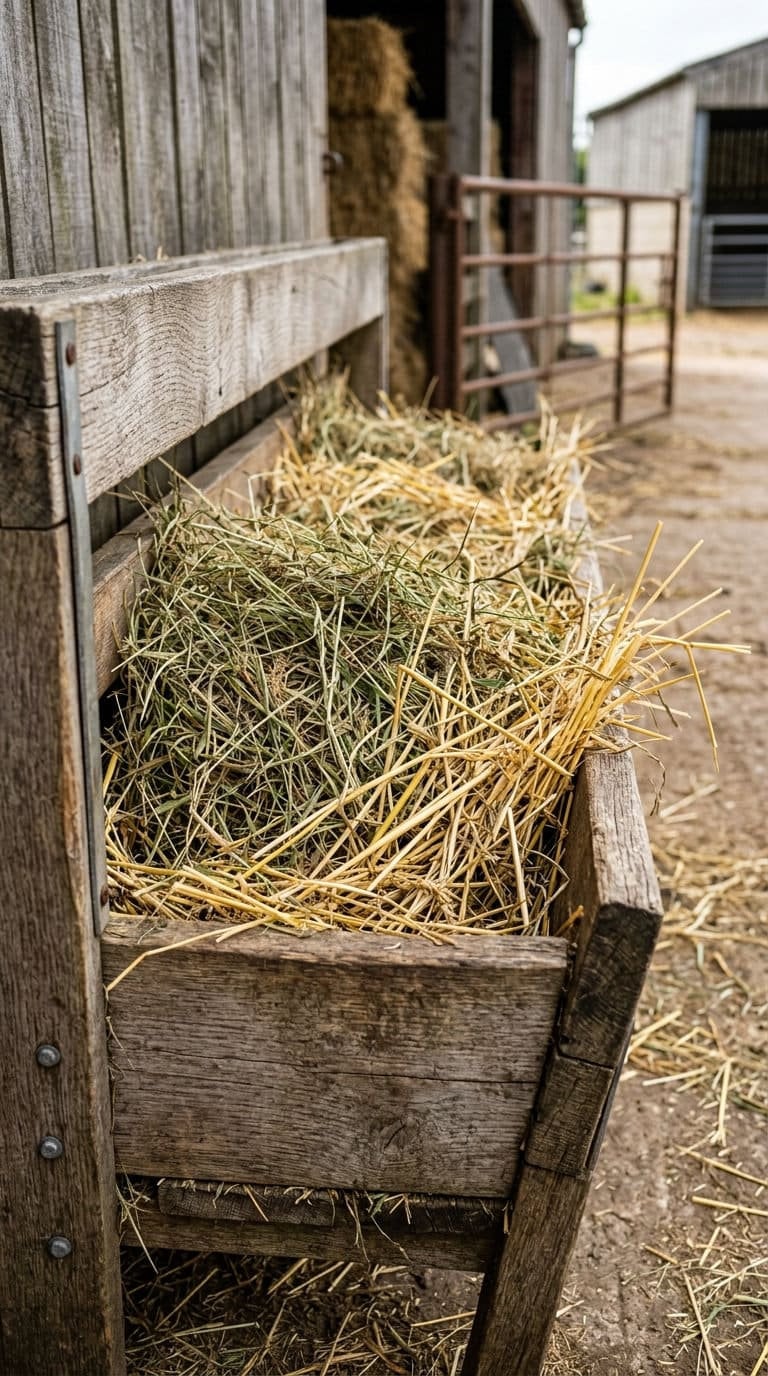
For the far-off dry period, good grass hay is the workhorse. It provides fiber, moderate protein, and enough nutrition without excess energy. Many experienced keepers deliberately feed average-quality hay to far-off dry cows rather than their best alfalfa, precisely because rich forage pushes condition too hard.
Straw has a place too, and it surprises people. Mixing some wheat or oat straw into the far-off ration fills the rumen without adding much energy, which keeps the gut working and the cow content without fattening her. It is a common practice in larger dairies and it works on a homestead scale as well, as long as the straw is clean and mold-free.
In the close-up period, forage quality matters again. This is when you transition toward the kind of feed she will get after calving, including some legume hay and a modest amount of grain introduced gradually. The rumen microbes need time to shift, and papillae in the rumen wall need weeks to adapt to higher starch levels. Starting grain three weeks before calving means the fresh cow is already adjusted when the energy demands of milk production hit.
The Calcium Question
Here is the part of dry cow feeding that seems backwards until you understand the mechanism. Milk fever, or hypocalcemia, happens when a fresh cow cannot pull calcium from her body fast enough to meet the sudden demand of colostrum and milk. The standard prevention is not to load her with calcium before calving. It is to do the opposite.
When a dry cow gets plenty of calcium, her body has no reason to keep its calcium mobilization machinery active. Then calving hits, demand spikes, and the system is slow to respond. When calcium is limited during the dry period, the hormone pathways that pull calcium from bone and improve gut absorption stay primed, so when the calf arrives, the machinery is already running.
Practically, this means avoiding high-calcium forages like heavy alfalfa during the close-up period and using grass hay instead. Larger dairies take this further with anionic salt products that acidify the blood and improve calcium status, and those have a place in commercial settings. For a family cow, the simpler version is usually enough: watch the calcium sources in the last few weeks, and save calcium supplementation for after calving when she actually needs it.
Minerals and Vitamins Do Not Take a Break
Even while energy and protein are being dialed back, the mineral program stays steady or gets more attention. Selenium and vitamin E in the dry period are tied to calf vigor, colostrum quality, and clean calvings. Copper, zinc, and manganese support the immune system right when it is about to be stressed.
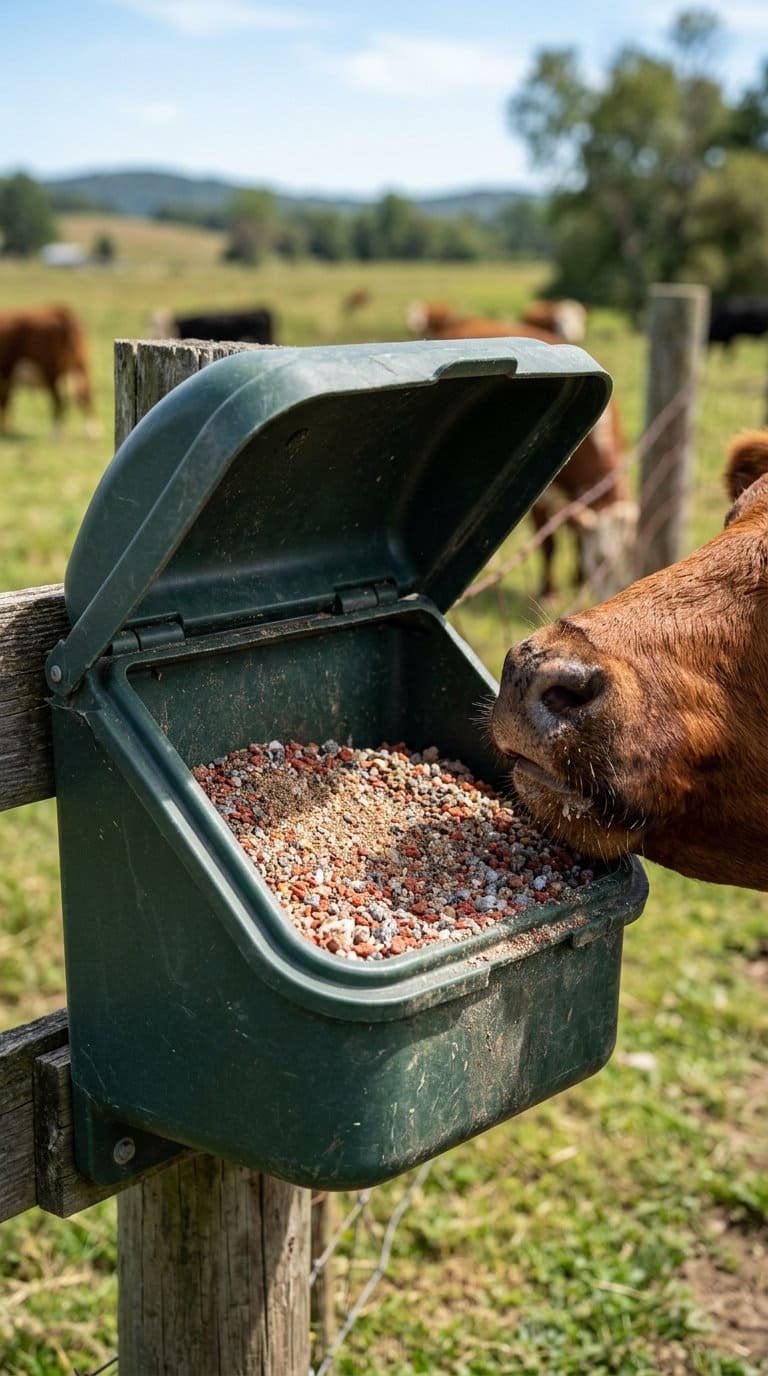
Keep loose mineral in front of her free-choice throughout the dry period, in a covered feeder that stays dry. If your area is known for selenium deficiency, and many regions are, this is the time to confirm your mineral is actually formulated for your region rather than grabbing whatever tub is on sale.
Water, Space, and the Details That Are Not Feed But Matter Anyway
A dry cow drinks less than a milking cow, but she still needs free access to clean water, and winter brings the usual freezing considerations. Housing matters too. A dry cow kept on feed she cannot reach, or crowded away from the hay by a herd boss, can end up thin no matter how good the ration looks on paper.
On small operations with one or two cows this is less of an issue, but it is worth watching if the dry cow lives with the main herd.
A Simple Timeline You Can Actually Follow
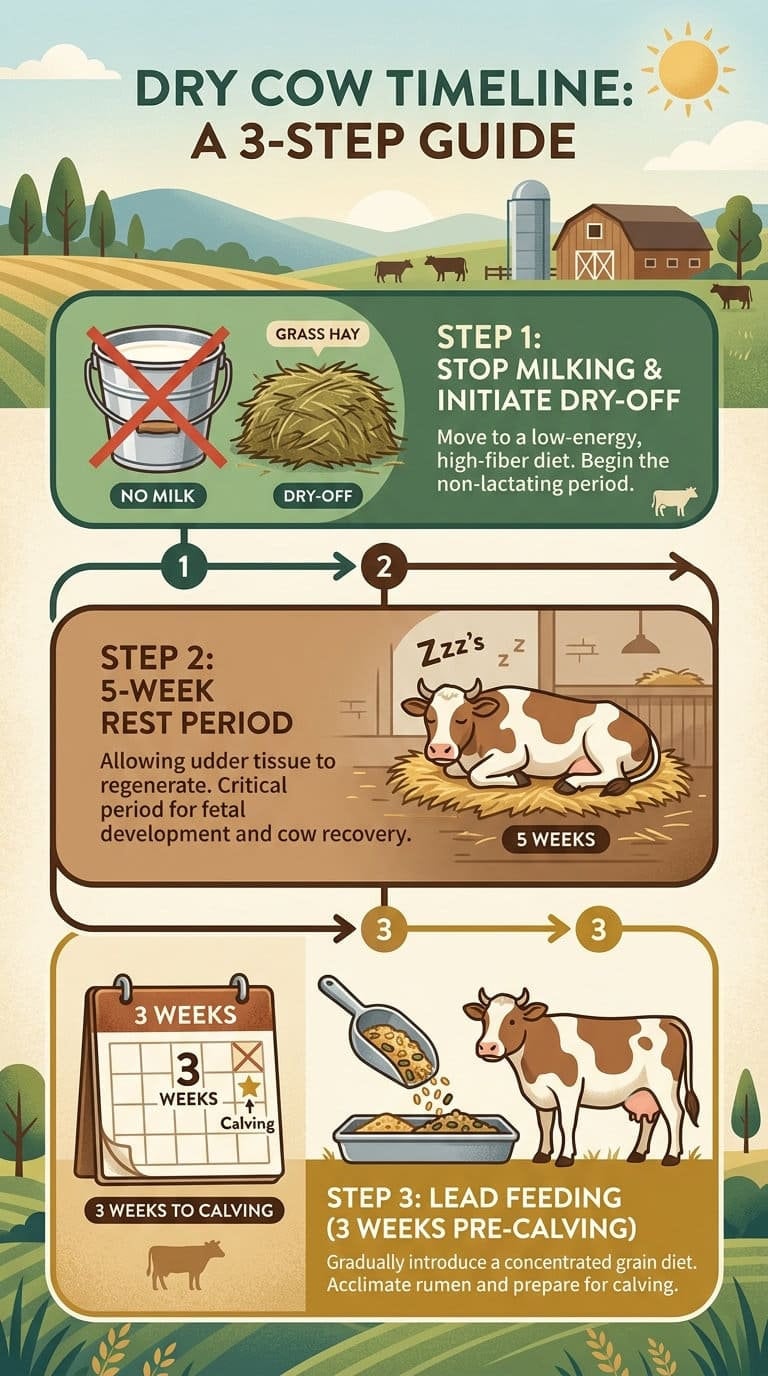
For a homestead cow with a known breeding date, the plan is straightforward. At dry-off, stop milking, cut the grain, and move her to grass hay with free-choice mineral. For the next five weeks or so, that is honestly most of the job.
Around three weeks before her due date, begin the close-up transition: introduce a small amount of grain and increase it gradually, shift toward better hay, and pay attention to calcium sources. After she calves, hold off on milking heavily for a few days, offer calcium support if needed, and ramp the milking ration up as her appetite allows.
Common Mistakes Worth Repeating
The errors that show up most are feeding the lactation ration straight through the dry period, letting a cow get too fat by calving, skipping the close-up grain transition, and overfeeding calcium-rich alfalfa in the final weeks. None of these look like mistakes on the day they happen. They all show up later, at the worst possible moment, in the form of a down cow or a slow start.
The Bottom Line
Feeding a dry cow well is mostly about restraint and timing. Hold energy back early, bring it back late, keep minerals steady, and let forage do the heavy lifting. Do that, and the dry period becomes what it is supposed to be: a rest that sets up a strong calf, an easy calving, and a heavy milk pail the next time she freshens.


Never miss an update — choose FarmFoodFamily as your preferred source on Google.
How it works: Tap the button below to open Google's settings page, then check the box next to FarmFoodFamily.
Tap the checkbox to turn it blue — that's how you know it's set.