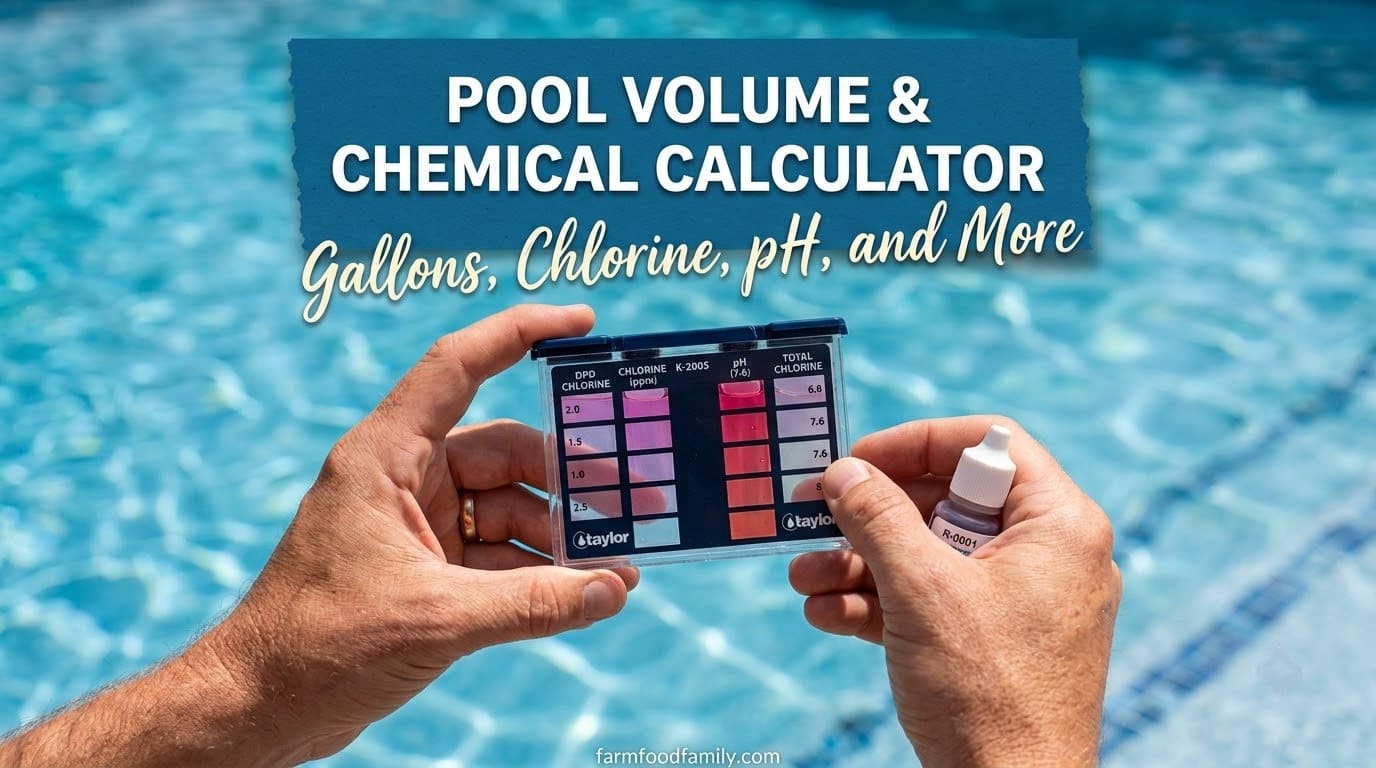
Pool Volume & Chemical Calculator: Gallons, Chlorine, pH, and More
Enter your pool’s shape and current test results. Get exact gallons and dosing for chlorine, pH, alkalinity, and stabilizer, with every number labeled by source so you know what’s verified.

Never miss an update — choose FarmFoodFamily as your preferred source on Google.
How it works: Tap the button below to open Google’s settings page, then check the box next to FarmFoodFamily.
Tap the checkbox to turn it blue — that’s how you know it’s set.
Pool volume depends on shape. A rectangle pool is length times width times average depth, times 7.5.
A round pool uses diameter squared times depth, times 5.9. An oval pool uses 6.7 instead.
These numbers come from one simple fact: a cubic foot of water holds about 7.5 gallons. Each shape just adjusts for how much of that box shape the water actually fills.
Once you know your gallons, chemical dosing follows your test kit readings. Raising free chlorine by 1 ppm in 10,000 gallons takes roughly 10 fl oz of 12.5% liquid chlorine, or about 2 oz of 65% granular cal-hypo. Exact amounts scale up with pool size.
The calculator below does every step for you. It covers four pool shapes and reads your chlorine, pH, alkalinity, and stabilizer levels.
It then shows exactly how much of each chemical to add. Every dosing figure is labeled too, so you’ll see whether it’s a verified standard or a typical estimate.
Pool Volume & Chemical Calculator
Calculate your pool’s exact volume by shape, then get chlorine, pH, alkalinity, and stabilizer dosing based on your current test results. Every dosing figure is labeled by source so you know what’s verified and what’s a typical estimate.
1. Pool volume
2. Current test results (optional, leave blank to skip a dose)
3. Chlorine product
Results
| Adjustment | Amount to add | Note |
|---|
- Never mix different pool chemicals together, especially chlorine products with acid.
- Always add chemical to water, never water to chemical.
- Add one chemical at a time and let it circulate before adding another.
- Wear gloves and eye protection, and work in a ventilated area.
- Retest after each addition. These figures are estimates, not a substitute for a test kit.
Why This Calculator Is More Honest Than Most
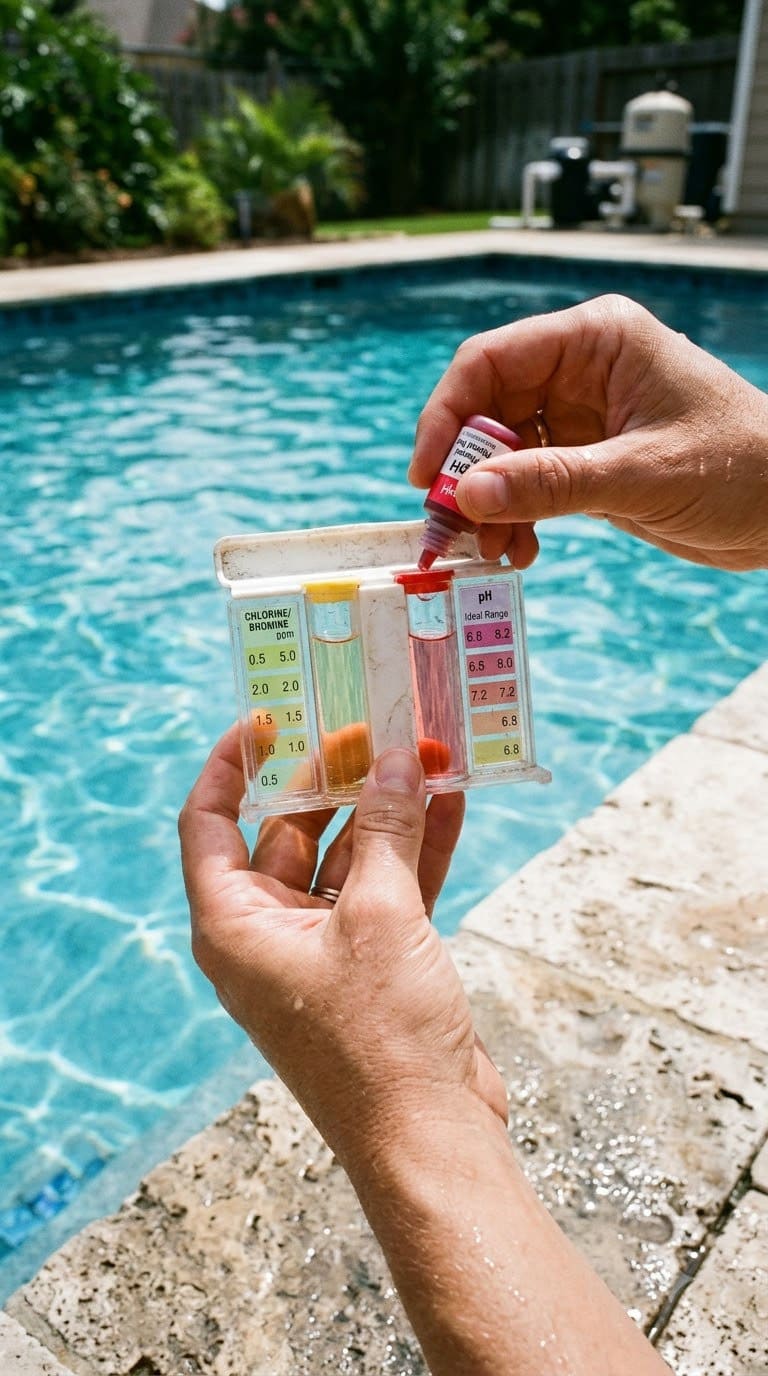
Search “pool chemical calculator” and most tools give you one confident number with no source. That’s a problem. Pool chemistry actually mixes two very different kinds of numbers.
Answer 4 quick questions and get matched to the exact fix for your yard — drainage, budget, layout, or something else entirely.
Take the Free QuizSome figures are settled science. The safe range for total alkalinity, the danger of mixing chlorine with acid, the volume math itself, these all come from published standards.
Other figures are different. Exactly how many ounces of a product raise chlorine by 1 ppm is a practical industry estimate.
It works well in real use. But no health agency publishes it as an exact constant.
This calculator tells you which is which. Every result includes a short note on where the number comes from. No other pool calculator we found does this.
It also covers more ground in one tool. Some competitors only calculate volume and stop there. Others do chlorine dosing but skip pH, alkalinity, and stabilizer, or only handle one rectangular pool shape.
How Pool Volume Is Actually Calculated
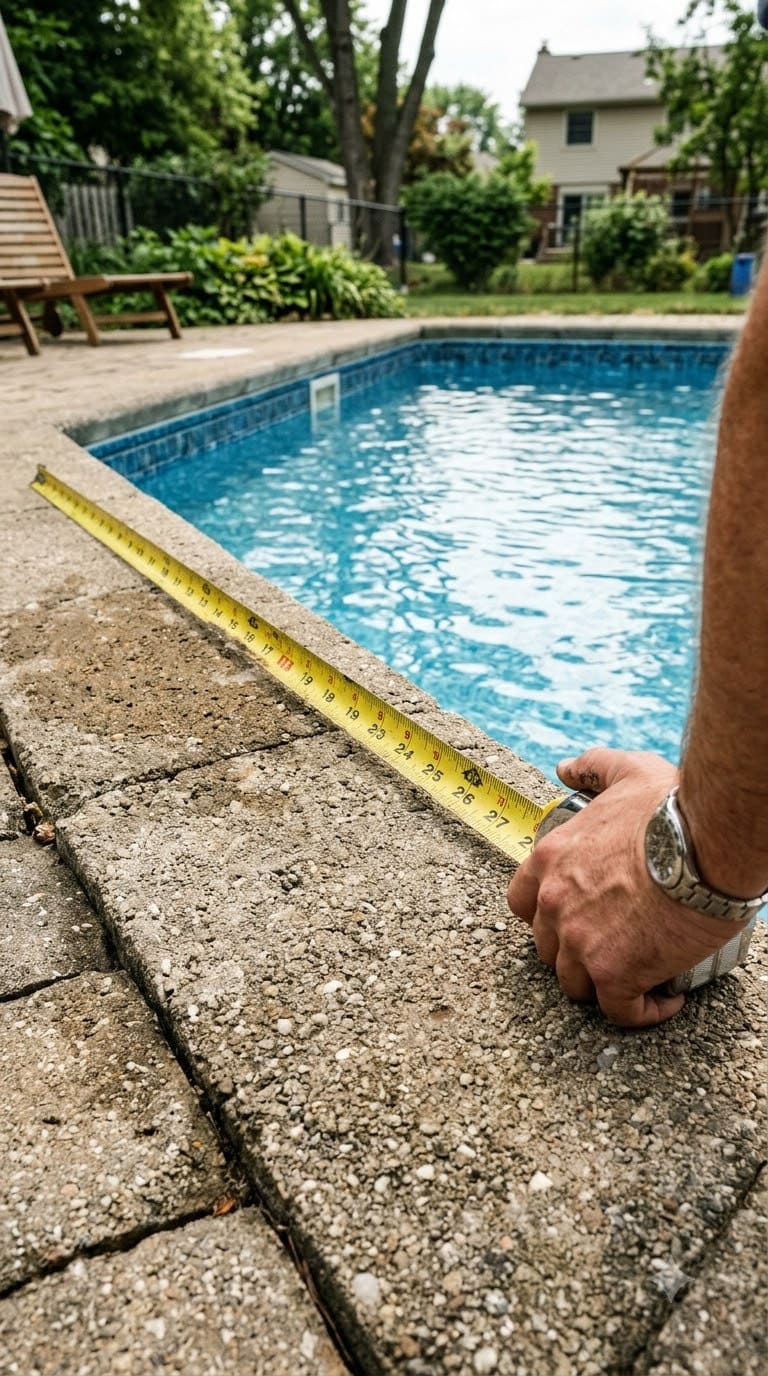
Volume math starts with a simple idea: length times width times depth gives cubic feet, and each cubic foot holds about 7.5 gallons.
Rectangle: Length (ft) x Width (ft) x Avg. depth (ft) x 7.5 = gallons
Round: Diameter (ft)^2 x Avg. depth (ft) x 5.9 = gallons
Oval: Length (ft) x Width (ft) x Avg. depth (ft) x 6.7 = gallons
Kidney / freeform: (Width A + Width B) / 2 x Length (ft) x Avg. depth (ft) x 7.5 = gallons
The 5.9 and 6.7 constants account for the curved shape of round and oval pools, which hold less water than a rectangle with the same outer dimensions. A kidney-shaped pool doesn’t have a clean formula, so the standard approach measures the widest point at two spots and averages them like a rough rectangle. It won’t be perfect, but it’s close enough for chemical dosing.
Most yard problems trace back to one specific, fixable cause. Find yours in 4 quick questions.
Take the Free QuizAverage depth for sloped pools
Most in-ground pools have a shallow end and a deep end, not one flat depth. Add the shallow depth and the deep depth, then divide by two, and use that number as your average depth in the formula above.
How Chlorine Dosing Is Calculated
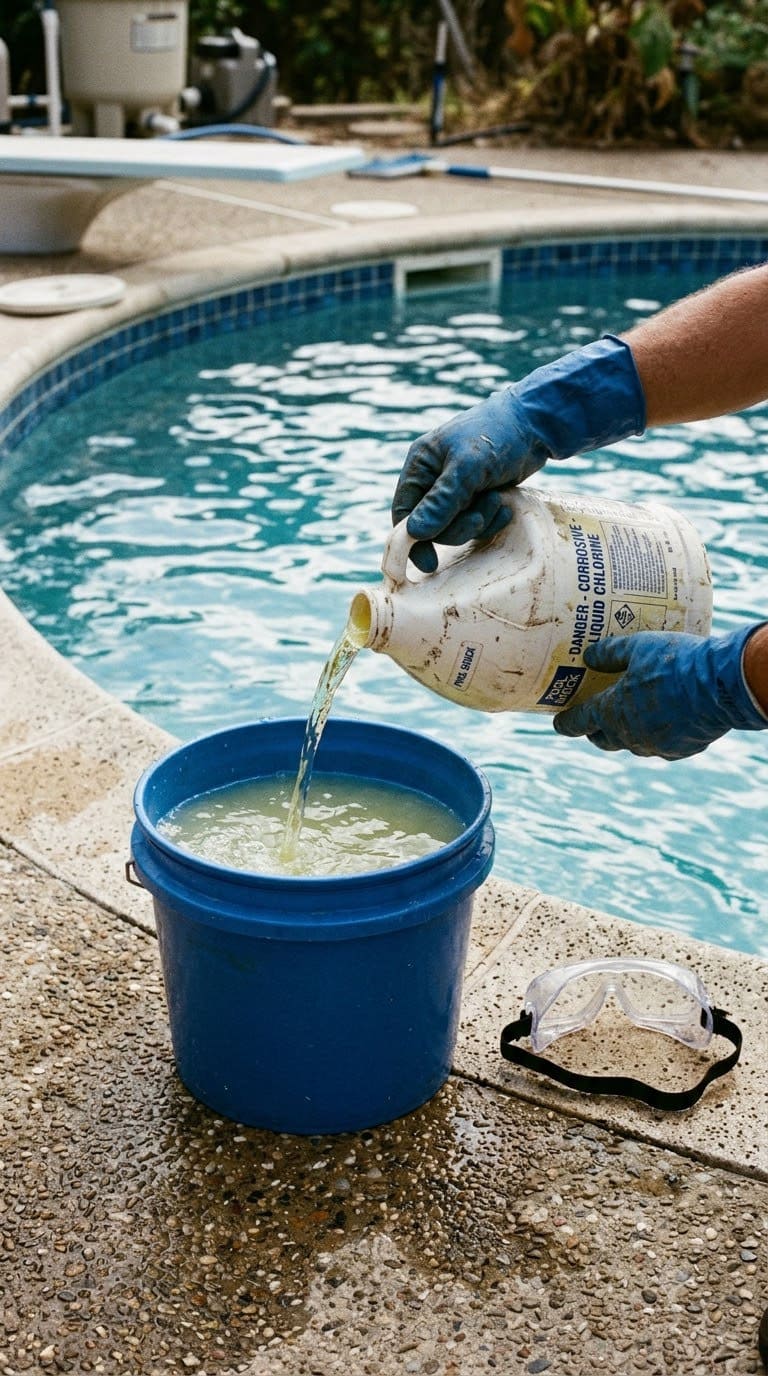
Free chlorine (FC) is the chlorine actively available to sanitize your water. Raising it takes more product in a bigger pool, and less product from a stronger concentration.
For liquid chlorine, pool professionals use a simple trade formula. A gallon of X% liquid chlorine added to 10,000 gallons raises FC by about X ppm.
Liquid chlorine (fl oz) = (ppm needed / % concentration) x (pool gallons / 10,000) x 128For granular products like cal-hypo or dichlor, the math works from real chemistry instead. One ppm equals one milligram of chemical per liter of water. A gallon of water weighs about 8.34 lbs.
Granular chlorine (oz by weight) = [(ppm needed x gallons x 8.34) / 1,000,000] / (% concentration / 100) x 16Both formulas are widely used across the pool industry. Neither is a number a health authority publishes directly.
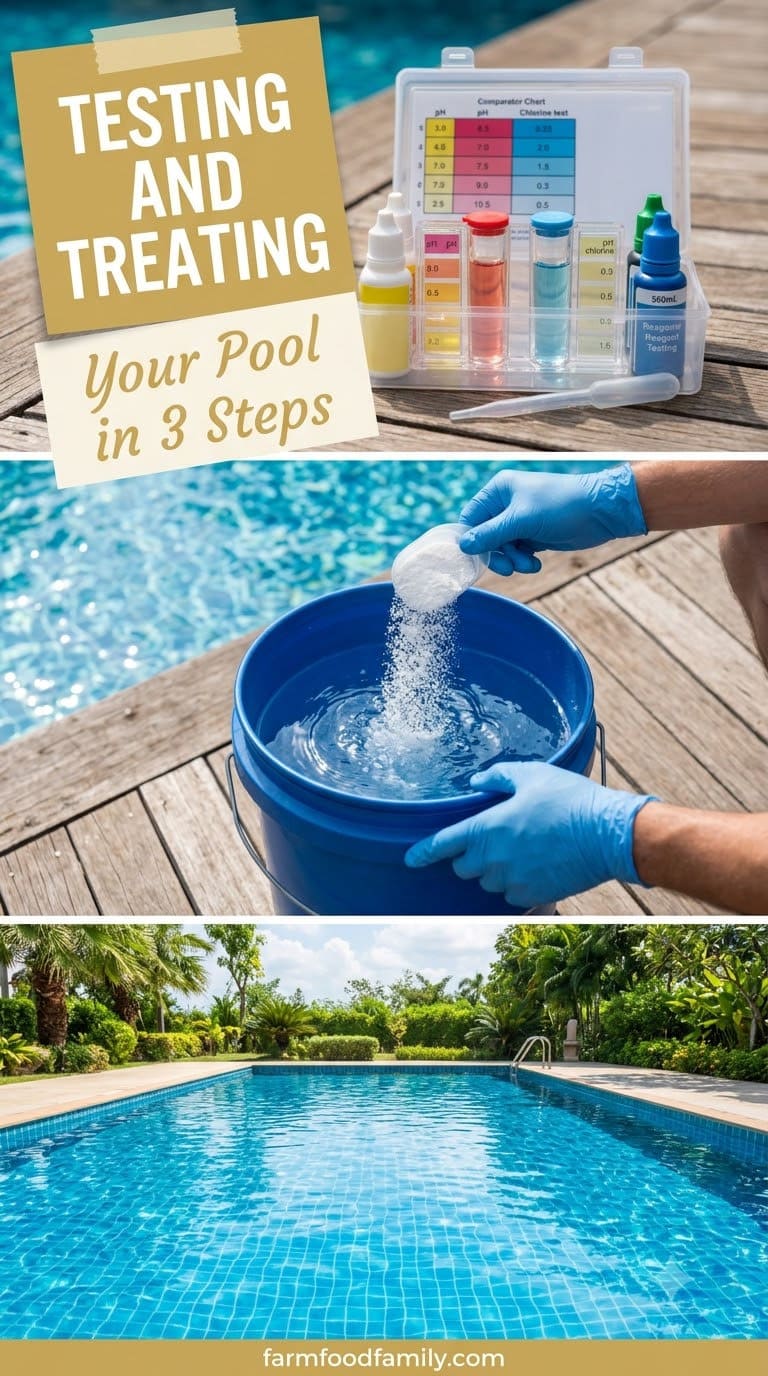
Treat the result as a solid starting dose. Confirm with a test kit an hour or two after the chlorine circulates.
Safe Ranges for Pool Water Chemistry
| Parameter | Recommended range | Source |
|---|---|---|
| Free chlorine | 2-4 ppm (with stabilizer present) | CDC Model Aquatic Health Code |
| pH | 7.2-7.8 | Commonly cited industry range, within CDC’s broader 7.0-7.8 |
| Total alkalinity | 80-120 ppm | CDC and PHTA both agree on this range |
| Cyanuric acid (stabilizer) | 30-50 ppm for residential pools | Common residential practice, stricter for public pools |
Cyanuric acid deserves a note. It’s the “stabilizer” that protects chlorine from sunlight. But too much of it makes chlorine less effective at killing germs.


Public pools under stricter health codes often cap CYA much lower than residential pools typically run. If your CYA tests above 50 ppm, partial draining and refilling is usually the only real fix. Nothing removes it from the water otherwise.
Adjusting pH, Alkalinity, and Stabilizer
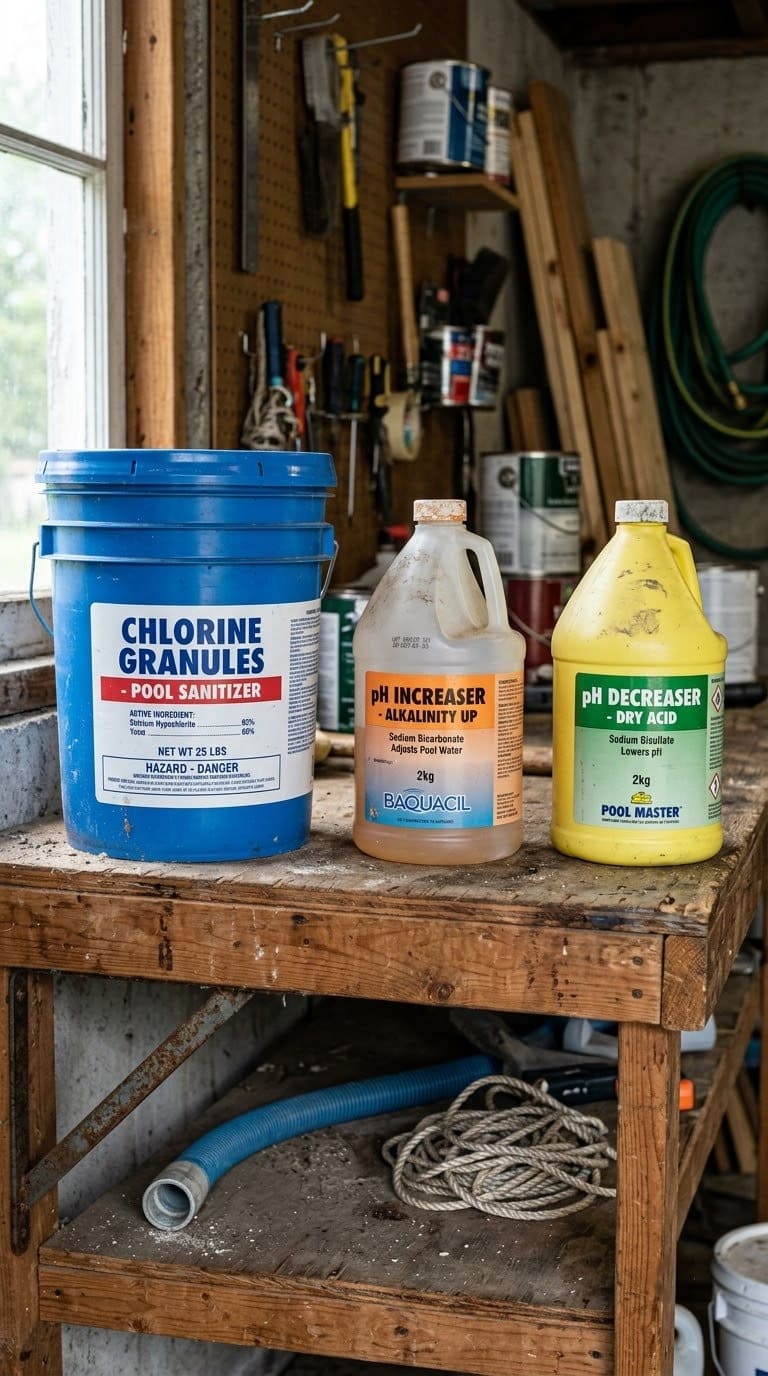
pH moves with soda ash to raise it, or muriatic acid to lower it. A common estimate is about 6 oz of soda ash per 10,000 gallons to raise pH by 0.2. Lowering pH by that same 0.2 takes roughly 8 fl oz of 31.45% muriatic acid per 10,000 gallons.
Higher total alkalinity buffers pH more strongly. A pool with high TA needs more acid to move pH the same 0.2 than this estimate assumes.
Total alkalinity rises with baking soda, also called sodium bicarbonate. A common figure is 1.5 lbs per 10,000 gallons to raise TA by 10 ppm. Add it gradually and retest, since alkalinity changes affect pH too.
The average homeowner spends $616/year on yard fixes that don't address the real problem. Find out what yours actually is — before you spend another dollar.
Take the Free QuizCyanuric acid rises with pool stabilizer or conditioner. A common figure is roughly 13 oz per 10,000 gallons for a 10 ppm increase.
It dissolves slowly, often over several days. Use a feeder or a sock in the skimmer rather than dumping it straight in.
Never Mix These: A Real Safety Section
Pool chemical injuries send people to the emergency room every year. Most incidents trace back to a small handful of preventable mistakes.
Never combine different pool chemicals directly, especially chlorine products with any acid. Mixing chlorine and acid can release toxic chlorine gas.
Store chemicals separately. Never reuse a scoop or container between products.
Always add chemical to water, not water to chemical. Pouring water into a concentrated chemical can cause a violent, splashing reaction. Add slowly to a full bucket of water instead.
Add one chemical at a time. Let it fully circulate, then test again before adding the next one.
Wear gloves and eye protection, and work in a ventilated area. Keep all chemicals away from kids and pets, in a dry, cool storage spot.
How Pool Size Changes Your Chemical Budget
A bigger pool doesn’t just need more water. It needs proportionally more of every chemical, every time you adjust anything.
Doubling your pool’s gallons roughly doubles the chlorine needed for the same ppm increase. This is why an accurate volume number matters so much before you even open a chemical container. A rough guess on gallons throws off every dose that follows.
This also explains why above-ground and inflatable pools cost so much less to maintain than in-ground pools. A typical 15-foot round above-ground pool holds around 5,000 gallons.
A modest in-ground pool often holds four times that. The chemical cost scales right along with it.
This is also why guessing your gallons “close enough” costs real money over a season. A 20% error on volume means a 20% error on every dose after it, in either direction, whether you’re overspending on chemicals or under-treating the water.
FAQs
How many gallons is a 16×32 pool? At a common average depth of 5 feet, a 16×32 ft rectangular pool holds about 19,200 gallons (16 x 32 x 5 x 7.5). Actual volume shifts with your specific average depth.
How much shock do I need for a green pool? Green pool water usually means algae has taken over, which can consume chlorine faster than normal dosing accounts for. A common approach is “shocking” with 2 to 3 times the usual chlorine dose, but severely green water may need multiple treatments over several days. Test often during recovery, since standard dosing math assumes a mostly clean starting point.
Can I use bleach instead of pool chlorine? Plain unscented household bleach is sodium hypochlorite, the same active ingredient as liquid pool chlorine, just usually at a lower concentration (commonly 6-8% instead of 10-12.5%). It can work in a pinch if you adjust the dose for the lower percentage, but confirm your specific bottle has no added fragrances, thickeners, or surfactants first.
Why does my chlorine disappear so fast? Low or zero cyanuric acid is the most common cause outdoors, since unstabilized chlorine breaks down in sunlight within hours. High bather load, algae, and hot weather all increase chlorine demand too. If CYA is in range and chlorine still vanishes fast, test for algae or a heavy contamination source.
Do I need different chemicals for a saltwater pool? A saltwater pool still uses chlorine, made on-site from dissolved salt by a chlorinator cell instead of added by hand, and you’ll still manage pH, alkalinity, and stabilizer the same way. See our guide on saltwater vs. chlorine pool maintenance for a deeper comparison.
How often should I test my pool water? Twice a week is a common baseline for chlorine and pH during swim season, with alkalinity and stabilizer checked less often since they shift more slowly. Test after heavy rain, after a big pool party, or any time the water looks off.
Is a lower chlorine reading always bad? Not necessarily, if pH, alkalinity, and stabilizer are all in range and the water is clear. But a consistently low reading combined with cloudy water or a chlorine smell (which actually signals chloramines, not too much chlorine) usually means it’s time to shock the pool.
Glossary
- Free chlorine (FC): The chlorine still active in the water, ready to sanitize. Different from chlorine that’s already been used up.
- Combined chlorine: Used-up chlorine now bound to contaminants. This causes the “chlorine smell” people blame on too much chlorine, when it actually means the opposite.
- Cyanuric acid (CYA): A stabilizer that slows chlorine breakdown from sunlight. Also called “conditioner.”
- Total alkalinity (TA): A measure of how well the water resists pH swings. Acts like a buffer.
- Shocking: A large dose of chlorine, well above normal maintenance levels. Used to rapidly clear contaminants or kill an algae bloom.
Sources & References
- Centers for Disease Control and Prevention. Model Aquatic Health Code
- Pool & Hot Tub Alliance (PHTA), industry water balance guidance for total alkalinity and pH ranges.
For pool setup and care beyond chemistry, see our guide to choosing a pool cleaner based on pool volume and how consistent pool care supports a healthy home. If you’re still planning your pool, our above ground pool ideas guide covers layout and setup, and our backyard inflatable pool ideas guide covers smaller seasonal setups where this calculator’s volume math still applies.
Never miss an update — choose FarmFoodFamily as your preferred source on Google.
How it works: Tap the button below to open Google's settings page, then check the box next to FarmFoodFamily.
Tap the checkbox to turn it blue — that's how you know it's set.