15 Smart Drainage Ideas for Sloped Yards to Keep Water Away
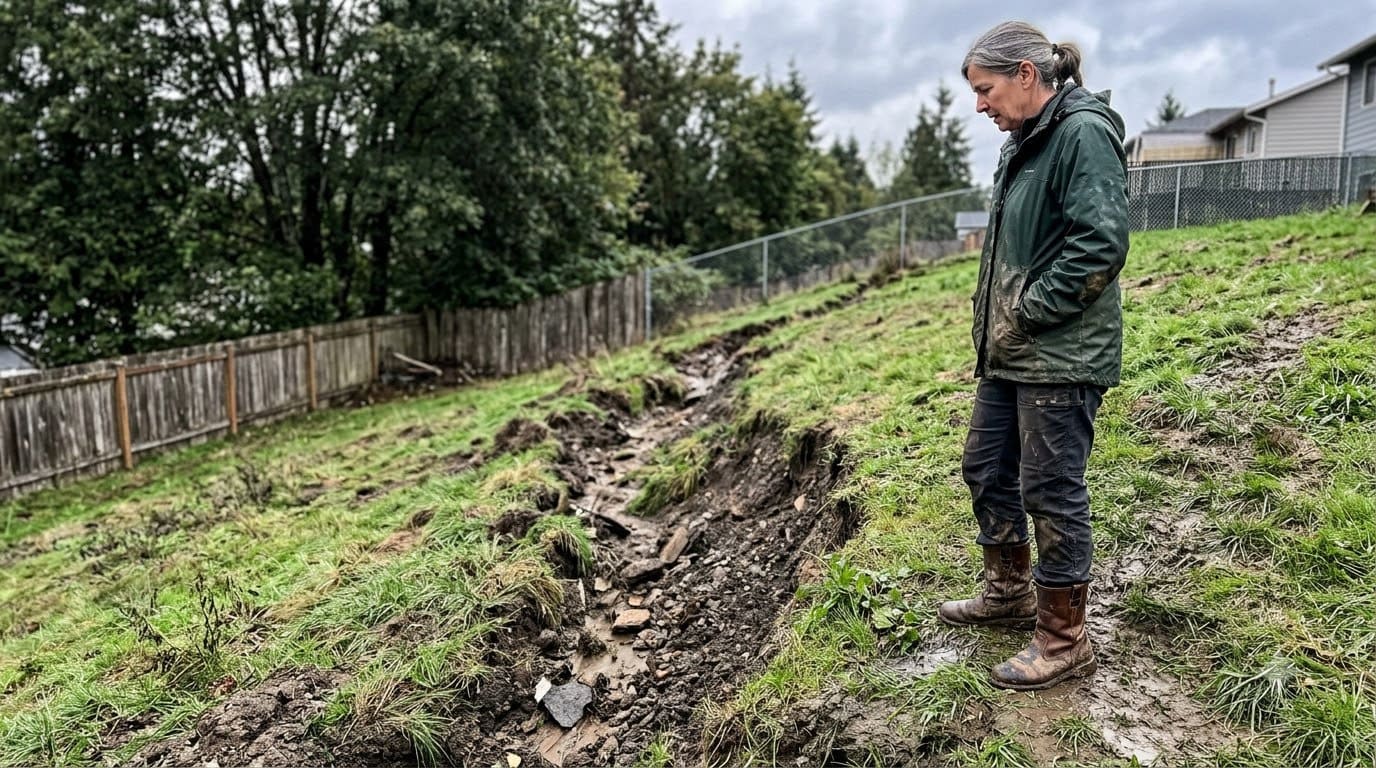
A sloped yard sheds water fast whether you plan for it or not, so the real choice isn’t whether to add drainage, it’s picking the one fix that actually matches your grade and soil instead of the first idea in a photo gallery.

Never miss an update — choose FarmFoodFamily as your preferred source on Google.
How it works: Tap the button below to open Google’s settings page, then check the box next to FarmFoodFamily.
Tap the checkbox to turn it blue — that’s how you know it’s set.
For most sloped yards, the right fix depends on grade and soil, not personal taste. A French drain (a gravel-filled trench with perforated pipe) handles slopes under 15% with clay or compacted soil that won’t absorb water on its own.
A dry creek bed works as a surface-only fix for mild slopes where water moves fast but the soil underneath drains fine. Grass swales need at least a 1% grade and top out around 4%, per Virginia Tech Cooperative Extension.
Rain gardens need 10 feet of clearance from the foundation and should sit on gently sloping ground, not a steep grade. Retaining walls become the answer once a slope is too steep to grade safely, and any wall over 4 feet usually needs a permit and an engineer’s stamped drawing. Combine two or three of these rather than expecting one fix to do everything.
Why Most Drainage Advice Doesn’t Fit Your Yard
Most of the drainage advice floating around for sloped yards reads like it was written for a flat lot with a vague slope problem tacked on. It wasn’t. A 20% grade behaves nothing like a 5% grade, and clay soil behaves nothing like sandy loam, so the fix that saved your neighbor’s yard might actively make yours worse.
Below are the same 15 approaches worth knowing, but with the actual dimensions, materials, costs, and permit rules that decide whether each one works on your specific slope.
Which Drainage Fix Actually Fits Your Yard?
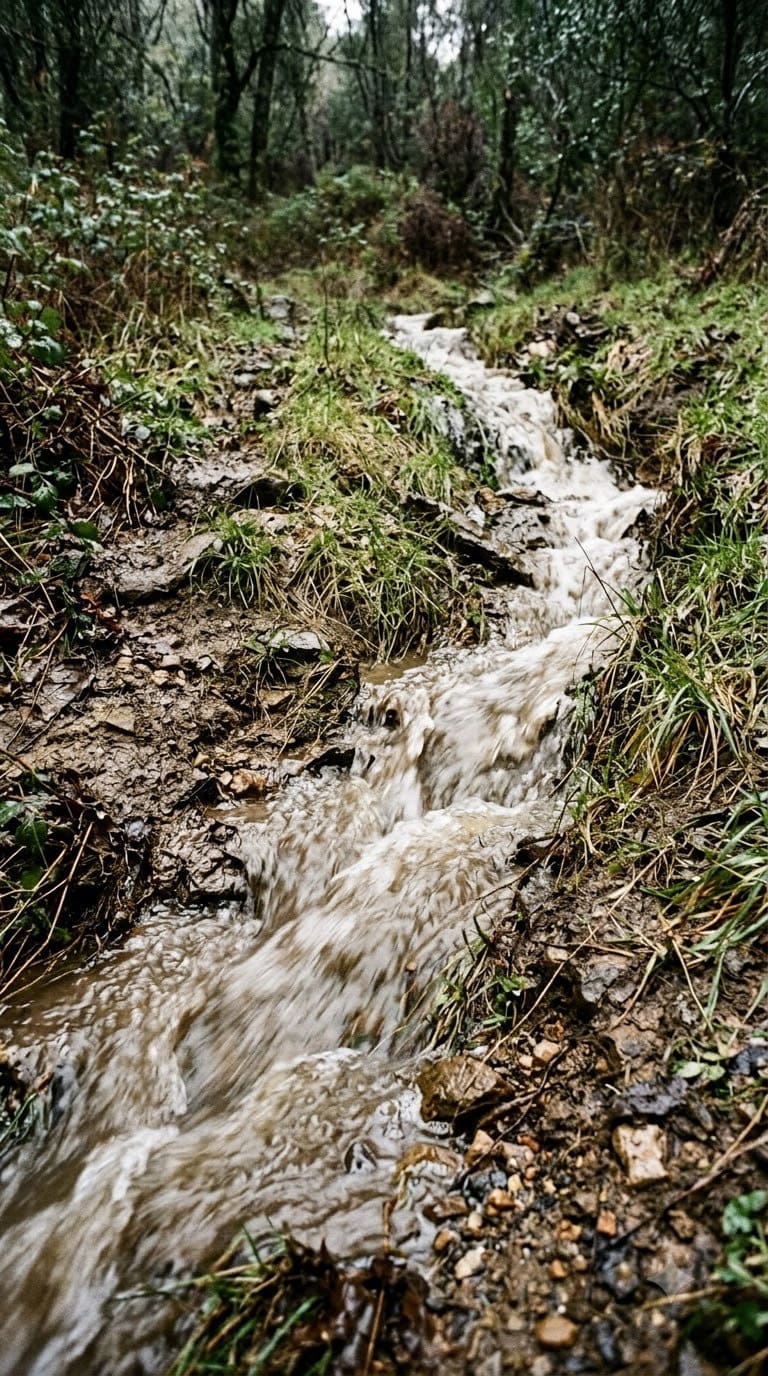
Before picking an idea below, use this table to narrow down what’s actually appropriate for your grade and soil. Skipping this step is the single biggest reason DIY drainage projects fail.
Answer 4 quick questions and get matched to the exact fix for your yard — drainage, budget, layout, or something else entirely.
Take the Free Quiz| Fix | Best slope range | Soil fit | Typical cost | DIY or pro |
|---|---|---|---|---|
| French drain | Under 15% | Clay or compacted, water pools on top | $10-$25/linear ft materials, $30-$60/linear ft installed | DIY for short runs, pro for anything over 50 ft or near a foundation |
| Dry creek bed | Mild to moderate, 5-15% | Any (it’s a surface fix, doesn’t fix subsurface saturation) | $10-$25/sq ft | DIY-friendly |
| Grass swale | 1-4% only | Sandy to loamy, needs some infiltration | $3-$10/linear ft | DIY |
| Rain garden | Flat to gentle slope near the base | Needs to actually absorb water, not solid clay | $5-$15/sq ft self-build | DIY with real research |
| Retaining wall | Steep, 15%+ or a sudden grade change | Any, wall does the work | $15-$35/sq ft depending on material | Pro above 4 ft, DIY possible under that with a permit check |
15 Effective Drainage Solutions for Sloped Yards That Actually Work
1. Terraced Levels
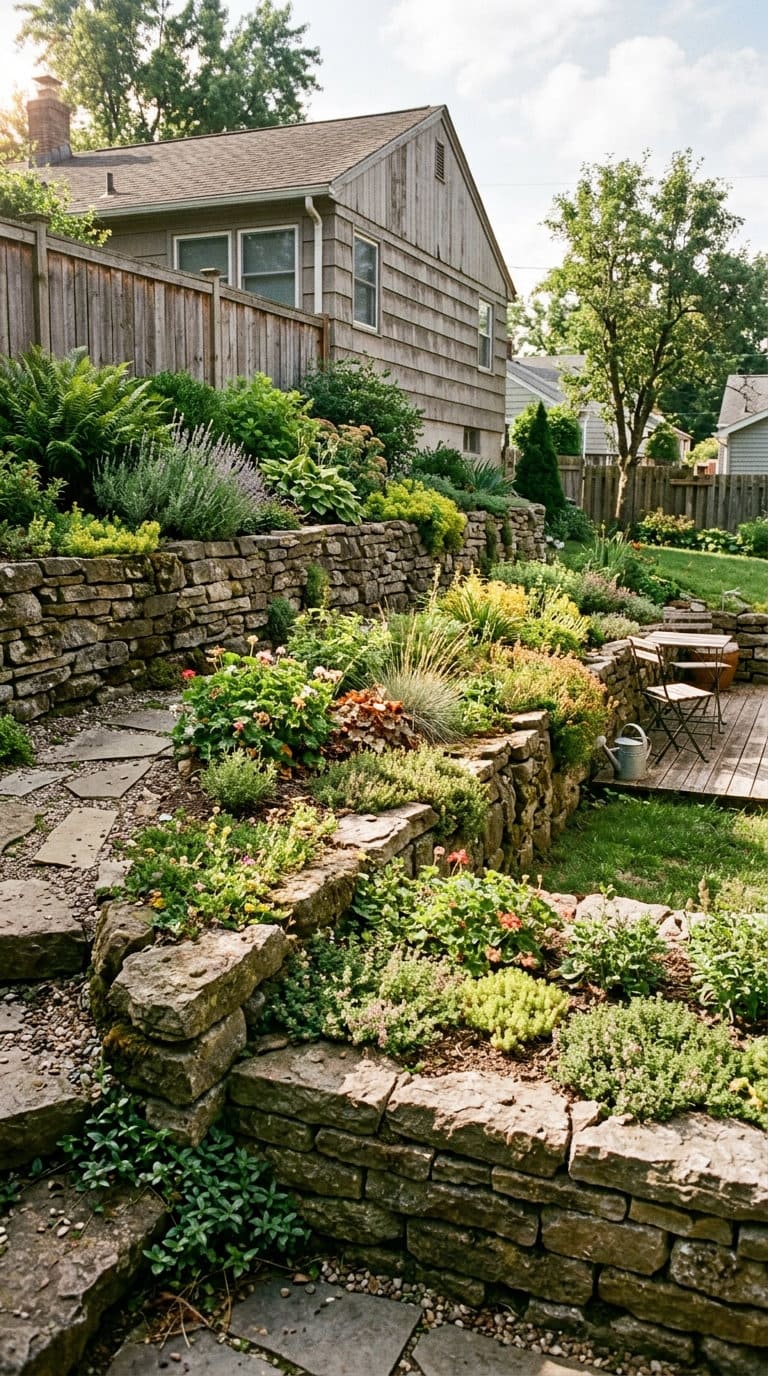
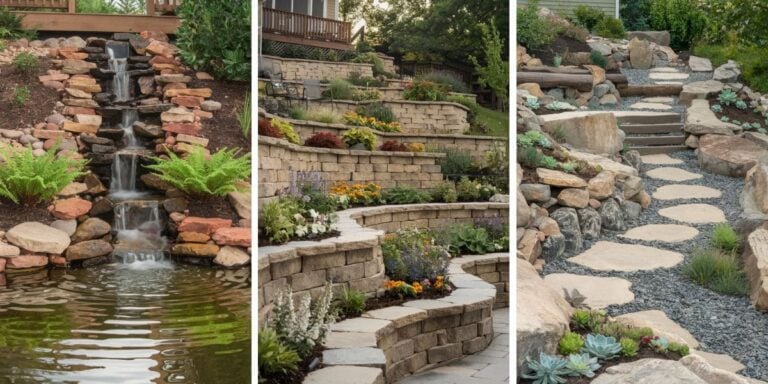
Terracing turns one unmanageable slope into a series of flat, usable steps. Each level should run 6 to 8 feet wide with a wall no taller than 4 feet holding back the soil behind it, since that 4-foot mark is also the point where most building departments start requiring an engineer’s stamped drawing.
Build each tier’s wall with a slight backward lean, about 1 inch of step-back for every 12 inches of height, so the wall resists the soil pressure behind it instead of tipping forward over time. Backfill with gravel, not the clay you dug out, or you’ve just built a wall with no drainage path at all.
Terracing pairs well with idea 8’s retaining walls below since most terraced yards use short walls at each level rather than one tall one. It’s also the one fix on this list that adds real usable square footage instead of just moving water somewhere else, and if your whole lot is small to begin with, carving a flat living space out of a tight, steep backyard covers layout tricks worth combining with the terracing itself.
2. French Drains
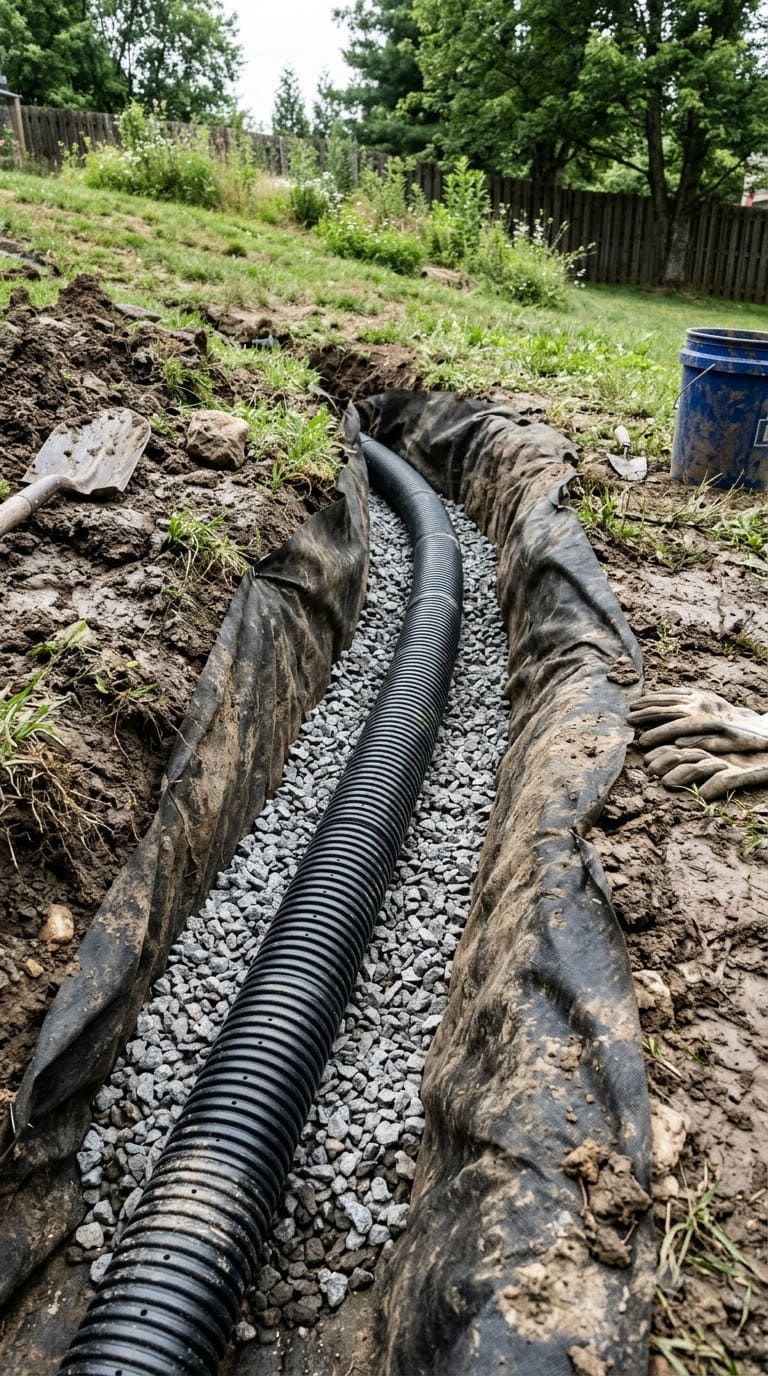
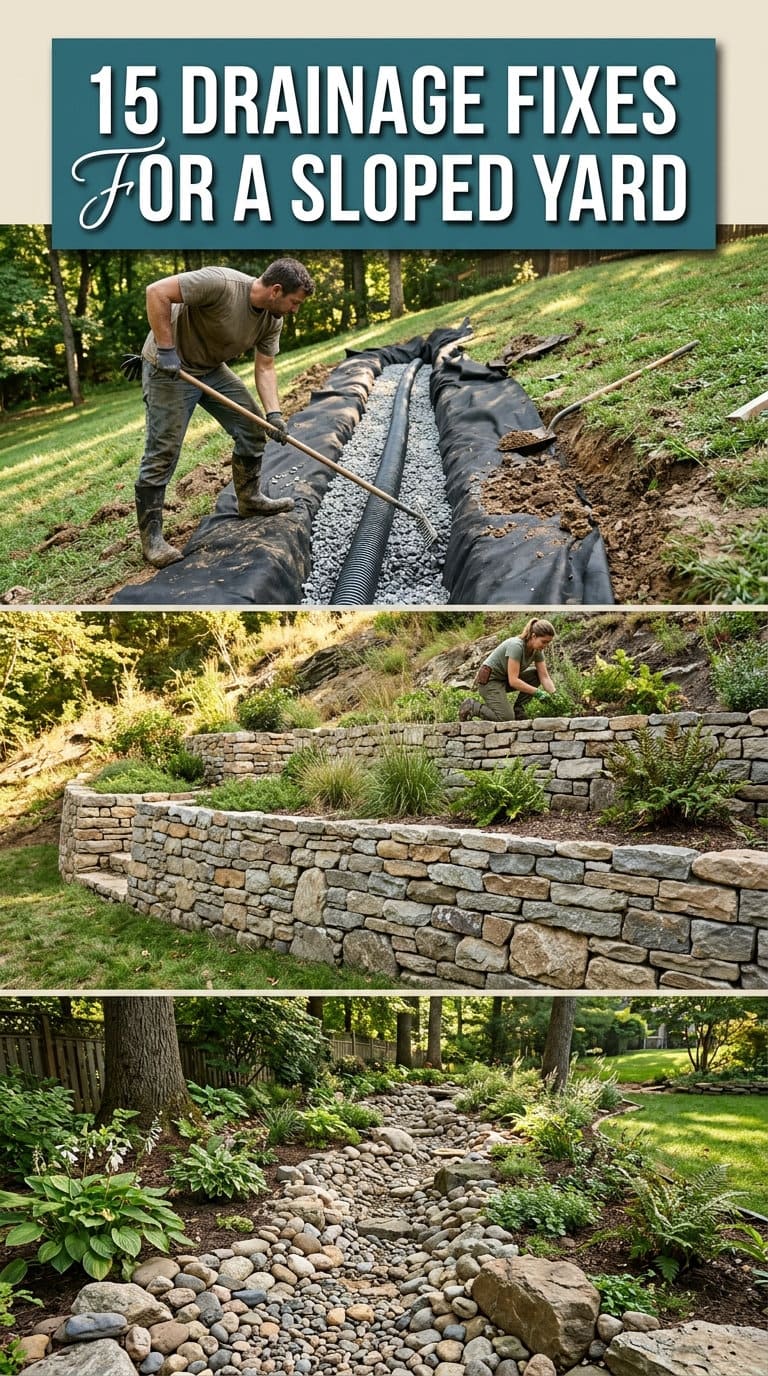
A French drain is a gravel-filled trench with a perforated pipe buried inside it, built to intercept water moving downhill before it reaches your house, patio, or garden bed. Dig the trench about 18 inches deep and 12 inches wide, running across the slope at a gentle 1-inch drop for every 8 feet of length so water actually flows toward the outlet instead of sitting still.
Line the trench with landscape fabric before adding gravel, or fine soil particles will clog the pipe’s perforations within a couple of seasons. Lay 3 inches of 3/4-inch washed gravel, set the pipe with holes facing down, then bury it under more gravel and a soil cap.
This is the fix Virginia Tech Cooperative Extension and most drainage guides point to for clay-heavy yards where water just sits on the surface, since a swale alone won’t infiltrate fast enough in dense soil. Expect $30 to $60 per linear foot installed by a pro, less if you’re renting a trencher and doing it yourself on a short run.
3. Dry Creek Beds
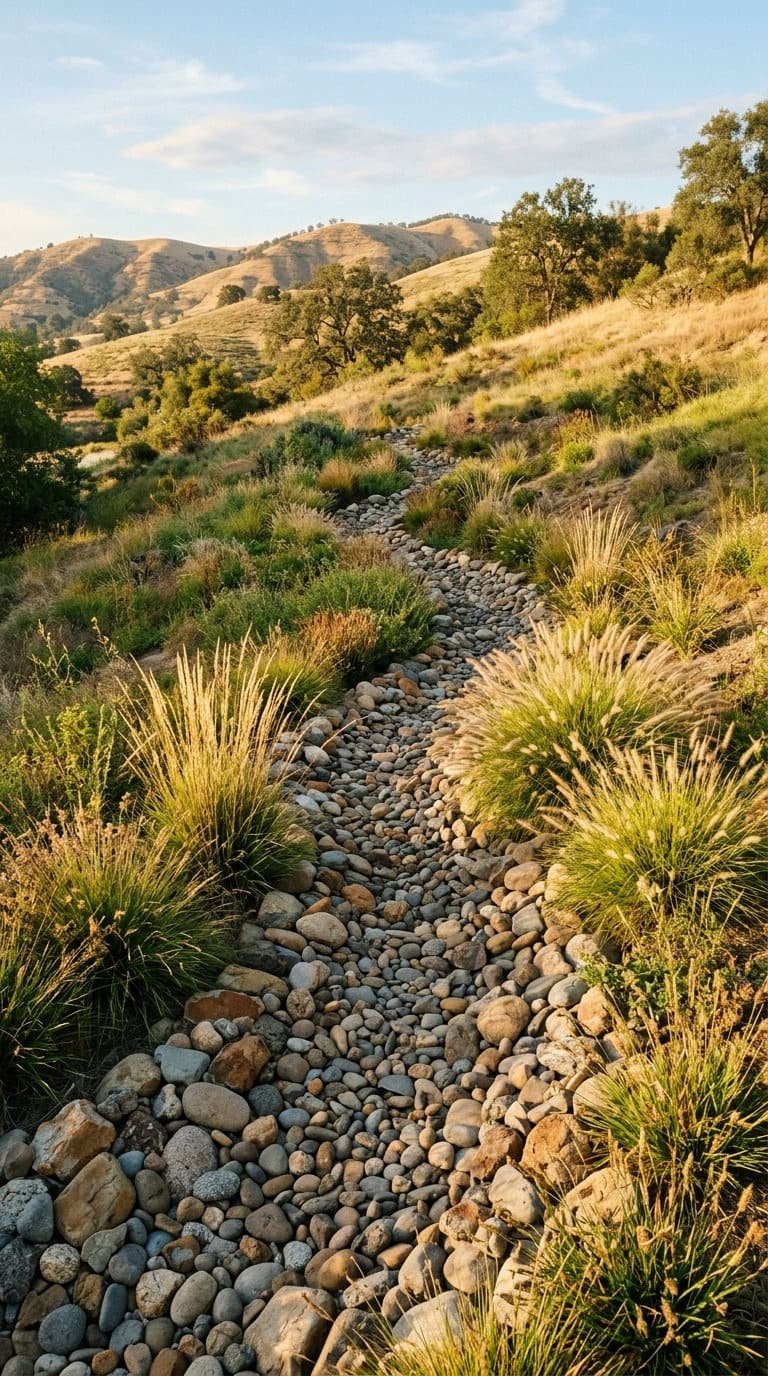
A dry creek bed looks like a natural streambed and functions as a surface channel that guides fast-moving water without a single buried pipe. Dig a shallow channel 4 to 6 feet wide and 12 to 18 inches deep, with the sides sloped at roughly 45 degrees so they don’t collapse after the first hard rain.
Most yard problems trace back to one specific, fixable cause. Find yours in 4 quick questions.
Take the Free Quiz
Redirects roof runoff away from the foundation, the fastest fix in idea 9 above. ~$25/2-pack, 4.4★ (845 ratings), Amazon's Choice.
Shop NowThis post contains affiliate links. We may earn a commission on qualifying purchases at no extra cost to you.
Layer the bed the way a real streambed forms: 1 to 2 inch gravel on the bottom, 3 to 4 inch cobbles in the middle zone, and larger 6 to 8 inch accent stones where the flow would naturally slow. Plant sedges or ornamental grasses along the edges, both because they hold soil in place and because a bare gravel ditch reads as a drainage feature that got abandoned halfway.
Don’t mistake this for a fix that handles saturated soil underground, it only manages what’s moving across the surface. Pair it with idea 2’s French drain if your yard has both a surface-flow problem and a soggy-ground problem underneath, and if you want the full rock-selection and layout breakdown for this specific look, the dedicated dry creek bed guide goes deeper than there’s room for here.
4. Catch Basins
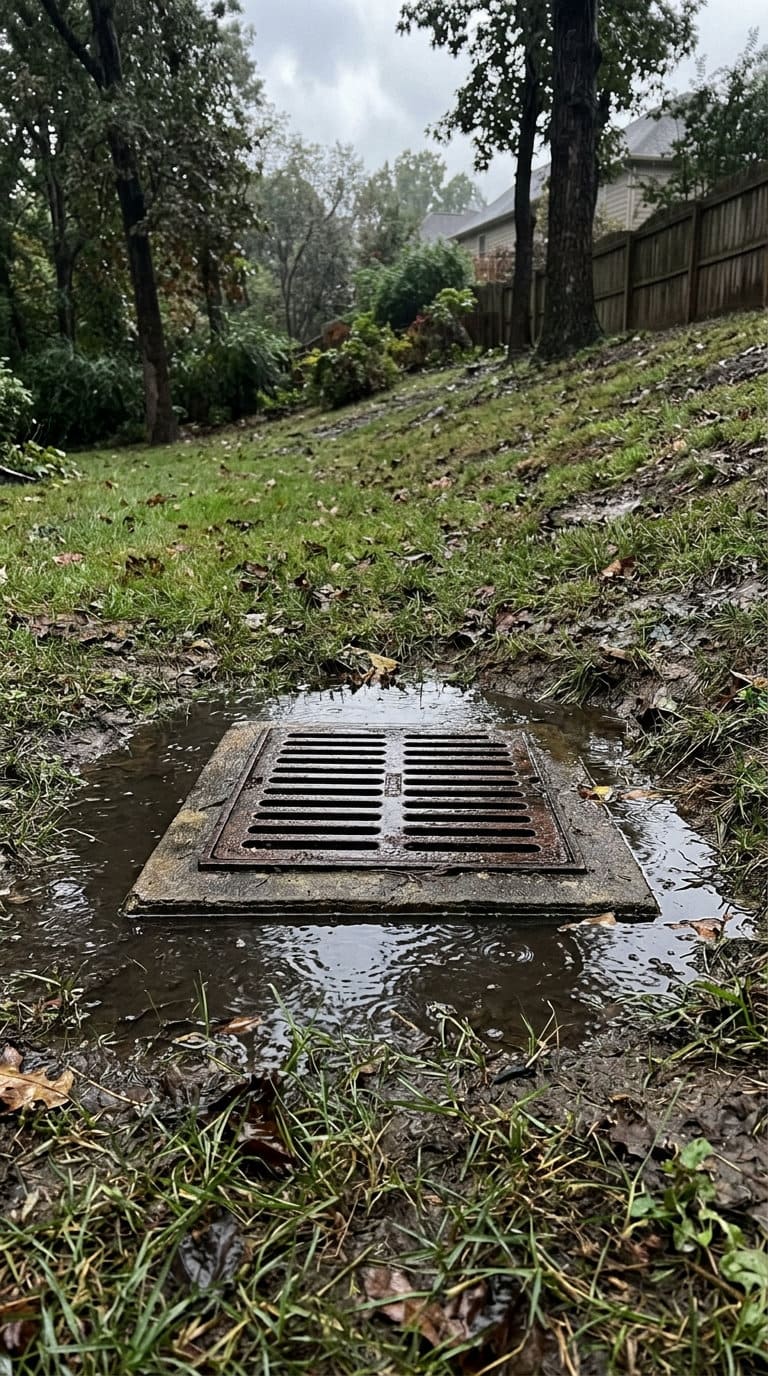
A catch basin is a grated box set into the ground at a low point, collecting runoff before it’s piped away to a French drain, storm drain, or dry well. Space basins every 50 to 75 feet along a slope’s collection points, and bury the connecting PVC pipe (4 to 6 inches in diameter) at least 12 inches deep so it survives foot traffic and mowing.
Catch basins earn their keep at the bottom of driveways, at the low corner of a patio, or anywhere water visibly pools after rain instead of soaking in. Never route the outflow pipe straight into a natural waterway without checking local rules first, several jurisdictions require a permit for exactly that connection.
Combine a catch basin with idea 12’s channel drains for hardscaped areas like driveways, where a linear grate catches the water before it ever reaches the basin.
5. Rain Gardens
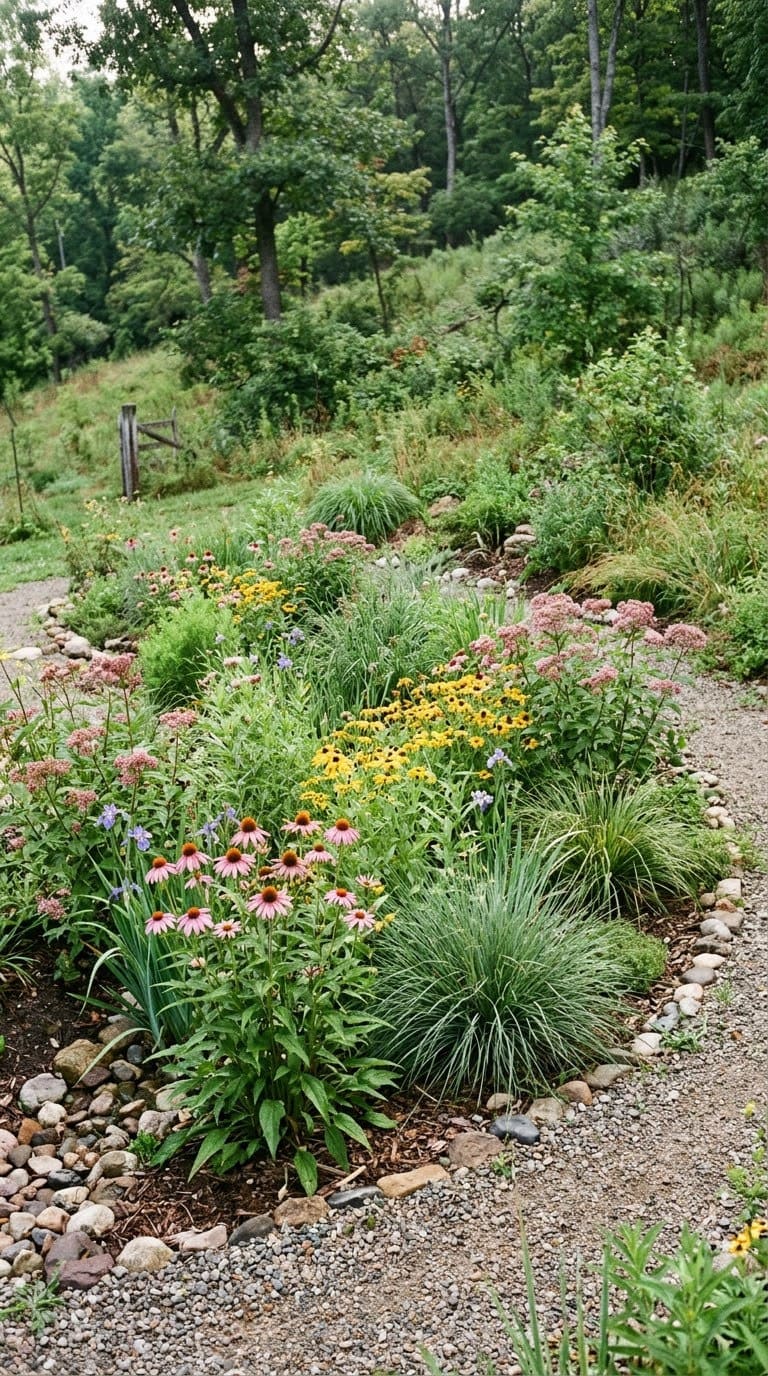
A rain garden is a shallow, planted depression that captures runoff and lets it soak into the ground instead of running downhill unchecked. Virginia Tech Cooperative Extension’s homeowner guidance is specific here: keep it at least 10 feet from your foundation, dig the basin 6 to 8 inches lower than the surrounding grade, and size it by dividing your impervious surface area (roof, driveway, patio) by 20.
For a 1,875 square foot drainage area, that works out to roughly 94 square feet of garden, which is bigger than most people picture when they hear “rain garden.” If you’d rather not do that math by hand, a sizing tool built around this exact formula plugs in your own roof and driveway numbers. Fill it with a mix of plants that tolerate both standing water after a storm and dry spells between, native sedges, swamp milkweed, and switchgrass all handle that swing well in most US regions.
The real limit here: rain gardens belong on gently sloping ground near the base of a slope, not partway up a steep grade, since a garden built on an actual incline just becomes another spot for water to run past instead of soak in.


6. Grassy Swales
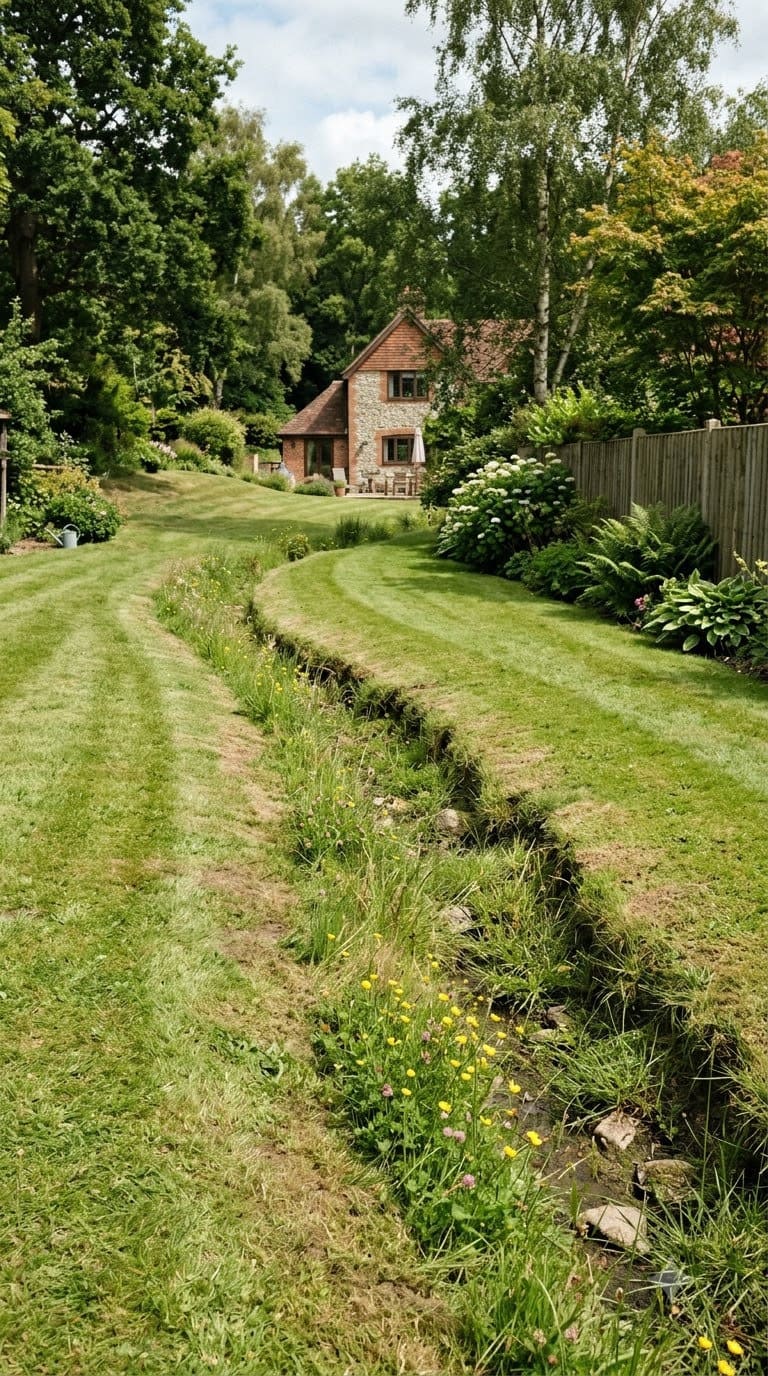
A grass swale is a shallow, grass-lined channel that slows water down and lets some of it filter into the soil as it travels. Per Virginia Tech Cooperative Extension’s Grass Swales fact sheet, the channel needs a minimum 1% slope to keep water moving, and swales aren’t recommended above roughly a 4% grade because faster water starts eroding the grass lining instead of filtering through it.
The average homeowner spends $616/year on yard fixes that don't address the real problem. Find out what yours actually is — before you spend another dollar.
Take the Free QuizKeep the swale at least 10 feet from your house, 50 feet from a septic field, and 100 feet from a well if you have one. Mowing at a taller height and checking for erosion after storms is basically the entire maintenance routine, and the fact sheet specifically recommends checking that water has drained within 4 days of a rain event.
This is the cheapest fix on the whole list, often under $10 a linear foot if you’re just regrading and reseeding existing lawn, but it’s also the pickiest about slope. Too flat and water sits, too steep and it just becomes a small ravine, and once a channel needs to handle real volume rather than a gentle trickle, a purpose-built drainage ditch is the next step up from a plain grass swale.
7. Permeable Pavers
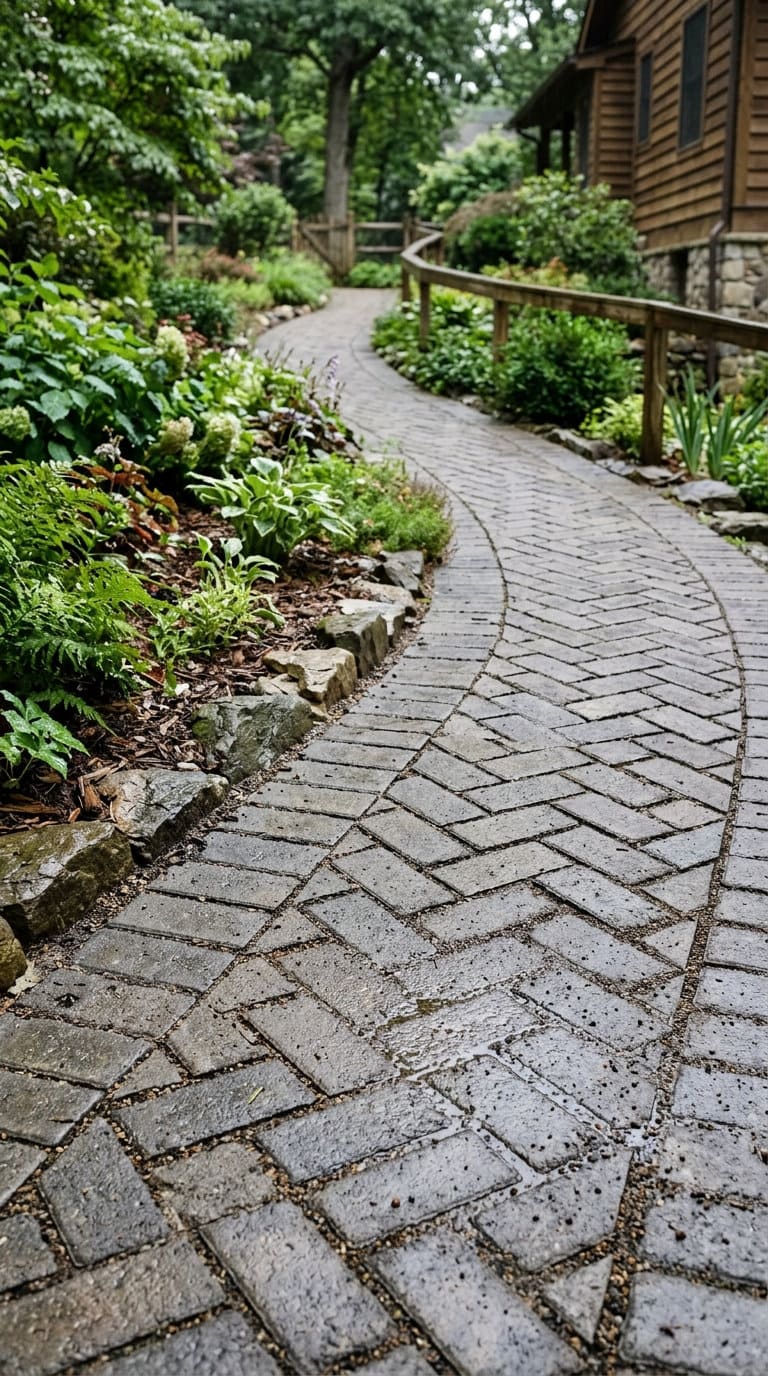
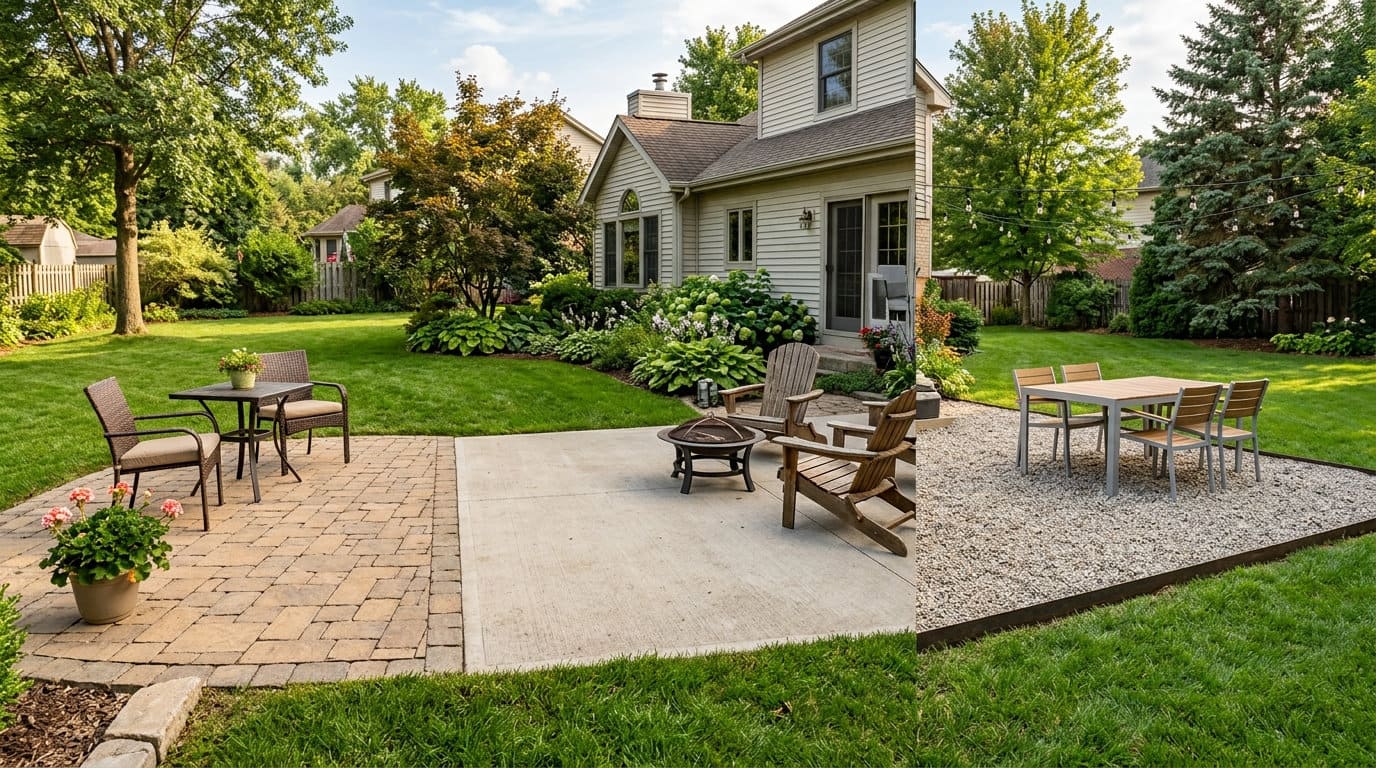
Permeable pavers let water pass through the paving surface itself instead of running off it, which matters on a slope where a solid patio or walkway would otherwise become its own mini-waterfall during a storm. They’re laid over a compacted gravel base rather than a solid concrete slab, with sand or fine gravel filling the joints instead of mortar.
On a slope, the gravel base itself needs to be engineered to slow water moving through it, not just filter it straight down, or the base washes out from underneath on a steep enough grade. This is a project most people hire out past a very small, mild-slope walkway, since a poorly built base looks fine for one season and then heaves.
Budget $15 to $25 per square foot installed, roughly double a standard paver patio, which is the tradeoff for a surface that manages its own drainage instead of shedding water onto whatever’s downhill.
8. Retaining Walls
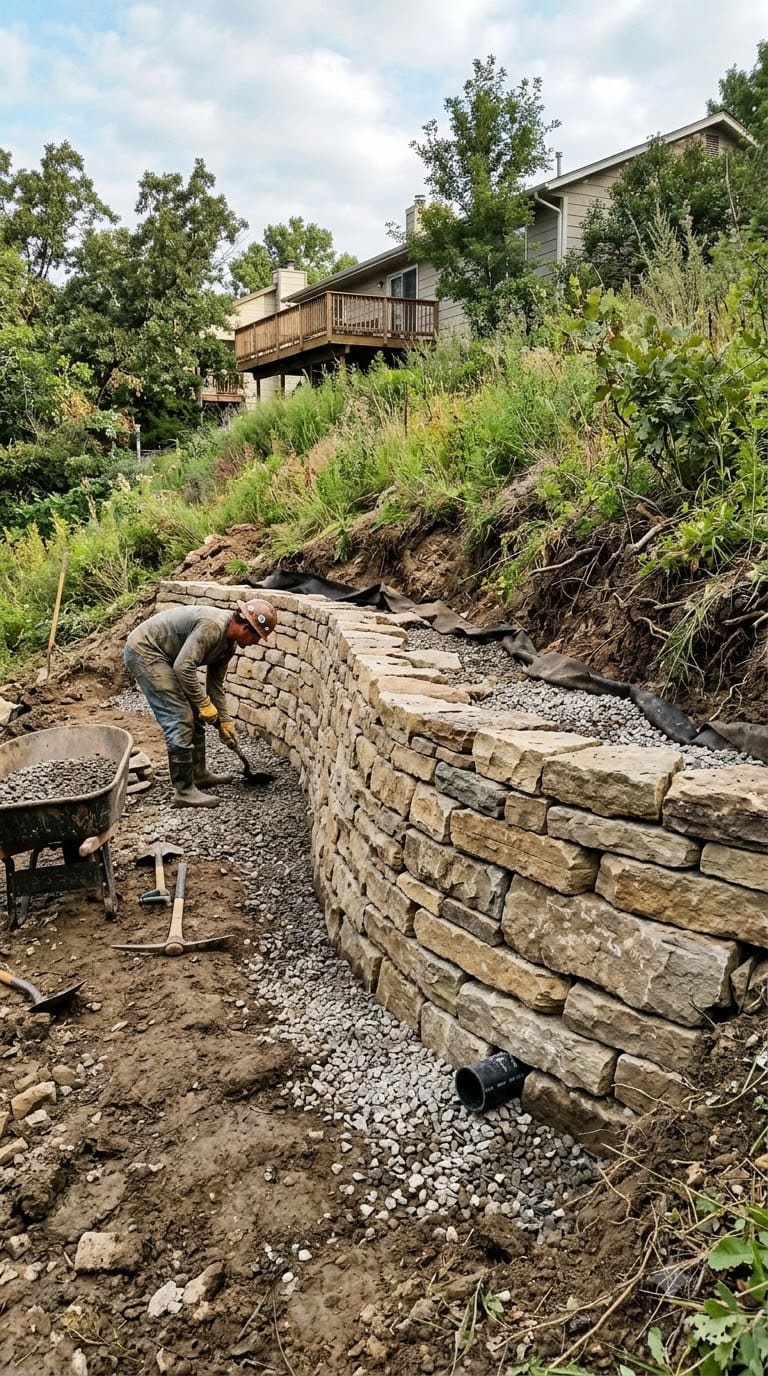
A retaining wall holds back soil on one side to create a flat area (or a shorter slope) on the other, and it’s usually the fix for grades too steep to safely manage with grading alone. Materials range widely: natural stone runs $20 to $35 per square foot, concrete block $15 to $30, and pressure-treated timber $10 to $20, with stone lasting the longest and timber needing replacement soonest.
The permit rule that trips people up most often: most local building departments, following the International Building Code’s general framework, require a permit and an engineer-stamped drawing once a wall exceeds 4 feet measured from the bottom of the footing to the top. Walls under that height can still trigger a permit if they’re holding back a driveway, sit near a property line, or stack as a series of tiered walls, so a quick call to your local building department before digging saves a lot of grief.
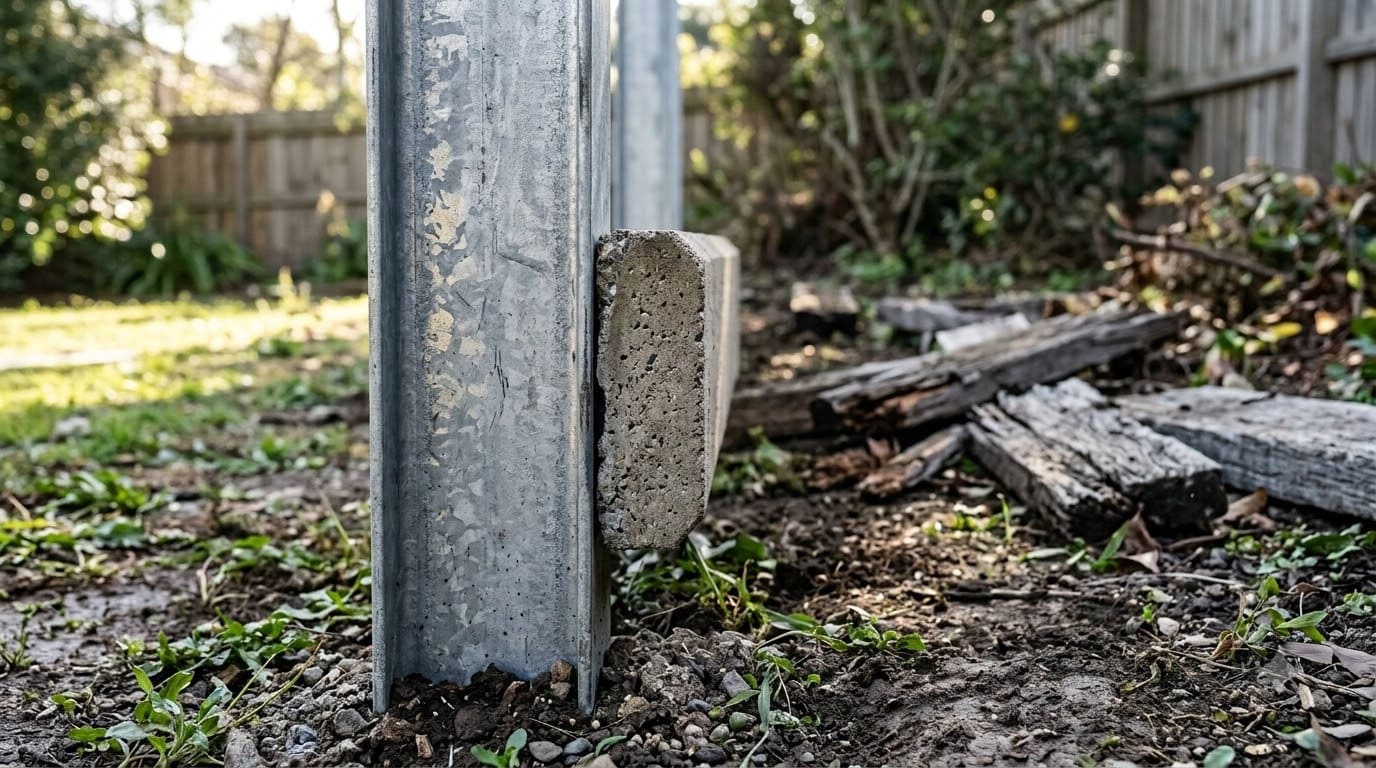
Any retaining wall over about 2 feet needs drainage built into it from the start, gravel backfill and weep holes behind the wall, or you’re just building a dam that eventually fails. This is exactly why idea 1’s terracing and this wall idea are so often the same project split into stages rather than two separate fixes, and more wall styles built specifically for steep grades are worth a look if your slope is steep enough that one wall won’t be enough.
9. Downspout Extensions
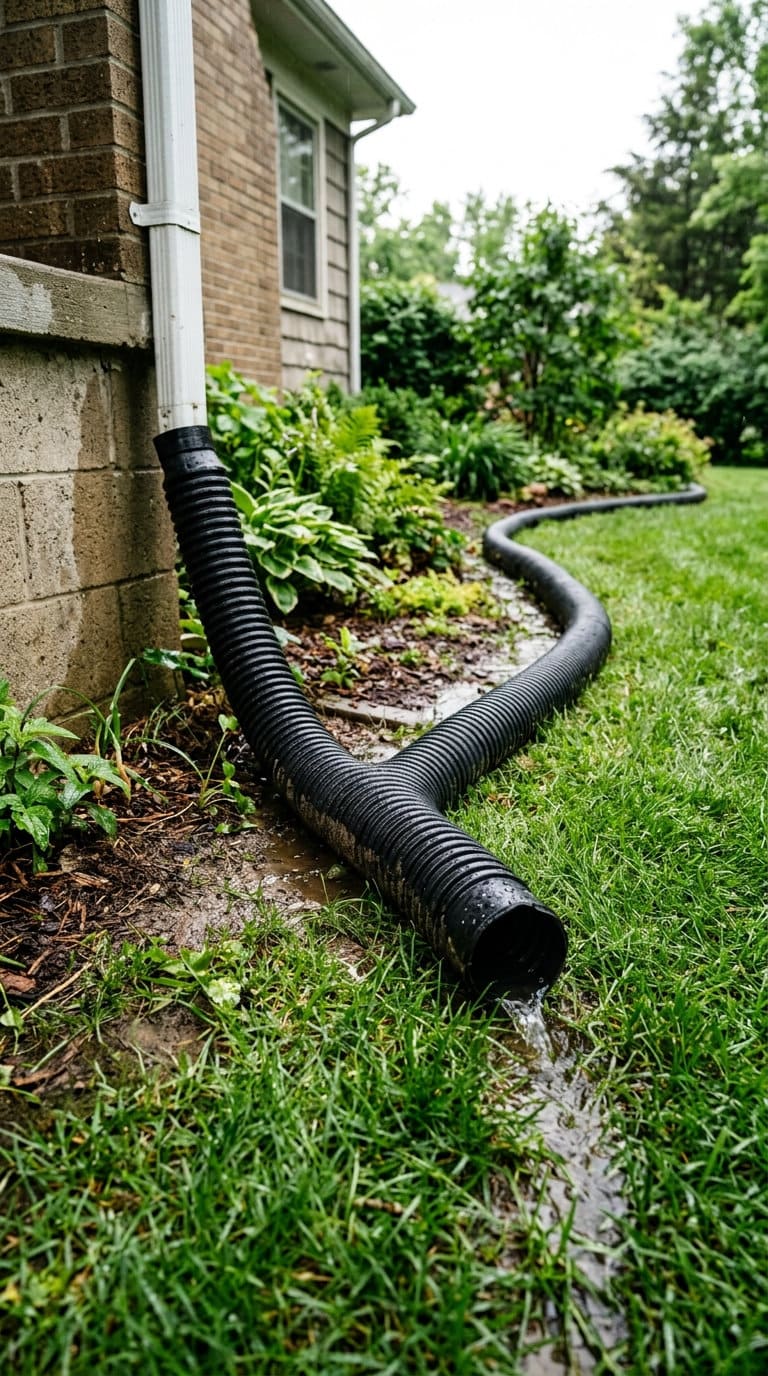
A downspout extension is the cheapest, fastest fix on this entire list and also the most limited one. A flexible extension pipe, often running $20 to $30 for a kit that reaches up to 8 feet, moves roof runoff away from your foundation without any digging at all.
The EPA’s “Soak Up the Rain” guidance frames this as disconnecting your downspout from a solid pipe or paved surface and redirecting it to a lawn, garden bed, or rain barrel where it can actually soak into the ground instead of adding to runoff that picks up oil, fertilizer, and sediment on its way to a storm drain.
Treat this as a first move, not a complete solution. It solves the roof-water problem specifically, it does nothing for groundwater already saturating your slope from other sources.
10. Slope Vegetation
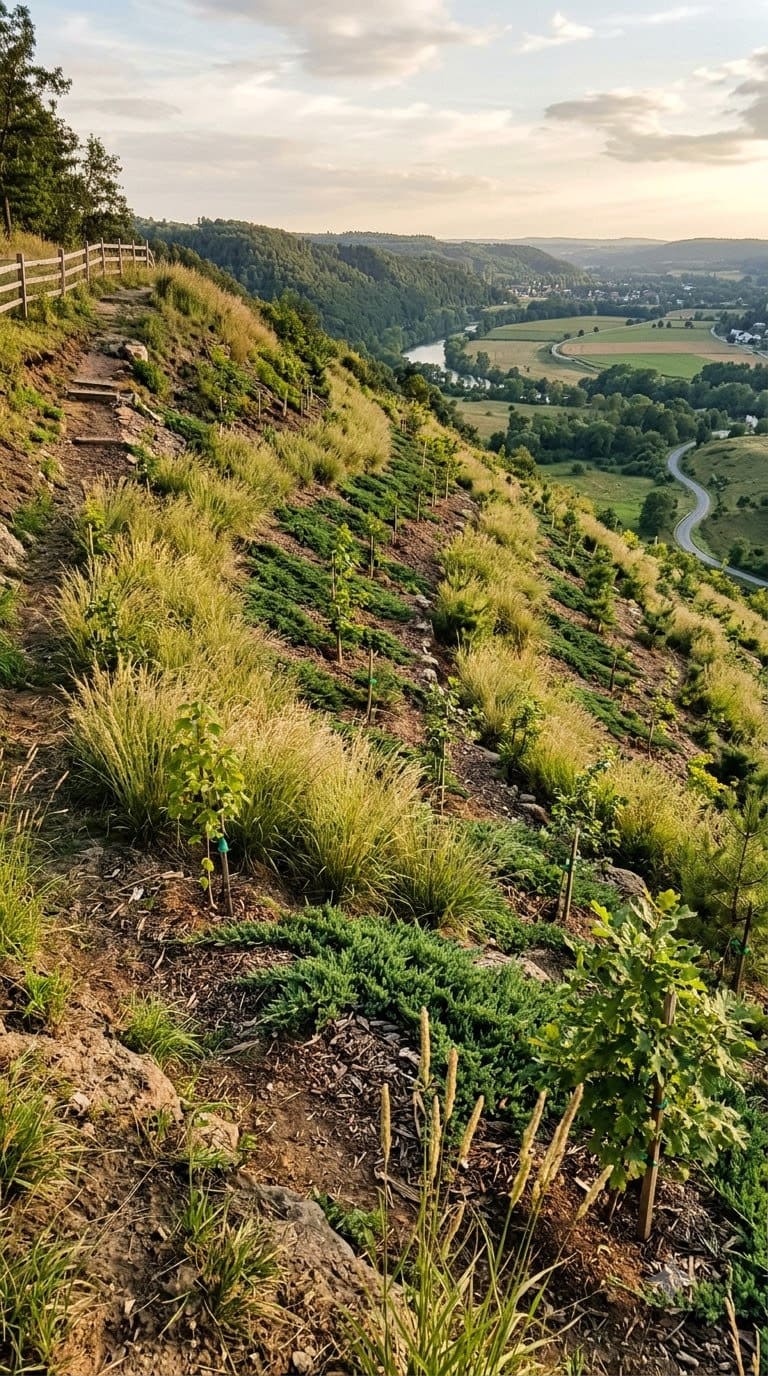
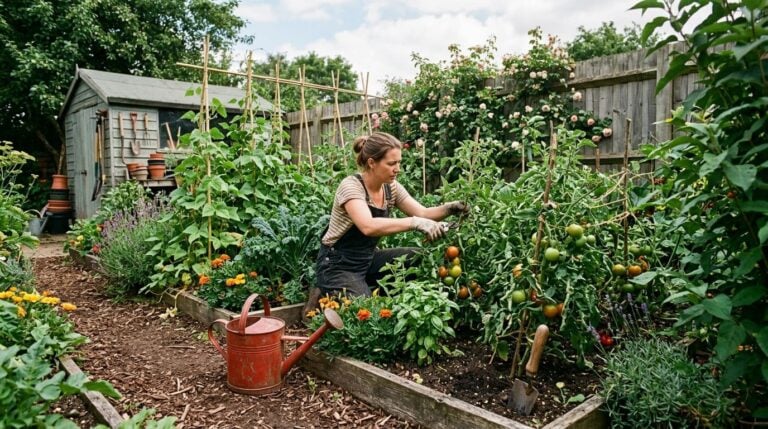
Deep-rooted plants hold slope soil in place and slow water enough that it has a chance to infiltrate instead of sheeting straight downhill. Switchgrass and little bluestem work well as ground-level erosion control, creeping juniper handles steeper, sunnier slopes where grass struggles to establish, and river birch or maple add root structure higher up the slope.
Position taller, deeper-rooted plants near the top of the slope and stagger rows moving downhill, spacing them closer together the steeper the grade gets. This isn’t a fast fix, plants need a full season or two to establish root systems strong enough to actually matter, so pair it with a faster mechanical fix like idea 2’s French drain if you need results this year rather than next. If the slope in question faces the street rather than the backyard, planting choices suited to a front-facing grade cover the curb-appeal side of the same problem.
11. Boulders and Rock Placement
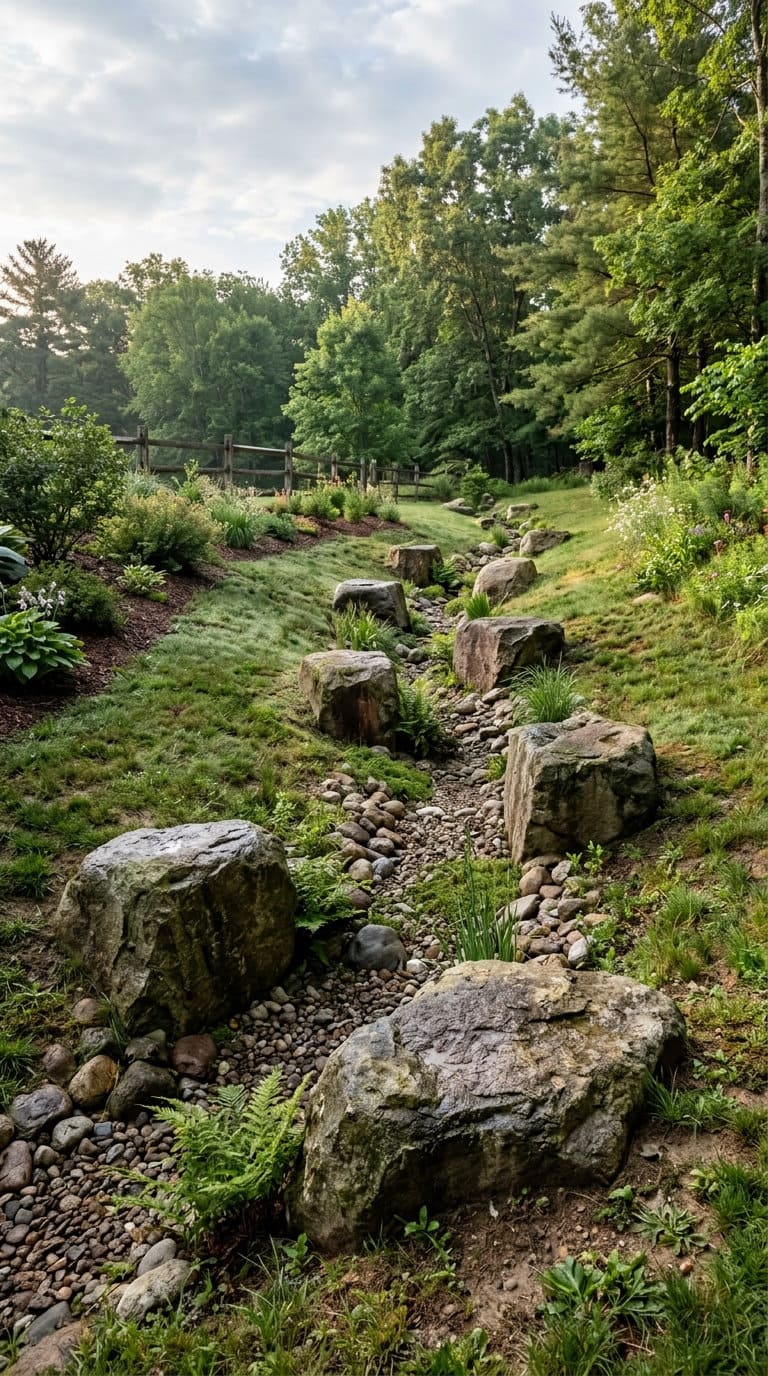
Strategically placed boulders slow water velocity on a slope and create small check points that reduce erosion between other drainage features. They work best set partially buried, roughly a third of the boulder below grade, so they read as a natural outcropping instead of decorative rocks dropped on top of dirt.
Place them at natural break points in the slope where water speed would otherwise increase, think of them as speed bumps for runoff rather than a complete drainage system on their own. Boulders complement idea 3’s dry creek bed particularly well, since a creek bed studded with a few larger accent stones both looks more natural and slows flow at the exact points where a straight gravel channel would otherwise let water pick up speed.
12. Channel Drains
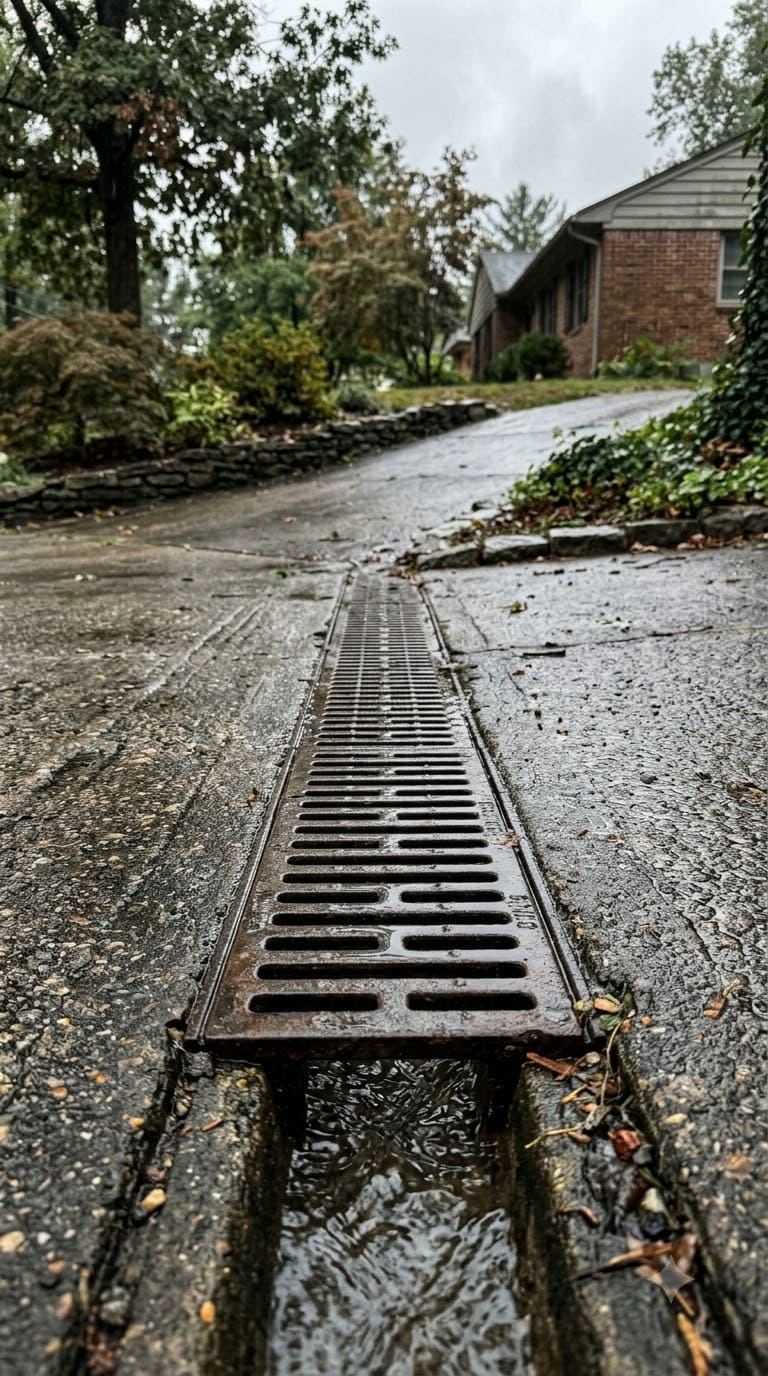
A channel drain (sometimes called a trench drain) is a narrow, grated linear drain set into hardscape, patios, driveways, and walkways, catching water right where it lands instead of letting it run to the edge first. Place them perpendicular to the slope’s flow direction, with a minimum 1% gradient toward the outlet.
These matter most at the base of a slope where a driveway meets the street or a patio meets a lawn, exactly the spots where sheet flow off a hard surface causes the most visible pooling. Clear debris out of the grate regularly, since a clogged channel drain defeats the entire purpose and just becomes a puddle with a metal cover on it.
13. Infiltration Trenches
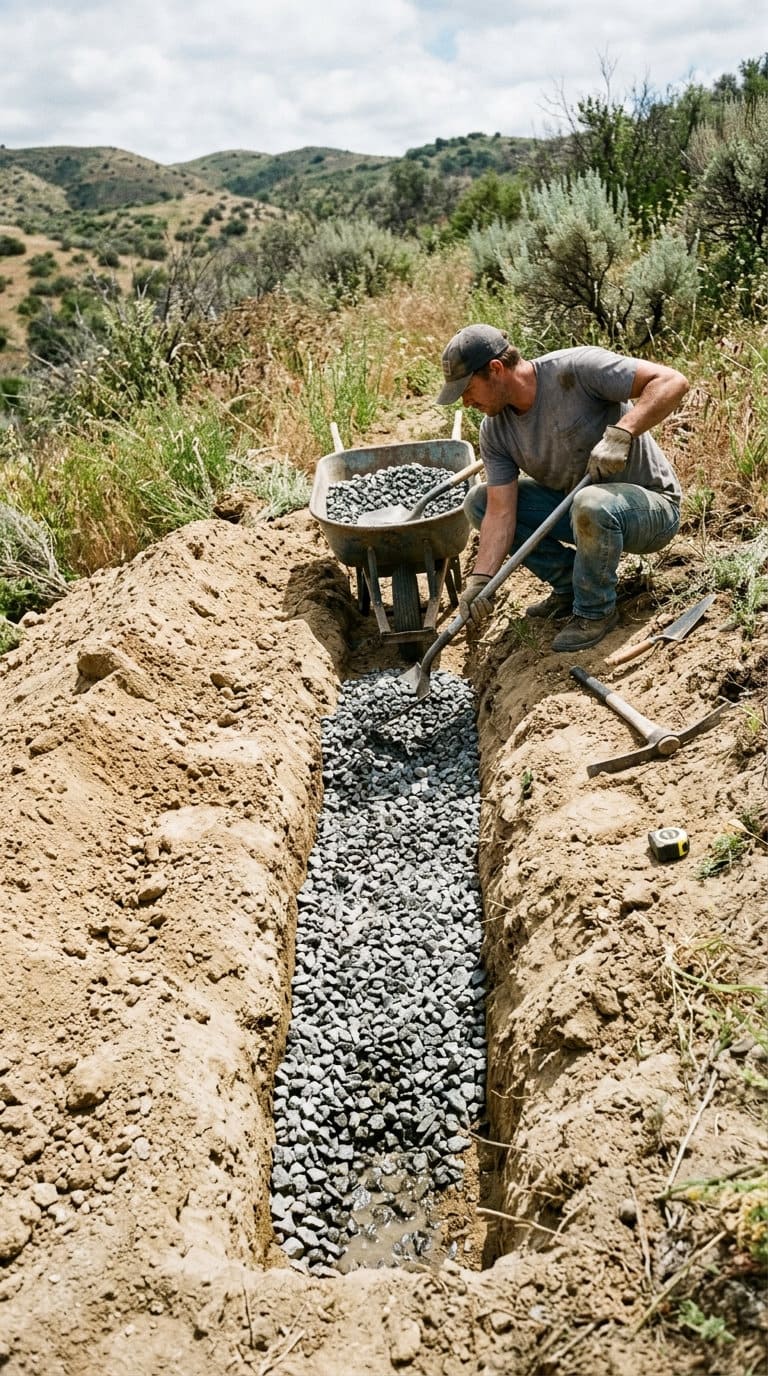
An infiltration trench is essentially a French drain without the pipe, a gravel-filled trench designed to let water soak into the surrounding soil directly rather than carrying it somewhere else. It works only where the native soil actually drains, sandy or loamy soil, not the compacted clay that makes a standard French drain necessary in the first place.
Dig the trench 2 to 3 feet deep and fill it entirely with clean, coarse gravel, no pipe, no fabric liner on the bottom (though sides can still use fabric to keep soil from sloughing in). Test your soil’s drainage first: dig a hole, fill it with water, and if it hasn’t drained within 24 hours, an infiltration trench isn’t going to work here and you need idea 2’s piped French drain instead.
14. Berm Creation
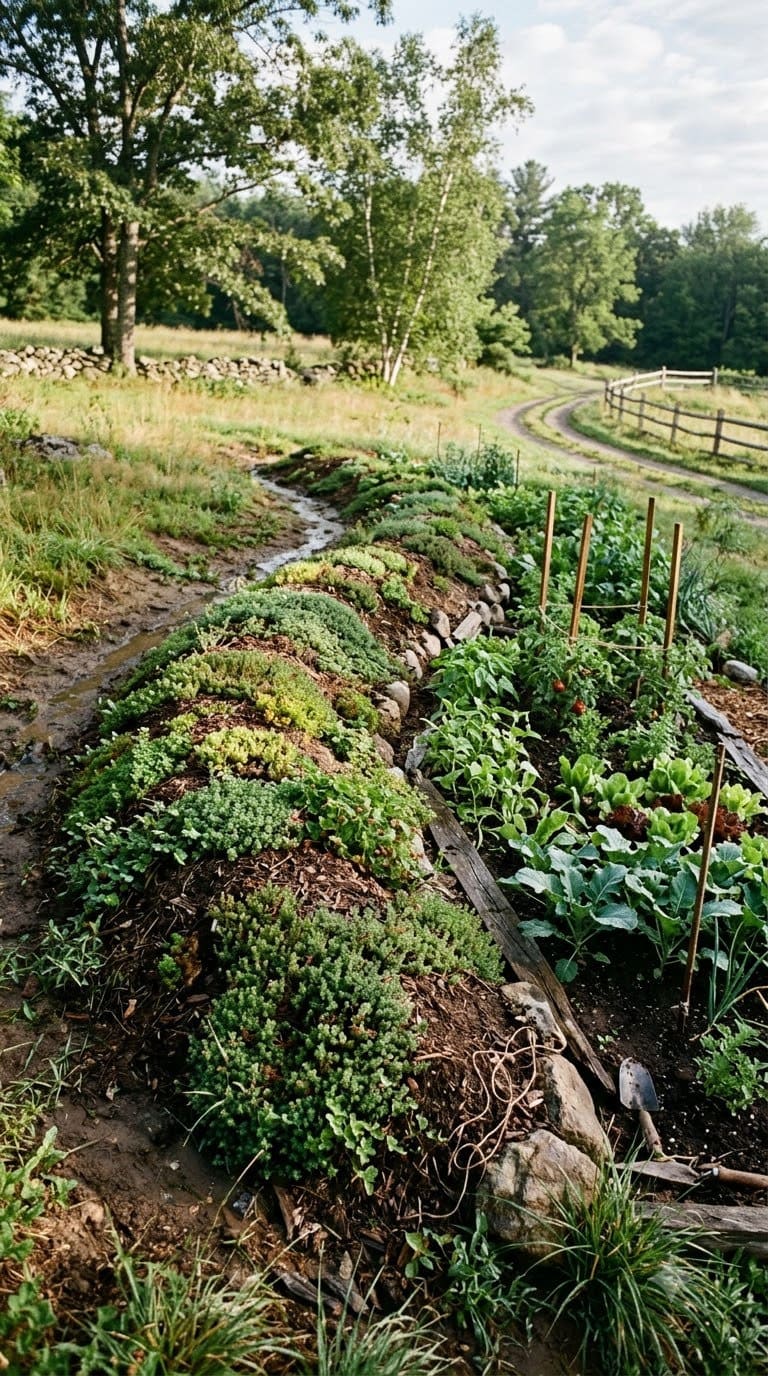
A berm is a raised ridge of soil that redirects water around a specific area instead of letting it flow straight through, most useful for protecting a single vulnerable spot like a garden bed or a shed foundation. Build it 12 to 18 inches high and at least 3 feet wide at the base, tapered gradually rather than steep-sided, or the berm itself erodes the first heavy rain it sees.
Compact the soil in layers as you build rather than piling it loosely, and seed or plant the surface immediately since bare, loosely-piled soil on a slope is exactly the erosion risk this whole article is trying to prevent. A berm works best as a small, targeted fix alongside a larger system like a swale or French drain, not as a standalone solution for a whole yard’s drainage.
15. Water Barriers (Sandbags and Modular Systems)
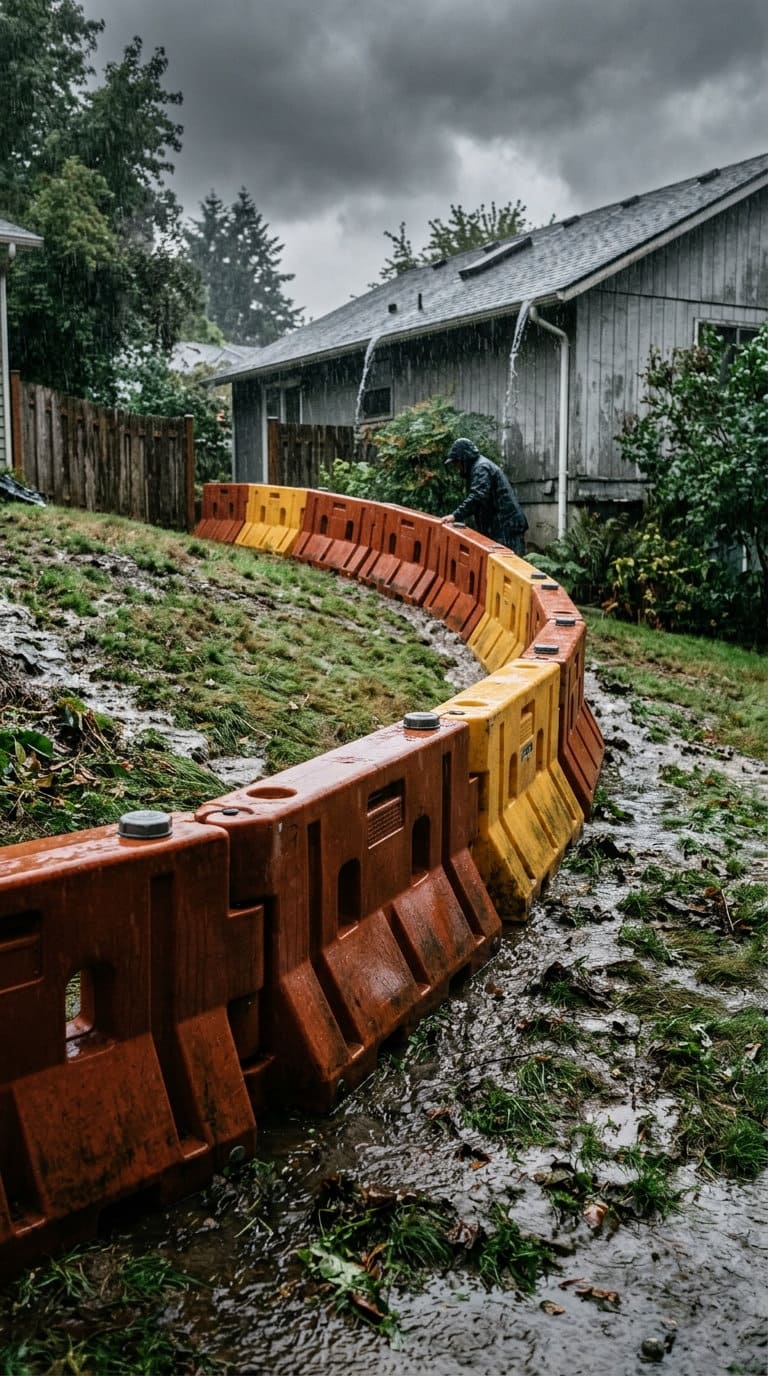
Sandbags and modular water-diversion barriers are the temporary, non-permanent version of a berm, useful during a single storm event or while a permanent fix is being planned and permitted. Modern modular barriers (interlocking plastic or fabric-and-frame systems) go up faster than traditional sandbagging and hold up better against repeated use.
Treat these as exactly what they are: a stopgap. If you’re setting up water barriers more than once or twice a season, that’s a sign the yard needs one of the permanent fixes above, most often a French drain or retaining wall, not a recurring sandbag routine every time it rains hard.
What We Learned the Hard Way
The mistake most people make with a sloped yard is picking whichever drainage idea looks best in a photo instead of testing their actual soil first. We dug a test hole in a spot that looked like an obvious dry creek bed candidate, filled it with water, and it was still sitting there two days later. Clay soil does that, and no amount of pretty gravel fixes a drainage problem that’s actually a soil problem.
Permits are the other thing people skip until it costs them. A retaining wall that looks like a weekend project can cross the 4-foot threshold faster than expected once you account for the footing depth, and tearing out an unpermitted wall after a neighbor complains is a genuinely bad way to spend a Saturday.
And if there’s one thing worth doing differently from the start, it’s testing infiltration before committing to anything that depends on soil absorbing water, a swale, a rain garden, or an infiltration trench. Takes 20 minutes with a shovel and a hose. Skipping it is how a $200 weekend project turns into redoing the whole thing with a French drain a year later.
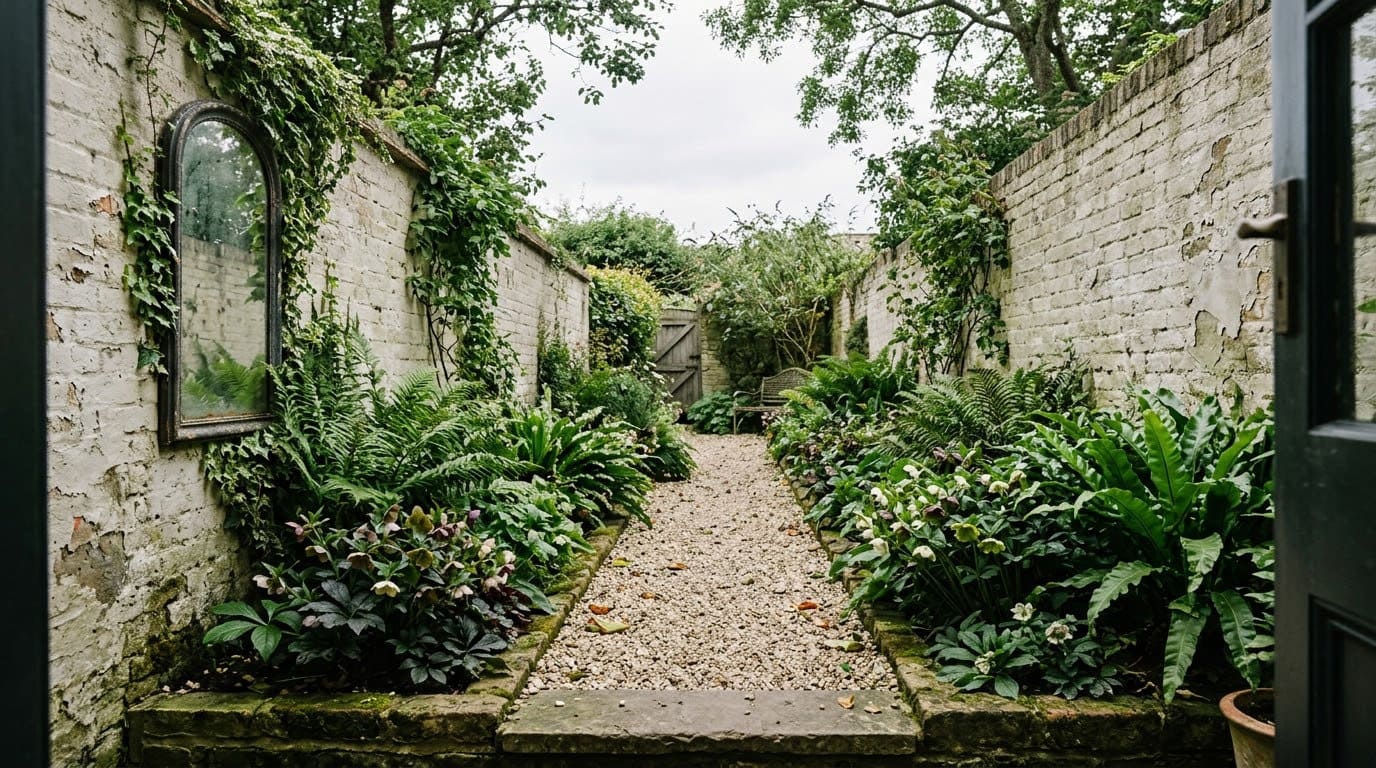
Combine fixes instead of expecting one to do everything. A French drain plus slope vegetation plus a downspout extension solves three different parts of the same problem, and that’s genuinely more effective than one bigger, more expensive single fix chasing all three at once. That combination logic holds even in tighter spots, a narrow side yard has its own version of this same drainage puzzle and usually needs two smaller fixes rather than one big one too.
FAQs
What’s the cheapest drainage fix for a sloped yard?
Downspout extensions and grass swales are the cheapest options, often under $10 to $30 total for materials on a DIY basis. Neither fixes a serious clay-soil or standing-water problem on its own, so treat them as a first step rather than a complete solution.
Do I need a permit for a French drain?
Usually not for a standard French drain on your own property, since it’s not a structural wall. Check with your local building department if the drain crosses near a property line or connects to a municipal storm system, since that connection specifically sometimes needs sign-off.
How do I know if my soil drains well enough for a rain garden or swale?
Dig a hole about 12 inches deep, fill it with water, and time how long it takes to drain. If water is still standing after 24 hours, you likely have compacted or clay soil, and a piped fix like a French drain will outperform anything that relies on infiltration.
Can I combine a retaining wall with a French drain?
Yes, and for a steep, wet slope this is often the actual answer rather than picking one. Build gravel backfill and a perforated pipe directly behind the wall so water pressure never builds up against it, since an undrained retaining wall is a common cause of wall failure.
Conclusion
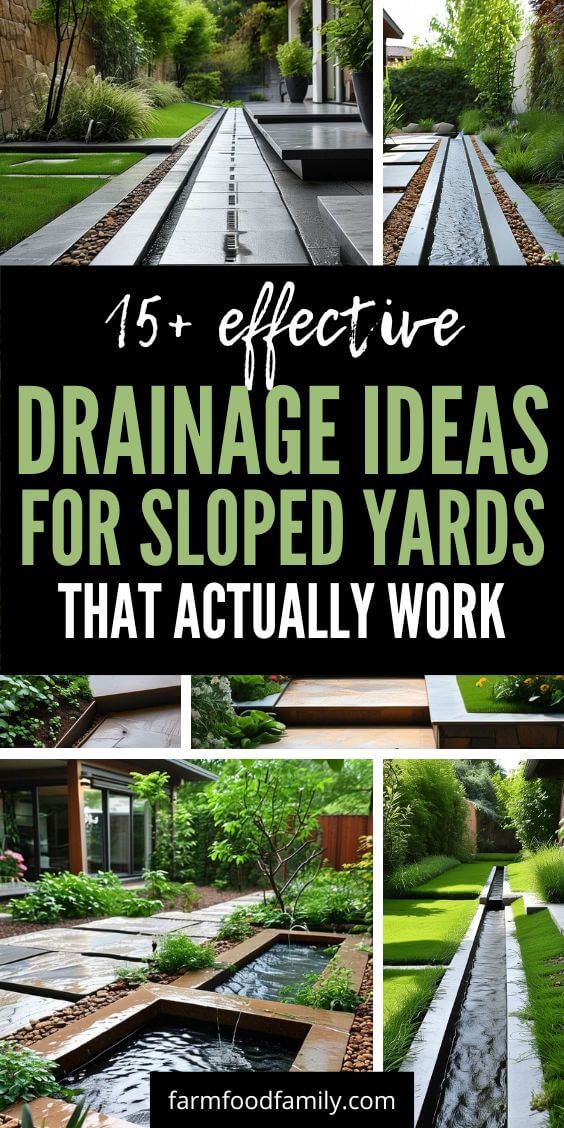
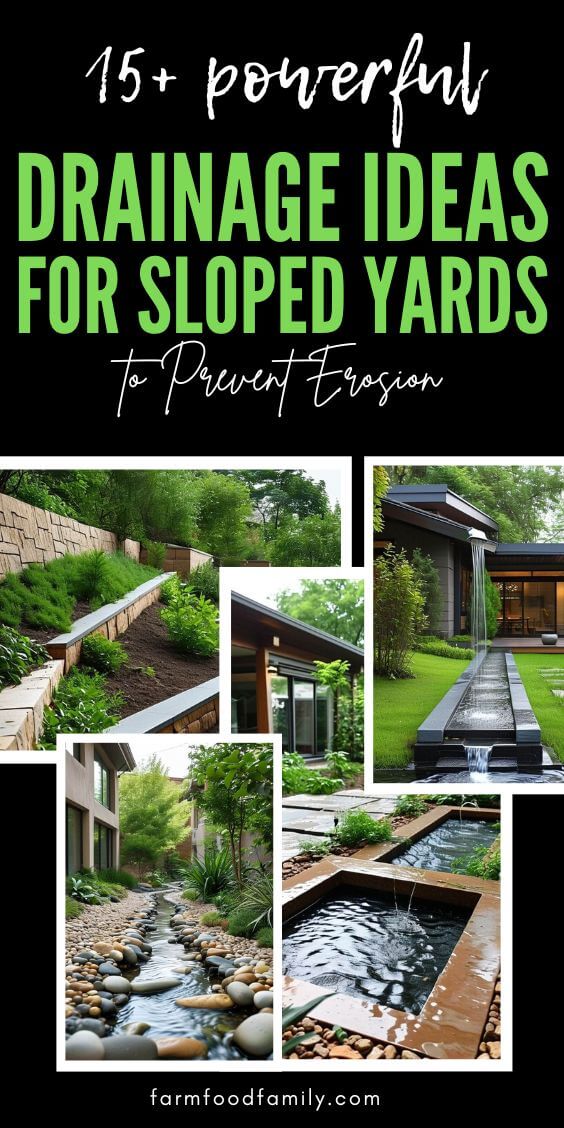
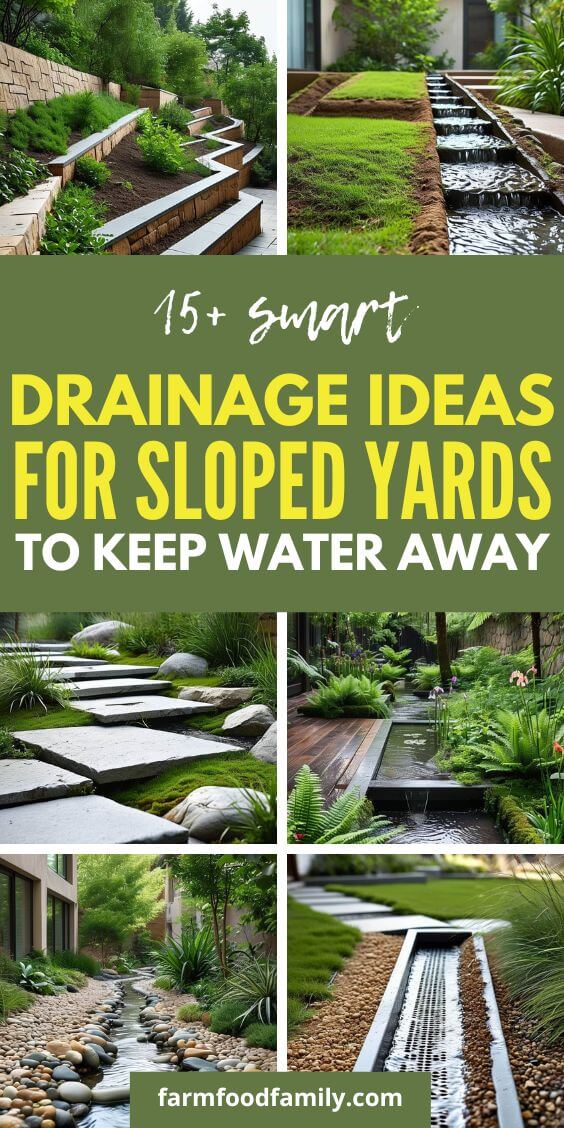
Armed with these 15 strategies, your sloped yard will not only manage water effectively but also transform into a standout feature of your home. Gear up to tackle that incline with gusto and make your yard the pride of the neighborhood!
Related Posts
Products We Recommend
This post contains affiliate links. We may earn a commission on qualifying purchases at no extra cost to you.
FEILAYDUN 2-Pack Rain Gutter Downspout Extensions (20"-66", combines to 10 ft)
Redirects roof runoff away from the foundation, the fastest fix in idea 9 above. ~$25/2-pack, 4.4★ (845 ratings), Amazon's Choice.
Shop Now
Super Geotextile Non-Woven Fabric, 8 oz, 3 ft x 50 ft
Lines a French drain or infiltration trench to keep soil from clogging the gravel, per idea 2 and 13. ~$80/roll, 4.6★ (2,023 ratings), Amazon's Choice.
Shop Now
Joyfolk 4" x 65 ft Spliceable Expandable Corrugated Drain Pipe (4 sections + 3 connectors)
The core flexible pipe for a DIY French drain trench described in idea 2. ~$78/set, 4.1★ (11 ratings; a thinner review base than the other two picks, worth a second look at checkout).
Shop NowNever miss an update — choose FarmFoodFamily as your preferred source on Google.
How it works: Tap the button below to open Google's settings page, then check the box next to FarmFoodFamily.
Tap the checkbox to turn it blue — that's how you know it's set.