Why Landscape Designers Say You Should Never Use Small Plants in a Small Garden (7 Options)
Small garden, small plants seems obvious, and it’s exactly the assumption landscape designers say wrecks a small garden’s design every time.

Never miss an update — choose FarmFoodFamily as your preferred source on Google.
How it works: Tap the button below to open Google’s settings page, then check the box next to FarmFoodFamily.
Tap the checkbox to turn it blue — that’s how you know it’s set.
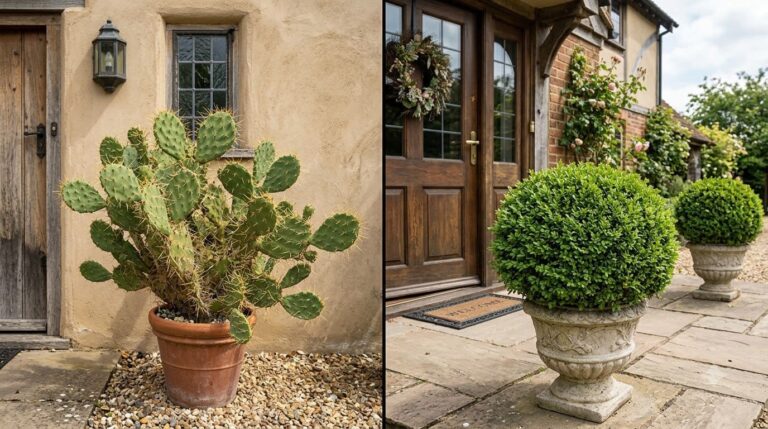
Small garden means small plants, right? Wrong, according to the landscape designers who actually work in tight spaces every day. Fill a small garden with a dozen dainty little plants and the whole space reads as busy, flat, and somehow even smaller than it actually is.
The fix runs opposite to instinct: use fewer, bigger plants instead. Here’s why designers say small plants are the mistake, and 7 real plant options that do the opposite job well, even in a genuinely small space with almost no room to spare.
Quick Answer: Landscape designers avoid small plants in small gardens because a space filled with many similarly-sized tiny plants reads as flat and cluttered, with nothing to anchor the eye.
A few larger plants do the opposite. They add scale and contrast, create real privacy through height instead of ground footprint, make use of otherwise wasted vertical space, cast the dappled shade smaller plants actually need to thrive, and add genuine architectural interest a dozen tiny plants never could.
Chartered landscape architect Hannah Gale, co-founder of the planting app Hota, puts it directly: large plants “give a hierarchy and a vertical focus to a garden design” and “help organise the space.” Seven real options that work well in a genuinely small garden: multi-stem serviceberry, Himalayan birch, Tetrapanax, Fatsia japonica, feather reed grass, Clematis montana, and a container-grown fig tree, several of which also work in large pots if ground space is limited or nonexistent.
At a Glance: Why Big Plants Win in Small Gardens
| Reason | What Small Plants Fail to Do |
|---|---|
| Scale and contrast | Small plants give the eye nothing to anchor on, everything reads the same |
| Privacy | Small plants can’t screen a sightline no matter how many you add |
| Vertical space | Small plants leave the fence, wall, and airspace completely unused |
| Shade | Small plants can’t create the dappled cover other plants need to thrive |
| Architectural interest | Small plants can’t function as a single striking centerpiece |
Why Small Plants Actually Work Against a Small Garden
It seems counterintuitive. A tiny garden, tiny plants, feels like the safe, proportional choice. But packing a small space with many small plants of similar size removes the one thing a good garden design actually needs: contrast.
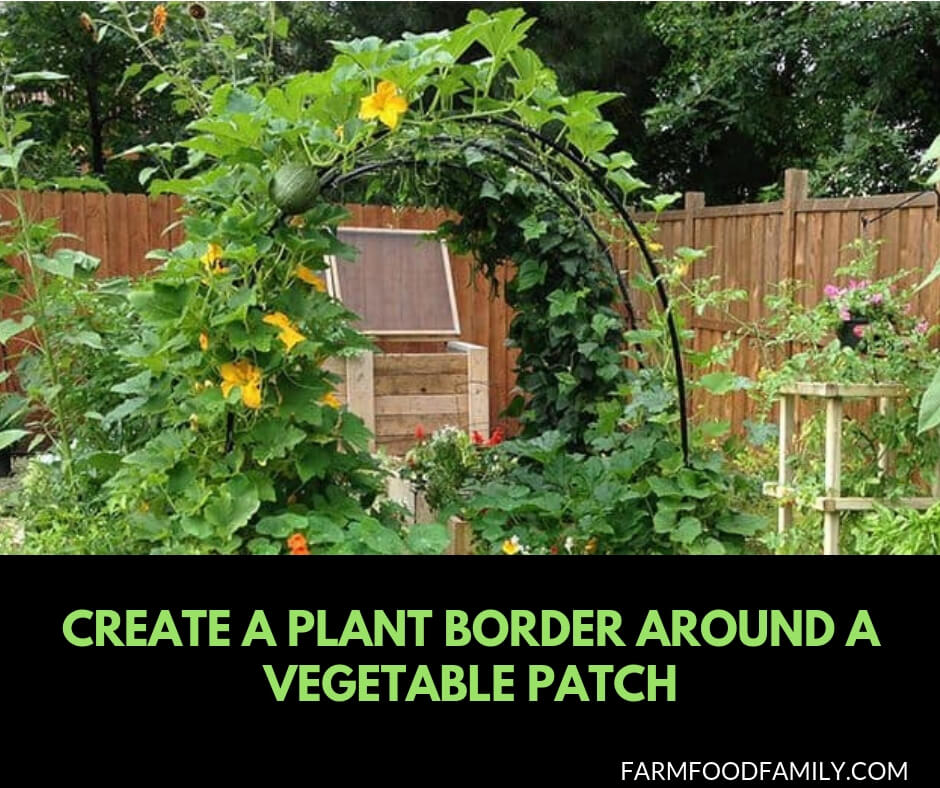
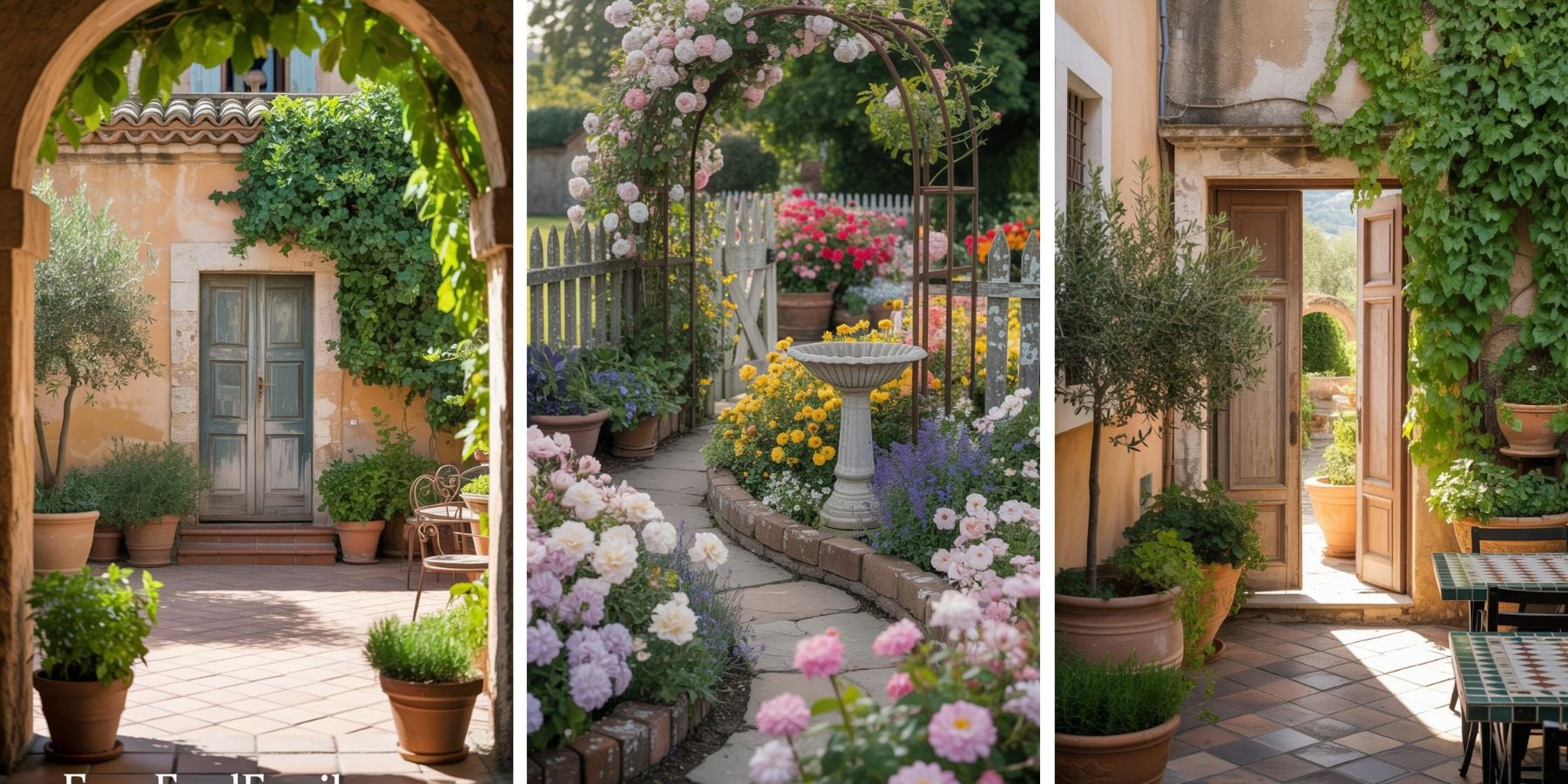
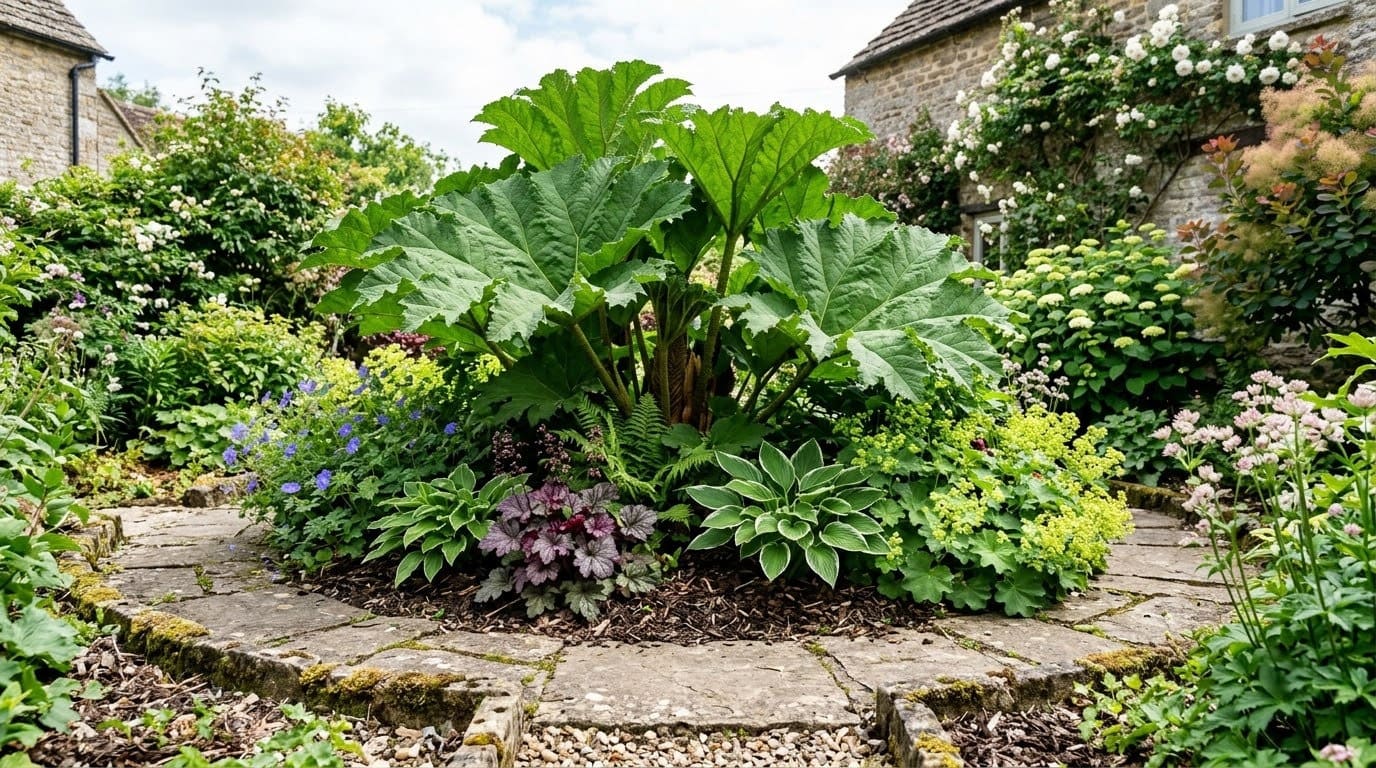
Chartered landscape architect Hannah Gale, co-founder of the planting app Hota, explains the mechanism directly: “Larger plants such as trees, shrubs and ornamental grasses give a hierarchy and a vertical focus to a garden design. A few large plants can help organise the space, giving anchor points for smaller perennials and ground cover to be arranged around.” Without that anchor, a small garden reads as a flat wash of similar-sized greenery. With it, the same square footage suddenly has depth: a foreground and a real focal point.
Quick tip: You don’t need to remove your existing small plants to fix this. Add one larger plant first, in a pot if you’re not ready to commit to the ground, and place it where you currently have the most cluttered cluster of small pots. The contrast alone usually makes the whole bed read as more intentional within a season.
Answer 4 quick questions and get matched to the exact fix for your yard — drainage, budget, layout, or something else entirely.
Take the Free QuizBeyond scale, big plants solve three more problems small ones structurally can’t: privacy, vertical space, and shade. A dense hedge of small plants can’t screen a neighbor’s upstairs window the way one well-placed multi-stem tree can. A garden full of ground-level planting leaves every fence, wall, and overhead sightline completely unused. And nothing shade-loving can actually thrive in a small garden without something larger casting real shade over it first.
1: Multi-Stem Serviceberry (Amelanchier lamarckii)
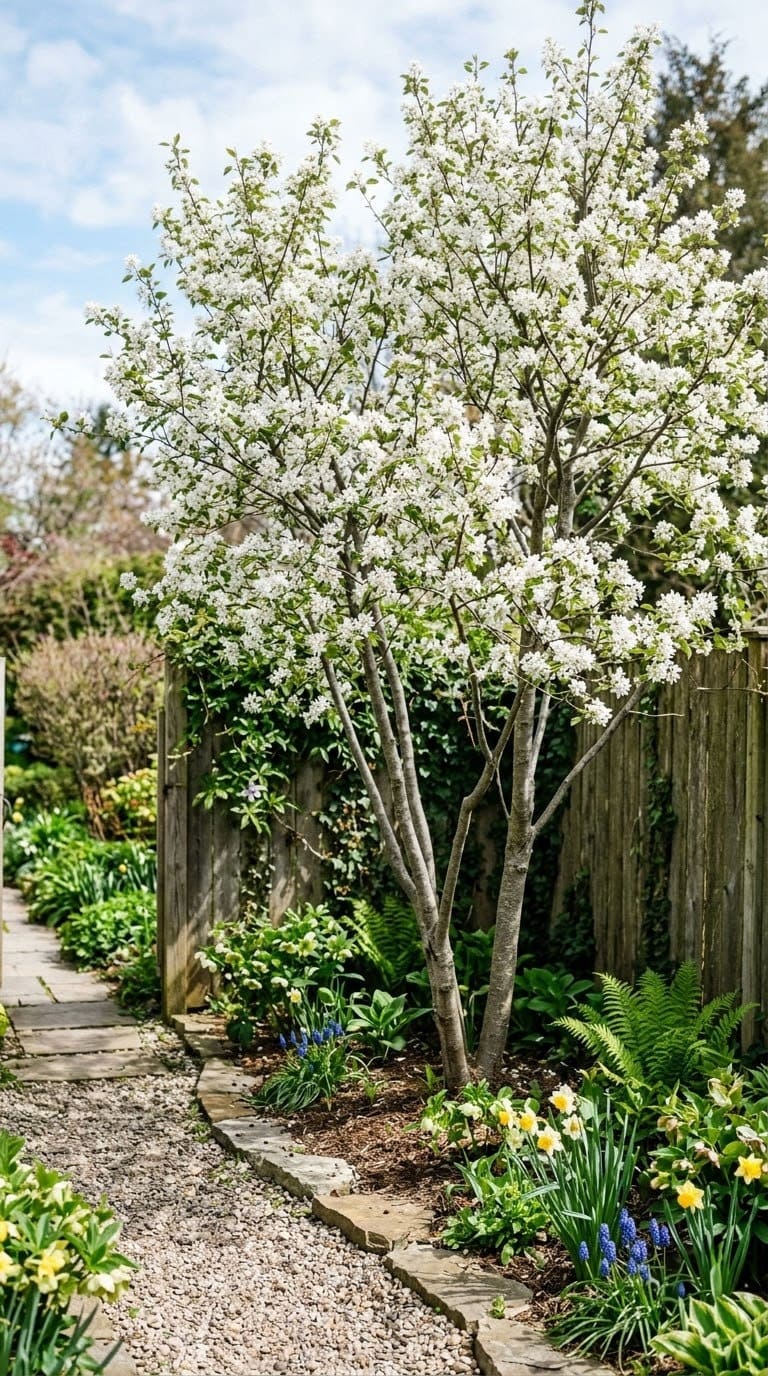
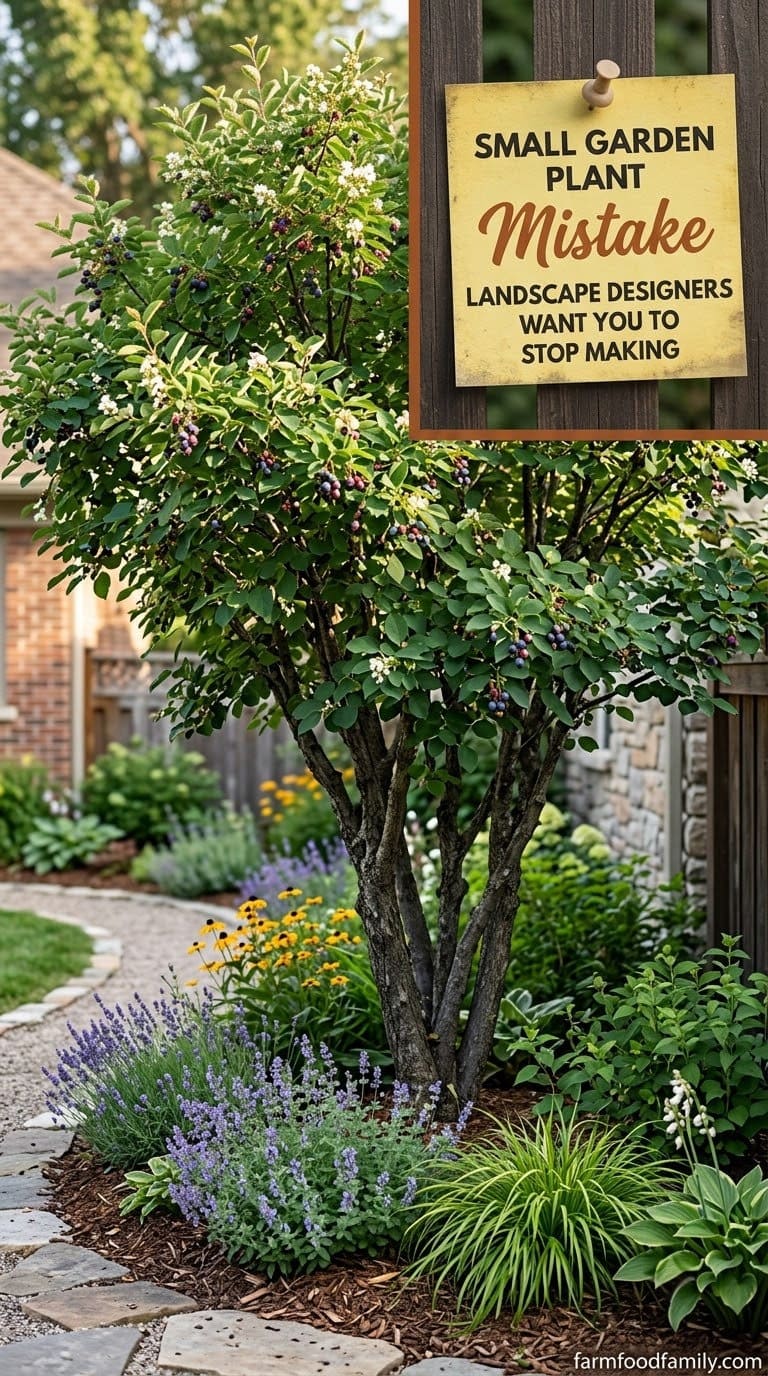
A multi-stem serviceberry does more design work per square foot than almost any other small-garden tree. It delivers white spring blossom, edible summer berries, and vivid fall color. Then it holds an open, airy canopy that lets dappled light through, instead of blocking it entirely.
Hannah Gale recommends multi-stemmed ornamental trees like amelanchier specifically “in oversized pots” as focal points that provide screening without a heavy footprint. The Missouri Botanical Garden’s Plant Finder confirms it as hardy across USDA zones 4a-9b. Mature size runs roughly 15-25 feet tall and wide, genuinely substantial for a “small garden” plant. That’s exactly the point.
Quick tip: If ground space is truly limited, grow it in a large container rather than in the ground. Container growing naturally limits the tree’s ultimate size while still delivering the multi-stem screening effect within a few seasons.
2: Himalayan Birch (Betula utilis var. jacquemontii)
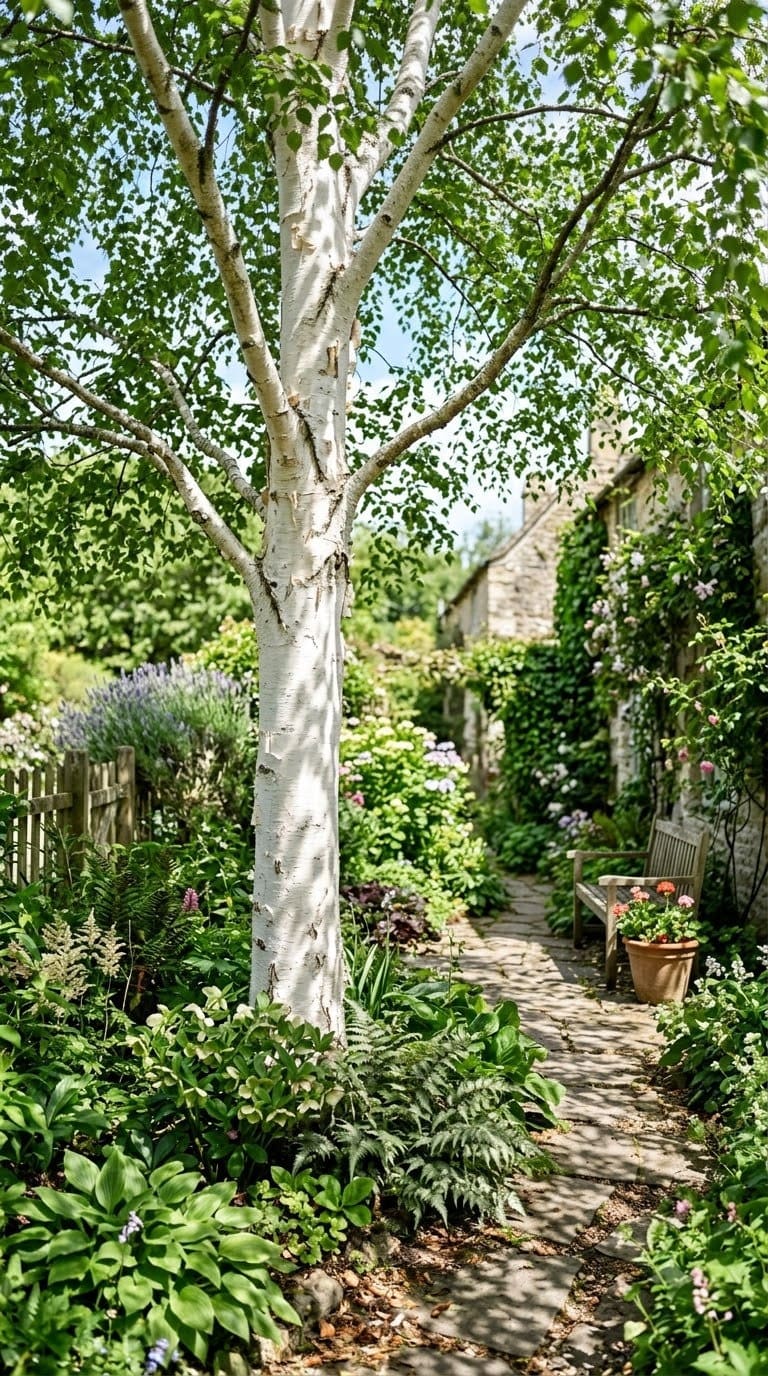
Few trees give more year-round visual reward for their footprint than Himalayan birch. Its brilliant white bark reads as a design feature on its own, even bare in winter, and its light canopy casts exactly the kind of dappled shade that lets shade-tolerant perennials grow underneath it.
Hannah Gale specifically recommends betula utilis var. jacquemontii for its “open canopy” that “allows some light through and casts dappled shade,” keeping the space beneath cooler while still letting a wide range of perennials thrive nearby. It performs best in cooler climates, USDA zones 5-6, and reaches a substantial mature size. Another case where “big” is genuinely part of the design payoff, not a maintenance problem to manage around.

Directly solves Options 1, 4, and 7 (container growing for serviceberry, Fatsia, or fig)
Most yard problems trace back to one specific, fixable cause. Find yours in 4 quick questions.
Take the Free QuizThis post contains affiliate links. We may earn a commission on qualifying purchases at no extra cost to you.
Quick tip: Plant it where its white bark will be visible from your main window in winter. Most small-garden plants have nothing to offer once summer ends. This one is arguably at its best when everything else has gone dormant.
3: Tetrapanax papyrifer (Rice Paper Plant)
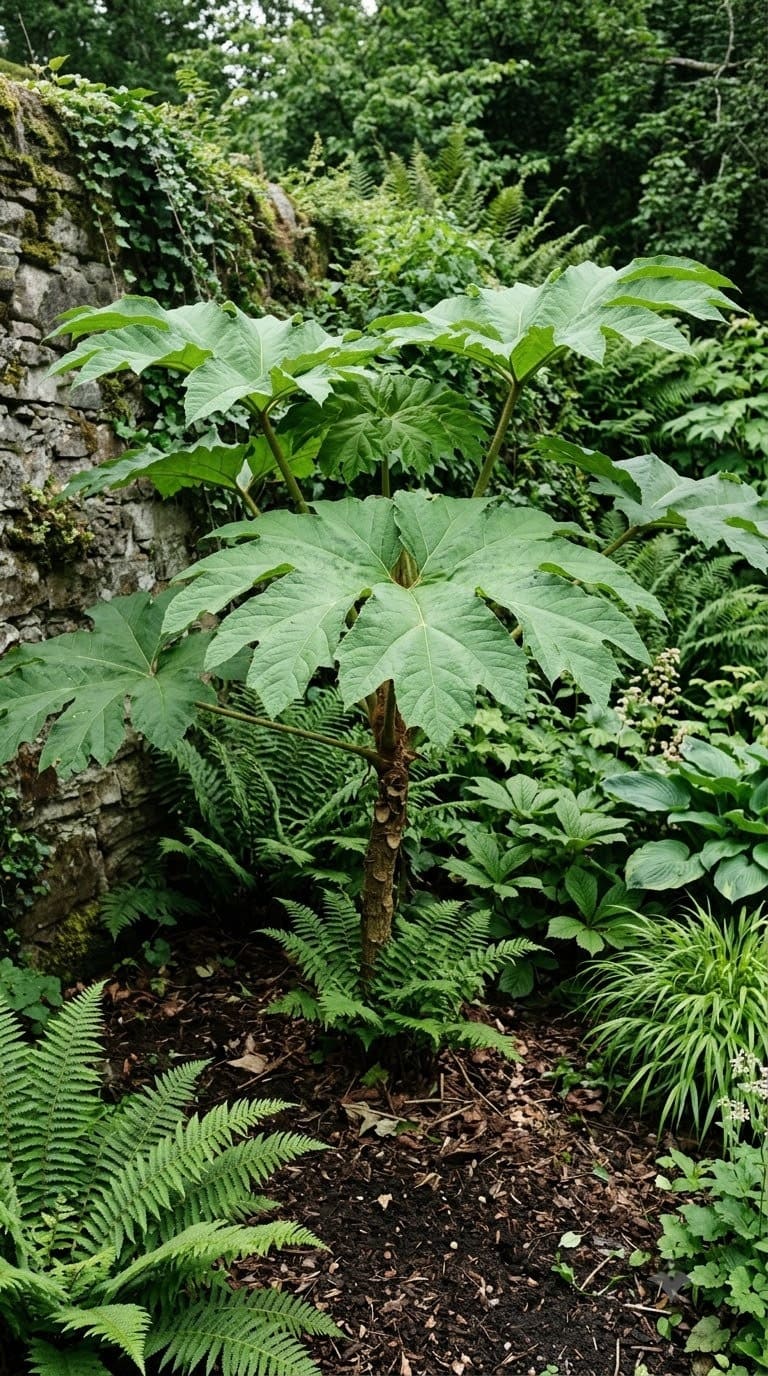
For a genuinely shaded small garden, the plant options shrink fast, and most of what’s left is small and unremarkable. Tetrapanax is the exception: enormous, deeply lobed leaves that read as a tropical statement piece even in a space that gets very little direct sun.
Hannah Gale recommends it specifically for naturally shaded gardens, noting it “can provide characterful moments if combined with ground cover plants like ferns and hostas that like shady spots.” It’s the rare plant that turns a genuinely difficult growing condition, deep shade, into a design opportunity. Not a limitation to work around.
Quick tip: Pair it with exactly the ground cover Hannah names, ferns and hostas, rather than trying to find more upright plants to go with it. The contrast between Tetrapanax’s huge leaves and low, textured ground cover is what makes the combination work, not matching heights.
4: Fatsia japonica
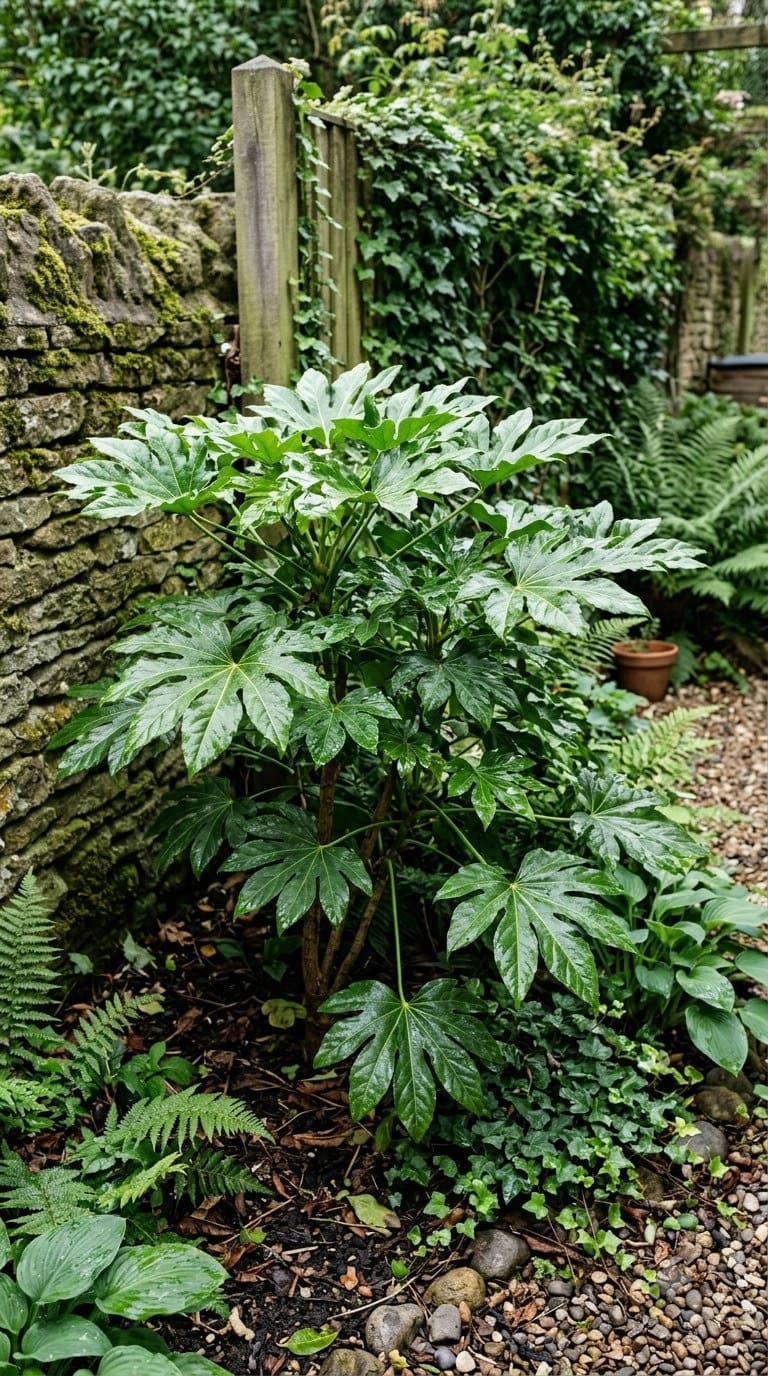
For a shaded corner that needs low maintenance more than drama, Fatsia japonica does the job with almost no upkeep. Garden content creator Chloe Plumstead, of Feverfew Garden Company, calls it out specifically: “Fatsias require practically no maintenance and are a great option for shadier corners crying out for shape. Not only are they evergreen, meaning they will offer interest through every season, they’re also incredibly versatile, working in most well-draining soils and pots too.”
Independent data backs the shade tolerance claim precisely. Missouri Botanical Garden lists Fatsia as tolerant of deep shade, under two hours of direct sun a day, with direct afternoon sun actually scorching its leaves. It’s hardy in USDA zones 8-10 and reaches roughly 5-8 feet tall and wide at maturity. That’s evergreen structure that works year-round, with no seasonal die-back to manage.
Quick tip: If you’re outside zone 8, grow Fatsia in a large container you can move to a sheltered spot for winter rather than skipping it entirely. It tolerates container life well and rewards the extra effort with genuinely tropical-looking year-round foliage.
5: Feather Reed Grass (Calamagrostis x acutiflora ‘Karl Foerster’)
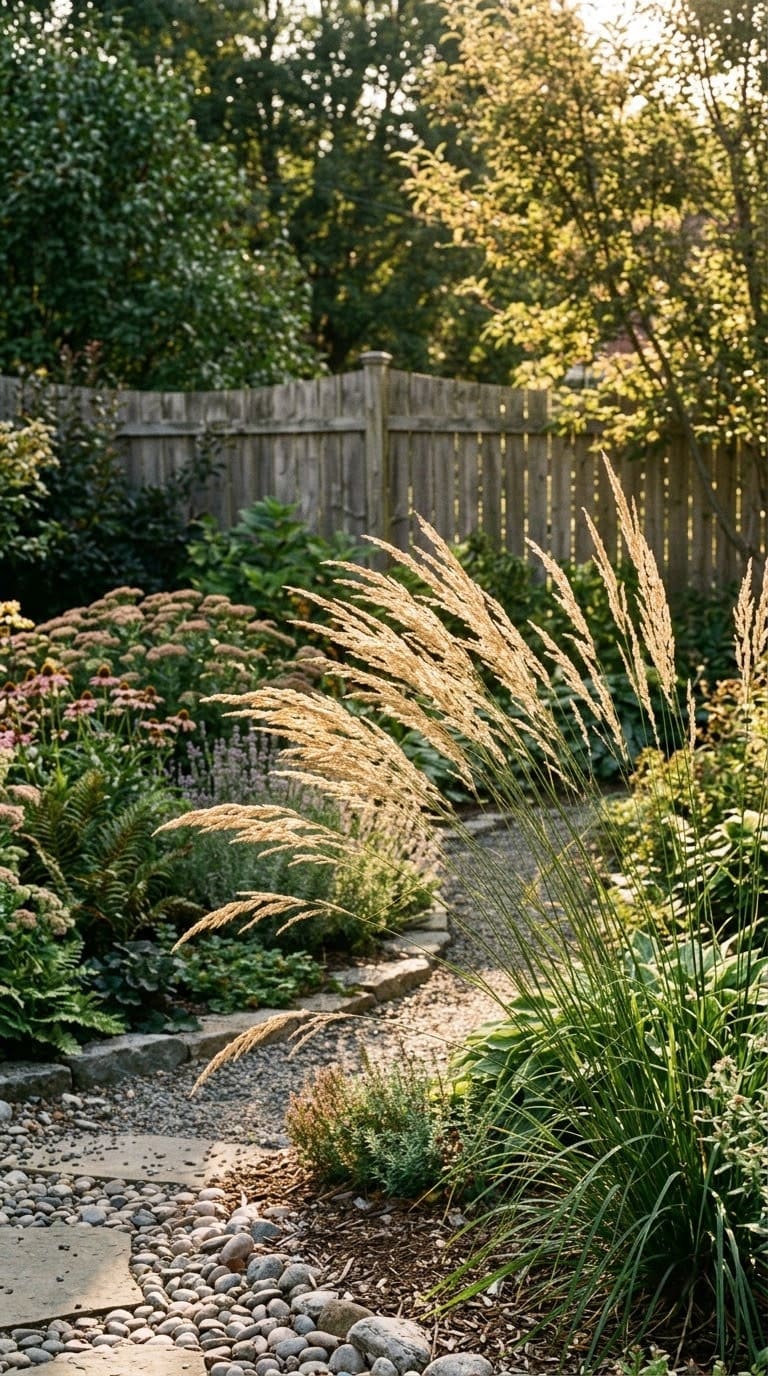
Bamboo gets recommended constantly for movement and screening, but it comes with a real invasiveness risk in the ground. Feather reed grass delivers the same swaying, architectural movement without that risk.

Hannah Gale is explicit about the bamboo tradeoff: “Bamboo is a wonderful singular plant for movement, and it sounds incredibly peaceful in the breeze, but be sure to plant it in a large pot, never into the ground, as it will take over! A less invasive approach to get the same sense of movement is to plant structural ornamental grasses like Calamagrostis x acutiflora ‘Karl Foerster’ and Stipa tenuissima.” Missouri Botanical Garden confirms Karl Foerster’s real scale: a compact 18-36 inch clump. Its flower stems reach nearly 5 feet by summer, genuinely tall for a grass, and it’s hardy across USDA zones 4-8.
Quick tip: Plant it somewhere it’ll catch late-afternoon backlight. The flower plumes are semi-translucent and light up dramatically when sunlight passes through them from behind, an effect that’s wasted if the grass is only ever viewed with the sun in front of it.
The average homeowner spends $616/year on yard fixes that don't address the real problem. Find out what yours actually is — before you spend another dollar.
Take the Free Quiz6: Clematis montana
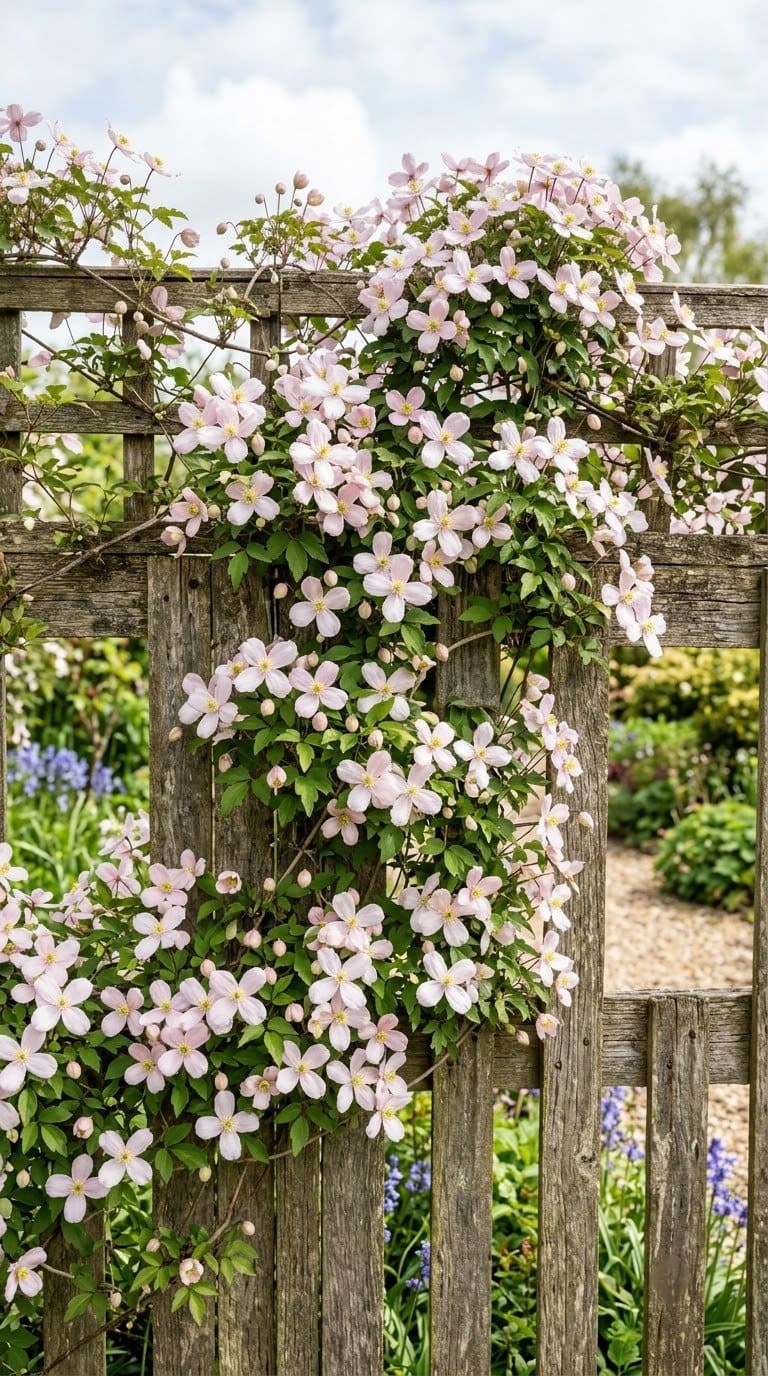
A bare fence is wasted vertical real estate in a small garden, and few plants cover it faster or more dramatically than Clematis montana. It’s a genuinely fast climber that smothers a structure in pale pink spring flowers within just a couple of seasons.
Hannah Gale’s own small-garden experience backs this directly: “I had a tiny garden in my first house, and we maximized the growing space by planting loads of climbers to cover the fences and grow up an existing mature tree. This gave us a vertical canvas and allowed us to make much more impact than the confines of the planted beds.” Clematis montana specifically suits shadier garden walls and gets established quickly. It does need a firm trim after flowering, though, to keep it from getting leggy.
Quick tip: Train it up the fence with horizontal wires spaced about a foot apart rather than letting it climb unsupported. Clematis montana grows fast enough that an unsupported plant becomes a tangled mass within a season, while wire-trained growth stays flat and covers the surface evenly.
7: Fig Tree in a Large Container
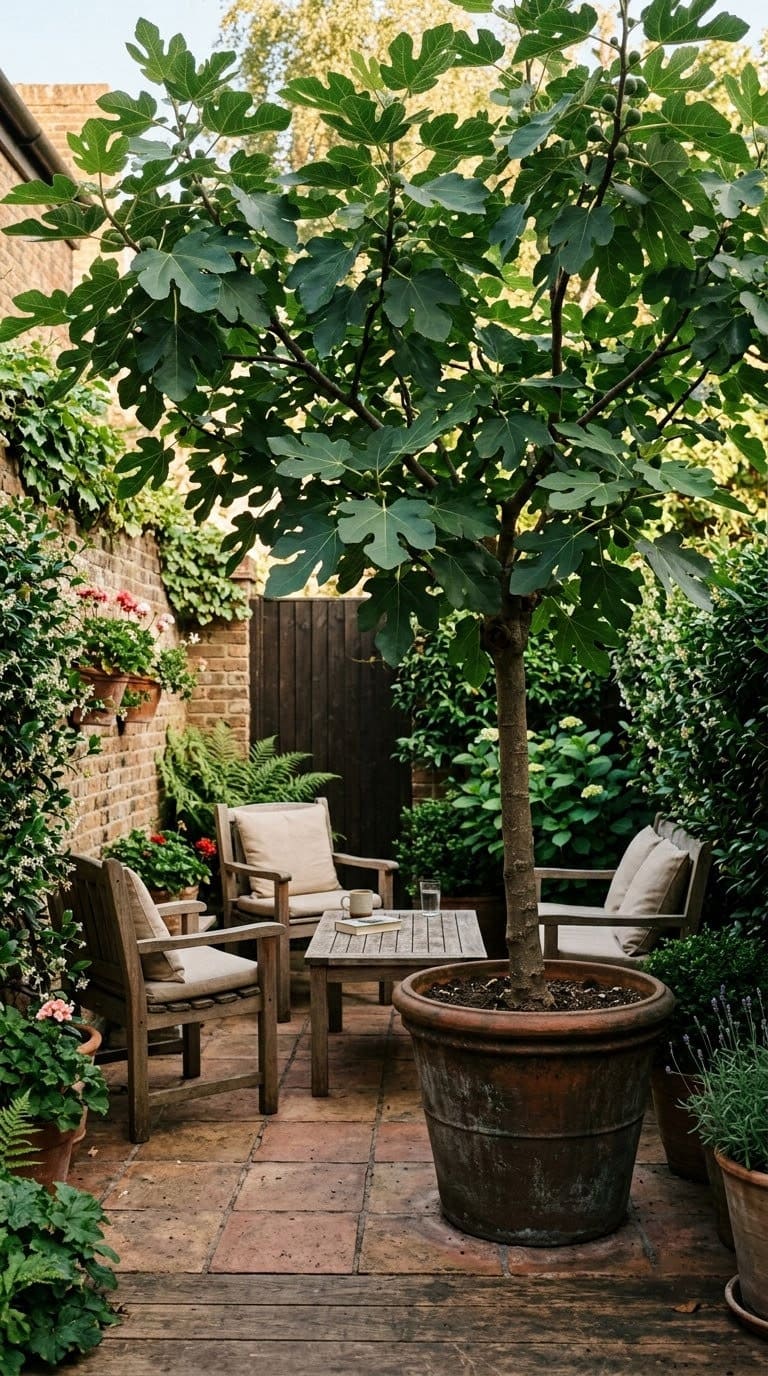
A container-grown fig tree solves two small-garden problems most people don’t expect one plant to handle: privacy screening and actual homegrown fruit, all from a footprint that never touches the ground.
The Mediterranean-style approach works especially well for privacy. Train branches along a trellis in a fan shape to screen a sightline, or leave the canopy loose to shade a seating area outright. Independent horticultural research adds a genuine bonus most gardeners don’t expect: root restriction in a container actually improves fruit production. A restricted root zone pushes the tree toward reproducing, fruiting, rather than just producing leafy growth. A potted fig often fruits more reliably than one planted in open ground. A minimum 20-gallon container is generally recommended for a fig grown long-term in a pot.
Quick tip: In colder climates (below USDA zone 7), the container is actually the whole point, not a compromise. It lets you wheel the tree into a garage or shed for winter protection, something impossible with an in-ground fig, while still getting the same screening and shade benefits in-season.
What We Learned Sizing Up Our Own Small Garden
Our own back garden is barely 150 square feet, and for the first two years it was filled almost entirely with small perennials and a scattering of little pots, the “safe” choice for a tight space.
The garden never looked finished no matter how much we added, because every new small plant just competed with the last one instead of anchoring anything. One multi-stem serviceberry, planted in the corner we’d always left as a catch-all for miscellaneous small pots, changed that within a single growing season. The garden isn’t any bigger. It just finally has something for the eye to land on before taking in everything else.
Frequently Asked Questions
Won’t a big plant make my small garden feel even more cramped?
Not if it’s placed correctly. One large plant used as a focal point, with smaller plants arranged around it rather than competing with it, actually makes a small garden feel more spacious. It gives the eye a hierarchy to follow instead of a flat wash of similar-sized greenery.
How many “big plants” does a small garden actually need?
Usually just one or two. The goal is a genuine focal point and anchor, not a forest. A single well-chosen tree or architectural shrub, paired with smaller perennials and ground cover around its base, does the job a dozen scattered small plants can’t.
Can I use big plants in containers if I don’t have ground space at all?
Yes, and several of the options above, serviceberry, Fatsia, fig, are specifically well-suited to container growing. A large pot also naturally limits the plant’s ultimate size, which can work in your favor in a genuinely tiny space.
What’s the biggest mistake people make when trying this?
Choosing a plant that’s technically “large” but still visually busy, like a shrub with tiny leaves and a dense, twiggy silhouette. The goal is a plant with bold, simple structure, big leaves, an open canopy, or a clean vertical form, not just more square footage of foliage.
Related Posts
Products We Recommend
This post contains affiliate links. We may earn a commission on qualifying purchases at no extra cost to you.
Sanmudecor Large Glazed Ceramic Planter, 15.7"
Directly solves Options 1, 4, and 7 (container growing for serviceberry, Fatsia, or fig)
Shop Now
Land Guard 20-Gallon Fabric Grow Bags, 4-Pack
Directly solves Option 7 (the exact 20-gallon minimum size recommended for a container-grown fig)
Shop Now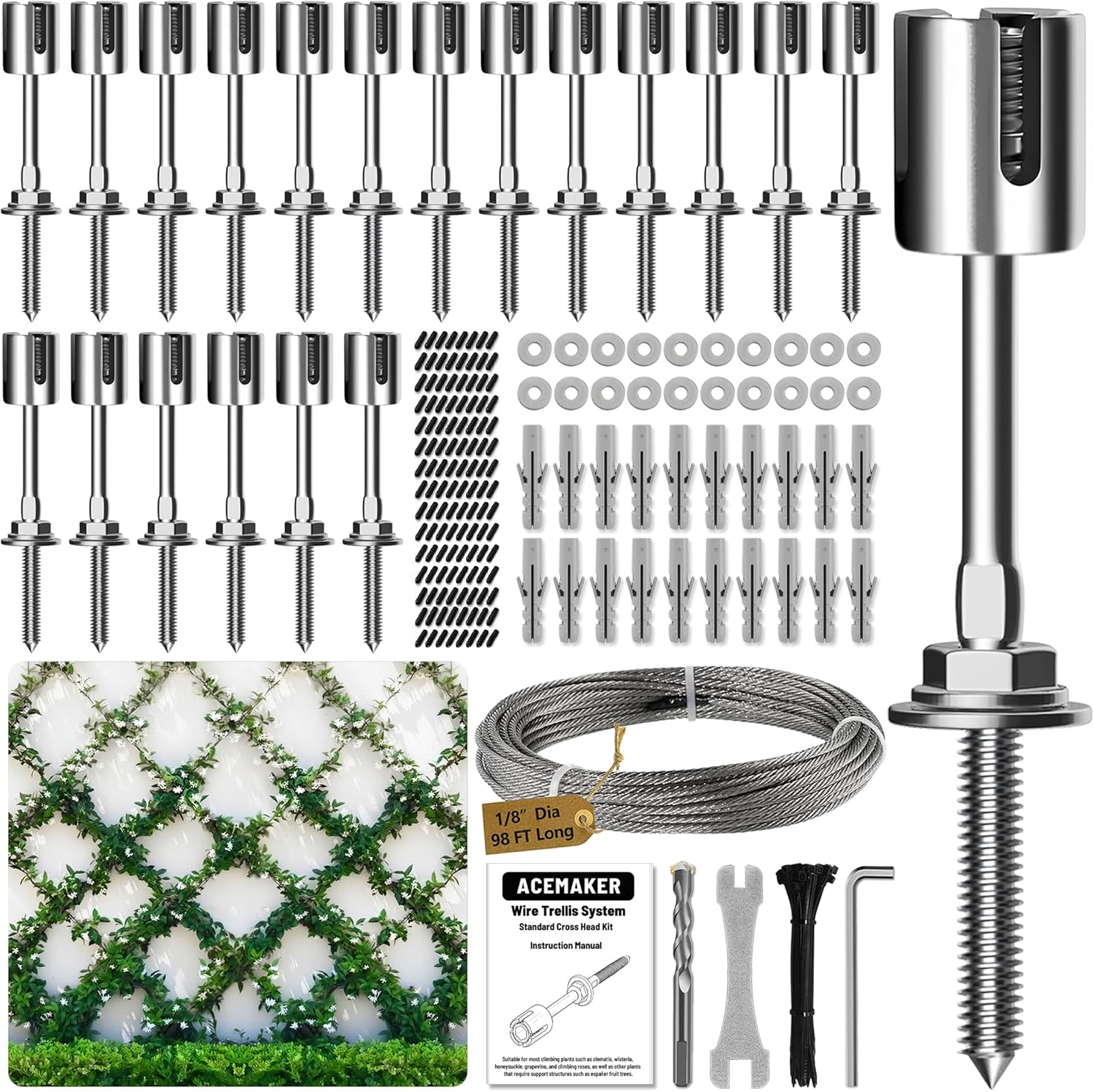
Acemaker Stainless Steel Wire Trellis Kit, 20-Set
Directly solves Option 6 (training Clematis montana flat against a fence)
Shop NowNever miss an update — choose FarmFoodFamily as your preferred source on Google.
How it works: Tap the button below to open Google's settings page, then check the box next to FarmFoodFamily.
Tap the checkbox to turn it blue — that's how you know it's set.