8 Reasons Your Pool Water Keeps Turning Green After Cleaning
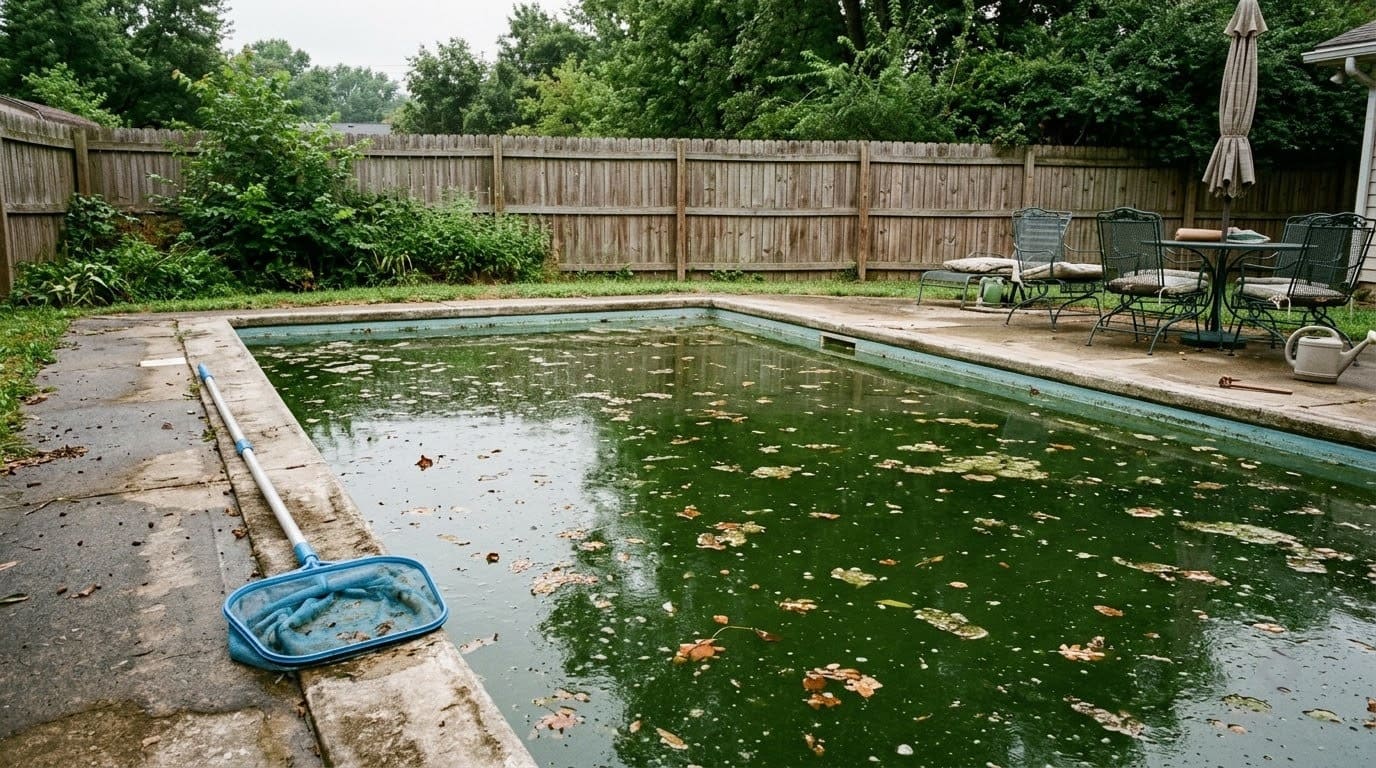
A green pool that clears and then comes back is a chemistry problem, not a scrubbing problem, and the fix usually costs less than the algaecide you keep buying.

Never miss an update — choose FarmFoodFamily as your preferred source on Google.
How it works: Tap the button below to open Google’s settings page, then check the box next to FarmFoodFamily.
Tap the checkbox to turn it blue — that’s how you know it’s set.
You shocked it. You brushed the walls. You vacuumed.
The water went clear, you felt good about it, and four days later it’s green again.
There are really two different problems hiding behind that. One is recurring green, where the pool clears and then blooms again within a week, because something in the water is letting algae come back.
The other is green right after you add shock, in water that stays clear, not cloudy. That one usually isn’t algae at all.
Cleaning harder fixes neither. The thing that actually decides whether algae can live in your pool is the ratio between your free chlorine and your cyanuric acid, and almost nobody tests both.

Quick Answer
Your pool keeps turning green because the free chlorine is too low for your cyanuric acid level, or because a nutrient or a metal is driving the color, not because you didn’t scrub enough. Chlorine bound to cyanuric acid can’t kill algae, so a reading of “3 ppm chlorine” means nothing until you know the CYA. Trouble Free Pool puts the minimum free chlorine to hold off algae at 7.5 percent of the CYA level, with 10 percent as the daily target.
Answer 4 quick questions and get matched to the exact fix for your yard — drainage, budget, layout, or something else entirely.
Take the Free QuizSo at a CYA of 80, you need at least 6 ppm free chlorine just to stay ahead of a bloom, not the 1 to 3 ppm most people run. If the water is green but perfectly clear right after shocking, that’s oxidized copper, not algae, and adding more chlorine makes it worse. Test free chlorine, pH, and CYA before you treat anything.
Free chlorine target by cyanuric acid level
Find your CYA on the left, then keep your free chlorine in that row. These are for a manually chlorinated pool. A saltwater pool with a salt cell can run a little lower, around 5 percent of CYA for the minimum.
| Cyanuric acid (CYA) | Minimum free chlorine | Daily target | Shock level to clear algae |
|---|---|---|---|
| 30 ppm | 2 to 3 ppm | 4 ppm | 12 ppm |
| 50 ppm | 4 ppm | 5 ppm | 20 ppm |
| 80 ppm | 6 ppm | 8 ppm | 31 ppm |
| 100 ppm | 8 ppm | 10 ppm | 40 ppm |
If your CYA is above 90 ppm, the shock level gets so high it’s hard to reach and hold with liquid chlorine. That’s the point where lowering the CYA comes first.
1. Your free chlorine is too low for your cyanuric acid level
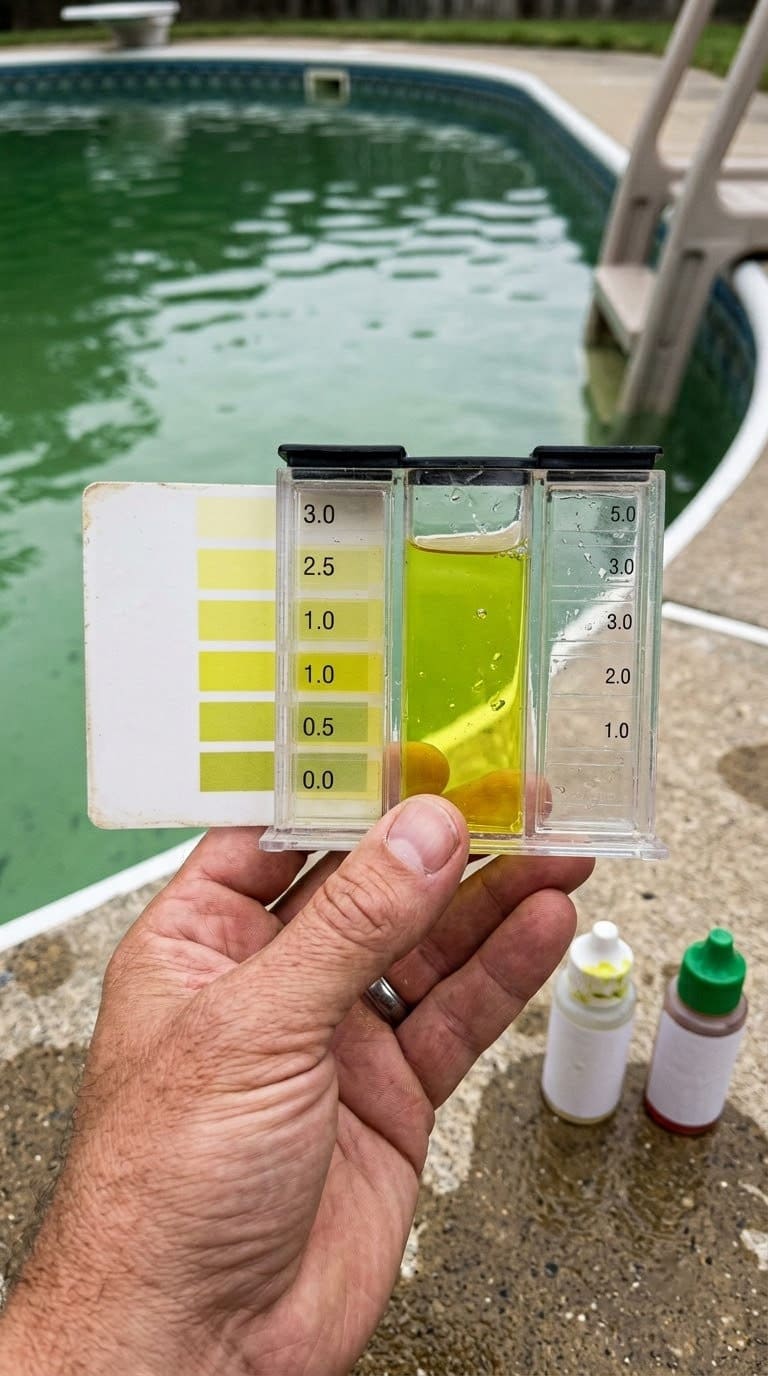
This is the one that catches almost everyone. Cyanuric acid, the stabilizer in most chlorine tablets, protects chlorine from the sun. It does that by holding onto most of it, which means only a small fraction of your measured chlorine is actually active against algae at any moment.
Run trichlor tablets all summer and your CYA climbs to 80 or 100 without you adding it on purpose. Now that same 3 ppm chlorine that kept the pool clear in May is nowhere near enough. Algae grows faster than the weak chlorine can kill it, so every time you shock and stop, it comes back.
Quick fix: Test CYA, then use the table above. Raise free chlorine to the shock level for your CYA using liquid chlorine or plain cal-hypo, and hold it there, testing and re-dosing daily, until the water is clear and the chlorine only drops a little overnight.
2. Your cyanuric acid is over 90 ppm and needs a partial drain
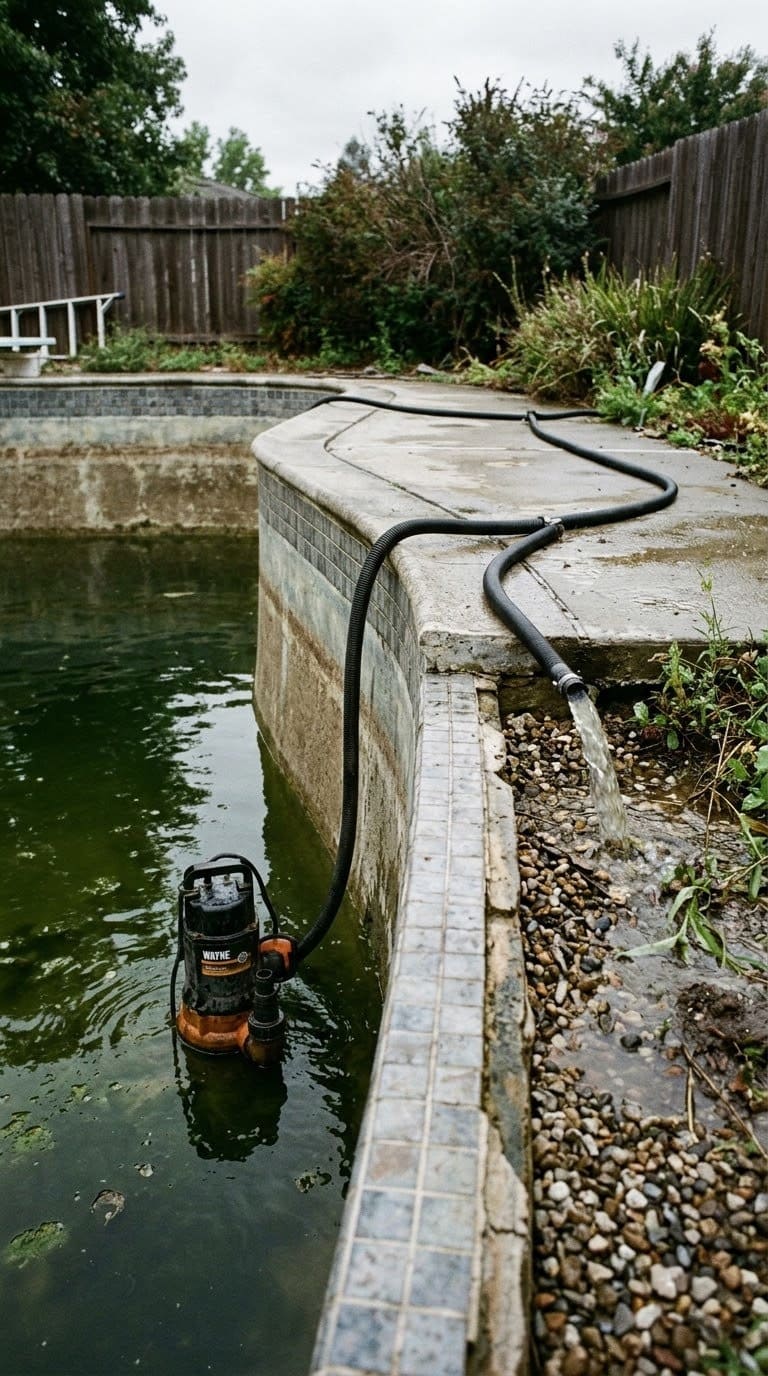
If your CYA test comes back at 100, 120, or the strip just reads “high,” no amount of chlorine is a practical fix. To hold shock level at a CYA of 120 you’d need close to 50 ppm of free chlorine, which is difficult and expensive to maintain.
Most yard problems trace back to one specific, fixable cause. Find yours in 4 quick questions.
Take the Free Quiz
FAS-DPD drop kit that reads free and combined chlorine, pH, alkalinity, calcium hardness, and cyanuric acid, the test that actually shows the chlorine-to-CYA ratio
Shop NowThis post contains affiliate links. We may earn a commission on qualifying purchases at no extra cost to you.
Cyanuric acid doesn’t break down or evaporate. The only way to lower it is to replace water. Drain and refill in stages, testing as you go, until the CYA lands around 40 to 50 for a chlorine pool or 60 to 70 for saltwater.
Quick fix: Drain 25 to 33 percent of the water, refill, retest, and repeat if needed. Never fully drain an inground vinyl or fiberglass pool yourself, an empty shell can float or the liner can collapse. Small above-ground pools, stock-tank pools, and inflatable pools are often easier to just empty and refill.
3. Your pH is high, so the chlorine you add barely works
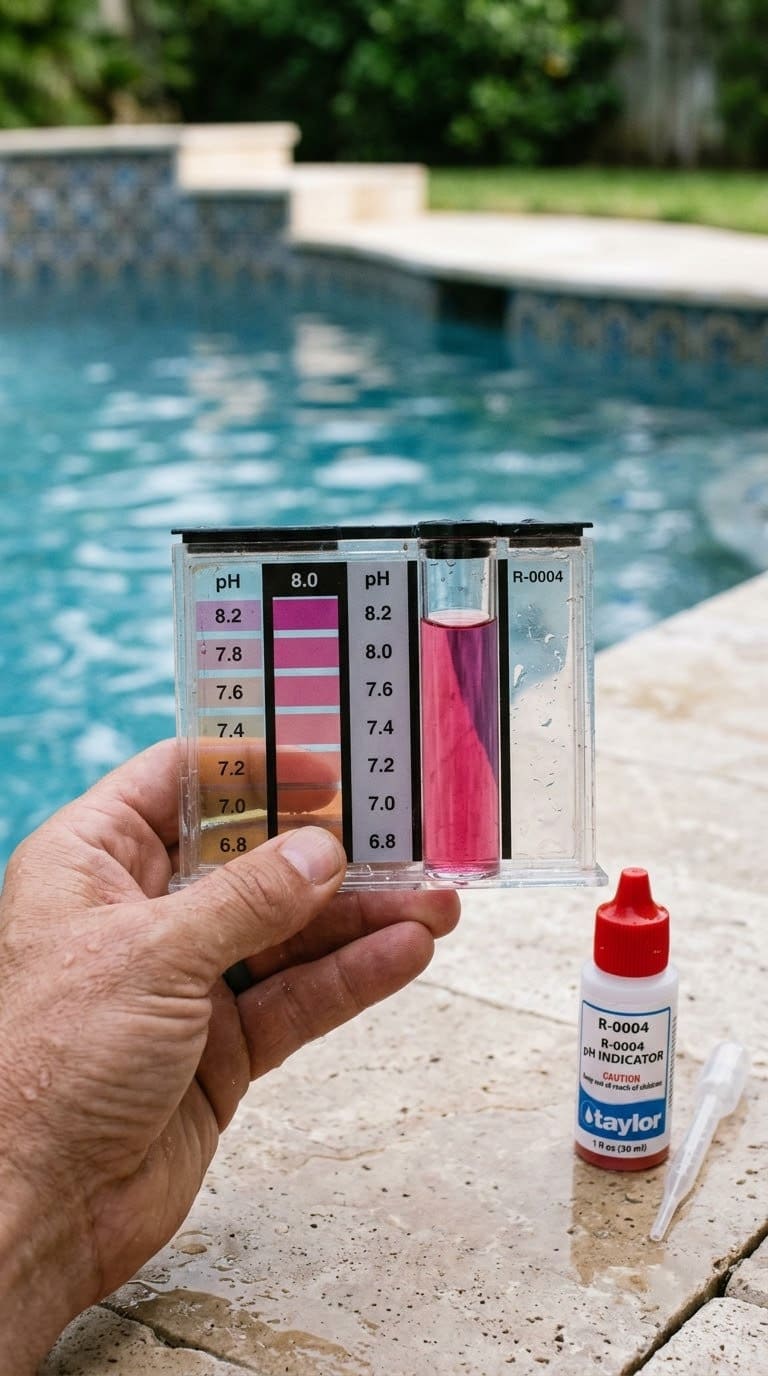
Chlorine’s killing power drops as pH rises. The CDC recommends a pH of 7.2 to 7.8 and notes that chlorine kills germs more slowly as pH climbs, especially above 8.0. Algae is a germ for this purpose.
Pools drift high on their own, from aeration, from fresh plaster, and from cal-hypo shock, which is alkaline. So you dump in shock, the pH jumps to 8.2, and a chunk of that chlorine is doing far less than the number on your test kit suggests.
Quick fix: Bring pH down to 7.2 to 7.5 with muriatic acid or dry acid before you shock, not after. Retest an hour later. Lower pH also helps a shock treatment actually clear the algae instead of just holding it back.
4. Phosphates are feeding the algae back faster than chlorine kills it
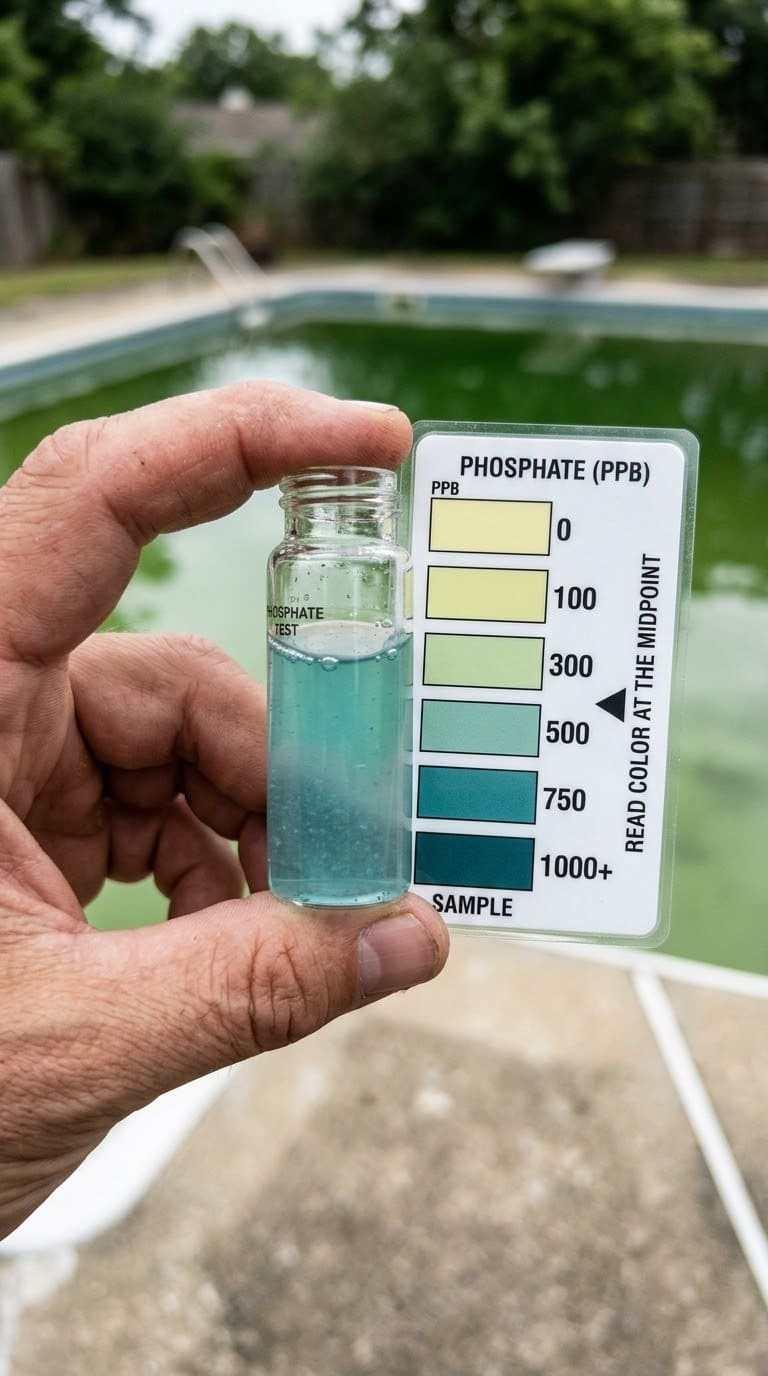
Here’s why some pools go green like clockwork every few days even with the chemistry dialed in. Phosphates are fertilizer for algae, and Orenda Technologies points out that chlorine does nothing to them. The two don’t react at all.
Phosphates come in with fill water, lawn runoff, leaves, swimmer sweat and sunscreen, and some stain-and-scale products. If your planting beds and trees sit right at the water’s edge, that’s a steady phosphate feed every time it rains.
Orenda’s guidance is that levels above roughly 100 parts per billion start feeding algae, and pulling them below that makes normal chlorine lethal to algae again. A pool sitting at 1,000 ppb is a buffet that chlorine can’t keep up with.
Quick fix: Test phosphates. If they’re over 500 ppb, or the pool keeps blooming despite a correct free chlorine level, dose a phosphate remover per the label, run the filter, and clean or backwash it afterward since the phosphates end up trapped there.
The average homeowner spends $616/year on yard fixes that don't address the real problem. Find out what yours actually is — before you spend another dollar.
Take the Free Quiz5. It isn’t algae, it’s oxidized copper or iron
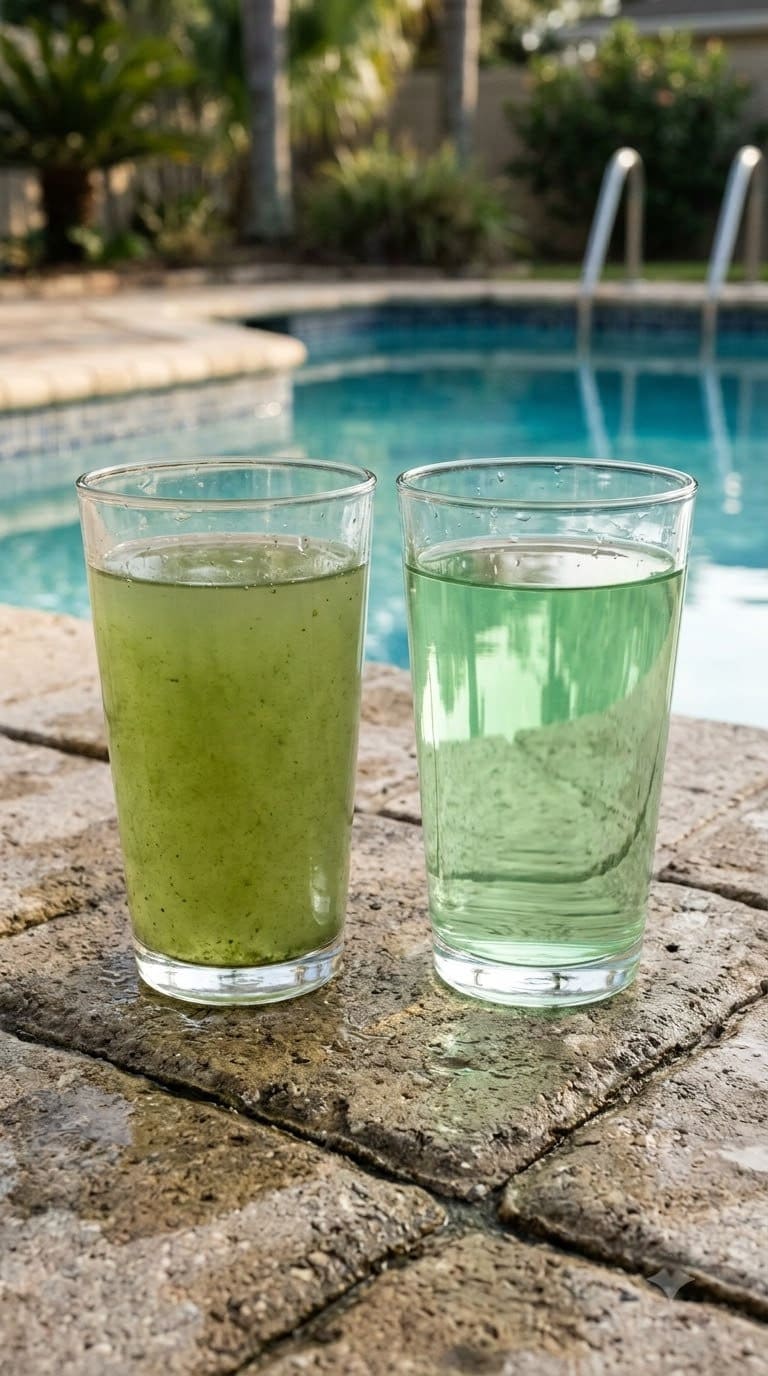
If your water turned green the moment you added shock, and it’s clear rather than cloudy, you’re probably looking at metal, not algae. Copper oxidizes green when an oxidizer hits it. As Eric Knight of Orenda Technologies puts it, think of the Statue of Liberty.
The copper usually comes from well fill water, from a corroding heater or other equipment, or from a copper-based algaecide someone added earlier. Shock it and the dissolved copper turns loose and tints the whole pool. More chlorine just oxidizes more copper.
Quick fix: Stop adding chlorine. Test for metals, or note whether the green is clear (metal) or cloudy with slime on the walls (algae). For metal, add a chelating sequestrant, run the filter continuously, and backwash. In Orenda’s case study the water cleared in about 48 hours.
6. Your filter runs too few hours a day, or the media is spent
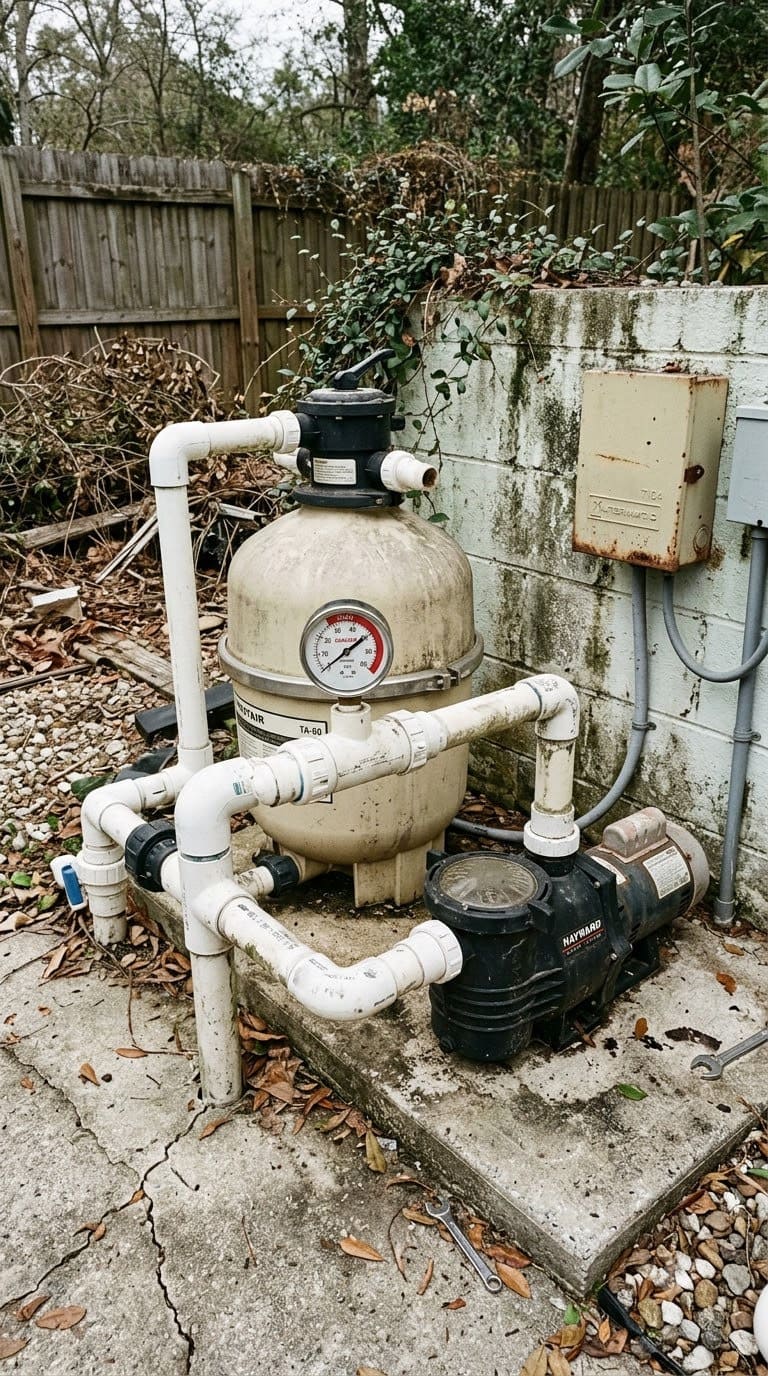
A lot of homeowners run the pump 4 to 6 hours a day to save on electricity. During a green bloom that isn’t close to enough. Dead algae has to be physically filtered out, and if the water isn’t moving through the filter around the clock, the pool stays green even with the chemistry right.
An old filter is the other half of this. Sand that’s 5 to 7 years old channels water instead of trapping fine particles. A cartridge that won’t come clean, or a filter pressure gauge sitting 8 to 10 psi above its clean baseline, means the media is done.
Quick fix: Run the filter 24 hours a day until the pool is clear, then settle into at least one full turnover a day, usually 8 to 12 hours. Backwash or clean the filter whenever pressure rises 8 to 10 psi over clean. Replace sand every 5 to 7 years and cartridges every 2 to 3. If the equipment pad is cramped or hard to reach, that’s worth fixing next time you redo the deck around the pool.
7. Dead spots and wall biofilm reseed the pool within days
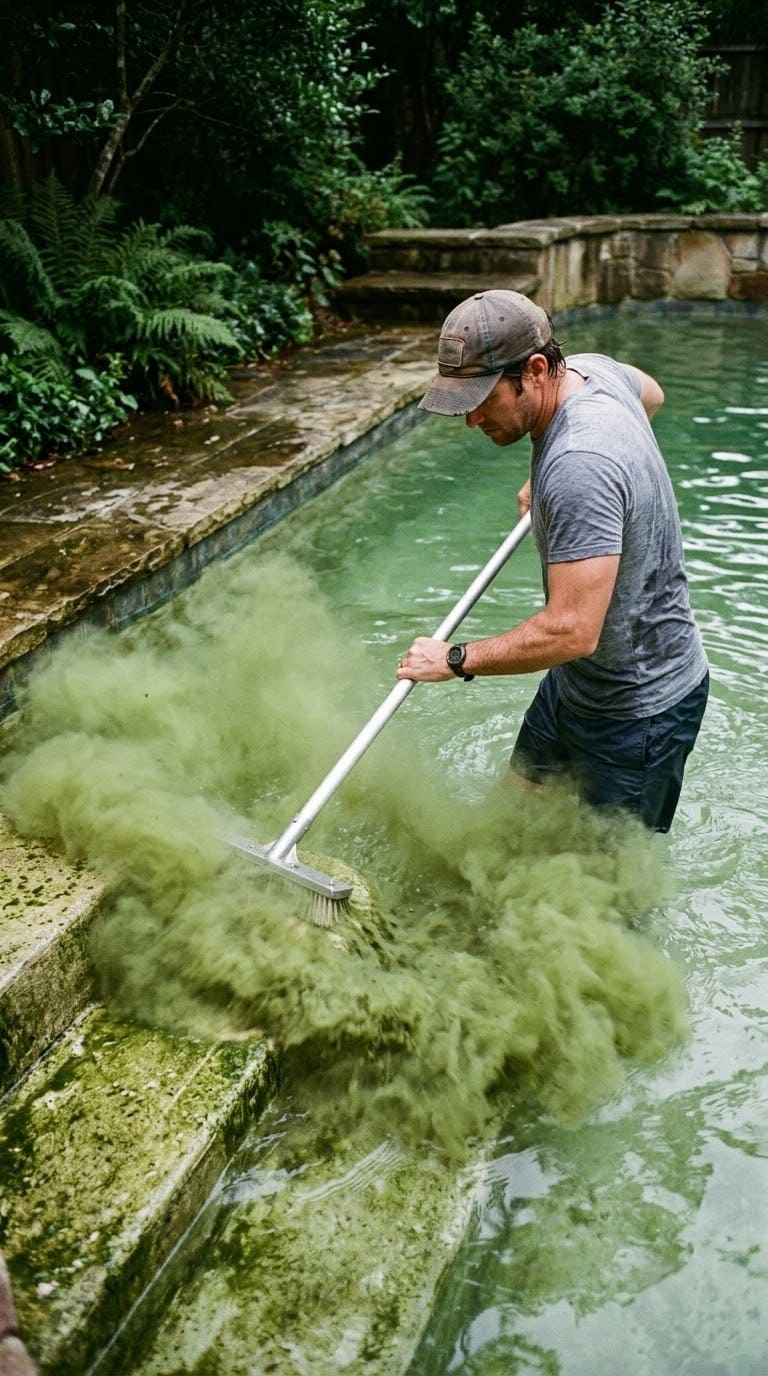
Algae anchors on surfaces first. Steps, ladders, the shady deep-end corner, behind the return jets, and the waterline all hold a thin biofilm that a quick vacuum never touches. Skip brushing and that film reseeds the open water in a day or two, so the pool looks green again while your chlorine still reads fine.
Poor circulation makes it worse. If a return jet is aimed at the wall instead of across the pool, or the skimmer is drawing from only one side, whole zones barely see chlorinated water.
Quick fix: Brush every surface daily during a bloom, especially the shady side and the steps. Point return jets to create a circular flow, angled slightly down. A robotic or pressure-side cleaner that climbs walls keeps the biofilm knocked back between manual brushings.
8. You shocked once and stopped instead of holding shock level
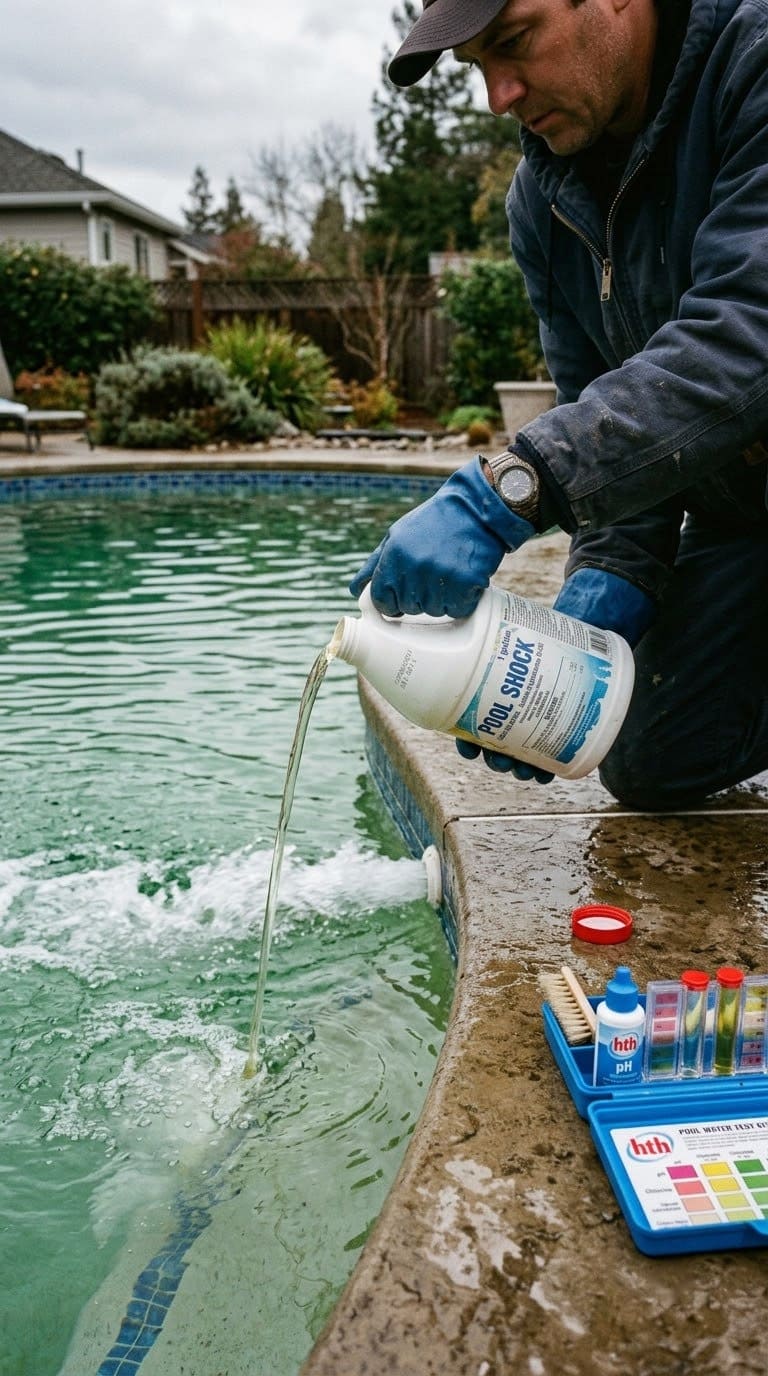
A single dose of shock spikes the chlorine, kills some algae, then gets used up fighting the dead organic load and the sun within a day. If there’s still living algae when the level falls back, it regrows. This is the loop most people are stuck in without realizing it.
Clearing a green pool is not one dose, it’s a process of holding the free chlorine at shock level for your CYA for several days straight, testing two or three times a day and adding more each time it drops.
Quick fix: Pick the shock number for your CYA from the table, get there with liquid chlorine, and hold it. You’re done when the water is clear and you lose less than 1 ppm of free chlorine overnight with the pump off. That overnight test is the real finish line, not how the water looks at noon.
Is it algae, metal, or pollen?
Three different green tints, three different fixes. Match yours before you spend money.
| Sign | Algae | Copper or iron | Pollen or debris |
|---|---|---|---|
| Water clarity | Cloudy, hazy | Clear, just tinted | Clear with floating specks |
| Walls and floor | Slippery film, slime | Clean, sometimes stained | Fine dust that stirs up |
| When it appeared | Over a day or few days | Instantly when you shocked | After trees flowered nearby |
| Free chlorine test | Often low or drops fast | Normal | Normal |
| The fix | Hold shock level, brush, filter | Sequestrant, filter, backwash | Fine filter or clarifier, skim |
If you’re not sure, take a water sample to a pool store for a metals test before you shock again. A wrong guess here wastes a week.
The fix, in the right order
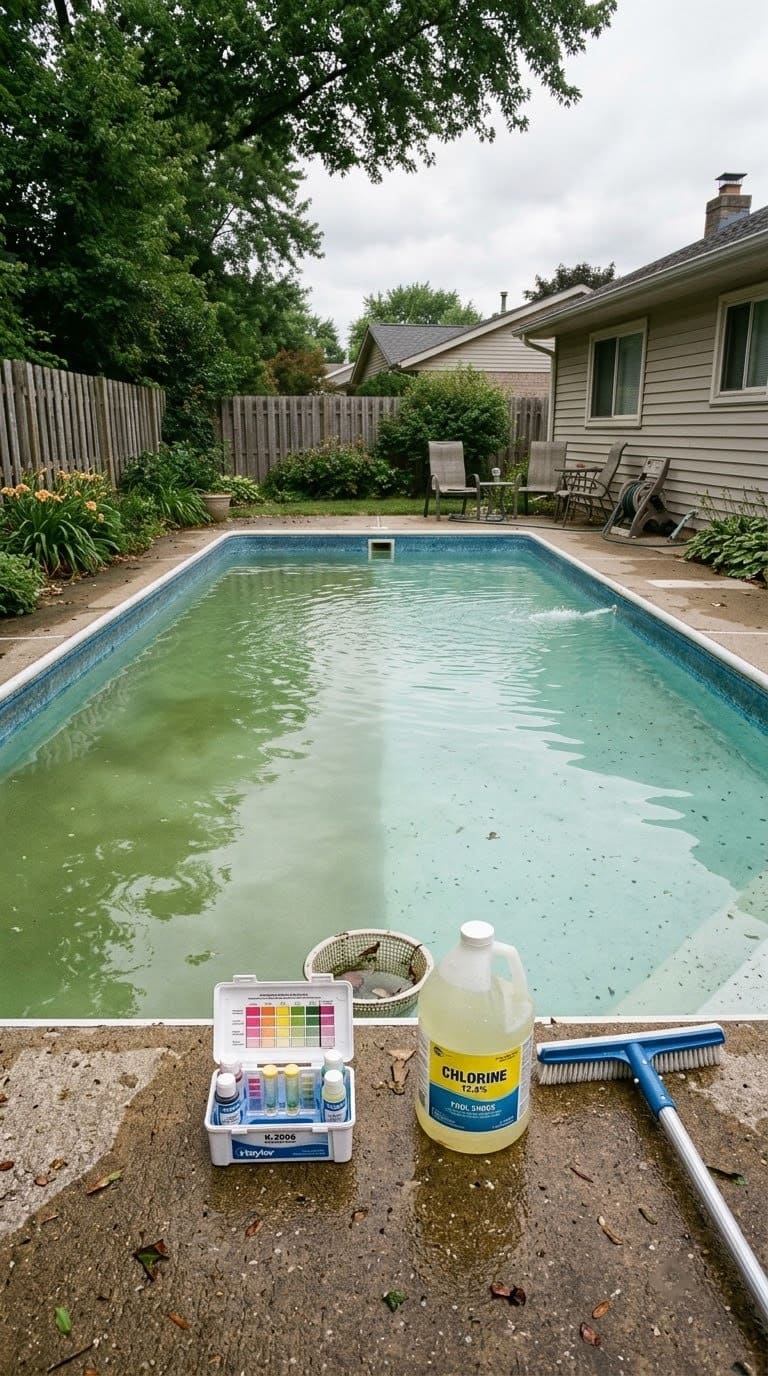
Doing these out of order is why the pool never fully clears.
First, test free chlorine, pH, and CYA with a drop kit, not strips. Strips can’t read high chlorine or give you a usable CYA.
Second, balance pH to 7.2 to 7.5. Everything downstream works better at that pH.
Third, get the CYA right. If it’s over 90, do a partial drain and refill until it’s near 40 to 50 before you bother chlorinating hard.
Fourth, raise free chlorine to the shock level for your CYA and hold it there for several days, testing two or three times a day. Run the filter 24/7 and brush every surface daily.
Fifth, if it still won’t clear with the chlorine held high, test phosphates and metals and treat whichever is off.
Sixth, call it done only when the water is clear and the overnight free chlorine loss is under 1 ppm. Then drop back to your daily target from the table.
What we learned the hard way
A few things that only became obvious after wasting a summer.
The pool store algaecide loop is real. We’d bring in a sample, walk out with a bottle of something, and be back in two weeks.
Nothing stuck because the CYA was 110 the whole time and no one tested it. A 15 dollar drop kit told us more in ten minutes than a season of store visits.
Test strips lied to us about CYA. The strip pad maxed out and just read “100+” when the real number, on a proper turbidity test, was around 130. We were dosing for a problem half the size of the real one.
The well-water refill kept re-greening it. Every time we topped off after backwashing, the pool tinted green again within the hour.
It was copper in the well water reacting with the chlorine, not algae, and we chased it as algae for a month. A sequestrant added with every top-off finally settled it.
And running the pump on the old 6-hour timer during a bloom was throwing good chlorine after bad. Once we set it to run continuously until clear, the same amount of shock actually got somewhere.
Frequently asked questions
Why is my pool green if my chlorine level is fine? Almost always because your cyanuric acid is high, so most of that measured chlorine is bound to the stabilizer and not available to kill algae. Test CYA and compare your free chlorine to the 7.5 percent minimum. A “fine” 3 ppm at a CYA of 90 is actually well below the line.
Is chlorine lock a real thing? Not really. What people call chlorine lock is almost always free chlorine that’s too low for the CYA level, or a real chlorine demand from a heavy algae or organic load. The fix is more free chlorine relative to CYA, or lowering the CYA, not a special product.
Should I just drain the whole pool and start over? Only for small above-ground or stock-tank pools. A full drain of an inground pool risks the shell floating out of the ground or the liner collapsing, and it can crack plaster if it dries out. Partial drains of 25 to 33 percent at a time are the safe way to reset CYA.
How long does it take to clear a green pool? A light green pool with correct chemistry and the filter running 24/7 often clears in 2 to 4 days. A deep green swamp can take a week or more, and may need the filter cleaned several times as it pulls out dead algae. Metal-green water usually clears within about 48 hours of a sequestrant.
Do I actually need algaecide? Usually no. If you hold the free chlorine at the right level for your CYA and keep phosphates down, chlorine handles algae on its own. Algaecide is a backup for problem spots or a winter-closing aid, not a substitute for the chlorine ratio.
Can I swim in a green pool? No. The CDC’s position is that if you can’t see the bottom or a swimmer in distress, the water isn’t safe, and green water usually means chlorine isn’t keeping up with contamination. Wait until it’s clear and the chlorine holds steady.
Related Posts
Products We Recommend
This post contains affiliate links. We may earn a commission on qualifying purchases at no extra cost to you.
Taylor K-2006C Complete Pool Test Kit
FAS-DPD drop kit that reads free and combined chlorine, pH, alkalinity, calcium hardness, and cyanuric acid, the test that actually shows the chlorine-to-CYA ratio
Shop Now
Pool Elevate Phosphate Remover (32 oz)
Binds phosphates into a filterable precipitate to starve recurring algae, for above-ground and inground pools
Shop Now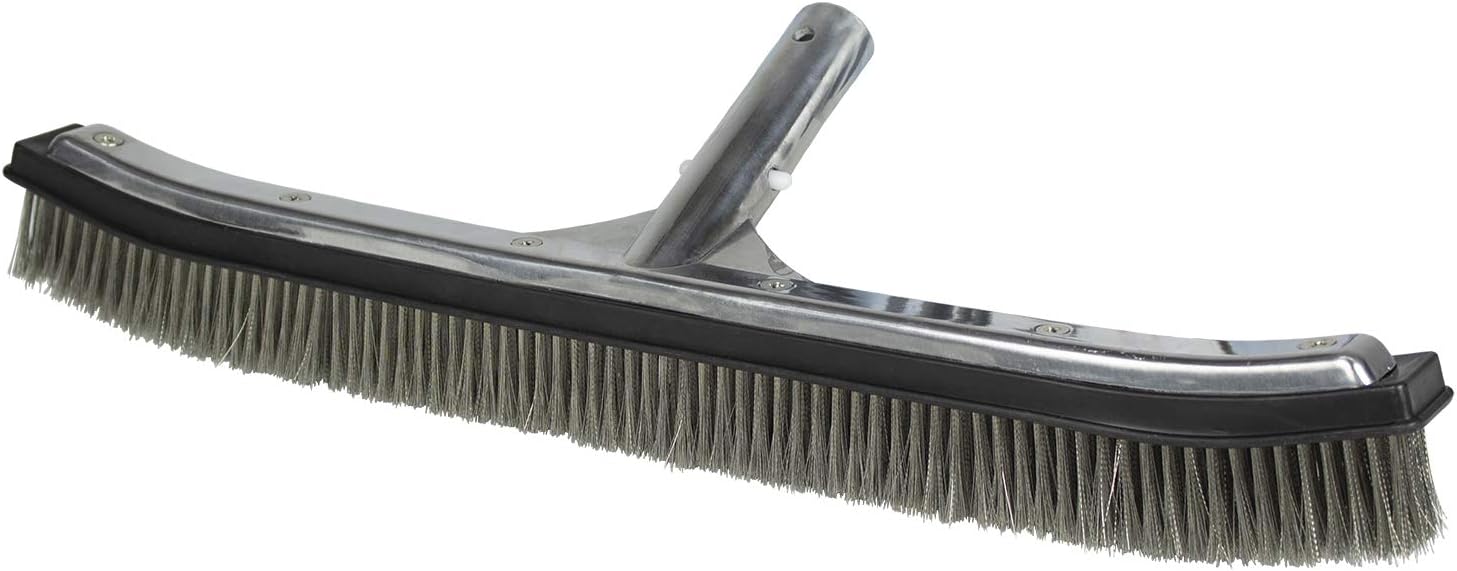
Poolmaster 18-Inch Stainless Steel Algae Brush
Wide heavy-duty wall and floor brush for knocking back the biofilm on steps, corners, and the waterline during a bloom
Shop NowNever miss an update — choose FarmFoodFamily as your preferred source on Google.
How it works: Tap the button below to open Google's settings page, then check the box next to FarmFoodFamily.
Tap the checkbox to turn it blue — that's how you know it's set.