12 Striking Red and Silver Christmas Tree Decorating Ideas That Feel Warm, Not Cold
Red is warm and silver is cool, so a red and silver tree works when you build a bridge between them with the right red, a little white, and the right bulbs.

Never miss an update — choose FarmFoodFamily as your preferred source on Google.
How it works: Tap the button below to open Google’s settings page, then check the box next to FarmFoodFamily.
Tap the checkbox to turn it blue — that’s how you know it’s set.
Red and silver looks like it should be easy. It is two colors and a shine.
But one is warm and one is cool, and that gap is why some red and silver trees glow and others feel like a hospital hallway. Getting the mix right is mostly about that gap.
Below are 12 red and silver tree ideas with ribbon loops, ornament counts, and budget notes. We also cover which lights to use, how to do this on a slim tree, and one fire risk that shiny ornaments create.
If you want the wider menu of styles first, there is a longer run of tree decorating tips for every theme on the site. This one sticks to red and silver.
Quick Answer
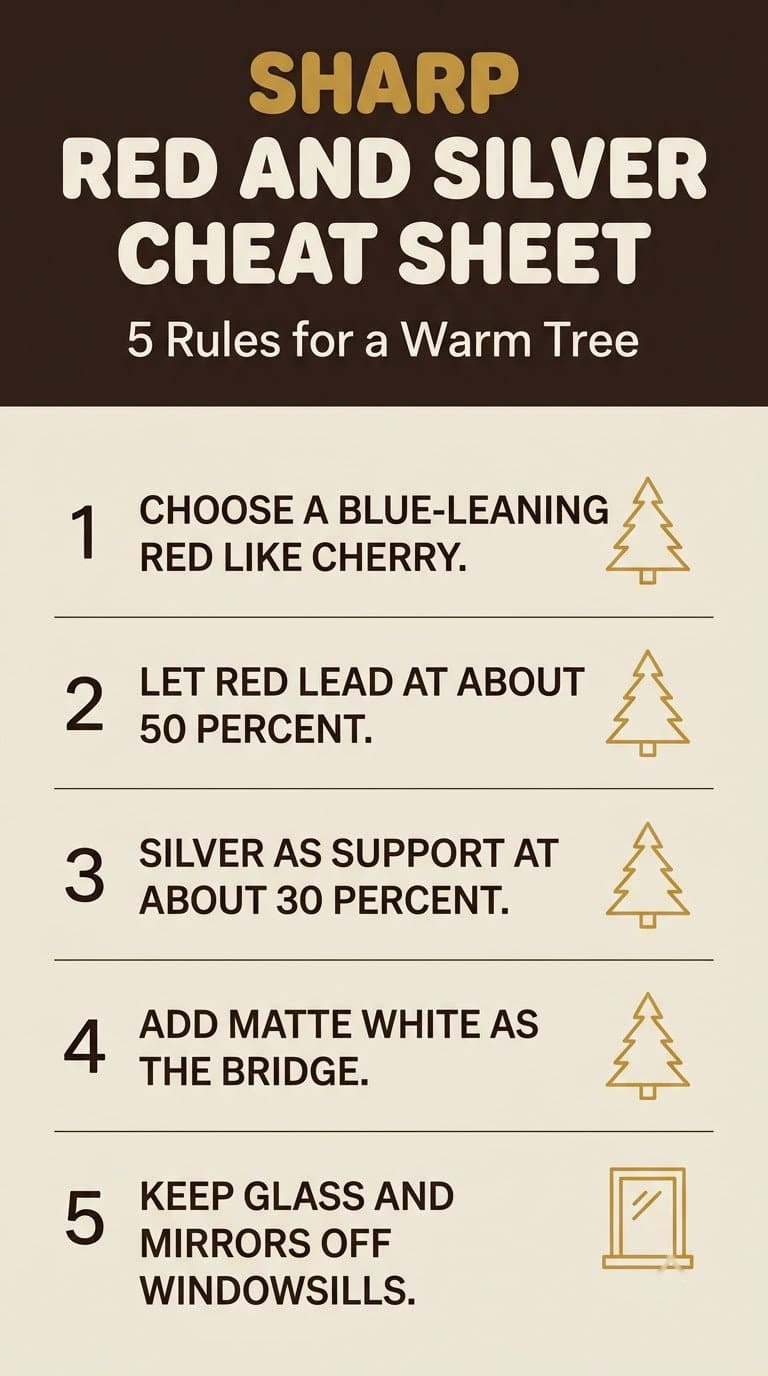
To keep a red and silver tree warm, choose a red that leans blue, like cherry or cranberry, and let red lead. Use silver as the support, at roughly a third of the tree. That one choice fixes most cold-looking trees.
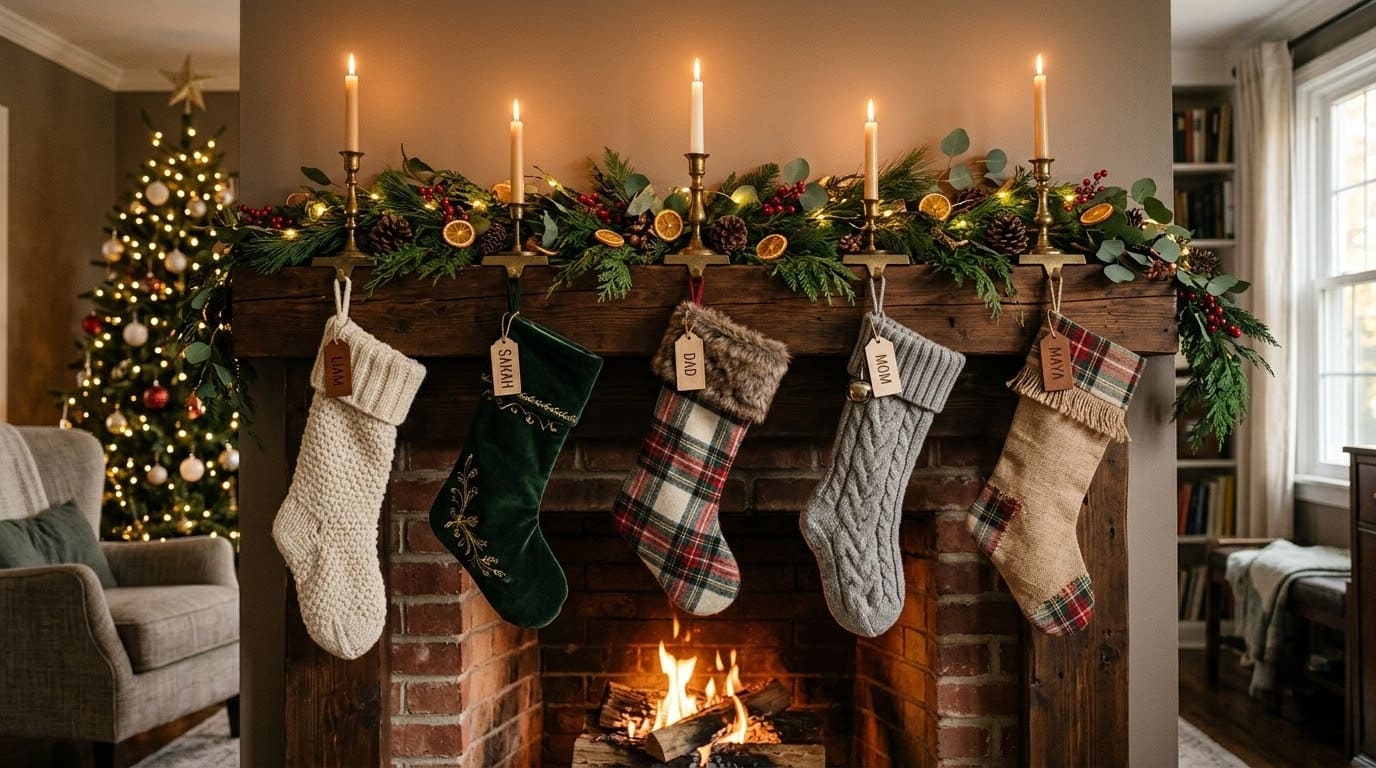

Add white as a bridge. It sits between the warm red and the cool silver, and it stops the two from arguing. Matte white works best, like felt or frosted glass.
Then choose your bulbs on purpose. Warm white bulbs flatter the red, and cool white ones flatter the silver. Pick the color you care about most, because you cannot have both.
Last, keep glossy red balls and mirrored silver ones off windowsills. A UK fire service warns that “any mirror or glass ornament with a curve in it should never be left on a windowsill or by a window.”
Why Does Red and Silver Sometimes Feel Cold?
Because silver is a cool metal, and a lot of silver at Christmas reads icy. Add a red that leans orange and the two fight.
The result is a tree that looks like two separate trees. One is warm and one is chilly, and they happen to share a stand.
| Problem | What it looks like | The fix |
|---|---|---|
| Too much silver | Icy, hospital-like | Let red lead, silver at about a third |
| An orange-leaning red | The red clashes with the silver | Use cherry or cranberry |
| No bridge color | Warm and cool feel separate | Add white |
| Cool lights only | The red looks flat | Try warm white |
| Bulky picks on a slim tree | Cluttered, no shape | Choose smaller stems |
None of this needs a bigger budget. It mostly needs a different red.
If you would rather go all red, our guide to red trees that look rich, not cheap covers that.
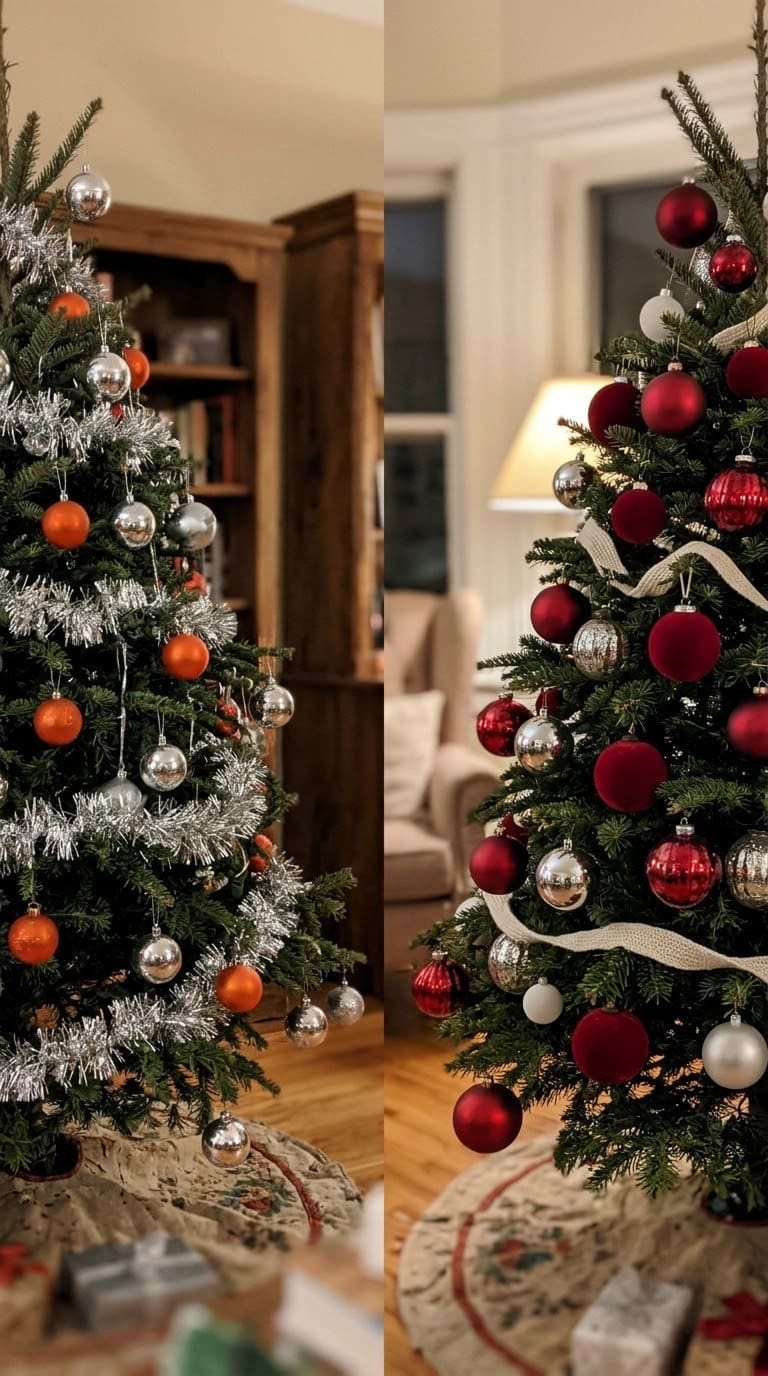
Why Is This Palette Harder Than It Looks?
Red and silver sit on opposite sides of the temperature line. That is the whole difficulty.
Sherwin-Williams color expert Sue Wadden explains undertones in a guide for paint buyers. “Warm colors typically have undertones that are orange, yellow, or red, while cool colors have undertones that are green, blue, or purple,” Wadden says.
That is about paint, not ornaments, so the tree version is our own reading. But the test carries over. Wadden’s advice is to “put the color you’re considering next to a pure example of that color,” and the undertone “will quickly reveal itself.”
So hold two red ornaments next to a plain white card. One will look slightly orange, and the other slightly blue. Pick the bluer one for a silver tree.
Wadden is also honest that “there are no hard and fast rules.” If you love a warm orange-red with silver, use it. It just needs more white to hold it together.
How Much Red, How Much Silver?
A viewer under one red, white and silver tree video asked it best: “Is there more white or red? Or even?” Nobody answered, so here is our answer.
Use red as the lead, silver as the support, and white as the bridge. A working split is about 50 percent red, 30 percent silver, and 20 percent white.
| Color | Share | Ornaments on a 7 foot tree (about 60) |
|---|---|---|
| Red | 50% | About 30 |
| Silver | 30% | About 18 |
| White | 20% | About 12 |
Those are our own planning numbers, not a standard. A tree that is half silver tends to read cold, so drop the silver first if it feels icy.
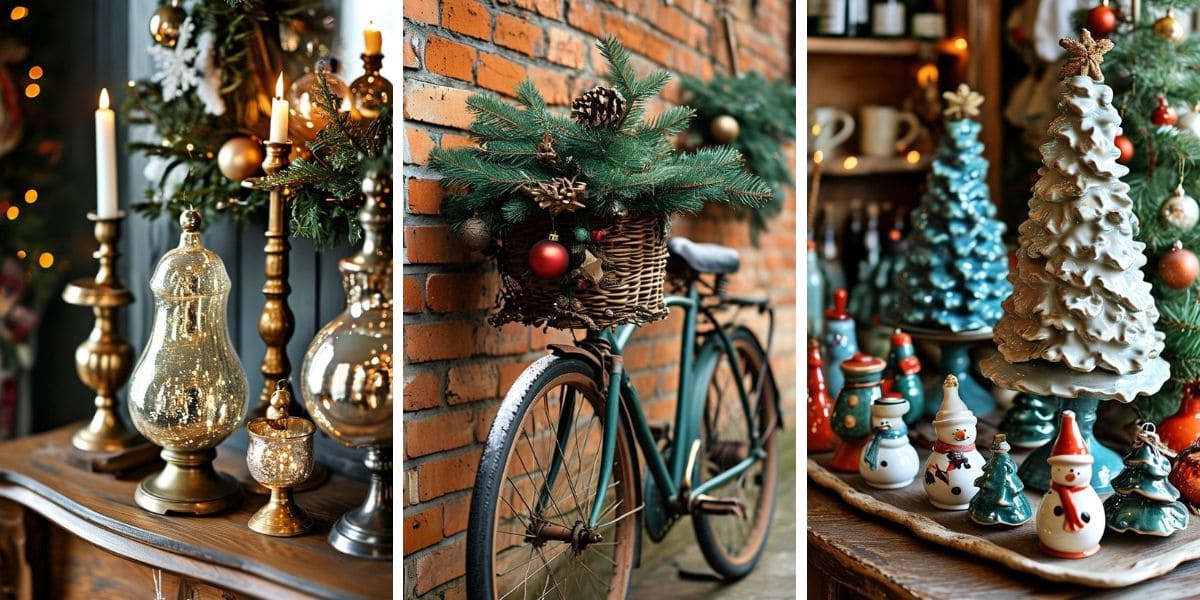
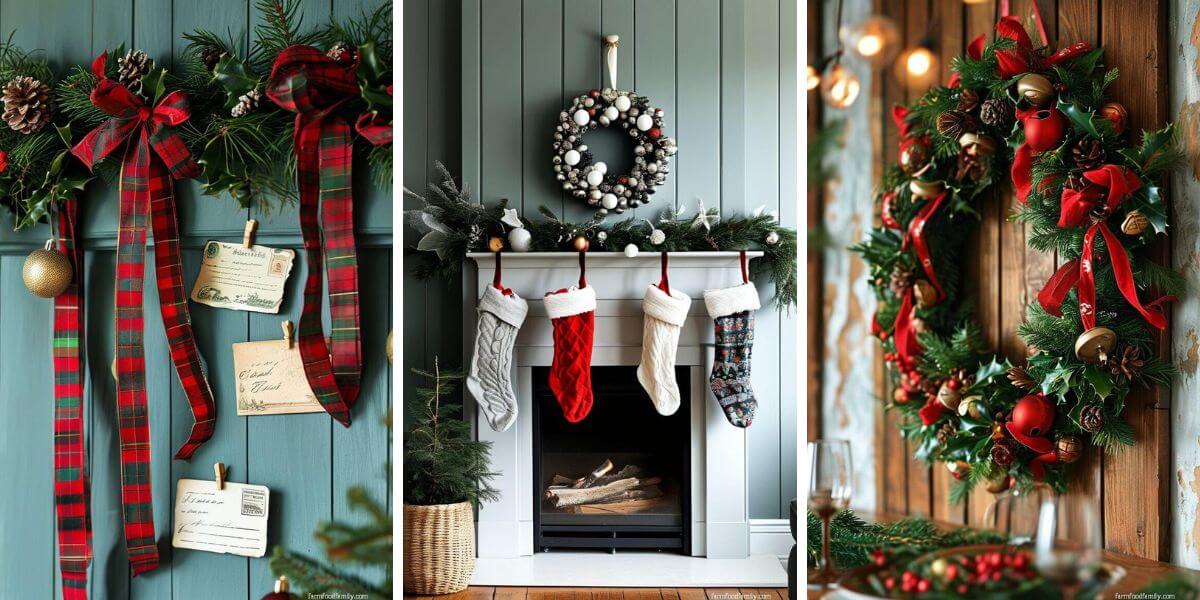
Warm or Cool Lights for Red and Silver?
This is a real tradeoff, and there is no free answer. Warm bulbs help the red and cool bulbs help the silver.
Designer Kylie Mawdsley of Kylie M Interiors says warm 2700K bulbs “enhance WARM PAINT COLORS,” and that cool colors get “toned down and muted by this warm light.” Cool white light does the reverse.
Mawdsley writes about paint, so applying it to a tree is our own step.
But it matches what you see. Under warm bulbs the red glows and the silver softens toward gold. Under cool bulbs the silver sparkles and the red goes a bit flat.
If red is your lead, go warm white. If you want a frosty, modern look, go cool white and add more red to compensate. Our roundup of Christmas light ideas covers the other rooms.
Should You Add White?
Yes, in most cases. White is the bridge between the warm red and the cool silver.
Brad Schmidt is a floral artist and product design consultant at Balsam Hill. Schmidt built a red, white, and sparkle tree that uses white the same way. Balsam Hill is a retailer, so read it as one designer’s approach, not a rule.
White also solves the ratio problem. It gives your eye a place to rest between the loud red and the shiny silver.
Use it in matte finishes, like felt, flocking, or frosted glass. Shiny white next to shiny silver just adds more shine.
If green is your usual partner for red, our red and green tree ideas show how to keep that classic from turning cliché.
Can Shiny Ornaments Start a Fire?
They can, and red and silver trees are built from exactly the kind of ornaments that do it. Curved glass balls and mirrored silver ones can act like a magnifying glass.
Dorset & Wiltshire Fire and Rescue Service in the UK explains that “when the sunlight hits it, it becomes concentrated and, if the rays are bounced onto something flammable (such as curtains or soft furnishings) then a fire can start.” It says “any mirror or glass ornament with a curve in it should never be left on a windowsill or by a window.”
The risk “does depend on the angle of the sun,” the service adds. This is a UK page, but the physics is the same anywhere.
In practice, keep spare glass balls, mirrored ornaments, and crystal decor off windowsills. And if your tree stands in a sunny window, watch where the light lands on your curtains during the day.
12 Red and Silver Christmas Tree Decorating Ideas
1. Cherry Red and Polished Silver
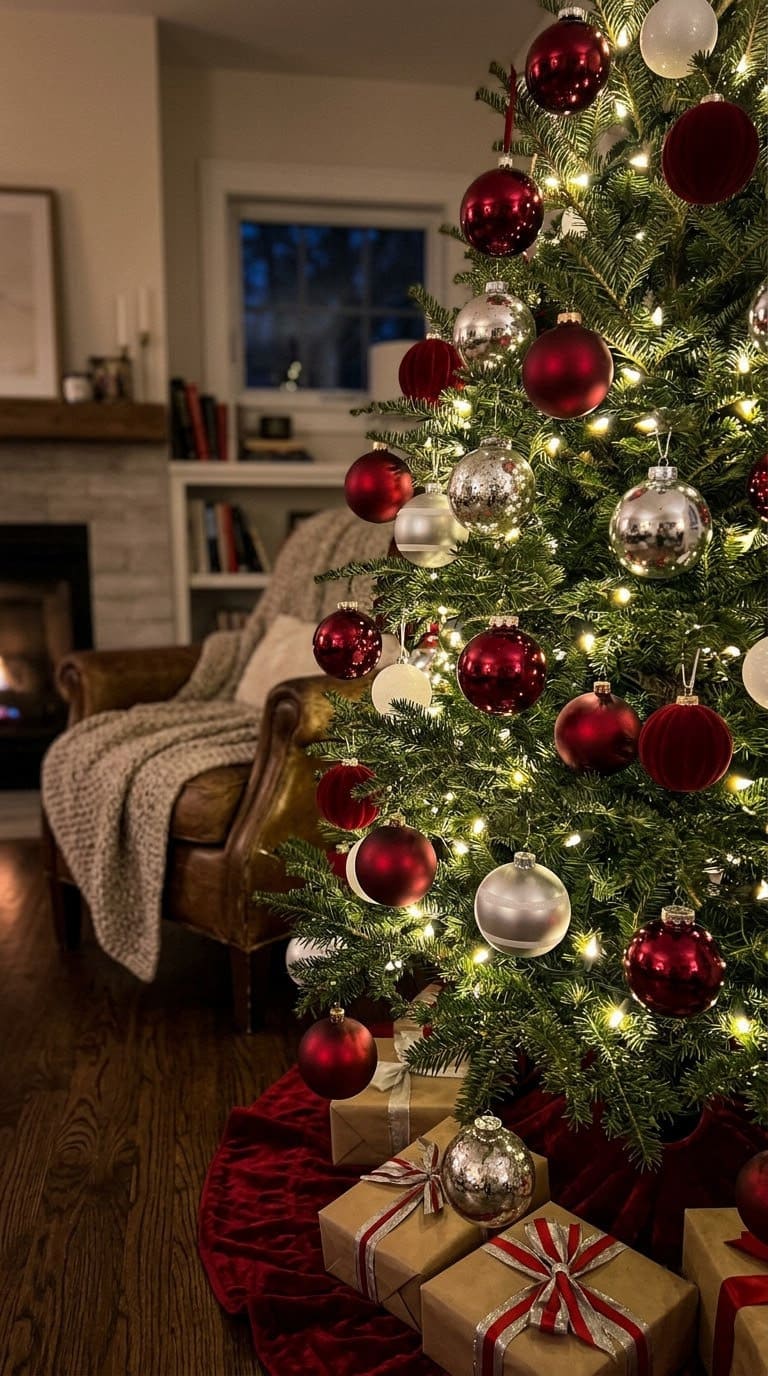
The default this whole article argues for. Use cherry red balls in 4 and 6 inch, about 30 of them, with about 18 polished silver balls in 3 and 4 inch.
Keep red in charge and silver in support. Budget: low to mid. Our Christmas ornament roundup has more shapes worth collecting.
Pairs well with idea 2’s white for a softer version.
2. Red, White, and Silver
The three-color version, and the one that answers the viewer’s ratio question. Use the 50, 30, 20 split from the table above.
On a 7 foot tree that is about 30 red, 18 silver, and 12 white. Budget: mid, since white and silver pieces add up.
Choose matte white, like felt, flocked, or frosted glass. Keep the shine for the silver.
3. Flocked Tree With Red Berries and Silver
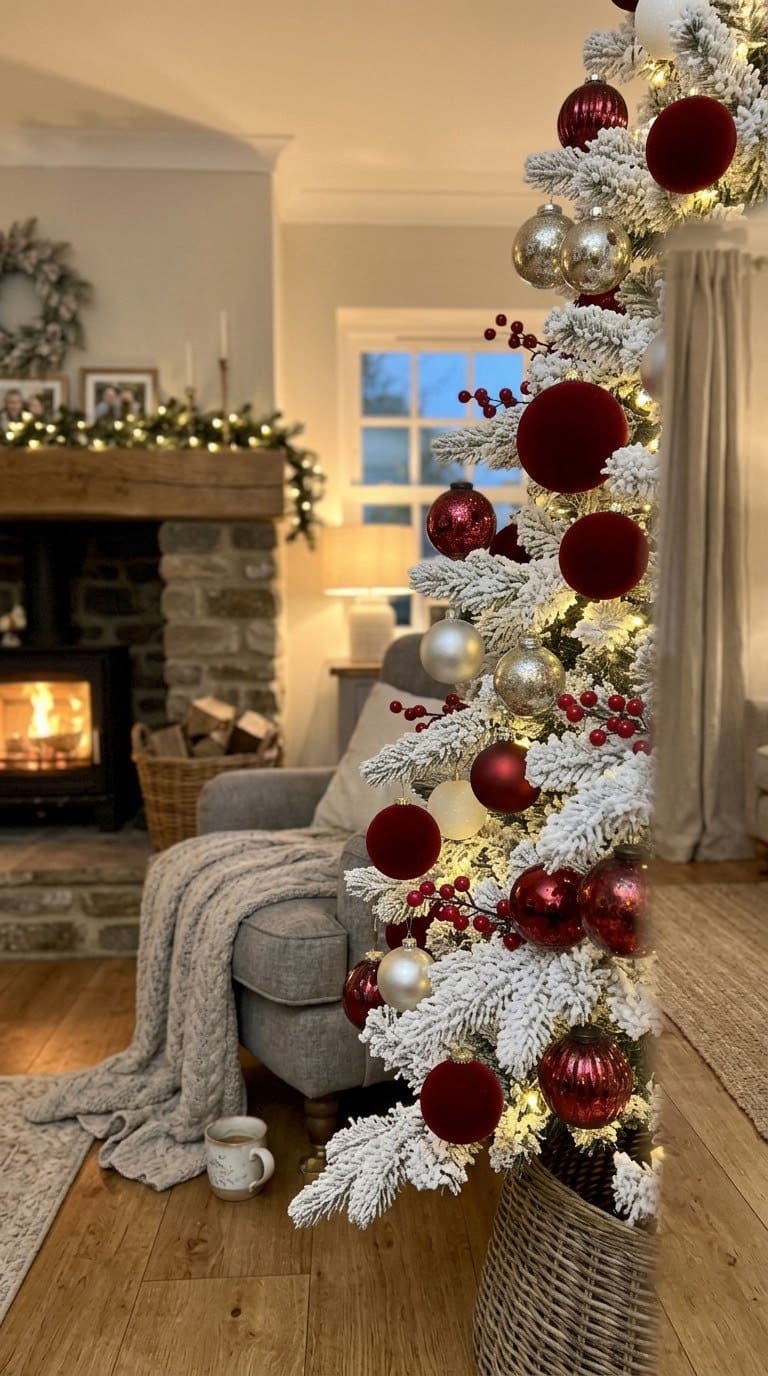
A white flocked tree is the neutral, so red and silver both look crisp against it. Use 10 to 12 red berry picks pushed deep, plus 15 silver balls in 3 to 4 inch.
Set the tree up over a sheet, since flocking sheds most on the first fluff. Budget: mid to invest, because a flocked tree costs more.
There is more on this look in our glam tree ideas, which also cover mixed metals.
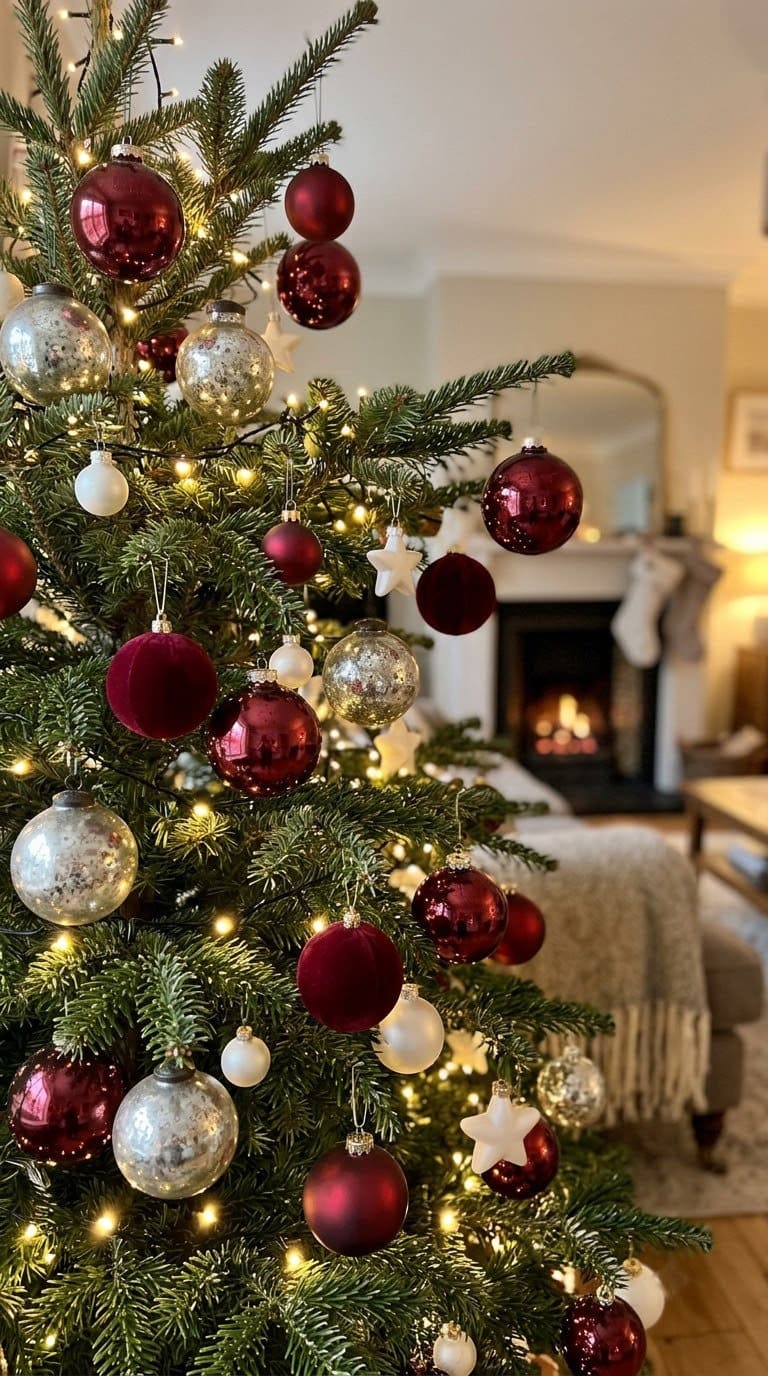
4. Mercury Glass and Red Velvet
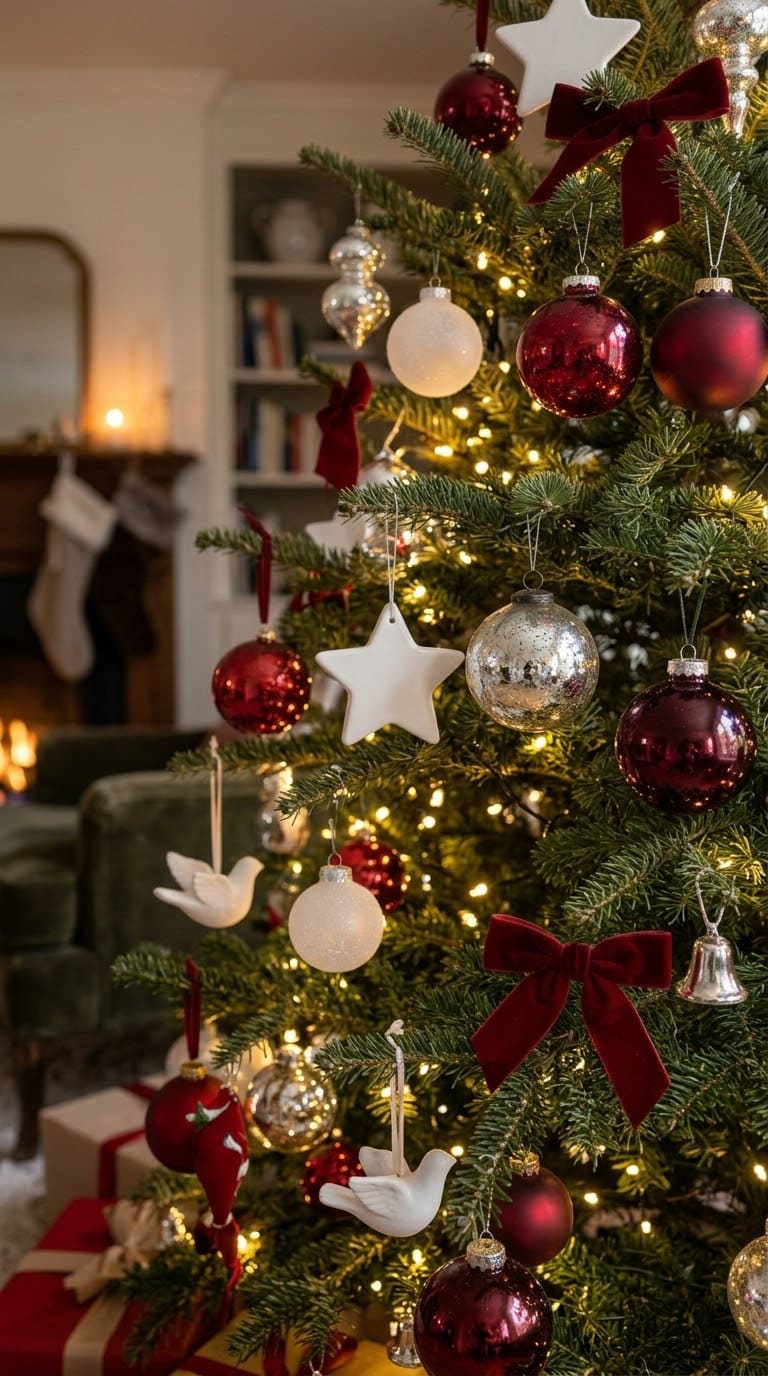
Soft silver against rich red. Mercury glass has a cloudy, worn shine that reads warmer than a mirror finish, so it eases the cold.
Use about 15 mercury glass pieces in 3 to 4 inch with 10 red velvet balls. Budget: mid to invest, because mercury glass costs more than plain silver.
Keep these away from windows, per the fire service note above. The cloudy finish still curves.
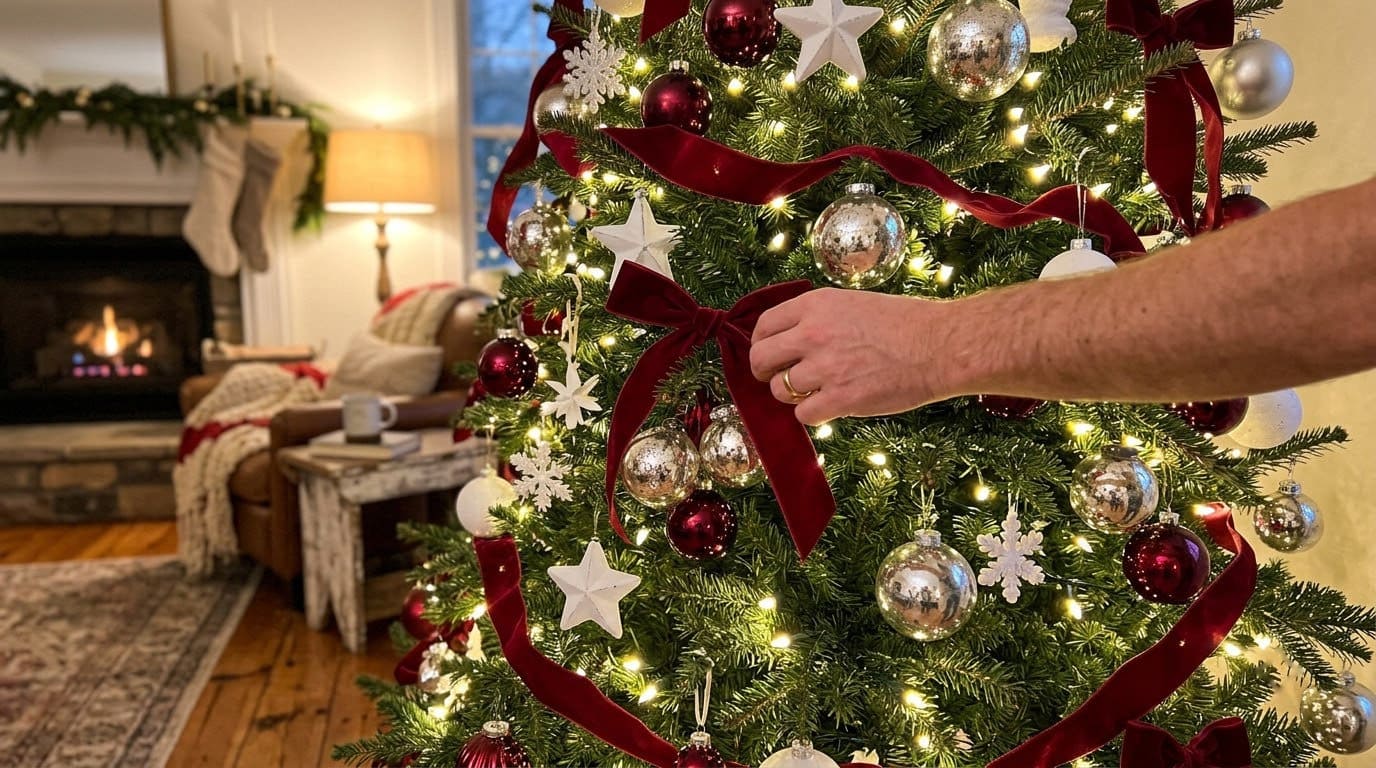
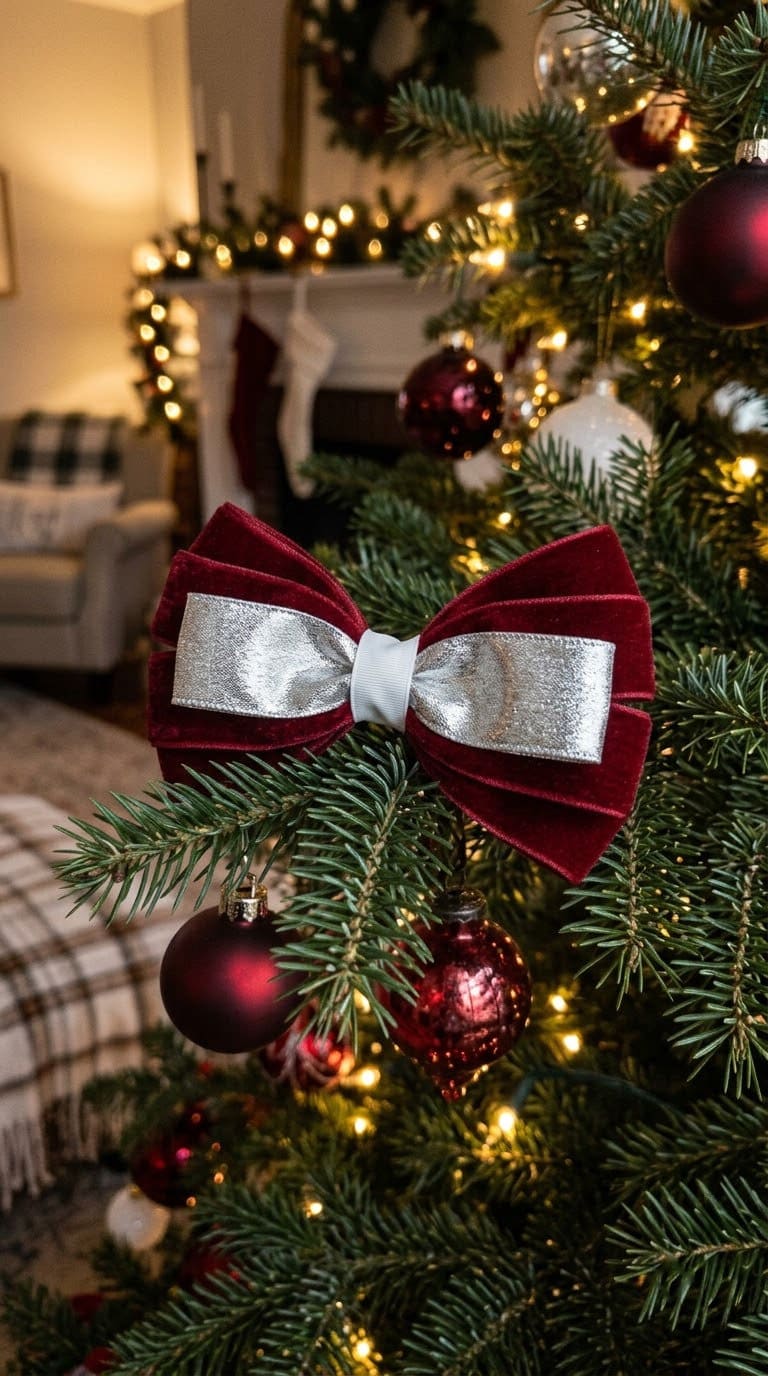
5. Layered Ribbon: Red Velvet Under Silver
The technique from Brad Schmidt, used on a slim tree. Schmidt layered a jeweled silver-white ribbon over a red velvet glitter one, so the red shows through.
The ribbon was shaped into “4 tight loops, then tying them with floral wire.” Use 2.5 to 4 inch ribbon, and put the silver on top.
Budget: mid. Ribbon eats yardage fast, so count rolls before you buy.
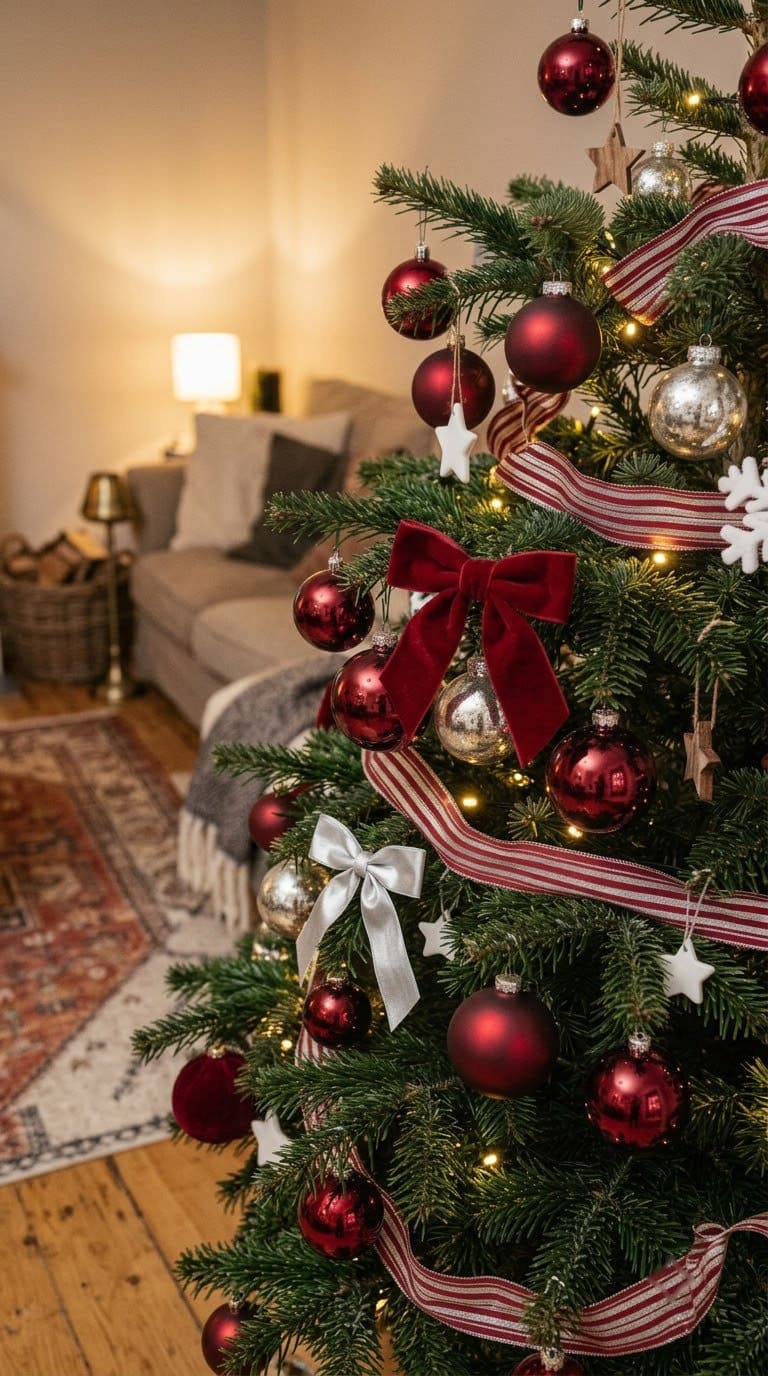
6. The Striped Ribbon Tree
A viewer under one red and silver tree video wrote, “I love the striped ribbon.” Stripes give you both colors in one ribbon, so the palette feels planned.
Use a 4 inch wired ribbon with red and silver stripes as the main line. Tuck it in staggered lengths instead of spiraling one long piece.
Budget: low to mid. Add solid red and solid silver bows, and skip a second pattern.
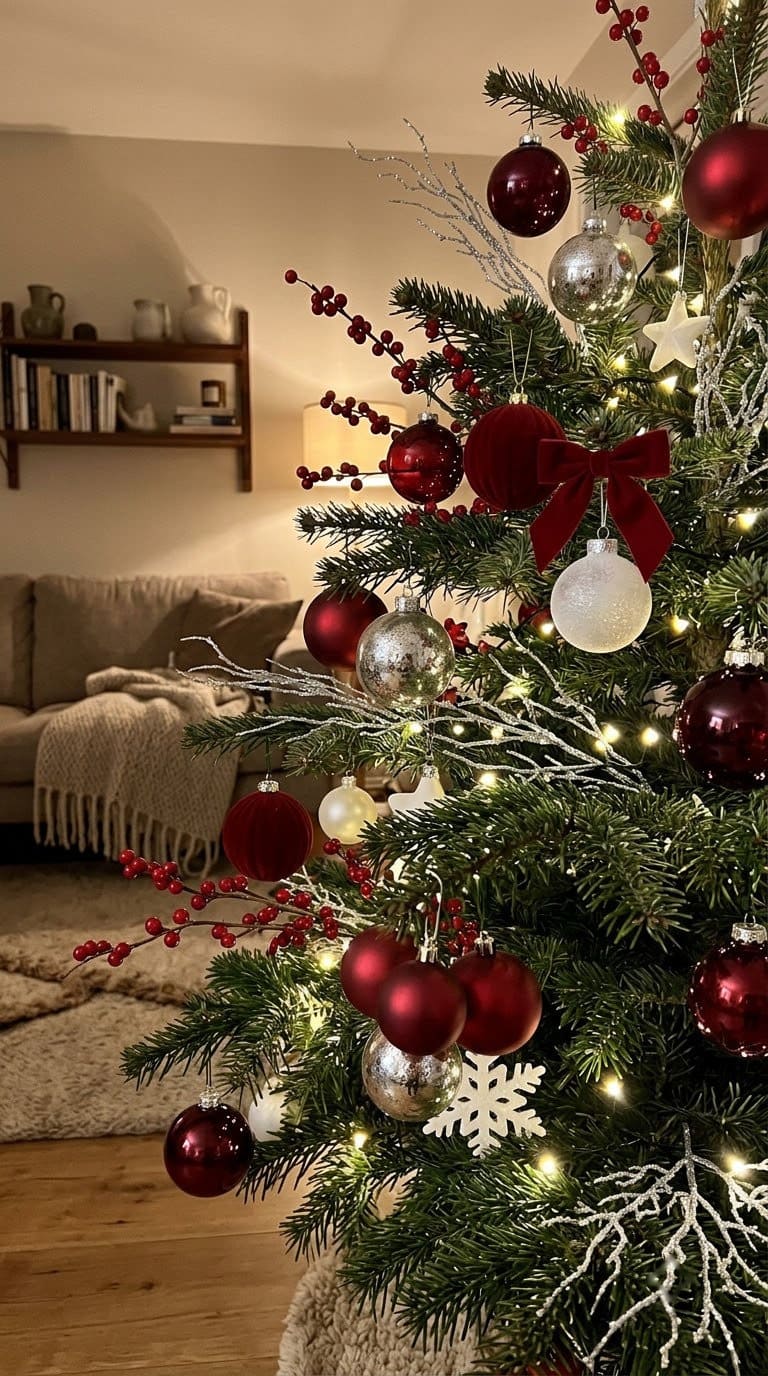
7. Berry Picks and Silver Twigs
One viewer’s favorites on a red and silver tree were the long red berry picks and the silver “fly-aways.” Use 8 to 10 long red berry picks and 8 to 10 silver glitter twigs.
Push both deep so they read as branches. Budget: low to mid, and this is one of the cheapest ways to add volume.
Mixing pick lengths is what makes it look natural, so vary them by a few inches.
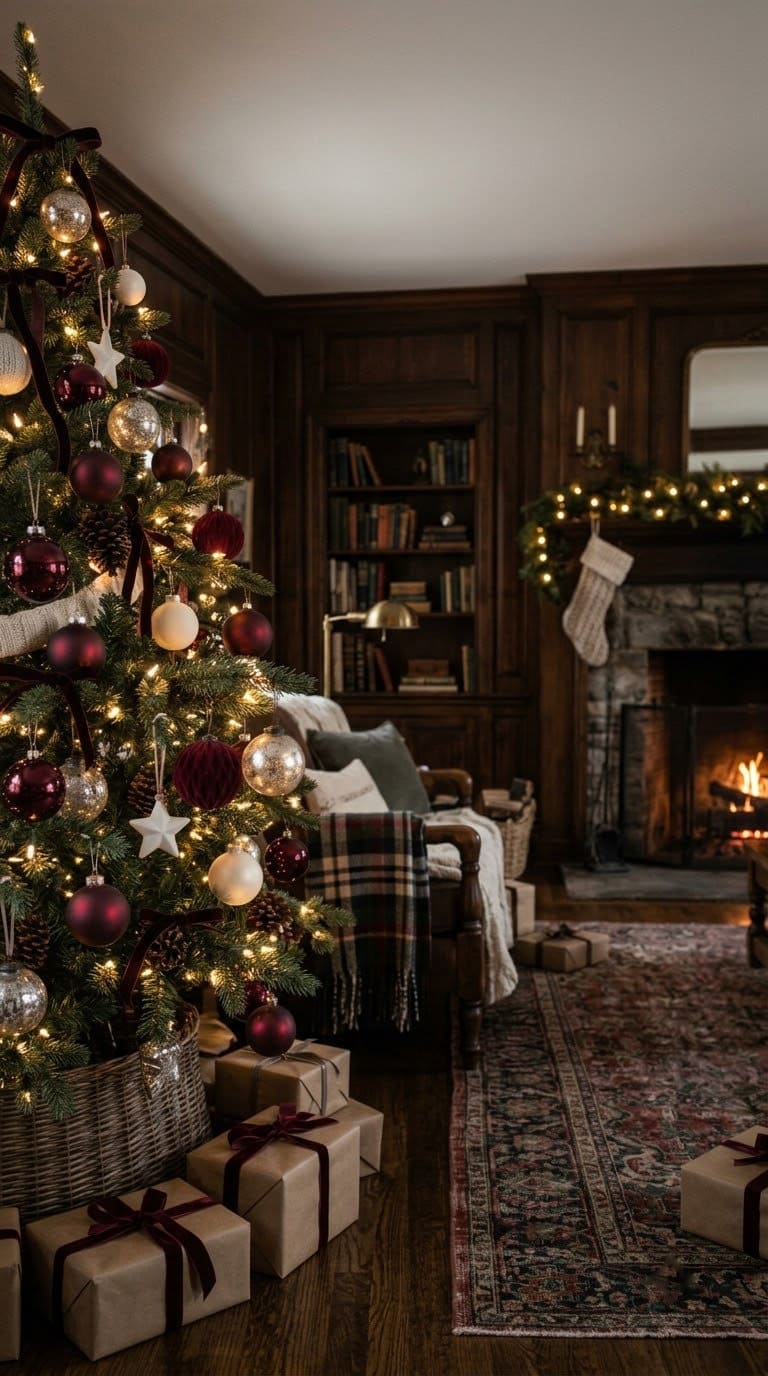
8. Burgundy and Pewter
The moodiest version. Burgundy is a deeper, more blue-leaning red, and pewter is a softer, darker silver, so the pairing feels grown-up.
Use about 25 burgundy balls in matte and velvet, with about 15 pewter or antique silver pieces. Budget: mid.
Best in a room with dark wood or deep paint. Warm bulbs work well here.
9. Chrome and Matte Red
Modern and graphic. Use 20 matte red balls in 4 inch against 12 bright chrome ones in 3 inch.
Keep everything else simple. A plain tree, no glitter, and one ribbon is enough.
Budget: low to mid. Cool white bulbs suit this version, so let the chrome sparkle.
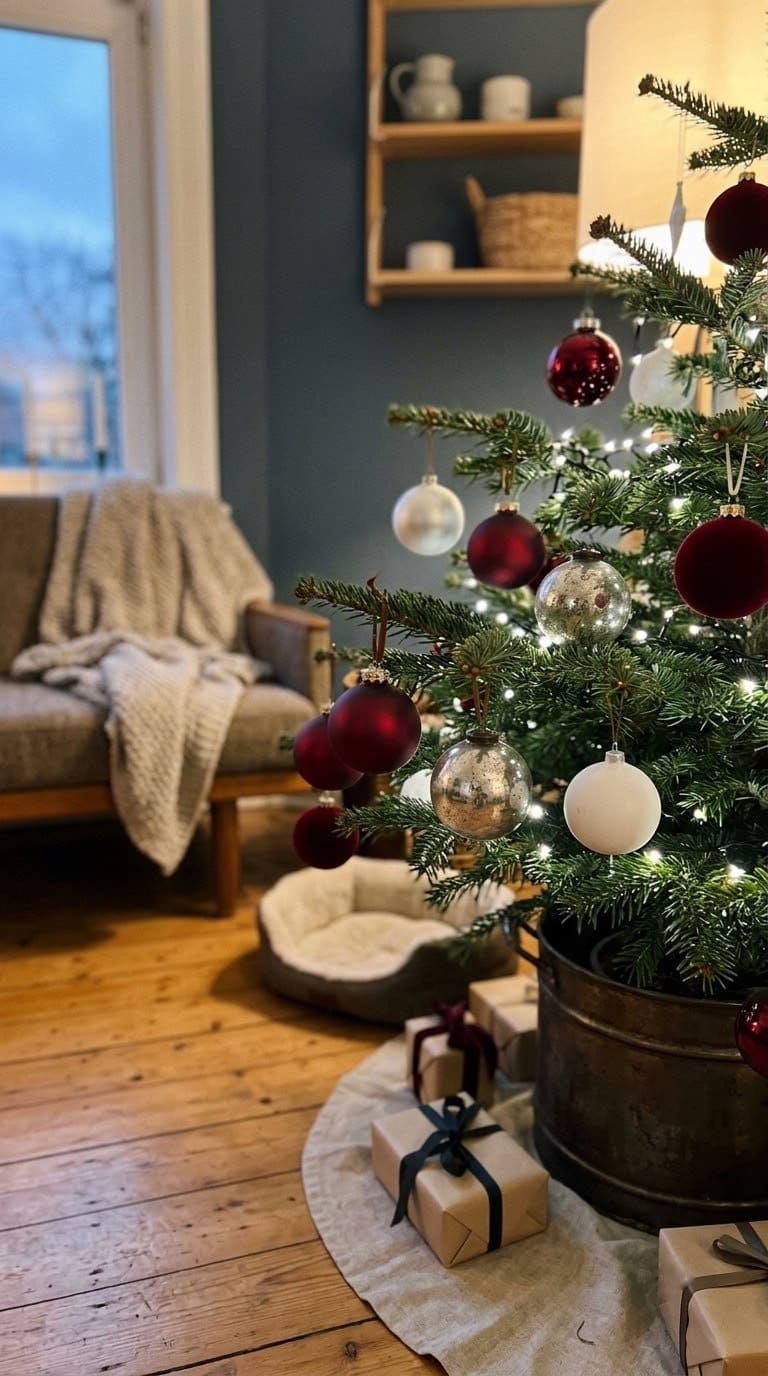
10. Cool White Lights With Cherry Red
The lighting idea. Use cool white lights on purpose, so the silver sparkles, and offset the chill with extra cherry red.
Put about 35 red pieces on a 7 foot tree instead of 30. That keeps the tree from tipping cold.
Budget: low. This is a good fit for a modern room with gray or white walls.
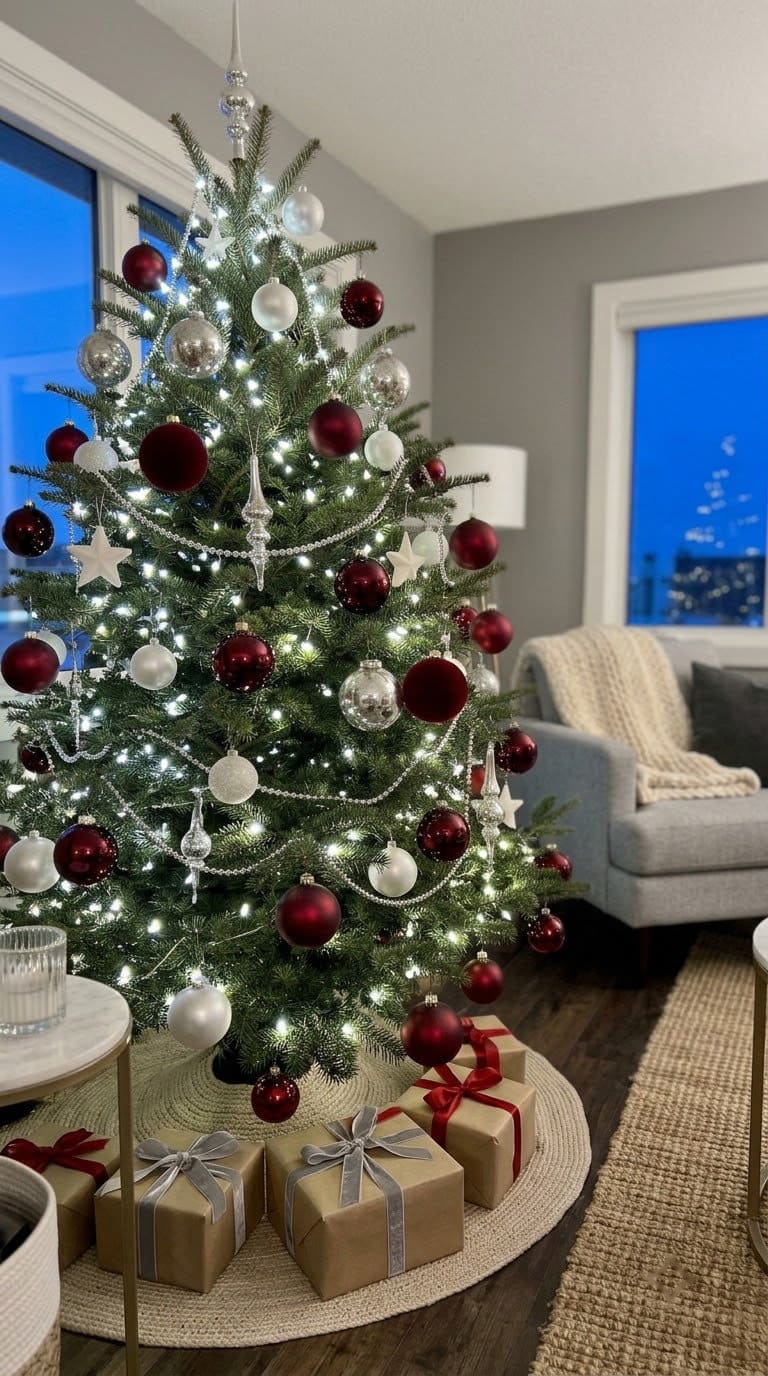
11. Slim Tree, Red and Silver
For a narrow tree, and it answers the viewer who found picks and ornaments “too bulky” for their slim tree. Use 2 to 3 inch balls only, about 30 in all, and slim stems.
Schmidt used a slim tree for the red, white, and sparkle look. Skip anything wider than 3 inches.
Budget: low. Work top down, and step back after each layer.
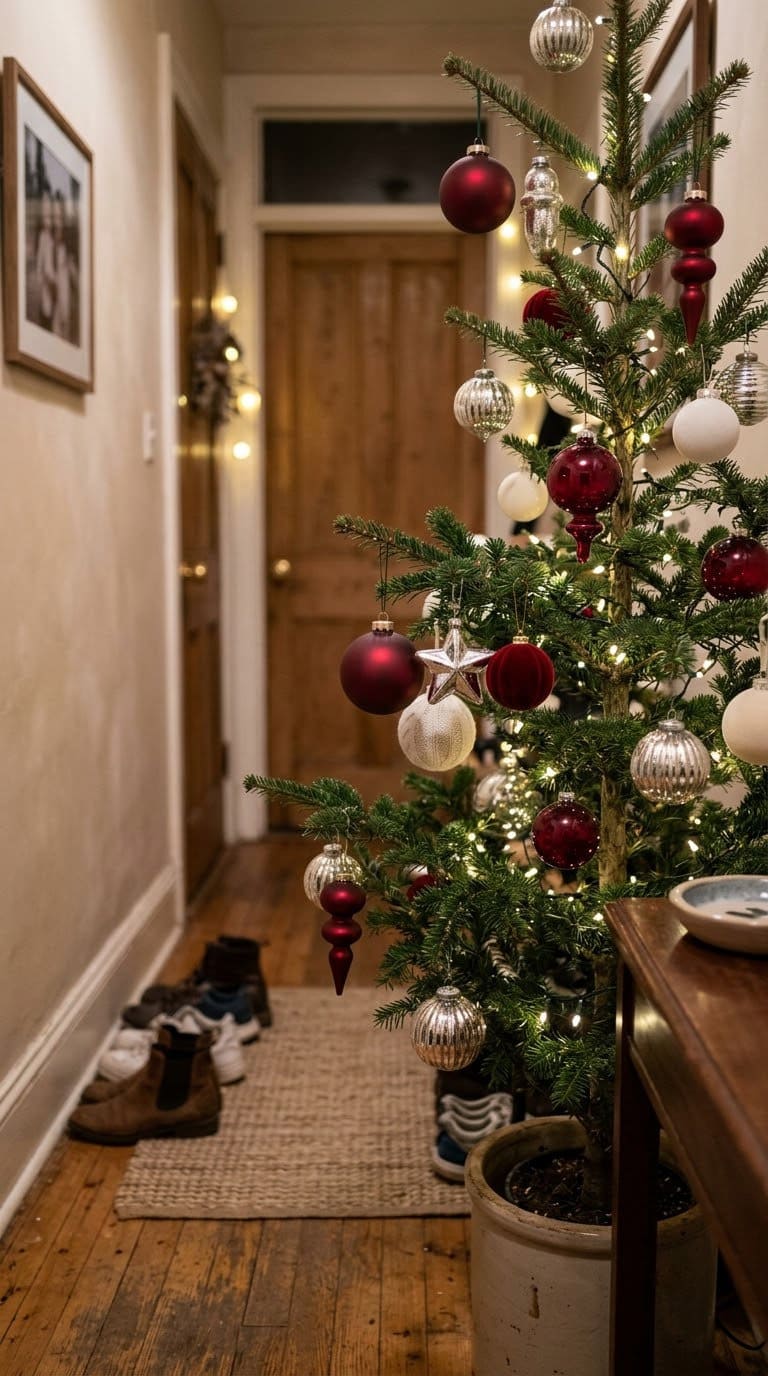
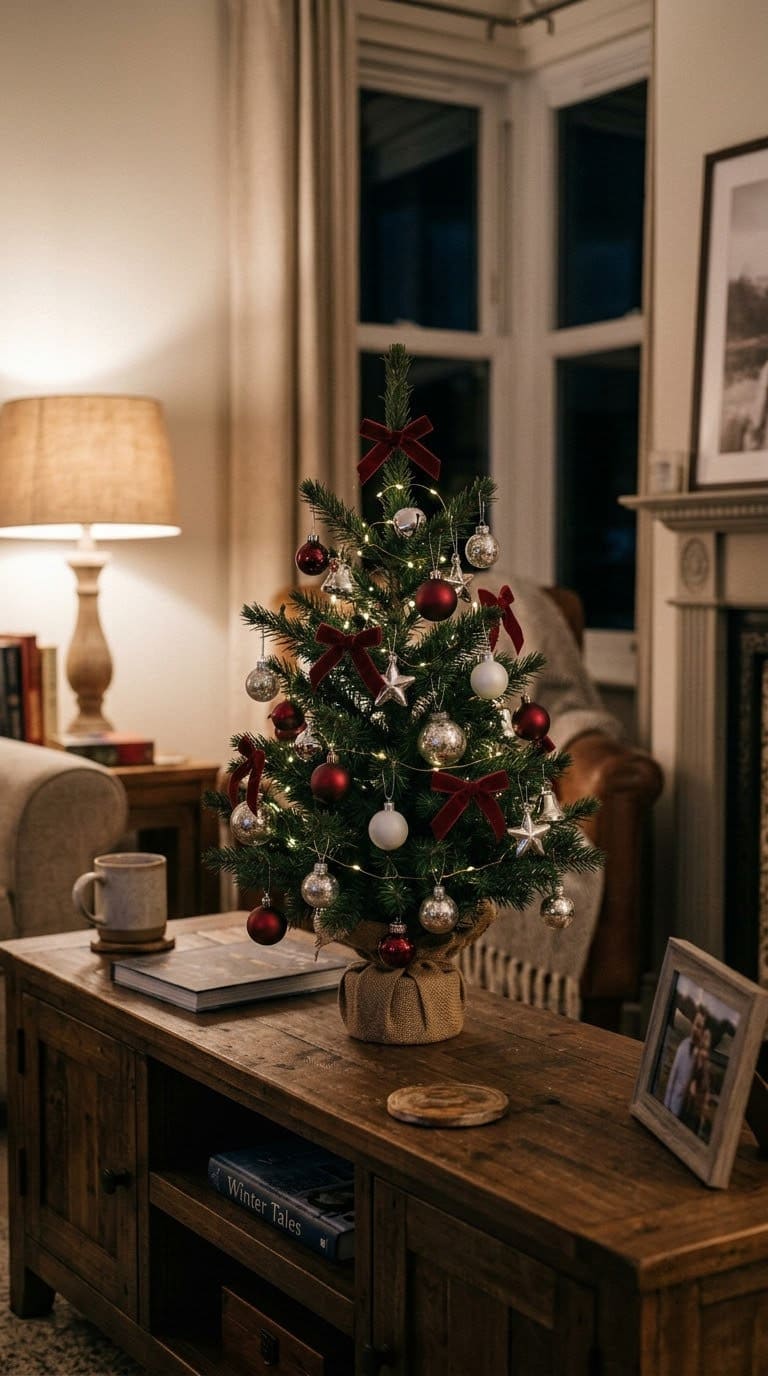
12. Tabletop Red and Silver Tree
Everything above at a quarter of the size. Use a 2 to 3 foot tree, 2 inch balls only, about 15 of them, and one narrow ribbon.
Small trees turn cold faster, so lean red. Budget: low.
Good for renters, offices, and shelves. Keep it away from windowsills, since glass balls are the very thing the fire warning covers.
How Do You Do This on a Slim or Budget Tree?
Two viewers raised this, and they are right that it gets skipped. One said the picks and ornaments in a video were “too bulky” for their slim tree.
The other said they “couldn’t afford Balsam Hill brand.” A reply set the right tone: “I am still gonna use the ideas on a less expensive tree and I know it will be just as elegant.”
Shrink everything, not just the tree. On a slim tree, keep balls to 2 or 3 inches and stems slim. On a budget tree, spend on ribbon and picks first, since they add volume for the least money.
Skip mirrored silver in bulk. Mix a few silver pieces with plenty of red and white, which stretches a small set further.
What Most People Get Wrong
The big one is treating the two colors as equals. Half red and half silver is where trees go cold.
The second is the red itself. People buy whatever red is nearest, and an orange-leaning one fights the silver every time.
The third is the lights. Most of us grab cool white because the silver looks better, then wonder why the red is flat.
And the fourth is showing off the finished tree but not how it was built. Viewers keep asking for the loops, the ribbon width, and the order. Here is the short version: ribbon first, then ornaments, then picks, working from the top down.
Your Two-Weekend Plan
Weekend one is testing. Buy two reds, hold them next to a white card, and pick the bluer one. Then test a warm and a cool light strand on a bare section for an evening.
Then decide your ratio. Write it down, because it slips in the store.
Weekend two is the build. Lights first, then ribbon, then red, then silver, then white, working from the top down.
Take a photo after each layer. If the photo looks icy, drop silver and add red.
Frequently Asked Questions
Does red go with silver on a Christmas tree?
Yes. It works best when red leads, silver supports, and a little white bridges the two.
What shade of red goes best with silver?
Cherry, cranberry, and burgundy read blue-leaning and suit silver well. Orange-leaning reds can clash, though there are no hard and fast rules.
Should I use warm or cool white lights?
Warm white flatters the red, and cool white flatters the silver. Pick based on which color leads on your tree.
How much silver should I use?
About a third of the tree is a good ceiling. More than that tends to feel icy.
Why does my red and silver tree look cold?
Usually too much silver or a red that leans orange. Let red lead, add matte white, and try warm bulbs.
Can glass ornaments start a fire?
They can. A UK fire service warns that any curved glass or mirror should not be left on a windowsill or by a window, because it can focus sunlight onto curtains or soft furnishings.
How do I decorate a slim tree in red and silver?
Use 2 to 3 inch balls and slim stems only. Bulky picks overwhelm a narrow tree.
What ribbon should I use for a red and silver tree?
A 2.5 to 4 inch wired ribbon, either striped or layered with red under silver. Tuck it in, rather than winding one long piece around.
How many ornaments do I need for a 7 foot tree?
Our own plan is about 60 in all, roughly 30 red, 18 silver, and 12 white, plus ribbon and picks.
Related Posts
Never miss an update — choose FarmFoodFamily as your preferred source on Google.
How it works: Tap the button below to open Google's settings page, then check the box next to FarmFoodFamily.
Tap the checkbox to turn it blue — that's how you know it's set.