12 Downspout Landscaping Ideas That Move Water Away and Look Good
A downspout needs a safe place to send roof water. Extensions, rain gardens and dry creek beds do that job, and each one comes with distance and digging rules.

Never miss an update — choose FarmFoodFamily as your preferred source on Google.
How it works: Tap the button below to open Google's settings page, then check the box next to FarmFoodFamily.
Tap the checkbox to turn it blue — that's how you know it's set.
A downspout needs a safe place to send roof water. Extensions, rain gardens and dry creek beds do that job, and each one comes with distance and digging rules.
Products We Recommend
This post contains affiliate links. We may earn a commission on qualifying purchases at no extra cost to you.

2 Pack Flexible Rain Gutter Downspout Extensions, Drain Downspout Extender
Flexible extensions to carry roof water away from the foundation. Set them to slope down at least 1/4 inch per foot and keep them off walkways.
Shop Now
Rain Chains for Gutters Outside Copper Rain Chain 8.5FT 12 Cups
A copper rain chain to replace a short downspout run. Set a stone basin below it and anchor the bottom so it doesn't swing.
Shop Now
RTS Home Accents Premium 55-Gallon Eco Rain Barrel with Removable Lid
A 55-gallon rain barrel. Add a fine screen and an overflow path, keep the lid closed and use the water within a week.
Shop NowThe best downspout landscaping sends water away from the house and into a place that can take it. Good ideas include extensions, dry creek beds, rain gardens and rain barrels. Pretty ones also hide or dress up the pipe.
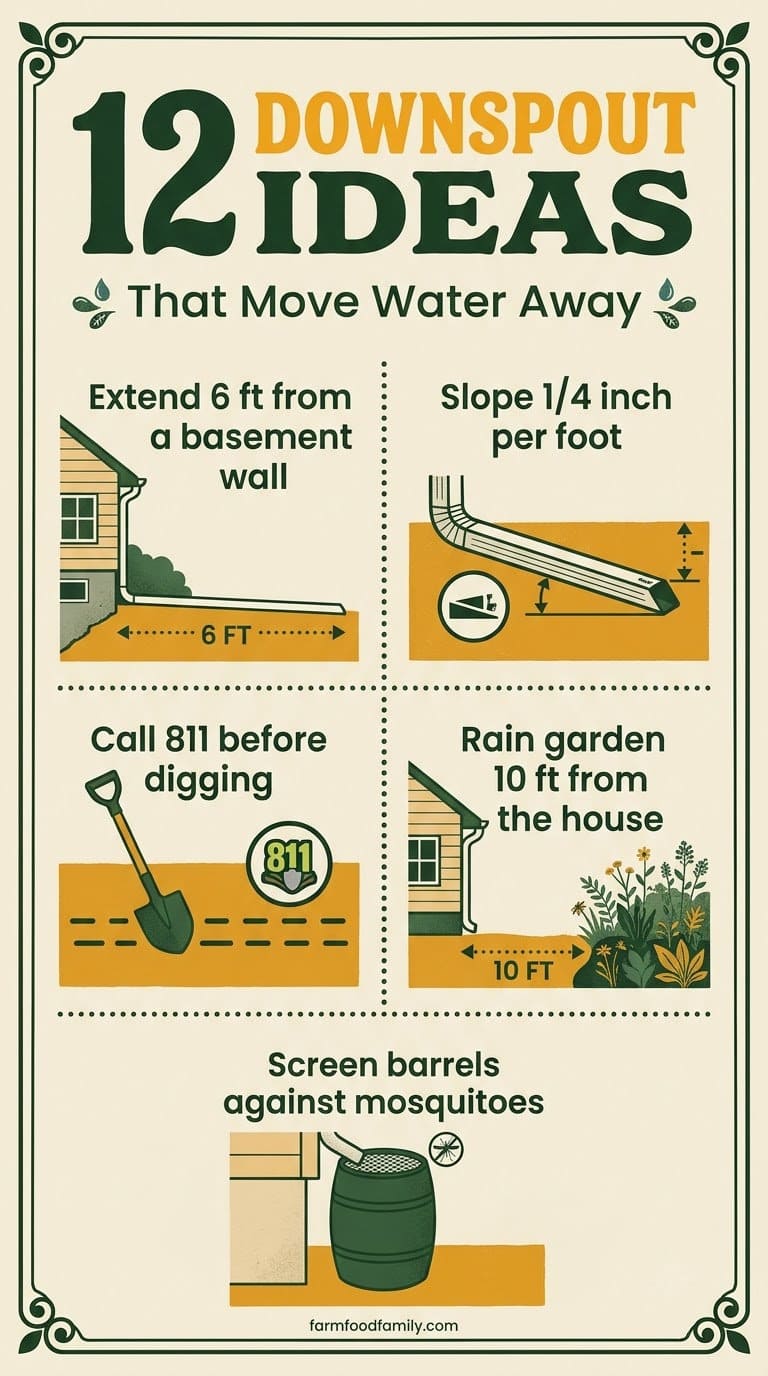
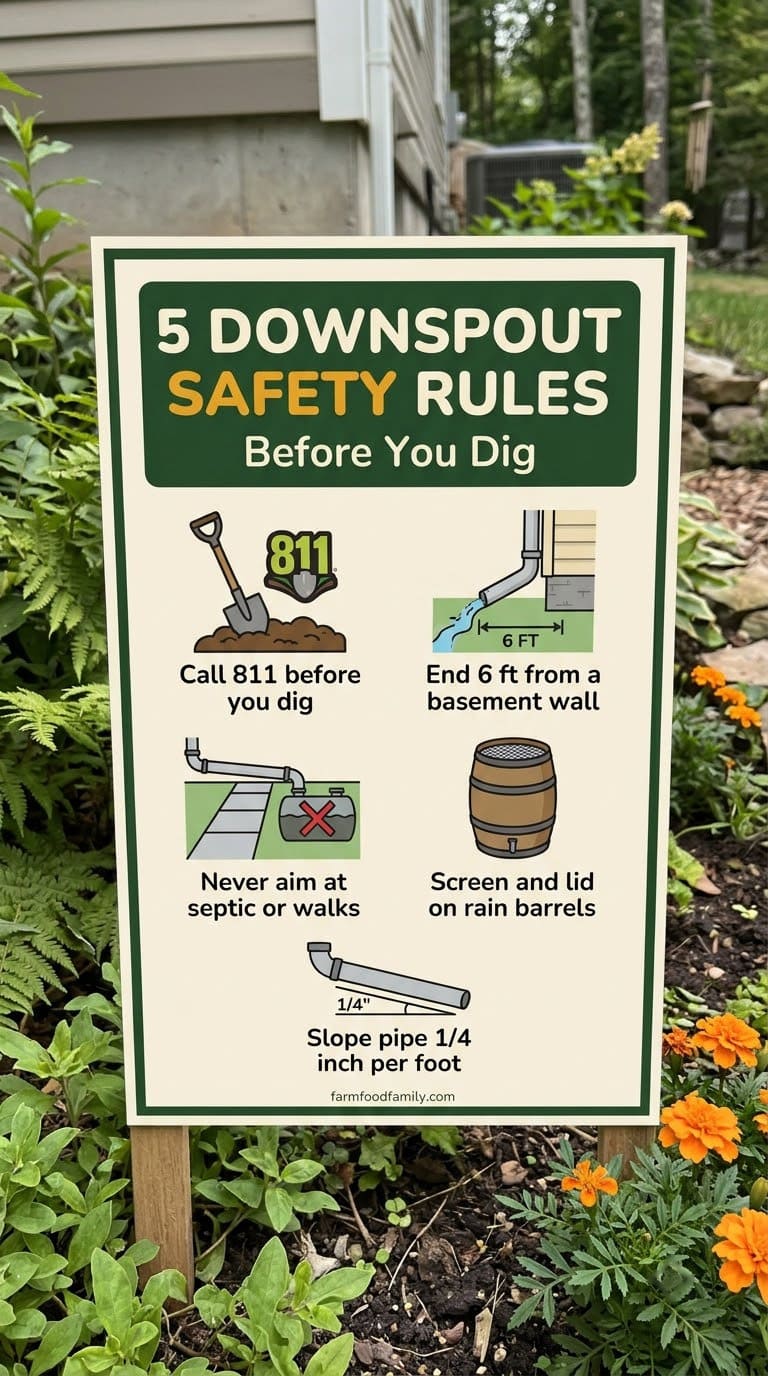
Distance matters most. The City of Portland says to end an extension at least 6 feet from a basement wall, or 2 feet from a slab or crawl space. Bob Vila’s team says extenders typically run 4 to 6 feet, and 8 to 10 feet in heavy clay.
Call before you dig. The national 811 service is free and asks for a few business days’ notice.
Answer 4 quick questions and get matched to the exact fix for your yard — drainage, budget, layout, or something else entirely.
Take the Free QuizThese 12 ideas give you materials, steps, a style tip and a watch-out each. Pick one downspout, and start with where the water should go. But don’t skip the call to 811, because pipes and wires sit close to the surface.
How Do You Choose a Downspout Idea?
Pick by where the water can go. Then pick by your budget and your skill.
A splash block is cheap and simple. A rain garden takes more work and pays back more.
Use this table. The skill levels and times are our own guide, except where a source gave a number.



| Idea | Skill | Time | Best when |
|---|---|---|---|
| Splash block and pebbles | Easy | 1 hour | You have a gentle slope away from the house |
| Downspout extension | Easy | 1 hour | You need quick distance |
| Rain chain and basin | Easy | 2 hours | You want a pretty, short run |
| Rain barrel | Easy | 2 hours | You want to save water |
| Planting bed | Medium | One weekend | The spot drains well |
| Dry creek bed | Medium | One weekend | You have a slope or a low spot |
| Buried drain pipe | Hard | Two weekends | You need to move water far |
| Rain garden | Hard | Two or three weekends | You have a sunny spot with good soil |
If you aren’t sure, start with an extension. It costs little and protects the foundation right away.
Most yard problems trace back to one specific, fixable cause. Find yours in 4 quick questions.
Take the Free QuizWhere Should Downspout Water Go?
Water should end up away from the house, away from walkways and away from neighbors. Portland’s rules are a good checklist.
The city says an extension should end at least 6 feet from a basement structure, or 2 feet from a crawl space or slab. It also says to keep the end at least 3 feet from a public sidewalk and 5 feet from a neighbor’s property line.
Don’t aim water at a septic system or drain field. Don’t run an extension across a walkway, patio or driveway. This is the city’s guidance, so check your local rules.
| Where the water ends | Rule |
|---|---|
| From a basement wall | At least 6 ft |
| From a slab or crawl space | At least 2 ft |
| From the property line | At least 5 ft |
| From a public sidewalk | At least 3 ft |
| Near a septic system | Never |
What Safety Rules Apply to Downspout Projects?
These projects involve digging, water and ladders. Read this before you start.
Call 811 first. The 811 service is free. It asks you to call a few business days before you dig. Shovels are the second most common tool in utility damage, and some lines sit just inches down.
Winter ice. Water that drains onto a walk or a drive can freeze. Aim it at the lawn or a bed. This is our advice.
Open water. Open barrels and buckets are a drowning risk for small children, since drowning happens in seconds. Keep barrel lids on. This is our advice.
Flexible extensions to carry roof water away from the foundation. Set them to slope down at least 1/4 inch per foot and keep them off walkways.
Shop NowThis post contains affiliate links. We may earn a commission on qualifying purchases at no extra cost to you.
Mosquitoes. Standing water breeds mosquitoes. Cover barrel openings with fine screen.
Ladders. Set the ladder on level ground, and keep your belt buckle between the rails. This is our advice.
The average homeowner spends $616/year on yard fixes that don't address the real problem. Find out what yours actually is — before you spend another dollar.
Take the Free QuizSeptic and wells. Keep discharge away from septic fields and wells.
What Tools and Materials Do You Need?
Gather what you need before you start. It saves trips.
Tools: shovel, tape measure, level, string, utility knife or hacksaw, work gloves and eye protection.
Materials: downspout extension or flexible pipe, splash blocks, gravel, river rock, landscape fabric, 4 inch pipe, a screen and plants.
1. Splash Block With a Pebble Bed
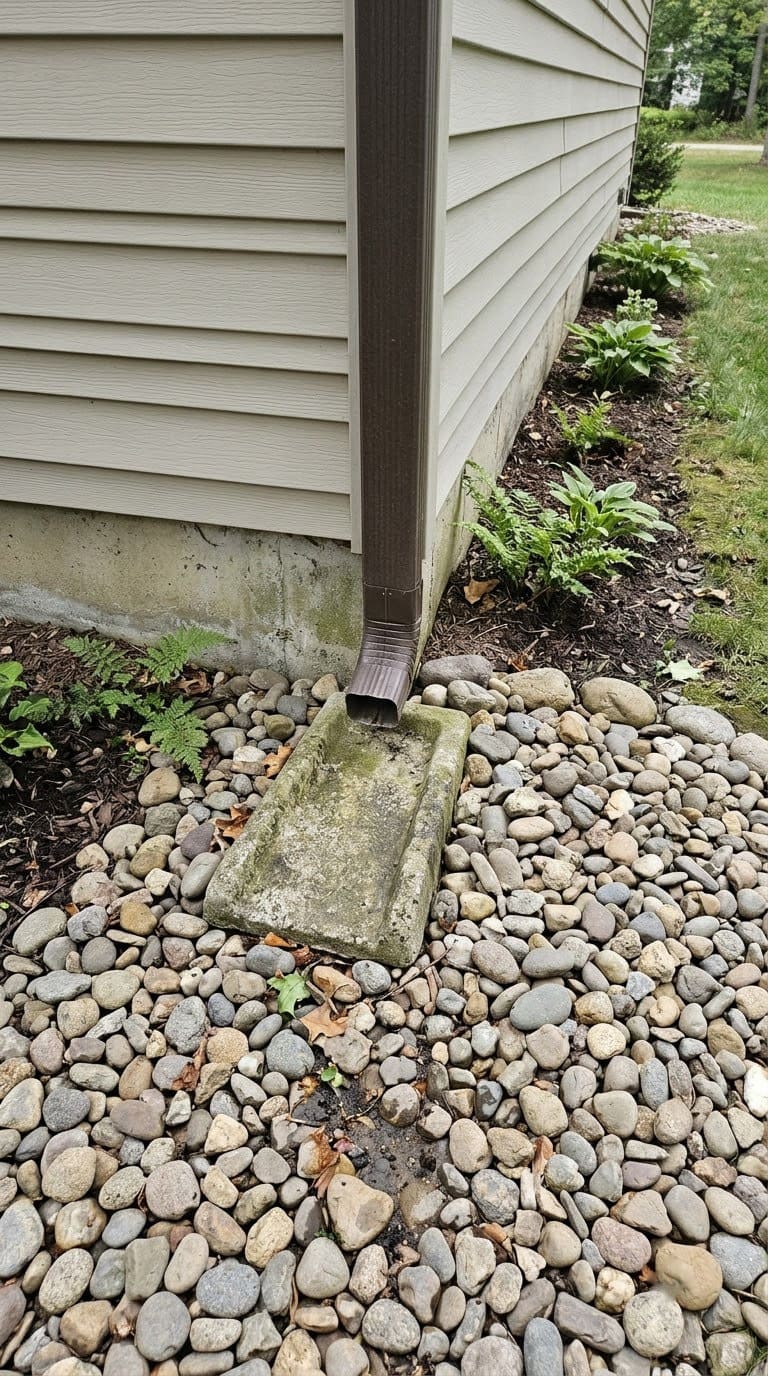
A splash block catches the first rush of water. Pebbles around it make it look finished.
Bob Vila’s team says a splash block runs 2 to 3 feet long and sends water about 2 feet out. It says that’s only enough if the ground slopes about 6 inches over the first 6 feet. A roofing expert in the article adds that a splash block alone probably won’t be enough.


Best for: a gentle slope and small roofs.
You need: a splash block, river rock and landscape fabric.
Steps:
- Check the slope. The ground should fall away from the house.
- Set the splash block under the downspout elbow.
- Dig a shallow bed around it. Line it with landscape fabric.
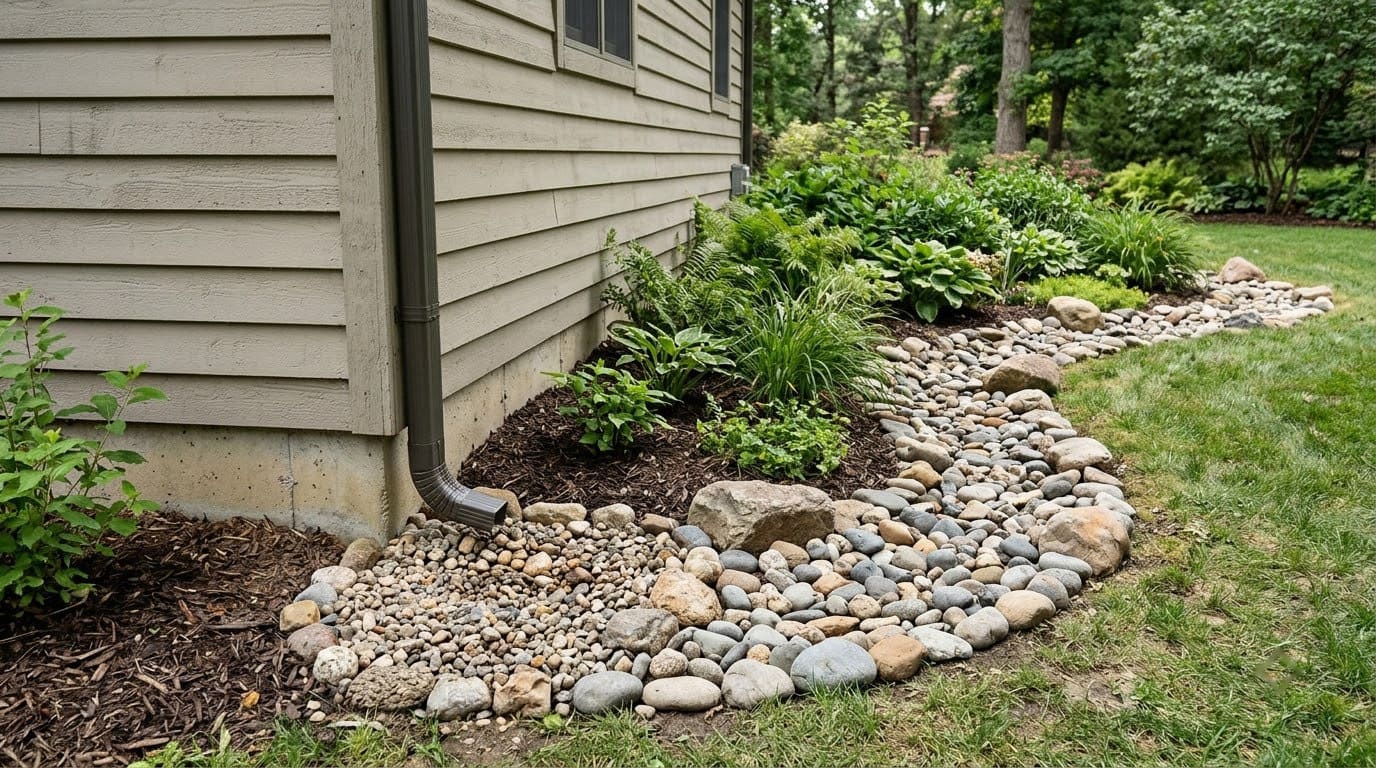
- Fill the bed with river rock.
- Test with a hose and watch where the water goes.
Style tip: Use rounded stones in two colors. A neat border looks planned.
Watch out: If water pools near the wall, add an extension.
2. Downspout Extension
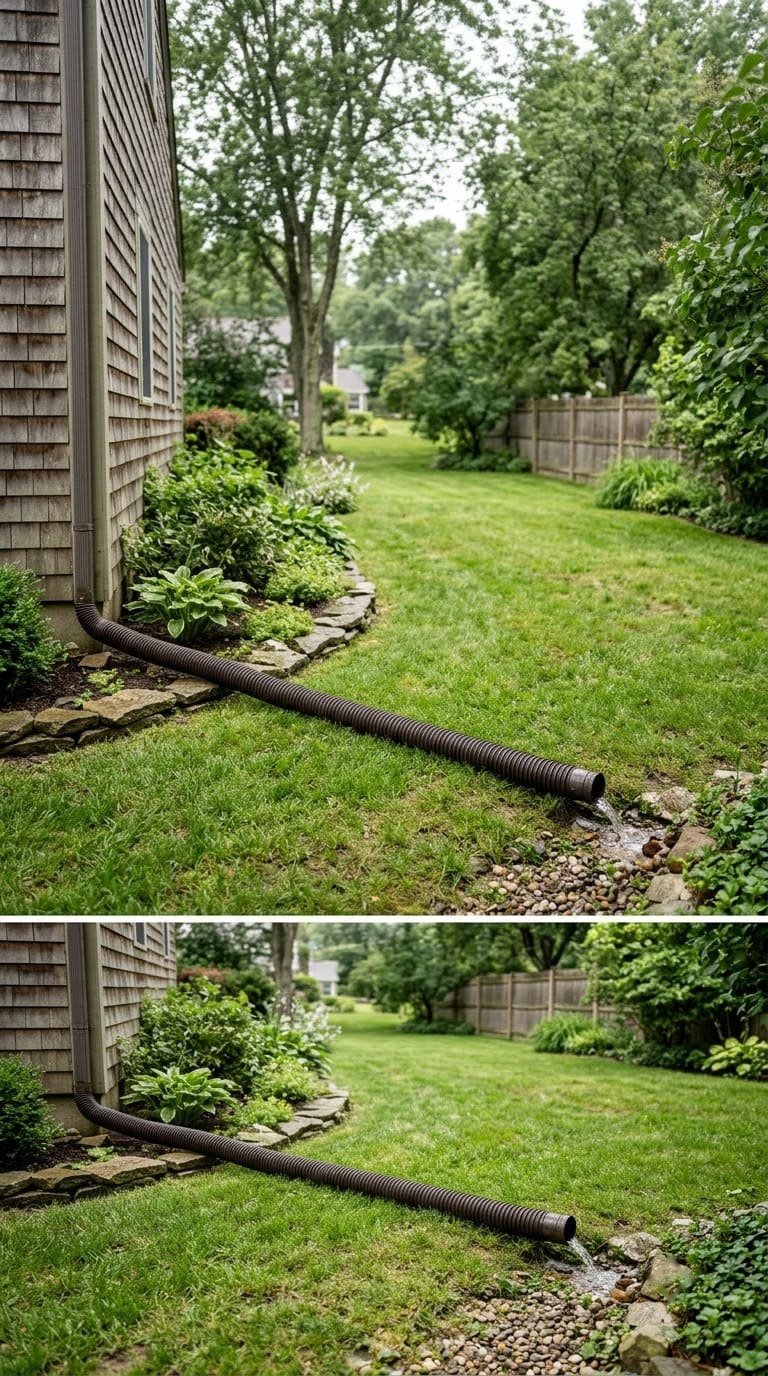
An extension is the simplest fix. It carries water to a safer spot.
Not sure you need gutters at all? See are gutters necessary.
Bob Vila’s team says an extender should drop at least 1/4 inch per foot, with the elbow 6 to 12 inches above the ground. It also says one downspout per about 30 feet of gutter is typical.
Best for: any house with water near the foundation.
You need: a flexible or rigid extension, a screwdriver and a measuring tape.
Steps:
- Measure the distance you need, based on your soil and basement.
- Attach the extension to the elbow.
- Slope it down at least 1/4 inch per foot.
- Secure it with a stake or clip.
- Check that it doesn’t cross a walk or a driveway.
Style tip: Use a color that matches your siding.
Watch out: A tripping hazard on a path is a problem. Use a hinged flip-up style near walkways.
3. Rain Barrel
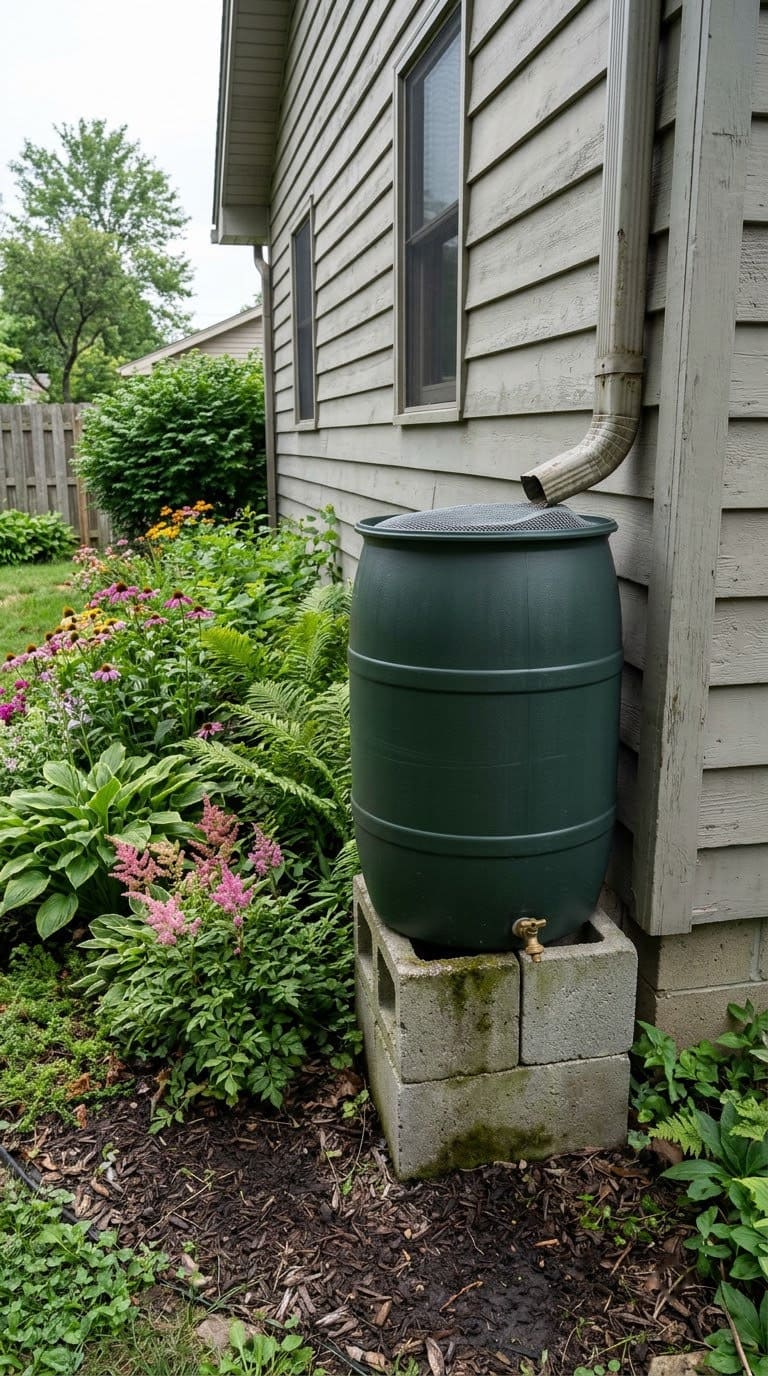
A rain barrel saves water for your garden. It also slows the rush from the roof.
Extension guides say about 600 gallons run off 1,000 square feet of roof for each inch of rain. Barrels usually hold about 55 to 60 gallons. A fine screen keeps mosquitoes out.
Best for: gardens that need watering.
You need: a food-grade barrel, a fine screen, an overflow hose and cinder blocks.
Steps:
- Set the barrel on level blocks near the downspout.
- Cut the downspout to fit.
- Add a fine screen on the lid.
- Run an overflow hose away from the foundation.
- Use the water within a week.
Style tip: Paint the barrel a soft color. Plant a small bed around it.
Watch out: Roof runoff can carry bacteria. Don’t use it on edible plants without thinking it through. Keep the lid closed and out of reach of children.
4. Planting Bed Under the Downspout
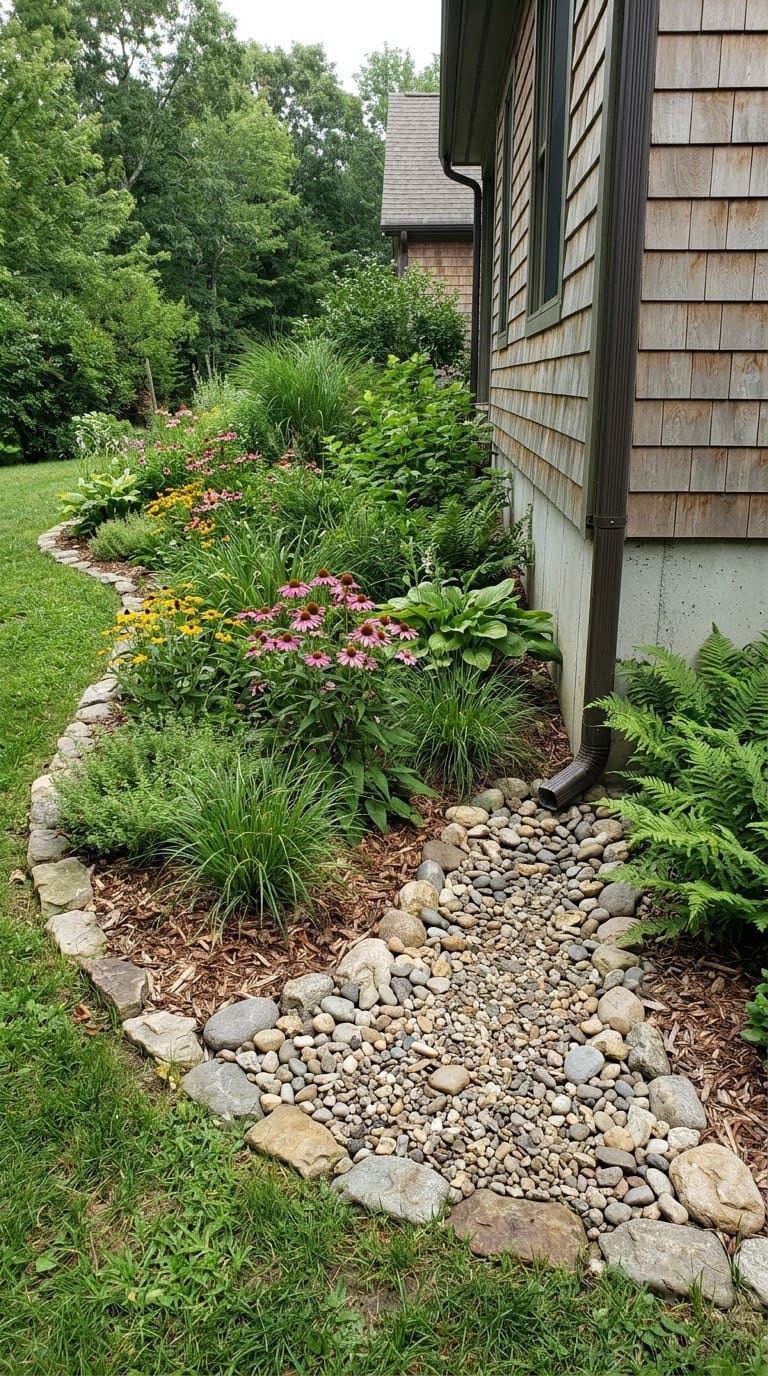
A bed under the spout turns runoff into a garden. It works when the soil drains.
Best for: sunny spots with good soil.
You need: a splash block, gravel, compost and plants that like wet feet.
Steps:
- Make sure the bed is well away from the foundation.
- Dig a shallow dish.
- Add gravel at the downspout end.
- Plant moisture-lovers at the low end.
- Mulch lightly.
Style tip: Use native plants. They handle both wet and dry spells.
Watch out: A bed that stays soggy for days is too wet. Move it or add drainage.
5. Dry Creek Bed
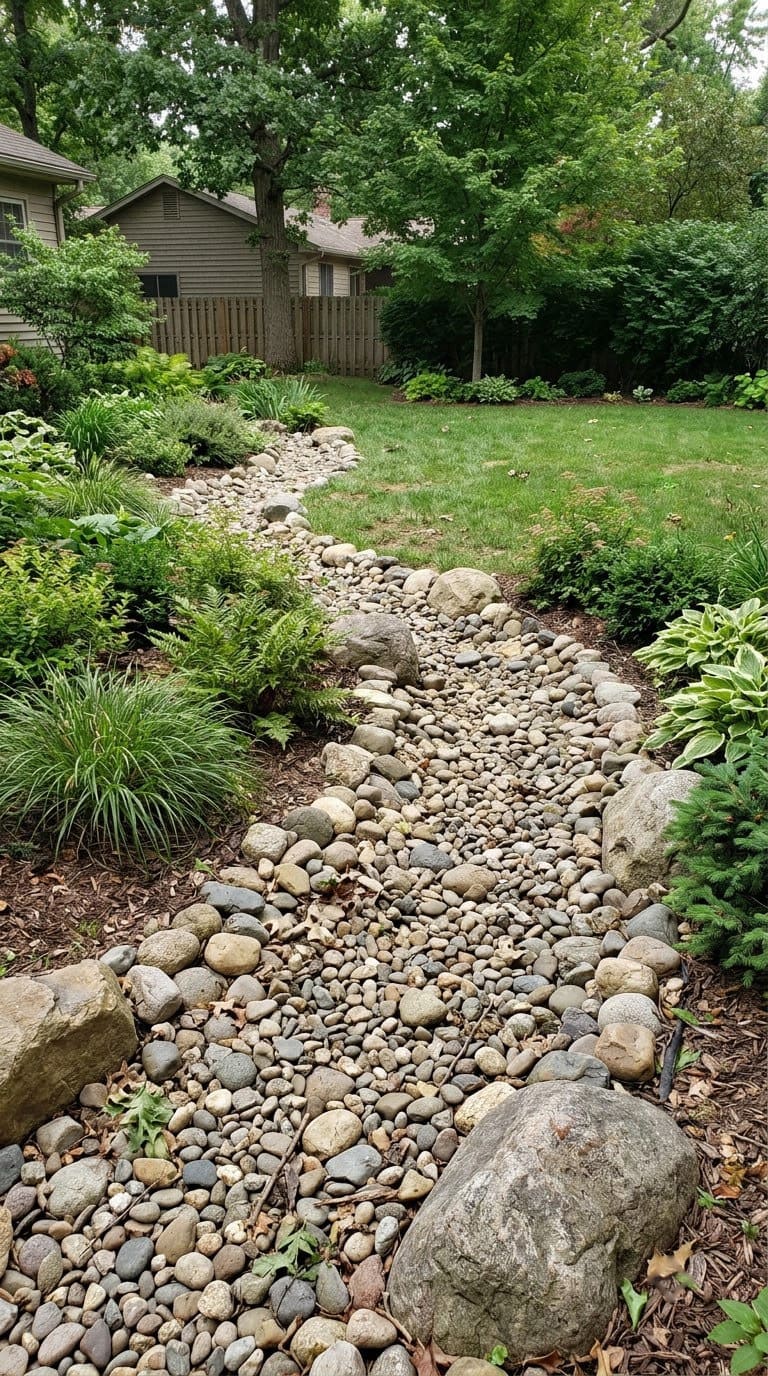
A dry creek bed looks like a stream. It carries water away across the yard. For sloped yards, see our drainage ideas for sloped yards.
One guide describes a bed about 3 feet wide, lined with landscape fabric. It suggests river rock in several sizes and boulders 1 to 3 feet across. That guide is old and doesn’t give a slope, so treat these as a starting point.
Best for: slopes and low spots.
You need: landscape fabric, river rock, boulders and a shovel.
Steps:
- Call 811, then mark a path with a hose.
- Dig the path with a gentle, curving slope.
- Line it with landscape fabric.
- Add larger rock first, then smaller stones on top.
- Set a few boulders along the edges.
- Test with a hose.
Style tip: Curve the bed. A straight line looks like a ditch.
Watch out: Don’t aim it at a neighbor or a septic area.
6. Rain Garden
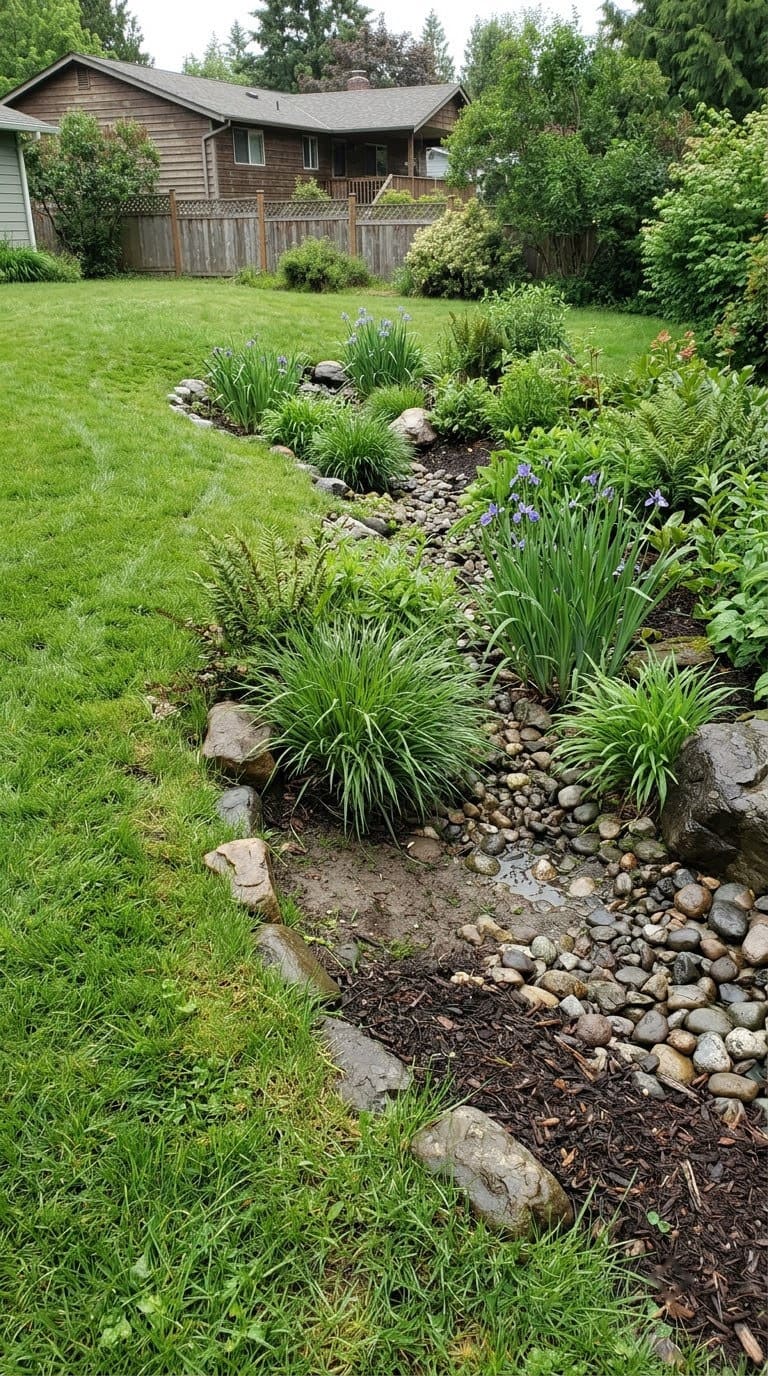
A rain garden is a shallow, planted basin. It soaks up roof water over a day or two. Learn how a rain garden works or size yours with our rain garden calculator.
The University of Nebraska says to build it at least 10 feet from the house. It says depth is usually 4 to 8 inches and never over 8.
Size is typically 100 to 300 square feet, with the length at least twice the width. An Alabama guide says to keep it 15 feet from a basement foundation. We picked 10 feet as a minimum and 15 feet with a basement.
Best for: sunny spots with soil that drains.
You need: a shovel, a level, compost, plants and mulch.
Steps:
- Call 811.
- Pick a spot at least 10 feet from the house, and 15 feet if you have a basement.
- Dig a 6 inch test hole and fill it with water.
- If it drains within 24 hours, the soil is suitable.
- Dig the basin 4 to 8 inches deep.
- Plant and mulch.
Style tip: Use native sedges, iris and ferns.
Watch out: Water that sits more than 48 hours is a problem. It can breed mosquitoes.
7. Rain Chain and Basin
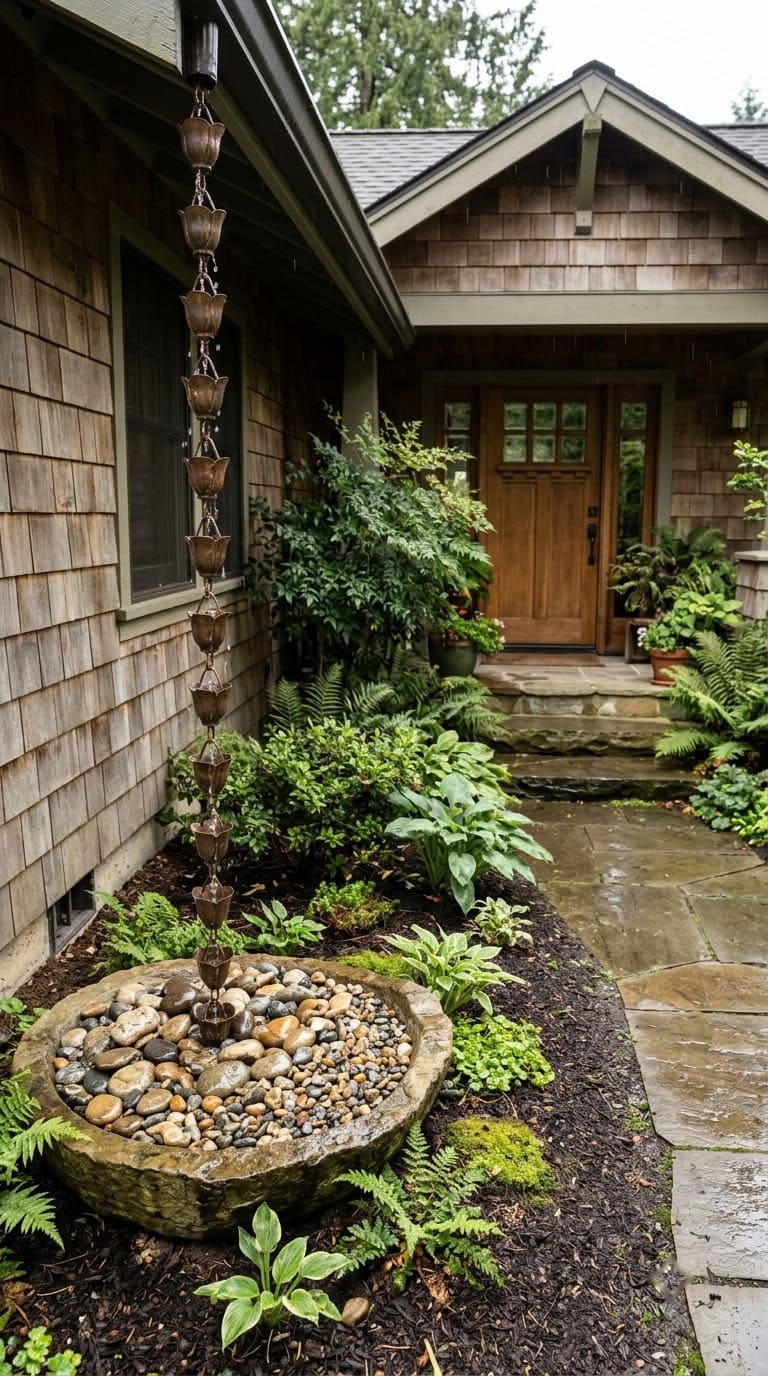
A rain chain replaces a downspout. Water follows the chain into a basin below.
Best for: short roof runs and entries.
You need: a rain chain, a basin or a bed of 3/4 inch stone, and a gutter hanger.
Steps:
- Remove the downspout section.
- Hang the rain chain from the gutter outlet.
- Dig a bed about 6 inches deep below it.
- Fill it with 3/4 inch stone.
- Anchor the chain’s bottom so it doesn’t swing.
Style tip: Copper chains develop a soft green patina.
Watch out: Chains splash. Keep the basin wide and away from the wall.
8. Buried Drain Pipe
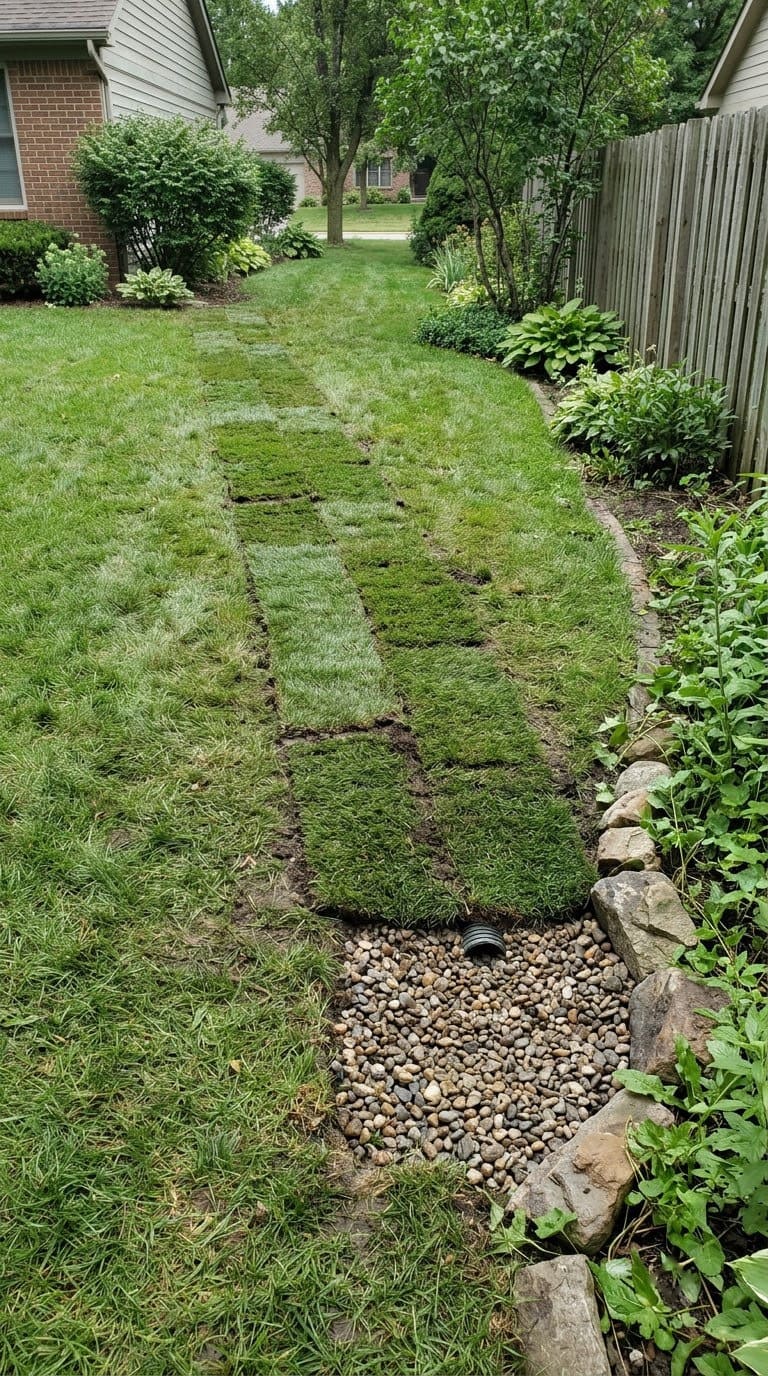
Buried pipe hides the water path. It carries water to a distant outlet. A ditch can also work, as in our drainage ditch landscaping ideas.
This Old House describes a trench at least 6 inches wide and 10 inches deep. It uses 4 inch solid Schedule 40 PVC.
In cold climates the frost line is often 32 to 48 inches. We used 1/4 inch of drop per foot, which is a safe value.
Best for: moving water far from the house.
You need: a trench shovel, 4 inch solid pipe, fittings and gravel.
Steps:
- Call 811.
- Dig a trench that slopes down about 1/4 inch per foot.
- Lay solid pipe from the downspout to a daylight outlet.
- Add gravel at the outlet.
- Backfill and test with a hose.
Style tip: Cover the trench with sod. The path vanishes.
Watch out: Check how deep your frost line is. Shallow pipe can freeze and crack.
9. Pebble Mosaic Splash Zone
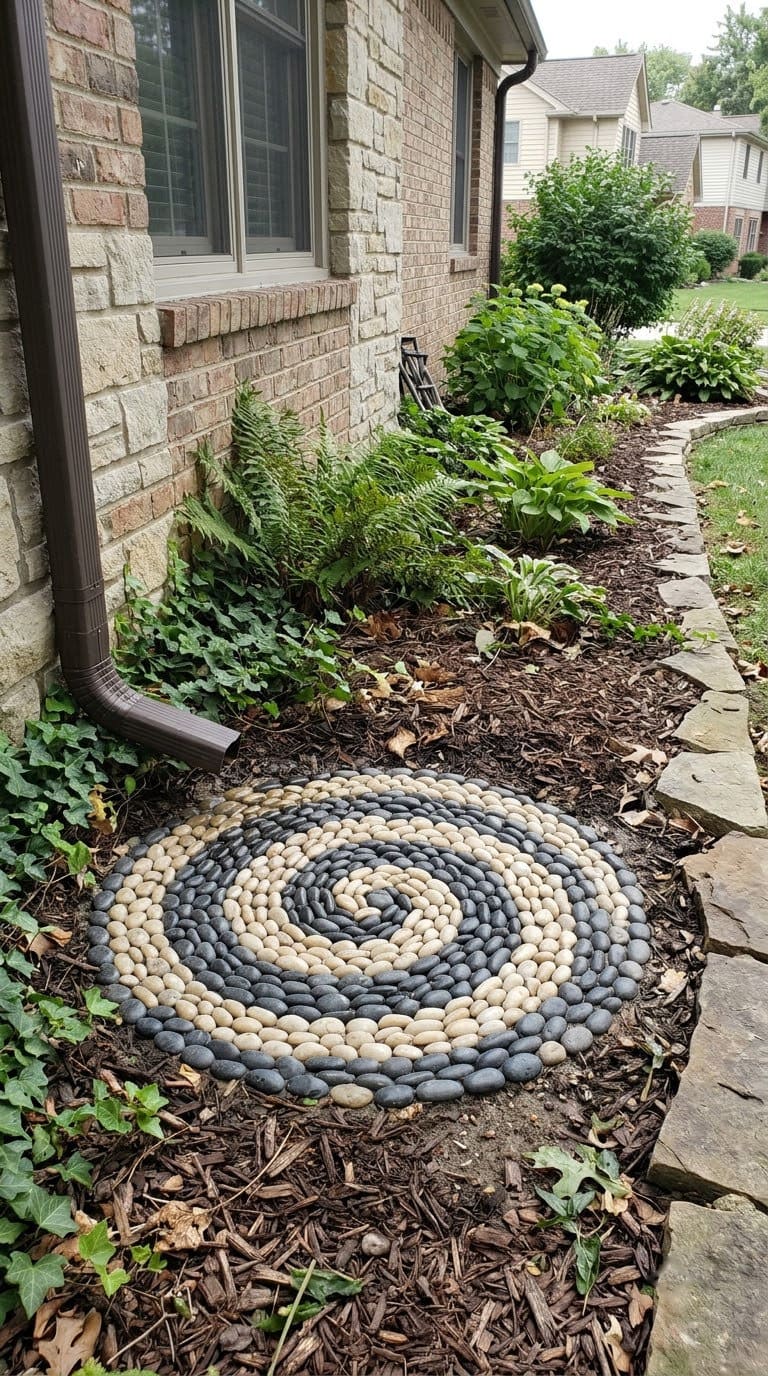
A mosaic of stones turns a wet patch into art. It also protects the soil from splash.
Best for: small entry corners.
You need: flat stones, pebbles, landscape fabric and sand.
Steps:
- Dig a shallow bed.
- Add fabric and a thin layer of sand.
- Lay flat stones in a pattern.
- Fill the gaps with pebbles.
- Tilt the bed slightly away from the house.
Style tip: Use two or three stone colors in a repeating pattern.
Watch out: Smooth stones get slippery when wet. Keep them off walking paths.
10. Blend or Paint the Downspout
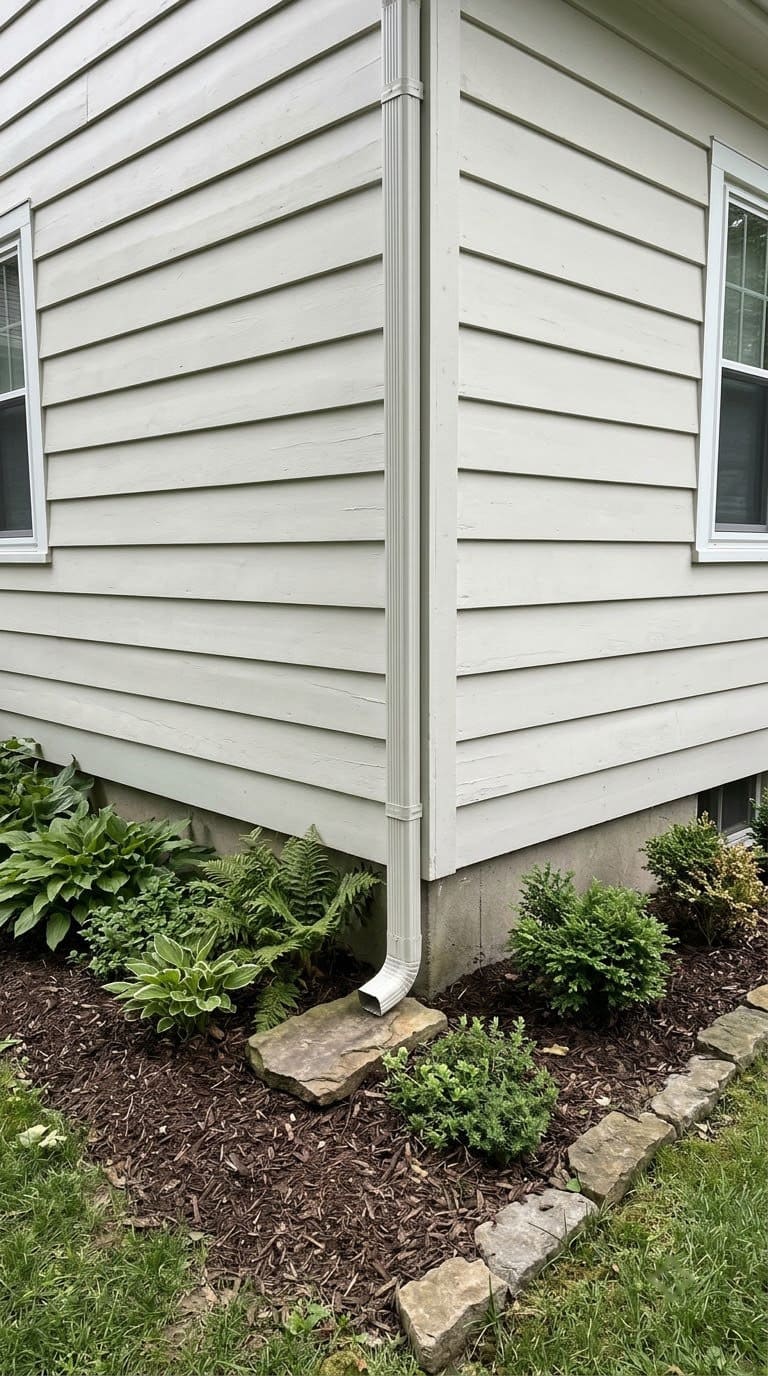
A downspout that matches your siding almost disappears. It’s the cheapest way to hide it.
A home blog says gutters have the best chance of going unnoticed when they match the siding. It says gutters can be painted when it’s done properly.
Best for: any house.
You need: metal primer, exterior paint and a brush.
Steps:
- Clean the downspout with soap and water.
- Sand lightly.
- Prime with a metal primer.
- Paint two thin coats.
Style tip: Match the downspout to the wall, and match the gutter to the trim.
Watch out: Old paint may contain lead if your house is old. Test before you sand.
11. Pop-Up Emitter
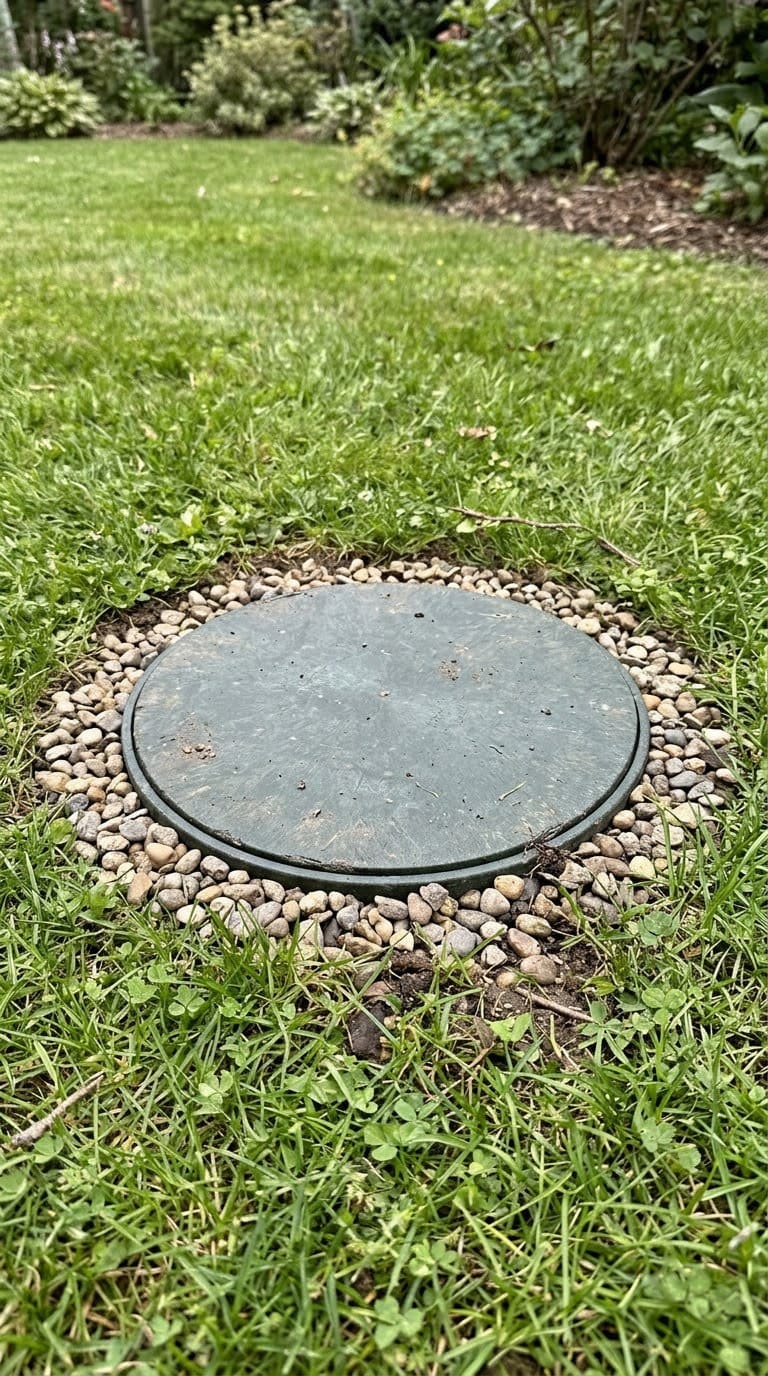
A pop-up emitter sits flat in the lawn. It opens when water pushes it, and it closes when the rain stops.
Best for: lawns with a buried drain pipe.
You need: a pop-up emitter, gravel and a buried pipe.
Steps:
- Run buried pipe to a spot in the lawn.
- Dig a hole below the outlet.
- Fill the hole with gravel.
- Fit the emitter on the pipe.
- Test with a hose.
Style tip: Set it in the lawn, not a bed. It hides in the grass.
Watch out: Keep it away from walks and neighbors. Water will shoot out in a big storm.
12. Downspout Planter Box
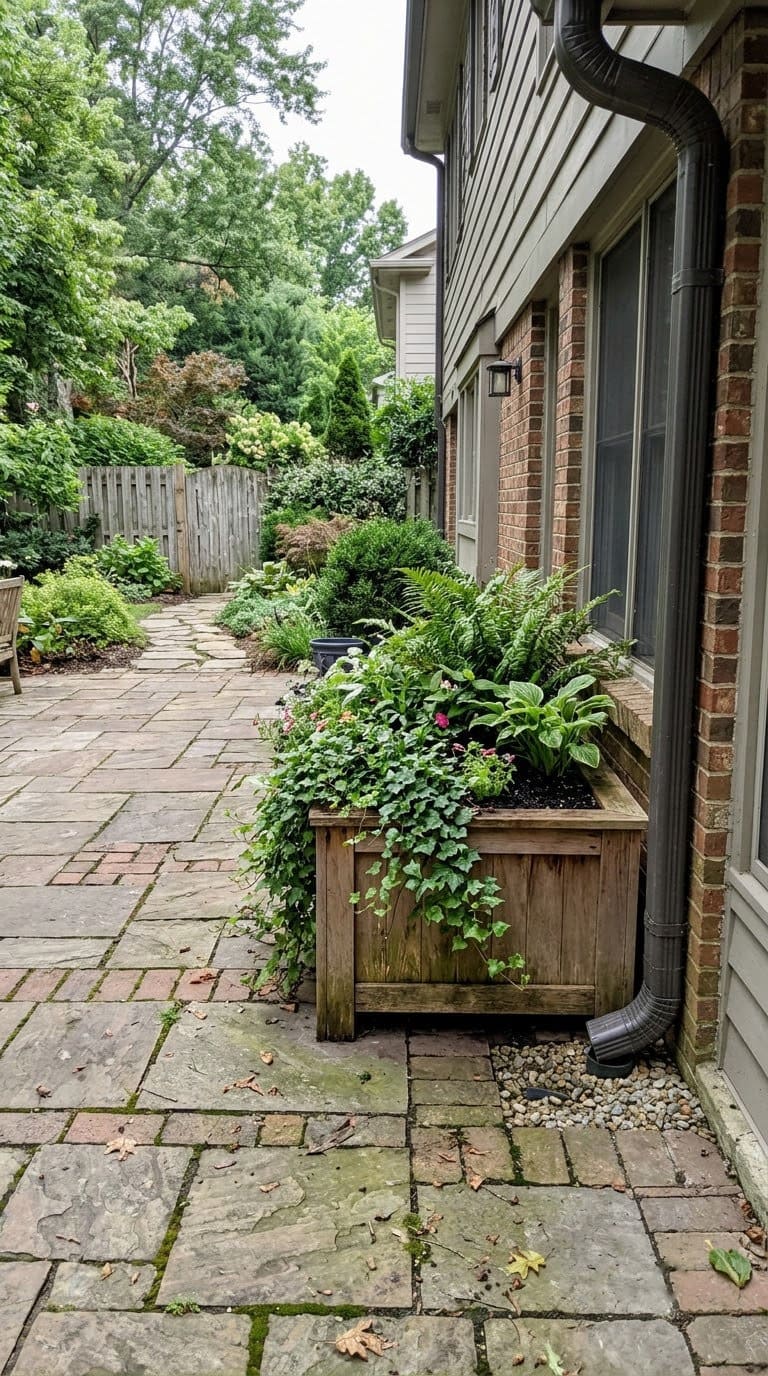
A planter box turns a downspout into a feature. It holds plants and catches drips.
Best for: entries and patios with space.
You need: a planter box, gravel, liner, soil and plants.
Steps:
- Place the box next to the downspout outlet.
- Add drainage holes in the bottom.
- Line the bottom with gravel.
- Fill with soil and plants.
- Check the box after each big storm.
Style tip: Use plants that like both wet and dry soil.
Watch out: A full box can get heavy. Make sure the base is solid.
How Much Water Does Your Roof Make?
It’s more than most people think. About 600 gallons run off 1,000 square feet of roof for each inch of rain, according to extension guides.
Example: A 1,500 square foot roof makes about 900 gallons in a one inch rain. That math is ours.
Four 55-gallon barrels would hold 220 gallons, so plan an overflow path.
How Much Do These Ideas Cost?
Costs swing by region and materials. One rain garden guide lists $4 to $30 per square foot. We did not price the other ideas, so check local stores.
Cheapest to priciest, in our view: splash block, extension, rain chain, planting bed, barrel, dry creek, buried pipe, rain garden.
Where Do Sources Disagree?
Sources don’t always agree. We picked one choice for each step above and list the others here.
| Topic | One source says | Another says | What we used |
|---|---|---|---|
| Rain garden distance | 10 feet from the house | 15 feet if you have a basement | 10 feet, or 15 with a basement |
| Rain garden depth | 4 to 8 inches | 18 to 30 inches for a deeper basin | 4 to 8 inches |
| Pipe slope | 1/8 to 1/4 inch per foot | 1/4 inch per foot | 1/4 inch per foot |
| Roof runoff | About 600 gallons per inch per 1,000 sq ft | Over 500 gallons | About 600 gallons |
Common Mistakes to Avoid
Ending the pipe too close to the house. Check the distances above.
Aiming water at a walk. It will freeze in winter.
Skipping 811. Call before every dig.
Using corrugated pipe that sags. Pick solid, smooth pipe.
Leaving barrels open. Screen the top and keep it closed.
Your Weekend Plan
Friday: walk the yard in a rain and note where water goes. Saturday: call 811, then dig and set the pipe or bed. Sunday: test with a hose, fix low spots and plant.
FAQ
How far should a downspout drain from the house?
At least 6 feet from a basement wall and 2 feet from a slab, according to Portland. Many guides say 4 to 6 feet, and 8 to 10 feet in heavy clay.
What can I do with a downspout in the yard?
Add an extension, a dry creek bed, a rain garden, a rain barrel or a rain chain. Each needs a safe place for the water.
Do I need to call 811 for a downspout project?
Yes, if you dig. It’s free, and it asks for a few business days’ notice.
How big should a rain garden be?
Typically 100 to 300 square feet, with the length at least twice the width. Keep it 4 to 8 inches deep and at least 10 feet from the house.
Are rain barrels safe?
Use a fine screen and a lid. Don’t let water sit more than a week. Keep barrels out of reach of small children.
Related Posts
Never miss an update — choose FarmFoodFamily as your preferred source on Google.
How it works: Tap the button below to open Google's settings page, then check the box next to FarmFoodFamily.
Tap the checkbox to turn it blue — that's how you know it's set.