9 Clever Companion Plants That Repel Tomato Pests (Backed by Real Research)
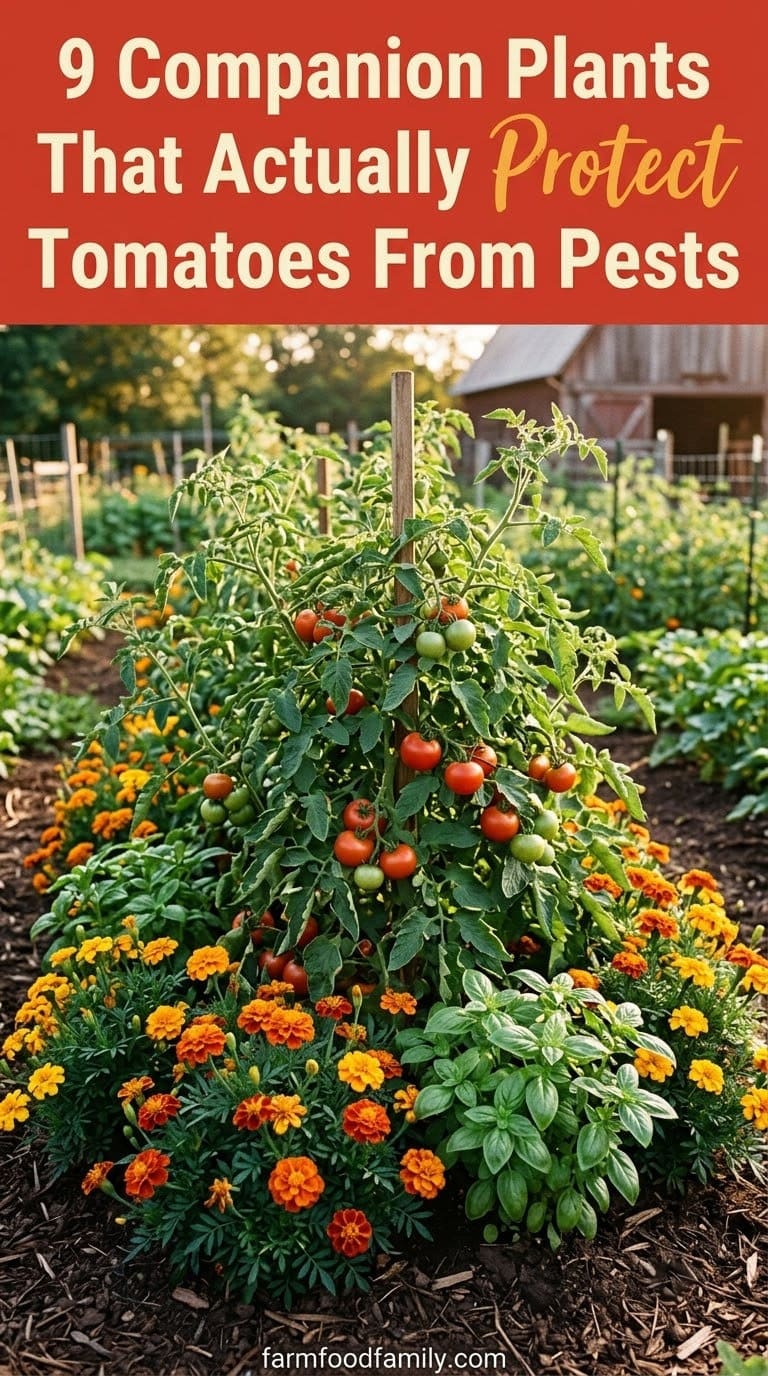
Only two of these plants actually repel a tomato pest with an airborne compound. The other seven work by pulling in predators or acting as a decoy, and knowing the difference is what makes a plan work.

Never miss an update — choose FarmFoodFamily as your preferred source on Google.
How it works: Tap the button below to open Google’s settings page, then check the box next to FarmFoodFamily.
Tap the checkbox to turn it blue — that’s how you know it’s set.
Type “companion plants for tomatoes” into any search bar and you get the same list every time, with the same one-word promise attached to each plant: repels aphids, repels hornworms, repels whiteflies. Most of that is wrong, or at least badly worded.
A couple of these plants genuinely repel a specific tomato pest, and there’s a real study behind it. The rest earn their spot a different way.
Some pull in the wasps and hoverflies that hunt tomato pests. Others act as a decoy, soaking up the aphids so your tomatoes don’t.
Here are nine that actually do something, sorted by the pest each one targets, with the mechanism and the evidence behind it.
Quick Answer
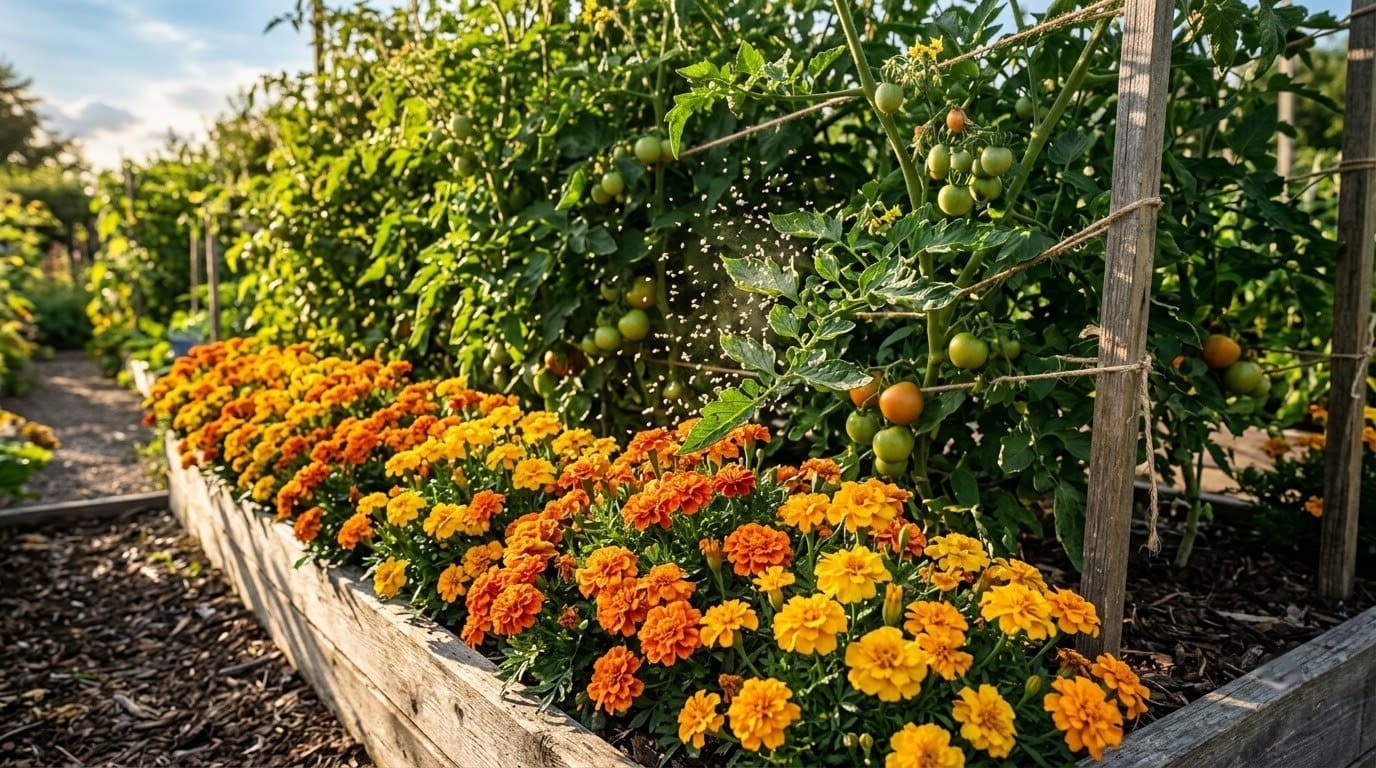
Most companion plants don’t repel tomato pests at all. They attract predatory insects or act as trap crops. The clearest exception is French marigold: a 2019 Newcastle University study found that tomatoes intercropped with French marigolds had significantly fewer glasshouse whiteflies, because marigold foliage and flowers release airborne limonene.
Basil similarly disrupts thrips and whiteflies with its volatile oils. The other useful companions for tomatoes, sweet alyssum, flowering dill, cilantro, parsley, fennel, nasturtium, and chives, work by feeding beneficial insects or luring pests away rather than by repelling anything.
Answer 4 quick questions and get matched to the exact fix for your yard — drainage, budget, layout, or something else entirely.
Take the Free QuizNo plant reliably repels the tomato hornworm moth, so those flowering herbs help only by attracting the braconid wasp that parasitizes the caterpillar after it hatches.
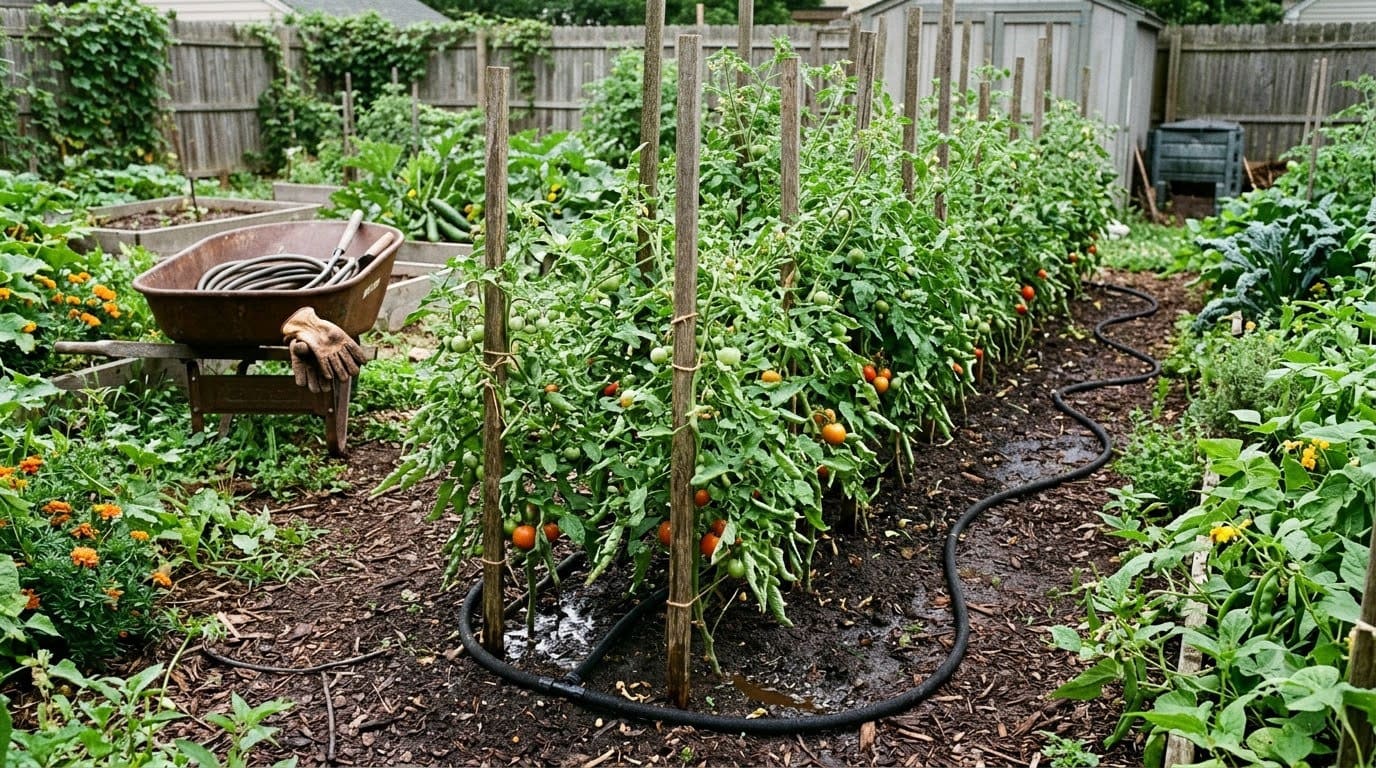
Companion planting is a supplement to handpicking, floating row cover on young transplants, and crop rotation, not a replacement for any of them. Used that way, alongside regular scouting, it genuinely lowers pest pressure across the season.
Do companion plants actually repel tomato pests?
There are three different things going on when a plant “helps” with tomato pests, and only one of them is actually repelling.
The first is genuine repellency. A plant releases volatile compounds into the air, and those compounds interfere with how an insect locates its host plant or make the area less appealing to settle in.
This is real but rare. The strongest documented case for tomatoes is French marigold against whitefly, from a 2019 study by Niall Conboy and Colin Tosh at Newcastle University. They found limonene was “the most abundant volatile released from both flowers and leaf tissue” of the marigolds, and tomatoes grown alongside them carried significantly fewer whiteflies from day 34 onward.
The second is predator attraction. Small-flowered plants provide the nectar and pollen that adult beneficial insects need before they can lay eggs. Clemson’s Home and Garden Information Center lists “alyssum, cilantro, parsley, dill, buckwheat, and fennel” as small-flowered plants that draw in parasitic wasps and flies, which then go after “caterpillars, stink bugs, and aphids” on the nearby crop.
The third is trap cropping. You plant something the pest likes more than tomatoes, at the edge of the bed, and it takes the hit instead. Nasturtium is the classic tomato-garden example for aphids.
Most yard problems trace back to one specific, fixable cause. Find yours in 4 quick questions.
Take the Free QuizThe 9 companion plants, and the tomato pest each one targets
1. French marigold, for whitefly
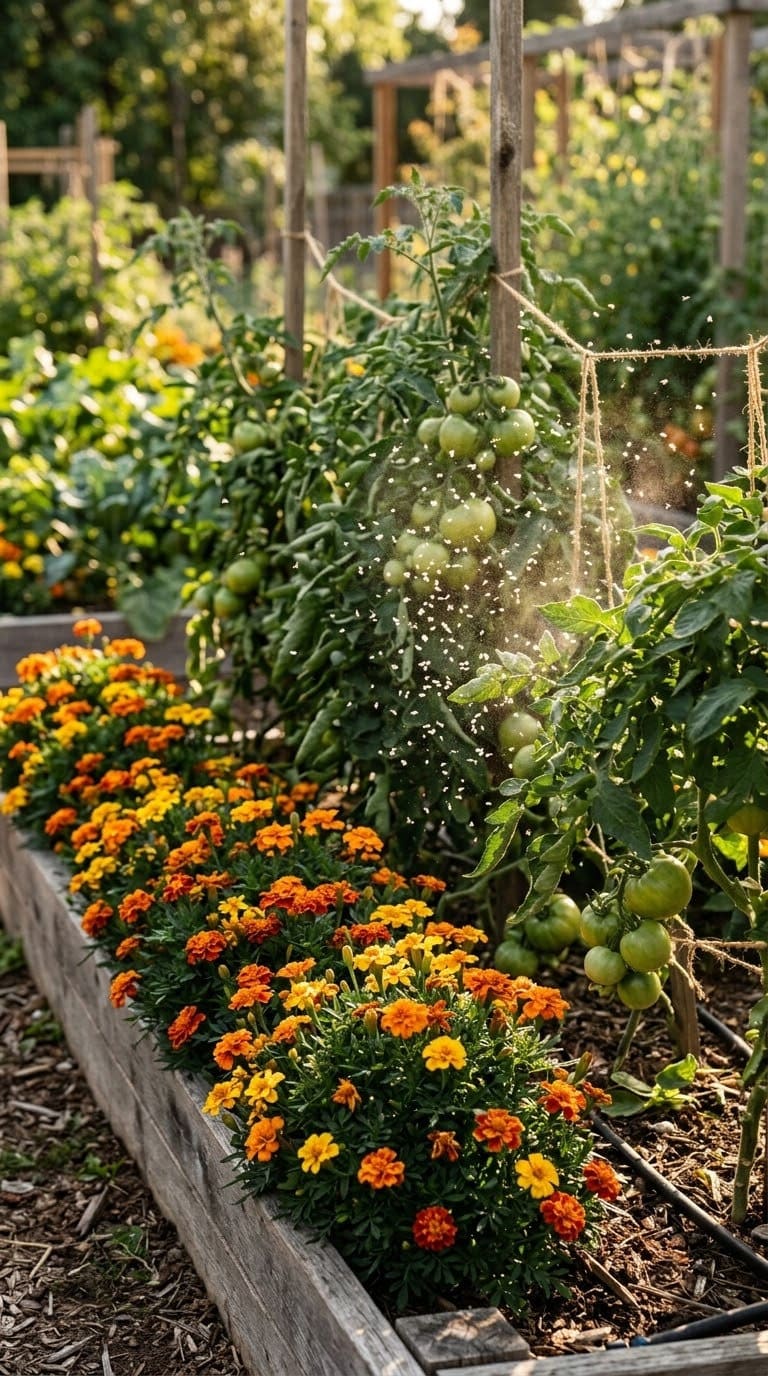
This is the one with the strongest evidence. In the Newcastle study, French marigolds (Tagetes patula) planted among tomatoes from the start of the season cut whitefly numbers significantly, and the researchers traced it to limonene, which made up about a quarter of the marigold’s total airborne volatile output.
Plant a continuous border of French marigolds along the sunny side of the tomato bed, close enough that the scent sits in the same airspace as the tomato foliage. You want them in from the beginning, not added after whiteflies show up.
The catch: this is a whitefly effect, not a nematode effect. Scattered marigolds do nothing measurable for root-knot nematodes in the soil, which is a separate job that needs a dense pre-crop stand grown months ahead, covered in our guide to companion pairs with a real mechanism behind them.
2. Basil, for thrips and whitefly
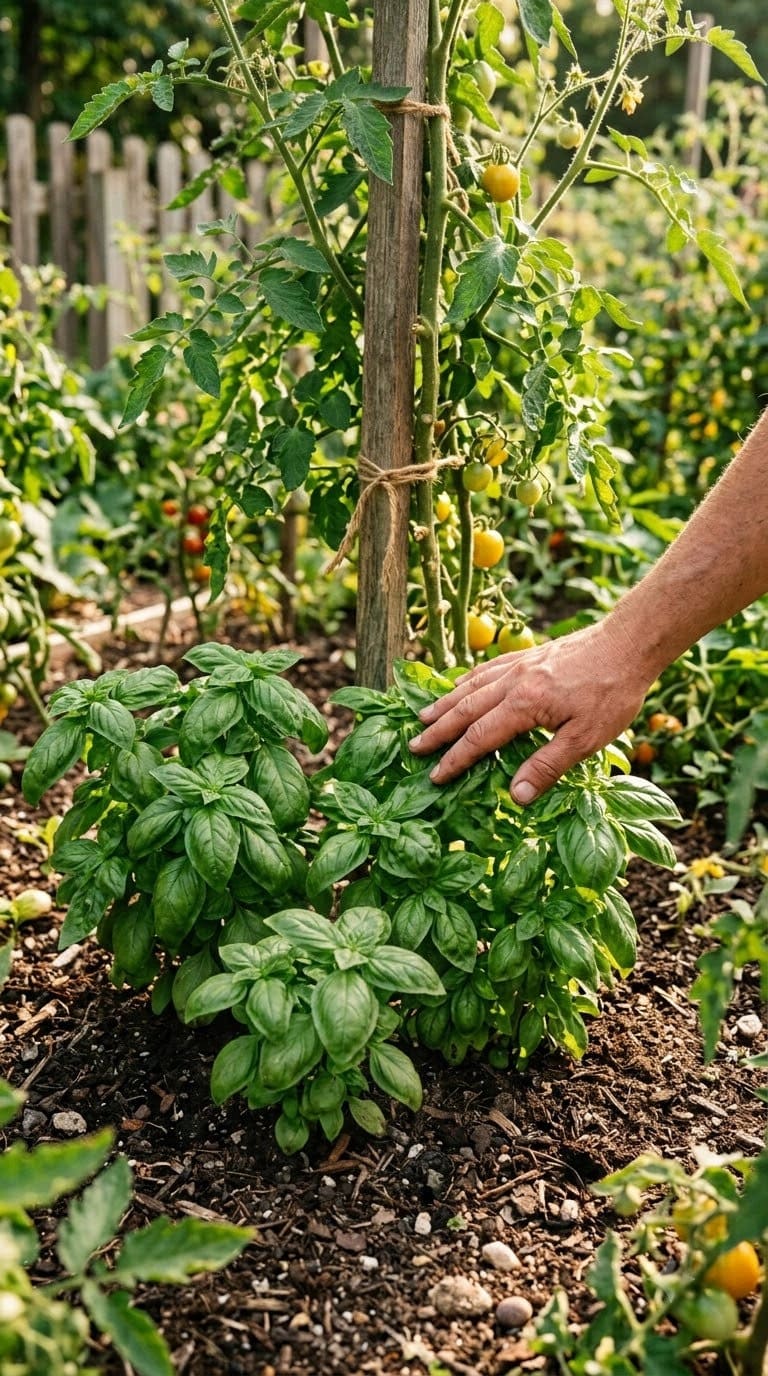
Basil gives off strong volatile oils, and those oils interfere with how thrips and whiteflies find a tomato plant. University of Minnesota Extension says basil can reduce thrips on tomatoes “in both field and greenhouse conditions,” and notes interplanting may even help the tomato grow.
Set two or three basil plants around the base of each tomato. Keep pinching the tops so the plants stay bushy and keep releasing oil.
The catch: basil wants the same rich, consistently moist soil as a tomato, so it’s a true companion that needs real care, not a plant-it-and-forget edge crop. Our tomato growing guide covers the spacing so the basil doesn’t get shaded out.
3. Nasturtium, for aphids and flea beetles
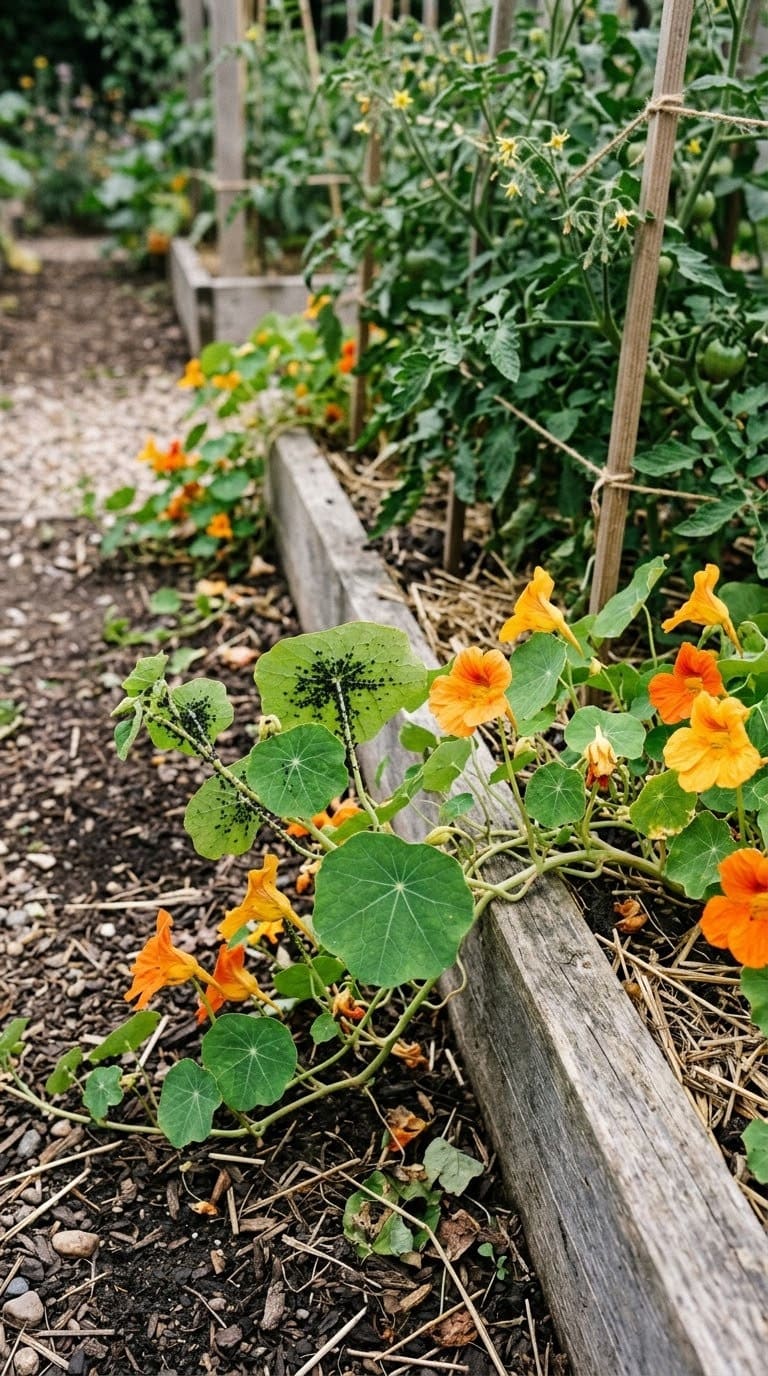
Nasturtium is a decoy. Aphids and flea beetles prefer it to tomatoes, so a ring of nasturtium at the edge of the bed pulls the pests onto itself. Washington State University Extension lists it among the standard trap crops for exactly this.
Plant nasturtium 2 to 3 feet out from the tomatoes, on the side the pests tend to arrive from. Check it weekly.

The catch: a trap crop only works if you deal with what it catches. Once the nasturtium is coated in aphids, hose it down hard, cut off the worst growth, or pull and bag it. Left alone, it just becomes an aphid nursery next to your tomatoes.
4. Sweet alyssum, for aphids
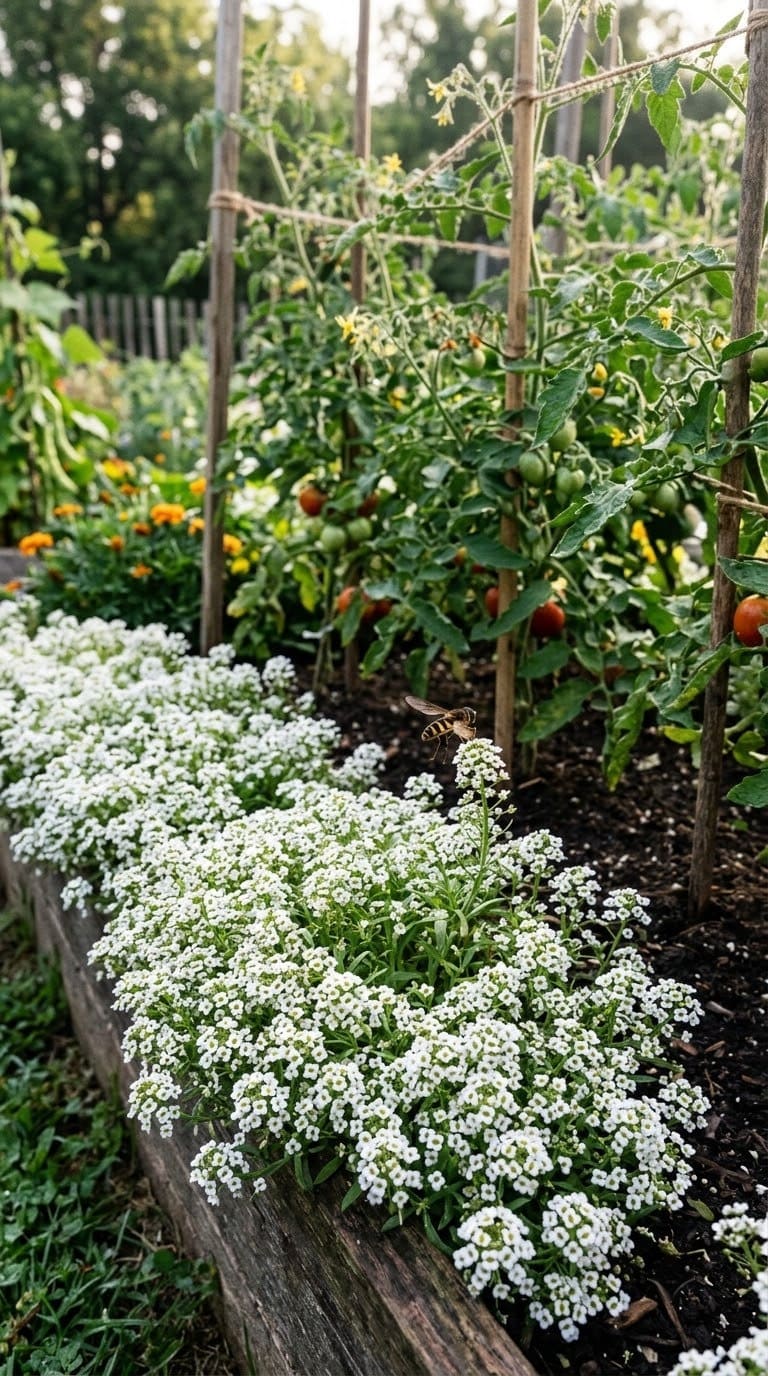
Alyssum is the lowest-effort real win on this list. Its tiny flowers feed hoverflies and parasitic wasps, and their larvae eat aphids. University of Florida IFAS Extension says “intercropping vegetables with sweet alyssum is beneficial because alyssum attracts hoverflies, which prey on aphids,” and calls it “a favorite of parasitoid wasps that control aphids and soft-bodied pests.”
Sow alyssum as a low carpet along the front edge of the tomato bed. It stays under 6 inches, so it never competes with the tomatoes for light.
The average homeowner spends $616/year on yard fixes that don't address the real problem. Find out what yours actually is — before you spend another dollar.
Take the Free QuizThe catch: it takes a few weeks for the alyssum to flower and for the hoverfly population to build, so this is a slow-burn defense, not a rescue for an infestation that’s already going.
5. Flowering dill, for hornworm and aphids
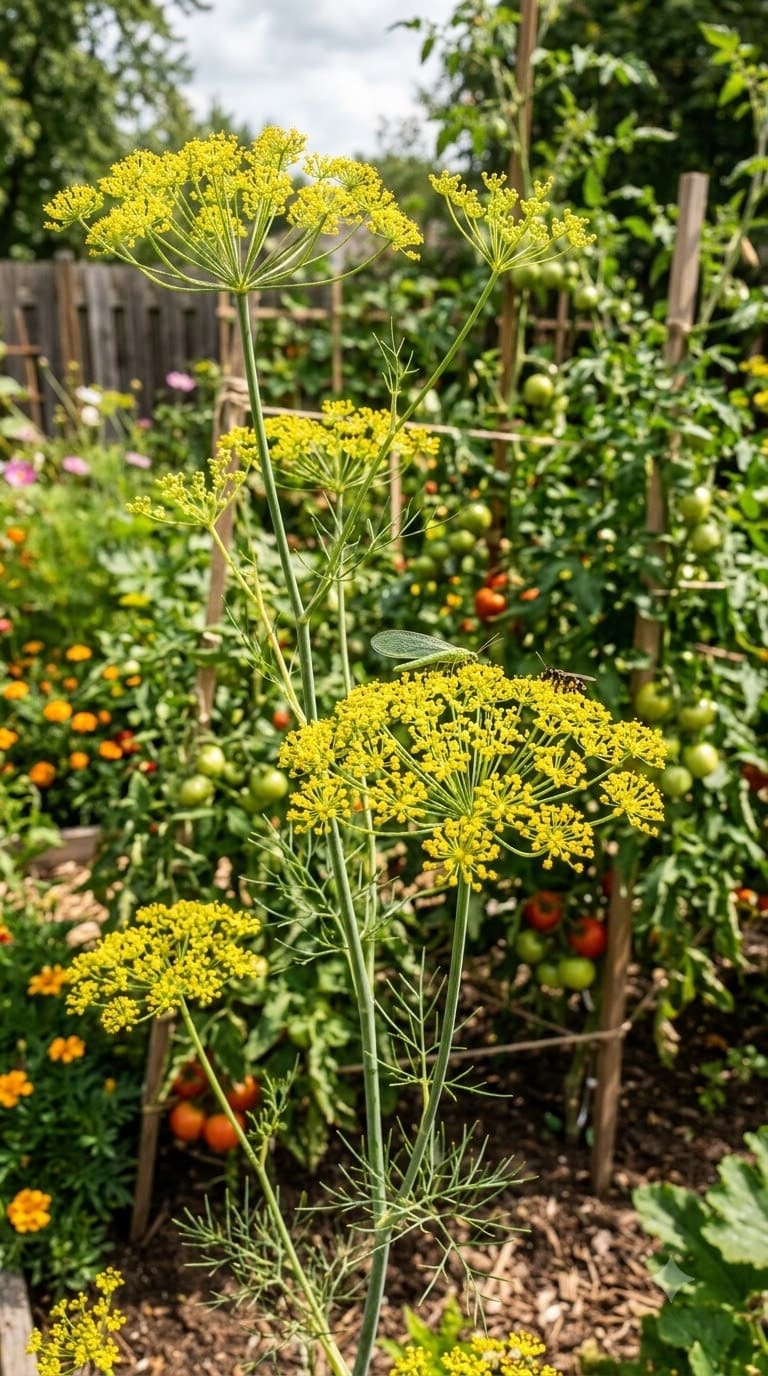
Dill in flower is one of the best insectary plants you can grow near tomatoes. The big yellow umbels feed the braconid wasp that parasitizes tomato hornworms, plus lacewings and hoverflies that work on aphids. Clemson lists dill among its top small-flowered plants for drawing in those wasps.
Let a few dill plants flower near the tomato bed and leave them standing while they bloom.
The catch: dill flips. Young dill is a good tomato companion, but once it bolts it releases compounds that slow tomato growth, and the umbels also attract hornworm moths looking to lay eggs. Keep it in its own spot a few feet away, and see our list of plants that work against tomatoes for the full story on that switch.
6. Flowering cilantro, for aphids and hornworm
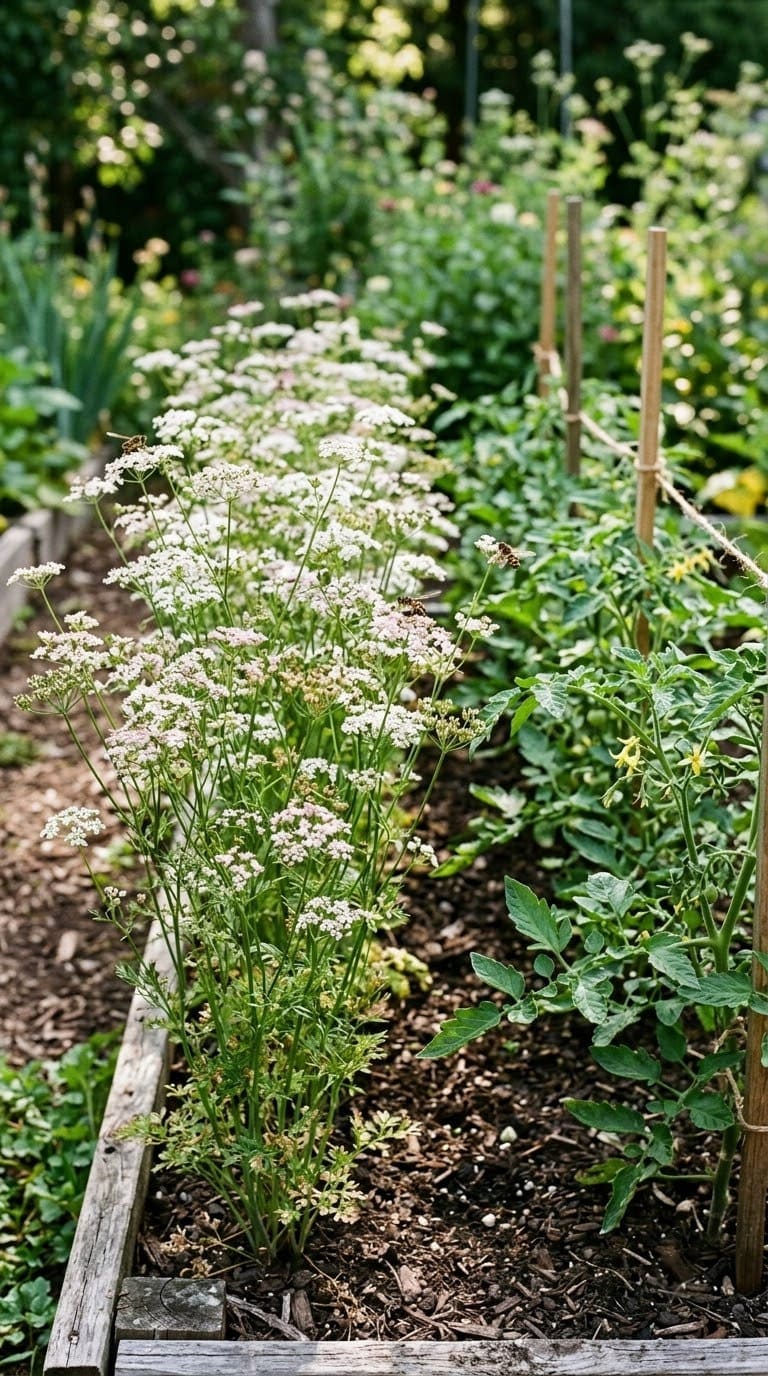
Cilantro bolts fast in warm weather, and for once that’s the point. The flowers are small, flat, and easy for tiny parasitic wasps and hoverflies to feed from. UF IFAS groups it with alyssum and dill as a reliable insectary herb.
Sow a short row of cilantro near the tomatoes in spring and just let it bolt. Succession-sow every few weeks so something is always in flower.
The catch: you’re growing this for the flowers, not the leaf. If you want cilantro for the kitchen, grow that separately, because you’ll be harvesting leaves right when the pest-control plant needs to be blooming.
7. Flowering parsley, for hornworm and armyworm
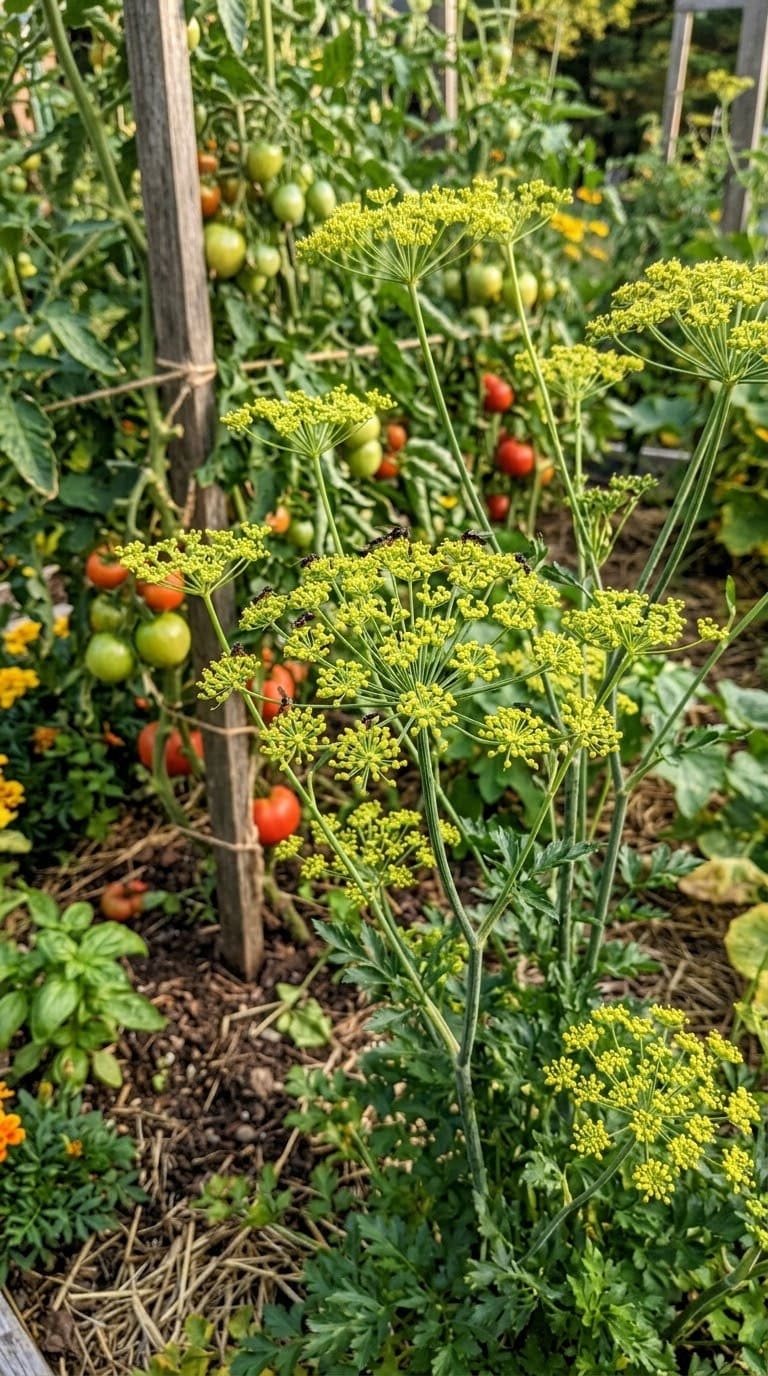
Parsley is a biennial, so it flowers in its second year, and those flat flower clusters are excellent for braconid and tachinid parasitoids that attack hornworms and armyworms. It’s on Clemson’s small-flowered-plant list alongside dill and cilantro.
Leave a couple of first-year parsley plants in the ground over winter and let them flower the next spring near the tomato bed.
The catch: first-year parsley does nothing for pest control, it’s just an herb. The payoff comes in year two, so this one rewards planning ahead.
8. Fennel, in a pot near the bed
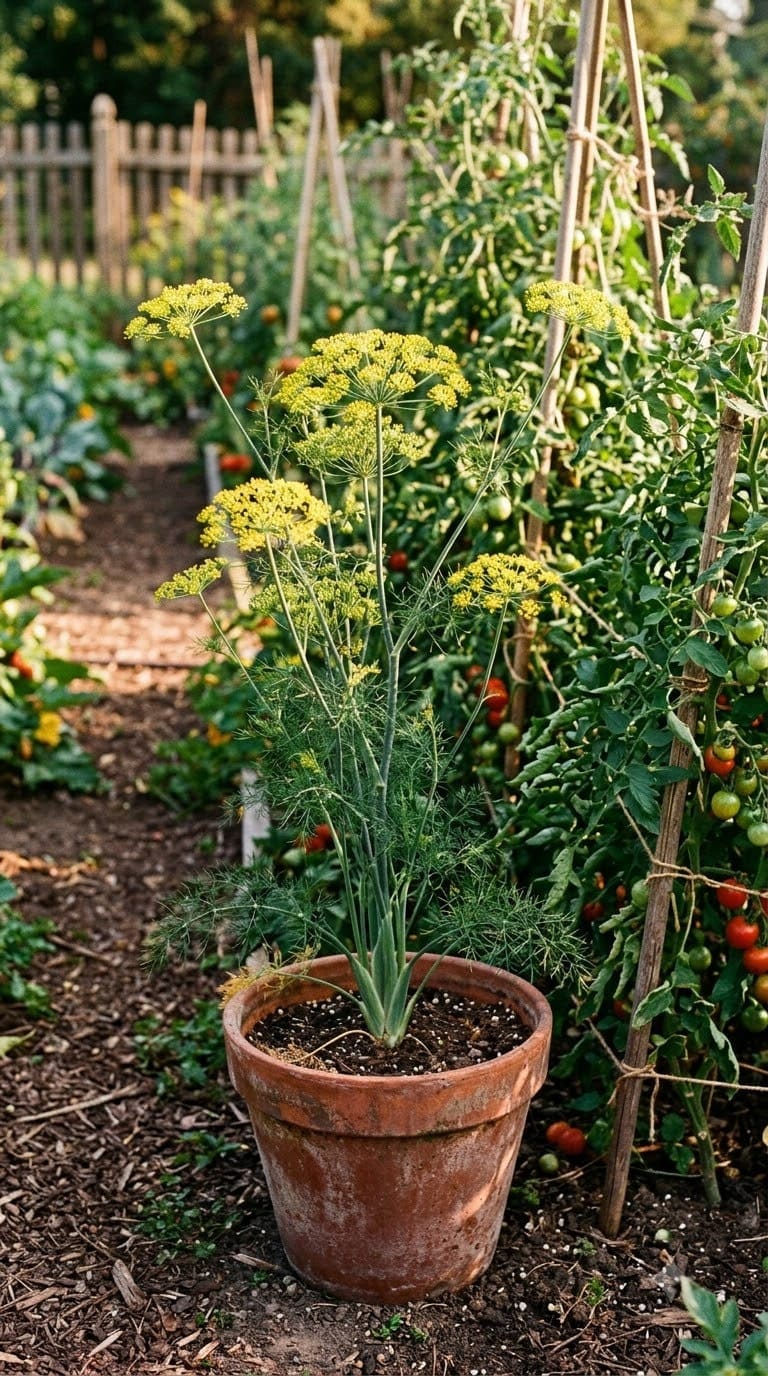
Fennel’s flower heads are magnets for parasitic wasps, hoverflies, and lacewings, arguably the best of the umbellifers for it. Clemson includes it in the same small-flowered group.
Grow one fennel plant in a large container and set it at the edge of the tomato patch where the flowers are close to the crop.
The catch: fennel cannot go in the tomato bed. It’s allelopathic, meaning it releases compounds that suppress the growth of most plants around it, tomatoes included. The container is not optional, it’s the only safe way to keep fennel near tomatoes.
9. Chives and other alliums, for aphids and spider mites
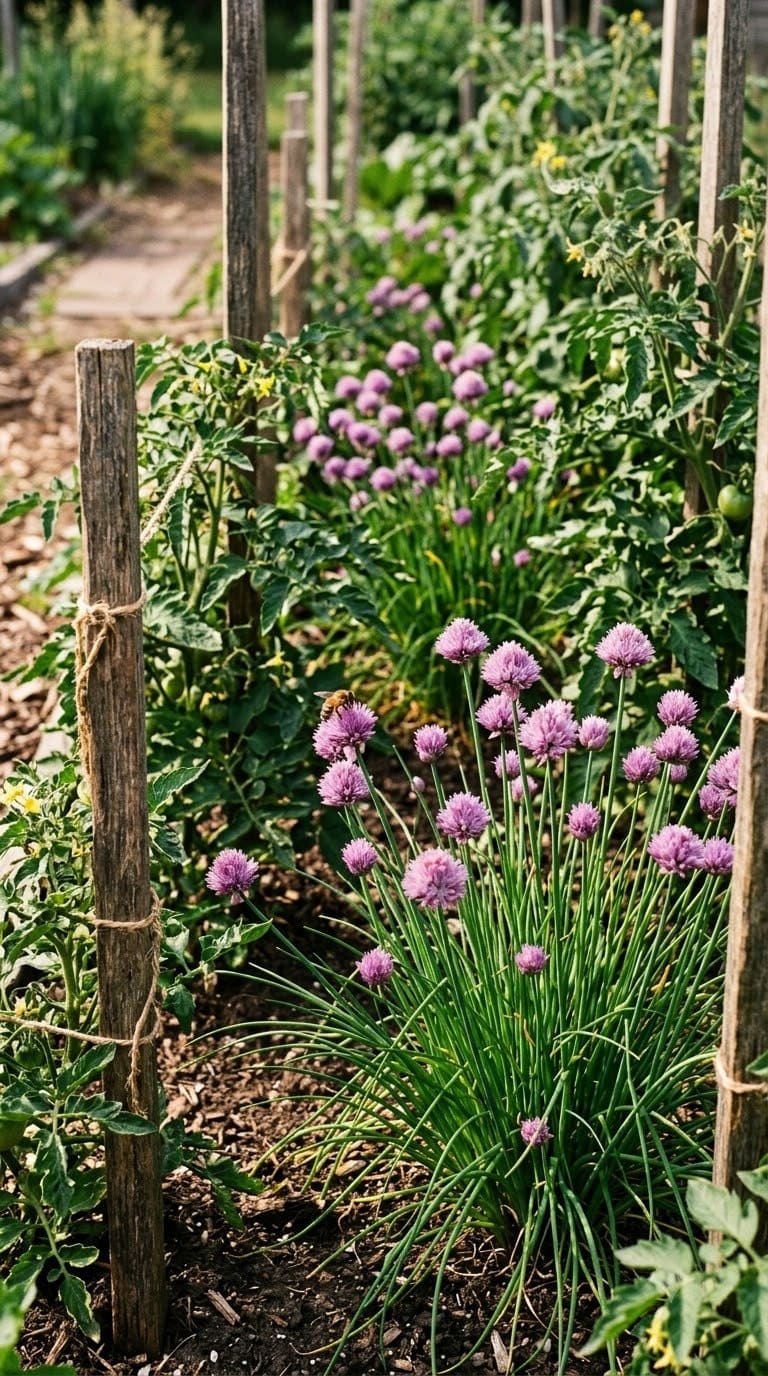
The strong sulfur scent of chives, garlic, and onions is traditionally credited with putting aphids and spider mites off tomato plants. The hard evidence here is thinner than for marigold or basil, but alliums take up almost no space and have no real downside near tomatoes, so the risk-reward is good.
Tuck clumps of chives between the tomato plants or run a line of them along the bed edge. Let some flower, since the blooms also feed hoverflies.
The catch: this is the most folklore-adjacent pick on the list. Treat it as a low-cost bonus layer, not your main defense.
Comparison table: plant, target pest, mechanism, evidence strength
| Plant | Target tomato pest | How it works | Evidence strength |
|---|---|---|---|
| French marigold | Whitefly | Airborne limonene disrupts the pest | Strong (Newcastle 2019 study) |
| Basil | Thrips, whitefly | Volatile oils disrupt host-finding | Moderate (extension-reviewed trials) |
| Nasturtium | Aphids, flea beetles | Trap crop, pest prefers it | Moderate (established practice) |
| Sweet alyssum | Aphids | Flowers feed aphid-eating hoverflies and wasps | Moderate to strong (UF IFAS) |
| Flowering dill | Hornworm, aphids | Flowers feed braconid wasps and lacewings | Moderate (mechanism well documented) |
| Flowering cilantro | Aphids, hornworm | Flowers feed parasitic wasps and hoverflies | Moderate |
| Flowering parsley | Hornworm, armyworm | Flowers feed braconid and tachinid parasitoids | Moderate |
| Fennel (in a pot) | Broad, via predators | Flowers feed wasps, hoverflies, lacewings | Moderate |
| Chives and alliums | Aphids, spider mites | Strong scent, traditional deterrent | Traditional (limited hard data) |
Tomato pest cheat sheet: spot it, then plant for it
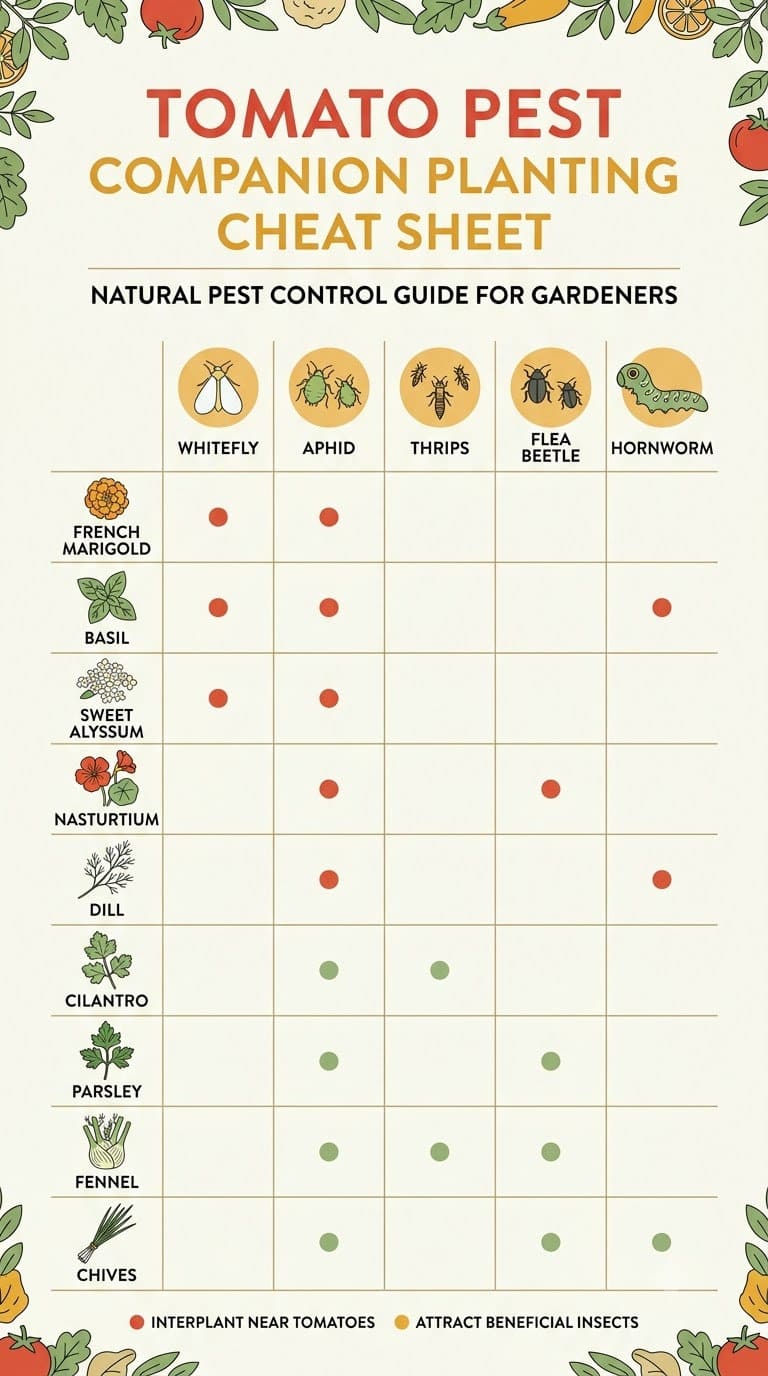
Use this to go straight from the damage you’re seeing to the companion plant that helps. Save it or screenshot it for planting day.
| Pest | How you know you have it | Companion plant to reach for | How to deploy it | If it’s already bad |
|---|---|---|---|---|
| Tomato hornworm | Chewed leaves near the top, dark pellets on lower leaves, stripped stems | Flowering dill, cilantro, or parsley | A few flowering plants per bed, kept blooming all season | Handpick at dusk, spray Bt on the foliage |
| Whitefly | Tiny white flies lift in a cloud when you brush the plant, sticky leaves | French marigold | Continuous border on the sunny side, planted from day one | Yellow sticky traps, hose off undersides |
| Aphids | Curled new growth, sticky residue, ants running the stems | Sweet alyssum plus a nasturtium trap crop | Alyssum carpet at the front edge, nasturtium 2 to 3 feet out | Strong water spray, cut off the worst nasturtium growth |
| Thrips | Silvery streaks and tiny black specks on leaves, distorted new growth | Basil | Two or three plants around each tomato, kept pinched and bushy | Blue sticky traps, remove badly streaked leaves |
| Flea beetles | Shotgun-hole pattern of tiny round holes on young leaves | Nasturtium trap crop | Ring the bed edge on the side the beetles arrive from | Floating row cover on young transplants |
| Stink bugs | Cloudy yellow spots under the skin of ripening fruit | Flowering dill, fennel in a pot | Let umbellifers flower near the bed to feed their parasitoids | Handpick, clear weedy edges where they overwinter |
| Spider mites | Fine webbing, stippled bronze leaves in hot dry spells | Chives and other alliums | Clumps between plants and along the edge | Hose the undersides, raise humidity around the plants |
| Root-knot nematode | Stunted plants, yellowing, knotty galls on the roots at pull-up | French marigold as a pre-crop, not an intercrop | Dense solid stand grown 2 months before tomatoes go in | Rotate the bed, solarize the soil in summer |
The one-bed companion planting plan
If you just want a layout to copy for a single 4 by 8 foot tomato bed, here it is.
- Front edge (the side you walk): a continuous carpet of sweet alyssum for aphid control, low enough that it never shades anything.
- Sunny long side: an unbroken border of French marigold, in from transplant day, for whitefly.
- Between each tomato: two or three basil plants at the base for thrips and whitefly, plus a clump of chives.
- Two to three feet off the shady end: a patch of nasturtium as an aphid and flea beetle trap crop, somewhere you can hose it or pull it without disturbing the tomatoes.
- Its own spot, a few feet away: a stand of dill and a short row of cilantro, both left to flower, to feed the wasps that parasitize hornworms. Keep dill out of the bed itself so its roots don’t slow the tomatoes once it bolts.
- In a large pot at the bed corner: one fennel plant for extra predator support, never in the ground.
That covers whitefly, aphids, thrips, flea beetles, and hornworm predators in one planting, for the cost of a few seed packets and a tray of herb starts.
A real tomato-garden experience
For two summers I did the thing every companion chart tells you to do. I scattered French marigolds through the tomato bed, one plant every few feet, and figured I’d bought myself some protection.
Both years the hornworms found the tomatoes anyway. I’d walk the bed at dusk and pull five or six fat green caterpillars off in a single pass, marigolds or no marigolds. The whiteflies were a little better, honestly, but the hornworm damage was exactly the same as the year before I planted anything.
What finally changed it was giving up on the idea that a plant would keep the moths away. I put in a dedicated clump of dill and let it flower, kept a stand of cilantro bolting all season, and started actually walking the bed twice a week to handpick.
By midsummer I was finding hornworms with white wasp cocoons already on their backs, which meant the parasitoids had moved in. The flowers did their job. They just weren’t doing the job I originally asked them to.
What companion planting can’t do for your tomatoes
No plant repels the tomato hornworm moth. The flowering herbs on this list help by feeding the wasp that kills the caterpillar after it hatches, not by keeping the moth from laying eggs in the first place. Handpicking and Bacillus thuringiensis spray still do the real work on an active infestation.
Scattered French marigolds also do nothing measurable for root-knot nematodes in your soil. That’s a real effect, but it needs a solid block of marigolds grown as a cover crop two months before you plant tomatoes, not a few plants tucked among them.
Companion planting is a layer on top of the basics, not a substitute. Crop rotation, floating row cover on young transplants, and walking the bed to scout still matter more than any flower you plant.
And for seven of the nine plants here, “repel” is the wrong word. They attract predators or bait the pest away, which works, but only if you understand that’s what you’re doing.
FAQ
Do marigolds actually keep bugs off tomatoes? French marigolds have a documented effect against whiteflies, shown in a 2019 Newcastle University study, through airborne limonene. They do not repel hornworms, and scattering a few plants does nothing for soil nematodes.
What’s the single best companion plant for tomato pests? Sweet alyssum, for most gardeners. It’s low-effort, stays small, and reliably brings in the hoverflies and parasitic wasps that control aphids. French marigold is the better pick if whitefly is your specific problem.
Will basil stop tomato hornworms? Not reliably. Basil has real evidence against thrips and whiteflies, but the hornworm claim is traditional and thinly supported. Flowering dill or parsley plus handpicking is the better hornworm strategy.
How many companion plants do I need per tomato? For scent-based plants like basil and marigold, you want them close and frequent, two or three per tomato or a continuous border. For insectary plants like alyssum and dill, a few flowering plants per bed is enough, since they work at the bed scale.
Can I just plant all nine of these around my tomatoes? You can, but fennel must stay in a pot, and dill needs its own spot a few feet away so it doesn’t slow tomato growth once it bolts. The rest can mix freely.
Do these replace spraying for pests? No. They reduce pest pressure and support beneficial insects, which can mean less spraying, but an active hornworm or aphid outbreak still needs direct action like handpicking, a strong water spray, or a targeted product.
Related Posts
Never miss an update — choose FarmFoodFamily as your preferred source on Google.
How it works: Tap the button below to open Google's settings page, then check the box next to FarmFoodFamily.
Tap the checkbox to turn it blue — that's how you know it's set.