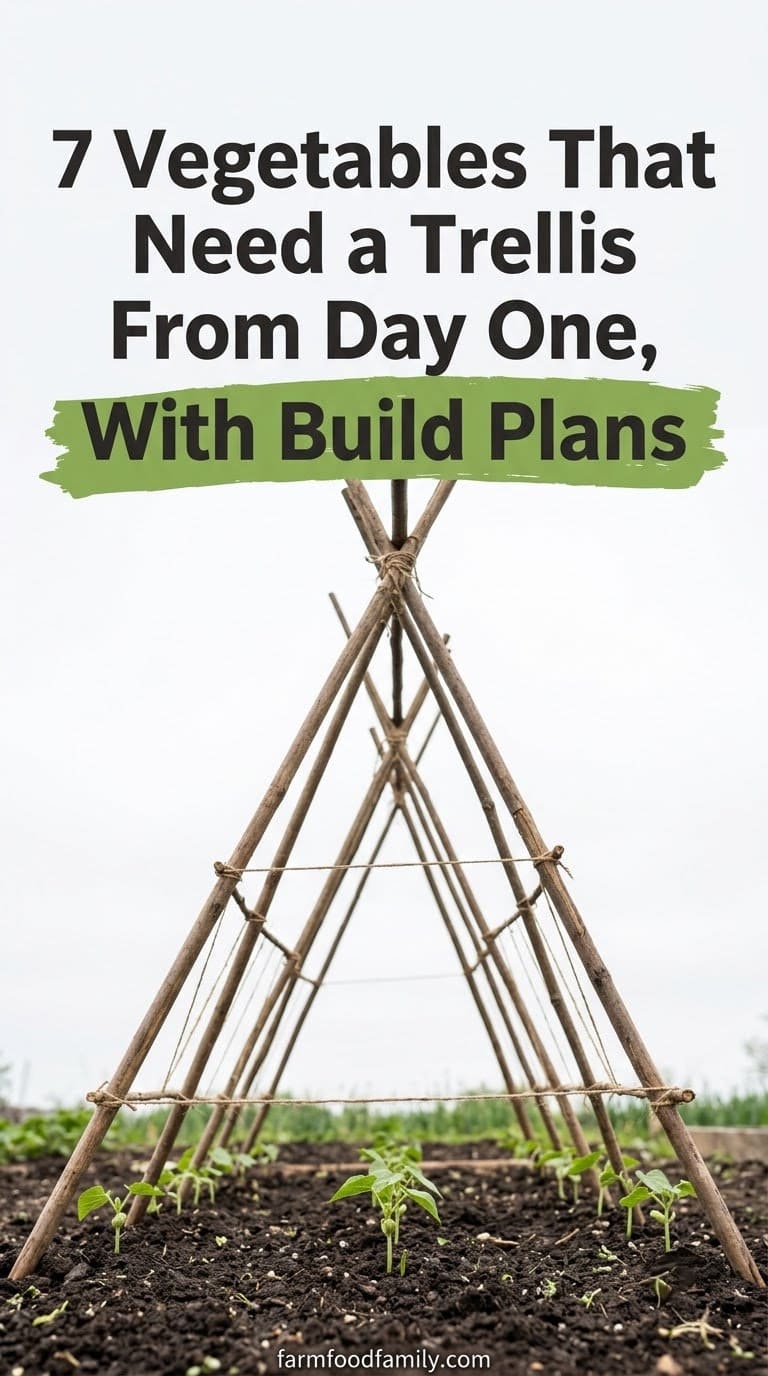
7 Vegetables That Demand a Trellis From Day One (With a Build Plan for Each)
For these seven crops, the support goes in the same day the plant does. Add it later and you drive a stake through the roots or peel a matted vine off the soil first.

Never miss an update — choose FarmFoodFamily as your preferred source on Google.
How it works: Tap the button below to open Google’s settings page, then check the box next to FarmFoodFamily.
Tap the checkbox to turn it blue — that’s how you know it’s set.
Most people treat a trellis as a mid-season job. The tomato gets tall, it flops, and only then does the cage come out of the shed.
For seven vegetables, that timing is a mistake. Their roots spread fast and their vines grab and sprawl within days.
By the time the plant “obviously” needs support, adding it means shoving a stake down through a full root system or unpicking a tangled mat off the bed.
Here are the seven, why each one needs its support from the day you plant, and a build plan for each with dimensions and cost.
Quick Answer
Seven vegetables need their support installed at planting, not later: indeterminate tomatoes, tomatillos, pole beans, tall peas, vining cucumbers, luffa or hardshell gourds, and Malabar spinach.
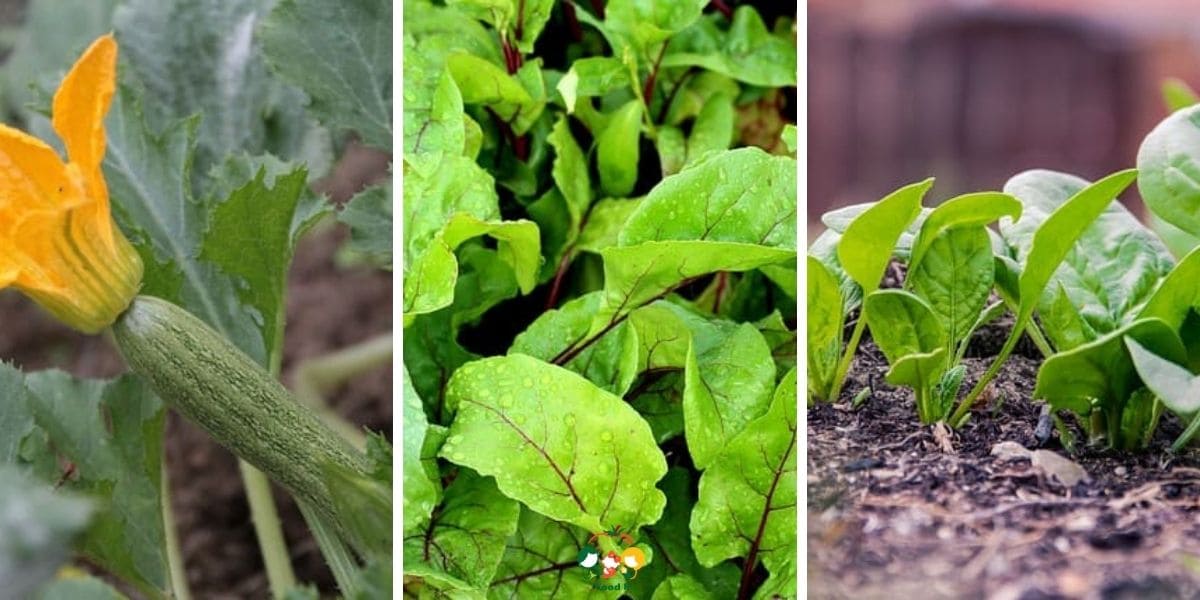
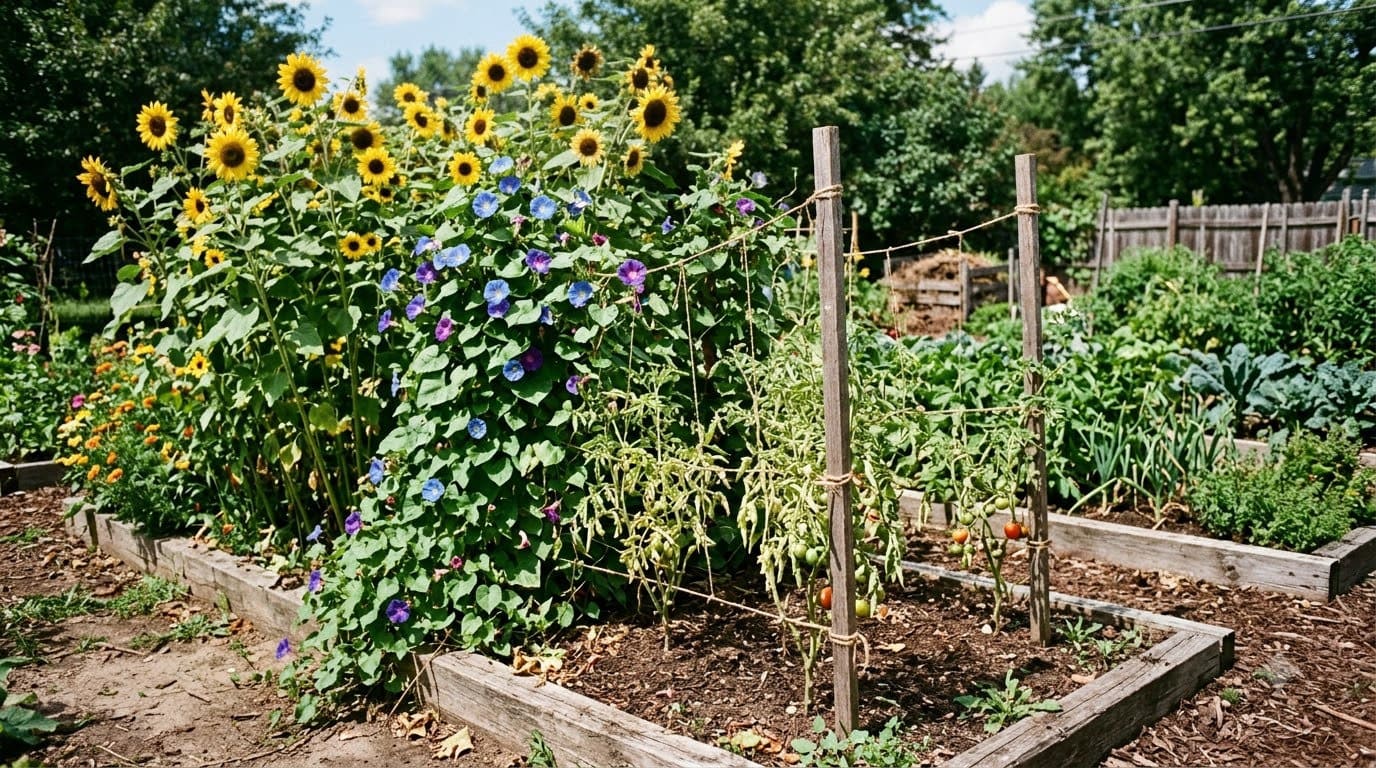
The reason is the same across all of them. Driving a stake or cage into an established plant severs feeder roots, and Penn State Extension says to start staking tomatoes when they are a foot tall or sooner.
Answer 4 quick questions and get matched to the exact fix for your yard — drainage, budget, layout, or something else entirely.
Take the Free QuizUtah State Extension has you drive a 48-inch tomatillo stake 18 inches deep right next to the stem. It also notes that tomatillo stems root wherever they touch soil, so a sprawling plant anchors itself down before you can lift it.
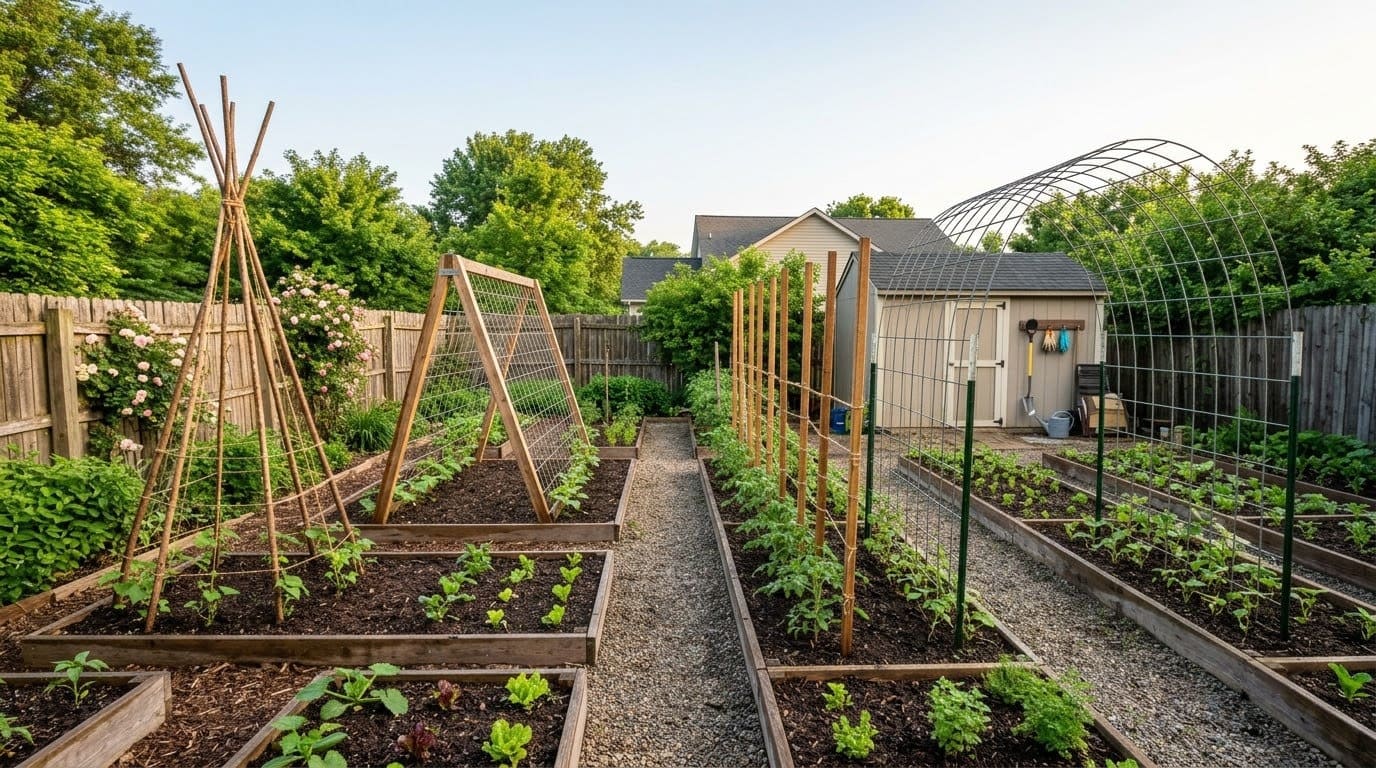
Build types by crop: a Florida weave for tomatoes, a heavy square cage for tomatillos, a teepee or string trellis for pole beans, netting between two stakes for peas, an A-frame or leaned cattle panel for cucumbers, a cattle-panel arch for gourds, and a tall string trellis for Malabar spinach.
Why these vegetables need support before they need it
The root problem is literally roots. A tomato or tomatillo transplant sends feeder roots well past the planting hole within a few weeks, often a foot or more in every direction.
Drive a stake or push a cage in after that, and you cut through the exact roots the plant relies on for water and nutrients. Penn State Extension is blunt about it: “Don’t wait to stake and trellis your tomatoes until they are large.” The same logic applies to every crop on this list that you have to drive a post for.
The second problem is what an un-supported vine does while you wait. Utah State Extension notes that tomatillo stems “voluntarily root if they come in contact with soil,” so a sprawling plant anchors itself flat to the bed and becomes impossible to lift onto a support later.
There is an upside too. University of Wisconsin-Madison Extension notes that supported crops get “better air movement through stems and leaves, which can reduce disease pressure,” plus “harvestable fruit quality and appearance” that ground-grown vines never match.
The 7 vegetables, and how to build support for each
1. Indeterminate tomatoes
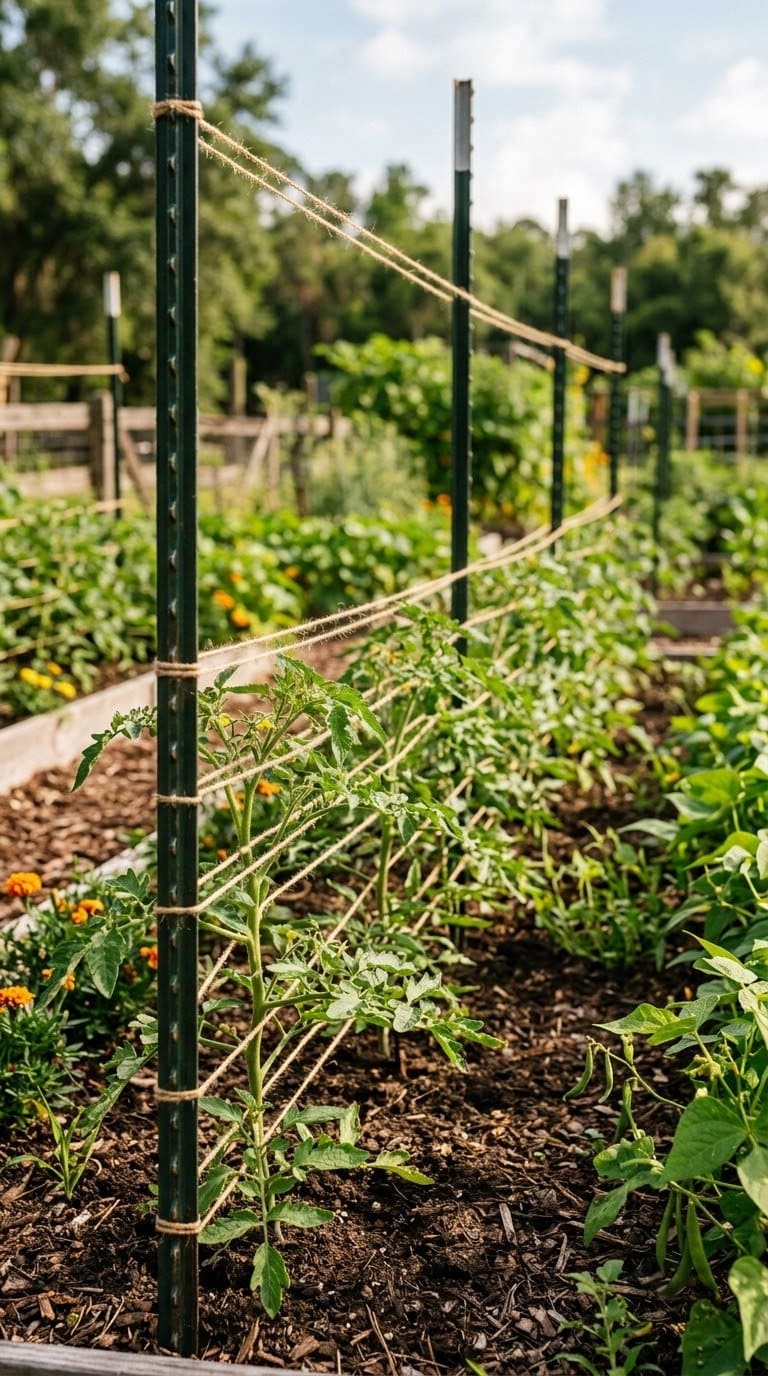
Indeterminate tomatoes never stop growing. They run 6 to 10 feet or more in a season, and they have no ability to hold themselves up.
Most yard problems trace back to one specific, fixable cause. Find yours in 4 quick questions.
Take the Free Quiz
The span between stakes for peas, cucumbers, and Malabar spinach
Shop NowThis post contains affiliate links. We may earn a commission on qualifying purchases at no extra cost to you.
Penn State says to stake when the plant is “a foot tall” so you can prune suckers as you go, and to use “sturdy wooden or metal stakes 6 to 7 feet long for indeterminate varieties.” Place each stake “3 to 4 inches from the base of the plant on the side away from the first bloom cluster.” Our full tomato growing guide covers spacing and pruning.
Build plan: the Florida weave. Drive a 6 to 7 foot T-post at each end of the row and one every two or three plants, with plants 18 to 24 inches apart. Tie garden twine to an end post about 8 inches off the ground, run it along one side of the row, loop it around each post, then come back the other side so each plant is pinched between two strands. Add a new line for every 6 to 8 inches of growth. Cost runs about 3 to 4 dollars per plant.
2. Tomatillos
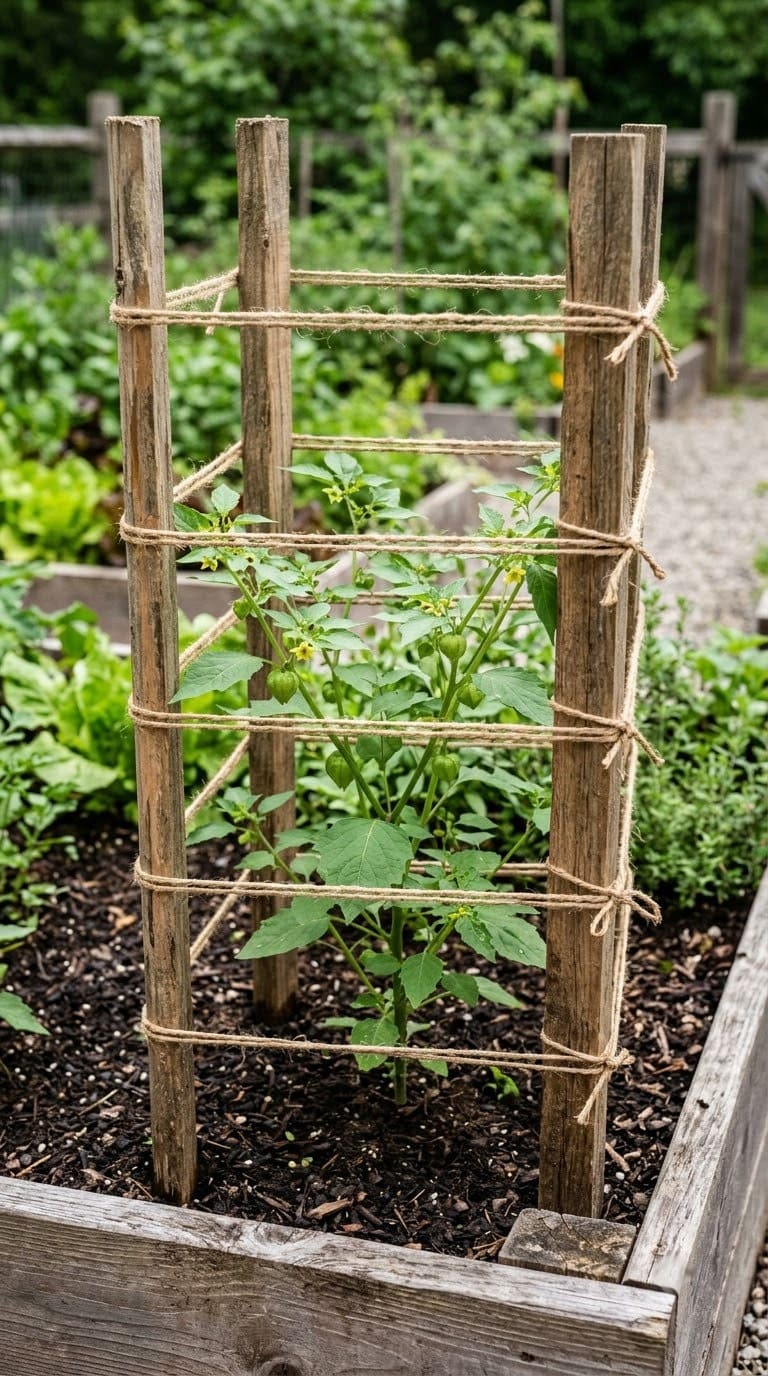
Everyone stakes tomatoes and almost nobody stakes tomatillos, which is backwards. Tomatillos are wider, heavier, and floppier, and Utah State describes their “indeterminate, sprawling growth habit.”
Left alone, the plant collapses outward, roots along every stem that touches soil, and turns into a low thicket you cannot harvest cleanly. Utah State’s fix is to “drive a 48-inch stake 18 inches into the soil adjacent to the plant stem” at planting time.
Build plan: a heavy square cage or four-stake box. A standard cone tomato cage is not enough. Set four 5-foot stakes in a 15 to 18 inch square around the transplant, driven 12 to 18 inches deep, and wrap twine around the outside at 12, 24, and 36 inches, adding levels as the plant fills out. A 5-foot livestock-panel section bent into a cylinder and staked also works. Cost is about 8 to 12 dollars per plant.
3. Pole beans
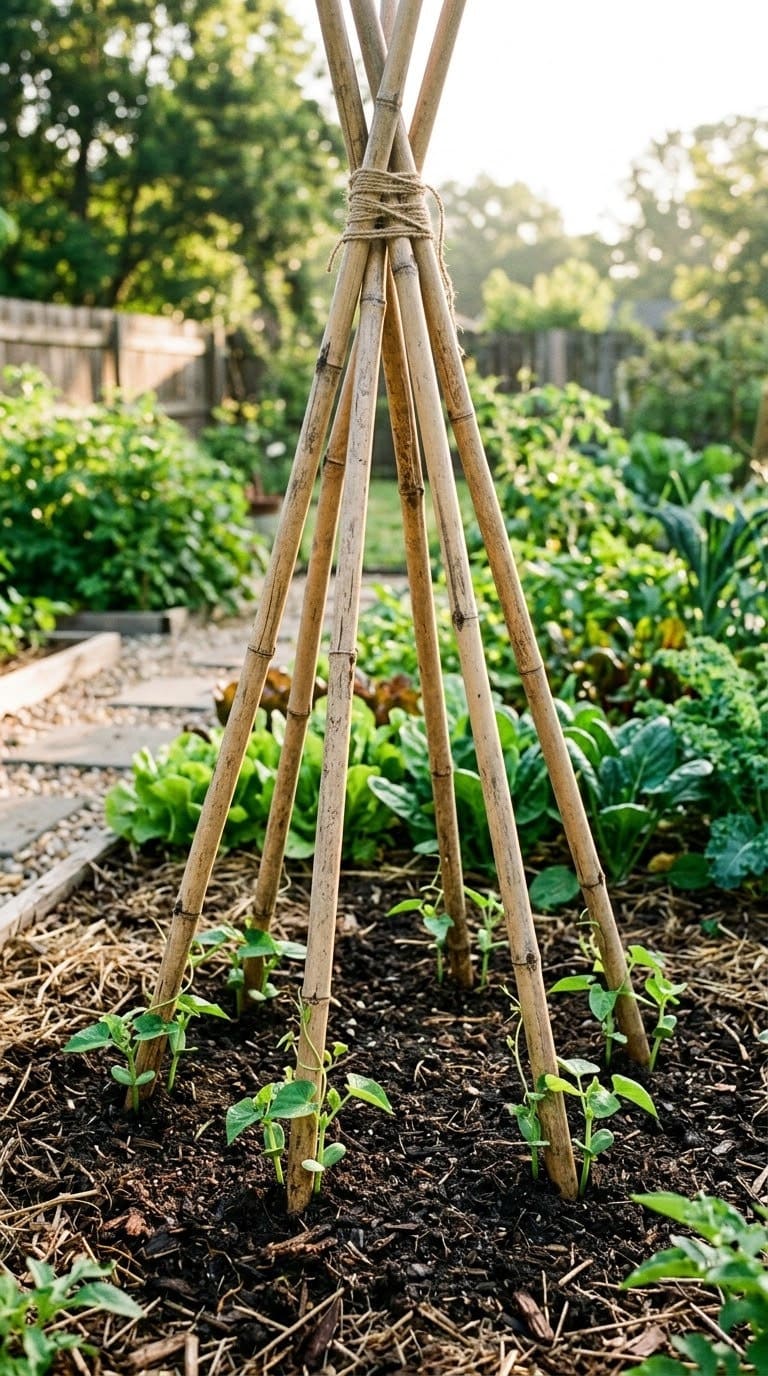
Pole beans are vining plants that run 7 to 10 feet and twine around anything vertical within days of germinating. University of Wisconsin lists them first among “vine-type vegetables that grow best on supports.”
If there is nothing there when they sprout, they grab each other and their neighbors and form a low tangle that never recovers into a productive vertical stand.
Build plan: a teepee or a string trellis. For a teepee, lash six 6 to 8 foot bamboo or furring-strip poles together at the top and spread the bases into a 2 to 3 foot circle, then sow 2 or 3 seeds at the base of each pole. For a row, run a top wire between two 8-foot posts and drop vertical strings every 4 inches, following the Maine Organic Farmers and Gardeners 8-foot span with verticals “about 4 inches apart.” Either build comes in under 15 dollars.
4. Tall peas
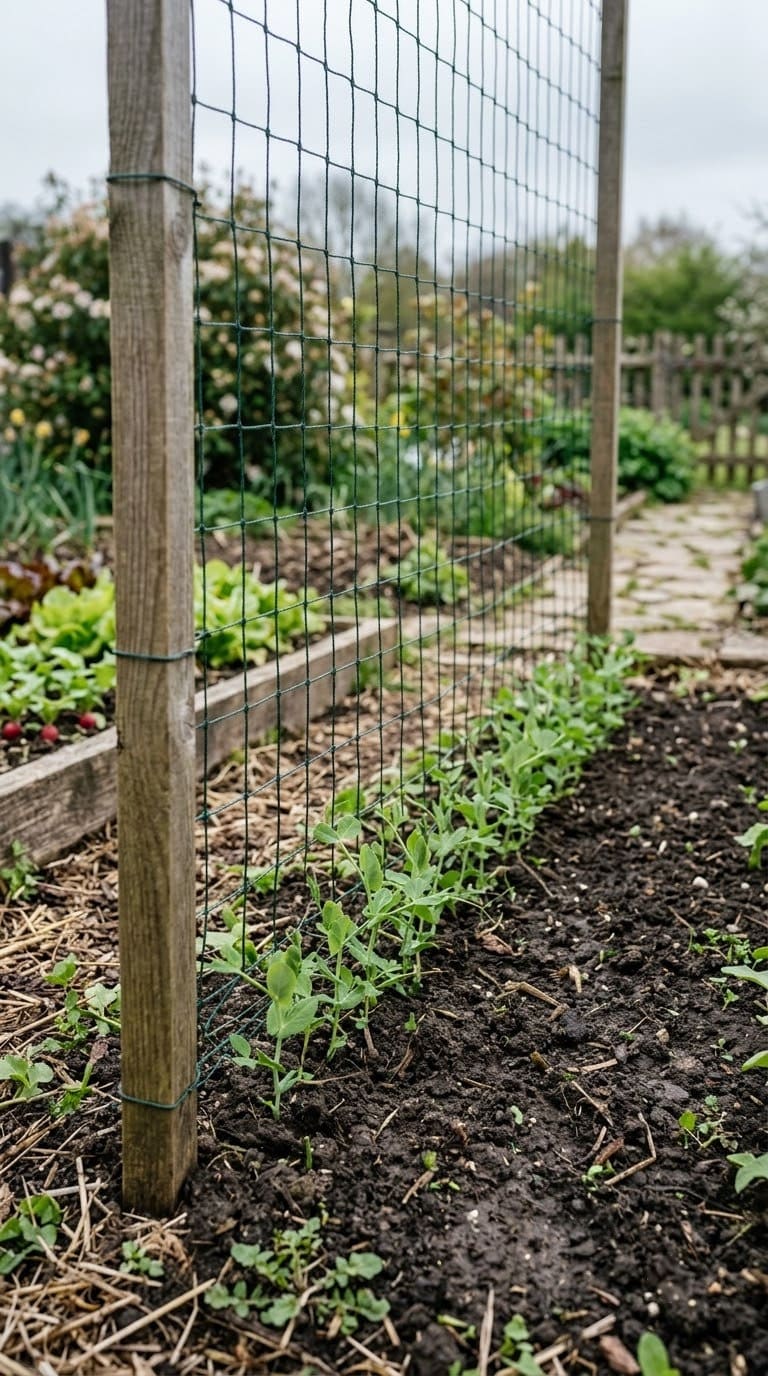
Vining and tall pea varieties climb by tendril, and those tendrils reach for a support within a few days of the seedling emerging. Miss that window and the plants flop, shade each other, and rot where they pile up.
The average homeowner spends $616/year on yard fixes that don't address the real problem. Find out what yours actually is — before you spend another dollar.
Take the Free QuizMOFGA uses “a 10-foot span” with “7-inch-mesh nylon netting” at 6 feet tall for peas. University of Minnesota Extension similarly recommends installing pea trellises early so the tendrils climb the structure naturally as the plants grow.
Build plan: netting between two stakes. Drive two 6-foot stakes or T-posts 8 to 10 feet apart at sowing time and stretch nylon or jute trellis netting with a 4 to 7 inch mesh between them, pulled tight. The no-cost version is “pea sticks,” twiggy prunings from a shrub or tree pushed into the row for the tendrils to grab. Netting runs about 10 to 15 dollars per span.
5. Vining cucumbers
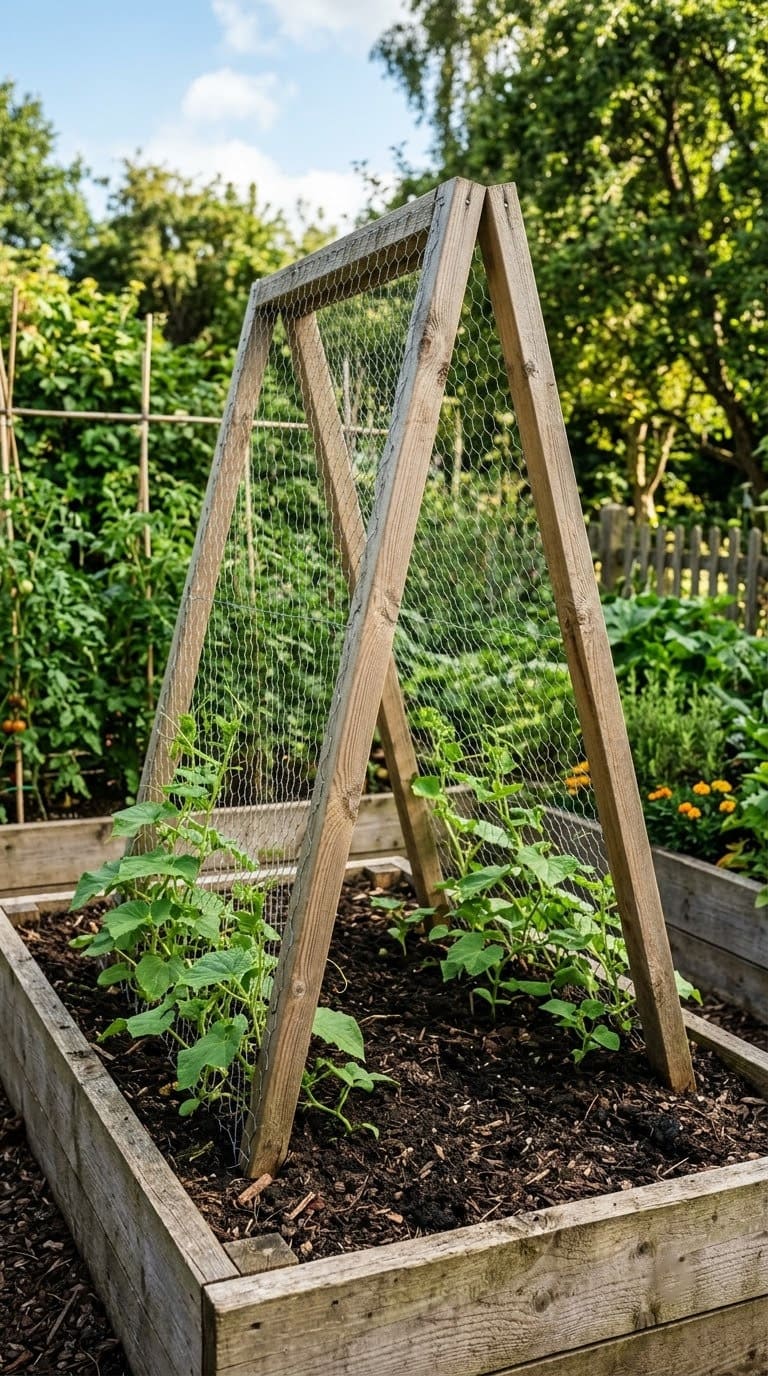
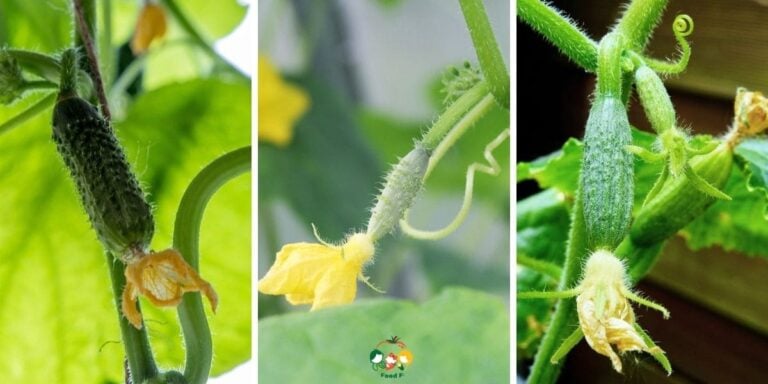
Vining cucumbers can technically sprawl on the ground, but they pay for it. Off the soil, MOFGA notes, crops “vastly improved air circulation are much more resistant to disease pressure,” and the fruit hangs straight and clean instead of curling against a clod.
Cucumber tendrils also grab early and hard, so a plant left to run flat gets its main stem tangled and stepped on before you ever get a trellis under it.
Build plan: an A-frame or a leaned cattle panel. Hinge two 4 to 5 foot frames of 2×2 lumber at the top and staple hog panel or netting to each face, then plant along both bases. Simpler still, lean a 16-foot cattle panel against a fence or post at a 60 to 70 degree angle and plant at the bottom edge. Wisconsin’s “4-inch square grid” mesh is ideal for the tendrils. An A-frame costs about 25 to 40 dollars in lumber and panel.
6. Luffa and hardshell gourds
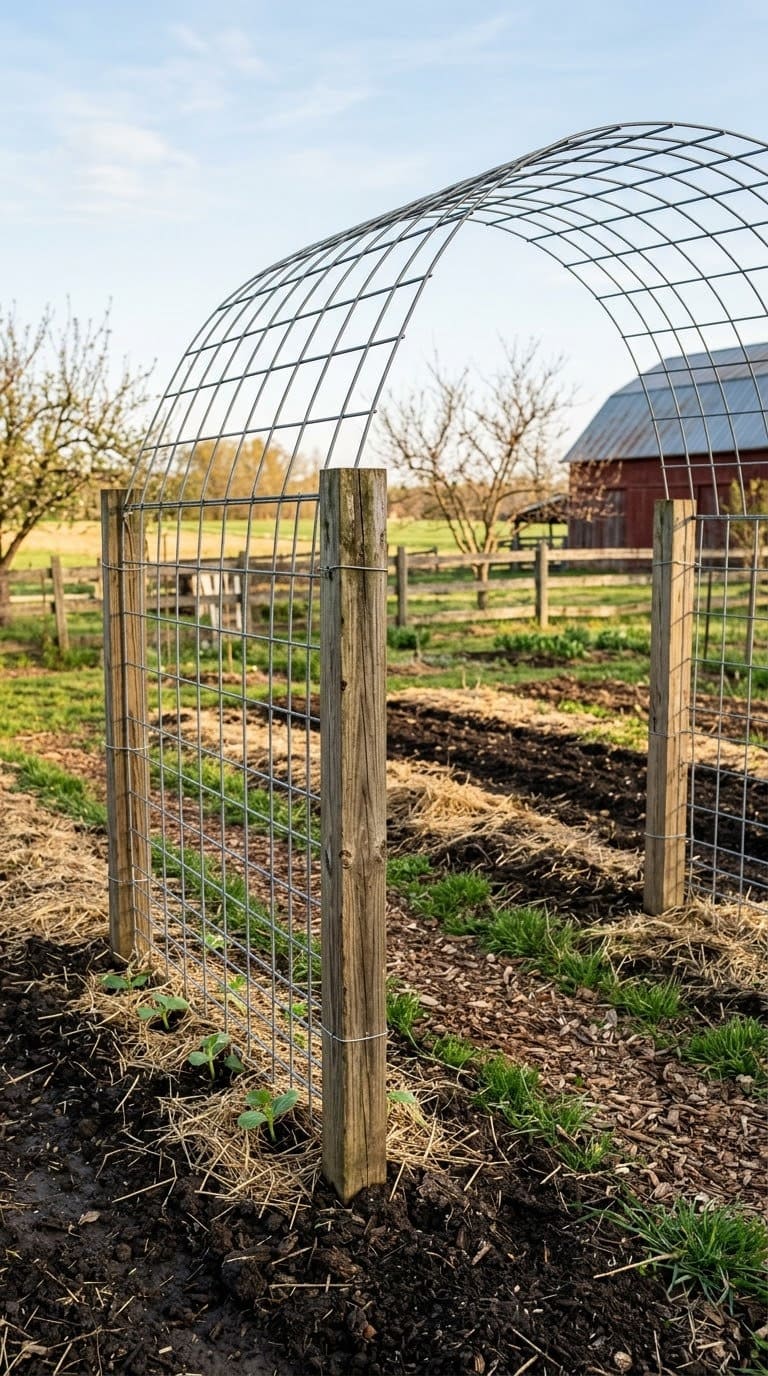
Luffa and hardshell gourds need the sturdiest support of anything on this list, and they need it before the seedlings go out. University of Illinois Extension says “a sturdy trellis is required” and describes “new tendrils reaching out in all directions to grasp and engulf anything they may contact.”
The vines run well past 15 feet, the season stretches to “200 days to reach maturity,” and mature gourds need to “freely hang and slowly dry with exposure to air.” A support that sags under that load takes the whole crop down in a late-summer storm.
Build plan: a cattle-panel arch or heavy wire wall. Set two rows of steel T-posts or 4x4s 2 to 3 feet deep and 6 to 8 feet apart, then bend a 16-foot cattle panel into an arch between them and wire it down at every contact point. Build it in spring, before you transplant. Add fabric or old-pantyhose slings under maturing gourds. Materials run about 40 to 70 dollars.
7. Malabar spinach
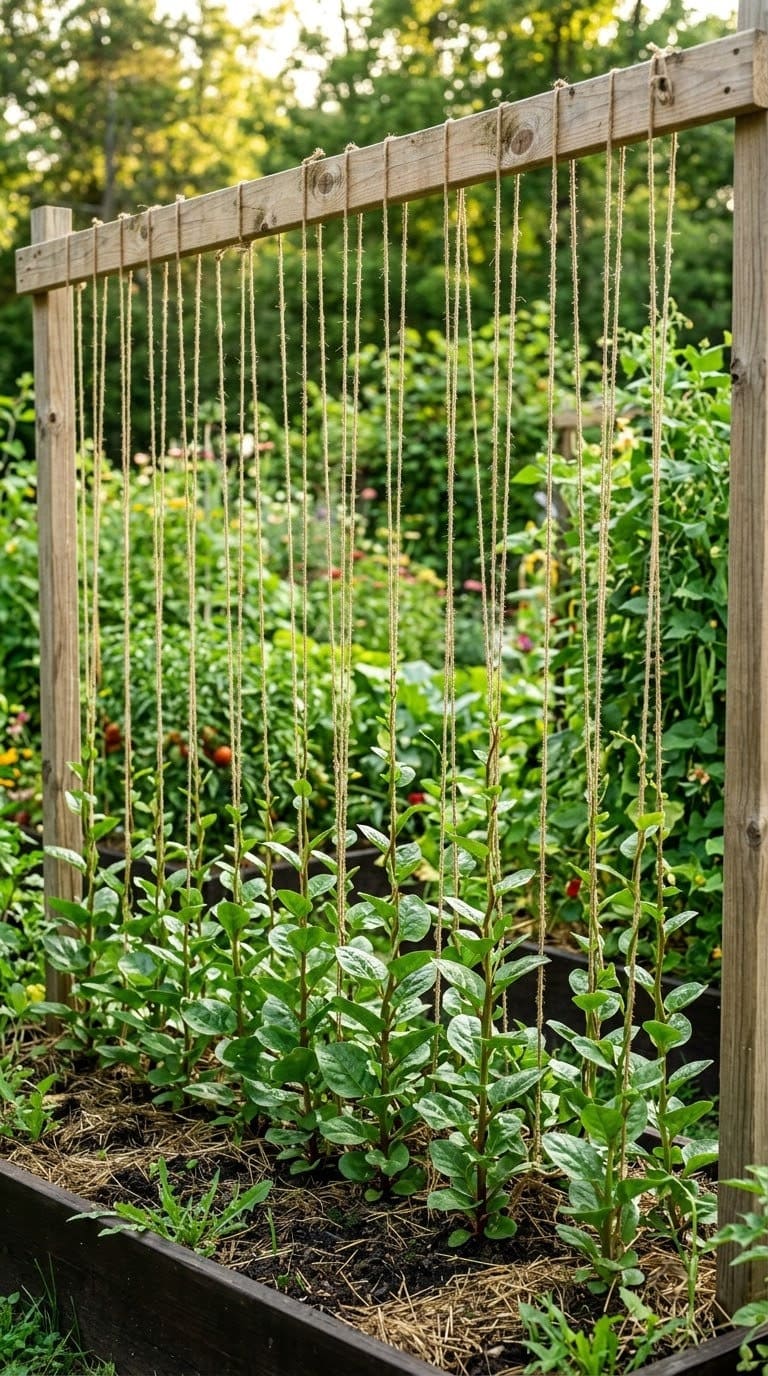
Malabar spinach is a hot-season leafy green that grows as “a fast-growing vine that can grow six feet or even longer,” per University of Florida IFAS Extension. It “is typically grown on a trellis or fence to help climbing.”
Without something to grab, the vine sprawls into a dense ground mat within a couple of weeks of transplanting, and the lower leaves yellow in the shade of their own growth.
Build plan: a tall string trellis. Run a top bar or wire at 6 to 8 feet between two posts and drop a vertical jute string down to each plant, spaced 12 inches apart per UF/IFAS. A stock panel or a section of chain-link fence works just as well. The vine climbs fast enough in summer heat that you only need to tuck it in once or twice. String and a top bar cost under 15 dollars.
One shopping trip covers most of these
You do not need a different kit for every crop. Four items build every trellis on this list.
A bundle of 6 to 7 foot steel T-posts handles the Florida weave, the pea span, and the gourd arch. One or two 16-foot livestock panels cover cucumbers, gourds, and a bean row, and they last for decades. A roll of 4 to 7 inch mesh netting spans the pea and Malabar spinach frames, and a spool of heavy tomato twine does the weaving and the teepee lashing.
The one build detail people skip is anchoring. Any post carrying a loaded vine wants to go at least 18 inches into the ground, and 24 inches for a gourd arch or a long bean row. A leaning trellis in July is almost always a post that was driven 8 inches deep in May.
Comparison table: vine length, support height, and when to install
| Crop | Mature vine length | Support height | Build type | Install when |
|---|---|---|---|---|
| Indeterminate tomatoes | 6 to 10+ ft | 6 to 7 ft | Florida weave or stakes | At transplant |
| Tomatillos | 3 to 5 ft, sprawling | 4 to 5 ft | Heavy square cage or stake box | At transplant |
| Pole beans | 7 to 10 ft | 6 to 8 ft | Teepee or string trellis | At sowing |
| Tall peas | 4 to 6 ft | 6 ft | Netting between stakes | At sowing |
| Vining cucumbers | 5 to 8 ft | 4 to 6 ft | A-frame or leaned cattle panel | At sowing or transplant |
| Luffa and hardshell gourds | 15+ ft | 6 to 7 ft, very sturdy | Cattle-panel arch or wire wall | Before seedlings go out |
| Malabar spinach | 6 to 10 ft | 6 to 8 ft | Tall string trellis or stock panel | At transplant |
A real trellis-too-late mistake
My first serious tomato year, I planted a dozen indeterminate seedlings and told myself I would cage them once they “needed it.” By the time they were knee high and starting to lean, the root systems were already wide.
I drove the stakes in anyway. Three plants wilted hard for the better part of a week, clearly root-shocked, and one never fully caught up to the others.
The tomatillos next to them were worse. I had not staked them at all, and by mid-July they had collapsed into a waist-wide mound that had rooted itself to the bed in six places.
I lost most of that row trying to lift and stake it. Now the stakes and cages go in the same afternoon as the transplants, every time, before I water them in.
What doesn’t belong on this list
Bush beans and determinate tomatoes do not need a trellis. They grow to a fixed size and hold themselves up, and a short stake or a low cage is the most they ever want.
Winter squash and melons are a choice, not a requirement. They grow fine on the ground, and if you do trellis them for space, the heavy fruit needs a sling under each one so the stem does not tear.
And a weak trellis is worse than no trellis. A structure that folds under a loaded pole-bean row or a luffa vine in an August storm takes the crop down with it. Build for the mature load, not the seedling in front of you.
FAQ
Can I add a trellis after the plants are established? For lightweight climbers like peas you can usually slip netting in a couple of weeks late without much harm. For tomatoes, tomatillos, and anything you have to drive a post for, adding support after the roots have spread cuts feeder roots and sets the plant back, so it is far better to install at planting.
What is the sturdiest cheap trellis material? A 16-foot livestock or cattle panel. It costs about 25 to 35 dollars, lasts for decades, and can be leaned, arched, or stood upright between posts for almost any crop on this list.
Do vining cucumbers really need a trellis? They will grow without one, but off the ground they get far less foliar disease, the fruit grows straight and clean, and the plant is easier to pick. For vining varieties in a humid climate, a trellis is close to essential.
How tall should a pole bean trellis be? At least 6 feet, and 7 to 8 feet is better. Pole beans run 7 to 10 feet, and once they reach the top of a short support they flop back down on themselves and tangle.
Will a regular tomato cage work for tomatillos? Usually not. Tomatillos get wider and heavier than most tomatoes and push a standard cone cage over by mid-summer. Use a taller, wider, heavier cage or a four-stake box driven deep.
What about cucamelons? Cucamelons, also called Mexican sour gherkins, are delicate vining climbers that also need support from the start. A fine-mesh pea netting or a string trellis at 5 to 6 feet works well, since their tendrils are small.
Related Posts
Products We Recommend
This post contains affiliate links. We may earn a commission on qualifying purchases at no extra cost to you.
Heavy-duty garden trellis netting
The span between stakes for peas, cucumbers, and Malabar spinach
Shop Now
6 ft heavy-duty steel T-posts, 10-pack
The backbone of a Florida weave, a pea span, or a gourd arch
Shop Now
Tomato tying garden twine (large roll)
The woven lines that hold a tomato or tomatillo row upright, plus lashing a bean teepee
Shop NowNever miss an update — choose FarmFoodFamily as your preferred source on Google.
How it works: Tap the button below to open Google's settings page, then check the box next to FarmFoodFamily.
Tap the checkbox to turn it blue — that's how you know it's set.