7 Best Deck Cleaners for a Genius Wood and Composite Refresh
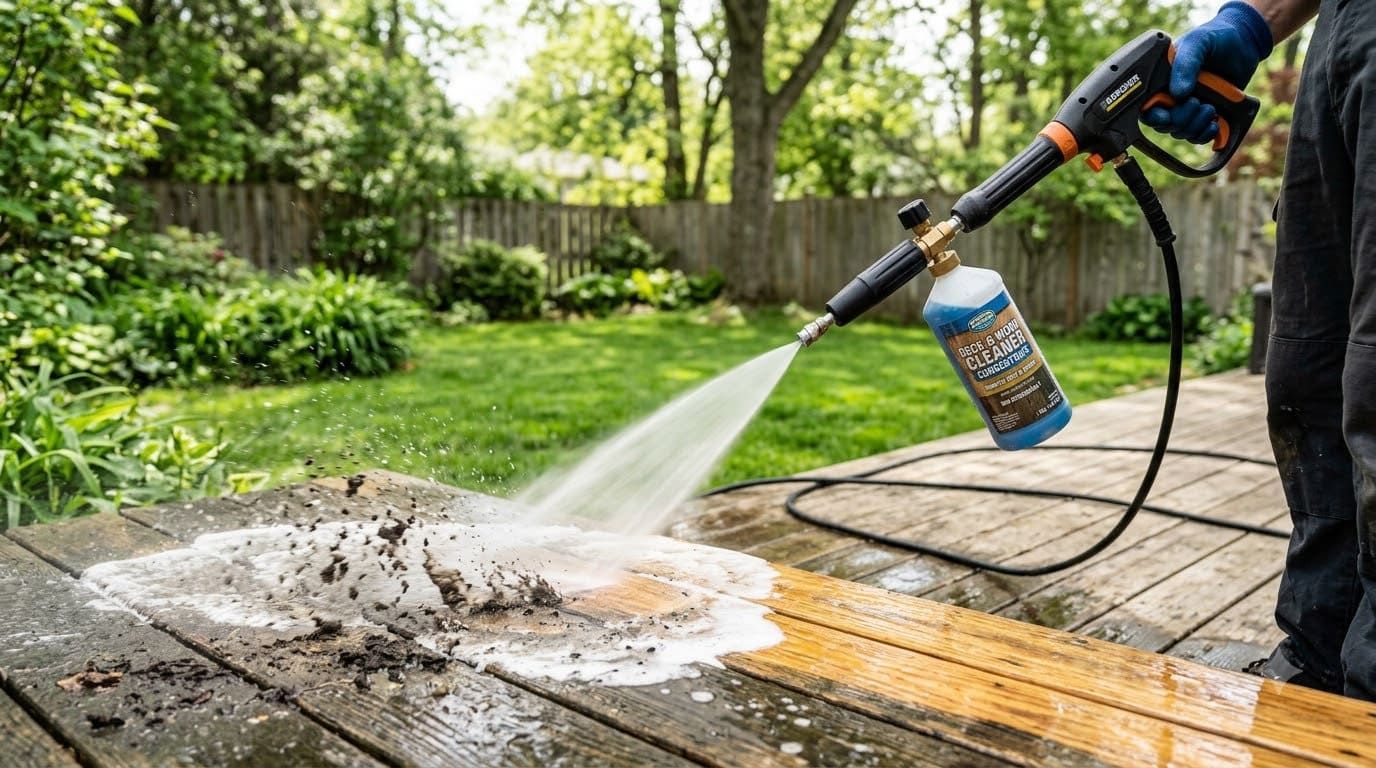
The right deck cleaner turns a gray, grimy deck back into a place you actually want to sit, as long as you match the formula to your deck material instead of grabbing whatever’s on the shelf at the hardware store.

Never miss an update — choose FarmFoodFamily as your preferred source on Google.
How it works: Tap the button below to open Google’s settings page, then check the box next to FarmFoodFamily.
Tap the checkbox to turn it blue — that’s how you know it’s set.
Quick answer: for a bare wood deck, start with the Wet & Forget Outdoor Cleaner, a bleach-free, non-acidic formula that won’t attack wood lignin the way chlorine bleach does. For a composite deck, check your manufacturer’s care guide first, since composite makers vary on which chemistries they’ll warranty. Heavier mold and mildew staining calls for a stronger oxygenated formula like Simple Green Oxy Solve, EPA Safer Choice Certified, peroxide-based, and rated for up to 6,300 square feet per concentrate bottle. Chemistry matters more than brand: oxygenated cleaners are the safer default for wood, chlorine bleach cleaners (sodium hypochlorite, the actual ingredient in several bottles on this list despite label language that avoids the word) work faster but can damage wood fibers and corrode fasteners, and composite needs a cleaner the manufacturer approves, since Trex’s own care guide warns bleach and acid-based cleaners can lighten composite and void the warranty.
I clean our deck twice a year, once in spring before the patio furniture comes back out and once in fall before the leaves turn it into a slip hazard. The first time I did it with straight bleach from under the sink, the boards came out streaky and the grass along the rail line turned yellow for a month. That’s the mistake this guide is built to help you skip.
This list covers seven deck cleaners that handle the real range of deck problems: green mildew film, black mold in shaded corners, gray weathered wood that needs brightening, and composite boards that need a gentler touch than a wood deck does. Every product below is a real, live Amazon listing we opened and checked ourselves, with specs pulled from the manufacturer’s own product page and buyer-review patterns we read and summarized rather than invented.
Before you clean, it’s worth knowing what you’re cleaning. If your deck is showing more than surface grime, the pros and cons of composite decking and a wood vs. composite decking comparison are worth a read before you pick a cleaner, since the material genuinely changes which formulas are safe to use.
The Best Deck Cleaners Of 2026
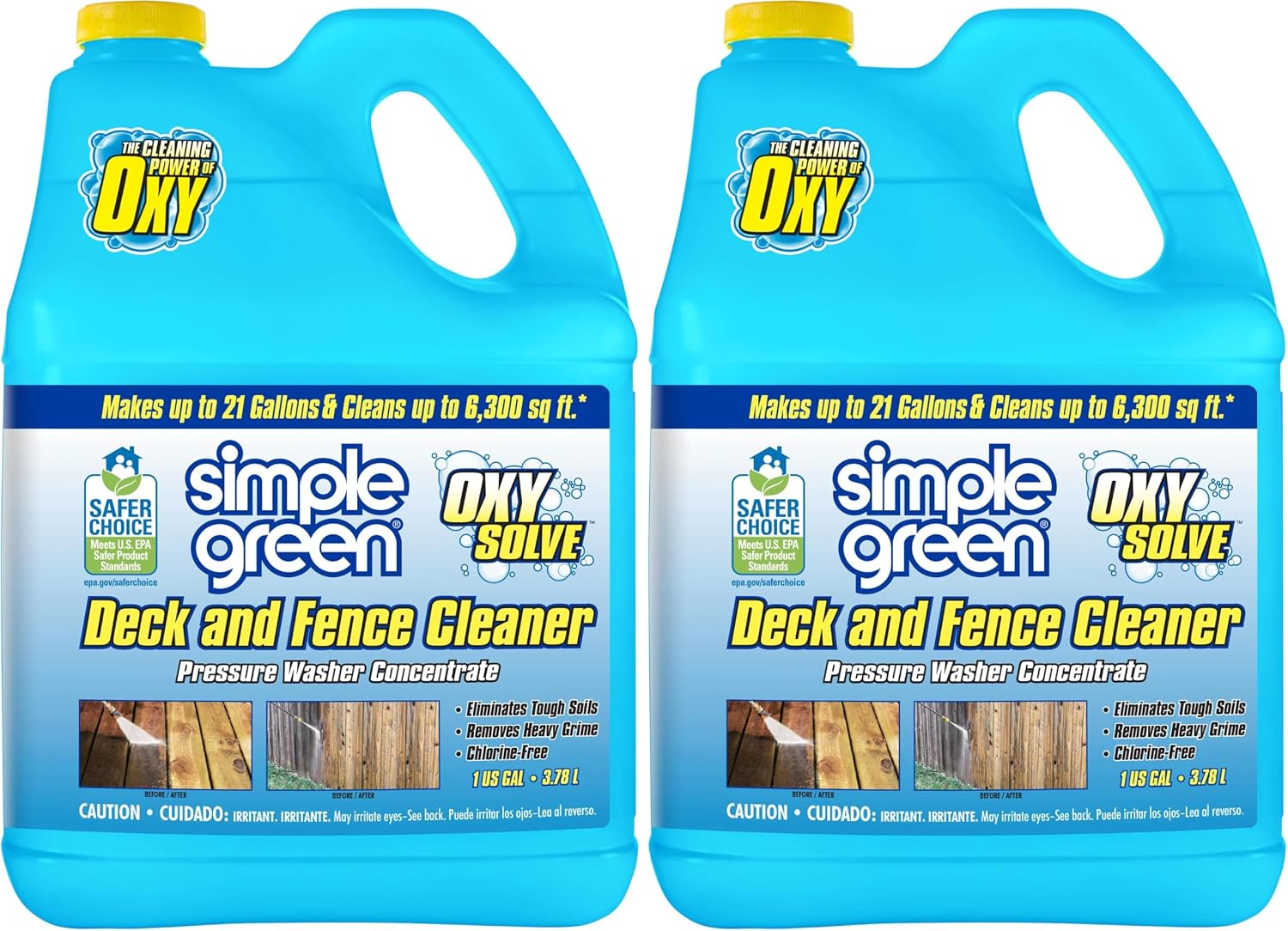
Simple Green Oxy Solve Deck and Fence Cleaner
Jump to Review ↓The 7 Best Deck Cleaners, Reviewed
1. Wet & Forget Outdoor Cleaner & Stain Remover
Wet & Forget Outdoor Cleaner

- Bleach-free and non-acidic, safe for bare, unsealed wood
- Zero scrubbing or pressure washing required
- Works down to 32°F, useful for an early-spring cleaning
- One application can keep surfaces looking clean for up to a year
- Slow results, heavy or long-established staining can take months to fully clear
- Each bottle covers only 60 to 180 square feet, small for a full deck without buying multiple bottles
We earn a commission, at no additional cost to you.
Wet & Forget’s formula is bleach-free and non-acidic, which is exactly what you want on bare, unsealed wood where a harsher chemical would shift the wood’s natural pH. It’s a no-scrub, no-rinse product, you spray it on a dry day and let wind and rain do the rest of the work over the following weeks.
That patience is the tradeoff. The label states green stains clear up in one to two weeks, while black stains or long-established growth can take several months to fully lift. Buyers who go in expecting an instant result are usually the ones disappointed, buyers who treat it as a slow-release treatment tend to report it working exactly as described.

One buyer sprayed half of a moldy vinyl fence and used plain water on the other half as a control, then photographed both sides two weeks later. The treated half came back visibly clean while the water-only half stayed dark, which is about as close to a real side-by-side as an unpaid customer review gets. Another applied it to three cemetery headstones so lichen-covered the dates weren’t readable, spraying three or four times over several visits before scraping the softened growth off with a plastic snow scraper.
Answer 4 quick questions and get matched to the exact fix for your yard — drainage, budget, layout, or something else entirely.
Take the Free QuizThe complaints follow the same pattern: several buyers describe the trigger sprayer requiring repeated pumping to cover anything larger than a few sidewalk panels, and one reviewer treating a shaded front yard with heavy moss said the stonework around a flowerbed showed almost no change after a full application cycle, moss is tougher for this formula than mold or algae film. The label itself also warns to keep it away from anywhere kids play, since it’s still a chemical treatment even without bleach in the formula.
2. Simple Green Oxy Solve Deck and Fence Pressure Washer Cleaner
Simple Green Oxy Solve Deck and Fence Cleaner
- EPA Safer Choice Certified, an actual third-party safety review, not just marketing language
- Peroxide-based formula lifts grease and tree sap without chlorine bleach's wood-fiber damage
- Massive coverage, up to 6,300 square feet per concentrate bottle through a pressure washer
- Also rated for pergolas, gazebos, and carports, useful if you're cleaning more than just the deck boards
- Formulated for pressure-washer use, less convenient if you only own a hose-end sprayer
- Concentrate needs to be diluted correctly, which adds a step compared to a ready-to-use bottle
We earn a commission, at no additional cost to you.
This is the oxygenated formula this guide keeps pointing to as the safer middle ground between bleach and doing nothing. The Amazon-listed ingredient panel confirms it: water, two ethoxylated alcohols, hydrogen peroxide, tetrasodium glutamate diacetate, a surfactant blend, and citric acid, no chlorine bleach anywhere in the formula. Simple Green’s own product page also lists this line as EPA Safer Choice Certified, meaning it’s been reviewed against the EPA’s ingredient-safety criteria for people, pets, and aquatic life.
Manufacturer directions call for a 3 to 5 minute dwell time at low pressure, then a high-pressure rinse from at least 2 feet away. Mixed for manual use, the concentrate stretches to roughly 21 gallons of ready-to-spray cleaner, which is where the 6,300-square-foot coverage claim comes from.
Reviewer accounts back up the peroxide chemistry claim with real detail. One buyer with a 22-year-old deck that had been stained multiple times let the product dwell for 20 minutes before pressure washing, and reported it stripped the old stain cleanly enough that new stain went on smooth. Another let it sit longer than the label suggested on a badly neglected deck and called the result “amazed how clean it turned out,” which lines up with a pattern in the reviews: buyers who extend the dwell time past the minimum tend to report stronger results than buyers who rinse right at the 3-minute mark.
Not every account is glowing. One reviewer testing it on small engine parts (an off-label use) found it “not real effective” on baked-on grime even after extended dwell time, and another said their wood deck showed no noticeable difference after following the directions exactly, a reminder that oxygenated cleaners are still gentler than bleach and can need a second application on genuinely heavy buildup.
3. Home Armor Deck & Patio Wash
Home Armor Deck & Patio Wash

- Manufacturer-rated across wood, composite, concrete, and stone in a single bottle
- No scrubbing, visible results within a 10-minute dwell time
- Clear plant-safety directions built into the label
- Active ingredient is sodium hypochlorite (bleach), despite marketing copy that doesn't use the word "bleach"
- Smaller review base than some of the more established brands on this list
- 1-gallon size means multiple bottles for a larger deck and patio combination
We earn a commission, at no additional cost to you.
Most yard problems trace back to one specific, fixable cause. Find yours in 4 quick questions.
Take the Free QuizThis is the pick the manufacturer markets as safe across the material mix most decks actually have: wood, composite, concrete, and stone in one formula. That matters if your deck has composite boards but a stone patio landing or a wood-framed stair, since you’d otherwise need a separate cleaner for each surface.
Here’s the detail worth knowing before you buy: the ingredient panel on the product’s own Amazon listing names sodium hypochlorite, chlorine bleach, as the active ingredient. That doesn’t match the “surfactant blend, no-scrub” framing the front-of-bottle marketing leans on, and it’s worth knowing given the pH and lignin-damage concerns this guide raises about chlorine bleach elsewhere. Barr Brands, the manufacturer, still rates it safe for wood and composite when used at the labeled dilution, so if you go with this one, follow the dilution ratio exactly rather than applying it full-strength the way you might with a true surfactant cleaner.
The label calls for a 10-minute dwell time with no scrubbing, and the directions explicitly note rinsing surrounding plants before and after application, a detail worth following exactly given how close most deck perimeters sit to garden beds and given that this is a bleach-based formula.
Buyer reviews back the bleach chemistry up in practice. One reviewer with an 18-year cleaning routine on a 23-year-old deck uses this product every spring to strip failing deck paint before touch-up sanding, crediting it with keeping the original wood in service for over two decades. Another reported it stripped mold off a vinyl top rail completely in one application, “wear old clothes when using” being their one caution.
A third reviewer, cleaning a stone patio, called the result only a slight visible change and said it wasn’t a substitute for pressure washing on deeply set-in grime.
4. RMR House and Siding Wash: Best Fast-Acting Mold & Mildew Stripper
RMR House and Siding Wash

- Fastest, strongest formula on this list for heavy black mold and algae
- No-scrub, hose-end application, minutes rather than weeks for visible results
- Trusted in commercial settings (hospitals, schools, municipalities per the manufacturer), a real signal of consistent strength
- Bleach-based, not rated for bare, unsealed wood decking, use it on painted or sealed surfaces instead
- Requires eye protection and rubber gloves per the manufacturer's own directions, more PPE than the gentler formulas need
We earn a commission, at no additional cost to you.
RMR is the one heavy-hitter on this list, a commercial-grade, bleach-based formula built for the kind of black mold and algae staining that a gentler oxygenated cleaner would need weeks to fully lift. It’s fast, no-scrub, and rated for painted wood, PVC, vinyl, and other hard exterior surfaces.
Here’s the catch nobody puts in the headline: it’s rated for painted wood trim and hard surfaces, not bare, unsealed decking boards. Save this one for painted rails, PVC fascia, or a composite railing post, and reach for one of the wood-safe picks above for the actual deck boards themselves.
RMR Solutions is a certified veteran-owned business founded in 2013 by Chris Atkinson, who grew it from a small mold-restoration company into, per the brand’s own account, the largest non-franchise restoration company in southeast Michigan before building this line of commercial-grade cleaners. That commercial-restoration background is the actual source of the “trusted by hospitals and schools” claim, not a generic marketing line.
Reviewer accounts confirm it’s genuinely strong. One buyer sprayed a second-story gray-turned-black vinyl exterior and reported the first application removed roughly 99 percent of the discoloration. Another used it specifically on siding that had gone from white to visibly black with mildew and got it back to white in a single pass, though they noted needing extra bottles to finish the whole house.
The recurring caution across reviews is worth repeating here: several buyers mention overspray leaving small bleach spots on their own clothing, and killing nearby plants when they didn’t cover them first. Both are consistent with this being a genuine bleach formula, not a gentler alternative.
The average homeowner spends $616/year on yard fixes that don't address the real problem. Find out what yours actually is — before you spend another dollar.
Take the Free Quiz


5. 30 SECONDS Outdoor Cleaner
30 SECONDS Outdoor Cleaner

- Label-stated safe for lawn, trees, shrubs, and landscaping when used as directed
- Three-bottle pack covers a meaningful stretch of deck without buying refills mid-project
- Works on wood decks, concrete, brick, and vinyl siding without switching products
- Less specialized than a dedicated composite-safe formula if that's your specific deck material
- Moderate coverage per bottle (roughly 200 square feet on porous surfaces like bare wood) means a big deck needs the full 3-pack
We earn a commission, at no additional cost to you.
This is the pick for a deck that doubles as the dog’s favorite spot or sits three feet from a vegetable bed. The label states it won’t harm lawn, trees, shrubs, or landscaping when used as directed, and it’s specifically called out as effective on wood decks alongside concrete, brick, and vinyl siding.
It ships as three 64-ounce bottles with a hose-end sprayer, no pressure washer required. The 30 SECONDS brand itself dates back to 1977, one of the longer track records among the brands on this list. Reviewers describe it as genuinely “spray and hose off,” no scrubbing, which matches its billing as a low-effort, broad-surface cleaner rather than a specialist formula for one tough problem.
Worth flagging for the “plant-safe” claim specifically: several buyers, including ones who reported good results, independently described the product as smelling like bleach during application, even though it isn’t marketed with the word. One buyer with yellow-colored vinyl siding spot-tested a small area first, waited two hours to confirm no fading, then treated the whole wall and reported the algae and dirt visibly lifting within minutes.
Another with a large stretch of aluminum siding said it removed mildew and lichen with almost no scrubbing but recommended covering AC units and gas meters before spraying. A reviewer who ran it against Dawn dish soap on the same siding two years apart called this product only “slightly better,” a useful data point if you’re comparing it to something you may already have under the sink.
6. Chemwell Oxalic Acid Wood Bleach
Chemwell Oxalic Acid Wood Bleach

- Genuinely restores a grayed, weathered wood deck's original color rather than just removing surface dirt
- 99.6% pure, industrial-grade concentration, a little goes a long way
- Resealable packaging keeps the unused portion usable for a future application
- A powder that needs mixing, more prep work than a ready-to-use spray
- Wood-only, not rated for composite decking, and handling a concentrated acid means real PPE is required
We earn a commission, at no additional cost to you.
This one is a different category from the other six. It’s not a mold or grime cleaner, it’s a wood brightener, 99.6% pure oxalic acid that restores a sun-grayed, tannin-stained deck board to something closer to its original color. Per Treated Wood’s technical guidance, an oxalic acid brightener is actually the correct follow-up step after an oxygenated cleaner, since it neutralizes the sodium percarbonate residue and restores the wood’s natural pH.
This is a powder, not a ready-to-use spray, so you’re mixing your own dilution and handling a genuine acid. Gloves and eye protection aren’t optional here, and it should never be mixed with a bleach-based cleaner, that combination is a real safety hazard, not just an ineffective one.
Chemwell’s own product description calls out that it dissolves quickly and is meant for targeted, controlled application rather than a full-surface soak, and buyer reviews back that framing up. One buyer used it at full saturation on old oxidized redwood siding and described the color change as “night and day.” Another treating rust stains from iron-heavy well water on a stone driveway followed the directions and eliminated roughly 95 percent of the staining on the first pass, noting that a second, more liberal application finished the rest.
Not every account is a quick fix. One reviewer working on a concrete and stone entryway said it took multiple applications on the most stubborn sections and, in their words, “works better than expected” but isn’t a one-and-done etching acid the way some marketing implies. That patience matches how oxalic acid actually behaves as a brightener, not a scrub-and-done cleaner.
7. Home Armor Outdoor Cleaner Concentrate
Home Armor Outdoor Cleaner Concentrate

- Cartridge refill system stretches further per dollar than most ready-to-use bottles
- Visible results within minutes, no scrubbing required
- Works across wood, brick, concrete, and vinyl in one system
- Made by WM Barr, an established manufacturer with a long history in this category
- Active ingredient is sodium hypochlorite (bleach), despite "surfactant" framing on the front label
- Not rated for cedar or redwood decking under two years old
- Directions require rinsing surrounding plants before and after, an extra step some ready-to-use sprays skip
We earn a commission, at no additional cost to you.
This is the pick for a big deck or a whole backyard cleaning day. It’s built around a refillable cartridge system the manufacturer describes as roughly twice the cleaning strength of an ordinary ready-to-use outdoor cleaner, which pushes the effective cost per square foot down compared to a standard spray bottle.
It’s made by WM Barr, the same manufacturer behind the Deck & Patio Wash pick above, and like that product, the Amazon-listed ingredient panel names sodium hypochlorite as the active ingredient, this is a bleach-based concentrate, not the “surfactant blend” framing its own marketing copy suggests.
The label is specific about one limitation worth flagging: it’s not rated for cedar or redwood under two years old, since young softwood is more reactive to the concentrate’s chemistry than older, weathered lumber. Everything else, wood, brick, concrete, vinyl, is fair game, provided you dilute and rinse per the directions.
Reviewer accounts describe real, varied results. One buyer with a permanently shaded, algae-covered stretch of siding said the green film washed off in about 10 minutes with no scrubbing. A reviewer with aluminum siding rated it four stars specifically because the bleach smell was strong in summer heat, though they noted it didn’t harm the hostas, ivy, and ornamental grasses growing directly beneath the treated wall.
A third buyer used it full-strength on new brick mortar that clashed with 36-year-old sidewalk brick and got a close color match after letting it sit longer than the label’s minimum dwell time.
Deck Cleaner Comparison Table
| Product | Chemistry | Best For | Wood-Safe | Composite-Safe |
|---|---|---|---|---|
| Wet & Forget | Bleach-free surfactant | Bare wood, no-scrub | Yes | Yes |
| Simple Green Oxy Solve | Oxygenated (peroxide) | Pressure-washer jobs | Yes | Yes |
| Home Armor Deck & Patio Wash | Chlorine bleach (sodium hypochlorite) | Mixed wood/composite decks | Yes, per manufacturer | Yes, per manufacturer |
| RMR House and Siding Wash | Chlorine bleach | Painted wood, hard surfaces | Painted/sealed only | Check label |
| 30 SECONDS Outdoor Cleaner | Surfactant blend | Pet- and plant-adjacent decks | Yes | Yes |
| Chemwell Oxalic Acid | Acid brightener | Gray, weathered wood | Yes | No |
| Home Armor Concentrate | Chlorine bleach (sodium hypochlorite) | Large decks, best value | Yes (not young cedar/redwood) | Yes |
How We Picked These Deck Cleaners
We started from products that actually show up as top sellers in the outdoor and deck-cleaner categories on Amazon, not a random sample pulled from a single search page. From there we narrowed to seven that cover the real decision points a deck owner faces.
That means chemistry (oxygenated vs. chlorine bleach vs. acid brightener), wood-only vs. wood-and-composite compatibility, and whether the household has pets, kids, or garden beds close to the deck.
We deliberately included one bleach-based, one plant-safe, and one acid-brightener formula instead of seven variations on the same chemistry, because the real question most buyers are searching for is which chemistry fits their specific deck, not which bottle has the fanciest label.
How We Evaluated Each Pick
This is a research-based roundup, not a lab test. We pulled every spec below directly from each product’s live Amazon listing (active ingredient, coverage area, surface compatibility, application method), read through 15 to 25 individual buyer reviews per product to find real, recurring praise and complaints rather than relying on the AI-generated review summary Amazon now shows on each listing, and cross-checked the wood-safety and composite-safety claims against manufacturer care guides, specifically Trex’s own published cleaning guidance and Treated Wood’s technical explainer on why bleach damages wood fiber.
A verified-purchase review carried more weight in our read than an unverified one, and a review with a specific detail (deck age, wood species, how many applications it took) got weighted over a one-line “worked great” or “didn’t work” with nothing else attached. That’s also why the ingredient list on the product’s own Amazon listing page, not the front-of-bottle marketing copy, is what we used to write the “active ingredient” claims below.
Two of the seven products here market themselves with language like “no bleach smell” or “surfactant blend” while their own Amazon-listed ingredient panel names sodium hypochlorite, which is chlorine bleach. We flag that directly in each product’s review rather than repeating the marketing framing.
Where we describe a product’s real-world performance, that’s paraphrased from patterns across many buyer reviews, not our own side-by-side test. We’re upfront about that distinction throughout this guide.
What to Look for When Buying a Deck Cleaner
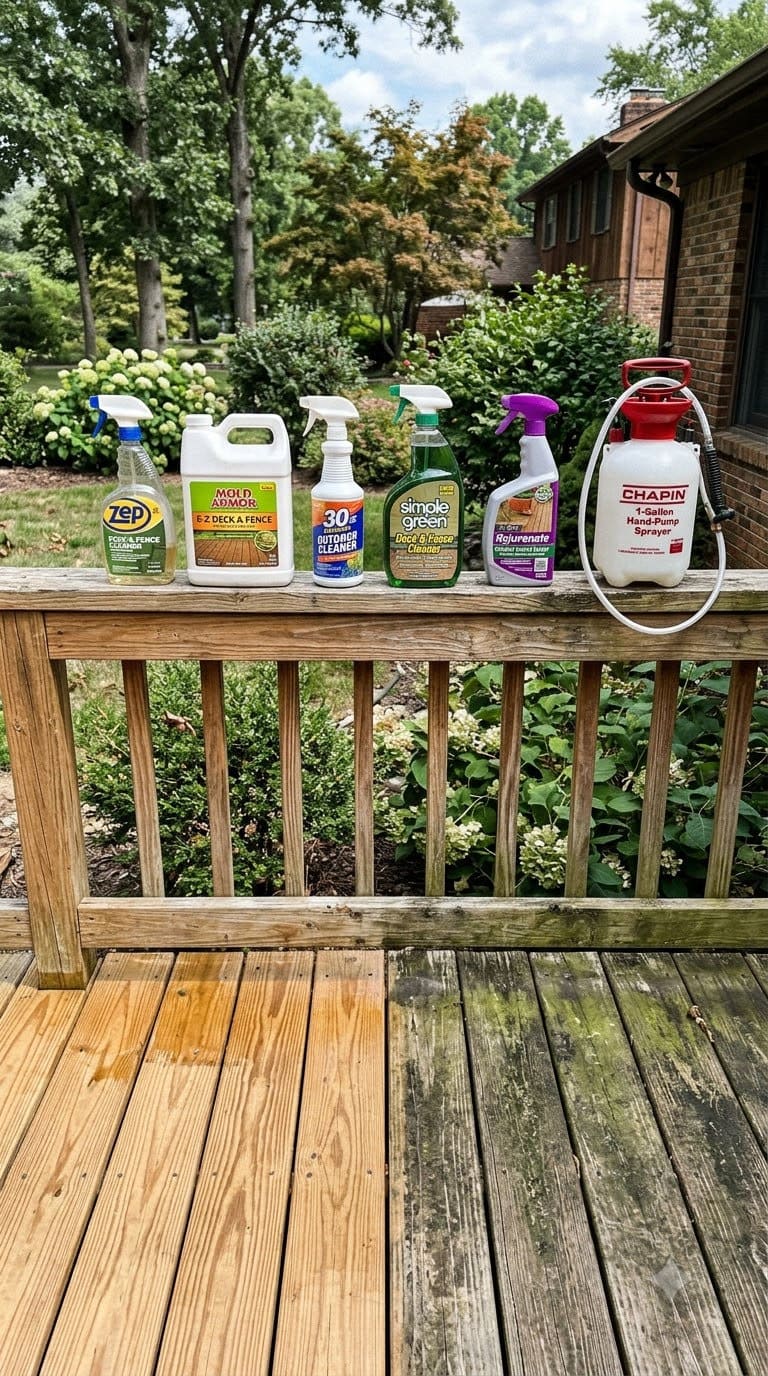
Wood vs. composite compatibility
This is the single most important spec on the label. Chlorine bleach and acid-based cleaners can lighten composite boards and, per Trex’s own care guide, can void the manufacturer’s warranty.
A cleaner labeled safe for “wood and composite” has been formulated to avoid that specific reaction.
Active ingredient and chemistry
Oxygenated cleaners (sodium percarbonate, a hydrogen-peroxide-based compound) lift mold and mildew without the pH swing that damages wood lignin. Chlorine bleach cleaners work faster on heavy black mold but carry real tradeoffs: they corrode metal fasteners, can harm nearby plants, and, per Treated Wood’s technical write-up, actually break down the cellular structure of the wood itself over repeated use. Oxalic acid is a different category entirely, a brightener that restores a grayed, weathered wood surface rather than a general cleaner.
Concentrate ratio and coverage area
A gallon of concentrate that covers 1,000+ square feet costs less per application than a ready-to-use bottle that covers 200. Check the label’s dilution ratio, not just the bottle size, before comparing price.
Do the math before you buy: Simple Green Oxy Solve’s own manufacturer directions call for mixing 1 part concentrate to 20 parts water for manual application, which is why a single 128-ounce bottle stretches into roughly 21 gallons of ready-to-spray cleaner. A ready-to-use bottle, by contrast, is already at full strength, no dilution math needed, but you’re paying for water shipped in the bottle. For a 300 to 400 square foot deck, a concentrate diluted at 1:20 will almost always beat a ready-to-use spray on cost per application.
Application method
Pump sprayer, hose-end sprayer, or pressure-washer concentrate each suit a different deck size. A hose-end sprayer is faster for a small deck, while a pressure-washer concentrate makes more sense for a large deck or a whole exterior cleaning job.
Safety around plants, pets, and metal
Look for explicit label language about rinsing nearby plants before and after application, and check whether the formula is safe near pet-traveled areas once it’s dry. Never mix two different deck-cleaning chemicals together, and always follow the label’s dilution ratio rather than eyeballing it.
Chlorine bleach cleaners also carry a metal risk most buyers don’t think about until it happens: repeated contact with deck screws, joist hangers, and railing brackets can accelerate corrosion over years of seasonal cleaning, which is one more reason an oxygenated formula is the safer long-term default for a deck’s structural fasteners, not just its surface color.
Reapplication frequency
A clean deck doesn’t stay clean forever. Most cleaner labels and manufacturer guidance point to a twice-a-year cadence, spring and fall, with a heavily shaded or tree-covered deck sometimes needing a mid-summer touch-up for pollen and algae regrowth.
Oxalic acid brightening is a different clock entirely, it’s a once-a-year-or-less step done only when the wood has actually grayed, not a routine cleaning task.
Price per square foot
Expect roughly $8 to $20 per gallon for a ready-to-use or lightly diluted formula, and less per square foot for a true concentrate. A pricier bottle that covers 6,000+ square feet can actually be the cheaper option on a per-application basis.
Once your deck is clean, ways to extend the life of your deck covers the sealing and maintenance steps that keep it looking that way, and if you’re leaning toward a pressure washer for the job, our guide to pressure washer surface cleaners is worth reading first, since the wrong attachment can gouge softwood decking.
Is It Safe to Use Around Pets, Kids, and Plants?
It depends on the specific bottle, not the category. Three of the seven picks here (Wet & Forget, 30 SECONDS, and Simple Green Oxy Solve) carry explicit label language stating they won’t harm lawn, trees, shrubs, or landscaping when used as directed, and Simple Green’s Oxy Solve line is the only one on this list with a genuine third-party review behind that claim, the EPA Safer Choice certification.
The other four, RMR House and Siding Wash, both Home Armor products, and Chemwell’s oxalic acid, are working chemicals in the more traditional sense. RMR’s own product page lists PPE (eye protection and rubber gloves) as required, not optional, and multiple buyers report it will kill uncovered plants if overspray drifts onto them. Both Home Armor products list sodium hypochlorite, chlorine bleach, as their active ingredient on the Amazon-listed ingredient panel, so treat them with the same plant-covering and pet-keep-off precautions you’d use for laundry bleach diluted in a garden sprayer.
Chemwell’s oxalic acid is a mixed-your-own acid powder. Gloves and eye protection are non-negotiable while mixing and applying it, and the manufacturer doesn’t market it as pet- or plant-safe at all, it’s positioned as a targeted wood, metal, and stone treatment, not a broad-surface spray.
The practical rule that holds across all seven: for a chlorine-bleach or acid formula, keep pets off the treated surface until it’s fully dry and rinsed, cover or pre-wet nearby garden beds before spraying, and never mix two different deck-cleaning chemicals in the same container or on the same surface on the same day. Ammonia and bleach in particular can produce dangerous fumes if they end up mixed by accident.
Return Policy & What Happens If It Doesn’t Work
Every product in this roundup ships and sells through Amazon.com directly (not a third-party marketplace-only listing), which means Amazon’s standard 30-day refund or replacement window applies if a bottle arrives damaged, leaking, or defective, the same policy shown on the RMR, Chemwell, and both Home Armor listings we checked directly.
That 30-day window covers a bad bottle, not a cleaner that simply didn’t lift a stain you expected it to lift. None of the seven manufacturers publish a separate satisfaction or money-back guarantee beyond Amazon’s own policy, at least not on the live listing pages we reviewed.
If a product doesn’t work as expected, you’ve got two practical options. Use Amazon’s standard return process within 30 days and keep the original packaging, or try a second application at a longer dwell time before writing the product off, several buyer reviews above describe meaningfully better results the second time around simply from letting the product sit longer than the label’s minimum.
Wet & Forget is the one product designed around patience rather than a fast result, so judge it against its own 1-to-12-month timeline, not a 30-day return window, before deciding it hasn’t worked.
What We Learned the Hard Way
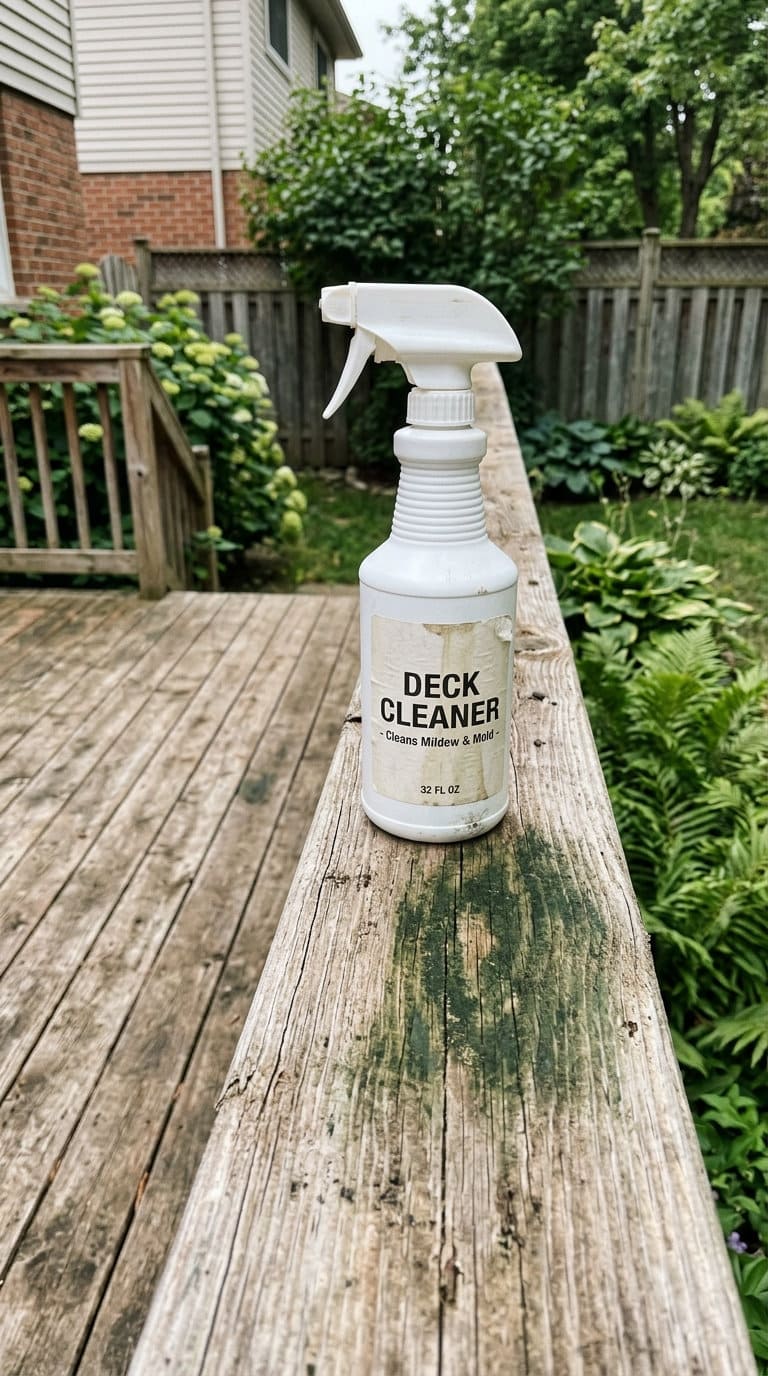
The biggest mistake in that first bleach-cleaning attempt of mine wasn’t the streaking, it was not rinsing the plants along the rail line first. The label said to, and I skipped it because I was in a hurry on a Saturday morning with about 340 square feet of deck still ahead of me.
And here’s the thing that took a second ruined summer to actually learn: chemistry matters more than brand name. A bleach-based cleaner and an oxygenated cleaner can look nearly identical on the shelf, but one of them is breaking down your wood’s lignin while the other one isn’t, per Treated Wood’s own technical explanation of the difference.
If there’s one thing worth doing differently on your first deck-cleaning day, it’s reading the “surfaces” section of the label before the “how to apply” section. That’s genuinely the part that tells you whether the bottle in your hand is even meant for your deck’s material.
I learned that one the same way, on a different job. A neighbor asked me to help clean the composite decking on her new build, and I almost grabbed the same bleach-based cleaner I’d used on my own wood deck out of habit. Her deck’s warranty paperwork, which she’d actually kept, specifically named bleach as a void-the-warranty chemical, and that near-miss is honestly the reason this guide leads with the wood-versus-composite question before anything else.
Ventilation matters too, even outdoors. Work with the wind at your back when spraying a stronger formula, wear the gloves and eye protection the label calls for, and never mix two different cleaning chemicals together, mixing a bleach product with an acid brightener or an ammonia-based cleaner can produce genuinely dangerous fumes. Keep runoff away from grass, garden beds, and anywhere pets spend time until the surface has fully dried.
Once the deck itself is clean, deck color ideas is worth a look if you’re planning to stain or reseal it afterward, and a covered deck setup can meaningfully cut down how often you need to do this whole process again, since shaded boards collect far less mildew than a deck sitting in full sun and rain all season.
Top Picks at a Glance
| Product | Best For | Active Ingredient | Wood/Composite Safe | Buy |
|---|---|---|---|---|
| Wet & Forget Outdoor Cleaner | Best for Bare Wood Decks (No-Scrub, Bleach-Free) | Bleach-free, non-acidic surfactant blend | Both | Buy at Amazon |
| Simple Green Oxy Solve Deck and Fence Cleaner | Best Oxygenated Cleaner for Pressure Washers | Peroxide (oxygenated) | Both | Buy at Amazon |
| Home Armor Deck & Patio Wash | Best for Composite Decks | Sodium hypochlorite (bleach-based), manufacturer-rated for wood/composite | Both, per manufacturer label | Buy at Amazon |
| RMR House and Siding Wash | Best Fast-Acting Mold & Mildew Stripper | Commercial-grade bleach formula | Painted/sealed wood and hard surfaces only | Buy at Amazon |
| 30 SECONDS Outdoor Cleaner | Best Pet- & Plant-Safe Formula | Surfactant blend, label-stated safe on landscaping when used as directed | Both | Buy at Amazon |
| Chemwell Oxalic Acid Wood Bleach | Best for Gray, Weathered Wood | 99.6% pure oxalic acid (wood brightener) | Wood only | Buy at Amazon |
| Home Armor Outdoor Cleaner Concentrate | Best Concentrate / Best Value | Sodium hypochlorite (bleach-based) | Wood, brick, concrete, vinyl (not cedar/redwood under 2 years old) | Buy at Amazon |
Frequently Asked Questions
Can I use bleach to clean a wood deck?
You can, but it’s not the best choice. Chlorine bleach shifts wood’s natural pH and can break down the lignin that holds wood cells together over repeated use, and it corrodes metal fasteners and screws. An oxygenated cleaner (sodium percarbonate) cleans mold and mildew just as effectively without that wood-fiber damage, which is why most of the wood-rated picks on this list skip chlorine bleach entirely.
What’s the difference between a deck cleaner and a deck brightener?
A cleaner removes dirt, grime, mold, and mildew from the surface. A brightener, usually an oxalic-acid formula, goes a step further and actually restores a grayed, weathered wood board closer to its original color. Many pros clean first, then brighten as a separate second step, since a brightener isn’t formulated to lift heavy grime on its own.
Is it safe to use a deck cleaner on composite decking?
Only if the label specifically says so. Trex’s own care guide warns that bleach and acid-based cleaners will lighten composite surfaces and can void the manufacturer’s warranty. Stick to a cleaner labeled safe for composite, and check your specific brand’s care page if you’re not sure, since dilution ratios and safe products can vary by manufacturer.
How often should I clean my deck?
Twice a year is the general rule most manufacturers and cleaner labels point to, once in spring and once in fall, though a heavily shaded deck under trees may need a mid-season touch-up for mold and pollen buildup.
Is deck cleaner safe for pets and plants?
It depends on the specific formula. Look for label language that explicitly addresses lawn, garden, and pet safety, rinse surrounding plants before and after application even when the label says it’s plant-safe, and keep pets off the surface until it’s fully dry and rinsed.
Related Posts
Never miss an update — choose FarmFoodFamily as your preferred source on Google.
How it works: Tap the button below to open Google's settings page, then check the box next to FarmFoodFamily.
Tap the checkbox to turn it blue — that's how you know it's set.