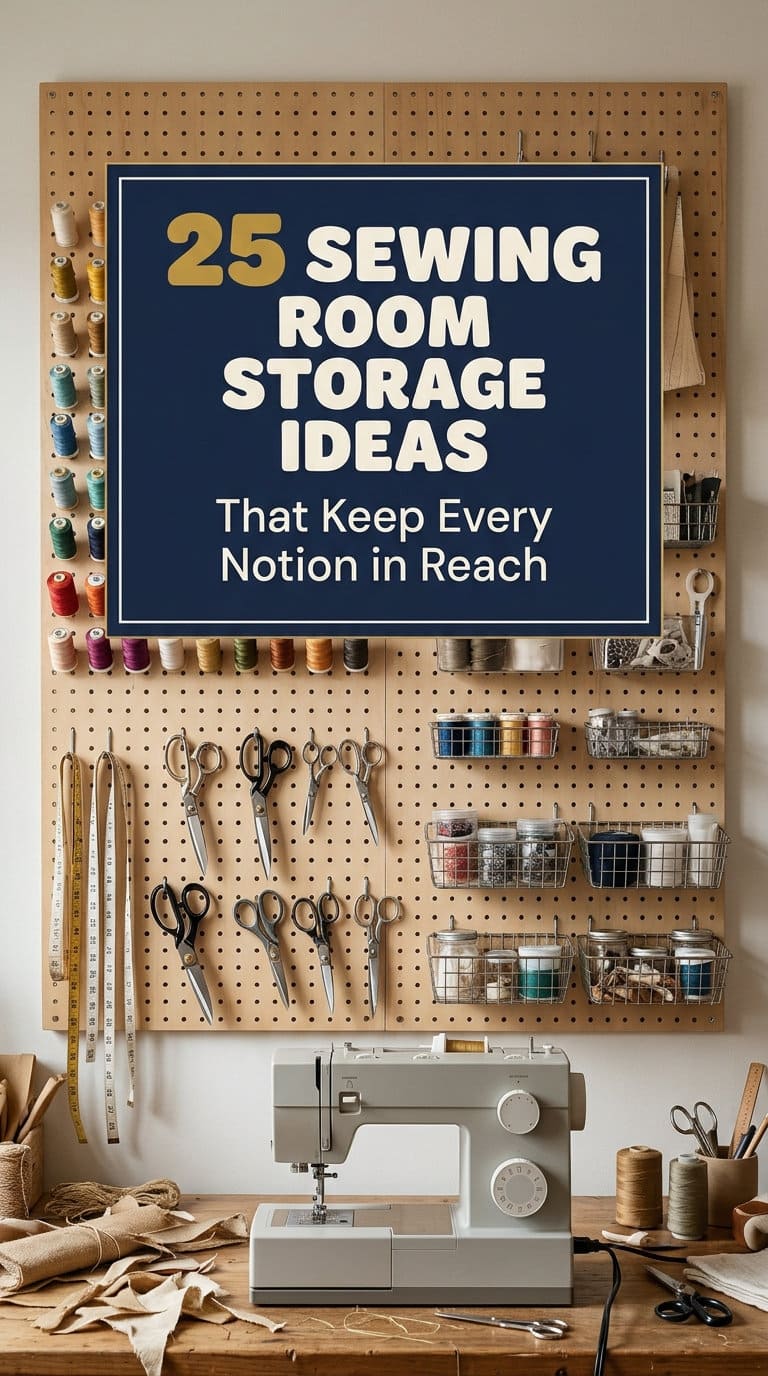
25 Clever Sewing Room Storage Ideas That Keep Every Notion in Reach
Good sewing room storage puts thread, pins, and patterns within arm’s reach, as long as you set it around your work heights and keep fabric away from light, damp, and raw wood.

Never miss an update — choose FarmFoodFamily as your preferred source on Google.
How it works: Tap the button below to open Google's settings page, then check the box next to FarmFoodFamily.
Tap the checkbox to turn it blue — that's how you know it's set.
Good sewing room storage puts thread, pins, and patterns within arm's reach, as long as you set it around your work heights and keep fabric away from light, damp, and raw wood.
Products We Recommend
This post contains affiliate links. We may earn a commission on qualifying purchases at no extra cost to you.

New brothread 2X60 Spools Wooden Thread Rack
Two 60-spool racks that stand on fold-out legs or hang on the wall, built for small embroidery and quilting spools. Wood is fine for thread, but keep stored fabric off raw wood.
Shop Now
Amazon Basics 3-Tier Rolling Utility Cart
A white three-shelf cart with lockable wheels that rolls from the machine to a closet. Shelves are open, so use small bins for pins and bobbins.
Shop Now
Spampur Peg Board, 4 Pack Metal Pegboard Panels with 50 Hooks
Four steel 16 x 12 in panels with 1/4 in holes that join into one wall, plus 50 hooks for scissors and spools. Mount into studs or rated anchors.
Shop NowA sewing room gets messy fast. One project leaves scraps, pins, and bobbins on every flat spot.
But the fix is not more bins. It’s the right home for each tool, placed where your hands already go.
These 25 ideas are sorted by what you store. Each one has steps and our view on who it suits. We also cover what can harm fabric while it sits on a shelf.
Quick Answer
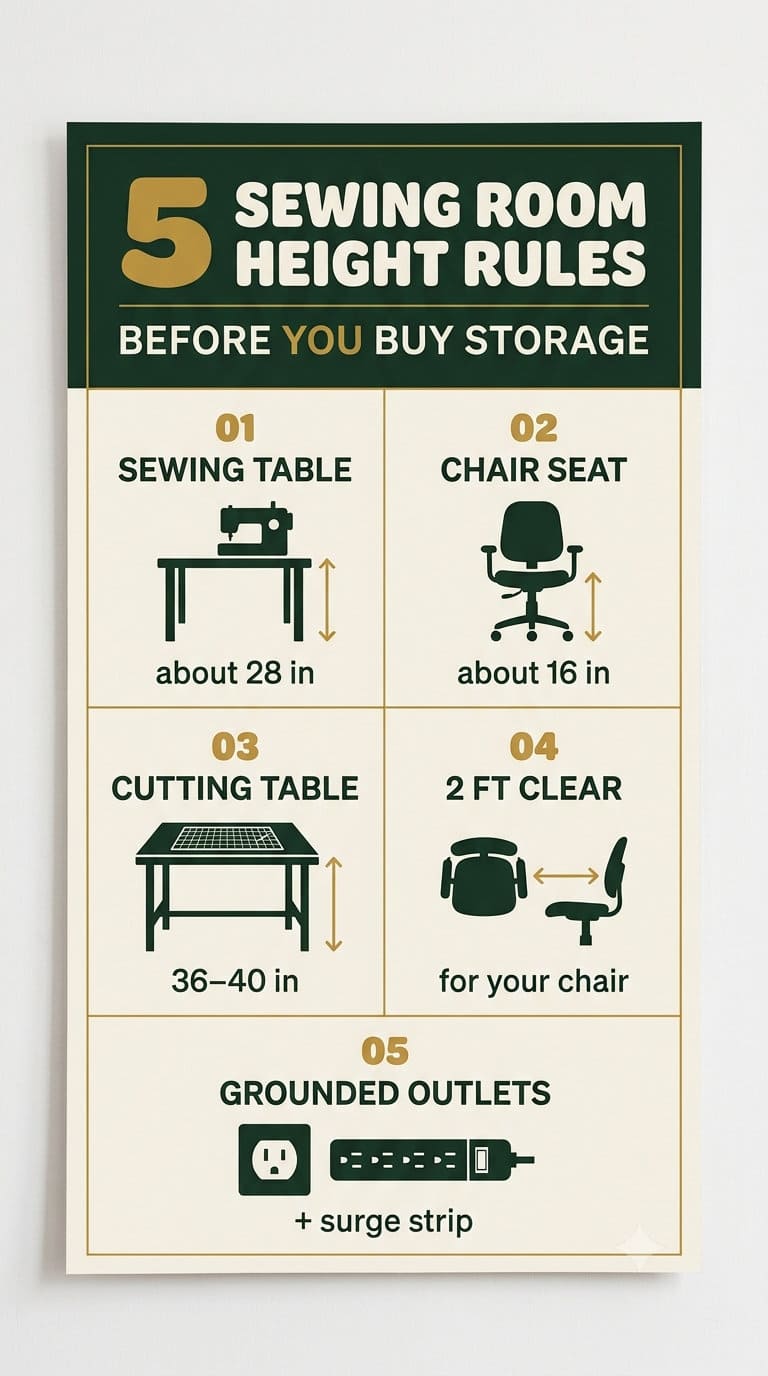
Start with your work heights, then store each tool near the spot where you use it. NMSU Extension agent Cydney Martin suggests a sewing table about 28 inches high and a cutting table 36 to 40 inches high. Leave at least 2 feet of open floor in front of the work area for your chair.
Next, split the room into zones by task. Thread and pins go on the wall by the machine, and rulers go at the cutting table. Patterns go in a file drawer, and the iron stays near an outlet.
Fabric needs more care than tools. The Canadian Conservation Institute says to keep textiles cool, dark, dry, and well aired. It warns against raw wood, plain cardboard, and moth balls.
Use clear, labeled bins for small parts. That way you can see what you own before you buy more.


How Should You Plan Sewing Room Storage?
Plan the room before you buy a bin. Each tool should sit at the height of the job it does. If you can pay for just one fix, we’d put the cash into table height first.
| Zone | What lives here | Height or space to plan for |
|---|---|---|
| Sewing table | Machine, bobbins, pins, scissors | Table about 28 in, chair seat about 16 in |
| Cutting table | Rotary cutters, rulers, mats | 36 to 40 in high, about 3 ft wide and 6 ft long |
| Seating area | Your chair and legs | At least 2 ft clear in front of the work area |
| Fitting spot | Full-length mirror | Room to stand 2 to 3 ft back |
| Power | Iron, machine, lamp | Grounded outlets, a surge protector for the machine and lamp, the iron in its own wall outlet |
Keep the machine bed level with the tabletop. A raised bed drags on big jobs, and the stitches suffer.
Thread and Notions Storage Ideas
1. Pegboard Wall Behind the Machine
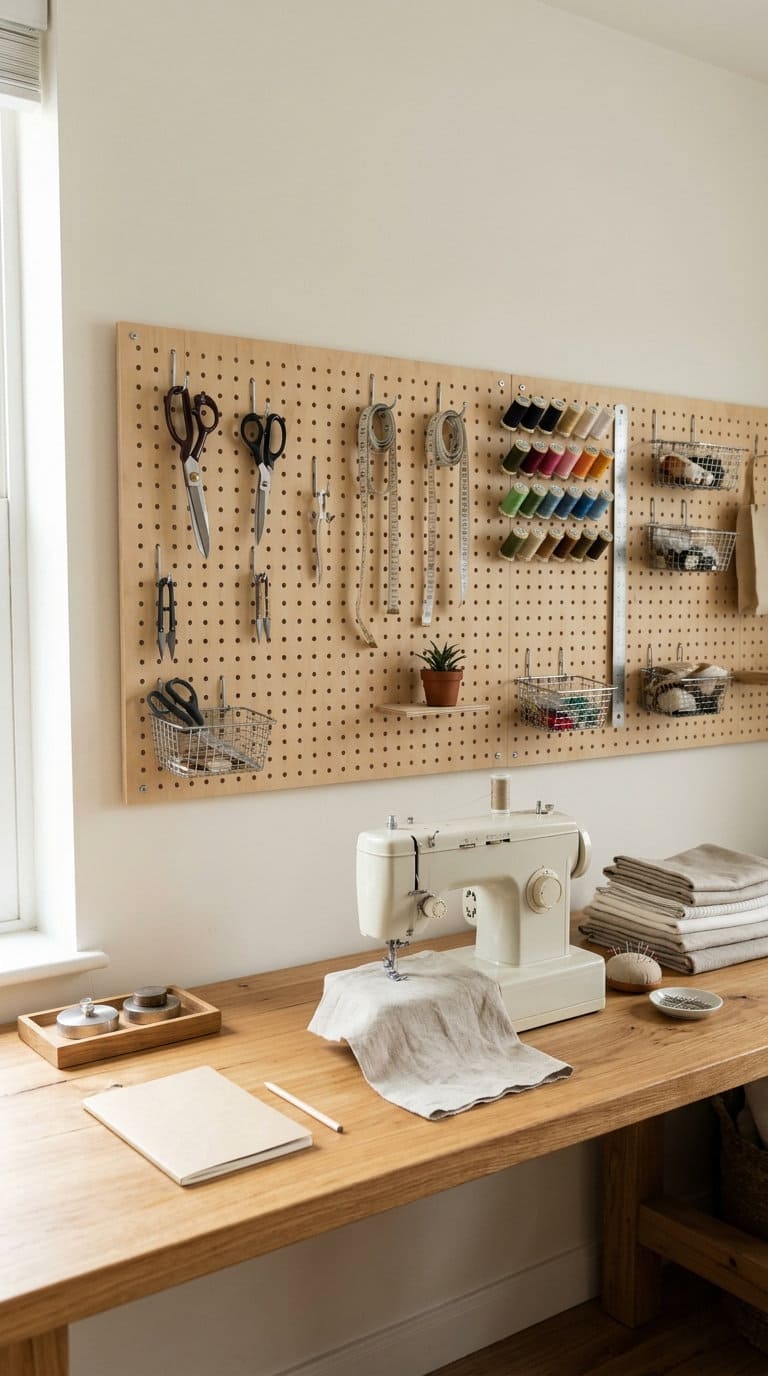
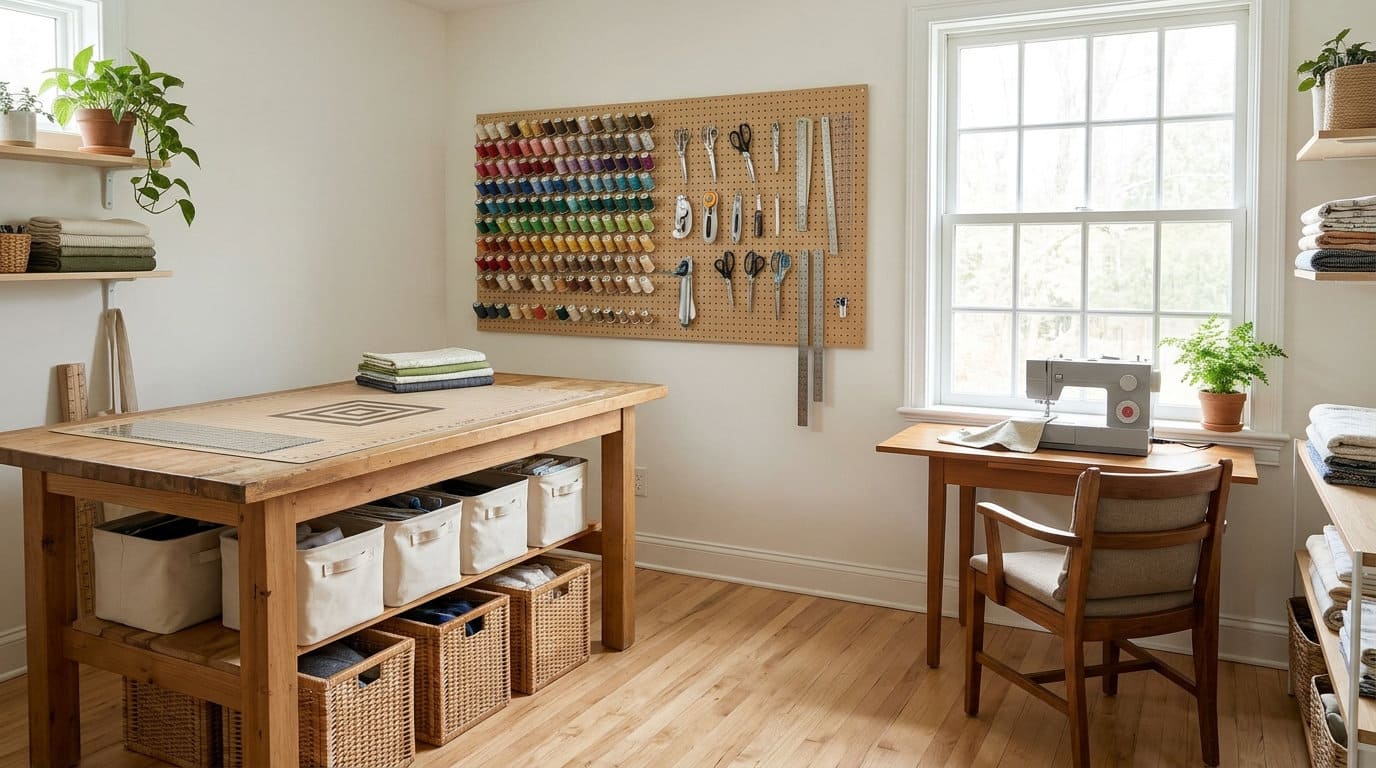
A pegboard turns blank wall into storage you can change any time. Mount it on furring strips so the hooks have room behind the board. Hang scissors, tape measures, seam rippers, and spools on short pegs.
Place it just above and to the side of your machine. You should reach it without standing up. For most rooms, this is the first piece we’d put up, since it frees the table.
Cost: low, since one board and a hook kit cover a small wall.
Test: sit in your chair and stretch your arm. Anything you use each session should hang inside that reach.
2. Wall Thread Rack Sorted by Color
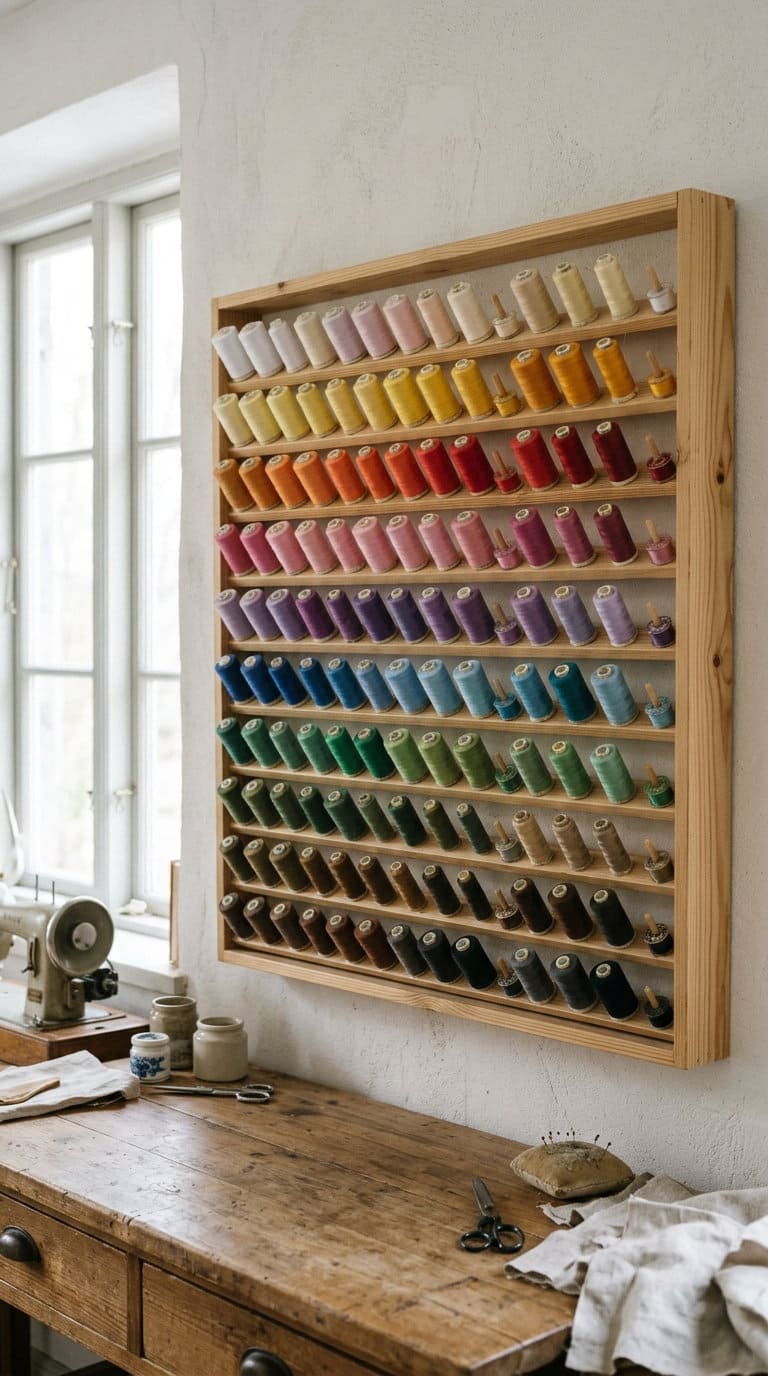
A wall thread rack keeps spools upright and in view. Sort by color from light to dark, so you can match a fabric at a glance. Keep it out of direct sun, which can fade the color.
Hang a second, smaller row for bobbins next to the matching spool. Then the top and bottom thread always match.
Two 60-spool racks that stand on fold-out legs or hang on the wall, built for small embroidery and quilting spools. Wood is fine for thread, but keep stored fabric off raw wood.
Shop NowThis post contains affiliate links. We may earn a commission on qualifying purchases at no extra cost to you.
An open rack suits people who sew each week. If yours would sit and gather dust, pick the drawer in idea 4.
3. Thread Tree for Serger Cones
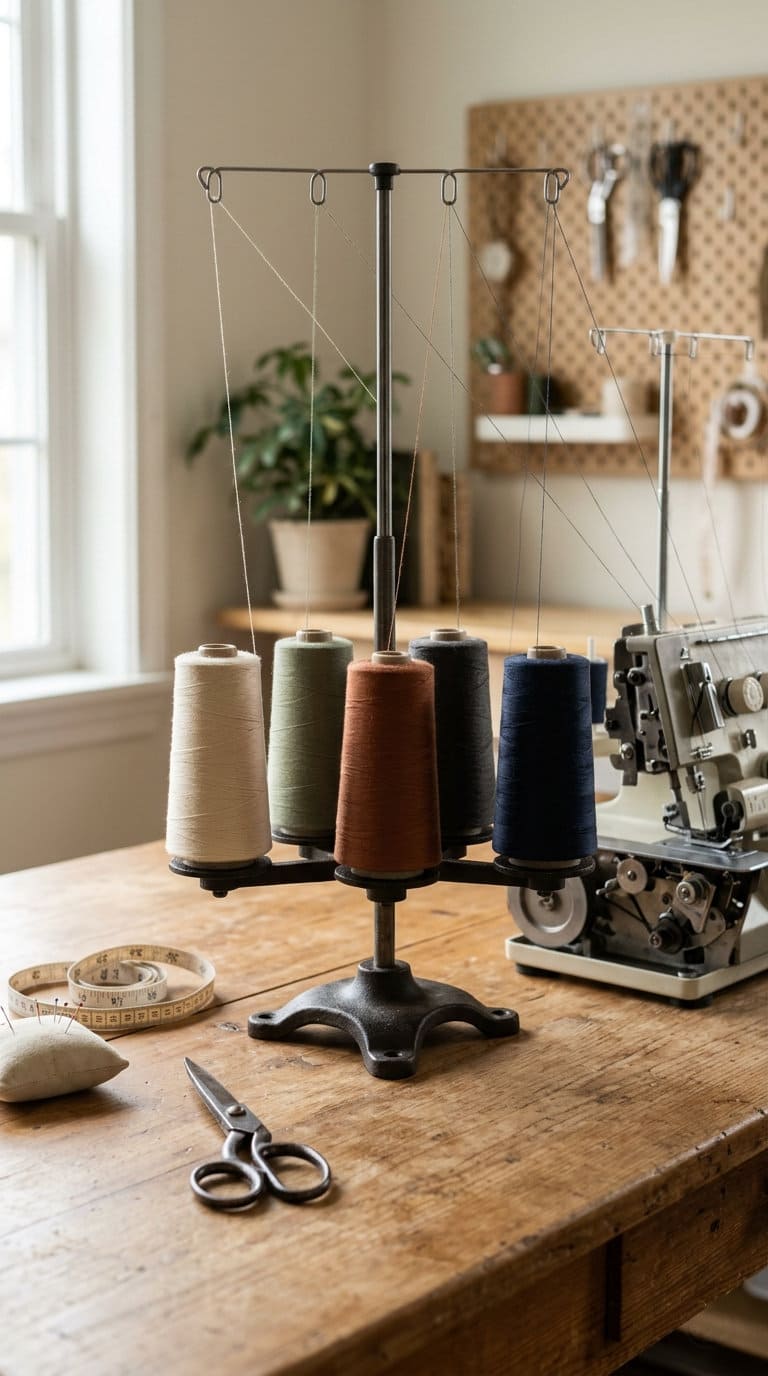
Serger cones are too tall for most spool racks. A thread tree, a stand with tall pegs, holds them upright. Set it on the serger table so you can change colors without leaving your seat.
Tip: group cones in sets of four, a match for a four-thread serger. Then a full color change is one grab. Skip the tree if you own just a few cones, since a shelf does the same job.
4. Long Narrow Boxes for Thread
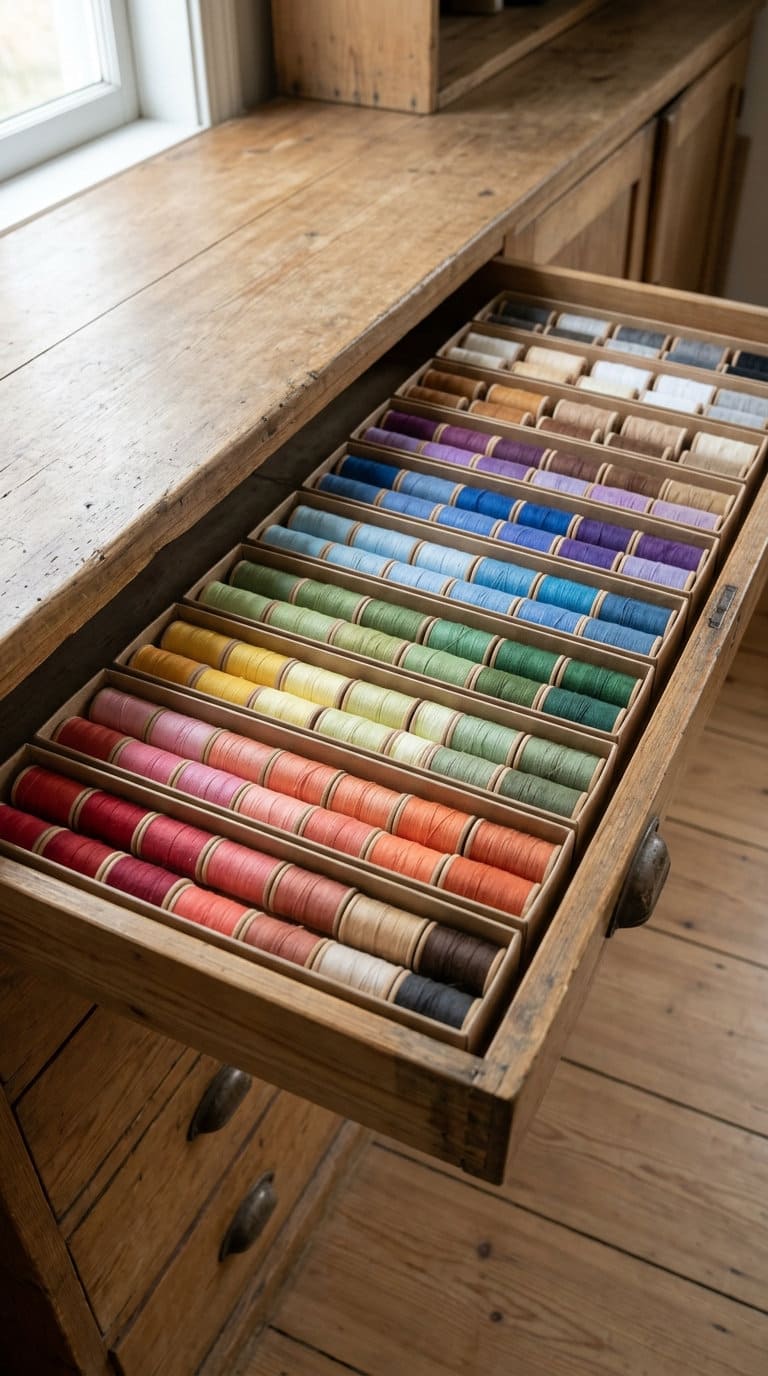
If you don’t want thread on the wall, use long, narrow boxes in a drawer. Give each row one color family. We like this better than a wall rack in a sunny room, because the drawer blocks the light.
A shallow drawer keeps spools from piling up and tangling. Label the front of each box so you can find a color with the drawer half open.
5. Jar Lids Screwed Under a Shelf
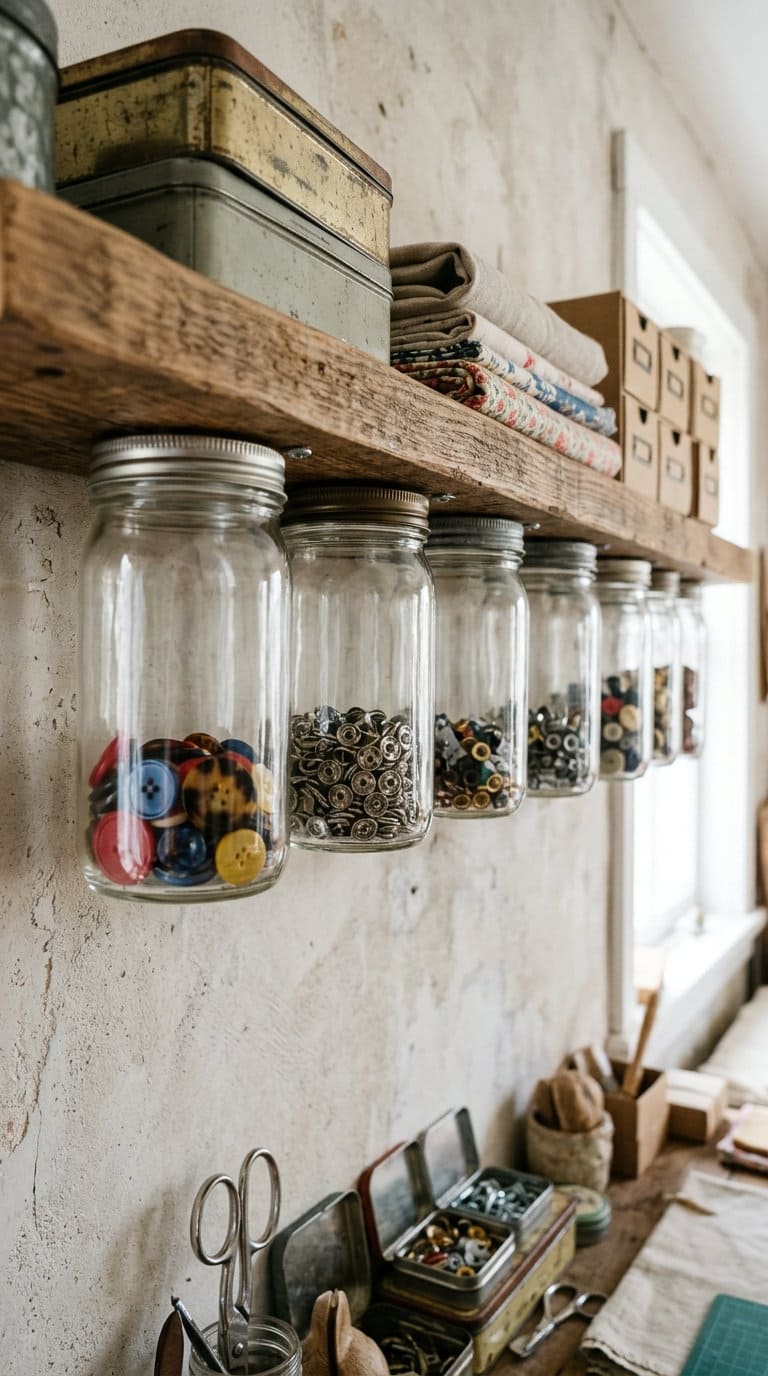
Screw jar lids to the bottom of a shelf, then twist jars into them. It’s an old workshop trick, and it earns its place because you see every button at a glance.
Fill them with buttons, snaps, bobbins, or safety pins. Cost: close to free if you reuse jars from the kitchen. Check: use two screws per lid so a full jar does not spin loose.
Keep the jars small and off any shelf you walk under. Glass at head height is a poor trade for tidy snaps.



6. Coffee Can Elastic Dispenser
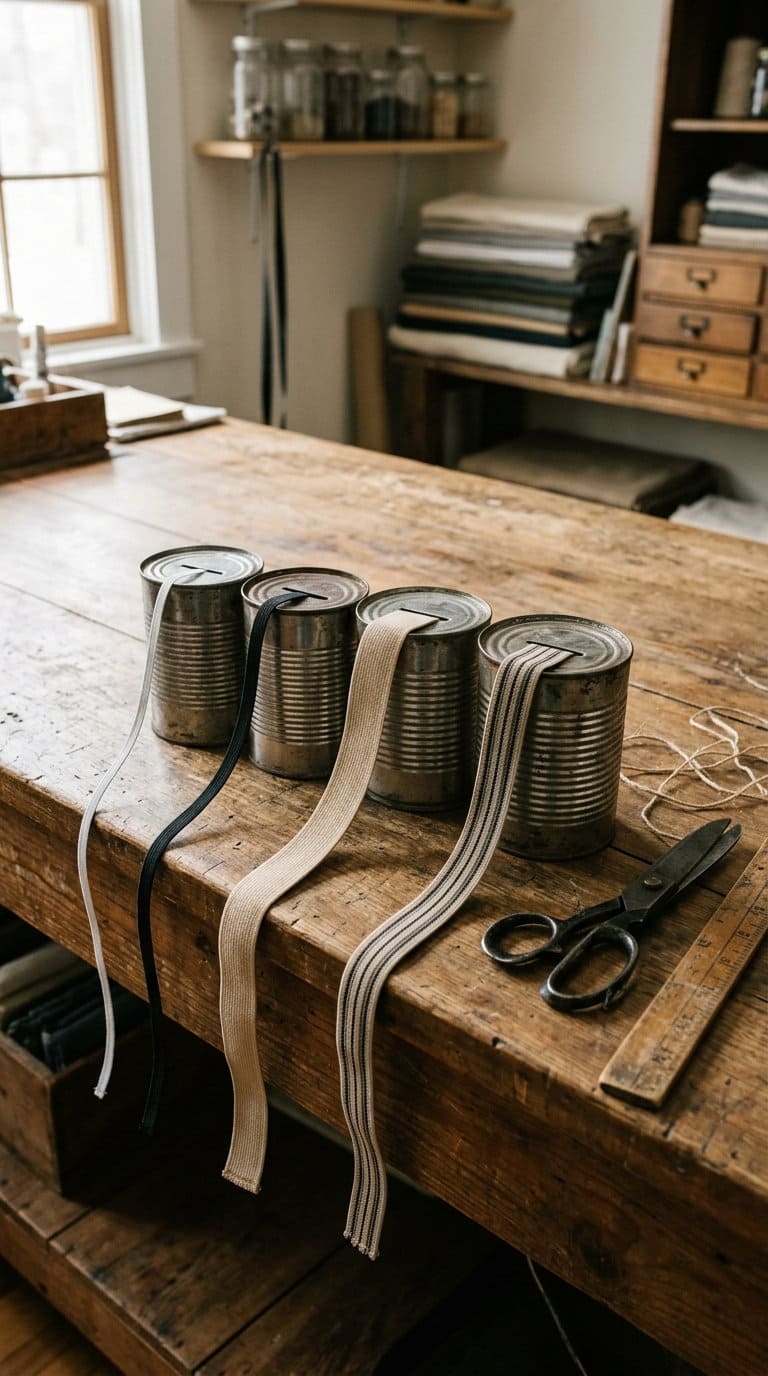
Loose elastic tangles fast. Cut a slot in the lid of a clean coffee can, drop the roll inside, and pull the end through the slot.
You can stack several cans, one per width. Label each lid, and tape the cut edge so it does not snag. It looks homemade, and we think that’s fine for a tool that lives in a drawer.
7. Magnetic Strip for Pins and Small Metal Tools
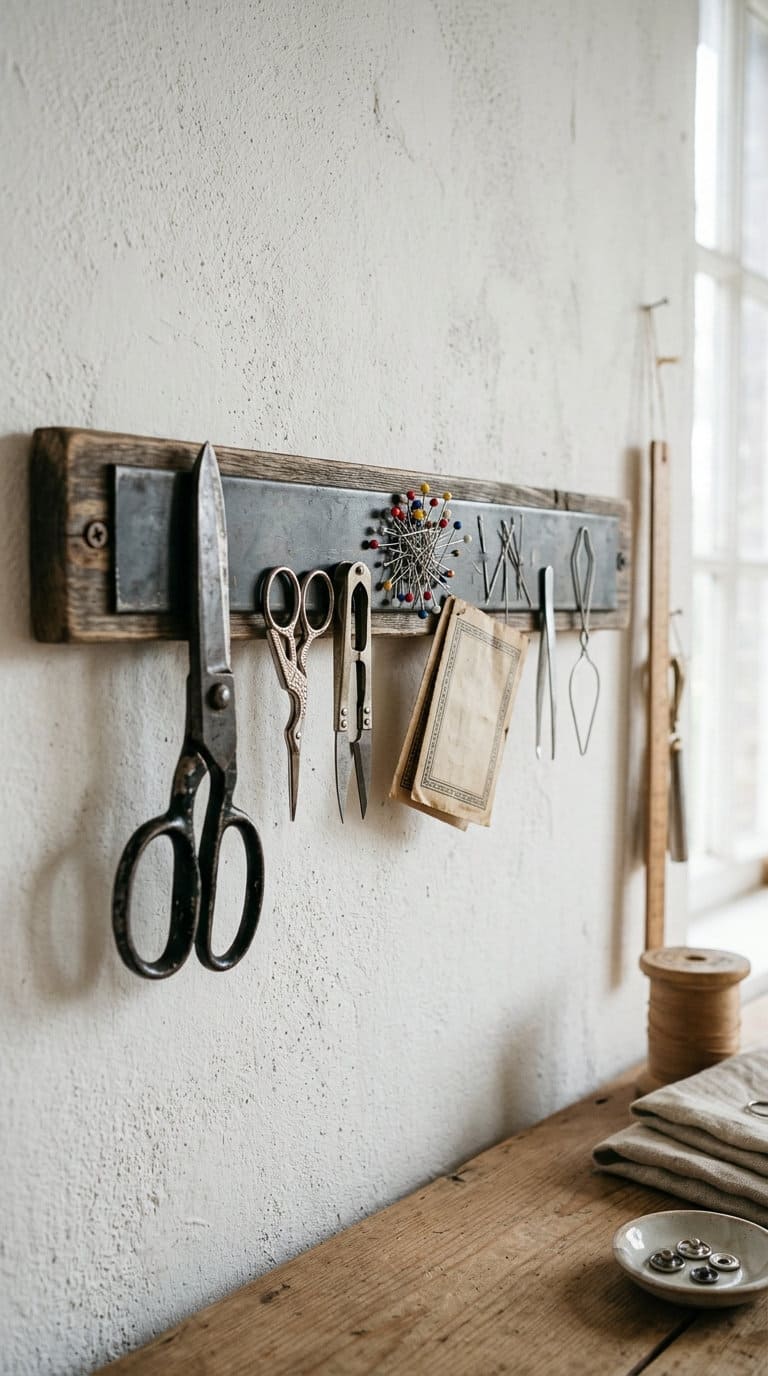
A magnetic knife rack holds scissors, pins, and needle packs in one row. Add a mug rack below for tools with loops. Mount the strip on the wall, not the table, so pins don’t drift onto your work.
Tip: keep a small magnet wand on the strip too. Sweep the floor with it after each session. In a home with kids or pets, we’d keep the pins in a lidded box instead.
Fabric Storage Ideas
For more looks, see our roundup of ways to stack, roll, and display a fabric stash. Here, we stick to what keeps cloth safe.
8. Covered Bins Lined with Muslin
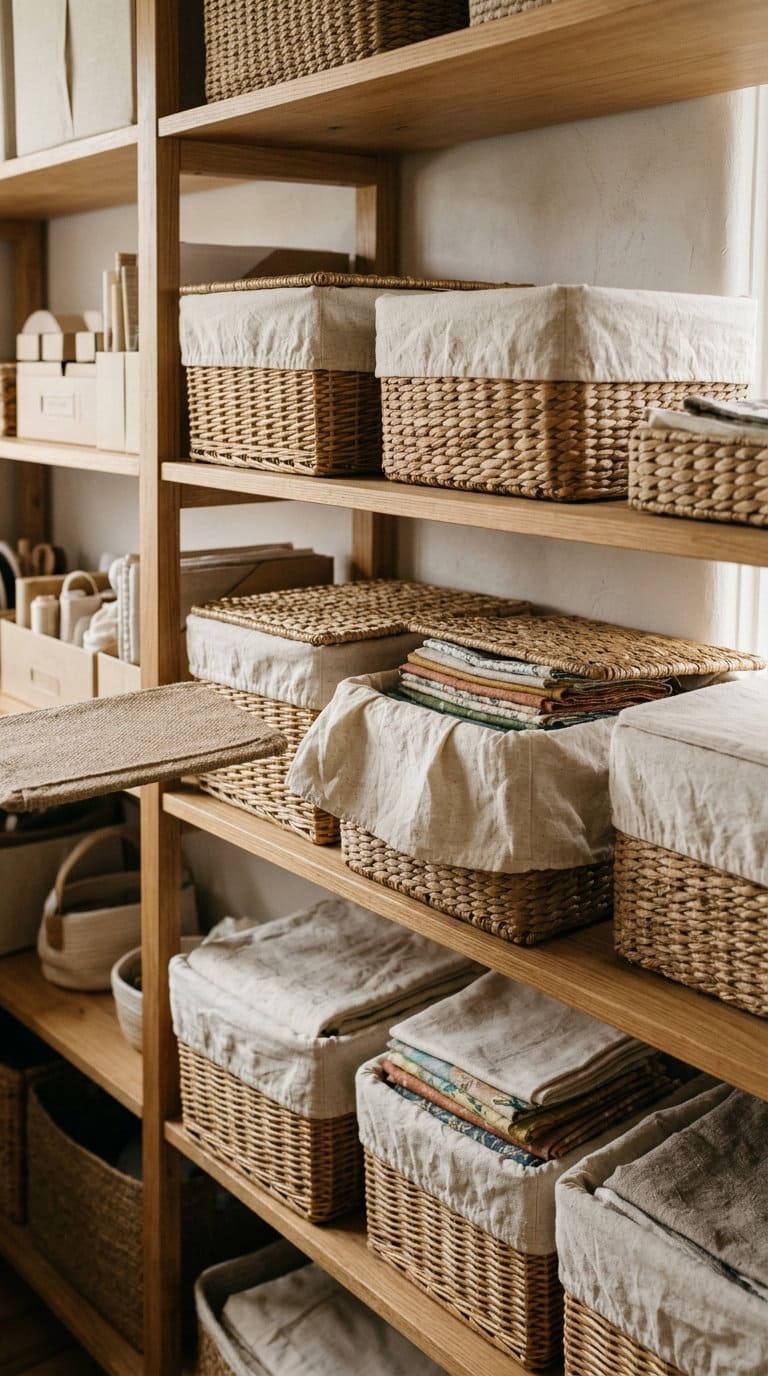
Store cloth flat in a lidded box that is acid-free or polyethylene. Line it with unbleached muslin.
This care makes sense for heirlooms. It’s too much for cotton you’ll sew next month.
Don’t pile heavy cuts on top of light ones. Put the big ones at the base, with acid-free paper in between.
9. Fabric Rolled on Sealed Dowels or Tubes
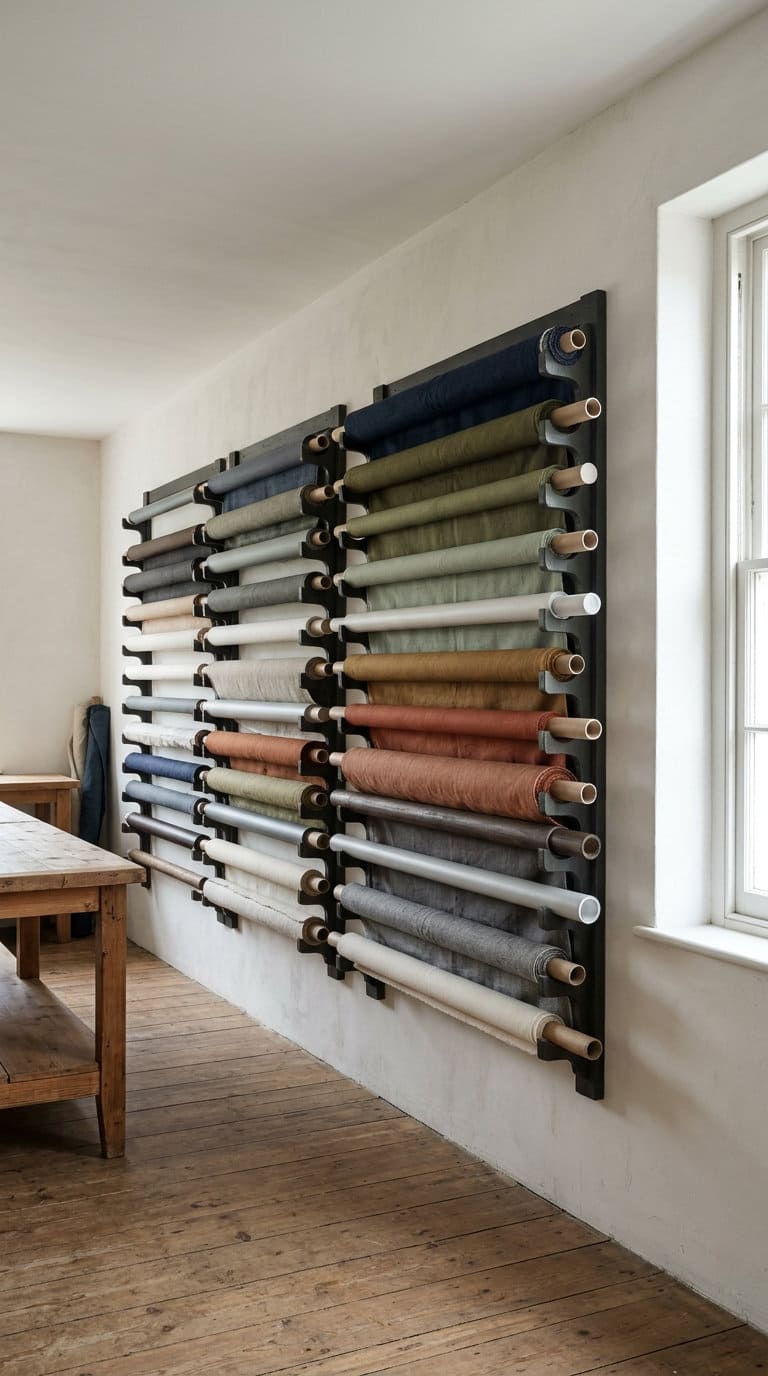
Rolling stops creases in long cuts. Use acid-free tubes that are longer than the fabric. Seal wood dowels with several coats of acrylic latex paint first.
Hang the rolls on wall brackets, like a paper towel holder in a long row. Rotate them now and then so the same edge does not bear the weight. Save this one for long cuts, because short pieces take less room folded.
10. Clear Stacking Baskets for Active Projects
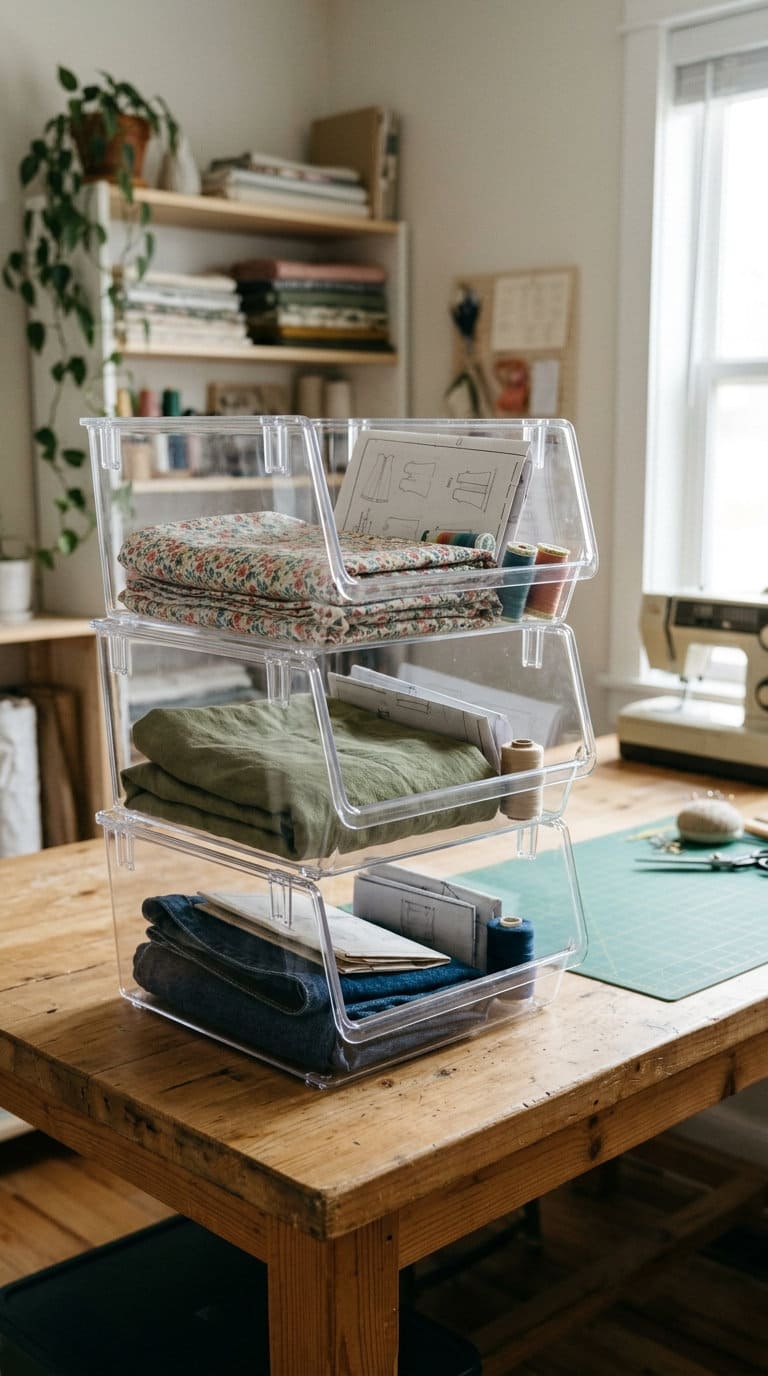
Give each current project its own basket. Put the cloth, thread, zip, and pattern in it.
When you sit down, you grab one basket and start. When you stop, it all goes back in.
If we could keep just one idea on this list, it’s this one. It makes a short time at the machine worth it.
11. Scrap Jars Sorted by Color
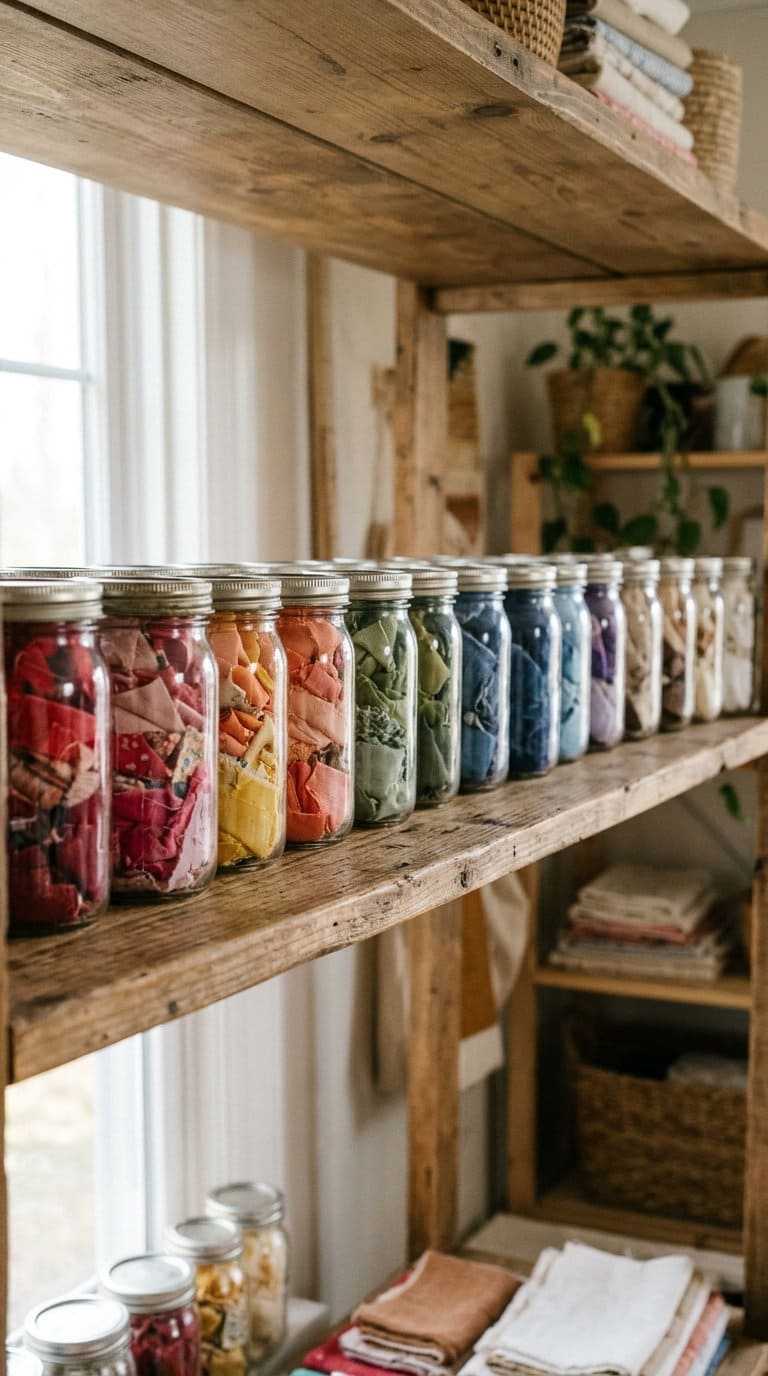
Scraps get lost in a big bag. Small clear jars or baskets let you sort them by color. A row of jars looks good on an open shelf, though plain baskets hold more for less.
Keep the jars on a shelf away from a sunny window. Tip: once a jar is full, use it for a scrap project before you start a new jar. A firm limit works better than one more bin.
Pattern and Paper Storage Ideas
12. Metal File Cabinet for Patterns
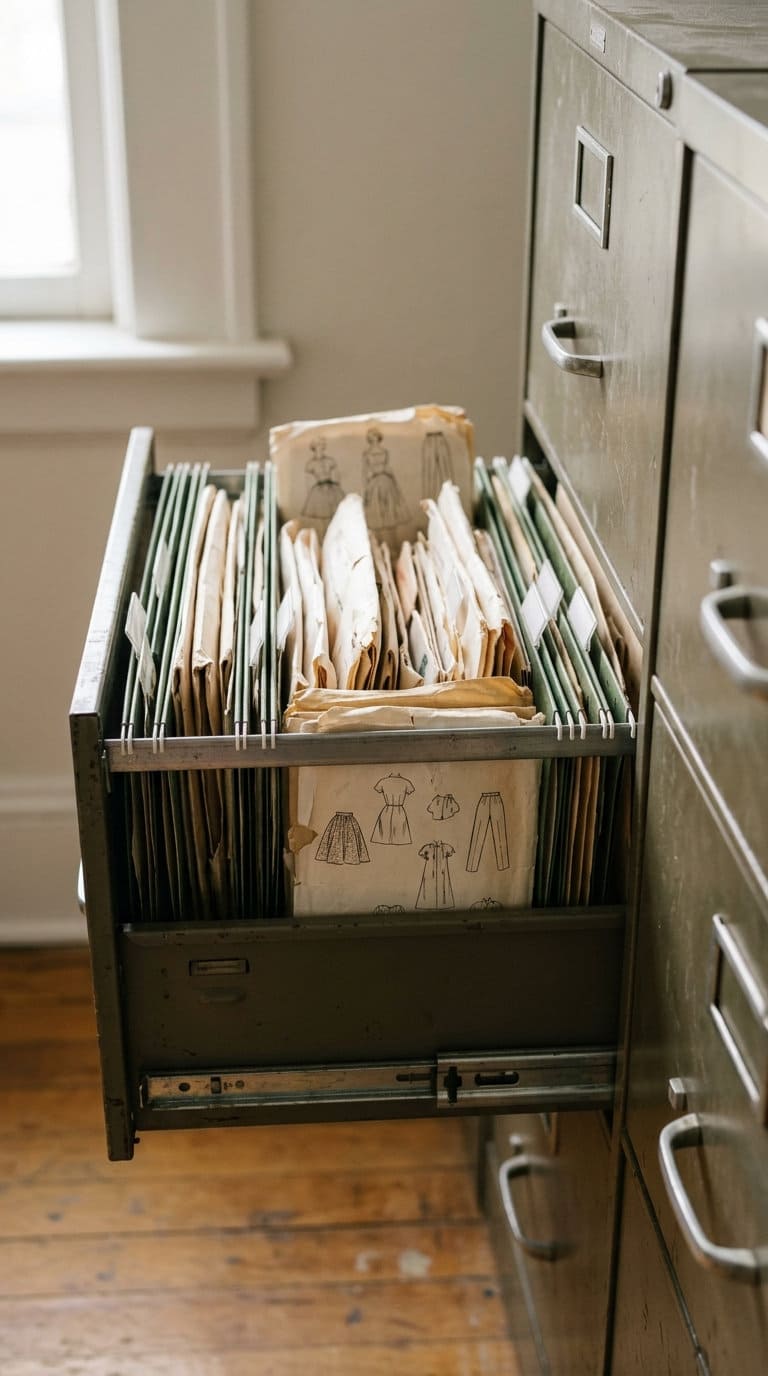
A metal file cabinet suits a big pattern stash. Hang folders in it so each one stands up. Sort them by type: tops, pants, bags, and quilts.
Skip raw wood here, since it can give off acid. Look for a used one first. A dent won’t hurt a pattern.
13. Shoeboxes for Pattern Envelopes
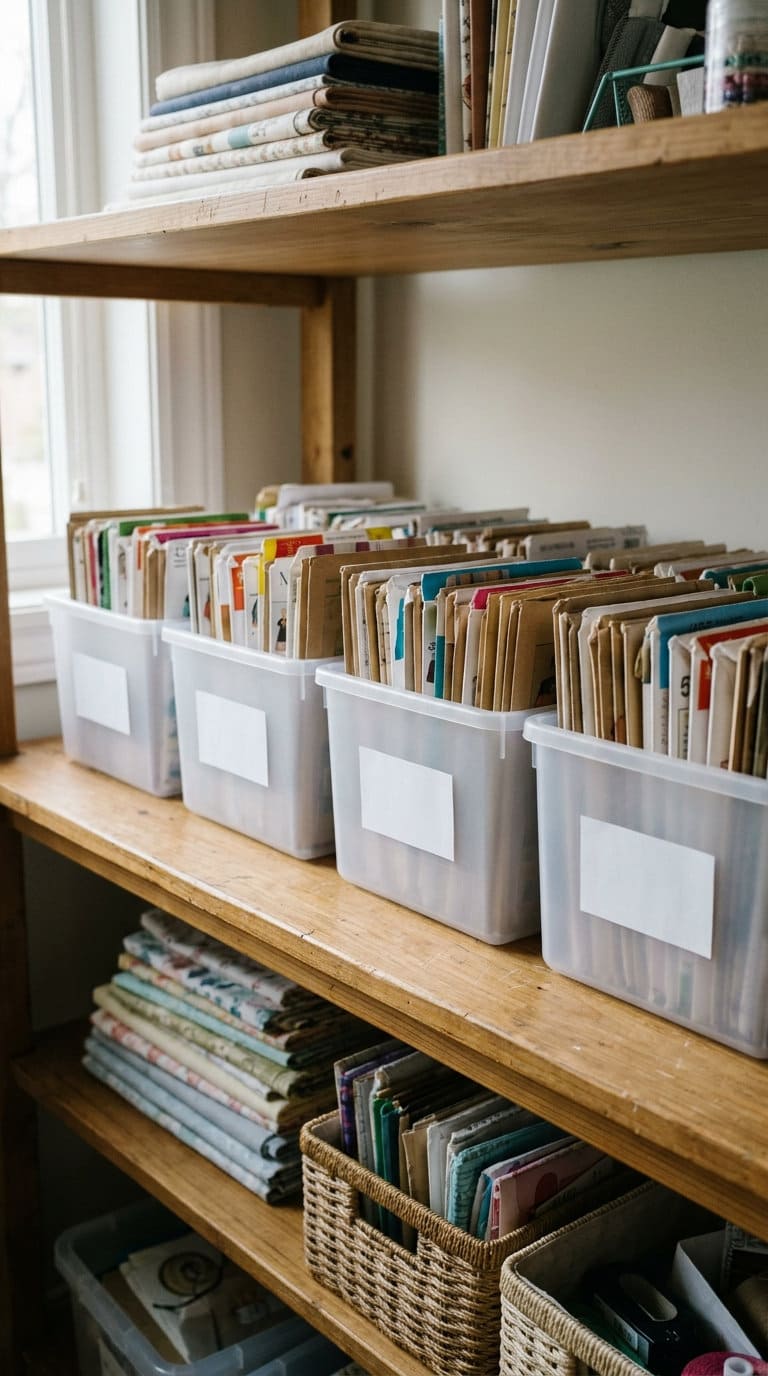
No room for a cabinet? Stand the envelopes up in shoeboxes on a shelf, and label the end of each box.
Use plastic ones if they sit near fabric. Plain cardboard can give off acids. For a small stash, we’d start here and buy a cabinet only when the boxes overflow.
14. Clipboard Hooks for Traced Patterns
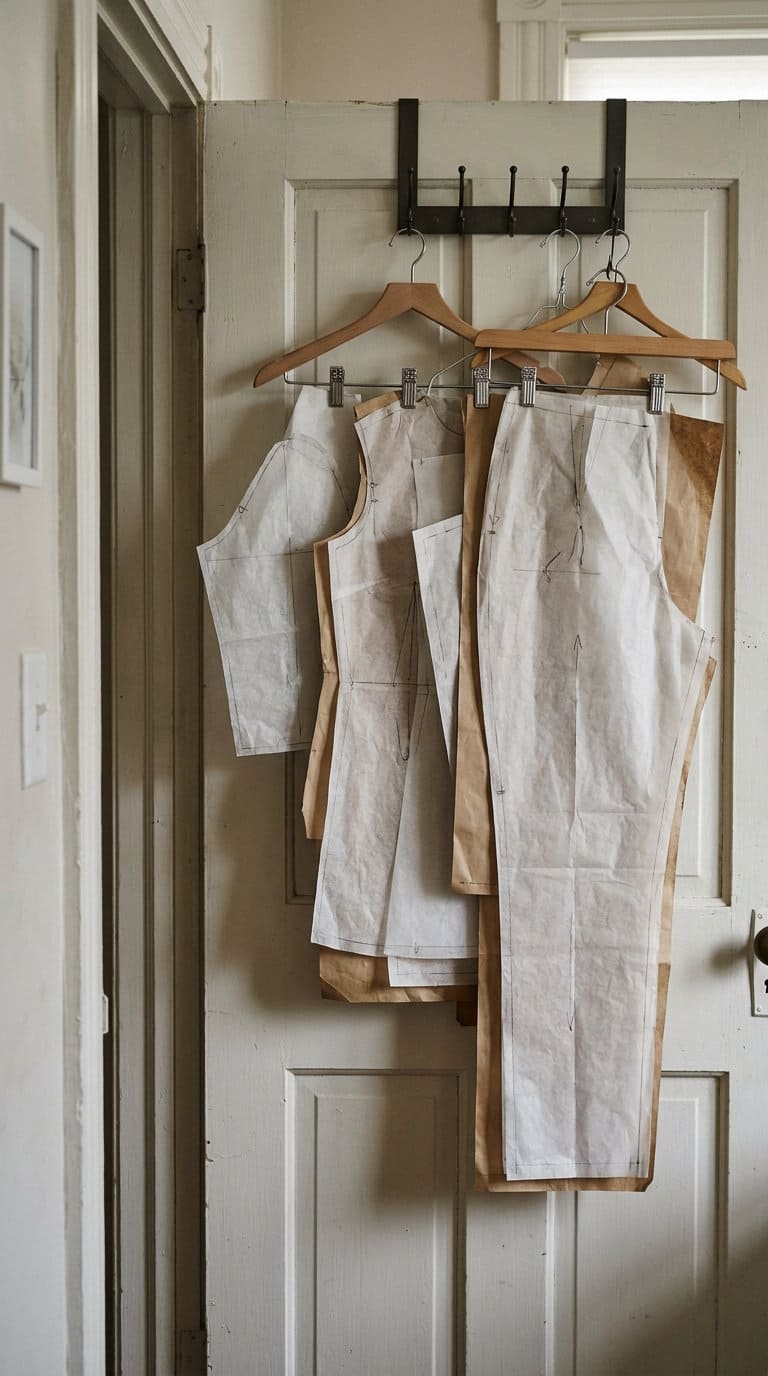
Traced pieces tear if you fold them a lot. Clip them flat to hooks on the back of a door. Write the name and size on each piece.
Hang only the ones you sew often, or the door turns into clutter.
If you trace old clothes, see our guide to copying a pattern from a garment you own.
Cutting Tools and Cutting Table Ideas
15. Cutting Table with Shelves Below
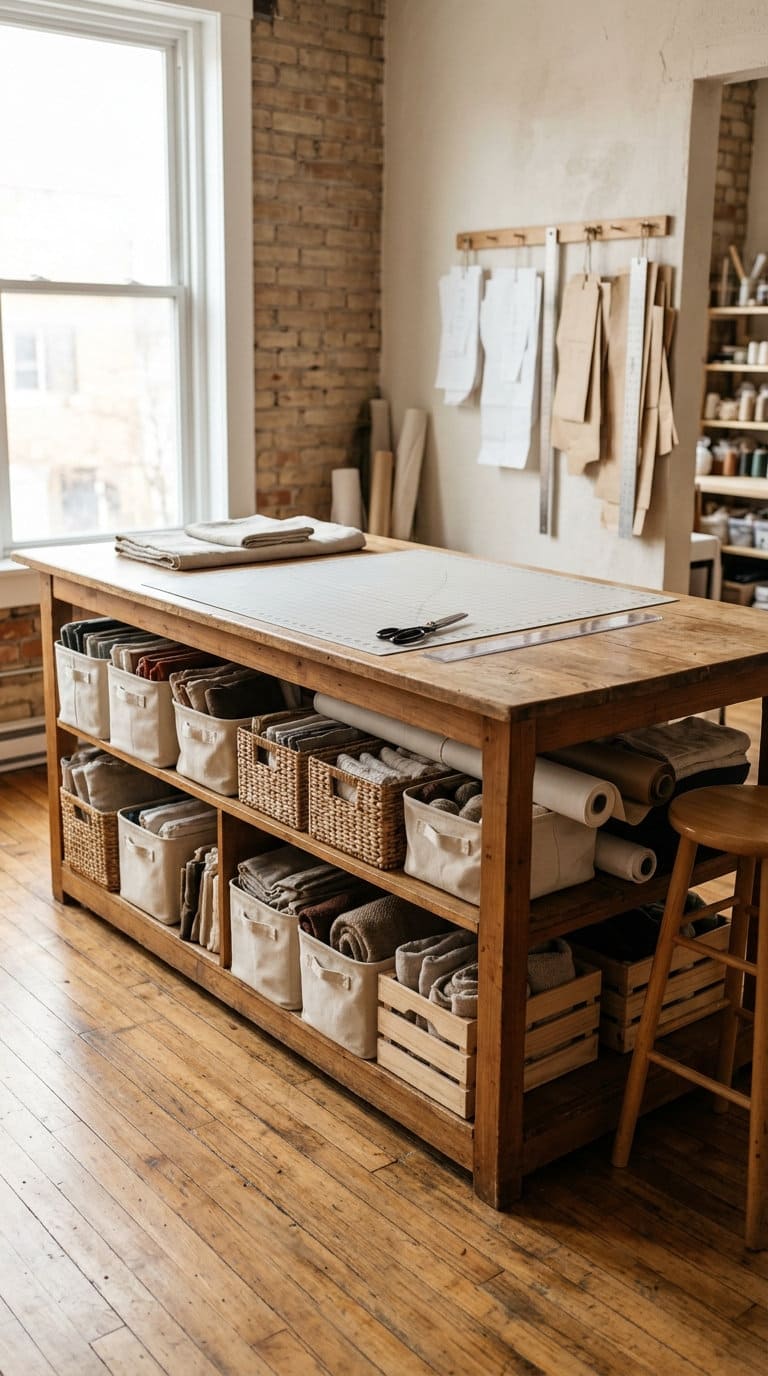
A good cutting table stands 36 to 40 inches high, about 3 feet wide and 6 feet long. Fill the space below with shelves or drawers. In a tight room, a smaller top at the right height is a better buy than a big one that makes you stoop.
Use it for fabric bins, batting, and pressing supplies. Cost: less if you raise a table you own on risers. Test: stand at the table and check that you don’t hunch.
16. Ruler Rack on the Side of the Cutting Table
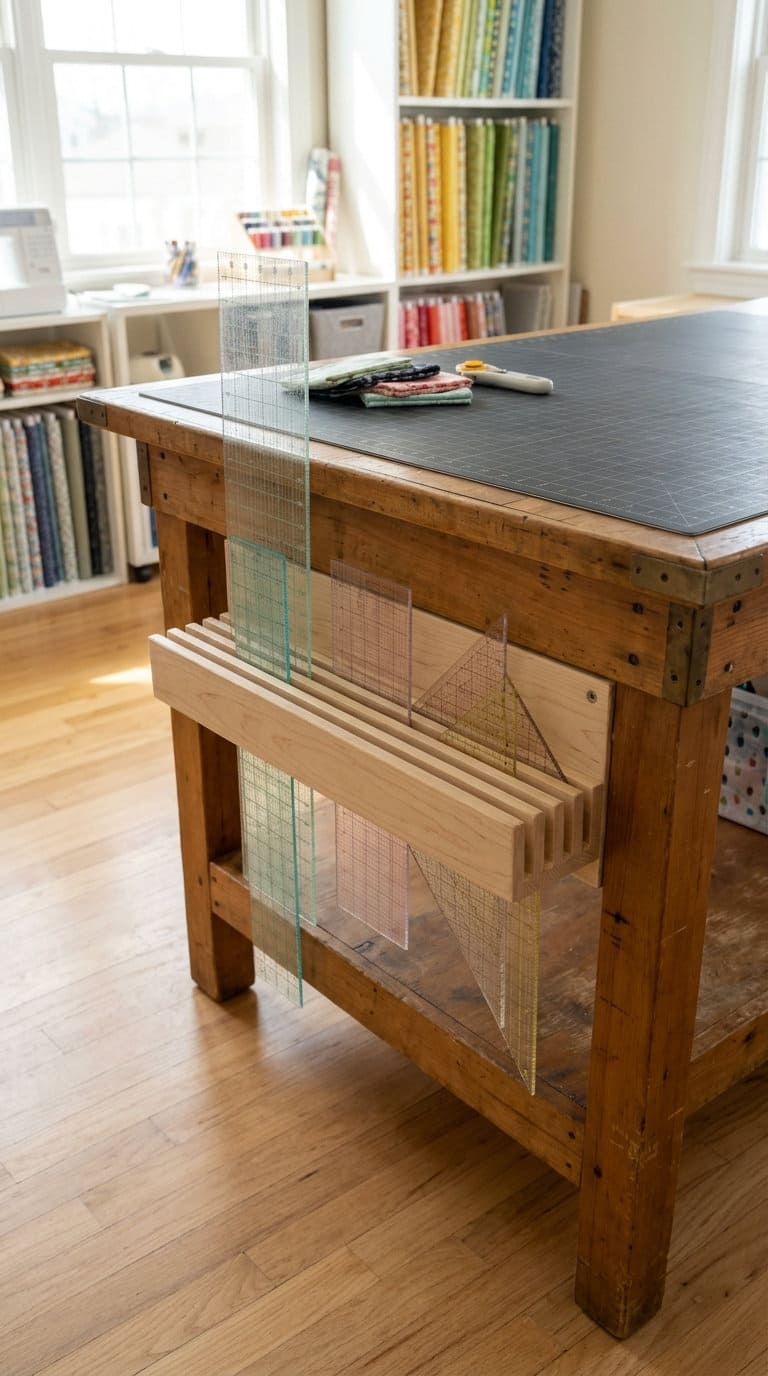
Rulers get lost and scuffed in a flat stack. Mount a slotted rack on the end of the cutting table. Each ruler slides into its own slot, edge up.
Keep the most used size closest to your cutting hand. A rack seems fussy until you own more than three rulers, and then it’s hard to do without.
17. Cutting Mat Stored Flat or Hung
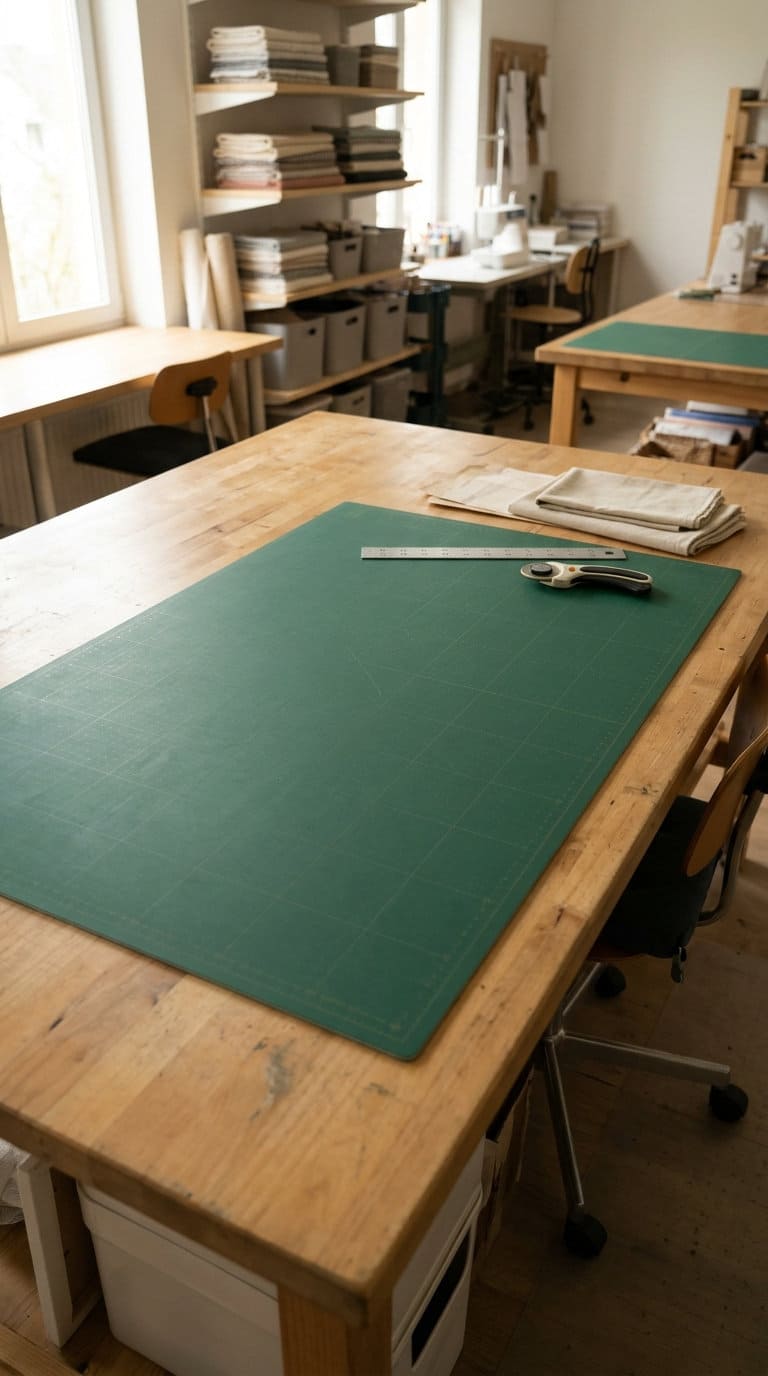
A mat that leans on a wall or sits in the sun may warp. Store them flat on the cutting table, or hang a spare from a large clip. Keep them away from heat vents.
Tip: slide a spare mat under the cutting table’s top shelf. A flat mat costs you no more space, so we’d make this a firm rule.
18. Rotary Cutter Caddy
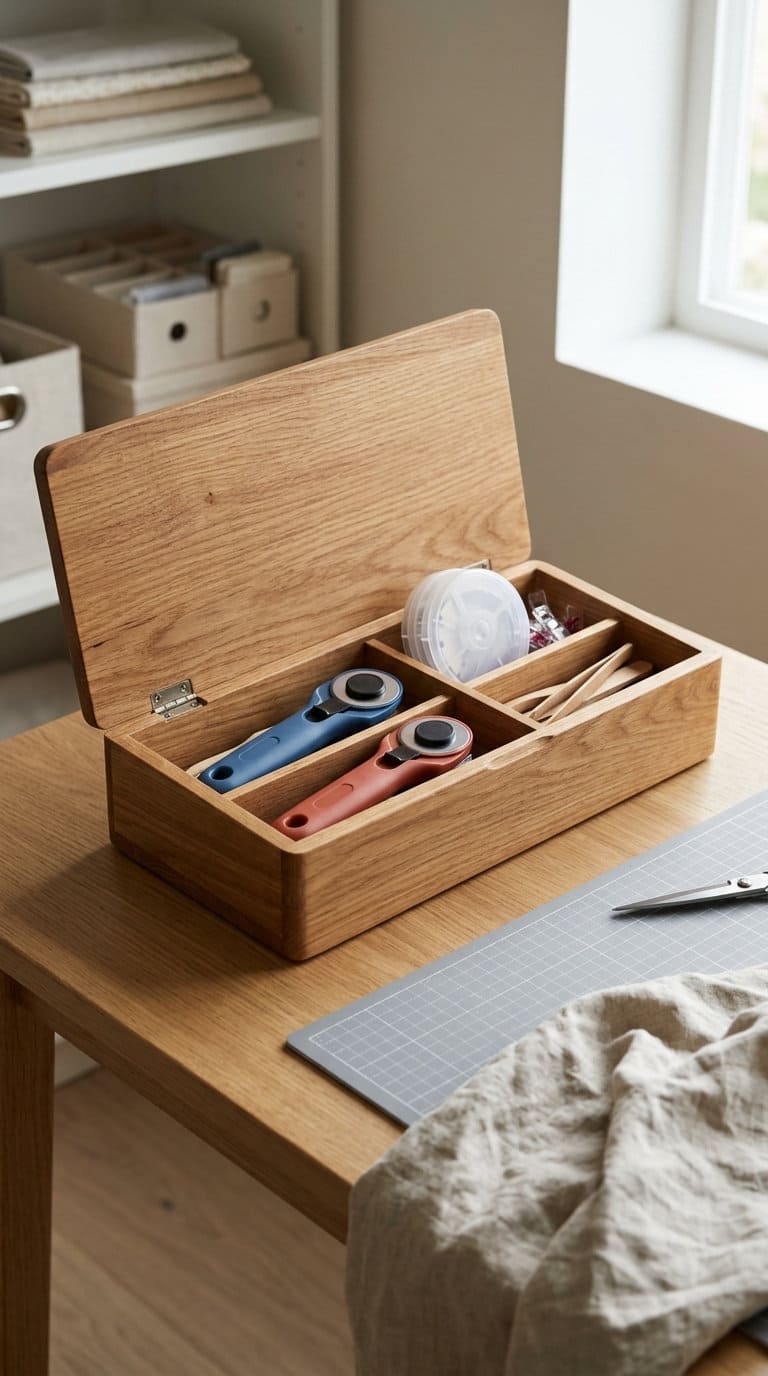
Rotary blades are sharp and easy to forget on a table. Give them a small caddy with a lid at the cutting table. Store spare blades in their case inside the same caddy.
Check: close the blade guard every time you set the cutter down. A caddy only helps if the blade is covered first. With kids in the house, we’d choose one that locks.
19. Cork Board for Project Notes
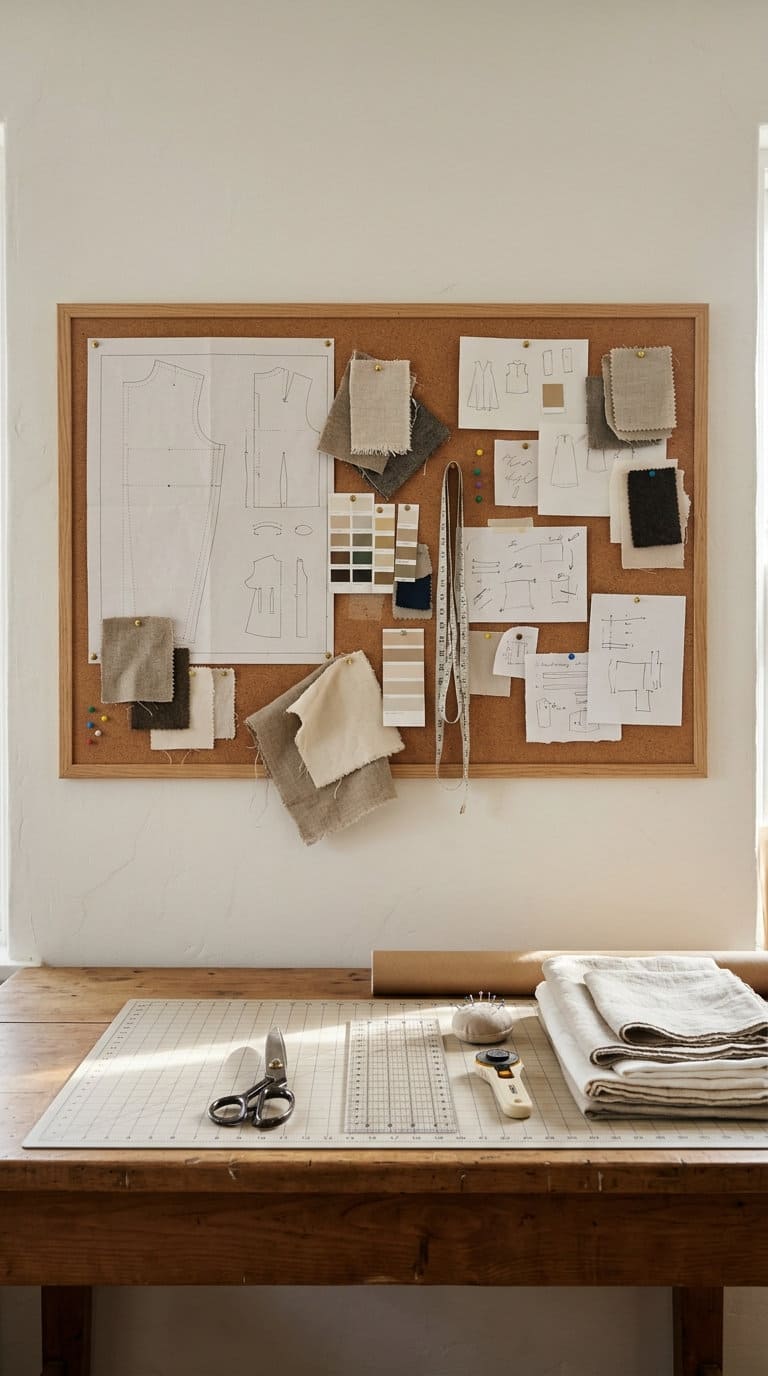
Pin up the pattern sheet, fabric swatches, and your cut list. A cork board keeps the plan at eye level, not buried on the table.
Hang it above the cutting table. Limit it to one project, because a board full of old plans is just wall clutter.
Machine and Pressing Storage Ideas
20. Low Machine Table with Drawers
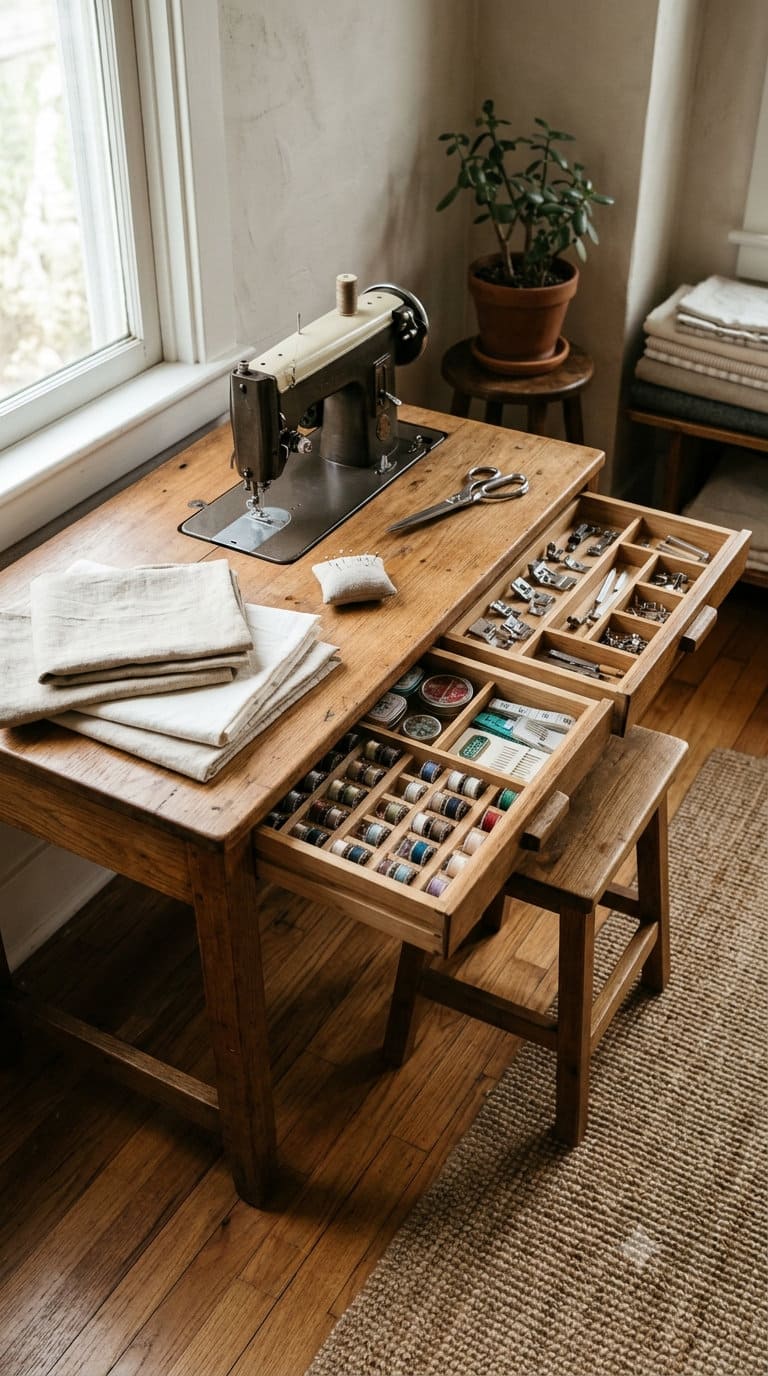
Look for a table about 28 inches high with shallow drawers, and set your chair seat near 16 inches. Store presser feet, bobbins, and machine needles there.
Sort feet in a divided tray and label each slot. Cost: from a plain desk to a full sewing cabinet. A sturdy used desk at the right height is the smarter first buy.
21. Wall-Mounted Ironing Cabinet
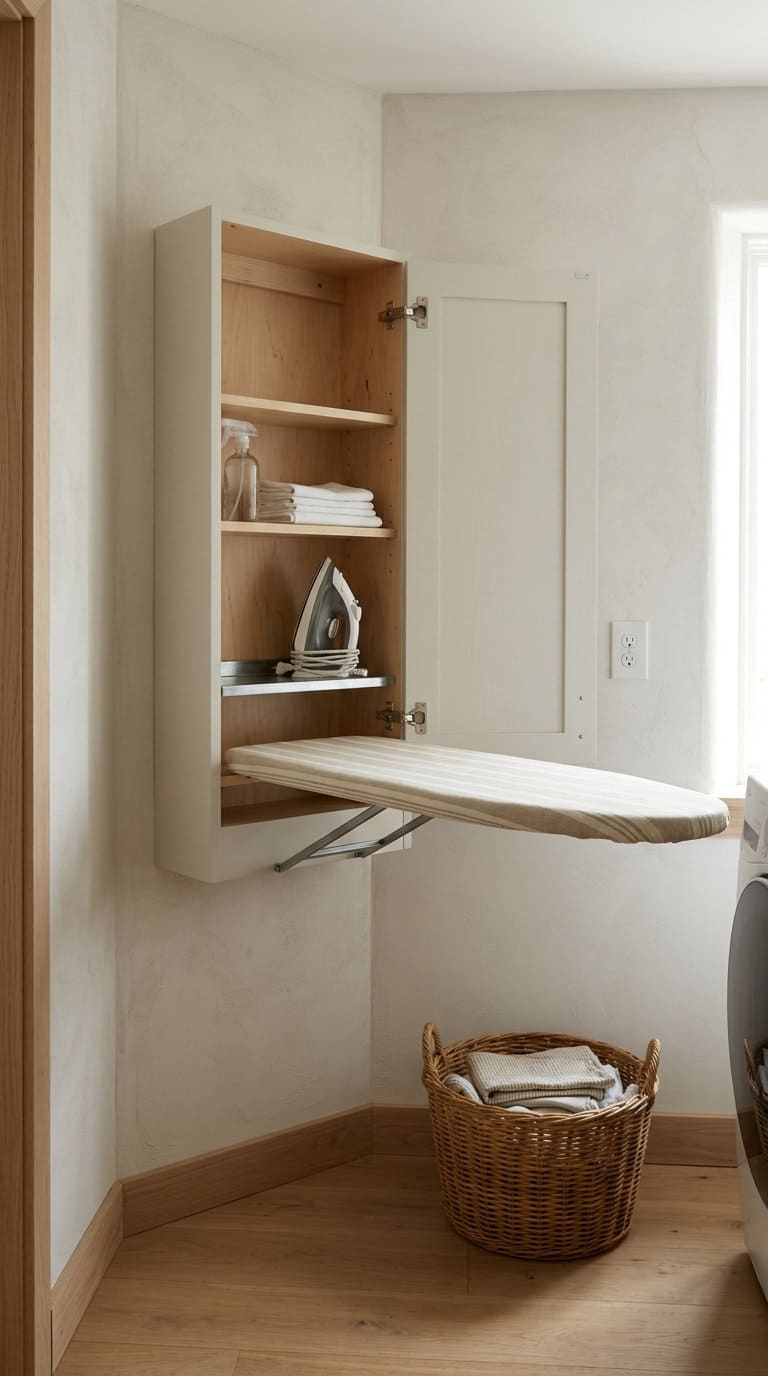
An ironing board takes up floor space. A wall case folds the board down when you press and hides it when you sew. The board may feel small for quilts, so we’d pick this for clothes.
Install it near a grounded outlet. Need a new outlet? Hire a pro, and don’t run a long cord across the room.
22. Machine Covers and a Closed Cabinet
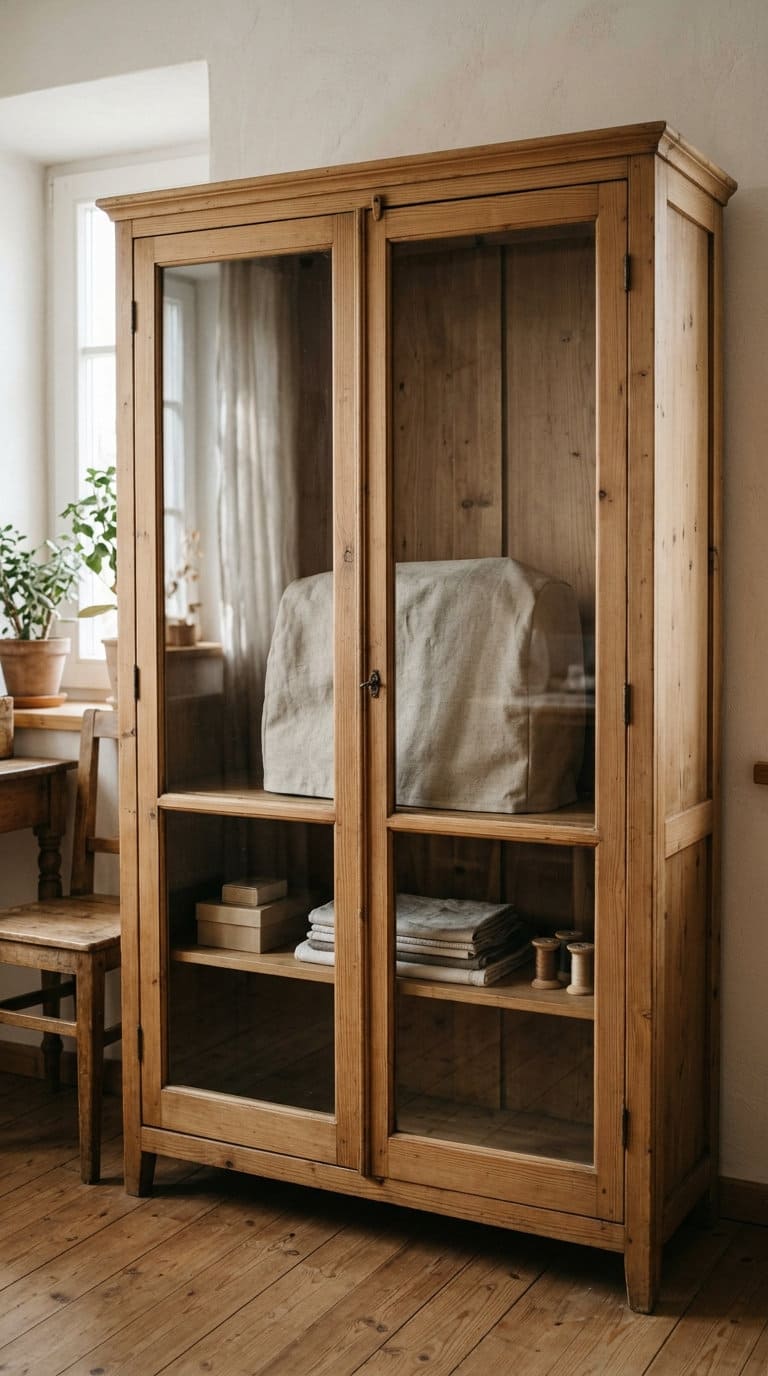
Dust lands on a machine that sits out. Cover it when you finish, or keep it in a closed cabinet. If you sew with a walking foot, our walking foot tips cover setup and care.
Keep the manual and spare parts in a box on the same shelf. A cloth cover is enough in most rooms. The case pays off with pets or kids.
Small Sewing Space Ideas
23. Rolling Cart That Parks Under a Desk
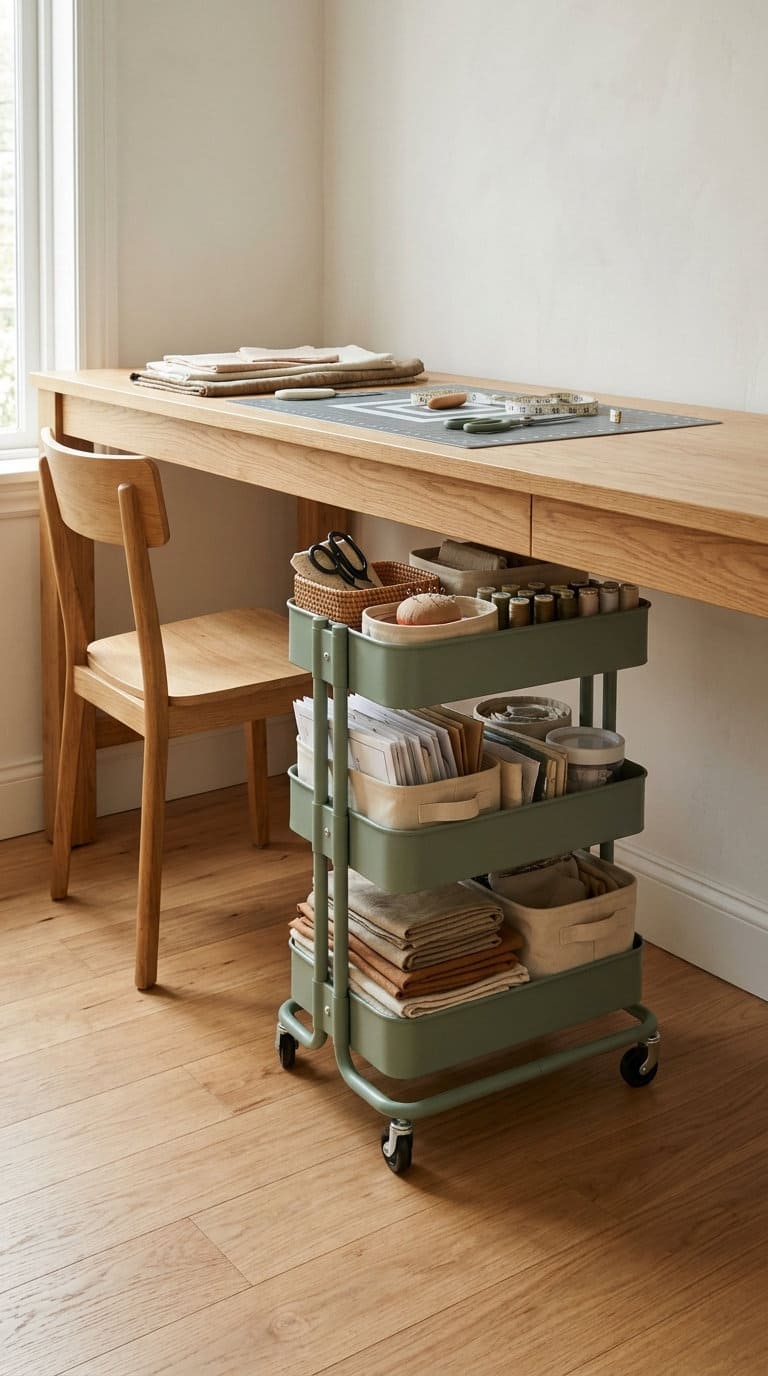
A rolling cart goes from the machine to the closet. Put thread on top, pins in the middle, and your project below. Roll it off when guests come.
For renters, this is our top pick, since it needs no holes and moves with you. It pairs well with clear labeled bins, like the ones in our cube and bin storage roundup.
24. Under-Bed Boxes for Fabric and Patterns
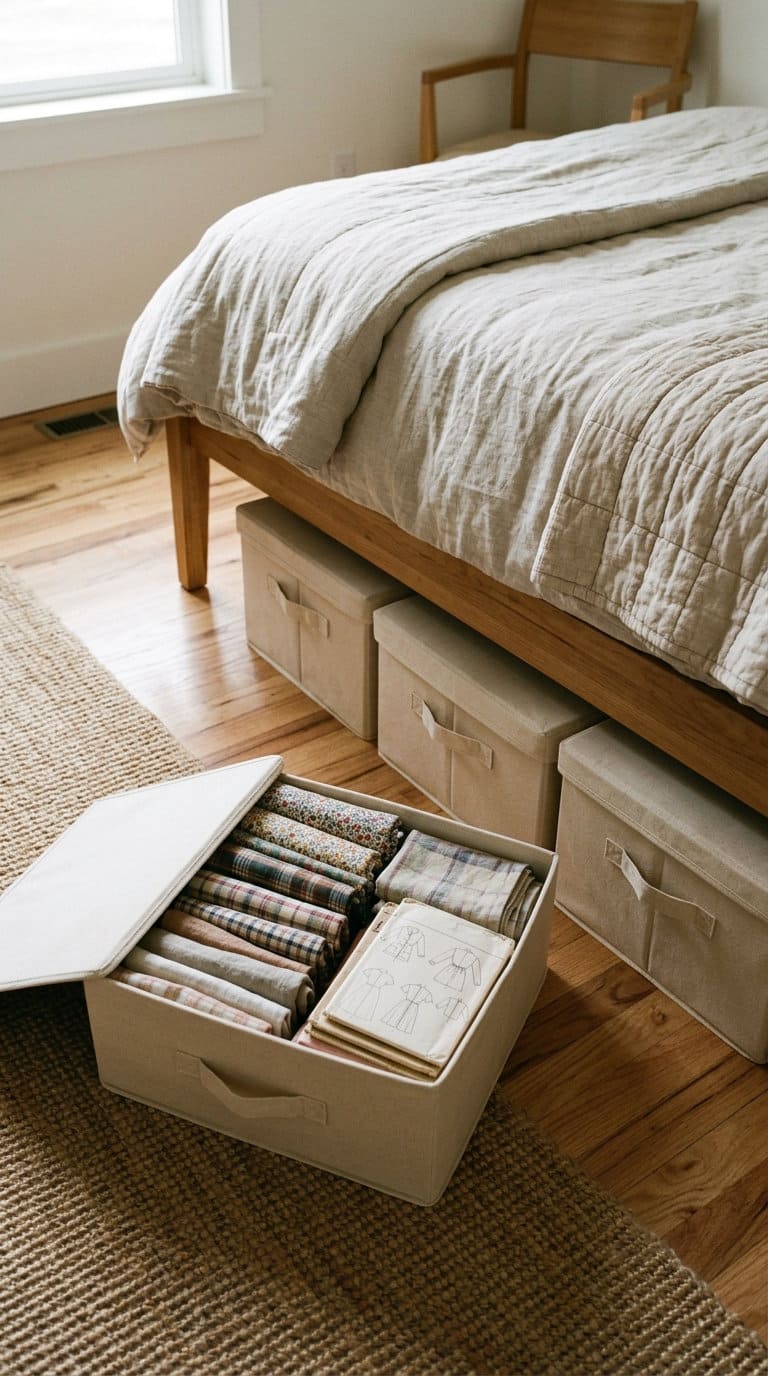
Use the dead space under a guest bed. Pick boxes with lids, and line them with muslin for fabric.
Don’t use the basement or attic if you can help it. Damp air can lead to mold. Use these boxes for backup stock only, because what you can’t see, you tend to buy twice.
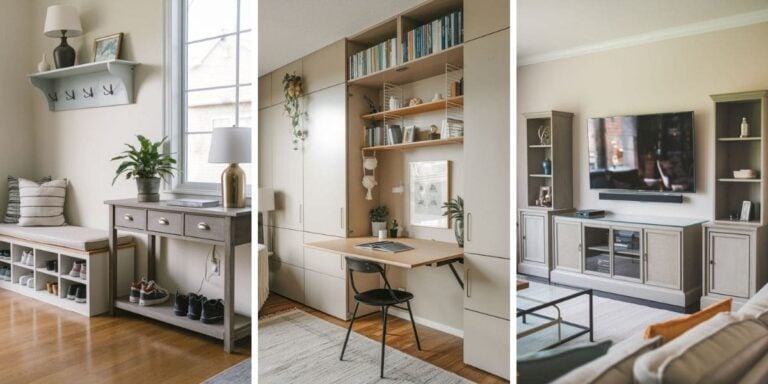
25. Closet Turned into a Sewing Nook
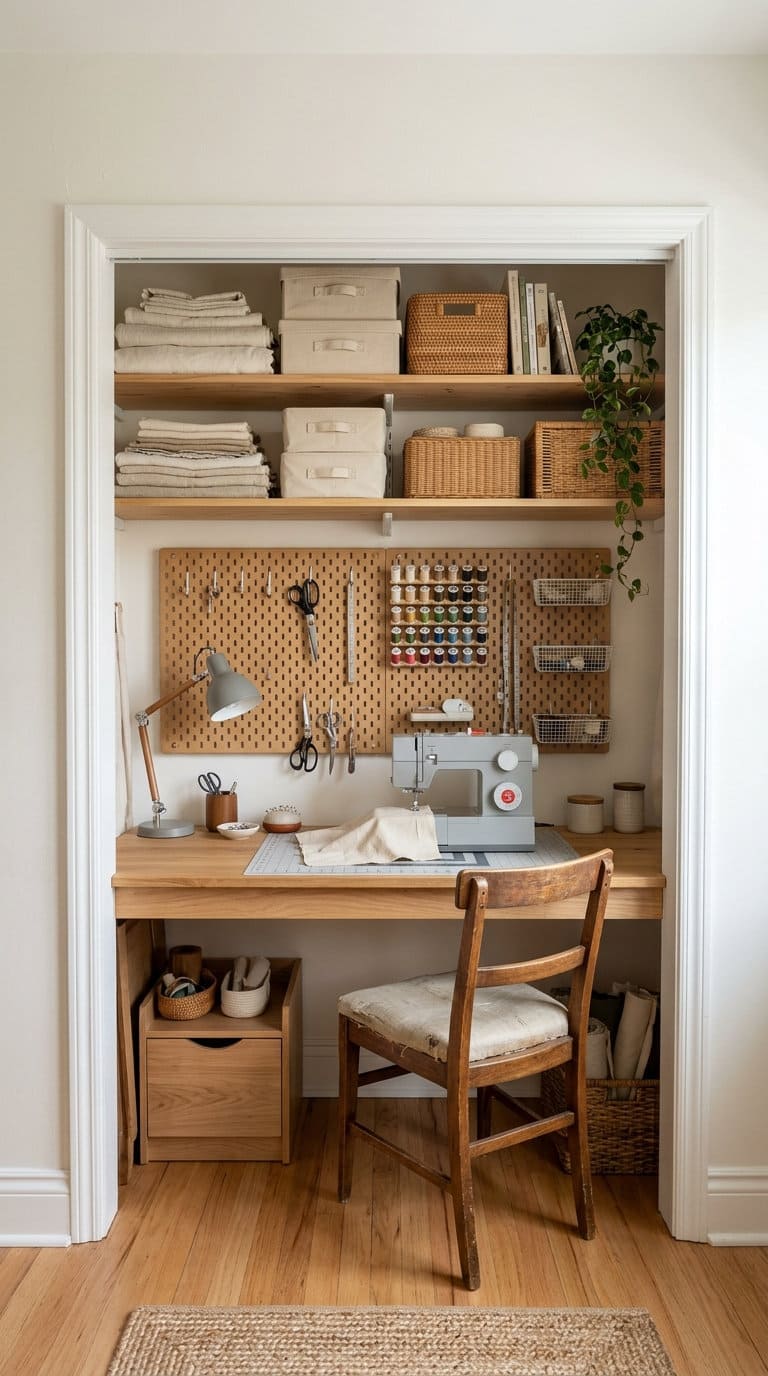
A small closet can hold a desk, a pegboard, and shelves. Keep the table at the same 28-inch height. Add a lamp, since closets are dark.
We’d pick this over a corner of the living room, since you can shut the door on a half-done hem. Use a surge protector, and keep cords out of the walkway.
For cheap shelf and rod setups, see these budget closet makeovers.
Which Storage Materials Are Safe for Fabric?
Tools can live almost anywhere. Fabric can’t, since some bins harm it over time.
Use this table for anything you plan to keep for years. For cloth you’ll sew this season, we’d worry more about sun and damp than about the box.
| Material | Safe for long-term fabric storage? | Why |
|---|---|---|
| Acid-free box or tissue | Yes | Will not give off acid |
| Polyethylene box with a lid | Yes | Good for flat storage |
| Unbleached muslin lining | Yes | Clean, breathable layer |
| Raw wood shelves or drawers | No, unless sealed | Can give off acidic vapors |
| Plain cardboard or paper | No, for long term | Can give off acids |
| Dry-cleaner plastic bags | No | No air flow |
| Cedar chests and moth balls | No | Poor choice for textiles |
Common Mistakes to Avoid
The most common mistake is storing fabric in the wrong place. A sunny shelf fades color, and a damp basement invites mold. Pick a cool, dark, dry closet away from heat vents, even if it’s less pretty than an open shelf.
The second mistake is trusting moth balls or a cedar chest to stop bugs. Skip both. If you find insects, wrap the piece in muslin or acid-free tissue and press the air out of a polyethylene bag.
Freeze it for a week at minus 20 degrees Celsius. Let it warm up slowly, then repeat the cycle.
The third mistake is building storage at the wrong height. It’s easy to add hooks later, but a table that’s wrong will bother you each time you sew. Plan heights first, then add shelves and hooks.
The last mistake is power. Irons and machines draw current in a small room.
Use grounded outlets and a surge protector for the machine and lamp. Plug the iron right into the wall, and keep cords off the path.
Frequently Asked Questions
How do you organize a small sewing room?
Use the walls and the space under tables. A pegboard by the machine, shelves under the cutting table, and a rolling cart cover most needs. Add under-bed boxes last, for backup stock.
How high should a cutting table be?
Aim for 36 to 40 inches, or about 3 inches below your belly button. That lets you cut without bending over.
Is it safe to store fabric in plastic bins?
Yes, a polyethylene bin with a lid and a muslin liner is fine. Avoid dry-cleaner bags, since no air moves through them. Keep any bin out of damp spaces.
How should I store thread?
Store it upright on a rack or in shallow boxes sorted by color. Keep it out of direct sun to slow fading. Use a thread tree for tall serger cones.
What is the best way to store patterns?
A metal file cabinet with hanging folders is best for a big stash. Shoeboxes on a shelf are plenty for a small one.
Related Posts
Never miss an update — choose FarmFoodFamily as your preferred source on Google.
How it works: Tap the button below to open Google's settings page, then check the box next to FarmFoodFamily.
Tap the checkbox to turn it blue — that's how you know it's set.