A Rising Backyard, Reimagined: Genuine Upward-Sloping Garden Ideas That Actually Work
When a yard climbs away from the house instead of falling from it, the water, the view, and even your privacy all run in the opposite direction, and most sloped-yard advice never mentions that.

Never miss an update — choose FarmFoodFamily as your preferred source on Google.
How it works: Tap the button below to open Google’s settings page, then check the box next to FarmFoodFamily.
Tap the checkbox to turn it blue — that’s how you know it’s set.
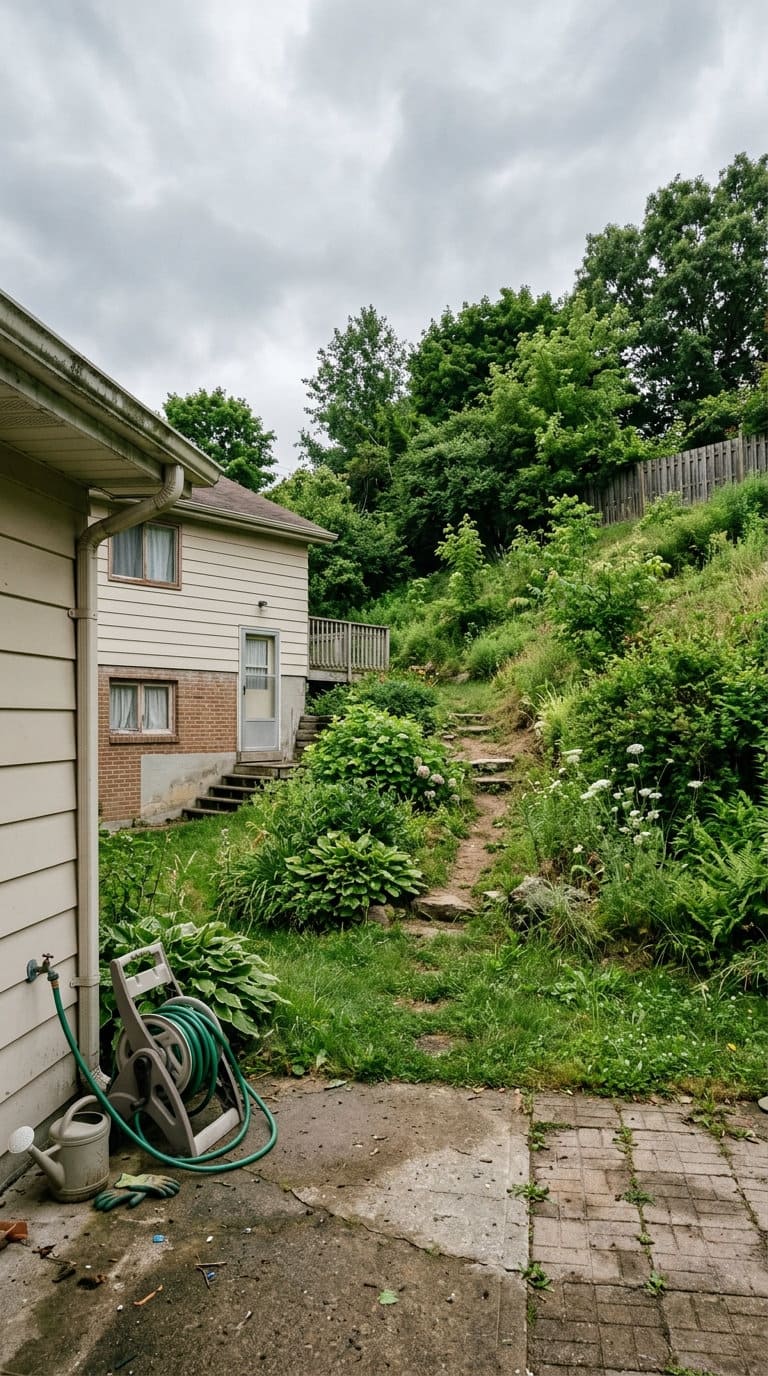
Most “sloped backyard” articles quietly assume the ground falls away from the house. That’s the more photogenic version, terraces stepping down toward a view, a lawn that drains itself toward the back fence.
An upward-sloping yard, where the ground climbs away from the house instead, is a genuinely different project, and treating it like a smaller version of the downhill problem is how people end up with a damp mudroom wall two years later.
I’ve spent a chunk of this year working through drainage complaints on exactly this kind of lot, and the thing nobody warns you about isn’t the slope itself. It’s that every instinct you’d apply to a downhill yard works backward here.
This guide is specifically about a yard that rises away from the house. If your yard falls away from the house and you want the general multi-level terracing strategy, our guide to turning a sloping backyard into a usable multi-level garden covers that in more depth.
If your actual goal is flattening the grade entirely rather than working with it, our cut-and-fill grading guide walks through that process step by step. This one is for the specific, and honestly more urgent, situation where the hill is coming at your house, not away from it.
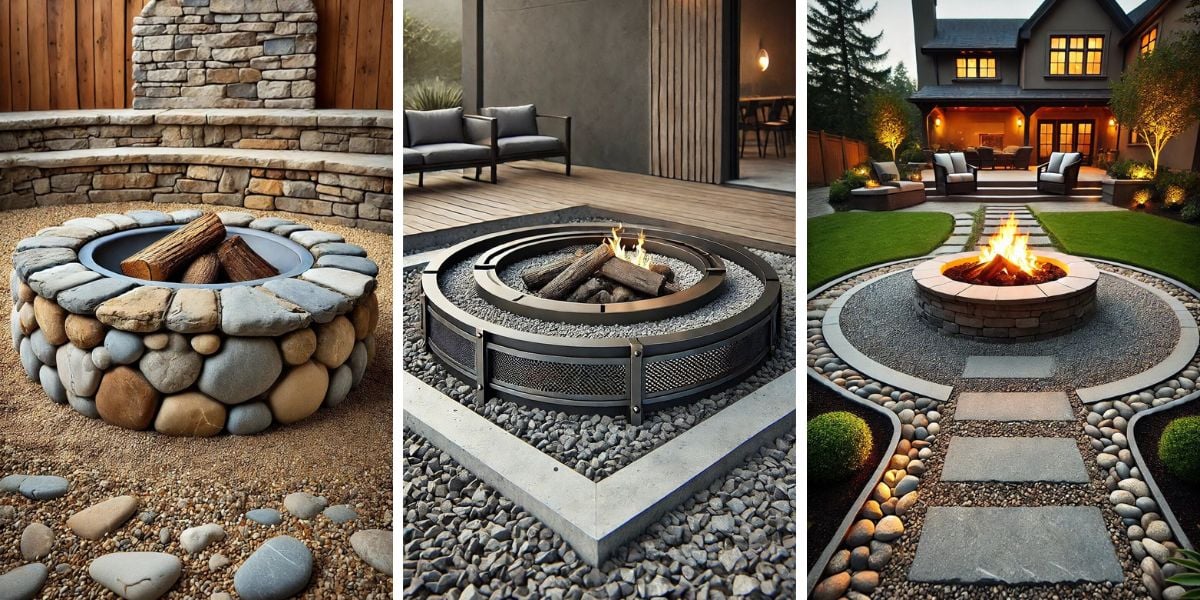

Is a yard that slopes up from the house actually worse than one that slopes down?
In one specific way, yes: the water problem is more urgent. A downhill yard sheds rain toward the back fence or the street, generally away from anything you care about.
Answer 4 quick questions and get matched to the exact fix for your yard — drainage, budget, layout, or something else entirely.
Take the Free QuizAn upward-sloping yard funnels rain, snowmelt, and irrigation runoff straight at your foundation unless you actively redirect it, and negative grading toward a house is one of the more common, fixable causes of basement dampness and foundation cracking. Three other things flip too.
The view from inside looks up at a rising slope, a “wall of green,” instead of down over descending terraces, so a destination at the top matters more than stacked platforms.
Privacy can flip: on a lot where the high ground belongs to a neighbor, someone above your yard is often looking down into it. And retaining walls, when needed, typically sit on the far side of the usable space, holding back soil above the lawn, rather than terracing the near edge off the back door.
None of the four sloped-yard articles on general terracing, budget fixes, vegetable gardening on a slope, or flattening a grade cover this specific combination, because a downward slope simply doesn’t create these problems in the same order or with the same urgency.
Get the direction of the slope right in your head before you plan anything, because half of the generic advice out there (terrace toward the view, build your fence taller) works against you on this kind of lot instead of for you.
Why does water run toward the house on an upward slope, and what actually stops it?
Because gravity doesn’t care what you built downhill of it. If the ground rises behind your house, every drop of rain that falls on that slope, plus whatever your gutters dump at the base of it, has nowhere to go but toward the lowest point nearby, which on this kind of lot is usually your foundation wall.
This Old House landscape contractor Roger Cook and magazine contributor Ted Carter put the fix in concrete terms: the ground immediately around a foundation needs to fall away at a minimum of about 1/4 inch per foot, roughly 6 inches of drop over the first 10 feet out from the wall.
Most yard problems trace back to one specific, fixable cause. Find yours in 4 quick questions.
Take the Free Quiz
A large-capacity catch basin with a debris grate designed to sit at the low point of a French drain or curtain drain run, catching surface runoff before it channels underground toward a discharge point, useful for the uphill-side drain approach covered in this guide.
Shop NowThis post contains affiliate links. We may earn a commission on qualifying purchases at no extra cost to you.
That’s the baseline for any house, but it’s genuinely harder to achieve on an upward-sloping lot because you’re fighting the yard’s overall grade to create a small “away from house” pocket right at the base of a much bigger “toward the house” slope.
Carter recommends bringing in a professional excavation contractor for anything beyond a small regrading job, and a minimum 4-inch layer of fresh topsoil to hold the new grade once it’s cut.
I found this out the annoying way on a property I helped a friend sort out last spring. The strip of lawn right against the back wall never fully dried out, even a full week after rain, while the rest of the slope fifteen feet up drained fine.
Turned out about 340 square feet of that lower strip had almost no fall at all, basically flat, sitting right where the slope’s runoff collected before it had anywhere else to go. Regrading just that pocket, not the whole hill, fixed it.
If regrading alone can’t create enough fall (common when the house sits close to the base of a real hill, not just a gentle rise), the next tool is a French drain or curtain drain positioned on the uphill side, upstream of the problem instead of downstream.
Washington State University Extension’s Clark County office describes curtain drains as gravel-filled trenches, typically 2 to 4 feet deep, dug on the uphill side of a structure specifically to intercept water before it reaches the foundation, with a minimum setback of around 10 feet from the wall itself. That’s a genuinely different placement logic than the French drain most people picture running along a downhill yard’s low point.
Upward-slope idea 1: an intercept swale set above the high-water line, not below it
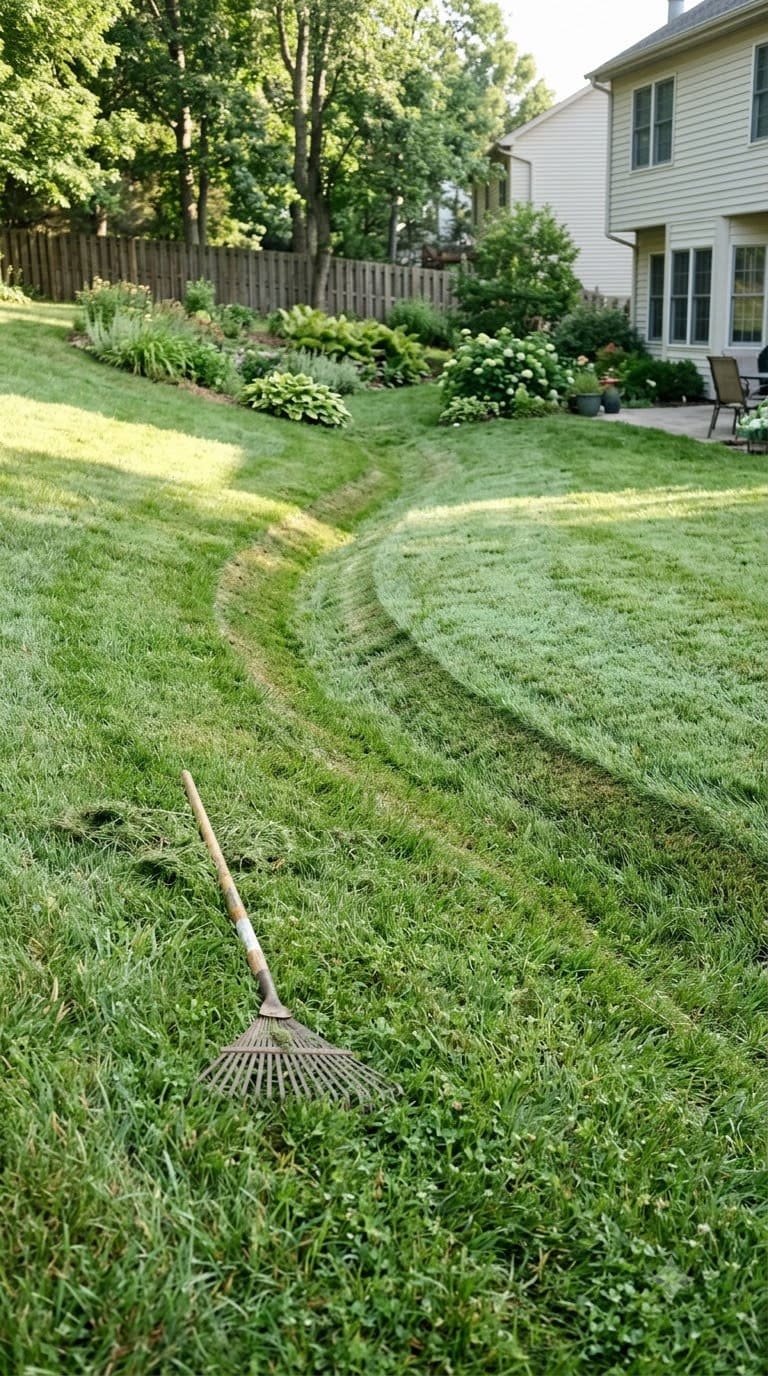
A swale is a shallow, gently sloped, grass-lined channel that catches runoff and carries it sideways instead of letting it keep heading downhill. On a downward-sloping yard, a swale usually sits somewhere in the middle of the terraced run.
On an upward-sloping yard, it needs to sit further up, above wherever water has historically pooled, so it’s actually intercepting the flow before it builds momentum.
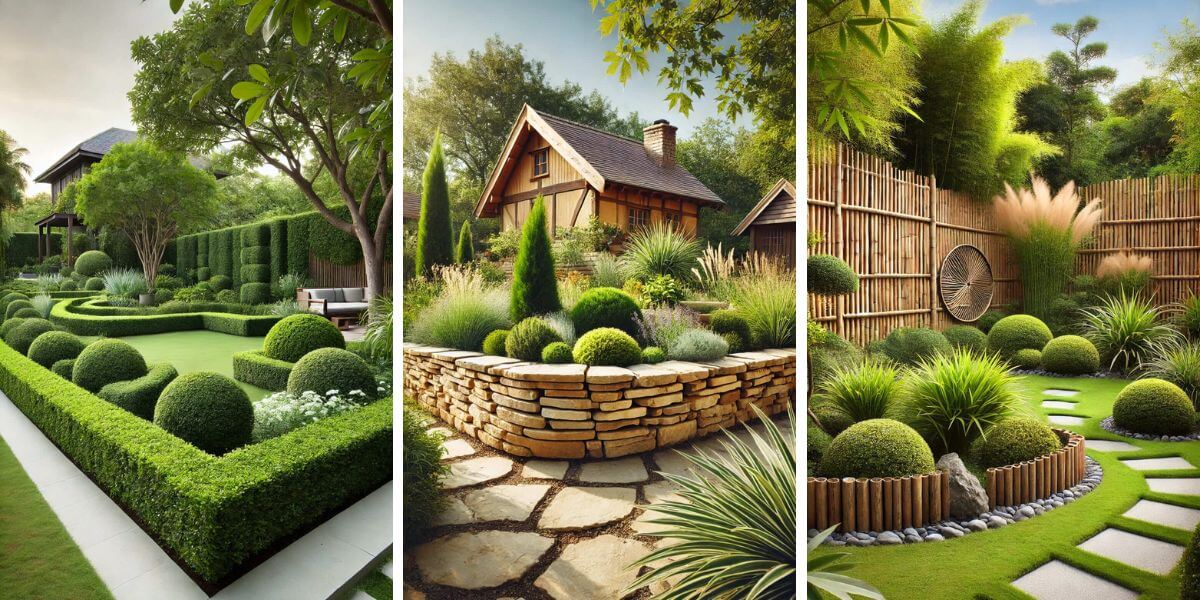


Dig it 8 to 12 inches deep and roughly 2 to 3 feet wide for a typical residential runoff volume, angled just enough to carry water sideways toward a discharge point (a dry well, a existing drainage swale on the property line, or daylighting somewhere the neighbors won’t mind).
The average homeowner spends $616/year on yard fixes that don't address the real problem. Find out what yours actually is — before you spend another dollar.
Take the Free QuizLine it with turf grass or a dense low groundcover, both slow the water down and filter sediment, which matters more here than on a downhill lot because this water is headed somewhere you actively don’t want it.
This is a genuine weekend DIY project on a mild grade with a garden rake, a length of string level, and some patience. It stops being one once the slope crosses into Iowa State University Extension’s “moderately steep” band.
How steep does the rise actually need to be before this becomes a different kind of project?
Iowa State University Extension’s guide to gardening on slopes and hillsides breaks slope into bands that are worth checking against your own yard with a string level and a tape measure before deciding how far to take any of this: under 5% grade has few special considerations at all, 8 to 16% is moderately steep and genuinely harder to water evenly since runoff starts outrunning how fast the soil can absorb it, 20% or more is steep and needs deliberate planting and drainage strategy, and around 30% or more is too steep to mow safely, period.
The Extension’s core advice for reducing erosion on any slope is to intercept water at the top before it gathers speed, redirecting driveway runoff, downspouts, and other concentrated flow before it ever reaches the open slope.
On an upward-sloping yard that advice points in the opposite direction from what you’d guess: the “top” of the slope you’re managing water at is the crest of the hill behind your house, not the edge nearest your patio.
| Slope band (Iowa State Extension) | What changes on an UPWARD slope | What changes on a DOWNWARD slope |
|---|---|---|
| Under 5% (mild) | Minor regrading near the foundation usually solves drainage | Minor terracing optional, mostly aesthetic |
| 8-16% (moderately steep) | Swale or curtain drain likely needed to intercept flow before the house | 1-2 terraces typically enough for usability |
| 20%+ (steep) | Engineered drainage and a wall on the far/uphill side become close to mandatory | 3+ terraces, engineered walls for usability |
| 30%+ (too steep to mow) | Groundcover and hardscape only; water management is the dominant design driver | Groundcover and hardscape only; erosion is the dominant design driver |
How do you make an upward slope feel like a destination instead of a wall of green?
This is the part that’s genuinely different from the terrace-by-terrace thinking covered in our multi-level backyard guide linked above. On a downhill lot, you’re designing a series of platforms you look down over.
On an upward lot, you’re designing something to look up toward, and if there’s nothing there, the slope just reads as an unfinished green wall behind the house.
Upward-slope idea 2: a real destination at the top of the rise
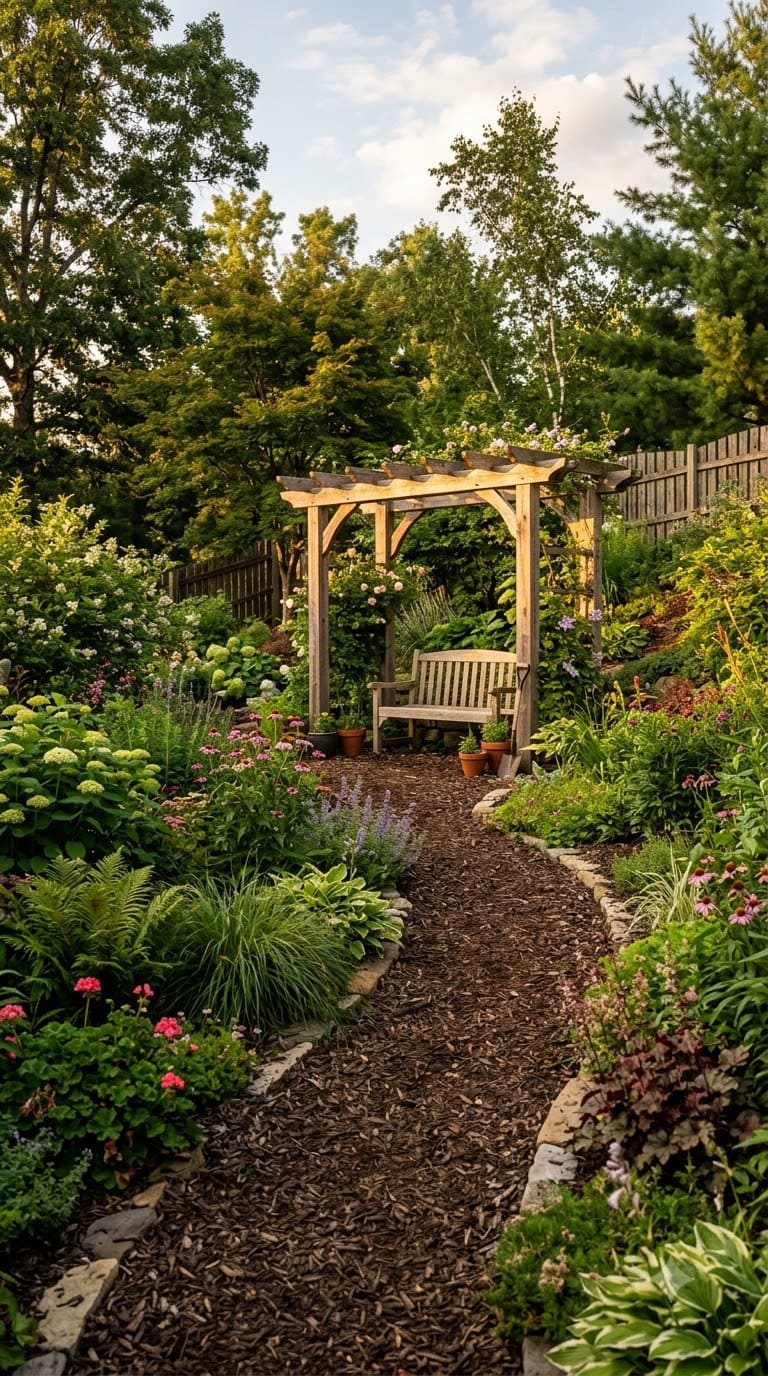
Put something worth walking toward at the highest usable point: a simple bench, a small arbor, even just a single well-placed specimen tree with a clear sightline to it from the patio. It doesn’t need to be elaborate.
A 4-foot cedar bench under a rustic arbor, with a mulched pad beneath it wide enough to actually sit and set a drink down, gives the eye somewhere to land and gives the space an actual purpose beyond “the hill behind the house.”
Frame the sightline from your main patio or back door before you commit to a spot. Stand where you’d actually be looking from most days, and pick the destination point from there, not from wherever looks convenient once you’re standing at the top.
Upward-slope idea 3: a stepped path that reads as a journey, not a chore
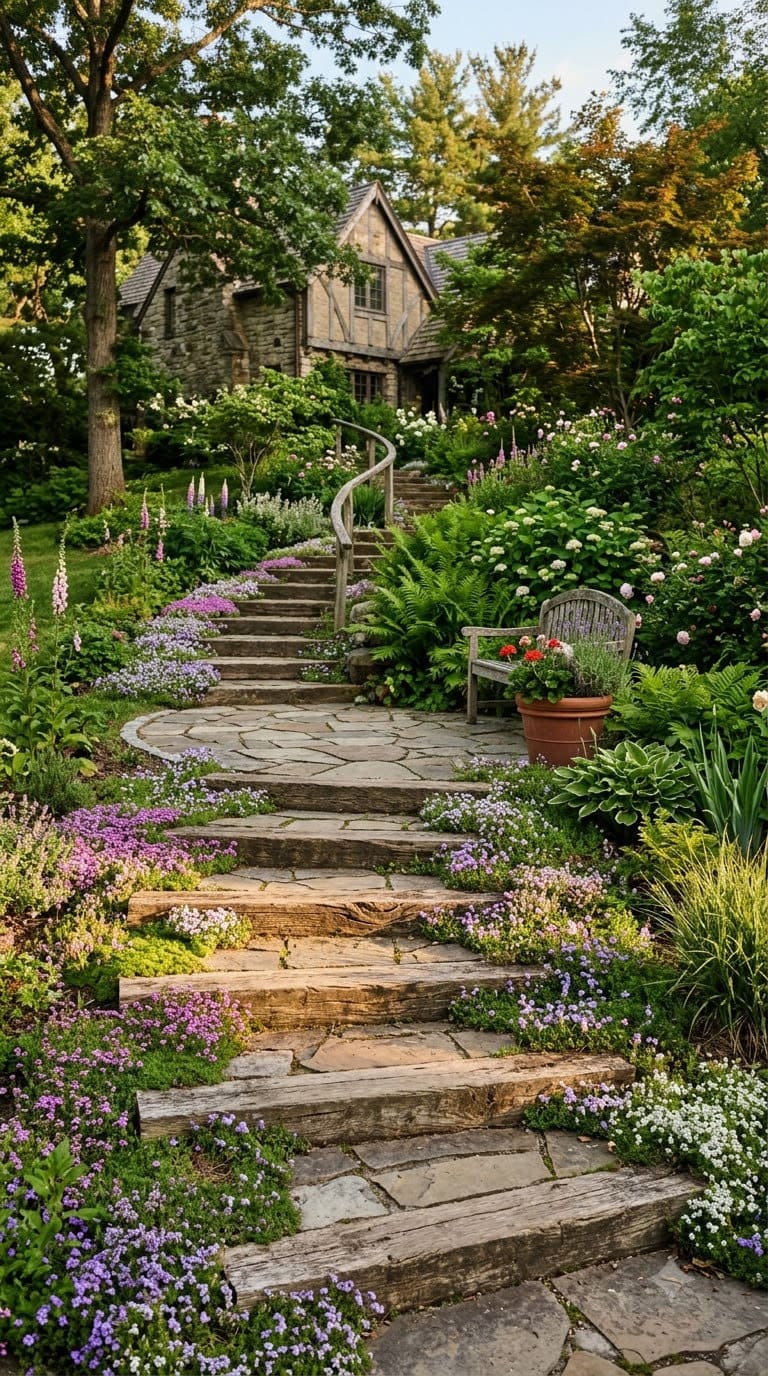
A straight run of stairs up a rising slope looks like a maintenance access route. A path that curves even slightly, with landings every 4 to 6 steps, reads as something you’d actually want to walk.
Standard outdoor stair proportions still apply here (roughly 6-inch rise, 12 to 14-inch tread depth for a comfortable, code-typical residential stair), but the layout is what makes it feel like a garden path instead of a fire escape.
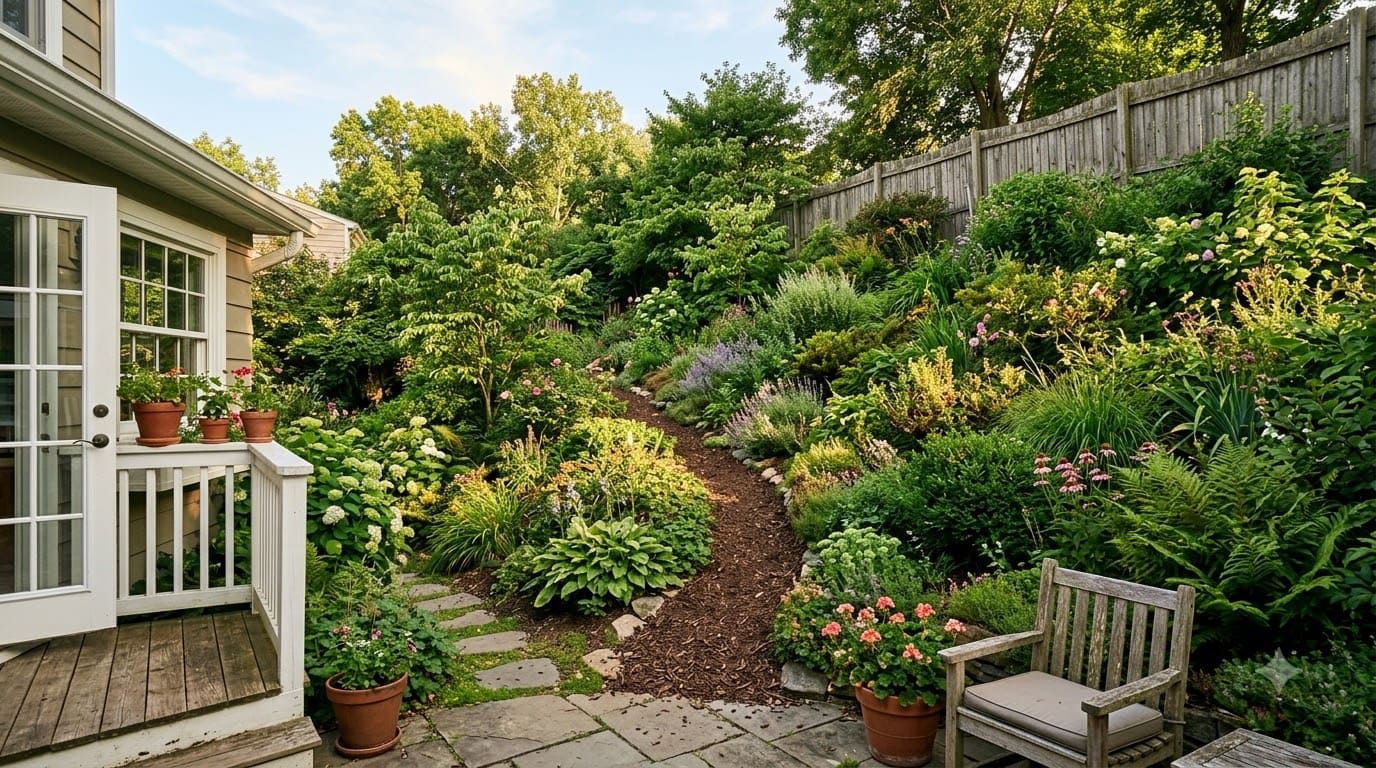
Natural stone or timber risers set into the slope, with low planting spilling over the edges of each tread, soften the “utility staircase” look considerably. Budget-wise, a timber-and-gravel version of this is a realistic weekend-to-week DIY project; natural stone set in mortar is closer to a professional job once the run gets past a few risers.
Upward-slope idea 4: layered planting that frames the climb instead of hiding it
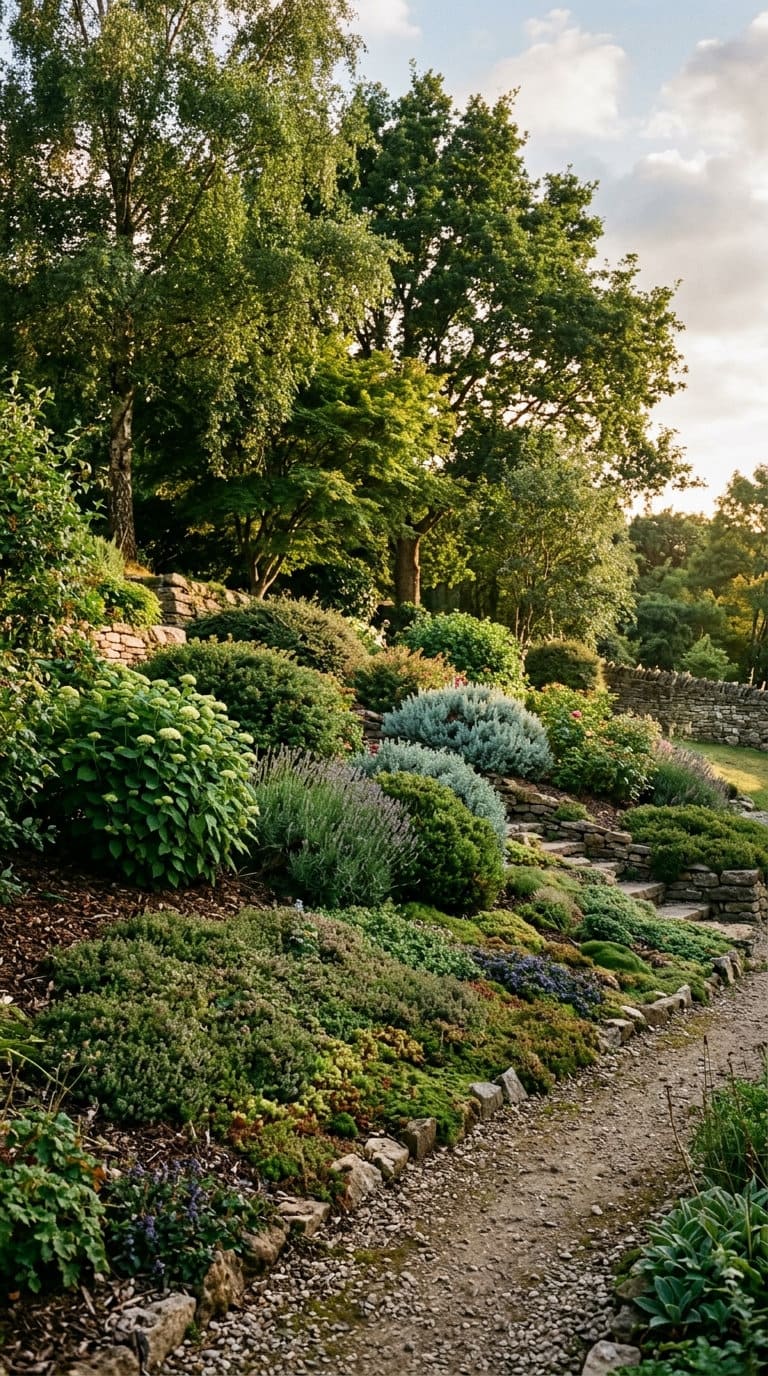
Low groundcover and mounding perennials at the base, structural shrubs partway up, and taller canopy trees or large shrubs near the crest, planted in that order, does two things at once: it stabilizes the slope with a spread of different root depths, and it visually breaks a single steep green mass into readable layers the eye can follow upward.
This is different from a downhill yard’s planting strategy, where the goal is usually softening terrace wall edges rather than leading the eye toward a top point. If your slope is small enough that the whole project fits in a compact footprint, our small sloped backyard ideas guide has additional planting layouts sized for a tighter lot.
Drought-tolerant species suit the upper slope, since it drains faster and dries out sooner. Moisture-tolerant species belong lower down, near wherever the swale or French drain from earlier in this guide is doing its job.
Can neighbors see into a yard that slopes up toward them?
Often, yes, and this is the part almost nobody plans for until they’re already sitting in their own backyard feeling watched. If the high ground on your property line belongs to a neighbor, or faces a street, their eye level sits above your yard’s eye level by however many feet of elevation separate the two properties, and a standard 6-foot fence stops blocking a downward sightline the moment that gap passes roughly 3 to 5 feet.
According to a landscaping resource that cites Iowa State University Extension’s slope-gardening guidance, the fix most homeowners get wrong is adding fence height.
What actually works better is moving the screening element 8 to 12 feet inward from the property line, closer to the patio or seating area you’re actually trying to protect, because a screen placed near where you sit blocks more of the real downward sightline than a taller boundary fence ever will.
Past roughly an 8-foot elevation difference, trying to screen the entire yard stops being realistic, and picking one private zone to protect (the dining table, not the whole lawn) is the more honest goal.
Upward-slope idea 5: an inward-set privacy screen instead of a taller fence
Before you build anything, it’s worth looking at fence options built specifically for a sloped property line, since a stepped or racked fence at the boundary still matters even when the real fix is an inward screen, it just isn’t the whole solution on its own here.
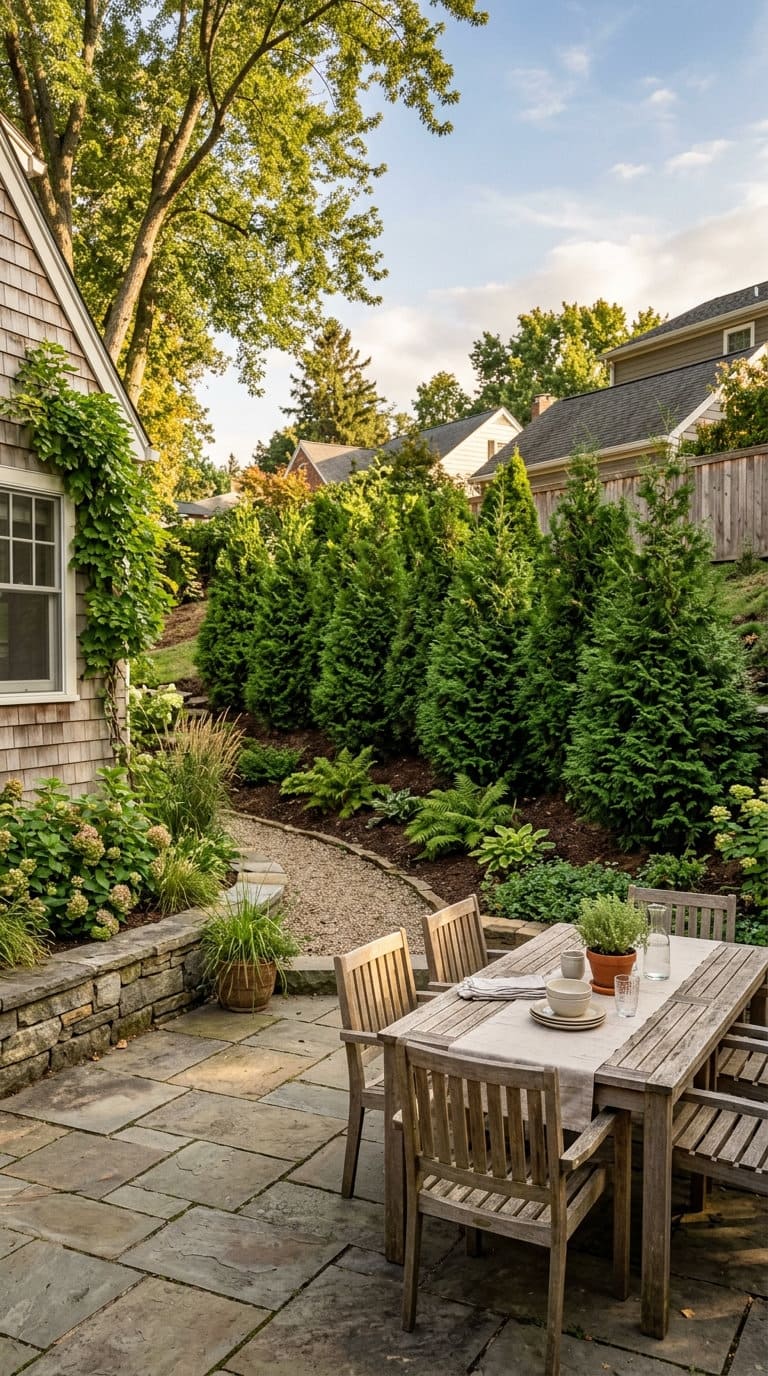
A 5 to 7-foot screen, whether it’s a hedge, a lattice panel, or a freestanding privacy wall, placed 8 to 12 feet in from the boundary and positioned specifically to block the sightline from the high ground down onto your seating area, does more real work than another 2 feet of boundary fence.
Staggered evergreen shrubs (arborvitae and similar dense-growing species are common choices here) close gaps faster than a single row, and they keep their density through winter when deciduous screening drops its leaves and its usefulness at the same time.
Upward-slope idea 6: an overhead structure over the one zone that matters most
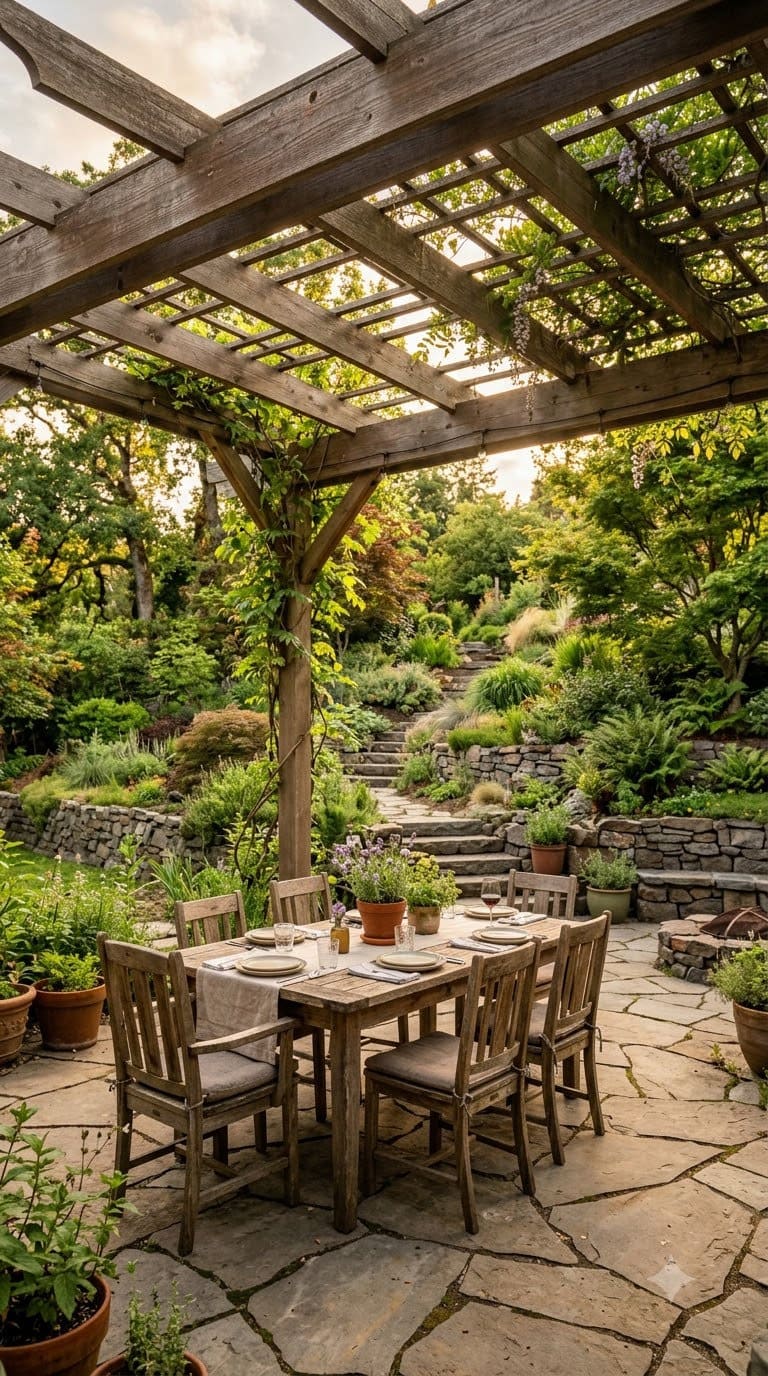
For a dining table or lounge area sitting directly below an uphill vantage point, a pergola with a partial cover, a large market umbrella, or a simple shade sail solves the specific problem a side screen can’t: someone looking down from above and slightly behind.
This only needs to cover the one zone you actually use most, not the entire yard, which keeps both the cost and the visual footprint reasonable.
Retaining walls sit on the far side here, not the near side
On a downhill yard, retaining walls usually show up right off the patio, stepping the near ground down into a series of usable platforms.
On an upward-sloping yard, if you need a wall at all, it’s typically at the true top of your usable space, holding back the soil of the still-rising hill beyond it, not terracing the lawn near the house.
For inspiration on how a single well-placed wall can double as a design feature rather than just a structural fix, our sloped backyard ideas with retaining walls and pools roundup shows several real examples, even for yards without a pool in the plan.
Upward-slope idea 7: one well-built wall at the top edge of usable space, not a series of small ones
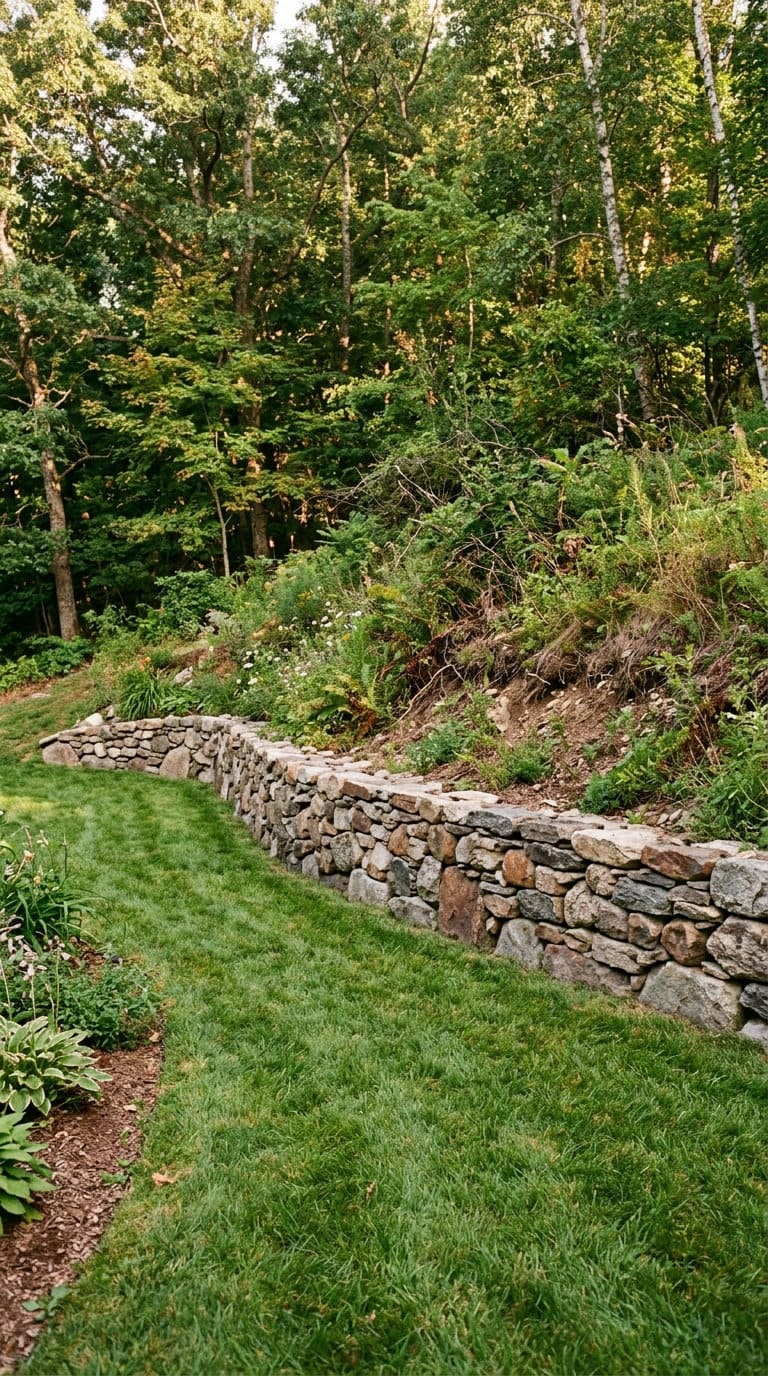
A single retaining wall, built at the point where your usable, mowed or planted yard ends and the steeper, unmanaged part of the slope begins, does more for both drainage and design than several small walls scattered up the hill.
It gives you a clean, flat edge to plant against on the low side and holds the loose soil of the upper slope in place on the high side.
Keep any wall you build yourself under about 2 to 3 feet without an engineer. Past roughly 3 to 4 feet, most municipalities require an engineered design and a permit, the same standard already true for the terraced walls in our multi-level backyard guide, because a wall holding back that much saturated soil is carrying real structural load, and a DIY wall that fails at that height usually fails suddenly, not gradually.
A real pain point, from actually dealing with one of these yards
The thing that surprised me most working through a friend’s upward-sloping lot wasn’t the water, honestly, it was how wrong my instincts were about the fence.
We’d already budgeted for a taller privacy fence along the back property line, assuming that was the fix, before actually standing at the patio table and looking at where the neighbor’s deck sat relative to us.
It was maybe 4 feet higher, not dramatic, but enough that a taller fence would have blocked almost nothing, since the sightline was going over the top of any reasonable fence height anyway.
What actually worked was almost embarrassingly simple once we saw it: a row of staggered arborvitae planted about 10 feet in from the fence line, right along the edge of the patio itself. It cost less than the fence upgrade would have and solved the actual problem instead of the one we assumed we had.
And the drainage side of that same yard took longer to sort out than the privacy issue did, mostly because the “damp patch by the wall” symptom looks identical whether the real cause is a gutter dumping too close to the house or a genuinely flat pocket in the grade, and you can’t tell which one you’re dealing with just by looking at it during dry weather.
I’ll be honest, the swale we eventually dug isn’t perfectly graded. It’s got a slightly uneven low point about two-thirds of the way along its run that I keep meaning to fix. It still works fine, but it’s a good reminder that “good enough and actually built” beats “perfect and still on the to-do list” for this kind of project.
Frequently asked questions
Does an upward-sloping yard need a French drain?
Not always. If you can achieve the standard 1/4-inch-per-foot fall away from the foundation through regrading alone, usually possible on a mild slope, a French or curtain drain isn’t necessary. It becomes the right tool once the house sits close enough to a real hill that regrading can’t create enough fall on its own, which is common on moderately steep to steep lots.
How do I stop water pooling against my foundation from a sloped yard?
Start by confirming the grade immediately around the foundation actually falls away at roughly 6 inches over the first 10 feet, per This Old House’s standard. If it doesn’t, regrade that strip first. Extend downspouts at least 10 feet from the wall. If pooling continues after both fixes, a curtain drain positioned upstream of the problem, per WSU Extension’s guidance, is the next step.
Can I use a swale instead of a French drain?
Often, yes, for surface water. A swale handles runoff that’s moving across the top of the ground. A French or curtain drain is for water that’s already saturating the soil near a foundation. Many upward-sloping yards need both: a swale to intercept surface flow higher up the slope, and, in more severe cases, a curtain drain closer to the house.
How do I get privacy when neighbors are above my yard?
Move the screening element inward, 8 to 12 feet from the boundary, rather than just raising the boundary fence. A taller fence stops helping once the elevation gap between you and the higher viewpoint passes roughly 3 to 5 feet, since the sightline simply clears the extra height.
Related Posts
Products We Recommend
This post contains affiliate links. We may earn a commission on qualifying purchases at no extra cost to you.
Natotela 18x18x15 in. Catch Basin with Stainless Steel Grate
A large-capacity catch basin with a debris grate designed to sit at the low point of a French drain or curtain drain run, catching surface runoff before it channels underground toward a discharge point, useful for the uphill-side drain approach covered in this guide.
Shop Now
Debialo 4-inch Angled Drainage Grate Yard Drain
An angled exit grate that matches the slope of the ground instead of sitting level, built specifically to carry water downhill away from a foundation; reviewers specifically confirm it works well on sloped yards and for moving water away from a house.
Shop Now
FEILAYDUN 2-Pack Flexible Downspout Extensions (up to 10 ft)
Flexible, extendable downspout extensions that carry roof runoff well clear of the foundation instead of dumping it right at the base of an already-rising slope, a small fix with an outsized effect on a yard sloping toward the house.
Shop NowNever miss an update — choose FarmFoodFamily as your preferred source on Google.
How it works: Tap the button below to open Google's settings page, then check the box next to FarmFoodFamily.
Tap the checkbox to turn it blue — that's how you know it's set.