8 Radiant Floor Lamp Ideas That Fit Your Room, Light Your Reading and Stay Safe
A floor lamp can fix a dark corner, a reading spot or a glaring TV in one move, as long as you match its height, brightness and bulb to the job.

Never miss an update — choose FarmFoodFamily as your preferred source on Google.
How it works: Tap the button below to open Google's settings page, then check the box next to FarmFoodFamily.
Tap the checkbox to turn it blue — that's how you know it's set.
A floor lamp can fix a dark corner, a reading spot or a glaring TV in one move, as long as you match its height, brightness and bulb to the job.
Products We Recommend
This post contains affiliate links. We may earn a commission on qualifying purchases at no extra cost to you.

Linkind A19 LED Light Bulbs, 6 pack
Dimmable 9W LED bulbs, 2700K warm white, 800 lumens, E26 base. Matches the reading and arc-lamp lumen ranges above.
Shop Now
Lamp Rewire Kit, 10 Foot Cord
Socket, 10 foot matching cord and hardware for the copper-pipe lamp or a thrift-store rewire.
Shop Now
Most floor lamps end up in the wrong spot. They’re too tall for the ceiling, too dim for reading or too close to a curtain.
That’s a shame, because a floor lamp is the easiest light to move and the cheapest to fix. For a plug-in lamp you don’t need an electrician.
These eight ideas pair a look with real numbers. Each one lists a height, a distance or a bulb spec, plus the mistakes to skip.
Quick Answer
Match the lamp to the job. Put an arc lamp’s base 8 to 12 inches behind the sofa arm and keep the shade about 70 inches off the floor, as Luxury Travel Magazine advises.
For reading, BenQ says to aim for at least 800 lumens. Homestyler puts the lamp head 15 to 20 inches above the seat cushion.
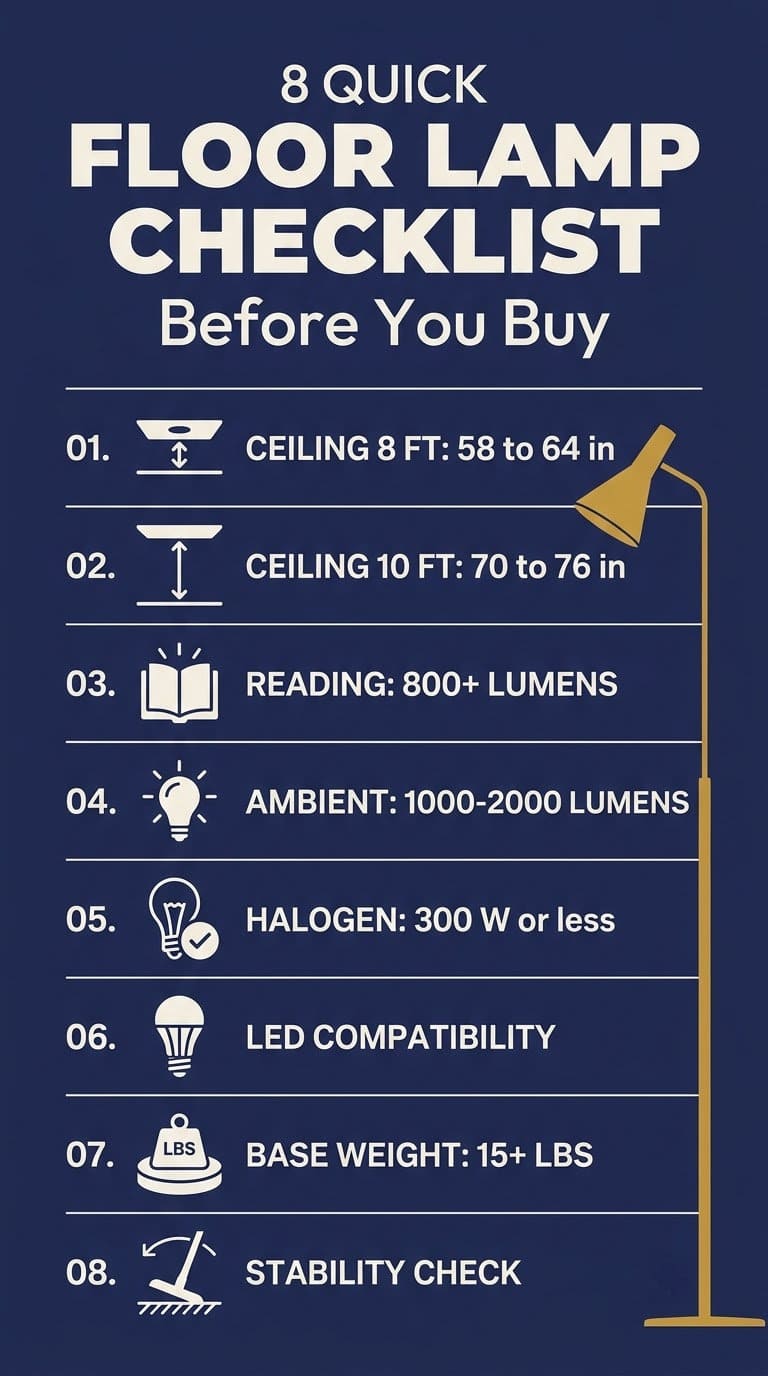
Size the lamp to the ceiling. BenQ lists 58 to 64 inches for an 8-foot ceiling and 70 to 76 inches for a 10-foot ceiling.
And check the bulb. The CPSC counted at least 189 fires and 11 deaths tied to halogen torchiere lamps and says to use halogen bulbs of 300 watts or less. An LED runs cooler, so it avoids most of that risk.



Pair that with a base heavy enough to stand firm. Homestyler suggests three lamps for a medium living room.
Which Idea Fits You?
Pick by room, budget and skill. This table sorts the eight ideas below.
| Idea | Best for | Budget tier | Skill | Main risk |
|---|---|---|---|---|
| 1. Arc lamp over the sofa | Sectionals, no ceiling outlet | Mid to high | Beginner | Heavy base needs floor space |
| 2. Reading-chair task lamp | Long reading | Low to mid | Beginner | Glare on the page |
| 3. Torchiere in a corner | Dark corners | Low | Beginner | Heat near curtains |
| 4. Slim lamp for a small room | Tight spaces | Low | Beginner | Tips over easily |
| 5. Drum-shade lamp | Layered light | Low to mid | Beginner | Shade too wide |
| 6. Lamp beside the TV | Screen glare | Low | Beginner | Cord across the floor |
| 7. Copper-pipe DIY lamp | Custom look | Low | Intermediate | Wiring done wrong |
| 8. New shade on a thrift lamp | Renters, tight budgets | Lowest | Beginner | Shade sits on the bulb |
Before You Start: Height, Brightness and Bulbs
Numbers decide whether a lamp feels right. Check these before you buy or build.
How tall should a floor lamp be?
Go by ceiling height. BenQ gives these ranges, and Homestyler puts the general living-room range at 58 to 68 inches.
| Ceiling | Lamp height |
|---|---|
| 8 feet | 58 to 64 inches |
| 10 feet | 70 to 76 inches |
| Torchiere (any room it fits) | 70 to 76 inches |
A shorter lamp for a sofa side table works fine. But pick a shade that hides the bare bulb from where you sit or stand.
How bright should it be?
The sources give slightly different numbers, so we put them side by side. The gap is small, and a dimmer closes it.
| Use | Source and range |
|---|---|
| Late-night reading | BenQ: at least 800 lumens |
| Reading (Homestyler FAQ) | 600 to 900 lumens |
| Mood or evening glow | BenQ: 300 to 500 lumens |
| Arc lamp, general light | Homestyler: 800 to 1,200 lumens |
| Torchiere, uplight | Homestyler: 1,000 to 2,000 lumens |
BenQ also says an average living room of about 250 square feet needs around 5,000 lumens in total. A floor lamp adds only 800 to 1,600 of that, so plan on two or three lamps plus your other lights.
Which bulb is safest?
Pick an LED. Bob Vila’s DIY floor lamp project notes that LEDs produce less heat than incandescent bulbs, and BenQ puts LED life at 25,000 to 50,000 hours.
Dimmable 9W LED bulbs, 2700K warm white, 800 lumens, E26 base. Matches the reading and arc-lamp lumen ranges above.
Shop NowThis post contains affiliate links. We may earn a commission on qualifying purchases at no extra cost to you.
Warm white (2,700 to 3,000K, per Homestyler) suits living rooms. Choose a dimmable bulb if the lamp or switch has a dimmer.
1. An Arc Lamp Over the Sofa
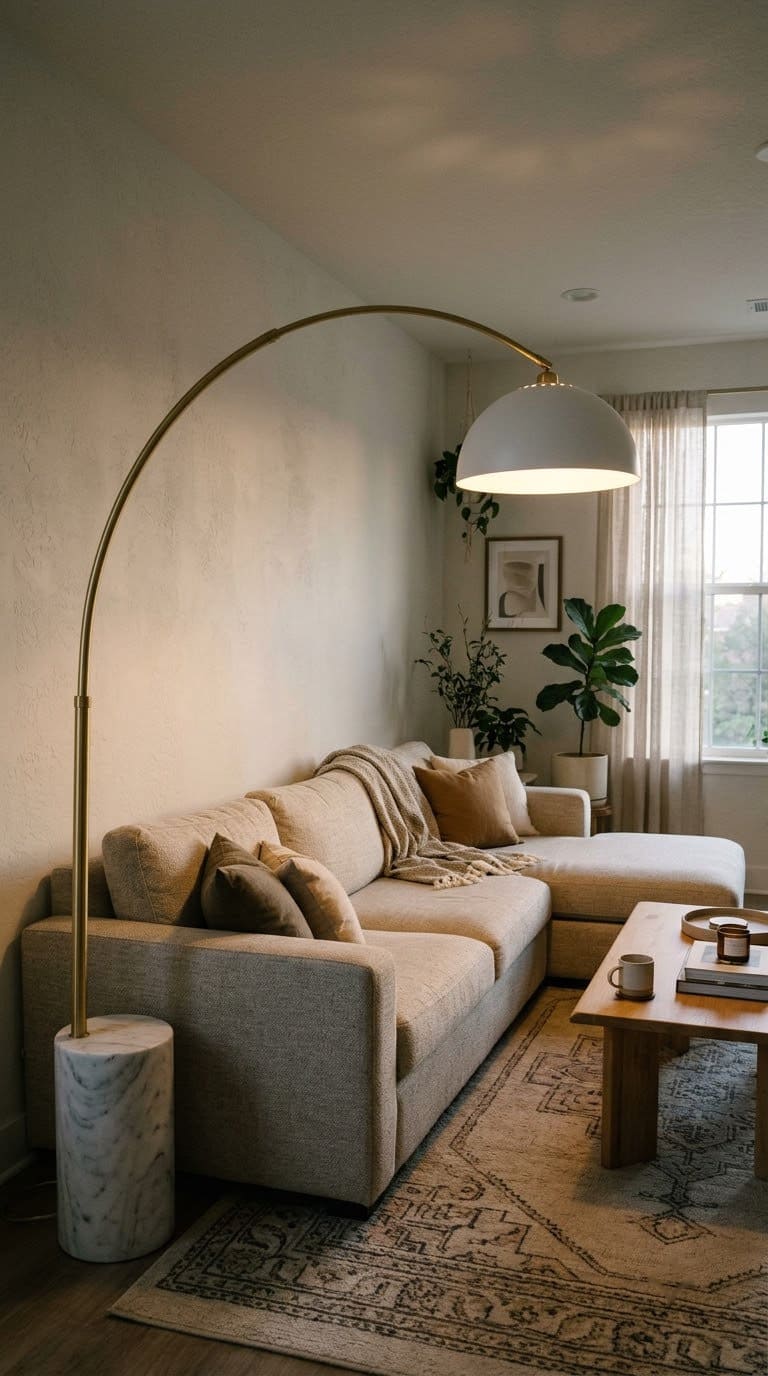
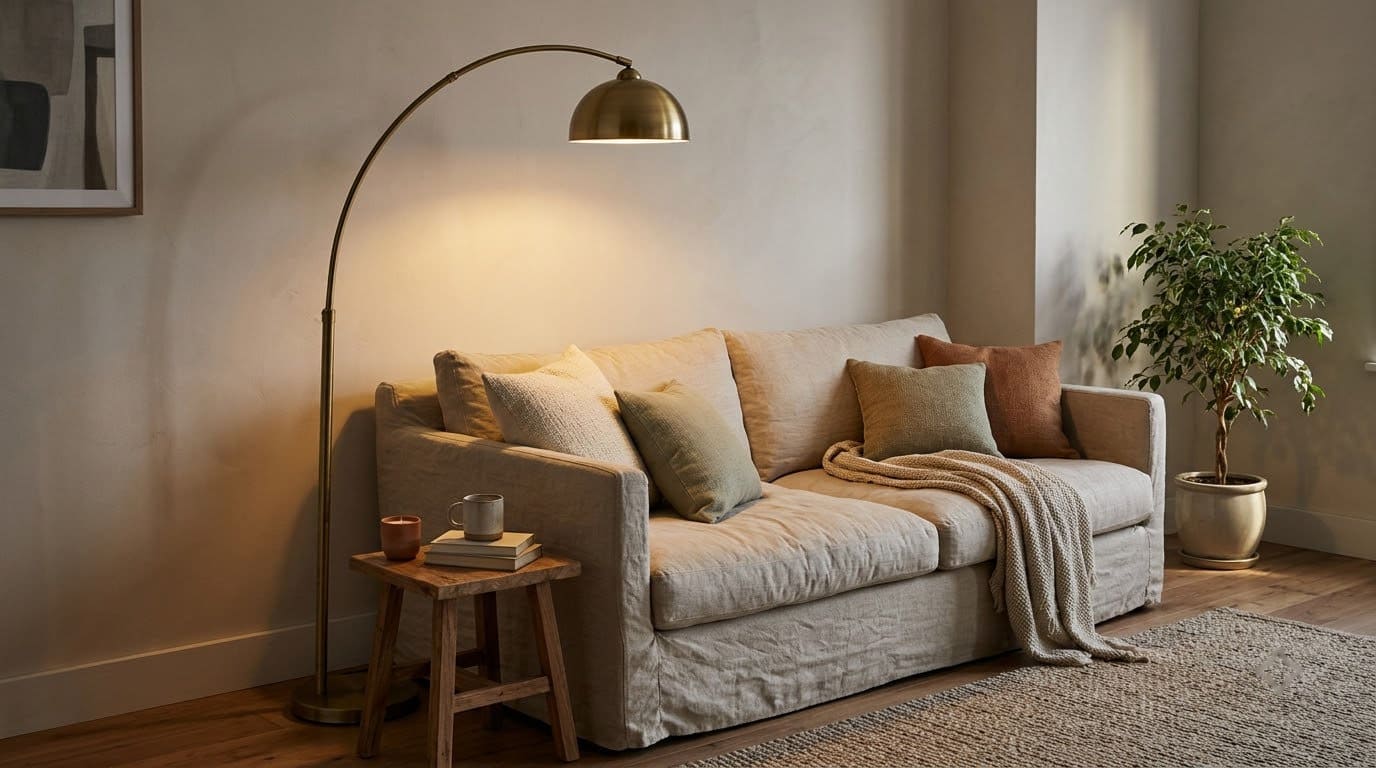
An arc lamp gives you a ceiling-style light without drilling a hole. The base sits to the side, and the arm carries the shade over the seat.
Luxury Travel Magazine says to set the base 8 to 12 inches behind the sofa arm and let the arch reach toward the center. Most arcs extend 5 to 6 feet, and the shade should hang about 70 inches above the floor.
Plan the floor space. The weighted base is big, so measure before you order. BenQ says base weight should run about 10 to 20 percent of the lamp’s height in pounds, so by that rule a 70-inch arc needs a 7 to 14 pound base.
Pick the bulb. Homestyler lists 800 to 1,200 lumens at 2,700 to 3,000K for an arc lamp. For a smaller corner version, see our guide to choosing a corner lamp for the living room.
Do a floor test first. Tape the base footprint on the floor. Then stand a broom upright at the base and picture the arm swinging out to the middle of the sofa. If the arm would cross a walkway or a ceiling fan, pick a shorter arc.
Plan the cord. An arc lamp’s base sits behind the sofa, so the cord often has to cross a gap. Run it along the baseboard to the outlet and secure it with a flat cord cover, so nobody trips on it.
Check the swing. Some arc lamps rotate on the base. Turn the arm to the sofa and make sure the shade never touches the wall or a curtain.

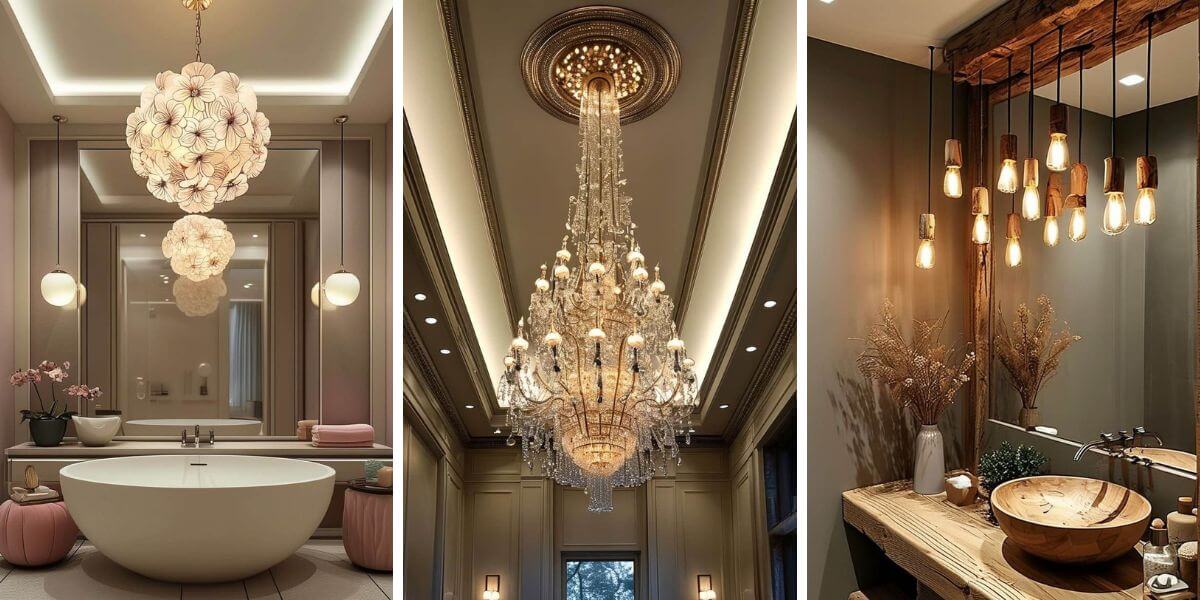
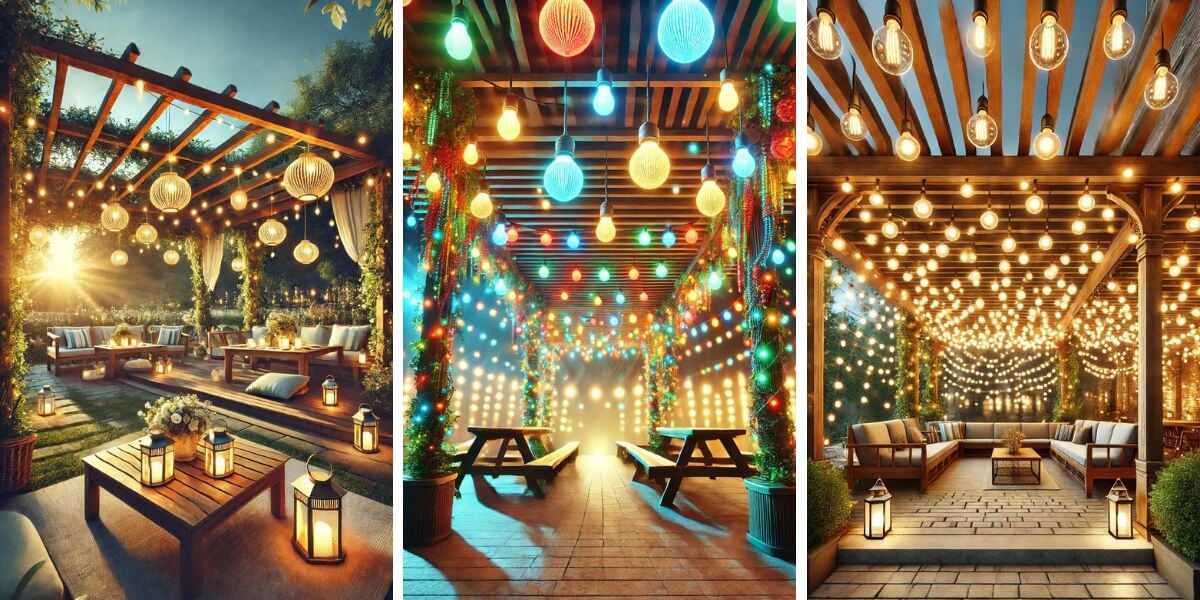
Budget: mid to high. Skill: none.
2. A Task Lamp at the Reading Chair
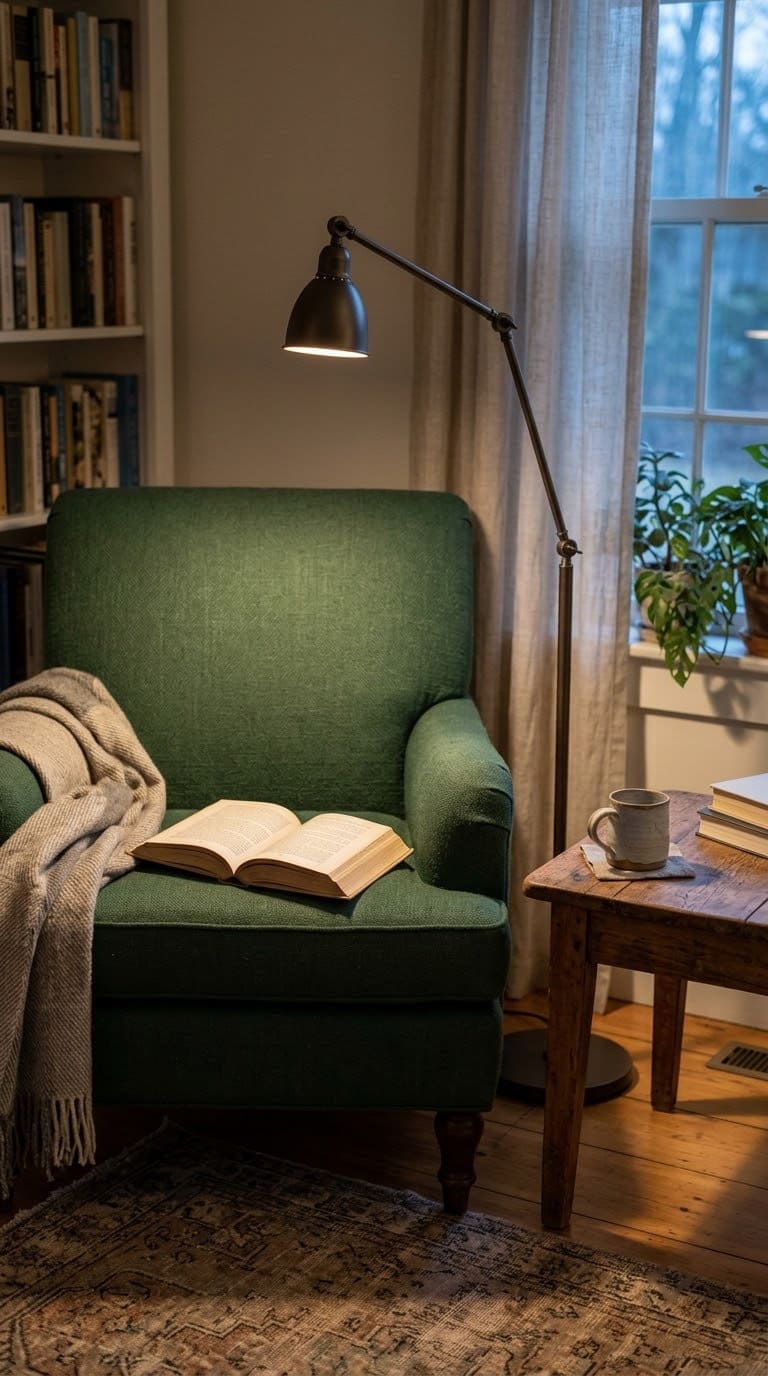
Reading needs direct light, not a general glow. A task lamp puts it where your eyes need it.
Luxury Travel Magazine advises setting the bottom of the shade near 47 inches, close to seated eye level. It also puts the base 6 to 10 inches from the chair arm.
Homestyler gives a second check: keep the lamp head 15 to 20 inches above the seat cushion, with the base 18 to 24 inches from the seat.
Mind the glare. Aim the head over your shoulder, not at the page. BenQ says to aim for at least 800 lumens for late-night reading, and a dimmer helps when you switch to a relaxed mood.
This also works well in a bedroom. Our bedroom lighting ideas show where else to place a reading light.
Test the shadow. Sit in the chair with a book. Move the lamp until your head and shoulders don’t cast a shadow on the page. A lamp slightly behind your shoulder and to the side works best for most people.
Pick the head type. A swing-arm or gooseneck head lets you aim the light, so one lamp serves a chair and a sofa. A fixed head is simpler but only lights one spot.
Mind the cord reach. Place the lamp where the cord reaches the outlet without stretching. A cord pulled tight can tip the lamp.
Budget: low to mid.
3. A Torchiere in a Dark Corner
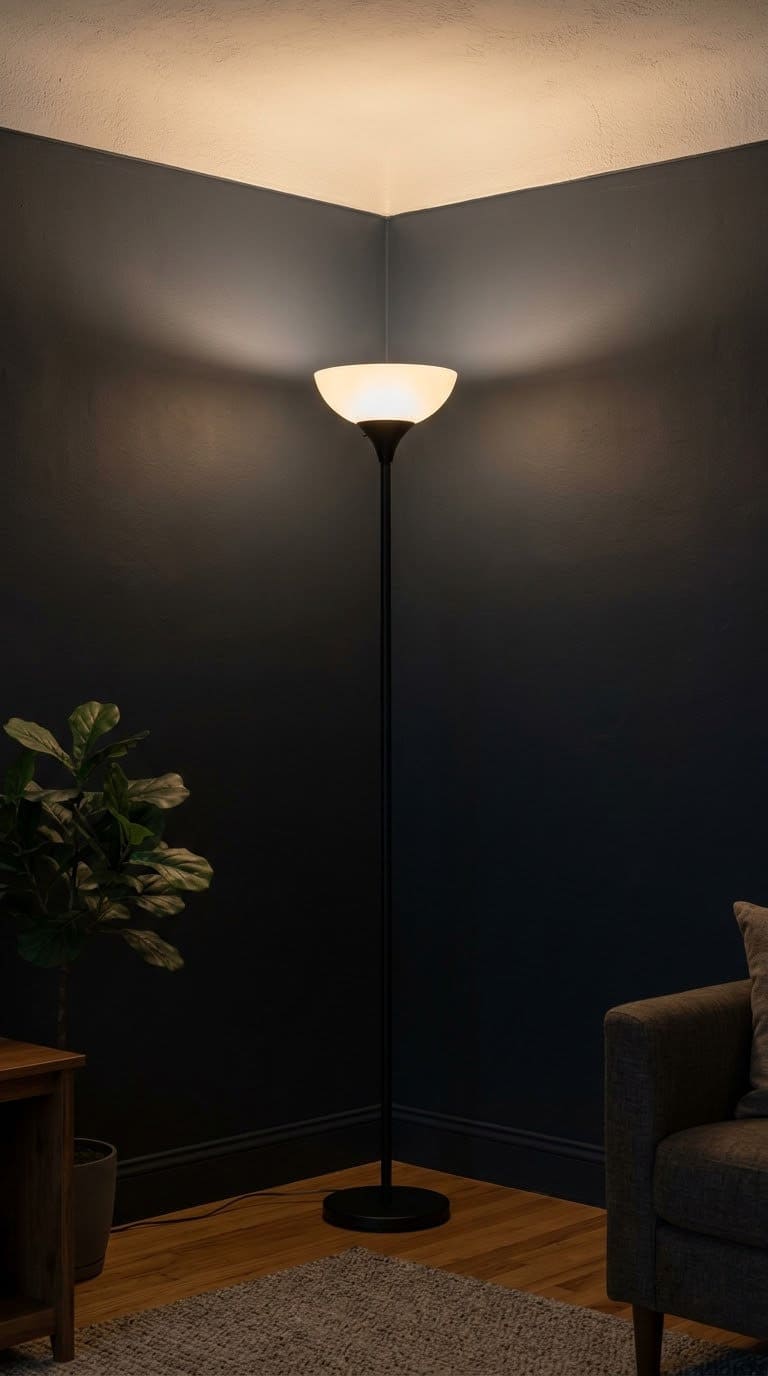
A torchiere throws light up at the ceiling, and the ceiling bounces it back into the room. That makes it a soft way to light a dark corner.
BenQ lists torchieres at 70 to 76 inches. Homestyler gives 1,000 to 2,000 lumens for an uplight, and Luxury Travel Magazine says they suit ceilings of 8 feet or higher.
Skip the old halogen type. The CPSC says halogen torchiere lamps were tied to at least 189 fires and 11 deaths since 1992. Its tests found that 250, 300 and 500 watt tubular halogen bulbs could start a fire if they touched flammable material.
The CPSC’s advice dates to 1997, but it still reads as common sense. Keep the lamp away from curtains and bedding, don’t drape clothes over it, turn it off when you leave and keep children and pets away from it. Use a bulb of 300 watts or less if you own an older halogen model, or switch to an LED.
Swap the bulb safely. Unplug the lamp and let an old bulb cool fully. Check the label on the socket for the maximum wattage and never go above it. A modern LED bulb that gives the same light uses far less power, so you stay well under the limit.
Check the clearance. Stand the lamp in its corner and look at the space between the bowl and the ceiling. Keep the bowl well clear of the ceiling and of anything above it, such as a shelf or a curtain rail.
Dust the bowl. A torchiere’s open bowl collects dust. Wipe it when the lamp is cold, since dust on a hot bulb is a nuisance and a hazard.
Budget: low. Skill: none.
4. A Slim Lamp for a Small Room
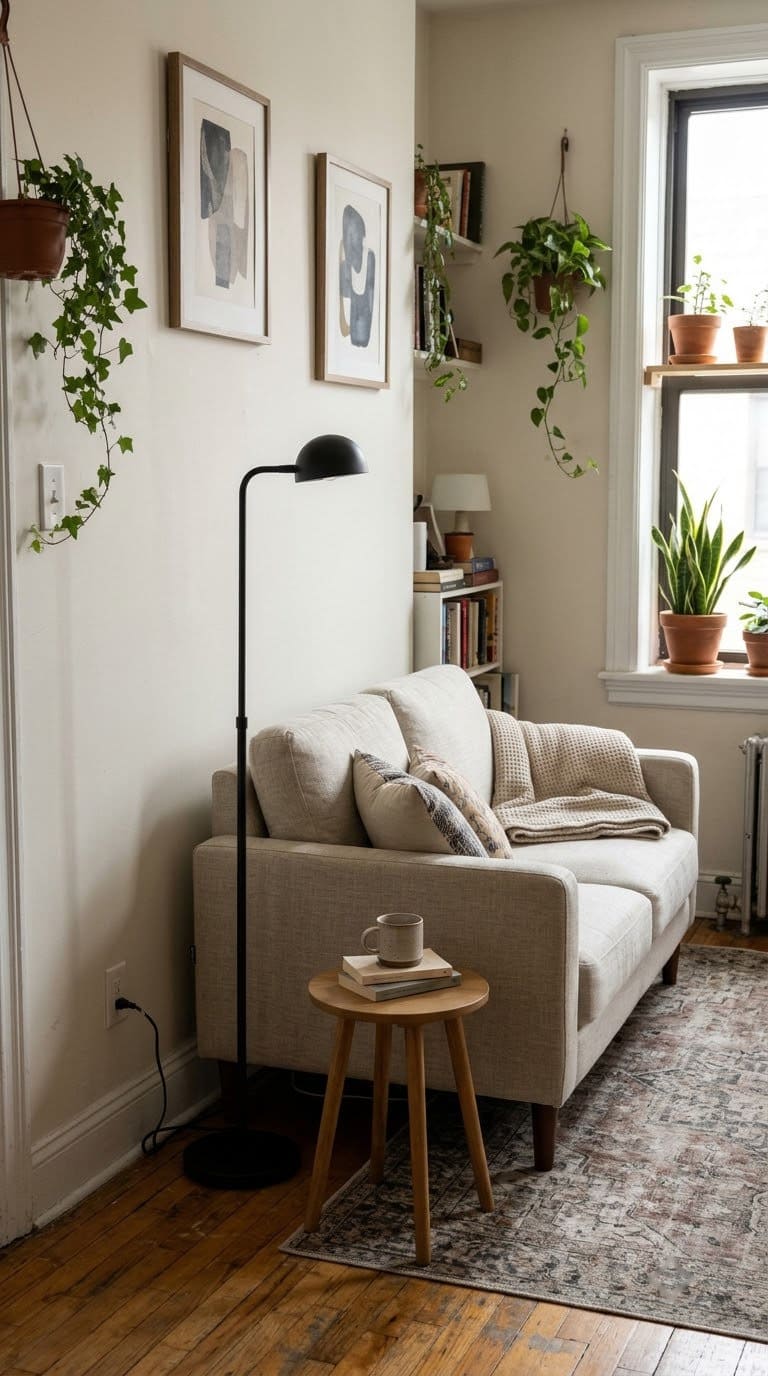
Small rooms need a lamp that takes up almost no floor. A slim stem with a small shade fits behind a chair or beside a bookcase.
For an 8-foot ceiling, BenQ suggests 58 to 64 inches. That keeps the shade in proportion without crowding the room.
Check the base. A narrow lamp can tip, and BenQ’s 10 to 20 percent rule applies to base weight. A 60-inch lamp needs a 6 to 12 pound base.
Think about pets and kids. The CPSC says to keep lamps away from children and pets to cut tip-over risk. Tuck a slim lamp into a corner where nobody walks past.
For more ways to light a tight space, our living room lighting ideas cover ceiling and wall options.
Use the wall. Put the lamp in the gap between a sofa arm and a wall, or behind a chair. Those spots are wasted floor, and a slim lamp fills them without crowding a walkway.
Stop the wobble. Stick felt pads on the underside of the base. On a rug, put a small flat board or a rug gripper under the base so it sits level.
Keep the cord short. Wrap extra cord with a hook-and-loop tie and tuck it behind the base. A loose loop catches a foot or a paw.
Budget: low.
5. A Drum-Shade Lamp for Layered Light
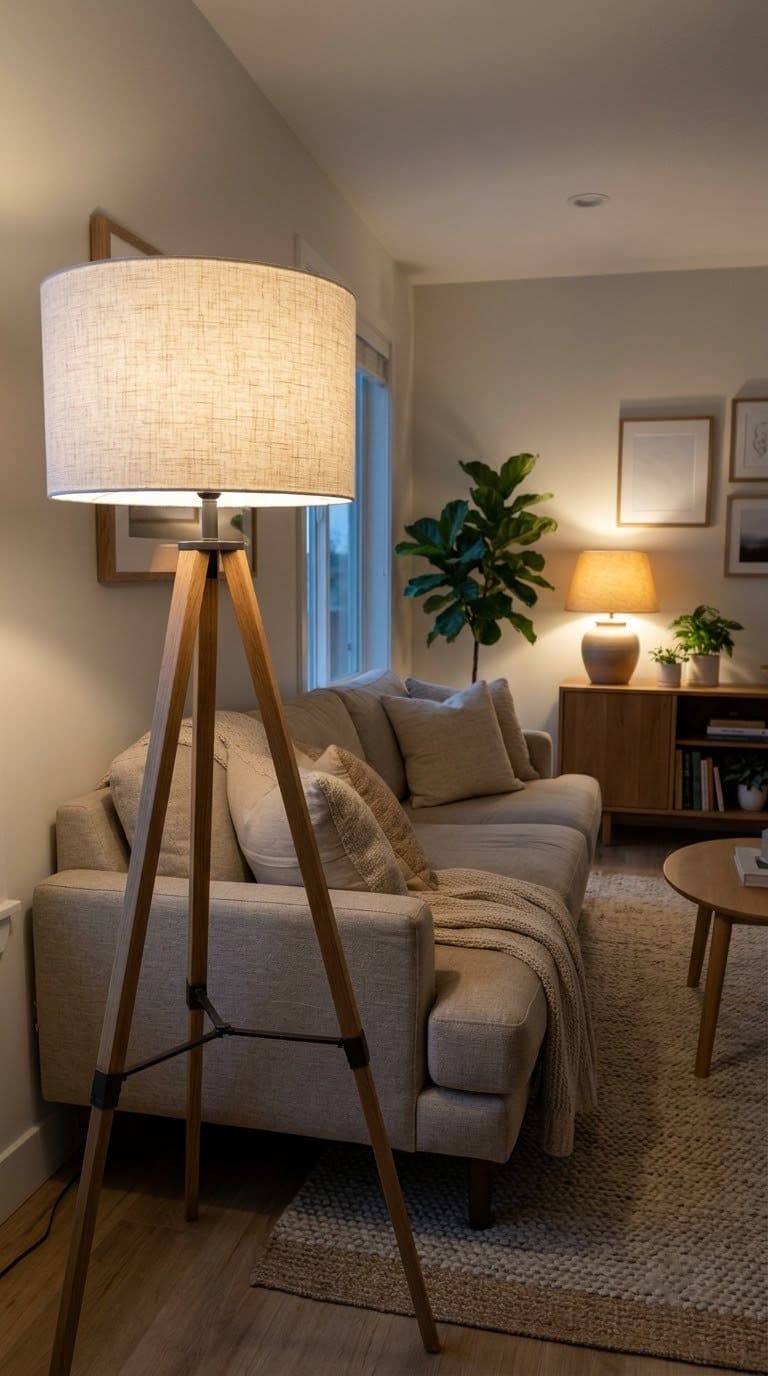
One lamp gives a pool of light. Three lamps give a room that feels finished.
Homestyler recommends three lamps in a medium living room: a task lamp by the sofa, an ambient uplight in a corner and an accent lamp. A drum-shade lamp fills the ambient slot nicely.
Choose the shade by shape. BenQ says the shade’s diameter should be about twice the base diameter, and never wider than the base is tall. That keeps the lamp from looking top-heavy.
Fabric shades soften the light. If you want to know which shade shape suits your lamp, our guide to types of lamp shades walks through each one.
Use a layering recipe. Put the tallest lamp at the back of the room, a medium lamp beside the sofa and a low lamp on a side table. The different heights fill the room with soft light at three levels.
Control them together. Plug the lamps into one smart plug or one switched power strip. You then turn the whole room on or off in one move, which makes the setup feel simple.
Match the bulbs. Use the same bulb color in every lamp. A mix of warm and cool bulbs makes a room look patchy.
Budget: low to mid.
6. A Lamp Beside the TV to Cut Glare
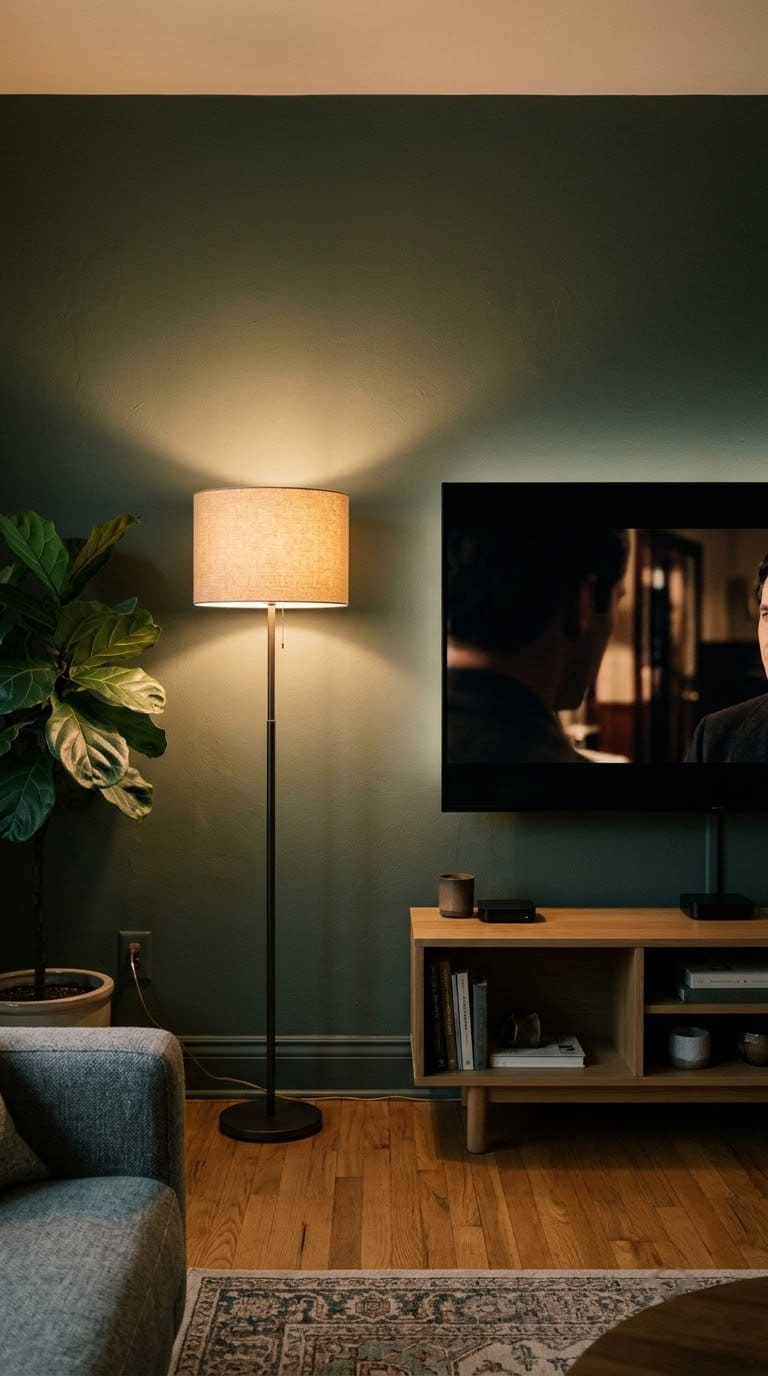
A bright screen in a dark room strains your eyes. A lamp near the TV softens the contrast.
Our old floor-lamp guide suggested placing a lamp behind the television, and the idea holds up. Set the lamp to one side so the shade glows on the wall but never reflects in the screen.
Dim it low. Aim for the 300 to 500 lumen mood range BenQ lists, ideally on a dimmer. Check the screen from your seat for reflections before you settle on a spot.
Try three spots. Turn the TV on in a dark room, sit where you sit, and move the lamp to the left side, then the right, then behind the screen. Pick the spot with no reflection and the softest wall glow.
Pick the shade. A fabric shade spreads light gently. A shade that’s open at the top and bottom throws light up and down the wall, which is useful behind a screen.
Run the cord along the wall edge, not across the walkway.
Budget: low.
7. A DIY Copper-Pipe and Dowel Lamp
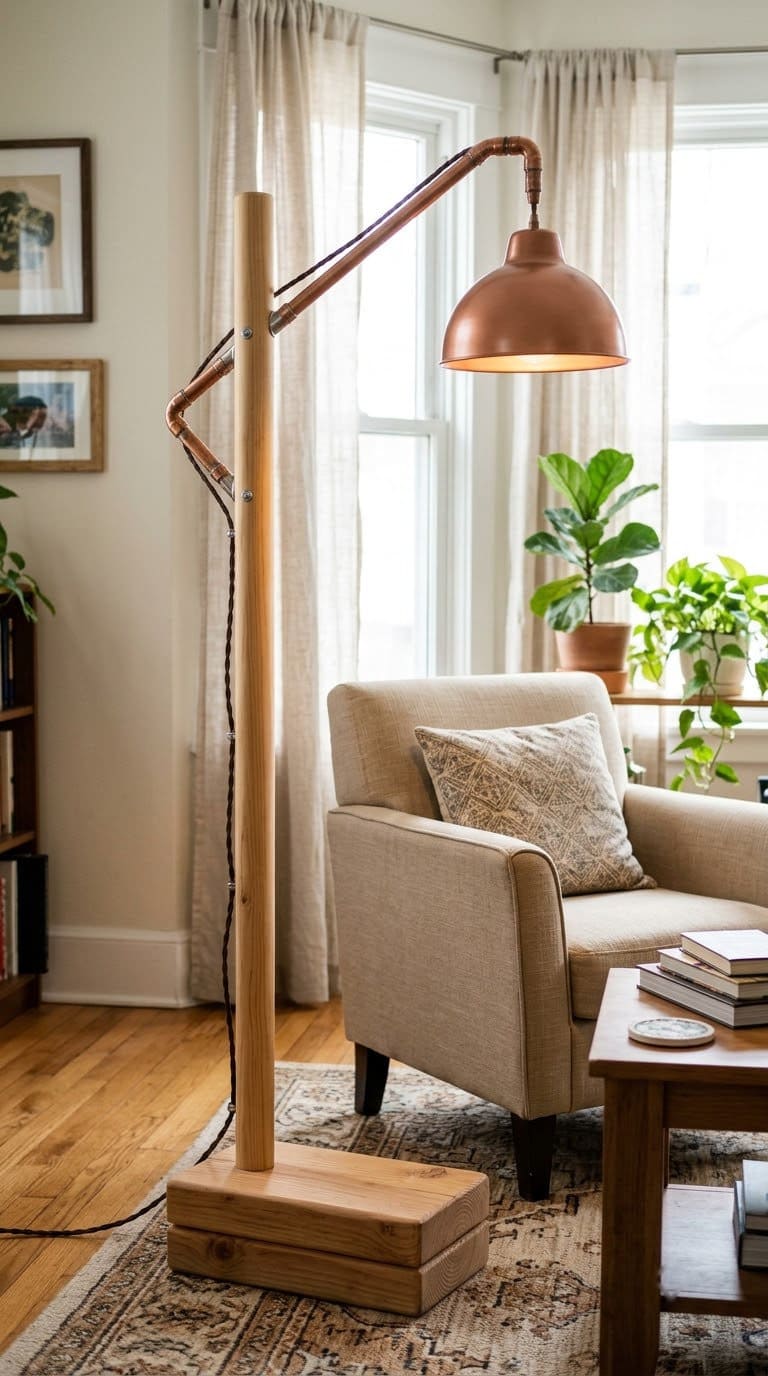
This is the one build in the list, and it’s a good first project. Ama Ryllis at Bob Vila built it from lumber, a dowel, copper pipe and a lamp kit.
Gather the parts. The base is a 2×8 plank cut to about 13 inches and a 1×6 plank cut to about 12 inches. Add a 1-1/4 inch dowel at least 55 inches long, a 3/4 inch copper pipe cut to 39 inches and a 3/4 inch copper elbow.
You also need a lamp kit with a cord of at least 10 feet, copper spray paint with primer and a small slotted plastic basket for the shade. Bob Vila lists a handsaw, a drill with 3/4 inch, 1/4 inch and 1-1/4 inch bits, clamps and a protractor.
Follow the key cuts. Drill a 1-1/4 inch hole 2 inches from the base edge. Mark the dowel 11 inches from one end and drill a 3/4 inch hole at 60 degrees for the pipe.
Wire it with care. Tie an underwriter’s knot where the cord splits. Connect the smooth wire to the brass screw and the ribbed wire to the silver screw, and follow your kit’s diagram.
Make the shade hole slightly smaller than the socket. That way the shade can’t slide down onto the bulb.
Use an LED bulb.
Follow the order. Cut the base pieces first, then drill the base hole, then cut the dowel and pipe. Dry fit everything before you glue. Paint the pieces, let them cure, then thread the cord and attach the socket last.
Unplug while you wire. Keep the plug out of the wall until the lamp is fully assembled. When you test it for the first time, plug it into a GFCI-protected outlet and turn it on with the shade attached.
Check the finish. Sand the cut edges of the pipe so the cord doesn’t snag. Run your finger along the inside of the elbow to feel for burrs before you feed the cord through.
Use a kit rated for the job. Buy a lamp kit with a listing mark, such as UL, on the socket and the cord. Check the maximum bulb wattage on the socket and use an LED well below it.
Budget: low. Skill: intermediate.
8. A New Shade on a Thrift-Store Lamp
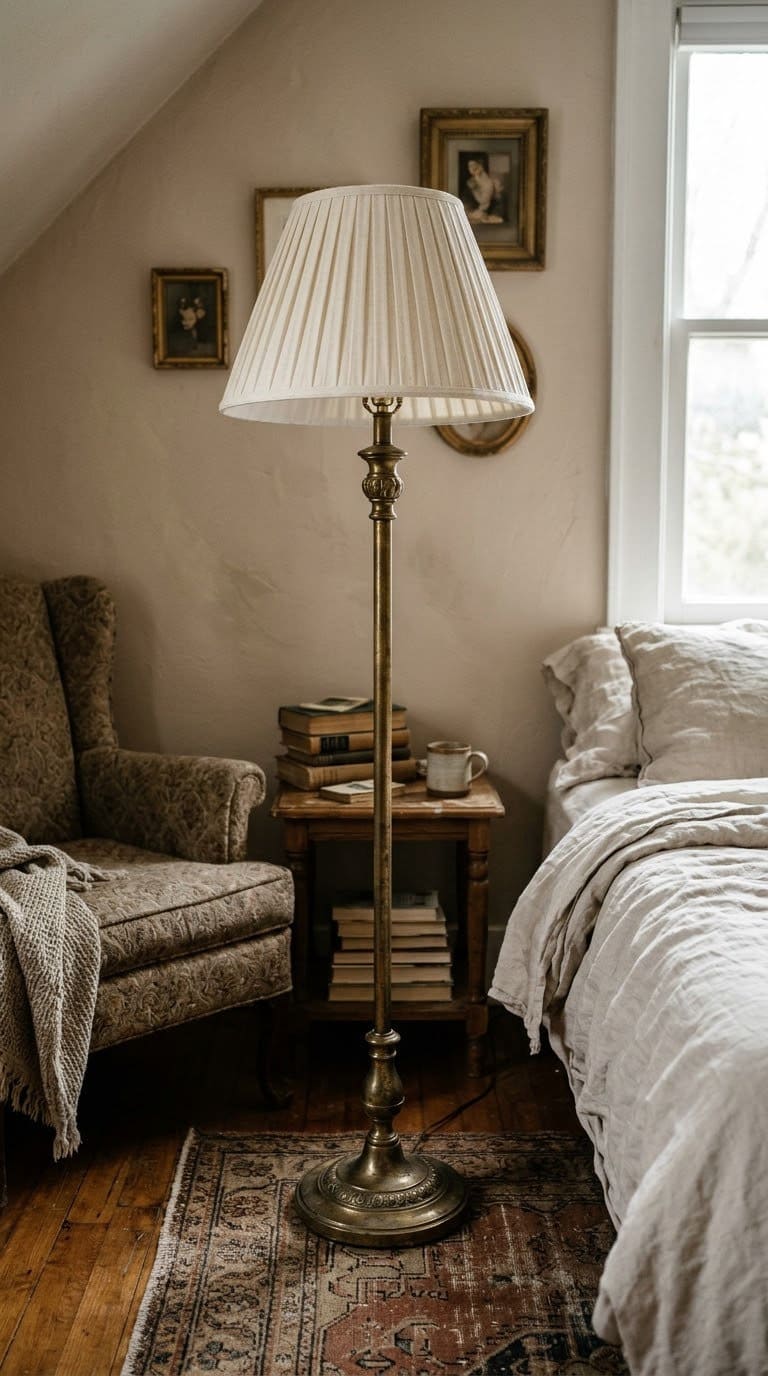
The cheapest new look is a better shade. Thrift stores and yard sales are full of sturdy stems with tired shades.
Use BenQ’s proportion rule: shade diameter about twice the base diameter, and never wider than the base is tall. Hold a tape measure to the base before you shop.
Check the wiring first. Look for a frayed cord, a cracked plug or a loose socket. If any of these show, buy a new lamp kit with a UL listing or skip the lamp.
For no-sew and fabric ideas, see our roundup of homemade lamp shade ideas. Our farmhouse lighting ideas also show shade styles that suit older lamps.
Check which fitter you need. Shades attach in three common ways. A spider fitter sits on the harp, an Uno fitter screws onto the socket, and a clip-on shade clips onto the bulb. Look at your lamp before you buy a shade, or you may need an adapter.
Match the shade to the room. A linen shade makes a lamp look relaxed. A black shade makes it look formal. A pleated shade suits a traditional lamp.
Clean the stem. Wipe a brass or painted stem with a damp cloth. For a dull brass finish, use a product made for brass and test it on a hidden spot first.
Budget: lowest. Skill: none.
How to Test a Lamp Before You Buy
You can try a lamp in your room before you spend a cent. This takes ten minutes.
First, mark the lamp’s footprint on the floor with painter’s tape. Second, stack boxes to the lamp’s height and hold a paper plate at shade level. Third, sit where you will use it and check the sightline.
Then ask three questions.
Does the lamp block a walkway? Does the cord reach the outlet without crossing a path? Can you reach the switch from your seat?
If you answer no to any of them, move the lamp before you buy it.
Shopping Checklist
Use this list in the store or when you read a product page.
| Check | What to look for |
|---|---|
| Height | Matches your ceiling, using the table above |
| Base weight | Heavy enough to stand firm, using the 10 to 20 percent rule |
| Bulb socket | Maximum wattage on the label, and an LED bulb that fits |
| Switch | Dimmer or a three-way switch you can reach from your seat |
| Cord length | Reaches the outlet without stretching |
| Listing mark | UL, ETL or CSA on the plug and the socket |
| Shade | Diameter and shape fit the base |
How Do You Care for a Floor Lamp?
A floor lamp needs little care. A few habits keep it safe and bright.
Check the cord and plug a few times a year. Look for fraying, a loose plug or a warm spot. Replace anything damaged before you use the lamp again.
Dust the shade with a soft brush. Tighten the screws on the base and the stem, since vibration can loosen them over time.
Swap a dim LED bulb for a new one. A lamp that seems weaker than it used to be often just needs a fresh bulb.
What to Fix First
Not sure where to start? Work in this order, since each step builds on the last.
First, measure your ceiling and pick a height range from the table. Second, choose the job: reading, mood or general light. Third, buy the bulb before the lamp, because the bulb sets the brightness and the heat.
Then place the lamp and check the cord path. A cord across a walkway is a trip hazard, so run it along the wall to the nearest outlet. Last, live with it for a week and adjust the dimmer or the angle before you buy a second lamp.
Common Mistakes to Avoid
Most lamp problems come from a short list of repeat errors.
Buying too tall or too short. BenQ’s ceiling table is the fix. Measure the ceiling first.
Ignoring the bulb. The CPSC found halogen torchieres were a real fire risk. Choose an LED, or keep any halogen bulb at 300 watts or less.
Leaving the lamp on near fabric. The CPSC says to keep lamps away from curtains and bedding. It also says to turn them off when you leave the room or the home.
Skipping the base weight check. A light base tips. BenQ’s rule gives you a number to check.
FAQ
How many floor lamps should a living room have?
Homestyler recommends three lamps for a medium living room. Use one for tasks, one for ambient light and one for accents.
How tall should a floor lamp be?
Pick 58 to 64 inches for an 8-foot ceiling and 70 to 76 inches for a 10-foot ceiling, per BenQ. Arc lamps are the exception, and Luxury Travel Magazine puts their shade at about 70 inches.
How do I fix a wobbly floor lamp?
Check the base first, since a light or uneven base is the usual cause. Add felt pads or a thin rubber pad under the base, and tighten the stem joints. If it still rocks, swap in a heavier base.
Are floor lamps a fire risk?
Older halogen torchiere lamps were. The CPSC reported at least 189 fires and 11 deaths since 1992 and recommended bulbs of 300 watts or less. An LED bulb runs cooler, so it avoids most of that risk.
For a study corner, see our study lighting ideas. And for homemade options, diy lamp ideas has more projects.
How do I fix a lamp that flickers?
Start with the bulb. Turn the lamp off, let it cool, and screw the bulb in firmly. If it still flickers, try a different bulb, since some LEDs don’t work with some dimmers.
If a new bulb doesn’t fix it, check the plug and the cord. A loose connection can cause flicker. Stop using the lamp and replace the cord or the socket if you find damage.
Where should I put a floor lamp in a small living room?
Use corners and the gap beside a sofa or chair. A slim lamp there lights the room without taking up walking space. See idea 4 for the base and pad tips.
Related Posts
Never miss an update — choose FarmFoodFamily as your preferred source on Google.
How it works: Tap the button below to open Google's settings page, then check the box next to FarmFoodFamily.
Tap the checkbox to turn it blue — that's how you know it's set.