8 Joyful Doggy Christmas Tree Ideas That Keep Your Pup Safe
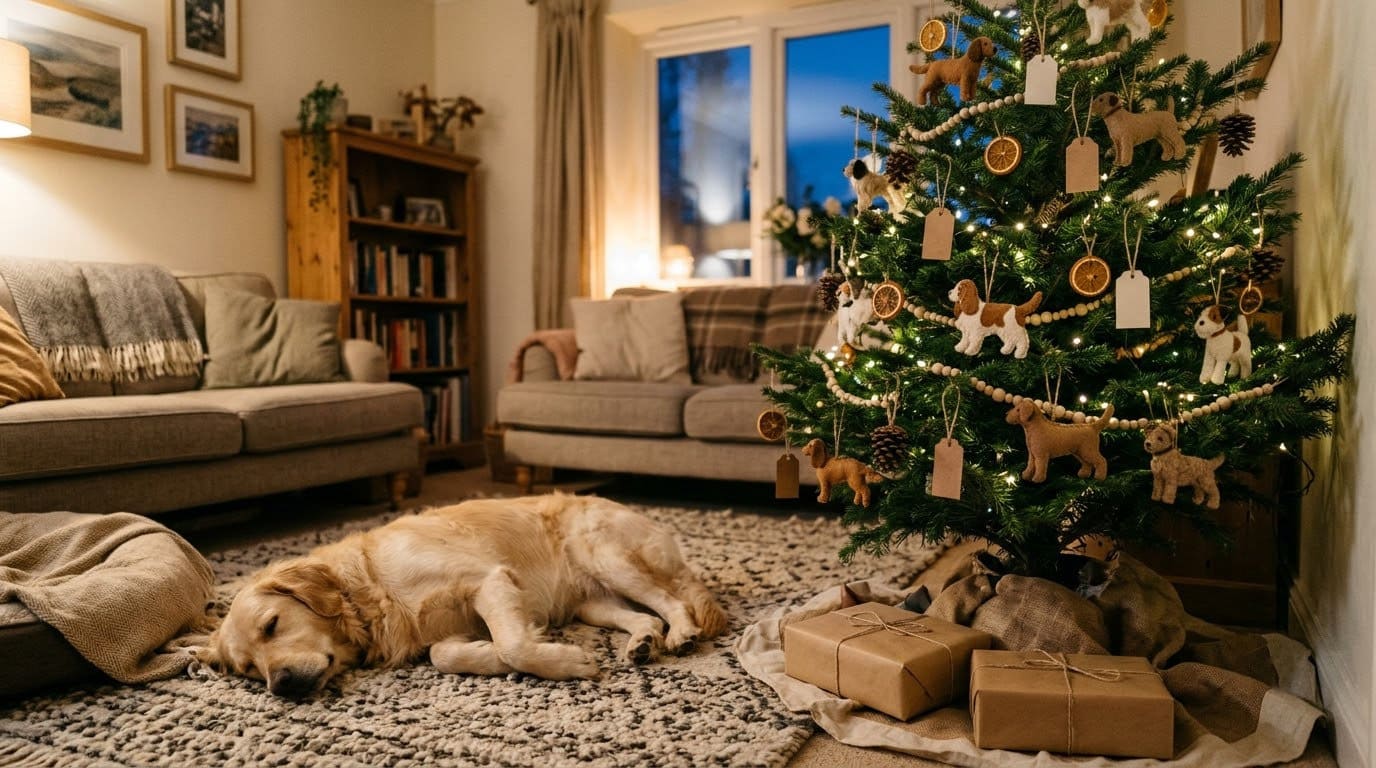
A dog-themed Christmas tree is easy to style and fun to build, as long as the tree is anchored and every ornament passes a quick dog-safety check.

Never miss an update — choose FarmFoodFamily as your preferred source on Google.
How it works: Tap the button below to open Google's settings page, then check the box next to FarmFoodFamily.
Tap the checkbox to turn it blue — that's how you know it's set.
A dog-themed Christmas tree is easy to style and fun to build, as long as the tree is anchored and every ornament passes a quick dog-safety check.
Products We Recommend
This post contains affiliate links. We may earn a commission on qualifying purchases at no extra cost to you.

Nuanchu 6-Panel Clear Acrylic Christmas Tree Fence
Six 20 x 32 inch clear panels that wrap a tree, for idea 8.
Shop Now
Natural Wood Slices, 30 pcs, 3.5 to 4 inch, predrilled
Unfinished wood rounds with holes for name tags and paw-print ornaments in ideas 1 and 5.
Shop Now
Dog lovers decorate with their dogs in mind. The tree is often the first place it shows.
But a dog sees a tree as a giant toy. Ornaments dangle, water sits at nose height and wires run along the floor.
These eight ideas give you a dog theme you’ll love. Each one also lists the safety rules from vet sources, so the tree stays up all season.
Quick Answer
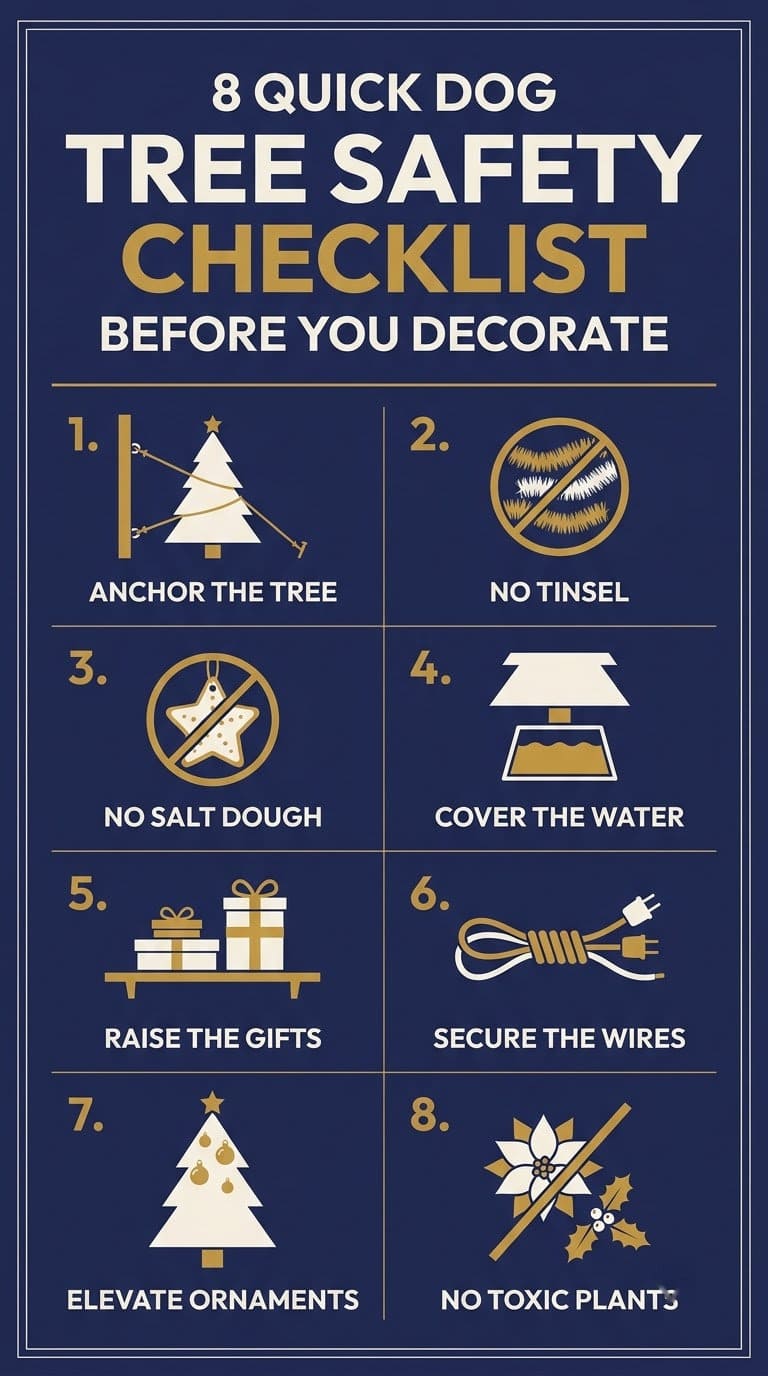
Anchor the tree and pick safe decorations. The ASPCA says to secure the tree tightly so it can’t tip, and to avoid tinsel, which can cause severe vomiting and a blocked gut.
Skip salt dough. The ASPCA says salt-dough ornaments are hazardous even when dry, because of the risk of life-threatening electrolyte imbalances.
Use a wide base stand and a wall anchor, says PetMD in a guide by the Pet Poison Helpline team. It also advises hanging sturdy ornaments low and fragile ones high.
Cover the tree water, since the ASPCA says standing water can harbor bacteria that upset a dog’s stomach. Tuck the cords under a skirt.
And wait a few days after setting up the tree before you decorate it. If your dog eats something risky, call the Pet Poison Helpline at 855-764-7661.


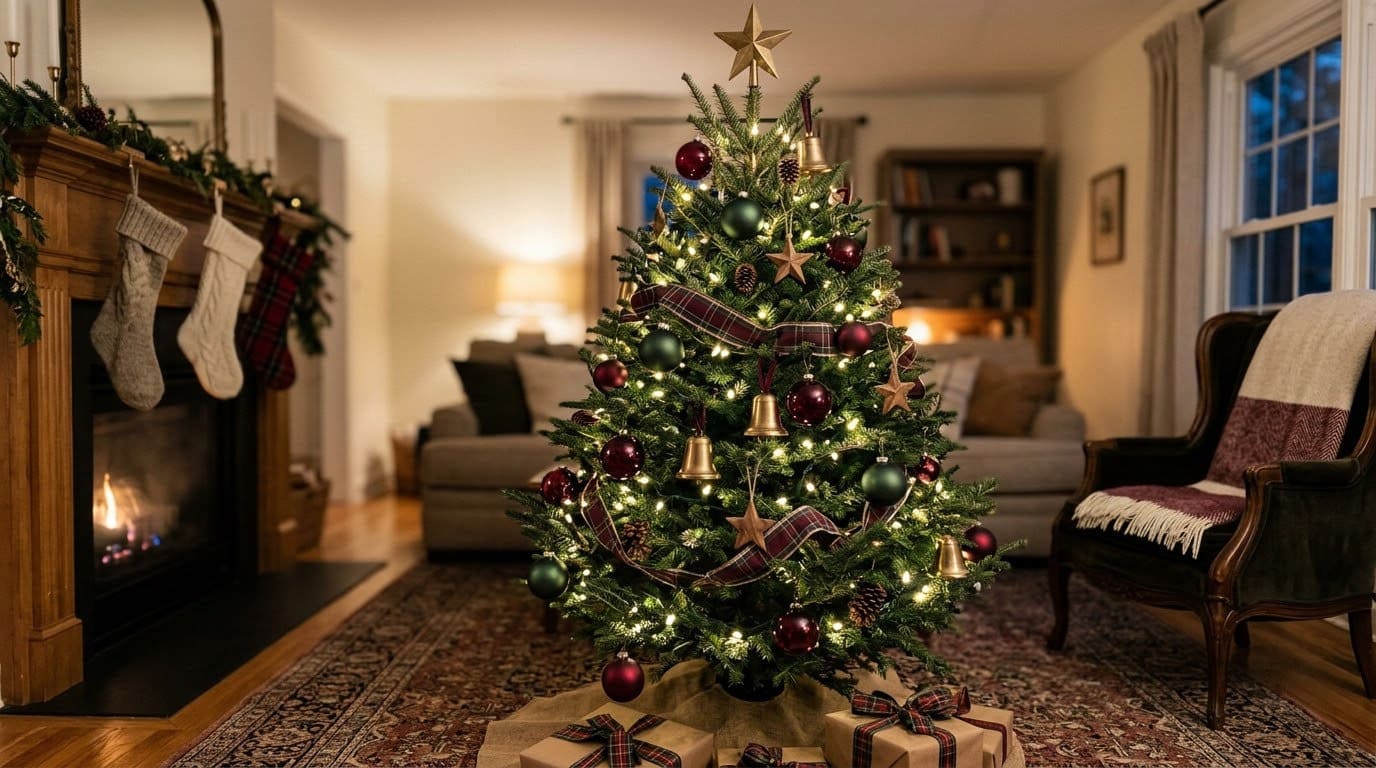
Which Idea Fits You?
Pick by your dog’s habits and your space. This table sorts the eight ideas below.
| Idea | Best for | Budget tier | Skill | Main risk |
|---|---|---|---|---|
| 1. Name-tag tree | Multi-dog homes | Low to mid | Beginner | Small tags swallowed |
| 2. Felt and plush pups | Chewers | Low | Beginner | Stuffing and eyes |
| 3. Breed-silhouette tree | One-breed fans | Low to mid | Beginner | Glass or brittle ornaments |
| 4. Tabletop doghouse tree | Small homes | Low | Beginner | Table knocked over |
| 5. Paw-print and photo ornaments | Keepsakes | Low | Beginner | Salt dough |
| 6. Santa Paws gift corner | Gift lovers | Low | Beginner | Food in gifts |
| 7. Entryway dog tree | Mudrooms | Low to mid | Beginner | Wet paws and cords |
| 8. Gated corner tree | Curious dogs | Mid | Beginner | Weak anchor |
Before You Start: What’s Safe on a Dog Tree
Check the material before you check the theme. Most tree risks come from the things we hang on it.
Which decorations are risky for dogs?
The ASPCA and the Pet Poison Helpline team at PetMD name the same trouble spots. This table sums them up.
| Item | The risk | Safer swap |
|---|---|---|
| Tinsel | Vomiting, a blocked gut, surgery | Lights and sturdy ornaments |
| Salt dough | Electrolyte imbalance, even dry | Felt, wood or printed photos |
| Glass or hard plastic | Cuts to mouth and gut | Shatterproof or fabric |
| Cords and batteries | Shock, or burns to the mouth | Cords under a skirt or guard |
| Tree water | Stomach upset | A covered stand |
| Food ornaments | Popcorn, dough, macaroni | Skip them |
What order should you set up in?
PetMD suggests setting up the bare tree first and waiting a few days before you decorate. That gives your dog time to look and sniff under supervision.
Then add lights, and fasten the cords so they can’t be chewed. Hang decorations last, with sturdy ones low and fragile ones high.
1. A Name-Tag Tree
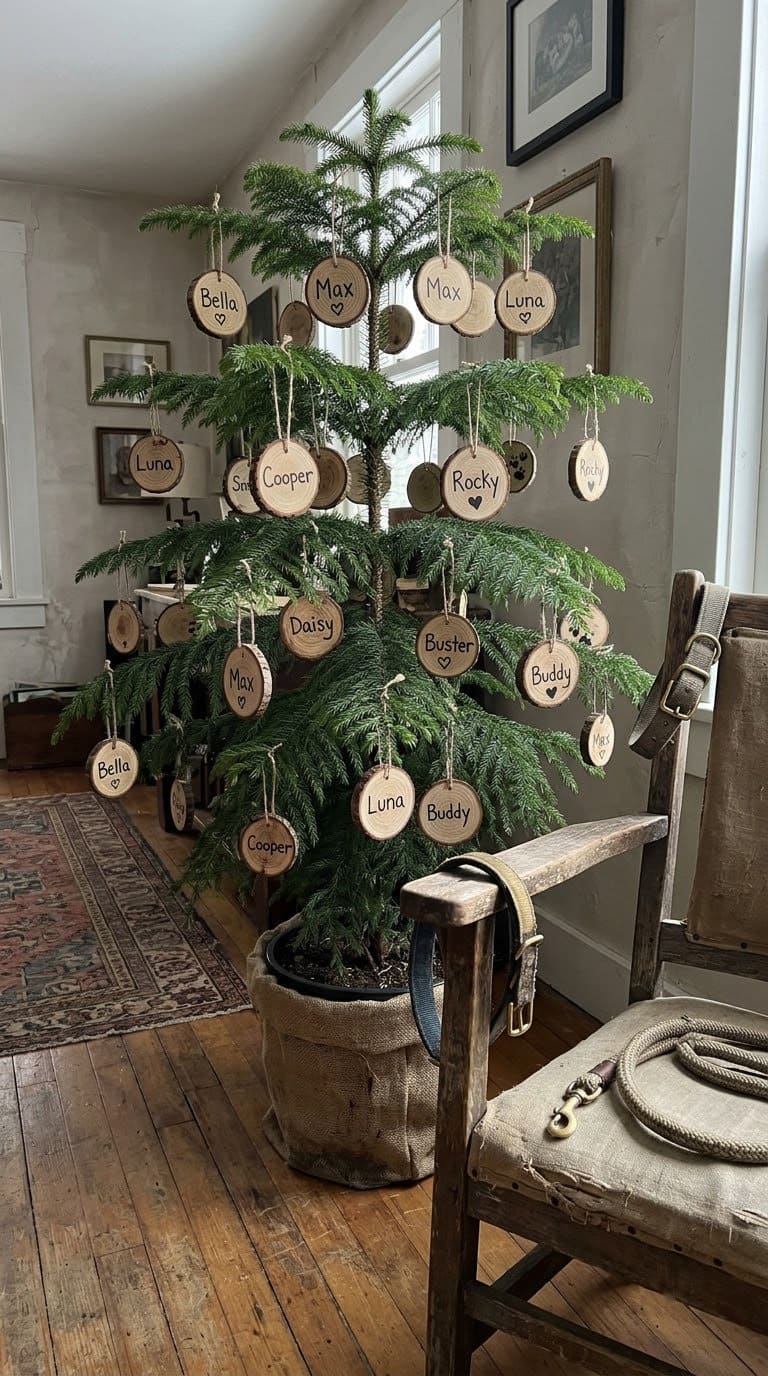
A name-tag tree gives every dog its own spot. It’s also a sweet way to remember a dog who’s gone.
Use wood slices or felt cutouts, not salt dough. Write each name with a non-toxic marker (look for the ACMI “AP” seal) and tie it on with a loop of ribbon.
Watch the small parts. The ASPCA’s crafting guide says to check craft products for the ACMI seal. “AP” means non-toxic, and “CL” means call a vet or the poison center if your dog eats it.
Six 20 x 32 inch clear panels that wrap a tree, for idea 8.
Shop NowThis post contains affiliate links. We may earn a commission on qualifying purchases at no extra cost to you.
Hang the tags high on the branch, and use a loop of ribbon that’s short enough not to wrap around a paw. If a tag falls, pick it up before your dog does. For more ornament ideas, see our Christmas ornament ideas.
Make them in five steps. Buy plain wood slices with a pre-drilled hole. Write each name in pencil first, then trace it with a non-toxic marker. Let the ink dry fully.
Thread a short loop of ribbon through the hole and knot it twice. Hang each tag on the branch tip, then lift the branch gently to check the tag stays on.
Add a small detail. Draw a paw print or a bone beside each name. Keep the drawing flat, with no glued-on beads or buttons that could come loose.
Make a keepsake tag for a dog who’s gone. Use a wood slice with the dog’s name and the years. Hang it near the top of the tree, where it stays safe and easy to see.
Budget: low to mid. Skill: beginner.
2. Felt and Plush Pup Ornaments
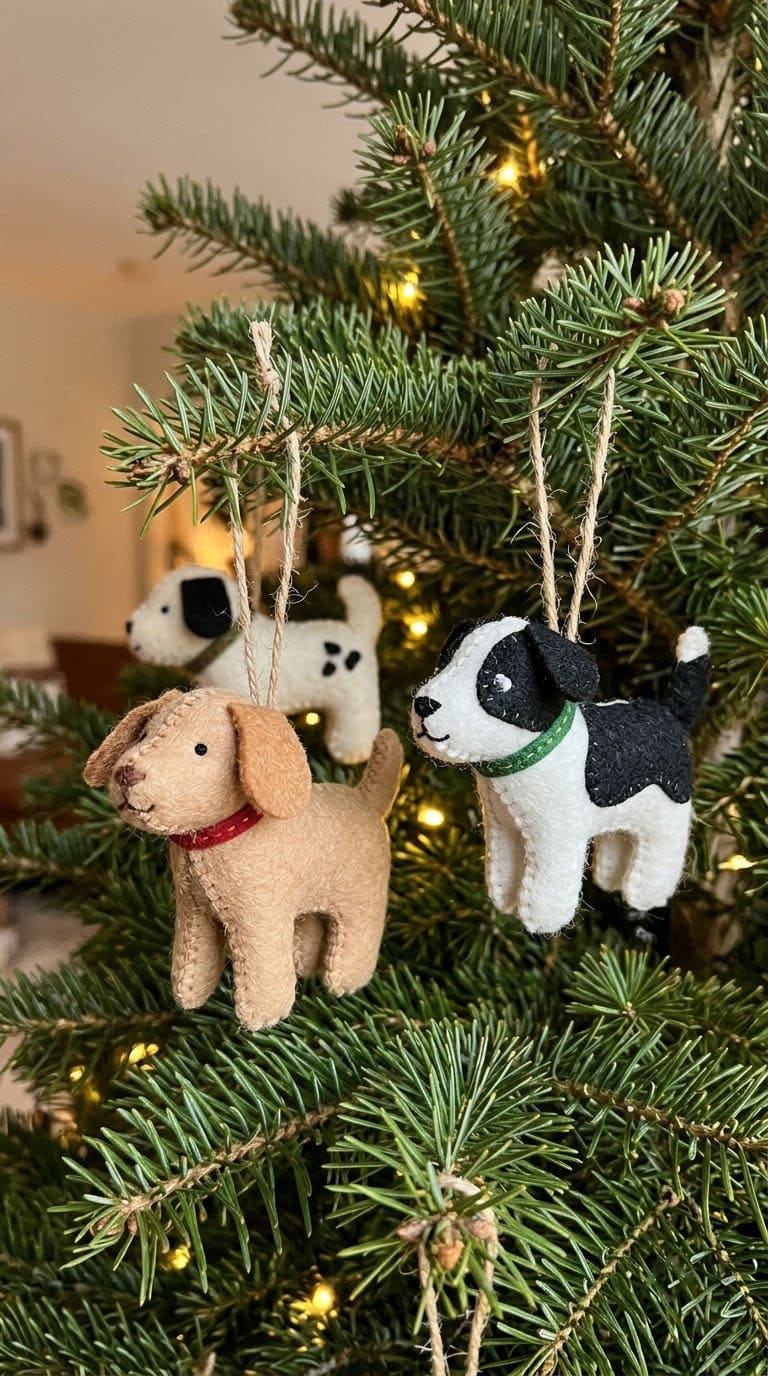
Felt is a good fit for a dog tree. It doesn’t shatter, and it’s soft if it falls.
Cut a dog shape from two pieces of felt, stitch the edges and stuff it lightly. Embroider the eyes instead of gluing on buttons.


Think about chewers. A dog that chews can still pull stuffing out. Hang these higher on the tree if yours is a shredder.
The ASPCA says to keep breakable glass or plastic ornaments away from pets, so fabric is the safer pick overall. Crochet fans can find free patterns in our amigurumi puppy guide.
Follow these steps. Trace a dog shape onto paper and cut it out as a pattern. Pin the pattern to two layers of felt and cut around it. Stitch the edges with a blanket stitch, leaving a small gap.
Stuff lightly with a little fiberfill and stitch the gap shut. Sew a loop of ribbon or thread to the top.
Add the face with thread. Use a few small stitches for the eyes and nose. A stitched face has no parts to pull off, which a button or bead does.
Choose wool or wool-blend felt. Wool felt holds its shape and is less fuzzy than craft felt. Craft felt works too, but it can pill.
Quick tip: make two or three spares. If your dog gets one, you can swap it out without a gap on the tree.
Budget: low. Skill: beginner.
3. A Breed-Silhouette Tree
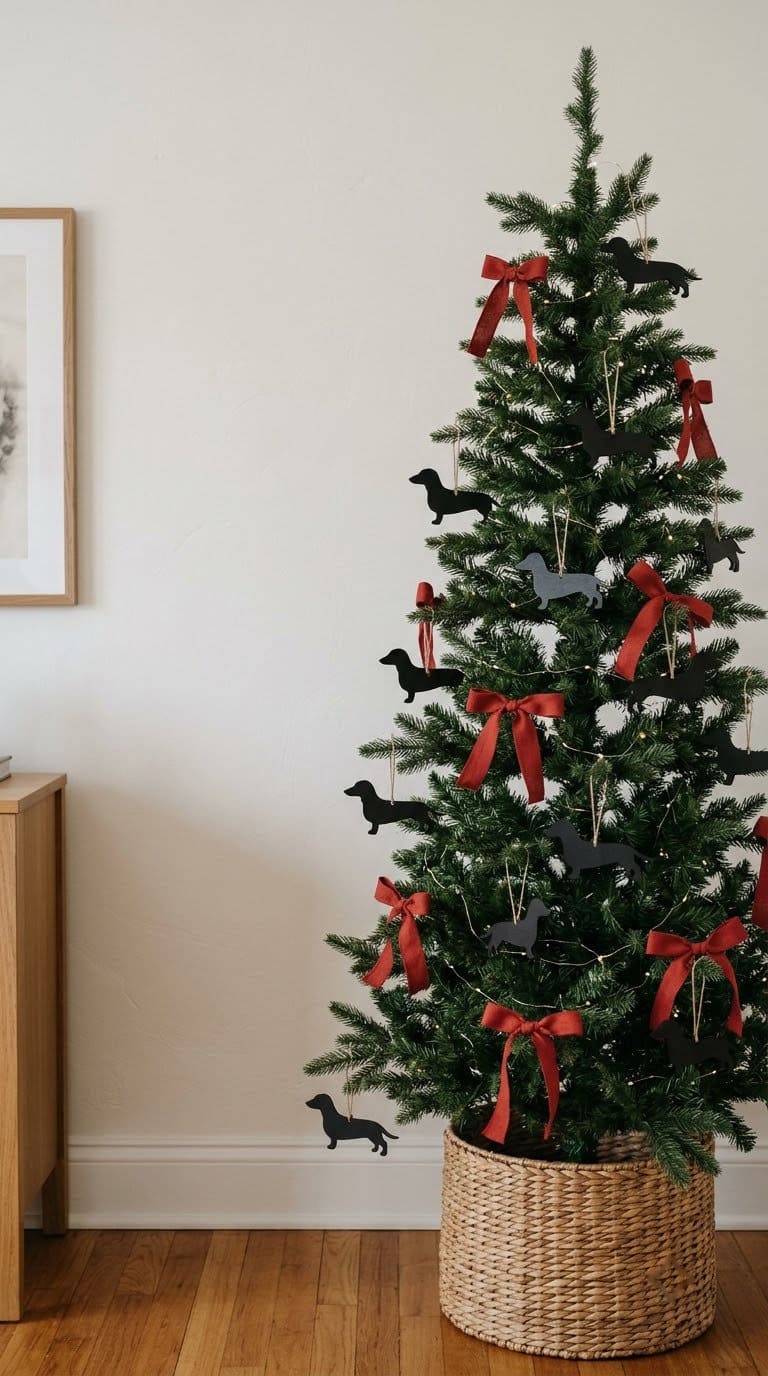
If you love one breed, build the tree around its outline. A dachshund, a corgi or a poodle all read clearly in silhouette.
Cut the shapes from black felt or thin shatterproof plastic. Hang a red or white ribbon through each one for color.
Match the size. Use ornaments about the size of your hand, so a dog can’t swallow one whole. This is our rule of thumb, not a sourced figure.
Keep it simple. A black-and-red palette looks sharp and keeps the tree from looking busy. Our Christmas tree decor ideas show more palettes to try.
Skip glass ornaments here. PetMD says to put durable, less chewable ornaments low and hang fragile ones high.
Cut clean shapes. Print a dog silhouette at the size you want, trace it onto black felt and cut it out with sharp scissors. Make a few in different sizes for a nice mix.
Hang with a ribbon. Use a thin ribbon through a small hole punched near the top of each silhouette. Tie the ribbon in a loop and hang each one over a sturdy branch.
Fill the gaps. Add warm white lights and a few wide ribbon bows in red. The black shapes stand out well against light green branches.
Keep it balanced. Hang the biggest silhouettes low and in the middle, and the smaller ones near the top. Step back from the tree and squint to check the spread.
Budget: low to mid. Skill: beginner.
4. A Tabletop Doghouse Tree
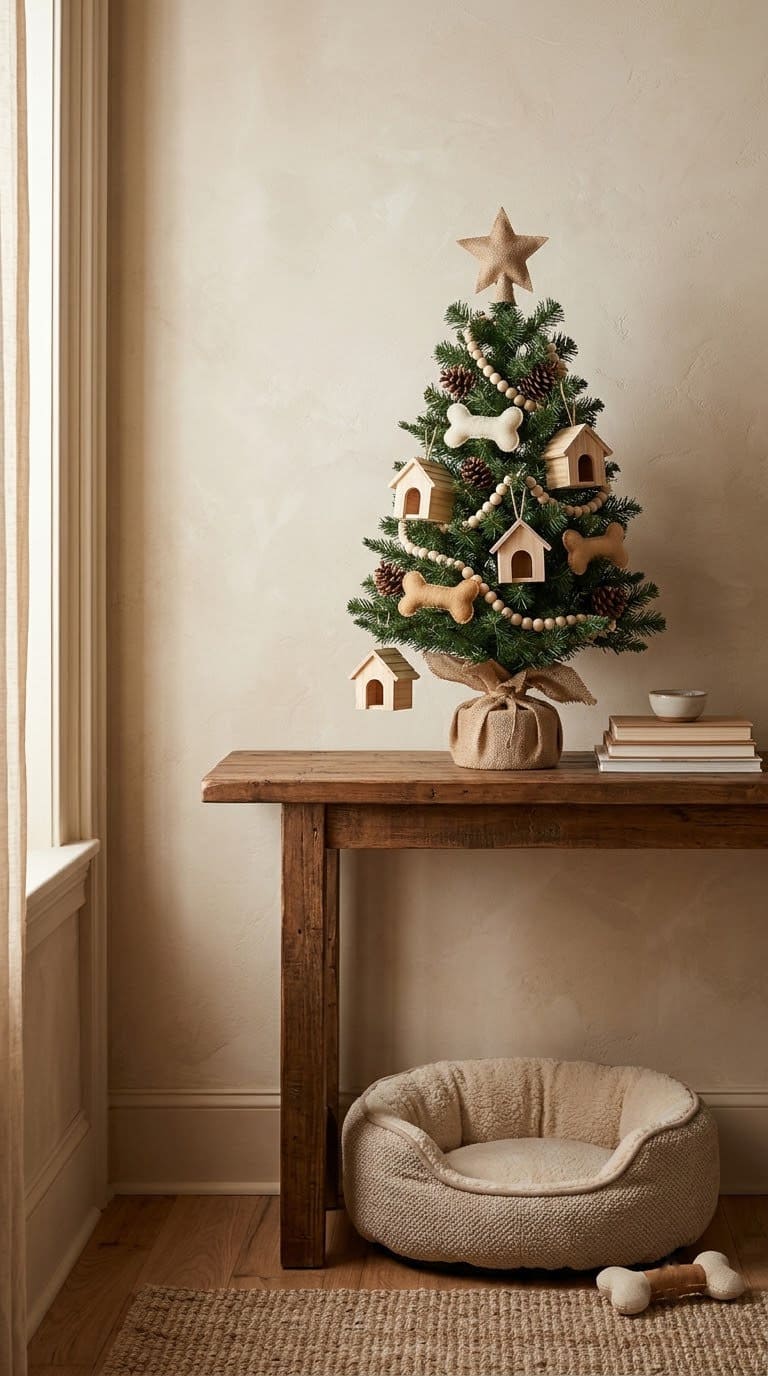
A tabletop tree keeps the whole setup off the floor. It’s also the best fit for small homes.
Put a mini doghouse and a few felt bones on the tree. Set it on a heavy table, against a wall.
Make the table solid. A tabletop tree can still be knocked over by a wagging tail or a jumping dog. Put it where your dog can’t reach and don’t use a wobbly table.
PetMD also suggests a dog gate or a closed door to limit unsupervised access. Our Christmas tree topper ideas have small toppers that suit a mini tree.
Secure the tree. Set the tree stand on a non-slip pad. Clamp or strap the stand to a heavy table if you can. Keep the cord short and tucked behind the table.
Make a mini doghouse. Glue craft sticks into a small house and add a felt roof. Hang it with a loop of thread near the middle of the tree. Make sure every piece is glued firmly.
Keep the area clear. Don’t leave a chair or stool beside the table. A dog can use it as a step to reach the tree.
Light it softly. Use a short string of lights and tuck the cord into a cord protector or behind the table leg.
Budget: low. Skill: beginner.
5. Paw-Print and Photo Ornaments
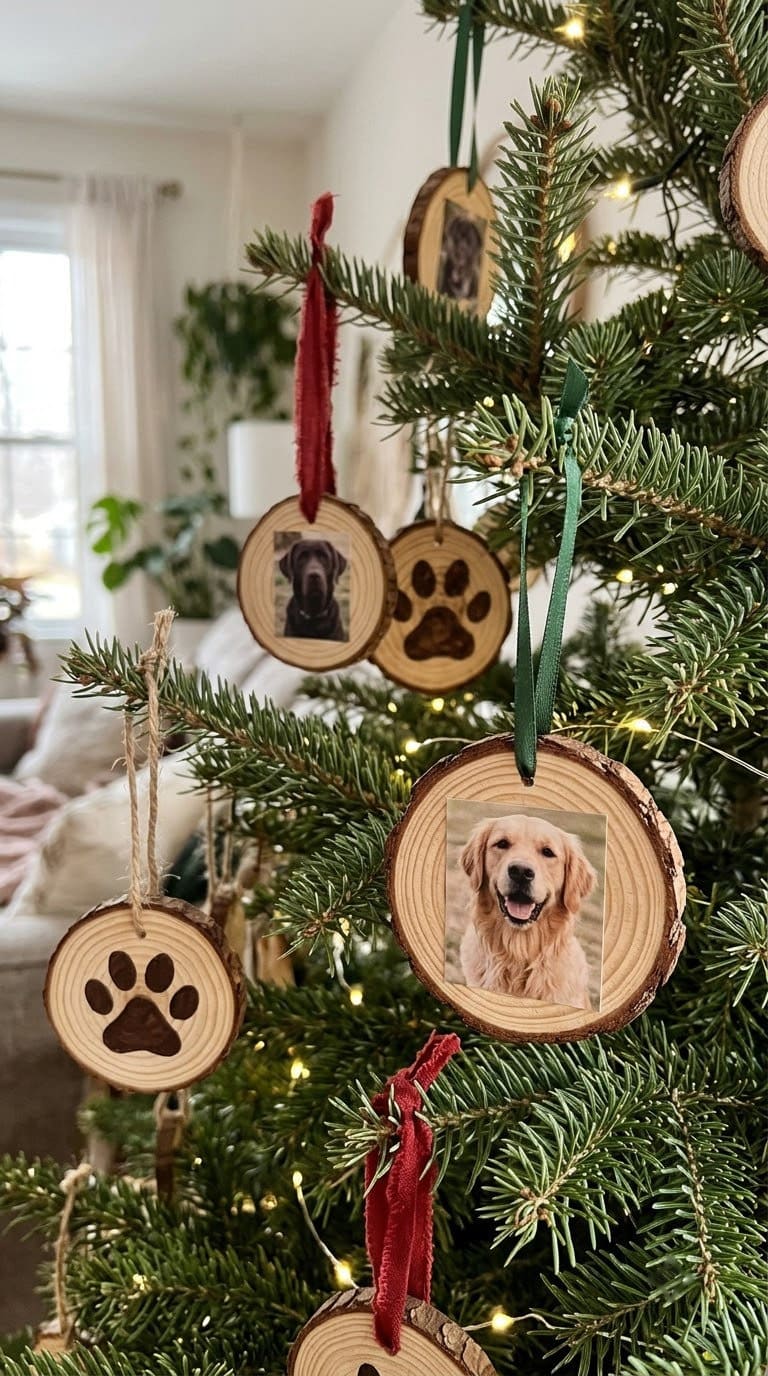
A paw print makes a lasting keepsake. But skip the classic salt-dough method.
The ASPCA says salt-dough ornaments are hazardous even when dry. Its crafting guide adds that even a small amount could be dangerous, and that old ornaments need to stay out of reach too.
Use a safe base. Print your dog’s photo on plain paper, trim it to fit and glue it to a wood slice. Seal the edges with a thin coat of clear sealer so the paper doesn’t peel.
Or, or press a paw in non-toxic paint on a wood disc. Check the paint label for the ACMI “AP” seal.
For more paw-print projects, see our DIY puppy paw print craft projects.
Make a paw print safely. Press your dog’s paw onto an ink pad made for pets or onto a soft sheet of paper coated in a pet-safe ink. Wipe the paw clean right away with a damp cloth and a little pet-safe soap. Never use ordinary craft paint on a paw.
Transfer the print. Place a wood disc over the paper print or trace the shape onto the wood with a pencil. Paint the outline with non-toxic paint. Look for the ACMI “AP” seal on the label.
Add the photo version. Print a close-up of your dog’s face, trim it to a circle and glue it to a wood disc. Seal the surface with a thin coat of clear sealer.
Date each one. Write the year on the back. A set of ornaments over the years makes a lovely tradition.
Budget: low. Skill: beginner.
6. A Santa Paws Gift Corner
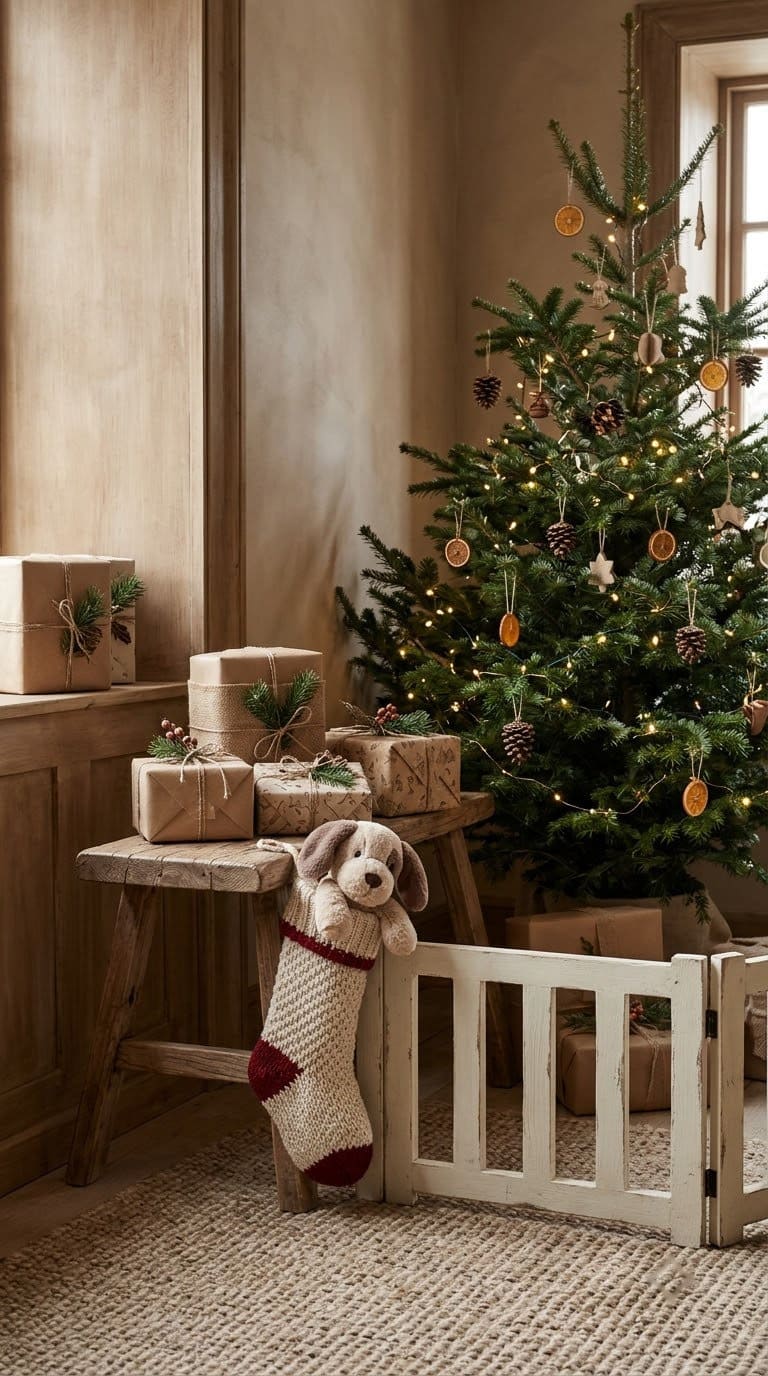
A gift corner is fun for the dog and for you. But gifts under the tree are easy targets.
PetMD says to raise presents or fence them off, since gifts may contain chocolate or coffee. Put the dog’s own gifts in a stocking or a basket, away from the human ones.
Use a skirt, not a mess. A tree skirt hides the cords and the stand. Our list of crochet Christmas tree skirt patterns has soft options.
Wrap treats in plain paper, and open them away from the tree.
Fill the stocking with safe items. Add a durable chew toy, a soft toy with no small parts and a few treats in a sealed bag. Check each toy’s size, so your dog can’t swallow it.
Wrap with care. Use plain wrapping paper with no ribbon or tape tails. Skip glitter and bows. A dog may chew a ribbon and swallow it.
Hide the real treats. Keep human sweets and any gifts with food in a closed cupboard until Christmas morning.
Make the unwrapping a game. Let your dog open its own gift on the day, with you right beside them. Take the wrapping away as soon as the gift is open.
Budget: low. Skill: beginner.
7. An Entryway Dog Tree
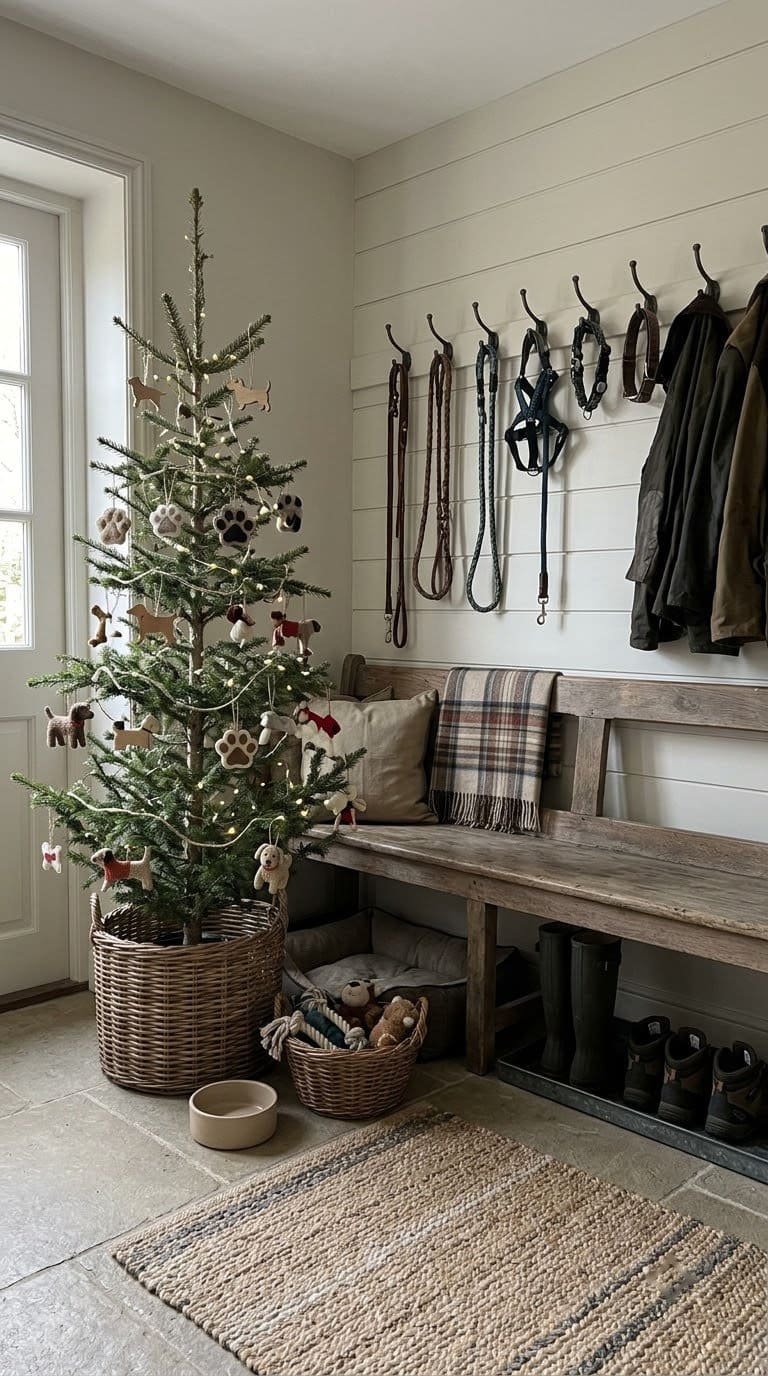
An entryway tree puts the dog theme where the leash lives. It also keeps the mess near the door.
Hang a few leash hooks and ornaments on or near the tree. Put a boot tray beneath it to catch wet paws.
Watch the water. The ASPCA says to cover tree water, because standing water can harbor bacteria. PetMD adds that water can contain sap and pine oils, so use a stand that blocks access and don’t add anything to it.
Vacuum the floor often. PetMD says fallen needles can cause drooling, vomiting and diarrhea.
Set it up in four steps. Place a slim tree near the door. Hang a few leash hooks on the wall beside it.
Put a boot tray under the tree to catch wet paws and fallen needles. Add a rug with a non-slip pad.
Use the hooks well. Hang the leash and a dog coat on the hooks. They become part of the theme and keep the floor clear.
Wipe paws at the door. Keep an old towel on a hook near the tree, so you can dry your dog’s paws before they walk across the floor.
Place the lights low-key. Use battery-free, plug-in lights and tuck the cord behind the bench.
Budget: low to mid. Skill: beginner.
8. A Gated Corner Tree
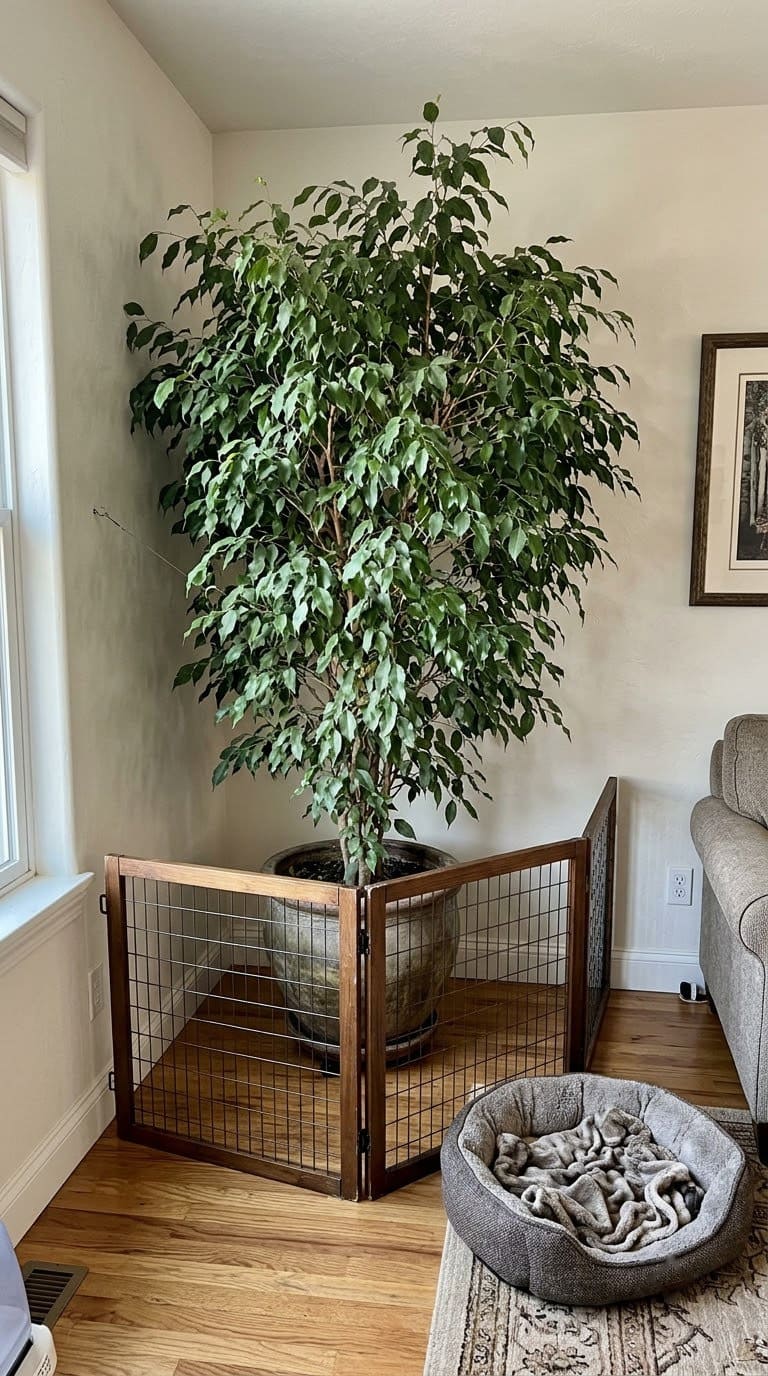
If your dog just can’t leave the tree alone, give the tree its own zone. A corner plus a gate is the simplest way.
PetMD recommends a wide base stand and a wall anchor, so the tree can’t fall on a dog. It also suggests a gate or closed door to limit unsupervised access, and says an indoor motion-activated camera is an alternative.
Tie it back. Run a thin line from the trunk to a wall hook. The ASPCA says the tree should be tightly secured so there’s no chance it can tip over.
Keep cords tucked under the skirt.
Anchor it in five steps. Pick a corner. Screw a small hook into the wall, ideally into a stud. Tie a thin line, such as fishing line, around the trunk about halfway up.
Run it to the hook and pull it snug. Test the tree by pushing it gently.
Place the gate well. Set the gate or panel far enough from the tree that a dog can’t reach through to the branches. Check that the gate stands firmly and can’t be knocked over.
Do a daily check. Look at the line, the gate and the stand each morning. Check for fallen needles and chewed ornaments.
Budget: mid. Skill: beginner.
How Do You Introduce Your Dog to the Tree?
PetMD suggests setting up the bare tree and waiting a few days before you decorate. Use that time to teach your dog the rules.
Sit near the tree with your dog on a leash. Reward calm sniffing with a treat and gentle praise. If your dog jumps or tugs, step back and try again later.
Then decorate in stages. Add the lights one day, the low-risk ornaments the next and the rest after that. Watch your dog’s reaction each time.
Never leave your dog alone with the tree at first. Use the gate or a closed door when you can’t watch.
A Simple Ornament Swap Guide
Swap risky decorations for safer ones. This table gives a quick plan.
| Instead of | Try this |
|---|---|
| Tinsel and garland | Wide fabric ribbon, firmly tied |
| Salt-dough ornaments | Wood slices or felt shapes |
| Popcorn or candy strings | Wooden beads on a strong cord, hung high |
| Glass balls on low branches | Shatterproof balls or fabric ornaments |
| Open bowl of water | A covered stand |
| Loose hooks | Ribbon loops |
Which Tree Setup Is Safest?
Where you put the tree matters as much as what you hang on it. Here’s how the four setups in this list compare.
| Setup | Safer because | Watch for |
|---|---|---|
| Full tree in a gated corner | Walls add stability and a gate limits access | Gate knocked down |
| Tabletop tree | Off the floor | Table tipped by a jump |
| Entryway slim tree | Small footprint | Wet paws near cords |
| Open floor tree | Easy to decorate | Tipping and tail swipes |
Keep the Lights and Cords Safe
Lights are part of the theme, but cords are part of the hazard. The ASPCA says a wire can cause a potentially lethal shock, and a punctured battery can burn the mouth and esophagus.
PetMD says to fasten cords and cover them with a tree skirt or a cord protector. That stops chewing and tripping.
Run the cords along the trunk side of the tree, away from the front, and bundle the extra length so it can not be pulled. And check battery-powered ornaments, since a dog that bites one can puncture the battery.
If you want a less risky look, choose lights and sturdy ornaments over tinsel. The ASPCA calls them safer decorations.
What If Your Dog Eats Something?
Stay calm and act fast. Call your vet and the Pet Poison Helpline at 855-764-7661, or the ASPCA Poison Control line at (888) 426-4435.
Know what to watch for. The ASPCA says swallowed tinsel can cause severe vomiting, an obstructed gut and dehydration. PetMD says tree needles can cause drooling, vomiting and diarrhea, and that frequent vomiting from drinking tree water can lead to dehydration.
Keep the wrapper or ornament so you can describe it. If a craft product has a “CL” label, the ASPCA says to contact a vet or the poison center right away.
Which Dog Needs Extra Care?
Every dog is different, so match the tree to yours.
Puppies and chewers. Go with a tabletop tree or a gated corner. Keep decorations to felt and wood, and hang everything high.
Calm adult dogs. You can use a full floor tree, as long as it’s anchored. Still keep tinsel, salt dough and food ornaments off it.
Big, bouncy dogs. A wagging tail clears a low branch in one swipe. Use a heavy stand and leave the bottom third of the tree bare.
Homes with other pets. The anchor and the no-tinsel rule still apply. Ask your vet about the other animals in your home.
What to Do First
Start with safety, then add the theme. This order saves you from redoing work.
First, set up the tree in its corner and anchor it. Second, wait a few days, as PetMD suggests, and watch your dog’s reaction.
Then add lights and tuck the cords. Last, hang the dog-themed ornaments, with the sturdy ones low and the fragile ones high.
How Much Should You Spend?
Skip the pricey ornaments. A dog theme works best with cheap, replaceable pieces.
Felt, wood slices and printed photos cost little, so losing one to a chewer won’t hurt. Spend a little more on the things that matter for safety: a wide stand, a wall anchor and a gate.
Common Mistakes to Avoid
Most tree problems come from a short list of habits.
Hanging tinsel. The ASPCA warns it can cause severe vomiting, an obstructed gut and dehydration, and may need surgery.
Making salt-dough keepsakes. The ASPCA says they’re hazardous even when dry. Use wood or felt.
Leaving the water open. The ASPCA says to cover it. PetMD says not to add anything to it.
Putting gifts at nose height. PetMD says gifts can hold chocolate or coffee. Raise them or fence them off.
FAQ
Are Christmas trees safe for dogs?
They can be, with the right setup. The ASPCA says to secure the tree and avoid tinsel, and PetMD says to anchor it and cover the water.
What should I do if my dog eats an ornament?
Call your vet and the Pet Poison Helpline at 855-764-7661. The ASPCA Poison Control line is (888) 426-4435.
Can I make salt-dough ornaments if I hang them high?
We’d skip them. The ASPCA says they’re hazardous even when dry, and old ones can still be risky.
Which ornaments are best for dogs?
Fabric and felt are good picks. PetMD advises sturdy, less chewable ornaments low and fragile ones high.
How do I stop my dog from knocking the tree over?
Anchor the tree to the wall and use a wide, heavy stand. Add a gate or a closed door while you’re out. Keep the lowest branches bare, so there’s nothing tempting to grab.
Should I use a real tree or an artificial tree?
Either can work. A real tree sheds needles, and PetMD says fallen needles can upset a dog’s stomach. An artificial tree has no needles or water, but it can still tip, so anchor it.
What should I do on Christmas Day?
Keep the routine simple. Walk your dog before guests arrive. Put the gate up and keep gifts out of reach.
Related Posts

Never miss an update — choose FarmFoodFamily as your preferred source on Google.
How it works: Tap the button below to open Google's settings page, then check the box next to FarmFoodFamily.
Tap the checkbox to turn it blue — that's how you know it's set.